



Abstract
This study explored the effect of mutual familiarity of interlocutors on quantitative contributions of conversation turns in dyadic conversation among Mandarin Chinese-speaking older adults. A quantitative quasi-experimental study was conducted. A total of 42 healthy older adults aged 65 years or over were recruited. Percentages of contributed conversation turns for each interlocutor were computed as frequency of interlocutor conversation turns divided by total frequency of dyad conversation turns multiplied by 100. Quantitative asymmetries were differences of percentages of contributed conversation turns. A total of 60 ten-minute dyadic conversation sessions were conducted, including 30 mutually familiar-older-adult sessions (FOAS) and 30 mutually unfamiliar-older-adult sessions (UOAS). Quantitatively asymmetrical contributions of conversation turns occurred in both FOAS and UOAS, and quantitative contributions of conversation turns in FOAS were significantly more asymmetrical than those in UOAS. There were three limitations to the current study, including limited representations of everyday conversation contexts (e.g., at home); no consideration of the types of conversation modes; and no consideration of sensitivity to conversation as one of the inclusion criteria for research participants. Quantitatively asymmetrical contributions of conversation turns occurred in both mutually FOAS and UOAS dyads among Mandarin Chinese-speaking older adults. Moreover, quantitative contributions of conversation turns in mutually FOAS dyads were significantly more asymmetrical than those in mutually UOAS dyads. Sufficient knowledge of changes in conversation turns in dyadic conversation among healthy older adults might reduce misperceptions of older adults suffering from neurological disease.
Introduction
Conversing with people in everyday life enables older adults to connect with their surrounding environment, such as family and communities, and to develop friendships (Azios et al., 2021; Kistner et al., 2020; Yorkston et al., 2010). This helps maintain positive attitudes toward and an understanding of aging (Mackenzie, 2000; Tuomenoksa et al., 2022; Yorkston et al., 2010). Conversation involves the complex interplay of perception and production across multimodal conversation modes, such as verbal veruss nonverbal (Holler & Levinson, 2019). The speaking and listening interlocutors collaboratively exchange diverse verbal and nonverbal conversation modes to co-construct their dyadic conversation (Hadley et al., 2021; Holler & Levinson, 2019; Marangolo & Pisano, 2020; Taylor-Rubin et al., 2017). These conversation turns correspond well with previous and anticipated turns that are controlled and shaped without precise preplanning (Levinson & Torreira, 2015; Norén et al., 2013). A perfect conversation is clearly acknowledged when a speaking interlocutor takes a conversation turn to communicate verbal and/or nonverbal messages to a listening interlocutor, and the listening interlocutor understands those messages and takes a new obligatory turn (Sacks et al., 1974).The preferred co-constructions are affected by the interlocutors’ shared personal experiences (Simmons-Mackie et al., 2004) and world knowledge (Olsson, 2004; Simmons-Mackie et al., 2004). Interlocutors without shared experiences and knowledge can collaboratively and alternatingly search for their preferred co-constructions (Vilela & Ranhel, 2017).
Although healthy older adults might be active rather than passive interlocutors in their dyadic conversation (Carter & Everitt, 1998), their conversation partners (e.g., friends, family members, and care providers) serve significant roles in listening, reflecting, and offering advice (Yamasaki et al., 2013; Yorkston et al., 2010). However, these quick alternations of conversation turns require substantial auditory attention-switching processes, which may be challenging for older adults (Hadley et al., 2021). Normal aging processes, including intrinsic changes in the body’s structure and function (e.g., central nervous system lesions and limited cognition) and extrinsic environmental changes (e.g., family structure), can cause conversation changes in older adults (Findlay, 2003; Mackenzie, 2000). Conversation changes may include speech disturbances (e.g., unintelligible speech), declined language skills (e.g., declined comprehension of complex utterances and names), and difficulty maintaining conversation (Hadley et al., 2021; Yorkston et al., 2010).
Over the past three decades, many studies have been conducted on dyadic conversations. Martin et al. (1996) examined the effect of interlocutor gender on number of conversation turns (verbal, non-verbal, and simultaneous) and topicalization (introduction, maintenance, and change of conversation topic) in dyadic conversation among healthy English-speaking older adults. They found that more verbal turns and changes occurred among men, whereas more nonverbal turns, such as head nods, initiations, and maintenances, occurred among women. The authors concluded that these differences may be attributable to men’s dominant social role and women’s submissive social role.
Mackenzie (2000) examined the effects of interlocutor age, level of education, and gender on conversation skills, including conversation initiation (i.e., conversation responsive and participation), turn-taking (i.e., cooperation in sharing conversation floor), verbosity (i.e., perceived appropriateness of length of turn), topic maintenance (i.e., contribution to topic), and referencing (i.e., clarity in referring to others and events), in dyadic conversation among healthy English-speaking adults. The results indicated that education and gender had no effect, whereas age was influential, with the group aged 75 to 88 years exhibiting highly significant differences, such as poor turn-taking and declined verbosity.
Korolija (2000) investigated coherence patterns of conversation among healthy Swedish-speaking older adults and healthy younger senior center staff members, who were mutually familiar. The author found that older interlocutors infrequently maintained a local situational topic and tended to topicalize without identifying references to avoid silence, whereas listening interlocutors never objected to listening or responding to familiar topics. Li (2001) investigated the frequencies of cooperative and intrusive interruptions in same-gender, mutually unfamiliar, healthy young adult conversation dyads, including native English- and Mandarin Chinese-speakers. The author reported asymmetrical conversation turn contributions among English- and Mandarin Chinese-speaking mutually unfamiliar conversation dyads, with Mandarin Chinese-speaking conversation dyads using more cooperative than intrusive interruptions, and the opposite trend among English-speaking conversation dyads. Li (2001) concluded that Mandarin Chinese-speaking young adult interlocutors often cooperatively took non-obligatory conversation turns, whereas English-speaking young adult interlocutors often intrusively took non-obligatory conversation turns. This may be because Mandarin Chinese-speaking interlocutors are more “other” oriented than English-speaking interlocutors.
In sum, existing studies acknowledge what is already known about dyadic conversations. However, several specific gaps were identified in these studies. First, although some studies (e.g., Korolija, 2000; Martin et al., 1996) reported the age of all interlocutors, other studies did not (e.g., Mackenzie, 2000). Studies consistently failed to identify differences in conversation elements in dyadic conversation among healthy older adults aged over 65 (Stover & Haynes, 1989). Second, extant studies recruited only either mutually familiar interlocutors (e.g., Korolija, 2000) or mutually unfamiliar interlocutors (e.g., Li, 2001; Mackenzie, 2000; Martin et al., 1996). The effect of familiarity of interlocutors on conversation turns in dyadic conversation among healthy older adults was not fully considered. Third, Hadley et al. (2021) argued that the dyad is unique in its minimal set of interlocutors (i.e., speaking and listening) and simple alternations of conversation turns with few negotiations. Attention should focus on interlocutors in co-constructing their conversation turns rather than on individual interlocutors in dyadic conversation (Hadley et al., 2021; Norén et al., 2013). Fourth, Mackenzie (2000) emphasized that sampling a greater number of older adults is required to generalize the results. Fifth, conversation turns are universal (Vilela & Ranhel, 2017), and units of conversation turns can be analyzed as contributions of dyadic conversation (Norén et al., 2013). However, they have not been investigated across a wide range of languages.
Mandarin Chinese is both the official and dominant language (Lee et al., 2019; Liu et al., 2017) of Taiwan and is spoken by 66.3% of Taiwanese people over 6 years of age, followed by Taiwanese, which is spoken by 31.7% (Department of Statistics, 2021). Modesty is a primary core value of Chinese culture, which stresses appropriate acceptance and agreement responses, and might guide dyadic conversation among Taiwanese people (Spencer-Oatey & Ng, 2001; Wu, 2011). In practicing social harmony, Taiwanese people seek agreement from other interlocutors before interrupting the current conversation turn and facilitating previous conversation meanings in their dyadic conversations (Bond, 1991; Leung & Au, 2010; Li, 2001; Yoon et al., 2015). Sacks et al. (1974) argued that symmetrical contributions of conversation turns might be expected without the occurrence of interruptions in typical conversation dyads. Symmetrical contributions of conversation turns might also occur in Mandarin Chinese-speaking dyadic conversation (Couper-Kuhlen & Thompson, 2005; Wu, 2011). Therefore, this study aimed to explore the effect of mutual familiarity of interlocutors on quantitative contributions of conversation turns in dyadic conversation among healthy Mandarin Chinese-speaking older adults. Two research questions were posed:
Q1: Did quantitatively asymmetrical contributions of conversation turns occur in Mandarin Chinese-speaking mutually familiar-older-adult sessions (FOAS) and mutually unfamiliar-older-adult sessions (UOAS)?
Q2: Were quantitatively asymmetrical contributions of conversation turns in the mutually familiar-older-adult sessions (FOAS) significantly different from those in the mutually unfamiliar-older-adult sessions (UOAS)?
Understanding changes in conversation turns due to typical aging processes in dyadic conversation among healthy older adults could reduce misperceptions of healthy older adults suffering from neurological diseases, such as stroke and dementia (Mackenzie, 2000). This could have mental health benefits, such as improved self-esteem, well-being, and social relationships (Ali et al., 2021).
Methods
Participants
The sample size was chosen based on resource constraints, due to limitations in time and cost, and the similar number of FOAS and UOAS dyadic conversation sessions (Lakens, 2022). A total of 42 healthy older adults were recruited from community care services, including 12 mutually familiar and 30 mutually unfamiliar older adults. Attributes such as living styles, education levels, and sensitivity to conversation were not matched to represent a heterogeneous group of healthy older adults in Taiwan.
Group of Healthy Older Adults
A total of six healthy older adults (OA), including three men and three women, were recruited. The inclusion criteria were: (a) being aged 65 years or over; (b) using Mandarin Chinese or Taiwanese in their daily conversation environments; (c) scores of Mini-Mental State Examination (MMSE) over 24 if educated, or scores of MMSE over 15 if uneducated; (d) hearing better than 40 dB or above with naked ears or with hearing aids; (e) type A in the tympanum picture; and (f) being able to engage in basic social conversation. Mean age and mean years of education were 70.83 and 4.50 years, respectively. Detailed demographic characteristics of each OA are presented in Table 1.
Demographic Information of Healthy Older Adults (OA) and Mutually Familiar Healthy Older Adults (FOA).
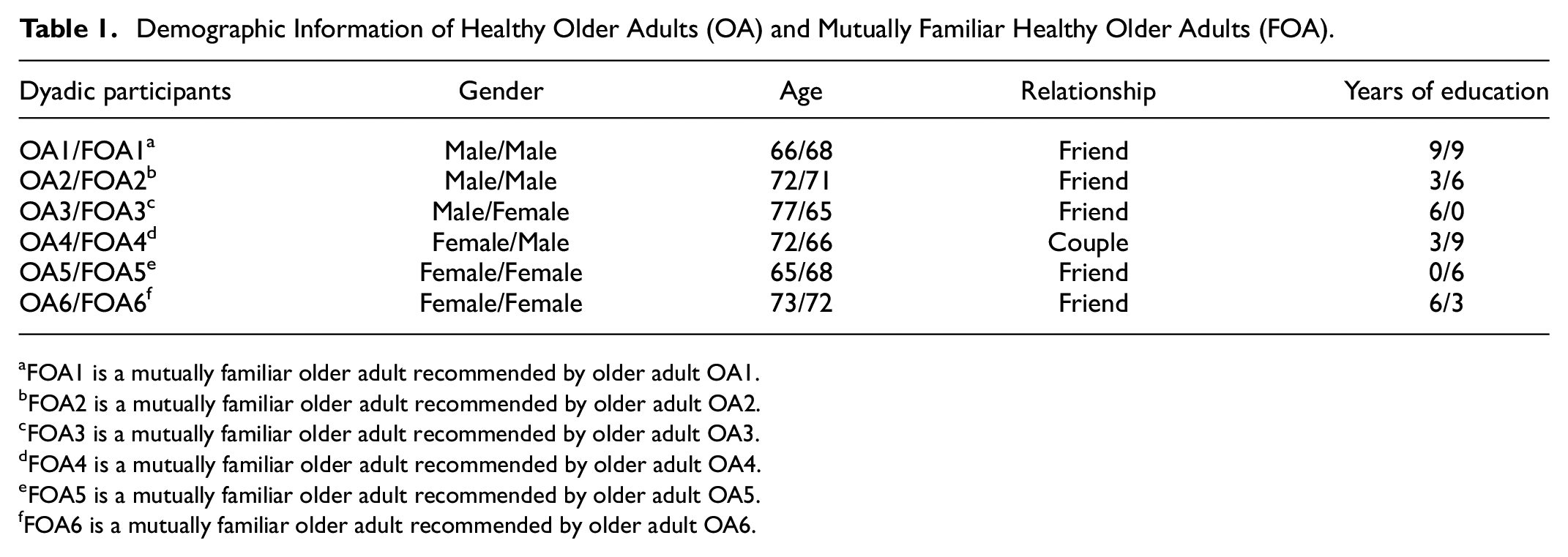
FOA1 is a mutually familiar older adult recommended by older adult OA1.
FOA2 is a mutually familiar older adult recommended by older adult OA2.
FOA3 is a mutually familiar older adult recommended by older adult OA3.
FOA4 is a mutually familiar older adult recommended by older adult OA4.
FOA5 is a mutually familiar older adult recommended by older adult OA5.
FOA6 is a mutually familiar older adult recommended by older adult OA6.
Group of Mutually Familiar Healthy Older Adults (FOA)
Each OA in the first group of healthy older adults was asked to recommend a mutually familiar healthy older adult (FOA), such as a spouse, sibling, relative, caregiver, or friend. Six participants were included in the second group (three men and three women). All participants met the following inclusion criteria: (a) being aged 65 years or over; (b) using Mandarin Chinese or Taiwanese in their daily conversation environments; (c) scores of Mini-Mental State Examination (MMSE) over 24 if educated, or scores of MMSE over 15 if uneducated; (d) hearing better than 40 dB or above with naked ears or with hearing aids; (e) type A in the tympanum picture; (f) able to engage in basic social conversation; (g) familiar with the OA and their conversation modes; and (h) routinely conversant with the OA for at least 1 year. Mean age and mean years of education were 68.33 and 5.50 years, respectively. Detailed demographic characteristics of each older adult are presented in Table 1.
Group of Mutually Unfamiliar Healthy Older Adults (UOA)
A total of 30 healthy older adults (12 men and 18 women), not mutually familiar with the adults in the first group, were recruited as mutually unfamiliar healthy older adults (UOA). All participants met the inclusion criteria similar to those of the mutually FOA, including criteria (a), (b), (c), (d), (e), and (f). However, these UOA additionally were not familiar with the OA and their conversation modes. Mean age and mean years of education were 69.67 and 6.97 years, respectively. Detailed demographic characteristics of each UOA are presented in Supplemental Table 1.
Settings and Materials
Two participants seated next to each other engaged in dyadic conversation in a conversation room at a university. The room was designed to resemble a living room and was equipped with two SONY®1 EVI-D70 camcorders for repeated review to avoid distractions. The camcorders were mounted on the wall behind the two conversation participants, with each camcorder providing a frontal view of just one participant. The recorded videos were sent simultaneously to a DATAVIDEO®2 SE-500, 4 channel analogue mixer/switcher, to produce a split-screen effect. The left-hand screen displayed the video of one interlocutor, and the right-hand screen displayed the video of the other interlocutor (see Figure 1). The two interlocutors’ voices were captured using two AKG®3 C417PP XLR professional lavalier microphones and then the audio signals were sent to a Behringer®4 XENYX 1002B digital audio mixer. The integrated video and audio signals were monitored through a 22-inch CHIMEI®5 TL-32LK60 LCD monitor and recorded in a LG®6 RH-387H DVD recorder.

A sample of split-screen image.
Research Design
The study utilized a quantitative quasi-experimental research design. The independent variable was the mutual familiarity of interlocutors, and the dependent variable was the quantitative contributions of conversation turns in dyadic conversation among Mandarin Chinese-speaking older adults. The study was conducted in accordance with the Declaration of Helsinki, and approved by the Institutional Review Board of Chung Shan Medical University (protocol code CS18099 and 2018/5/16 approval). All participants provided their written informed consent to participate in the study.
The primary investigators were the two authors and one undergraduate student from the Department of Speech Language Pathology and Audiology, who all majored in speech language pathology. The second author, an associate professor, had extensive experience in transcribing speech samples and coding transcripts in previously published studies, and taught these topics in an undergraduate course. The first author and the undergraduate student, who had taken a course and was experienced in transcriptions and coding, transcribed speech samples, and coded transcripts. Both were trained to transcribe the audio-recorded speech samples. A minimum of 80% reliability on the transcriptions was reached for at least three of the segmented audio-recorded speech samples (Guralnick & Paul-Brown, 1989; Kazdin, 1982). Reliability was obtained by dividing the number of agreements between the undergraduate student and first author by the total number of agreements and disagreements multiplied by 100 (Banajee et al., 2003).
The first author and the undergraduate student were trained to code conversation turns. First, the second author discussed the definitions of conversation turns with them. The first author and the undergraduate student independently coded two 10-minute transcripts that were not collected in the current study and compared their coding. Any discrepancies were addressed through discussions with the second author. Finally, they independently coded conversation turns on two randomly selected 10-minute transcripts. Agreement was established by dividing the number of agreements of occurrences by the number of agreements and disagreements of the occurrences and multiplying the quotient by 100 (Kazdin, 1982; Patten, 2007; Portney & Watkins, 2000). A minimum of 80% reliability was achieved between the first author and undergraduate student.
Dependent Measures
The primary dependent variable was frequency and percentage of coded conversation turns, as the study purpose was to assess whether interlocutor familiarity caused asymmetrical contributions of conversation turns in dyadic conversation among older adults.
Conversation Turns
A conversation turn was coded when nonverbal conversation modes (e.g., head shake) and verbal conversation modes (e.g., spoken utterance) conveyed meanings or contributed to the intent of the conversation (Tsai & Chih, 2021). Supplemental Table 2 presents detailed examples of conversation turns adapted from Tsai (2013).
Procedures
Each OA conversed with both their recommended FOA and six randomly assigned UOA in the conversation room. Each dyad conversed as naturally as possible for at least (but not limited to) 10 minutes, once per week for five weeks. A total of 60 dyadic conversation sessions were conducted, including 30 mutually familiar-older-adult sessions (FOAS) and 30 mutually unfamiliar-older-adult sessions (UOAS). Boles and Bombard (1998) emphasized that a 10-minute conversation sample usually provides an adequate representation of dyadic conversation, and this conversation sample length has been used in several studies (e.g., Almoaily, 2020; Hadley et al., 2021; Hall et al., 2018; Mackenzie, 2000; Sluis et al., 2019; Stickle & Wanner, 2019). Conversational topics were chosen by the interlocutors and no structured scripts were provided to make the dyadic conversation as natural as possible (Söderlund et al., 2016).
All of the FOAS and UOAS were individually video-recorded for repeated review (Elder, 1999). The mean age of the interlocutors, mean years of education of the interlocutors, and the mean length of the video-recording were 70.22 years old, 5.33 years, and 10 minutes 13 seconds in the FOAS, and 71.68 years old, 6.35 years, and 10 minutes 6 seconds in the UOAS. Although awareness of video-recording might have initially affected dyadic conversation to some degree, Wiemann (1981) argued that anxiety (e.g., awareness of video-recording) usually diminished within the first 1 to 3 minutes after starting the video-recording. Furthermore, each interlocutor was told that the video-recording mainly focused on the other interlocutor’s conversation modes, which was an additional attempt to allay potential anxiety (Wiemann, 1981).
Data Collection
The data collection comprised three steps, including transcribing the video-recorded conversations of the FOAS and UOAS and coding conversation turns. The first author conducted the first step, which entailed transcribing all conversations of the FOAS and UOAS. The accuracy of transcriptions was checked by the undergraduate student, who was trained by the authors. Transcription notations, as documented in Supplemental Table 3, were adapted and modified from Tsai (2013). Any discrepancies in agreement on the transcripts were discussed in one of two ways: (a) if the first author agreed with the corrected transcriptions, and the final transcript was revised accordingly; or (b) if the first author did not agree with the corrected transcriptions, the second author met with them to reach an agreement (Higginbotham et al., 2007; Olsson, 2004). All transcription discrepancies were resolved before the second step (Higginbotham et al., 2007; Olsson, 2004). The first author conducted the second step, which was to independently code conversation turns in transcripts on an utterance-by-utterance basis (Tsai et al., 2011). The coding symbol “CT” was used to represent the occurrence of a conversation turn.
Data Analysis
Quantitative analysis, the most commonly used methodology, documented the contributions of conversation turns (Clarke & Wilkinson, 2007) in the present study and existing research (Muller & Soto, 2002; Tsai, 2013; Tsai & Chih, 2021; Tsai et al., 2011). Frequency and percentage of the coded conversation turns were tallied for each interlocutor of all FOAS and UOAS. The percentages of the contributed conversation turns for each interlocutor were computed using the frequency of conversation turns for each interlocutor divided by the total frequency of conversation turns of the dyad and multiplying the quotient by 100 (Tsai & Chih, 2021). Quantitative asymmetries were the differences in percentages of the contributed conversation turns by one interlocutor compared to those by the other interlocutor. These differences indicate that one interlocutor made more contributions than the other (Tsai & Chih, 2021). A paired-samples t-test, which has been used in existing studies (e.g., Taylor-Rubin et al., 2017; Tsai, 2013; Tsai & Chih, 2021), was conducted to compare quantitatively asymmetrical contributions of conversation turns in both FOAS and UOAS. An independent-samples t-test was conducted to compare the differences of asymmetries of the contributed conversation turns between FOAS and UOAS.
Inter- and Intra-Coder Reliability
In the coding training, the definitions of conversation turns were discussed. Two randomly selected 5-minute portions of the conversation transcripts were independently coded and compared by the first author and the undergraduate student (Tsai & Chih, 2021). Any discrepancies were discussed. The undergraduate student independently coded a second 10-minute portion of a conversation transcript and discussed discrepancies to achieve consensus (Tsai & Chih, 2021). The reliability was established by dividing the number of agreements by the number of agreements plus disagreements and multiplying the quotient by 100 (Kazdin, 1982; Patten, 2007; Portney & Watkins, 2000). A minimum of 80% reliability achieved between the trained undergraduate student and the first author was considered reliable (Guralnick & Paul-Brown, 1989; Kazdin, 1982).
After the coding training, all of the transcripts were coded by the first author. Six of the 60 transcripts were randomly checked for inter-coder reliability and intra-coder reliability (Kazdin, 1982), and point-by-point reliability for conversation turns was determined (Portney & Watkins, 2000). The first author coded the selected transcripts again one week after the initial coding, and the undergraduate student coded the selected transcripts without engaging in any discussions during the coding process (Olswang et al., 2006). If 80% inter- and intra-coder reliability were not attained, an additional coding training identical to the initial training was provided before the next coding (Tsai & Chih, 2021). The mean inter-coder reliability of coding conversation turns was 99.02% (range = 96.83%–100%), and the mean intra-coder reliability of the trained undergraduate student was 99.38% (range = 98.55%–100%).
Results
A paired-samples t-test compared quantitatively asymmetrical contributions of conversation turns in both FOAS and UOAS. The mean percentage of the contributed conversation turns was 51.72% (SD = 2.64) for the OA and 48.28% (SD = 2.64) for the FOA in FOAS. Significant asymmetries of the contributed conversation turns were found (t (29) = 3.56, p = .001), and the effect size (d = 1.30) was found to exceed Cohen’s (1988) convention for a large effect (d = 0.80). The mean percentage of the contributed conversation turns was 50.08% (SD = 1.48) for the OA and 49.92% (SD = 1.48) for the UOA in UOAS. No significant difference between these two interlocutors was found (t (29) = 0.30, p > .05).
An independent-samples t-test compared differences of asymmetries in the contributed conversation turns between FOAS and UOAS. A significant difference of asymmetries (t (29) = −8.79, p < .05) was found, and the effect size (d = 2.00) exceeded Cohen’s (1988) convention for a large effect (d = 0.80). The mean percentage of the asymmetries of the contributed conversation turns in FOAS (M = 3.44%, SD = 4.78) was significantly higher than that in UOAS (M = 0.16%, SD = 1.98).
Discussion
This study aimed to investigate the effect of mutual familiarity of interlocutors on the quantitative contributions of conversation turns in dyadic conversation among Mandarin Chinese-speaking older adults. The results revealed quantitatively asymmetrical contributions of conversation turns in both UOAS and FOAS, which contradicted the argument that symmetrical contributions of conversation turns might be observed in Mandarin Chinese-speaking dyadic conversation (e.g., Couper-Kuhlen & Thompson, 2005; Wu, 2011). These asymmetrical contributions are respectively illustrated in Extracts 1 and 2 in Table 2.
Illustrations of Asymmetrical Contributions of Conversation Turns.
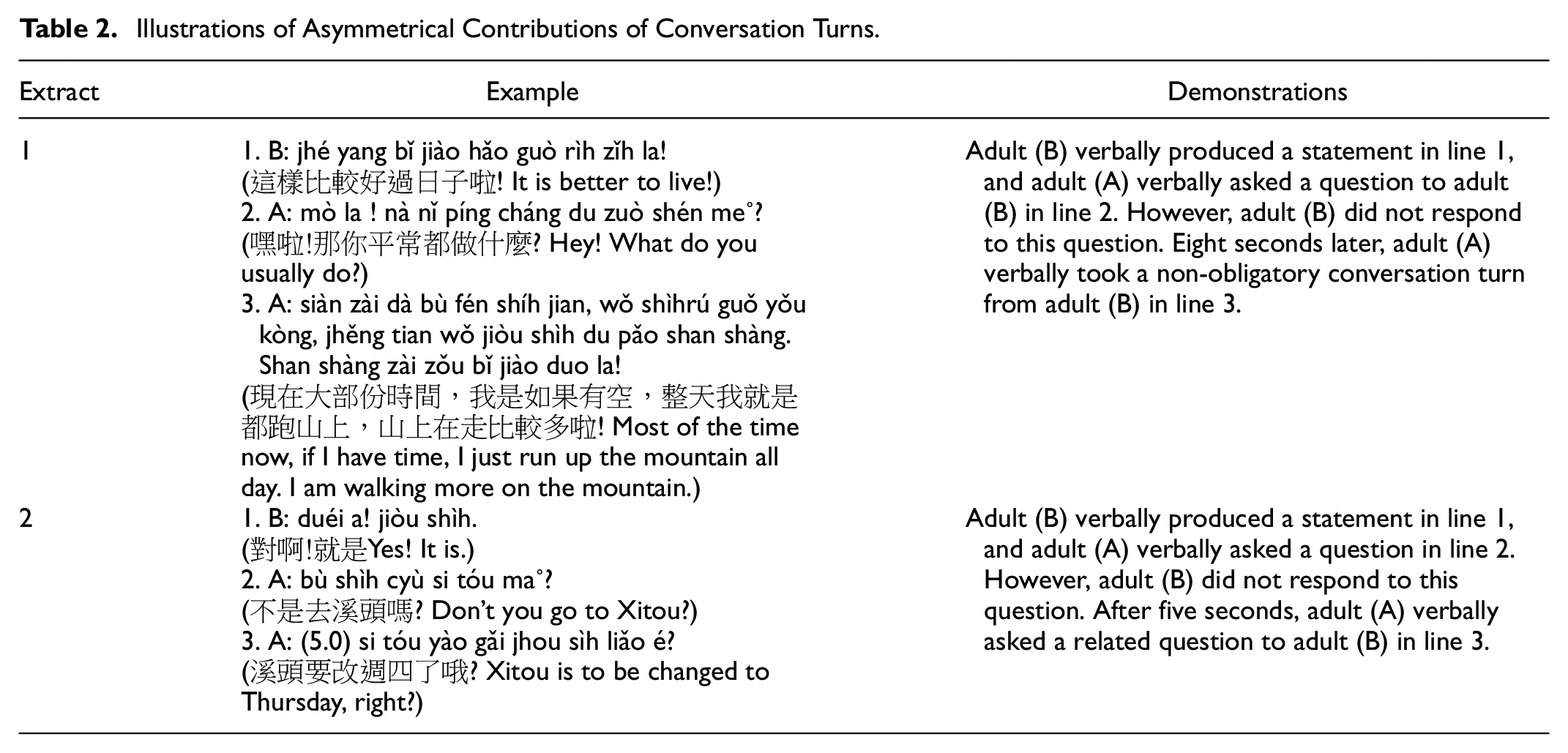

Several facts could explain these asymmetrical contributions. First, Korolija (2000) found that older interlocutors took non-obligatory conversation turns from the other interlocutors to co-construct their dyadic conversation. More contributions of conversation turns were expected from the older interlocutors in their mutually familiar conversation dyads. Second, modesty, which is a primary core value of Chinese culture (Spencer-Oatey & Ng, 2001; Wu, 2011), might guide these Mandarin Chinese-speaking interlocutors, in seeking agreement from the listening interlocutors before taking non-obligatory conversation turns and facilitating previous conversation meanings from the listening interlocutors (Bond, 1991; Leung & Au, 2010; Li, 2001; Yoon et al., 2015). Third, Li (2001) found mutually unfamiliar Mandarin Chinese-speaking adult conversation dyads (mean aged 30) took more cooperatively non-obligatory conversation turns than mutually unfamiliar English-speaking conversation dyads. Asymmetrical contributions of conversation turn occurred in these Mandarin Chinese-speaking student conversation dyads. Li (2001) argued that Mandarin Chinese-speaking interlocutors were “other” oriented, and the “other” oriented value might exist in Mandarin Chinese-speaking older adults who are mutually familiar and unfamiliar to each other.
The contributed conversation turns in FOAS were significantly more asymmetrical than those in UOAS, representing instances where the interlocutors in FOAS might take more non-obligatory conversation turns than those in UOAS. Several facts might potentially explain these significant differences of asymmetrically quantitative contributions between FOAS and UOAS. First, Mackenzie (2000) found that mutually unfamiliar 75 to 88 year old English-speaking interlocutors had poor turn-taking conversation skills. A slightly symmetrical contribution of conversation turns in these conversation dyads between mutually unfamiliar older adults can be expected. Second, dyadic conversation is co-constructed, and the preferred co-constructions are affected by the interlocutors’ shared personal experience (Simmons-Mackie et al., 2004) and shared world knowledge (Olsson, 2004; Simmons-Mackie et al., 2004). Although these mutually unfamiliar interlocutors might not have shared experience and knowledge, they can collaboratively and alternatingly search for their preferred co-constructions (Vilela & Ranhel, 2017).
Therefore, “other” oriented values and modesty, which are core values of Chinese culture, cause Mandarin Chinese-speaking mutually familiar and unfamiliar interlocutors to cooperatively take non-obligatory conversation turns to supportively facilitate the other interlocutors’ conversation meanings in their dyadic conversation. Quantitatively asymmetrical contributions of conversation turns in both FOAS and UOAS can be anticipated. Furthermore, the mutually familiar interlocutors with shared personal experience (Simmons-Mackie et al., 2004) and shared world knowledge (Olsson, 2004; Simmons-Mackie et al., 2004) co-constructed their preferred conversation. On the other hand, mutually unfamiliar interlocutors with no shared experience and knowledge still collaboratively and alternatingly searched for their preferred conversation (Vilela & Ranhel, 2017). The contributed conversation turns in FOAS that are significantly more asymmetrical than those in UOAS can be anticipated.
Limitations and Future Research
The results and limitations of the study suggest several directions for future analysis of contributed conversation turns in research and clinical contexts. There are several limitations to the current study. First, these dyadic conversation sessions were investigated in a living-room-like conversation setting, and were not representative of everyday conversation contexts (e.g., at home; Hadley et al., 2021). Second, the types of conversation modes of the two interlocutors in their dyadic conversation were not highlighted in the current study. Although Tsai (2013) indicated that co-construction of the dyadic conversation focuses on the conversation processes rather than the types of conversation modes, it might be better to understand the types of conversation modes of the interlocutors used in their dyadic conversation. Third, the interlocutors’ sensitivity to conversation was not one of the inclusion criteria of the research participants. Mackenzie (2000) argued that an interlocutor’s sensitivity to conversation is essential to positive conversation, and insufficient sensitivity might interrupt the interlocutor’s contribution and cause a failure in appropriately co-constructing their dyadic conversation. However, the current study included familiarity of the interlocutors as one of the inclusion criteria.
Future research should explore several directions. First, dyadic conversations should be investigated in natural conversation contexts (e.g., at home) to fully understand dyadic conversations in natural contexts. Second, the types of conversation modes of two interlocutors in dyadic conversation should be examined in addition to the co-construction of conversation processes. Examinations of the types of conversation modes could allow better understanding of conversation processes co-constructed through diverse types of conversation modes supported by the other interlocutors. Third, interlocutors’ sensitivity to conversation could be considered one of the inclusion criteria of participants. However, how to measure sensitivity to conversation should be investigated.
Conclusions
This study aimed to explore the effect of mutual familiarity of interlocutors on quantitative contributions of conversation turns in dyadic conversation among healthy Mandarin Chinese-speaking older adults. The quantitatively asymmetrical contributions of conversation turns occurred in both mutually familiar and unfamiliar conversation dyads among healthy older adults. Based on the Chinese culture’s core values of modesty and being “other” oriented, Mandarin Chinese-speaking older adults took significantly more non-obligatory conversation turns from the other older adults to co-construct their mutually familiar and unfamiliar dyadic conversation. Furthermore, quantitative contributions of conversation turns in mutually familiar Mandarin Chinese-speaking conversation dyads were significantly more asymmetrical than those in mutually unfamiliar Mandarin Chinese-speaking conversation dyads.
Implications for Practice
Analysis of conversation turns provides an additional universal method to profile contributions of two healthy older adults across multimodal conversation modes in their dyadic conversation.
Understanding of conversation changes among healthy older adults might provide a basis to develop effective conversation support. This may provide mental health benefits, such as improved self-esteem, well-being, and social relationships.
Sufficient knowledge of changes in conversation turns in dyadic conversation among healthy older adults might reduce misperceptions of older adults suffering from neurological diseases, such as stroke or dementia.
Supplemental Material
sj-docx-1-sgo-10.1177_21582440231169630 – Supplemental material for The Effect of Familiarity on Conversation Turns in Dyadic Conversation Among Chinese Older Adults
Supplemental material, sj-docx-1-sgo-10.1177_21582440231169630 for The Effect of Familiarity on Conversation Turns in Dyadic Conversation Among Chinese Older Adults by Wen-Shin Chang and Meng-Ju Tsai in SAGE Open
Footnotes
Acknowledgements
The paper was the master thesis of the first author. The authors wish to thank research assistants from the Department of Speech Language Pathology and Audiology, Chung Shan Medical University, Taichung City, Taiwan for their contributions. We thank Professor Chin-Hui Chen and Professor Ren-Hau Li in commenting on the master thesis.
Declaration of Conflicting Interests
The author(s) declared no potential conflicts of interest with respect to the research, authorship, and/or publication of this article.
Funding
The author(s) received no financial support for the research, authorship, and/or publication of this article.
Institutional Review Board Statement
The study was conducted in accordance with the Declaration of Helsinki, and approved by the Institutional Review Board of Chung Shan Medical University (protocol code CS18099 and 2018/5/16 approval).
Informed Consent Statement
Informed consent was obtained from all subjects involved in the study.
Notes
Data Availability Statement
The authors confirm that the data supporting the findings of this study are available within the article and its supplementary materials.

Supplemental Material
Supplemental material for this article is available online.
References
Supplementary Material
Please find the following supplemental material available below.
For Open Access articles published under a Creative Commons License, all supplemental material carries the same license as the article it is associated with.
For non-Open Access articles published, all supplemental material carries a non-exclusive license, and permission requests for re-use of supplemental material or any part of supplemental material shall be sent directly to the copyright owner as specified in the copyright notice associated with the article.
