




Abstract
At the start of 2016, the 10 nations of the Association of Southeast Asian Nations (ASEAN) entered a new era. With it, came the decade-old start of the implementation of the 2005 mutual recognition arrangement (MRA) on engineering services, and the free flow of skilled labor (FFSL). Although created with noble intentions, actual specifications and qualifications for an individual’s foreign employment heavily restricts its actual implementation. This study, therefore, conducted a confirmatory factor analysis using LISREL 9.1 software of 278 engineers selected from a population of 1,211 Thai Federation of Industries companies to investigate how need, gap, and competency affect readiness. From the analysis, need was shown to have the highest effect on readiness, whereas competency also had a direct effect on readiness. Finally, the research determined that less than 1% of the surveyed engineers were certified as ASEAN engineers, which is a precondition for registration for work as an engineer in another ASEAN country, and that cultural awareness of other member nations was perceived as the weakest link in an individual’s engineer readiness perception.
Introduction
The 10-nation, regional community, commonly known as Association of Southeast Asian Nations (ASEAN; 2005), is an incredibly diverse and dynamic region whose population in 2017 exceeded 639 million people, which at the end of 2016 had an economy valued at US$2.555 trillion (ASEAN Economic Community [AEC], 2017).
Thailand is a key member of this community, and promotes itself as the “hub” of many industrial and technology sectors, such as automotive manufacturing, computer disk drive manufacturing, smartphone mobile technology, and renewable energies. And, whether a desired outcome or not, Thailand has become a “hub” for an estimated 6.5 million, migrating intra-ASEAN foreign workers (mostly unskilled; International Labour Organization and the Asian Development Bank [ILOADB], 2014).
In this market, an International Labour Organization (ILO; 2014) survey of ASEAN companies indicated that less than one in three surveyed agreed that secondary school graduates were equipped with the relevant skills needed by their firms. Some good news, however, can be found in another ASEAN ILO study, which indicated that 80% of these same organizations felt it important to invest in human resource development (HRD). Also, 90% of these same firms reported that training investment is an important way to address performance gaps, promote continuous development of the workforce, and improve productivity
It seems, however, that ASEAN managers feel that education beyond high school (tertiary education), especially vocational education and training systems, is better aligned with industry requirements. What was interesting to also note from the survey was where the greatest skill gaps were, with training needed greatest in management and leadership skills (29.0%), then vocational training (17.0%), and customer service training (15.0%; ILOADB, 2014).
Depending on which ASEAN country you choose to establish your business in can also determine what skill shortage a foreign manager might expect. In Cambodia, communication and foreign language skills are in great shortage (Bruni, Luch, & Kuoch, 2013). In Vietnam, the World Bank (2014) company survey identified job-related technical skills gaps, including problem solving, critical thinking, teamwork, and communications. The study also indicated that until these shortages are relieved, firms will be faced with high staff turnovers, or having to fill skilled positions with marginally capable domestic workers, or having to recruit skilled workers from other ASEAN member nations (Aring, 2015).
The World Bank’s (2014) Vietnam analysis of skill shortages and the need for foreign recruitment are already being confirmed in Thailand; as in late 2016, the Thai government announced a US$1 billion program to recruit/produce 12,290 postdoctoral researchers to meet the needs of 10 targeted industries under the banner “Thailand 4.0” (Jones & Pimdee, 2017). This program is focused on technological development and innovation, and in the first recruitment cycle of the 300 scholarships being awarded to produce doctoral researchers, 60 scholarships (20%) are targeted for researchers from other ASEAN nations (“Govt Designs 20-Year Plan,” 2016).
With tighter integration of the AEC at the start of 2016, the ability for the free flow of skilled labor (FFSL) also began (Sugiyarto & Agunias, 2014). The FFSL, combined with the mutual recognition agreements (MRA), is designed to allow AEC member countries to share their expertise across borders, “without any legal limitations” (Chia, 2011; Fukunaga, 2015). This, however, seems to be at odds with the reality of the “fine print” within the documents concerning “certification” and “qualifications.”
A year has now gone by since the beginning of a new era of AEC integration, and from all appearances, not much has changed. This has, therefore, lead to the following statements concerning the issues regarding Thai engineer readiness to participate in AEC engineering projects, under the existing MRA and FFSL regulations.
Problem Statement
The Thai government has announced “Thailand 4.0,” which focuses on technological development and innovation within 10 key industrial sectors. From subsequent announcements concerning the funding and recruitment of 12,290 postdoctoral researchers (domestic and foreign), indications are a critical shortage of “skilled knowledge workers” and engineering expertise is looming. Furthermore, as Thailand looks to other ASEAN markets to expand its own business presence, issues concerning engineer readiness are being raised. Therefore, this study aimed to determine what level of readiness (either perceived or real) Thai engineers have and what are their “needs” and “gaps” in accomplishing work outside Thailand, within an ASEAN structure. Investigation included engineer certification requirements, MRA agreements, language skills, and cultural skills.
Literature Review
Readiness
The Korn Ferry Institute (2015) has indicated that individual readiness is the crucial link between high potential and success in a new job (which is not the same as potential), as readiness is the ability to act “now.” As a knock-on effect from American’s space program in 1974, and in a search for a contractor support criterion, the technology readiness level (TRL) metric was developed, which assessed the maturity of evolving technologies prior to incorporating them into a system or subsystem (Fedkin, 2015). This later became a standard metric for communication of a technology’s development status (Mankins, 2002).
Although the TRL is not a scale to directly measure an engineer’s readiness, it does, however, require a high level of professional capability to search out the most recent information, from a multitude of sources, concerning the characteristics of new systems, prototypes, and competition, and being able to justify the resultant cost and economic viability (Fedkin, 2015). This is consistent with Davis, Beyerlein, and Davis (2006), who investigated the roles that professional engineers utilize in their careers, and indicated that information retrieval and evaluation skills are important for five of the 10 readiness roles the study described, which included analyst, problem solver, designer, researcher, and communicator.
Denham, Zinsser, and Bailey (2011) referred to emotional intelligence (EQ) as emotional competence. Later, research by Buzdar, Ali, and Tariq (2016) examined EQ’s effect on readiness, and determined that positive effects on students’ readiness for online learning.
The Consortium for Research on Emotional Intelligence in Organizations (CREIO, 2016) identified 19 areas concerning EQ importance, and its contribution to organizational profitability. A similar meta-analysis study by Miao, Humphrey, and Qian (2016) concluded that a manager’s EQ positively relates to a subordinate’s job satisfaction. This is consistent with Parke, Seo, and Sherf (2015), who also concluded that a worker or manager’s EQ is a key factor for higher income and advancement, with Elegbe (2015) indicating that EQ was a missing priority in an engineering program’s education curriculum.
From a review of the literature and theory, four observed variables were identified and added to the research framework for readiness. These included the variables environment and emotion, motivation, and personality (EMP).
Competency
A study on the theory of competency can begin with Flanagan’s (1954) “Critical Incidents Technique,” which is thought of as a key methodology in competency studies. McClelland later adopted Flanagan’s work, which led to the adoption of the term “competency,” and the separation of “competency” and “intelligence” (McClelland, 1973). This agrees with Gipps and Stobart (2003), who defined “competent” as one’s individual experience and his or her related educational training, rather than a natural feature such as intelligence.
The next milestone in competency modeling occurred when Boyatzis (1982) introduced his book on competency modeling, which emphasized the importance of systematic analysis. Boyatzis also introduced the behavioral event interview (BEI), which today is part of many interview processes for the Fortune 500, universities, and organizations such as the World Bank.
Myatt (2013) voiced concerns that when organizations value technical competency more than personal competency and an individual’s “soft skills,” the organization will miss the real value of the individual. Knowledge, therefore, should be used to inspire and create brilliance in others, and “A leader’s job is to close gaps—not create them” (Myatt, 2013).
More recently, from the development of Matveev’s (2016) collaborative intercultural competence model (CICM), it was determined that the most crucial issue facing today’s global business leaders and their multicultural workforce is how to relate effectively and work in an intercultural context. As a component of this, Deardorff (2009) was surprised to discover the lack of second-language learning and overseas experience in the competencies identified as most important. Implications from this suggested that language learning is secondary to the basic motivational and cognitive orientations that permit movement in and among cultures, with or without language competence.
Asamoah, Okuada, and Hayfor (2014) discussed competency as a tool and indicated there were three components including knowledge (informational expertise such as in automotive engineering); skills, which is the ability to demonstrate one’s expertise (such as in contract negotiations); and finally, attitude, which involves how one perceives himself or herself.
Both Reeve (2016) also indicated the importance of competency by stating it is the key to vocational and educational training (VET). This is consistent with directives from the European Union (2015), which state that lifelong learning needs to be relevant, with high-quality knowledge, skills, and competences developed throughout a person’s career. The focus of learning should also be employability, innovation, active citizenship, and well-being.
From the above theories and scholars’ concepts of competency, competency was frequently discussed in terms of three elements. These were knowledge, skill, and attitude, and were, therefore, placed into the research framework. From this, the following hypotheses concerning competency were developed:
Need
From Accreditation Board for Engineering and Techno-logy’s (ABET) international engineering accreditation guide “Accrediting Engineering Programs, 2016-2017,” which is currently being used in 30 countries, 752 colleges, and 3,709 engineering programs, the curriculum necessary for preparation of students in an engineering profession should include, in part, (a) leadership, (b) professional ethics, (c) and recognition and the ability to engage in lifelong learning (ABET; 2015).
As previously discussed, both the ILO and the ADB, agree with this assessment (ILOADB, 2014). In addition, ABET also indicated that responsibility must be instilled in students in both a professional and ethical way. General knowledge or basic knowledge is imperative as well, which includes the necessary basics in the math and sciences to do a job in a related engineering field.
After graduation, the concept of “need” is normally associated with the discrepancy or gap between what the company expects to happen, and what happens (Rouda & Kusy, 1995). For example, if the company wants to promote an engineer to a higher position that involves working and interacting with foreigners from other ASEAN countries, that engineer will need to improve his or her English proficiency (Joungtrakul, 2013). This discrepancy may become a reason for a training or HRD need (Lim, Werner, & Desimone, 2013).
Many motivational theories are rooted in the concept of needs, with needs being stated as deficiencies or imbalances, either physiological or psychological, that drive or direct employee behavior. Although needs are internal states of individuals, they are influenced by forces in the companies (Lim et al., 2013). Needs drive behavior through a combination of need activation and need satisfaction. Only activated needs can be motivational, because only an activated need generates the tension the person is motivated to get rid of (Noe, Hollenbeck, Gerhart, & Wright, 2014)
Two well-known need-based theories of motivation are Maslow’s (1943) need hierarchy theory, and later, Alderfer’s (1969) existence, relatedness, and growth (ERG) theory. Alderfer (1969) emphasized the importance of emotional and material well-being, the desire to satisfy interpersonal relationships, and the need for continual psychological growth and development.
Further review of human motivation theories literature identifies other popular scholars including McClelland’s “Need theory of motivation” (Royle & Hall, 2012), and the basic needs theory (BNT; Deci & Ryan, 2000). McClelland’s (1965, 1973) need theory is particularly interesting as it focuses on needs for motivation/achievement (nACH), affiliation (nAFF), and power (nPOW), which were indicated as traits that can be learned.
Need theories tend to suggest that to motivate employee learning, companies should identify employees’ needs, followed by informing the employee how each training program relates to fulfilling his or her needs (Redmond & Subedi, 2016).
From the above list of need theorists, Maslow’s need hierarchy theory is probably most recognized, which visualized the theory in a hierarchy, ascending from the lowest to the highest (Maslow, 1943). Lower ordered needs are experienced first, which must be satisfied before higher ordered needs are perceived. Therefore, before employees can be trained and developed, it is important to determine what type of training is necessary, and whether employees are willing and ready to learn.
In a discussion about “need” and the evaluation of it, there is an operational definition problem of what exactly they are and what it entails. It seems, at times, that “assessment” and “analysis” are used interchangeably, but in fact, they are two different ideas (Kaufman & Guerra-López, 2013), with “assessment” designed to identify gaps in results, whereas “analysis” seeks to understand the root causes.
In the United Sates, the Office of Personnel Management (OPM) has indicated that the purpose of a training needs assessment is to identify performance requirements, and the knowledge, skills, and abilities needed by personnel to accomplish the requirements. This helps organizations direct their resources to help with the organizational mission, its productivity, and help with providing quality products and services.
From the above theories, need has a multitude of elements depending on a wide array of conditions and circumstances. However, the researchers made their best effort to narrow the discussion to professionals and management in engineering-related disciplines. From this, the following observed variables were determined, which included ethics, collaborative management, response management, leadership, lifelong learning, and basic knowledge. From the above and other scholars’ research, the following hypotheses concerning need were developed:
Gap
Professional knowledge and skills have been thought of “soft skills,” and are frequently thought to include teamwork skills, communication skills, and leadership skills (ABET, 2014; Brunhaver, Korte, Barley, & Sheppard, 2016; Knight, 2012; Shuman, Besterfield-Sacre, & McGourty, 2005). This is consistent with survey data from the National Association of Colleges and Employers (NACE; 2015), which indicated that 75% of all hiring managers seek new graduates who can work as a team, whereas 80% of the same managers were looking for evidence of leadership skills, which had the greatest influence over hiring one candidate over another. Other priority skills can be seen in Figure 1.

Skills firms look for on a candidate’s resume.
From the Australian researchers Male, Bush, and Chapman (2010), competency deficiencies in new graduates were also referred to as “skill gaps,” with the World Chemical Engineering Council (WCEC) indicating that new engineering undergraduates’ management and administration skills having the highest gap levels (WCEC; 2004). Research from Passow (2007) also concluded that there were 11 skills required for industrial competency, and of these, the four most important were (a) problem solving and communications skills, (b) ethics, (c) learning, and (d) teamwork.
Patil, Nair, and Codner (2008) studied competency gaps and found that there were 23 related competency variables, of which 10 variables were crucial. These included (a) oral communication, (b) interpersonal skills, (c) written communication, (d) solving problem, (e) new concept development, (f) time management, (g) teamwork, (h) knowledge application in working, (i) stress management, and (j) learning new things.
Zaharin (2009) researched the perception gap between employers and engineering undergraduates in Malaysia, and found that there were six important competencies including (a) communication, (b) problem solving, (c) teamwork, (d) learning, (e) knowledge application in working, and (f) ethics. In Thailand, Cheerakarn (2012) also discussed required competencies in human resource staffing and identified the following key attributes including innovation, leadership, flexibility, motivation, and building relationships.
As aforementioned, there are a variety of competency gap elements with management and teamwork being two strong concepts, which were identified and included in the hypothesized model depicted in Figure 2 and stated in the final hypothesis:
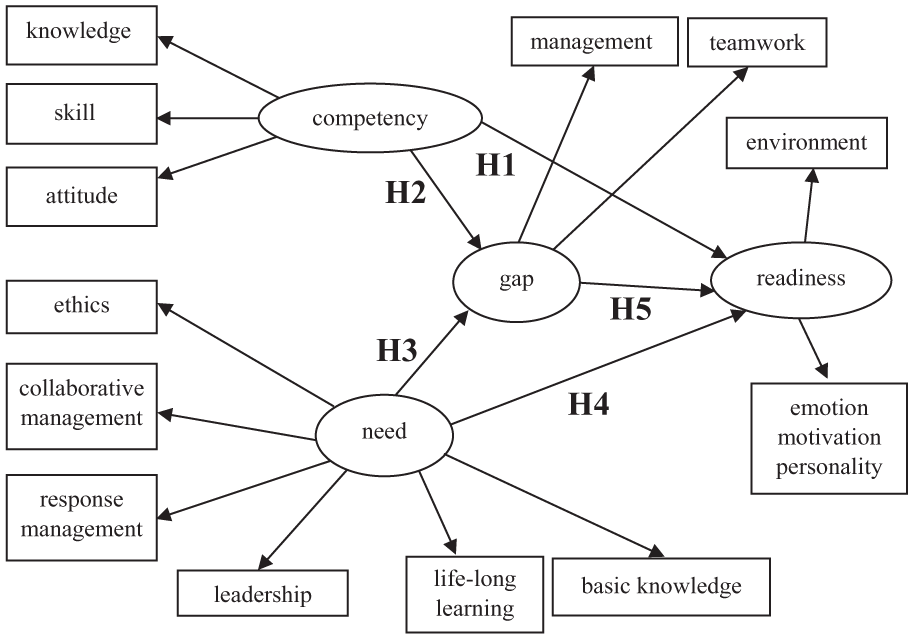
Hypothesized framework.
Hypothesized Framework
Based on the above hypotheses and review of the literature, the researchers have developed Figure 2’s conceptual framework, which includes the causal relationships between competency, gap, needs, and readiness of Thai professional engineers to work within the AEC.
Method
Sample and Data Collection
The survey’s population was engineers who worked in Thai industrial companies registered by the Federation of Thai Industries (FTI). For the study, the 1,211 companies were divided into 12 industrial sectors (Table 1).
Population and Sample.

Note. CNC = computer numerical control; FTI = Federation of Thai Industries.
Of the questionnaires sent and returned, 412 questionnaires were deemed complete and usable, of which 278 respondents who affirmatively answered the survey question “Are you prepared to work in another ASEAN country?” were selected for further analysis.
Furthermore, the questionnaire was divided into two parts, with Part 1 consisting of the respondent’s general and personal information, whereas Part 2 consisted of the actual questionnaire concerning the engineer’s perception of his or her readiness for work within an AEC member country. Part 2 also consisted of 60 questions divided into four parts, with competency consisting of 12 questions, needs with 24 questions, competency gap with 11 questions, and readiness with 11 questions (Tables 2 and 3). Respondents’ perceptions of their readiness were noted by use of a Likert-type agreement scale (Likert, 1932) ranging from 1 (strongly disagree) to 7 (strongly disagree).
Thai Engineer Readiness to Work in AEC Engineering Projects.

Note. AEC = ASEAN Economic Community; ASEAN = Association of Southeast Asian Nations.
Thai Engineer Readiness for AEC Projects Likert-Type Scale Interpretation.

Note. AEC = ASEAN Economic Community; ASEAN = Association of Southeast Asian Nations.
Therefore, from the seven levels of frequency (Table 3), the interpretation of these responses was calculated by using the following formula:

A 0.86 (rounded) interval level for the seven levels of frequency was used and is detailed in Table 3.
Research Instrument Quality Verification
Questionnaire validation enhancement was accomplished in a two-step process, which included the following:
Content validity was evaluated by using item-objective congruence (IOC) value, with the IOC value of 0.6 or more being considered satisfactory. The index of IOC developed by Rovinelli and Hambleton (1977) is a procedure used in test development for evaluating content validity at the item development stage. Using this criterion, the content validity was reviewed by five researchers to determine the relevancy and validity of the questions, including the latent variables.
The reliability was estimated using Cronbach’s alpha, resulting in values ranging from .7 or greater (Tavakol & Dennick, 2011).
Reliability
Thirty questionnaires were used in the initial reliability test to ensure the responses collected through the instrument were consistent and reliable, which was calculated with use of Cronbach’s alpha and was determined to be highly reliable with a score of .958. George and Mallery (2010) illustrated the value of Cronbach’s alpha (Table 4), although some authors suggest higher values of .90 to .95 should be used (Tavakol & Dennick, 2011).
Cronbach’s Alpha Scale of Acceptability.

Quantitative Data Analysis
The study identified two exogenous latent variables, which consisted of two observed variables (Hancock & Nevitt, 1999), including competency (knowledge, skill, and attitude) and need (ethics, collaborative management, response management, leadership, lifelong learning, and basic knowledge).
The study also identified a mediator latent variable, which was gap. Gap consisted of two observed or manifest variables, including management and teamwork. Mediating variables are important in psychological theory and research, and transmit the effect of an independent variable on a dependent variable (MacKinnon, Fairchild, & Fritz, 2007).
In addition, the endogenous latent variables relating to readiness consisted of environment and EMP. Readiness was identified as the moderator variable of the research. From the literature review and theory, Table 5 shows the exogenous, mediator, and the endogenous latent variables, along with their related observed variables and supporting theory.
Summary of Exogenous, Mediator, and Endogenous Latent Variables Along With Associated Theory.

Note. ABET = Accreditation Board for Engineering and Technology; NACE = National Association of Colleges and Employers; WCEC = World Chemical Engineering Council.
Qualitative Data Analysis
The UCLA Statistical Consulting Group (2016) has suggested sample sizes typically range between five and 15 items per estimated parameter, with sample sizes greater than 200 cases, but vary depending on the complexity of the specified model. Nunnally and Bernstein (1994) suggested a middle number of 10 cases per variable as being sufficient. Therefore, from the above and other reviewed theory, a ratio of 20:1 was deemed to be highly reliable. Thus, the study’s 278 individuals for 13 observed variables (13 × 20 = 260) were deemed to be highly reliable.
Qualitative research was conducted by use of in-depth, semistructured, guided interviews with five experts (three university engineering lecturers and two engineers certified from the Council of Engineers of Thailand [COE]) to determine the questionnaire’s content validity, which covered the following five topics. Revision was based on the comments and feedback from each expert.
the measurement of readiness,
the measurement of competency,
the measurement of gap, and
the measurement of need.
Results
Respondent’s Demographic Characteristics
Table 6 shows the results from the 278 Thai engineering professionals surveyed, the majority were male (85.0%) and were 40 years old or younger (80.80%). Engineers with undergraduate degrees represented 74%, while 19.90% had a master’s degree. Civil engineers (38.80%) led the professional list, followed by electrical engineers (18.90%) and mechanical engineers (14.80%). Engineers involved in operations represented 64.80%, while engineering managers represented 35.20%. The operations/management ratio was nearly a mirror of the experience ratio, which indicated that 63.11% had 10 years of experience or less, while the remaining (36.85%) had 11 years or more experience.
Respondents Overview (278 Samples).

Note. COE = Council of Engineers; ASEAN = Association of Southeast Asian Nations; ACPE = ASEAN Chartered Professional Engineer; AEC = ASEAN Economic Community.
When the survey focused on professional membership in the “Council of Engineers of Thailand (COE),” 36.20% indicated that they were not a member, whereas 51.20% indicated they were registered as “associate engineers,” with another 11% registered at higher levels. Although 67.50% indicated in the first part of the survey that they were “ready” to work outside Thailand as a professional engineer in the AEC, only 0.72% (two individuals) had achieved “ASEAN Chartered Professional Engineer (ACPE)” status. It is ACPE certification that allows a Thai engineer to work outside Thailand in another AEC country (Council of Engineers of Thailand, 2010).
For clarification, Thailand’s COE is a statutory body under the Engineers Act B.E. 2542 (1999), which provided for the registration of professional engineers, and the associated qualifications and conduct regulations for both them and the Thai companies they work for (Council of Engineers, 2016).
Respondent’s Information
Table 7 shows that the factors that affect Thai engineering professional readiness to work within the ASEAN community (AEC) includes readiness, competency, gap, and need, whereas Table 8 shows the specific questions in Part 4 (readiness) and each question’s M and standard deviation averages, as well as the interpreted results from the 7-point survey, which ranged from 4.87 to 5.84 (Best & Kahn, 2003; Likert, 1932).
Mean, Standard Deviation, and Survey Interpretation.

Mean and Standard Deviation of Thai Engineering Readiness Levels to Work Within AEC Member Countries.

Note. AEC = ASEAN Economic Community; ASEAN = Association of Southeast Asian Nations.
Pearson Product–Moment Correlation (PPMC) Coefficient
The PPMC coefficient (r) was used to calculate the direction and strength between the constructs, with Table 9 showing the results of the 13 variables tested. Cohen (1988) has stated that the sign of the correlation coefficient indicates the direction of the relationship, whereas the magnitude of the correlation (how close it is to −1 or +1) indicates the strength of the relationship. Table 9 shows the results from the study, which indicate the positive relationships. In addition, the variables are most correlated at the statistically significant level of p < .05. The study also considered the pairs of observed variables’ correlation coefficients (Table 9) where values were above .85. The empirical data showed that the correlation coefficient was between .111 and .814, and because this was below .85, the researchers, therefore, concluded that multicollinearity was not a problem (Pumim, Srinuan, & Panjakajornsak, 2017; Studenmund, 2006).
Pearson Product–Moment Correlation Coefficient.

p < .01.
Confirmatory Factor Analysis (CFA)
Magistris and Gracia (2008) stated that to access the measurement models, a CFA is used followed by structural equation modeling (SEM) to examine the general fit of the proposed model with data, and to identify the overall relationships among these constructs. Wong (2013) indicated also that, for marketing research, a significance level of 5%, a statistical power of 80%, and R2 values of at least .25 are considered typical.
Standard modeling accepts the proposed model if the p value is higher than .05 and if the χ2/df ratio is less than two (Byrne, Shavelson, & Muthén, 1989). This is consistent with Kline (1998) and Ullman (2001), who also indicated that the relative chi-square should be less than two.
In addition, another common reported statistic, and a potential mechanism for accommodating large sample sizes, is to use the root mean square error of approximation (RMSEA), as a measure of goodness-of-fit in SEMs (Chen, Curran, Bollen, Kirby, & Paxton, 2008; Steiger, 2007) and to measure the discrepancy per degree of freedom (Hu & Bentler, 1999).
Competency
Using SEM, the researchers specified the CFA model (Hox & Bechger, 1998), where competency (Figure 3) is influenced by knowledge, skills, and attitude. From the modeling, the χ2 was indicated to be 0.54, with a p value of .764, and RMSEA = 0.000, which indicates an acceptable fit with the model. This ensures that the observed variables are sensitive to competency and are suitable for further analysis.
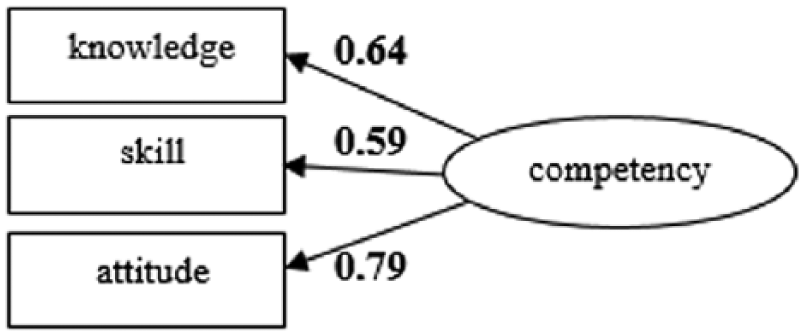
CFA for competency (value from completely standardized solution).
Need
Using SEM, the researchers specified the CFA model (Hox & Bechger, 1998), where need (Figure 4) is influenced by ethics, collaborative management, response management, leadership, lifelong learning, and basic knowledge. From the modeling, the χ2 was indicated to be 0.54, with a p value of .764 and RMSEA = 0.000, which indicates an acceptable fit with the model. This ensures that the observed variables are sensitive to need and are suitable for further analysis.
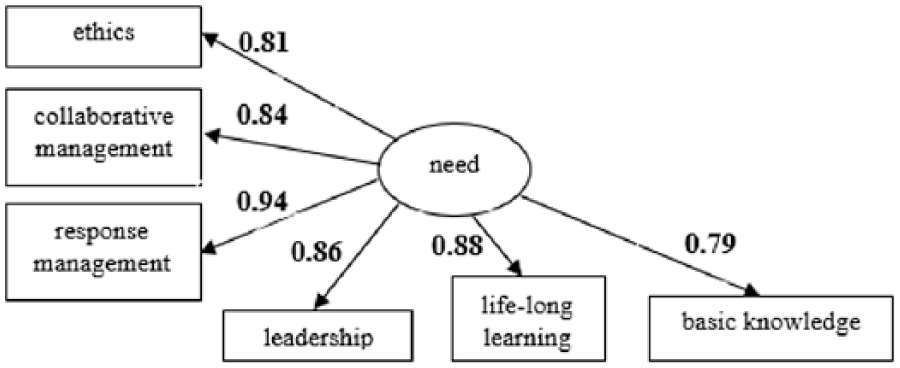
CFA for need (value from completely standardized solution).
Gap
Using SEM, the researchers specified the CFA model (Hox & Bechger, 1998) where gap (Figure 5) is influenced by management and teamwork. From the modeling, the χ2 was indicated to be 0.54, with a p value of .764 and RMSEA = 0.000, which indicates an acceptable fit with the model. This ensures that the observed variables are sensitive to gap and are suitable for further analysis.
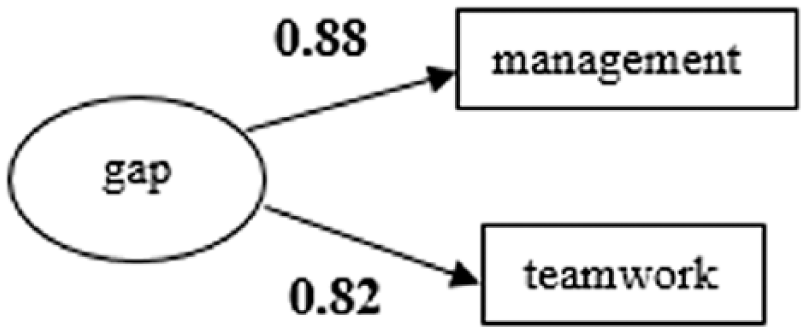
CFA for gap (value from completely standardized solution).
Readiness
Using SEM, the researchers specified the CFA model (Hox & Bechger, 1998) where readiness (Figure 6) is influenced by environment and EMP. From the modeling, the χ2 was indicated to be 0.54, with a p value of .764 and RMSEA = 0.000, which indicates an acceptable fit with the model. This ensures that the observed variables are sensitive to readiness and are suitable for further analysis.
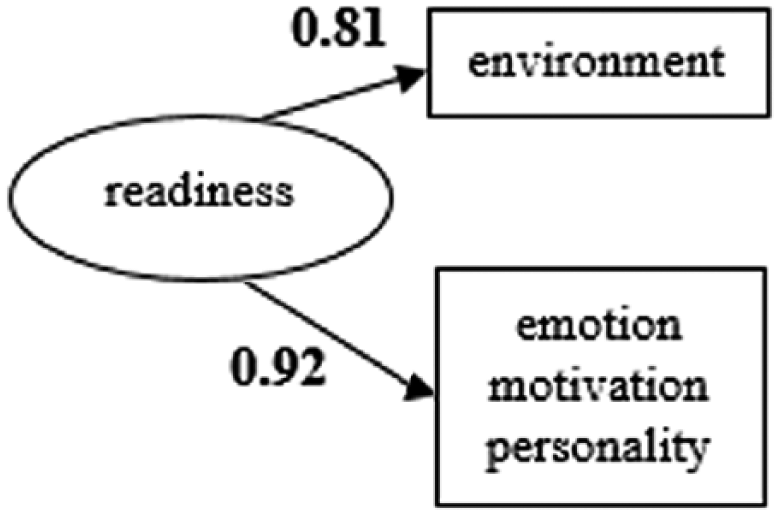
CFA for readiness (value from completely standardized solution).
Scholars such as Hooper, Coughlan, and Mullen (2008) and Hair, Hult, Ringle, and Sarstedt (2016) have stated items with low multiple R2 (less than .20 and .25, respectively) should be removed from an analysis as this is an indication of very high levels of error. Goodness-of-fit statistic (GFI) was indicated to be 0.971 (Table 10), which Hooper et al. (2008) recommended to be higher than 0.90. The adjusted goodness-of-fit index (AGFI) should also have a value greater than 0.90, which indicates a well-fitting model (Hooper et al., 2008).
Criteria and Theory of the Values of Goodness-of-Fit Appraisal.

Convergent Model Analysis
From the LISREL 9.1 analysis of the four latent variables and their related hypotheses, it was determined that the model had a good fit with the empirical data. Confirmation of this was obtained by the consistency of the following measurements and data:
Result details were as follows:
Due to the χ2 value being equal to 38.64, and the use of 47 degrees of freedom (df), the ratio between chi-square and the df was equal to 0.82 when tested, which showed statistical significance as it was >.05 (p = .802), which confirms the model’s hypotheses are not different from the empirical data.
Further confirmation was established as the results of the GFI equaled 0.979 and the AGFI equaled 0.959.
The comparative fit index (CFI) was equal to 1.000.
The RMSEA was equal to 0.000.
The standardized root mean square residual (SRMR) was equal to 0.023. As SRMR is an absolute measure of fit, a value of zero indicates a perfect fit with a value of <0.08 indicating a reasonable fit (Hu & Bentler, 1999).
Hoelter’s “critical N” (CN) was equal to 499.086 (Hoelter, 1983), which is considered to the largest sample size in which acceptance of the hypothesis for the model is correct.
All the above further confirm that the model was consistent with the data and had a good fit. Campbell and Fiske (1959) proposed two constructs to assess the validity of a test, which were convergent validity and discriminant validity. In SEM, CFA is usually used to access construct validity (Jöreskog & Sörbom, 1993). Hair et al. (2016) and Byrne (2010) indicated that factor loadings or regression weight estimates of latent to observed variables should have values greater than 0.50, which indicates that all the constructs conform to the construct validity test and validity convergence. In Figure 7, the respecified model of the factorial structure is shown.

Respecified model of factorial structure.
The validated results are detailed in Tables 11 and 12.
The Correlation Coefficient Between Latent Variables (Below the Diagonal), Reliability of Latent Variables (ρC), and the AVE.

Note. AVE = average variance extracted.
p < .01.
Relative Influence of Items (Unstandardized Regression Weights) Used to Access Thai Engineering Readiness Results After Adjusting the Model.

Note. Critical ratios (t values) more than 1.96 are significant at the .05 level. SE = standard error; CR = critical ratio (t value).
In Table 13, the direct effect (DE), indirect effect (IE), and total effect (TE) of each variable is shown (Bollen, 1987; Zou & Fu, 2011). Readiness is influenced by the direct positive recognition of need the most, due to the value of 0.38. Competency also has a direct positive influence on readiness, as TE was shown to be 0.53. And, need is influenced by the direct positive recognition of gap due to the value of 0.30.
DE, IE, and TE of the SEM Analysis.

Note. DE = direct effect; IE = indirect effect; TE = total effect.
p < .01.
SEM Results
The SEM results (Figure 8) showed that all models meet the required criteria at χ2 = 26.45, with χ2/df (26.45/33) at 0.80, p value at .78, GFI at 0.98, AGFI at 0.96, RMR at 0.019, RMSEA at 0.000, and CN at 565.430, respectively.

Final model with values from estimates (n = 278).
From Table 13, GFI is indicated to be 0.96, with Figure 8 indicating a well-fitting model (Hooper et al., 2008). The AGFI for the study in Table 13 is 0.96.
Results Discussion
For the study’s results, competency was determined to have had a direct (0.52) and positive affect (p < .001) on readiness, which supports H1. Furthermore, competency was shown to have an indirect, but positive effect on readiness through gap (H2). Casner-Lotto and Barrington (2006) have indicated that competency is the ability to use knowledge, facts, and data to solve workplace problems, as well as being able to apply math and science concepts to problem solving.
In the research from Rugarcia, Felder, Woods, and Stice (2000), concerning their vision for engineering education, it was strongly suggested that the traditional classroom environment will probably not be adequate to equip engineering graduates with the knowledge, skills, and attitudes they will need in the coming decades, although alternative methods (e.g., team based and discovery learning) have good prospects to do so.
Need also had a direct and positive influence (0.30) on gap (H3). This result is supported by a survey of 606 U.S. organizations (Barrington, Casner-Lotto, & Wright, 2006), from which seven career readiness competencies were identified as essential (Table 14). At the top of the list was “professionalism/work ethic” with an overwhelming 97.5%, indicating this was a key element to readiness. In addition, results were supported by NACE (2015), which indicated that 80% considered leadership skills as greatest factor in hiring one candidate over another. NACE’s (2015) study indicating “teamwork” was the most important factor (with a score of 75%) also supports the research’s findings and further supports H3.
Essential Career Readiness Competencies.

Need also has a direct and positive influence on readiness (H4; p < .001) with a positive DE of 0.30. And, once again, NACE’s study supports the hypotheses as career management was identified as one of the seven essential prerequisites for career readiness by the 606 survey participants with a score of 45% (NACE, 2015).
In Thailand, Reeve (2016) indicated in the process for lifelong learning; technical and vocational education and training (TVET) must properly prepare their students to live and work in the 21st century. This was consistent with the human resource study by Anh (2015) in Vietnam, in which it was stated that to restructure the economy, a high-quality workforce is necessary that is trained with high technologies and/or sciences. Furthermore, as Thailand sets off on its path toward Industry 4.0 and the Internet of Things (Iot; Thailand 4.0 in Thailand), a digitally enabled, knowledge worker is stated to be a pillar to Thailand’s economic future and 10 key economic sectors (Jones & Pimdee, 2017).
Concerning ethics, the study identified numerous times the stated need for ethics training in engineering education (ABET; 2015, 2017; Council of Engineers of Thailand, 2010). However, Bairaktarova and Woodcock (2014) have suggested doing so is not straightforward, and motivating students to take professional ethics seriously is difficult. Also, ethics undergraduate curriculum has been found to be inadequate and ineffective in preparing students to face ethical issues in their workplace (Colby & Sullivan, 2008; Lattuca, Terenzini, & Volkwein, 2006; McGinn, 2003; Shuman et al., 2004). This is especially true in Asia, and was ranked at the bottom as an engineering need by the engineers themselves for this study.
Gap has a direct and positive influence on readiness (H5), which is primarily due to gap’s two observed variables, which included management and teamwork that were found to be key factors on gap’s positive and direct influence on readiness. This was once again supported by the NACE (2015) study, in which “teamwork/collaboration” was identified by 90% of the survey participants as being a key component of career readiness (Table 14). Malaysian managers also ranked as highest (55.7%) the ability to function effectively as an individual and in a group with the capacity to be a leader or manager as well as an effective team member as the most important aspect to graduate readiness (Zaharin, 2009). This is consistent with research from the World Bank (2014), in which Vietnamese employers indicated that next to job-specific technical skills, working well in teams, and being able to solve problems are considered important behavioral and cognitive skills for blue-collar workers.
Readiness and its observed variables were verified by Cheerakarn (2012), who added innovation, leadership, flexibility, motivation, and building relationships as important components. Torrente’s (2014) discussion, concerning Philippine transnational entrepreneurs, indicated that successful personality traits included the need for achievement, an internal locus of control, and the willingness to take risks.
Conclusion
This study identified some glaring inadequacies related to Thai engineer readiness in working within other AEC member countries on engineering projects. From the results, follow-on study is recommended, which explores the specific experience of Thai engineers, as well as their ability to meet the very specific criteria established by the 2005 mutual recognition arrangement (MRA) on engineering services.
A key item in the MRA is the section in which it states individual engineers must be in charge of significant engineering work for 2 years (Fukunaga, 2015). Furthermore, research is needed to establish how much culture (and language) plays a role in ASEAN engineering projects, and to what level Thai engineers have the necessary language skills to “manage” foreign workers, as it is “managers” that the ASEAN MRA appears to be actually written for. In addition, industrial companies in Thailand need to reduce the engineers’ competency gap by use of collaborative management and teamwork so that their competency and needs can be improved.
Footnotes
Declaration of Conflicting Interests
The author(s) declared no potential conflicts of interest with respect to the research, authorship, and/or publication of this article.
Funding
The author(s) received no financial support for the research, authorship, and/or publication of this article.