




Abstract
To make teaching personal and social responsibility (TPSR) more effective, this study aimed to determine whether integrating moral disengagement (MD) minimization strategies into TPSR can enhance students’ positive behaviors and reduce their misbehaviors in PE. A pretest-posttest quasi-experimental design was conducted with an experimental group and two control groups. One hundred forty-five students from nine classes in three middle schools were assigned to experimental group (TPSR + MD minimization strategies; N = 50), control group A (TPSR; N = 46), and control group B (general PE instruction; N = 49) respectively. A pretest was performed in the first week, and a posttest was performed in the 18th week. The results showed that integrating MD minimization strategies into TPSR could significantly reduce students’ misbehaviors in PE classes. However, the effects of the strategy on students’ positive behaviors (e.g., following rules, helping others, and cooperation) showed no improvement. This study made a breakthrough by finding that integrating MD minimization strategies could make TPSR more effective at reducing students’ misbehaviors. By understanding the psychosocial mechanisms behind student behavior in PE, we suggest that MD minimization strategies could be applied in the TPSR model.
Because of the high level of interpersonal interaction during the learning process, physical education (PE) is regarded as an ideal educational field to cultivate students’ social-behavioral development (Coakley, 2011; Fraser-Thomas et al., 2005). Hence, the US Society of Health and Physical Educators (SHAPE America, 2013) listed “exhibits responsible personal and social behavior that respects self and others” as one of the goals in PE. In line with this trend, the importance of understanding how to enhance students’ positive behaviors (i.e., behaviors lead to positive growth in social, emotional, and other domains; Feuerborn & Chinn, 2012), such as taking responsibility, respecting others and reducing their misbehaviors in PE, has long been recognized by researchers (Bailey, 2005; Selickaitė et al., 2019). In recent decades, model-based practices (e.g., cooperative learning, teaching games for understanding, TPSR) in PE have been regarded as tools to help students accomplish important outcomes, such as positive behaviors (Dyson et al., 2021). According to Richards and Shiver’s (2020) review report, model-based studies for cultivating student behavior are mainly based on the model of teaching personal and social responsibility (TPSR).
The TPSR program was first developed by Hellison to help children become responsible through physical activities. It started as a community-based approach to assist school education. As the model further developed and gained recognition, it came to be used in much wider domains (Martinek & Hellison, 2016). The TPSR includes five primary goals/levels (i.e., respect for others, effort and cooperation, self-direction, helping others, and transfer) that have been linked to students’ positive behaviors (Hellison, 2003a, 2011). Five structured intervening sessions—relational time, awareness talks, physical activity plans, group meetings, and self-reflection time—are used in physical activities, sports, or PE to achieve the aforementioned goals of TPSR; Hellison, 2011). Past studies have provided evidence to support the effects of TPSR on all levels of responsibility through various methodological approaches involving qualitative, quantitative, and mixed methods across PE settings in primary and secondary schools (see Pozo et al., 2018, for a review). The positive outcomes of TPSR have been supported; nonetheless, scholars continue to search for better strategies to advance the model since some impediments were mentioned in relevant studies, including cultural differences (Alcalá et al., 2019); the lack of evidence on the outcomes of transfer (to outside of the gym) (Pan, Chen et al., 2019); or inconsistent outcomes (Cryan & Martinek, 2017). Therefore, PE researchers began to consider how to combine other models, for instance, TGfU, cooperative learning, or Trauma-Informed Practices (Ellison et al., 2019; Fernandez-Rio, 2014; García-Castejón et al., 2021) or to integrate new strategies, for instance, Observational System of Teaching Oriented Responsibility, into the existing model to reinforce the effects of TPSR (Ellison et al., 2019; Fernandez-Rio, 2014; García-Castejón et al., 2021; Hayden, 2012).
Given the goal of making TPSR more effective, a potential approach is integrating new elements into the model to reduce students’ misbehavior. As previously noted (Gordon & Beaudoin, 2020), the TPSR model mainly focuses on teaching responsibilities in a positive way. TPSR assumes that students’ misbehaviors such as chatting, arguing, or bullying in class would decrease by increasing students’ positive behaviors such as effort and cooperation (Hellison, 2011). However, previous PE studies (e.g., Cothran et al., 2009; Kulinna et al., 2006) have shown that students’ misbehavior in PE classes not only disrupts the quality of instruction but also impedes the learning effects of peers. In the TPSR program, students’ misbehaviors also hamper the positive outcomes of learning (Hsu, 2017; Wahl-Alexander et al., 2019). Therefore, to make TPSR more effective, physical educators should not only enhance students’ positive behaviors but also reduce their misbehaviors.
In probing misbehaviors, the mechanisms of moral disengagement (MD) proposed by Bandura (1999) suggested that individuals tend to adopt psychosocial mechanisms to rationalize their behaviors when behaving negatively. A recent study (Hsu & Pan, 2018) found that students mainly use advantageous comparison (comparing one’s negative behaviors to behaviors that are more severe in nature to make the former behaviors seem less harmful) and nonresponsibility (diffusing or displacing one’s responsibility to others) in the mechanisms of MD to justify their misbehaviors. Thus, integrating strategies for minimizing students’ MD mechanisms of advantageous comparison and nonresponsibility may make TPSR more effective. To date, few studies (if any) have been conducted in integrating MD minimization strategies with TPSR programs. Providing empirical evidence of the better outcomes of TPSR program when including MD minimization strategies would enhance the contributions of the studies.
The Role of the Teaching Personal and Social Responsibility Model
The guidelines of the TPSR model are to teach students how to take responsibility for themselves and others (i.e., respect for others, effort and cooperation, self-direction, helping others, and transfer). To achieve this, a TPSR-based lesson generally follows the daily format that contains five components: relational time, awareness talk, physical activity plan, group meeting, and reflection time (Gordon et al., 2016; Richards et al., 2019). According to Hellison (2011), the first component—relational time—refers to educators seeking to understand and construct relationships with students in short conversations; the second component—awareness talk—refers to informing students of the importance of taking responsibility for themselves and others and encouraging students to initiate positive behavioral objectives for themselves; the third component—physical activity plan—means that educators guide students to show positive behaviors with properly designed activities; the fourth component—group meeting—refers to discussing the performance of students and providing feedback on the activities, designs and regulations; and the fifth component—self-reflection time—provides students an opportunity to assess and improve their performance. Moreover, four crucial principles for applying the model are suggested: a great teacher–student relationship, empowering students, teaching responsibility through physical activity, and promoting the transfer of the outcomes to daily life (Hellison, 2003a).
A considerable number of studies have found that the implementation of TPSR in PE can enhance students’ positive behaviors and reduce their misbehaviors (see Gordon & Beaudoin, 2020; Pozo et al., 2018). The effects of TPSR have been field tested for decades, and many researchers have reported its positive impacts on students’ behavior. These studies are mainly qualitative case studies (Hellion & Walsh, 2002; Richards & Shiver, 2020). As Pozo et al. (2018) proposed in their systematic literature review of the TPSR, researchers should consider designing quantitative or mixed methods due to the preponderance of qualitative investigations in TPSR research.
Moral Disengagement in Physical Education
Bandura (1991) suggested that individuals tend to behave in accordance with social norms and self-consciences with rational self-monitoring in social cognition theory. On the other hand, restrained or inhibited reactions occur when individuals consider their behaviors or actions to violate social norms and self-consciences. While engaging in inappropriate or immoral behaviors, individuals may seek justifications for themselves to break free from the self-regulations mentioned above. This psychosocial mechanism of such rationalization is called Moral Disengagement (MD). Bandura (1999) further categorized MD into eight mechanisms: euphemistic labeling, moral justification, advantageous comparison, diffusion of responsibility, displacement of responsibility, distortion of consequences, dehumanization, and attribution of blame.
By using qualitative interviews or quantitative questionnaires, numerous studies have reported medium to high levels of correlation among various misbehaviors and these eight mechanisms of MD (Aquino et al., 2007; Baker et al., 2006; Hyde et al., 2010; McAlister et al., 2006). Specifically, MD is seen as the main factor behind the misbehavior of students (from the mild behavior of laziness to the more severe behavior of bullying) in the education context (Baker et al., 2006; De Caroli & Sagone, 2014; Gini et al., 2014). The most prominent PE study was from Hsu and Pan (2018), who examined the predictability of the effect of MD on students’ misbehaviors through a two-phase questionnaire survey. A total of 282 and 336 middle school students participated in the respective phases of the study, and the results suggested that students in PE tended to use advantageous comparison (e.g., laziness in class is no big deal compared to skipping class) and nonresponsibility (e.g., no one is taking the class seriously, and I am just like everyone else) among all eight MD mechanisms to rationalize their misbehaviors.
The Present Study
In line with the crucial suggestion to integrate new elements into the existing TPSR model to reinforce its effects, this study aimed to determine whether integrating MD minimization strategies into TPSR can enhance students’ positive behavior and reduce their misbehavior in PE. Based on previous research assessing TPSR and MD in PE, the present study hypothesized that by integrating MD minimization strategies in TPSR, students would demonstrate better learning outcomes than students who merely participated in TPSR and general PE classes on positive behaviors and misbehaviors. The findings in the study will not only answer to the call for model combination of the TPSR but also serve as the reference for practitioners who wish to enhance students’ positive behaviors and eliminate misbehaviors in PE.
Methods
Research Setting
In Taiwan, attending two sessions of PE per week is mandatory for all students in middle schools. The PE class is mostly instruction oriented, followed by practice or game time for students. In the past, studies suggested that PE teachers were interested in using PE classes and sports to cultivate students’ responsibilities and other positive behaviors (Baptista et al., 2019; Pan & Keh, 2014). The research aimed to determine whether the students would exhibit a higher degree of positive behaviors (i.e., respect, effort, self-direction, following class rules, helping others, and cooperation) and a lower degree of misbehaviors (i.e., aggression, low engagement, failure to follow directions, poor self-management, and distracting behavior) after integrating MD minimization strategies into the TPSR model. A pretest-posttest quasi-experimental design was conducted with an experimental group and two control groups. There are three middle schools that participated in the research, and three PE teachers were invited to be the instructors. Each teacher taught a class of experimental groups and two control groups separately for a total of three teachers teaching nine classes. The above design is based on the recommendation of Cecchini et al. (2007), in which the number of teachers was increased so that deviations due to the school environment or teaching style would be minimized.
The research was administered in middle school PE classes in Taiwan. In Taiwan, all middle school students have to take two compulsory 45-minute PE classes every week. The 2019 new curricular guideline of 2-year compulsory education in Taiwan included cultivating the civil responsibilities of students as one of the objectives for health and PE. Hence, minimizing students’ misbehaviors and enhancing their positive behaviors is one of the crucial topics in this curricular area. In addition, the middle school phase is viewed as a crucial period for youths’ behavioral development and cultivation (Gordon, 2010; Hellison & Martinek, 2006); therefore, the authors chose to conduct the research in middle school PE classes.
Participants
Nine classes in three different middle schools were purposively sampled based on whether both teachers and students were willing to participate in this research. Three PE teachers from these schools were selected, and the students taught by each PE teacher were included. Each of the three teachers had one class as the experimental group (TPSR + MD minimization strategies), one class as control group A (TPSR), and one class as control group B (general PE instruction). The experimental group comprised 27 male and 23 female students (n = 50) with a mean age of 14.27 ± 0.51. Control group A comprised 24 male and 22 female students (n = 46) with a mean age of 14.32 ± 0.54. Control group B comprised 27 male and 20 female students (n = 49) with a mean age of 14.18 ± 0.44. The study was approved by the research ethics committee of National Taiwan University (201706ES027), and consent forms were obtained from the parents and students. After parental consent forms were obtained from all participants, one researcher collected the data. All the participants were informed that participation was optional and that their responses would be confidential.
Procedures
The expected course is 18 weeks, in which the pretest took place in the first week and the posttest was conducted in the 18th week. The actual intervention is 16 weeks. During the 16 weeks, badminton, table tennis, basketball, and volleyball were taught in every class in accordance with the present curricular design at school. Control group A fully executed the five formats of the TPSR model “relational time, awareness talk, physical activity plan, group meeting, and self-reflection time.” These five formats specifically followed chapter 4’s “Daily Program Format” in Hellison’s (2011) book on TPSR.
In relational time, educators find opportunities to chat with students individually, such as casual chats about students’ outfits or asking how they have been lately. The purpose of relational time was to establish relationships with the students and enhance their confidence in themselves and others. After each lesson, the educators would conduct relational time again. In awareness talks, educators directly taught the connotations of responsibility and guided the students to consider how to achieve the goals of responsibilities. Specifically, teachers encouraged and guided students to consider how to achieve their goals (e.g., “If people can get to you with their talk, they can control you” or “Can you share your ideas about helping others?”). In the physical activity plans, the educators integrated the TPSR concepts into class activities to allow the students to achieve their goals through physical activities. Specifically, the included elements required cooperation or might lead to conflicts in practice and group activities. To ensure that the students had enough successful experience, the educators gradually transferred class dominance to the students through empowerment and provided encouragement. In the group meetings, the educators divided the students into groups or directly assembled the students to discuss and express opinions from a positive perspective. In self-reflection time, educators guided the students to evaluate the relationship between their performance and achieving responsibilities. Ultimately, the educators guided the students to consider how to transfer the responsibilities to their daily lives. The lesson plan and time arrangement are shown in Table 1.
Lesson Plan for the TPSR Daily Program.

The instructor of control group B taught according to the existing syllabus without any intervention or manipulation. The instructor of the experimental group adopted MD minimization strategies integrated into the TPSR model. For example, the strategies include teacher-led discussions regarding advantageous comparison and nonresponsibility during relational time to remind students not to compare their misbehaviors with more severe deviant behaviors to make the former seem less harmful (advantageous comparison) and not to view their misbehaviors as being forced by peer pressure or to attribute responsibility to others in the group (nonresponsibility).
In general, all three classes followed the original curricular design formulated by the school, and the only differences were the teaching approaches adopted by the educators. In control group A, five formats of TPSR were introduced by the educator to the class; in control group B, the educator simply followed the existing syllabus; and in the experimental group, the educator implemented the five formats of TPSR and guided students not to rationalize their behaviors with MD in class. The research design is shown in Figure 1.

Research design.
Measures
Positive behaviors in PE
In this study, the scale used for measuring positive behaviors in PE is the Students’ Responsibility in PE Scale (SRIPES) developed by Hsu et al. (2014). This scale has a six-factor structure (i.e., respect, effort, self-direction, following class rules, helping others, and cooperation) and 26 items measured using a 6-point Likert-type scale. A previous study conducted in the middle school PE context (Hsu et al., 2014) demonstrated sufficient evidence for its reliability and validity.
Misbehaviors in PE
The measure of student misbehaviors in PE was based on the short version of the PE Classroom Instrument (PECI-S) developed by Krech et al. (2010). This scale has five factors (i.e., aggression, low engagement, failure to follow directions, poor self-management, and distracting behavior) and 20 items that were answered on a 5-point Likert-type scale. Wu et al. (2016) translated this scale into Chinese and examined its suitability for middle school students. In their study, sufficient evidence for reliability and validity was also reported.
Fidelity of Implementation
To ensure implementation fidelity in this study, we conducted the following four steps. First, all the participating educators in this study had 6 to 10 years of PE teaching experience. Before implementing the TPSR program, they participated in a 3-day TPSR and MD minimization training program (total of 24 hours) provided by the program designer (researcher). During this specific training program, participating educators were familiarized with TSPR guidelines, relevant literature, and case studies. Past TPSR implementation experiences were also shared with these participating educators by the program designer. Before the end of the training program, all participating educators were asked to demonstrate their teaching in accordance with the TPSR guideline and were given suggestions from the program designer. Second, all the participating educators were asked to answer a series of questions about TPSR and MD minimization implementation. Sample questions included the following: “The aim of relational time is…” (a) to put responsibility into practice, (b) to remind students of their goals, and (c) to offer a chance for one-on-one interactions to ensure their knowledge regarding the TPSR program. Third, every lesson plan were carefully examined to make sure that all five formats of TPSR and MD minimization strategies were included. Finally, the educators were asked to verbally explain what strategies were applied in this class to help students achieve responsibility goals and minimize their MD. In general, the fidelity in this study was supported through the above four steps. Through these four steps, we can confirm that the educators had a sufficient understanding of the TPSR model and MD minimization strategies.
Data Analysis
There were three classes each in the experimental group, control group A, and control group B respectively in the research; therefore, the average score of the three classes in each group was taken. Because the grouping was not randomly conducted, analysis of covariance (ANCOVA) using IBM Statistical Package for the Social Sciences (SPSS) version 20.0 was conducted. To determine the effects among the MD experimental group, TPSR control group, and general PE control group, the pretest scores for the various aspects of student positive behavior were employed as covariates, and the posttest scores were employed as dependent variables. The test for homogeneity of within-group regression coefficients showed that the F values of the variables were not significant (p > .05). Then, a 2 × 2 (time × group) ANCOVA with repeated measures over time was performed. After excluding the effect of covariates, the univariate testing of the experimental group and the two control groups on the various aspects were compared. The significance level was set at 0.05.
Results
The Effects on Student Positive Behaviors
The test for the homogeneity of the within-group regression coefficients showed that the F values of the variables were not significant (p > .05). As shown in Tables 1 and 2, the results of the ANCOVA showed that there were significant differences among the three groups on students’ effort (F = 4.24, p = .02) and self-direction (F = 4.68, p = .02), with effect size η2 of these variables of 0.06 and 0.07, respectively. The experimental group showed significantly higher values of improvement than the other two groups.
The Results of Students’ Positive Behavior.

However, there were no significant differences in the following behavior: respect, helping others, and cooperation. Therefore, it could be concluded that the intervention of MD minimization strategies could affect students’ effort and self-direction.
The Effects on Students’ Misbehavior
The test for the homogeneity of the within-group regression coefficients showed that the F values of the variables were not significant (p > .05). As shown in Tables 3 and 4, the results of the ANCOVA showed that there were significant differences among the three groups on students’ aggression (F = 20.23, p = .00), low engagement (F = 12.13, p = .00), failure to follow directions (F = 16.83, p = .00), poor self-management (F = 20.74, p = .00) and distracting behavior (F = 16.82, p = .02), with effect size η2 of these variables at “0.23, 0.15, 0.19, 23, and 0.19,” respectively. The experimental group showed significantly higher values of improvement than the other two groups. Therefore, we concluded that the intervention of MD minimization strategies could decrease the five types of student misbehaviors as shown in Table 5.
Group Comparison of Students’ Positive Behavior.
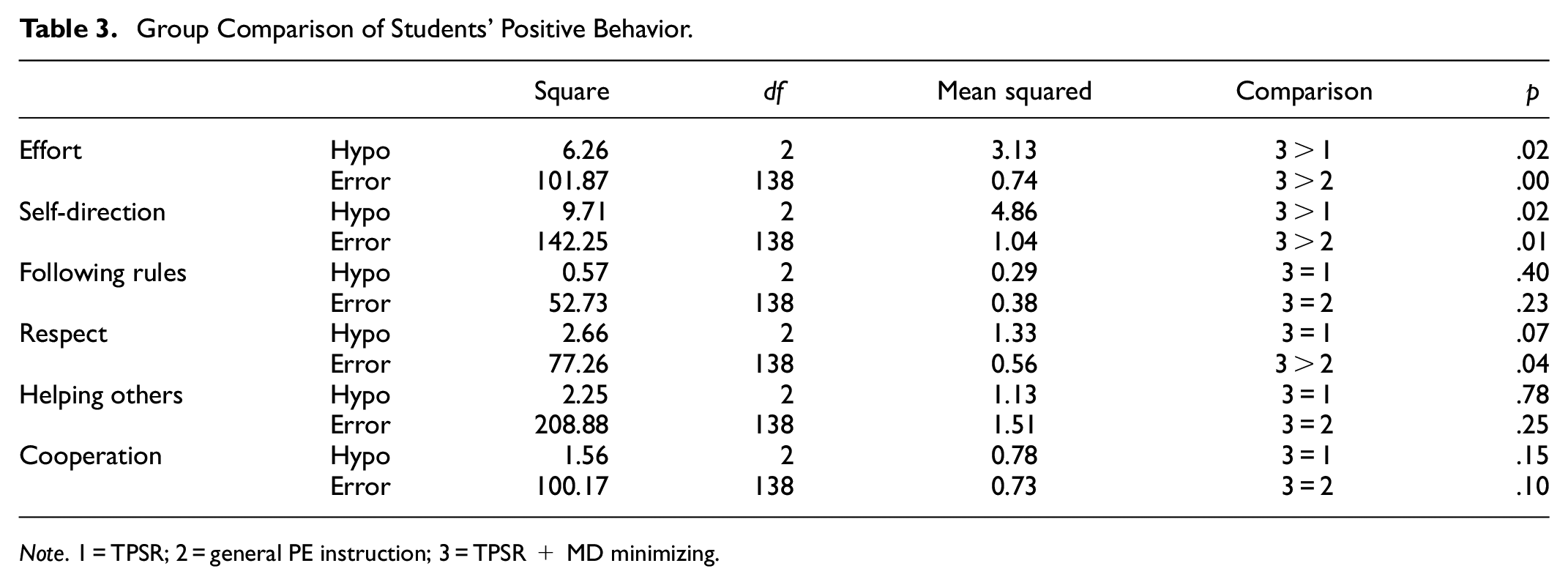
Note. 1 = TPSR; 2 = general PE instruction; 3 = TPSR + MD minimizing.
The Results of Students’ Misbehavior.
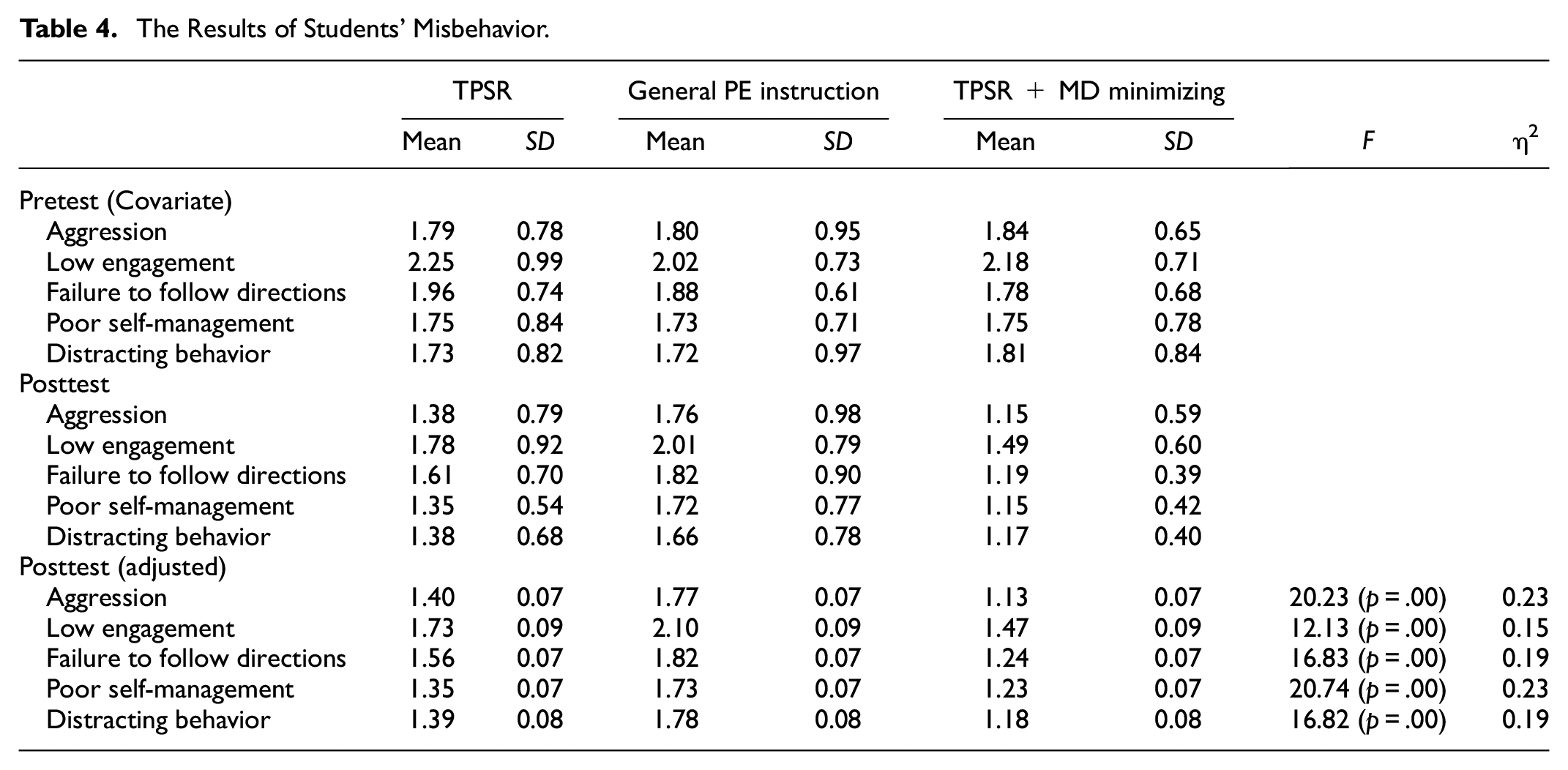
Group Comparison of Students’ Misbehavior.

Note. 1 = TPSR; 2 = general PE instruction; 3 = TPSR + MD minimizing.
Discussion
Students in the experimental group in which the MD minimization strategies integrated TPSR showed better improvement in effort and self-direction than students in both control groups A (TPSR) and B (general PE instruction). However, there were no significant differences in the following behaviors among the three groups: respect, helping others, and cooperation. On the other hand, the students in the experimental group demonstrated better outcomes on weakening aggression, low engagement, failure to follow directions, poor self-management, and distracting behavior than their counterparts in control groups A (TPSR) and B (general PE instruction).
Integrating MD minimization strategies into TPSR can only significantly enhance positive behaviors of effort and self-direction in PE, which may be explained by Hellison’s (2003a) ideas on responsibility development. Both effort and self-direction are responsibilities at the primary level (Hellison, 2003a); therefore, the improvements can be measured in a rather short time, while other positive behaviors, such as helping others and cooperation, are higher-level responsibilities (Hellison, 2003a), which may be more difficult or require a longer time to achieve. Pozo et al. (2018) also addressed a similar viewpoint in their review that the outcomes of TPSR would be better manifested with long-term interventions. However, limited by the school policies, this study only conducted the teaching intervention for 16 weeks. The shorter period of intervention may hinder the outcomes to a certain degree.
Furthermore, Bandura (1991) considered that MD is selectively activated by individuals to regulate the emotions of guilt resulting from their immoral behaviors. Self-regulation is inhibited, reactions of uneasiness and guilt are eliminated or lowered, and restraints on norm-breaking behaviors can be lifted when adopting this psychosocial mechanism (i.e., MD). Kavussanu (2008) also argued that MD is directly connected to the antisocial behaviors of individuals. Furthermore, the connections between MD and prosocial behaviors are indirect and have less supporting evidence in empirical studies. A recent study (Hsu et al., 2021) focused on students’ MD in the PE context can also help explain the results showing differences between positive behavior and misbehavior in the present study. In Hsu et al.’s (2021) study, advantageous comparison and nonresponsibility could highly predict students’ positive behaviors but had less but still significant predictability of misbehaviors. Therefore, the effects of MD minimization strategies integrated into TPSR on reducing students’ misbehaviors were fully supported. In contrast with misbehaviors, the effects on positive behaviors (e.g., effort and cooperation) were not fully supported.
Generally, our findings revealed that students from classes implemented with TPSR or MD minimization strategies integrated with TPSR had advanced improvement compared to their counterparts in general PE classes. These findings not only supported Hellison’s (2011) assumption of the TPSR model but also might be influenced by contextual factors, such as external obstacles to model implementation (Hellison, 2003b). Instead of applying the TPSR program initiated exclusively for unserved students (e.g., Gordon et al., 2016; Whitley & Gould, 2011), this study had fewer barriers to implementing TPSR in compulsory PE classes, as students were able to participate (or were required to participate) in the program from the beginning to the very end and, hence, suffered from fewer external obstacles. Furthermore, badminton, table tennis, basketball, and volleyball were rather popular sports disciplines taught at schools in Taiwan. In a previous study in which the TPSR model was conducted in Tai Chi (Wright & Burton, 2008), students needed more time to get used to the designed scenario because students tended to become bored by the slow movements and repetitive nature of Tai Chi. Comparatively, TPSR could be better applied when the students were familiar with and interested in the sports taught (Hellison, 2003b). As argued by Gordon and Beaudoin (2020), when they found cultural differences offered some challenges while implementing the TPSR program, it is necessary for program designers or implementers to make local adaptations to maximize the positive effects. Moreover, whether to add the elements of positive values in PE has been a popular topic of sports and physical activities on the social-behavioral development of students (Coakley, 2011; Turnnidge et al., 2014). There are already objectives on teaching right from wrong and behavioral modifications in PE. However, this study found that classes that received existing teaching programs showed very limited changes in positive behaviors and misbehaviors. Our findings echoed Hellison (2003b, 2011) idea on TPSR that students’ behavioral development could be further improved through properly designed interventions.
In general, the findings in this study contributed to “how to make TPSR more effective.” Moreover, the study also expands the existing literature compared to previous studies on MD in PE (e.g., Hsu & Pan, 2018; Pan, Huang et al., 2019). The research design has also been extended from the examination variable correlations to a quasi-experimental approach. Nevertheless, the exploration of the educational outcomes of PE is a continuous and sustained process (Bailey et al., 2009). Future studies should follow this path and further impact the social-behavioral development of students in PE.
Limitations and Future Research
Although the study contributes both theoretically and practically, several limitations must be addressed. First, the participants in this study engaging in PE classes based on their original classes rather than being randomly assigned to the experimental and two control groups might limit the inferences of the findings. Although it is indeed difficult to randomly assign nine classes of students to experimental and control groups, we still suggest that random assignment should be used in future studies. Second, the students in the three groups had the opportunity to only be involved in badminton, table tennis, basketball, and volleyball in the 16-week courses. The sports they participated in were all ball sports and are only a small portion of all sport in PE; therefore, we should be cautious when applying current results to other sports (e.g., gymnastics and track & field). It is suggested that the outcomes of MD minimization strategies should be examined in different or more types of sports. Third, the TPSR model was implemented following a flexible format that allows modification to meet the needs of the students and the teaching environment (Gordon et al., 2016). Although the best efforts were exhausted to ensure implementation fidelity, improvements can still be made. As mentioned in previous studies, teacher training and knowledge of TPSR are crucial for the implementation to be fruitful (e.g., Camerino et al., 2019). It is suggested that future researchers refer to the methods partook by Carreres-Ponsoda et al. (2021) to conduct teacher training, which is considered the most current and relatively extensive training for coaches or teachers to implement TPSR. Finally, the participants in the study were middle school students in Taiwan. Age and cultural differences should be considered when applying the implications. The examination of diverse samples in future studies will surely lead to more robust results.
Conclusion
This study made a breakthrough by finding that integrating MD minimization strategies could enhance TPSR’s effectiveness at reducing students’ misbehaviors. By understanding the psychosocial mechanisms behind students’ behaviors in PE, we believe that, in certain contexts, the combination of MD minimization strategies (instructing students not to rationalize their own behaviors with MD) or other model-based practices and the TPSR model may be beneficial for producing better outcomes in PE. Specifically, we recommend that physical educators adopt all five aspects of TPSR and introduce MD minimization teaching strategies at carefully selected moments (e.g., discuss the consequences of MD during awareness time). Moreover, we also recommend that subsequent researchers continue examining the effects of MD minimization strategies on misbehaviors in depth. In closing, this study represents a new attempt to examine the effects of integrating MD minimization strategies into TPSR in the PE context. Our findings contribute to the existing literature on how PE educators could reduce students’ misbehaviors.
Footnotes
Declaration of Conflicting Interests
The author(s) declared no potential conflicts of interest with respect to the research, authorship, and/or publication of this article.
Funding
The author(s) disclosed receipt of the following financial support for the research, authorship, and/or publication of this article: This work was supported by the Ministry of Science and Technology, Taiwan under Grant MOST 106-2410-H-431-020-MY2.
