



Abstract
Despite the critical importance of critical thinking in higher education, a gap remains regarding how environmental factors shape these dispositions. This study examined the influence of school climate, classroom management, and parenting styles on university students’ critical thinking dispositions, with an inclusive classroom climate as a mediator. The sample comprised 454 undergraduate education students, and data were collected via scales assessing discussion engagement, classroom management, school climate, parental attitudes, and critical thinking dispositions. Structural Equation Modeling revealed that a positive school climate (β = .19, p < .01), authoritative classroom management (β = .35, p < .01), and democratic parental attitudes (β = .17, p < .01) significantly enhanced critical thinking. Moreover, an inclusive classroom climate mediated these effects, underscoring its role in fostering intellectual engagement. The findings highlight the importance of democratic, supportive educational environments and school-family collaboration to promote critical thinking within the framework of Ecological Systems Theory.
Plain language summary
Critical thinking is one of the most essential skills for university students, helping them analyze information, solve problems, and make informed decisions. However, not all students develop strong critical thinking skills, and researchers are trying to understand the factors that influence this ability.
This study explores how different environmental factors, such as parental attitudes, school climate, and classroom management, affect university students’ critical thinking dispositions.
The researchers analyzed data from 454 undergraduate students using surveys that measured classroom management, school climate, parenting styles, and students’ willingness to engage in critical thinking. The findings reveal that:
● A positive school climate, where students feel supported and engaged, is linked to better critical thinking.
● Authoritative classroom management, where teachers set clear expectations but also encourage discussion, fosters critical thinking skills.
● Democratic parenting, where parents encourage open conversations and independent thinking, helps students develop critical thinking abilities.
● Most importantly, an inclusive classroom climate, where students feel comfortable expressing diverse opinions, plays a key role in strengthening these relationships.
These results suggest that creating supportive educational environments, both at school and at home, can significantly enhance students’ ability to think critically. Universities and educators can promote this by fostering discussion-based learning, encouraging open dialogue, and ensuring a classroom atmosphere that values diverse perspectives and active participation.
Keywords
Introduction
Critical thinking is a fundamental competency shaping individual and societal success in the 21st century. In an era characterized by rapid changes and complex global challenges, analytical reasoning, problem-solving, inquiry, and critical communication play a vital role in academic and professional domains, social engagement, and lifelong learning (Hyytinen et al., 2019; Jintalan & Litao, 2024; Yurt, 2025). International standards guiding education and the workforce consider critical thinking among the most essential skills of the age and deem it an indispensable competence in the global job market (Indrašienė et al., 2021; Partnership for 21st Century Skills, 2017; Şanlı, 2024). Critical thinking is the purposeful, self-regulatory judgment involving analysis, evaluation, and synthesis of information to guide belief and action (Ennis, 2011). It encompasses the ability to engage in reflective and independent thinking, enabling individuals to assess arguments, solve problems effectively, and make reasoned decisions. Critical thinking has two main dimensions: cognitive skills and dispositions (Paul & Elder, 2014). Dispositions include curiosity, flexibility, analytical reasoning, and the pursuit of reliable information, which are crucial for fostering critical thinking. These dispositions help individuals overcome intellectual barriers and adopt an open and inquisitive approach to knowledge. Hence, critical thinking skills are shaped by cognitive abilities and these dispositions, underscoring their decisive role in critical thinking processes (Facione, 1990). Despite its recognized importance and well-established theoretical foundations, evidence suggests that critical thinking development remains a significant challenge in contemporary educational settings.
The literature indicates that university students often need more critical thinking skills. For instance, Lodhi et al. (2023) found that more than half of university students perform poorly in inferential reasoning and analytical evaluation. Similarly, Al-Husban et al. (2022) revealed that students in Jordan exhibit critical thinking levels significantly below academic expectations. Din (2020) also highlighted a mismatch between critical reading skills and critical thinking dispositions, suggesting that current educational approaches must be revised to foster this essential skill. There is an urgent need for more effective models and approaches to enhance critical thinking skills and dispositions at the university level. Existing research often examines factors influencing critical thinking skills and dispositions in isolation, neglecting their interplay. Variables such as parental attitudes (Deng et al., 2023; Fadhil et al., 2024), school climate (Gómez & Suárez, 2020; Türkdoğan & Özgenel, 2021), classroom management strategies (Demirdağ, 2015; Turabik & Gün, 2016), and classroom climate (Lorencová et al., 2019; Samwel et al., 2025) have been studied individually about critical thinking. However, the lack of a holistic and interactive examination of these factors limits our understanding of the determinants of critical thinking dispositions. This gap impedes the development of comprehensive models and approaches that could effectively enhance critical thinking dispositions in practice.
This study aims to investigate the holistic effects of factors influencing critical thinking dispositions among university students within the framework of Bronfenbrenner’s (1979) ecological systems theory. The primary objective is to comprehensively analyze various factors impacting critical thinking development at the microsystem level, where individuals interact directly with their environment. This approach diverges from existing research by aiming to provide a deeper understanding of the factors influencing the development of critical thinking.
An inclusive classroom is a learning environment that accommodates and values all students’ diverse backgrounds, abilities, and perspectives, ensuring everyone feels respected, supported, and empowered to participate fully (Ainscow, 2020). An inclusive classroom climate represents a pedagogical approach that fosters an equitable and supportive learning environment, encouraging openness to diverse ideas and perspectives (Tinto, 1997). Such a climate creates an atmosphere where students feel psychologically safe, individual differences are valued, and ideas can be freely expressed. It may also mediate the impact of various factors on students’ critical thinking dispositions. For example, democratic parenting, which encourages children to express their ideas freely, might influence a classroom environment that fosters inclusivity. Similarly, effective classroom management can promote discussion and problem-solving by ensuring equal participation among students. However, its full impact may only be realized in a classroom atmosphere fostering belongingness and trust. By creating an environment where individual differences are acknowledged and appreciated, an inclusive classroom climate could amplify the effects of democratic parenting or effective classroom management on critical thinking. These observations suggest that an inclusive classroom climate could mediate among the factors influencing critical thinking dispositions. However, research has yet to be found in the literature to test this potential empirically. This study aims to fill this gap by examining the mediating role of inclusive classroom climate in the effects of democratic school climate, school commitment, democratic parenting, and effective classroom management on critical thinking dispositions.
This research is expected to provide significant theoretical and practical contributions. Theoretically, it will offer a deeper understanding of the social and environmental factors influencing critical thinking development. By presenting a novel framework on how factors such as school climate, classroom management, and parenting styles shape critical thinking dispositions, the study aims to provide an original perspective to the literature. Practically, this research seeks to guide educators and policymakers in designing effective strategies for fostering critical thinking skills in students. It highlights the importance of discussion-based learning approaches, positive school climate, and supportive parenting styles. It offers actionable insights for enhancing critical thinking skills in educational environments.
The research model of this study, which aims to determine the impact of democratic school climate, commitment, preferred classroom management profiles, and democratic parenting on critical thinking dispositions through the mediation of inclusive classroom climate, is presented in Figure 1.

Research model.
Theoretical Framework
This study examines the factors influencing university students’ critical thinking dispositions within Bronfenbrenner’s (1979) Ecological Systems Theory framework. This theory offers a holistic approach to understanding human development through multilayered systemic interactions (Rosa & Tudge, 2013). The theoretical model explains individual development due to the complex interplay of environmental factors (Tudge et al., 2009). The theory divides the developmental context into five layers: microsystem, mesosystem, exosystem, macrosystem, and chronosystem (Bronfenbrenner & Morris, 2006). The microsystem represents immediate environments of direct interaction, while other systems encompass broader social structures and cultural contexts (Evans et al., 2010; Lerner, 2006).
Building on this framework, this study focuses on the microsystem level, encompassing the immediate environmental contexts where university students engage in direct interactions that significantly influence their critical thinking development (Bronfenbrenner & Morris, 2006). This microsystem framework examines four key variables: democratic parental attitudes, school climate, classroom management strategies, and inclusive classroom climate as a mediating factor. The microsystem represents the most proximal influences on individual development, where these variables collectively create the immediate social contexts that directly shape students’ critical thinking dispositions.
Bronfenbrenner’s theoretical perspective offers a unique framework for understanding the complex developmental process of critical thinking dispositions, holding significant potential in higher education to elucidate the multilayered nature of advanced cognitive skills (King & Kitchener, 1994; Pascarella & Terenzini, 2005). It enables examination of students’ critical thinking skills as outcomes of the reciprocal interactions of social, cultural, and educational factors.
Within this microsystem context, democratic parental attitudes represent a fundamental influence that shapes students’ intellectual dispositions through sustained family socialization processes. According to Bronfenbrenner’s theory, family interactions constitute the primary microsystem context where individuals initially develop cognitive and social competencies that later influence academic engagement (Evans et al., 2010). The continuing relevance of parental influence during university years is supported by Arnett’s (2000) emerging adulthood theory, which recognizes ages 18 to 25 as a distinct developmental period where individuals remain susceptible to family influences. Additionally, intergenerational transmission suggests that cognitive approaches established through democratic parenting persist across developmental transitions (Knafo & Schwartz, 2003). Bandura’s (1991) social cognitive theory further emphasizes how university students continue to be influenced by parental problem-solving models through observational learning processes. Empirical evidence supports this theoretical rationale, as Wang et al. (2020) found that optimal parental bonding experienced before age 16 is positively associated with higher critical thinking disposition levels in university students.
Similarly, school climate constitutes another critical microsystem element influencing students’ intellectual development through daily institutional interactions. Within the microsystem framework, school climate represents the immediate psychological and social environment where students engage with educational content and establish meaningful peer relationships (Cohen et al., 2009). A democratic school climate, characterized by trust, collaboration, and intellectual freedom, creates the microsystem conditions necessary for supporting critical inquiry and analytical thinking.
Furthermore, classroom management strategies function as immediate microsystem processes that directly structure students’ learning experiences and cognitive engagement patterns. Effective classroom management creates the proximal conditions necessary for intellectual risk-taking, analytical discussion, and collaborative problem-solving—all fundamental components of critical thinking development (Demirdağ, 2015). Within Bronfenbrenner’s framework, these management approaches represent structured interactions that consistently expose students to intellectually challenging experiences.
Although conceptualized as a mediating variable, inclusive classroom climate is also positioned within the microsystem, reflecting the quality of immediate peer and teacher interactions that students experience daily. This construct embodies a meta-environment within the microsystem that integrates and amplifies the effects of other proximal influences by fostering psychological safety and inclusivity. An inclusive classroom environment creates the psychological conditions necessary for democratic parenting influences, positive school climate effects, and effective classroom management strategies to fully impact students’ critical thinking. This inclusive pedagogical approach establishes an equitable and supportive learning context that promotes openness to diverse ideas and multiple perspectives (Tinto, 1997).
Particularly relevant to this context, Bronfenbrenner and Morris’s (2006) concept of proximal processes emphasizes the importance of sustained and reciprocal interactions within the microsystem that drive development. Each variable examined in this study can be seen as facilitating proximal processes that provide consistent opportunities for cognitive stimulation and social learning, fostering critical thinking dispositions. Integrating these microsystem variables within a single theoretical model provides a comprehensive understanding of how immediate environmental factors collectively influence critical thinking development. The Ecological Systems Theory framework enables examination of students’ critical thinking skills as outcomes emerging from the dynamic interplay of multiple proximal contexts rather than isolated influences, offering significant insights for understanding the complex interactions among environmental variables that shape university students’ critical thinking dispositions.
Literature Review and Hypotheses
School Climate and Critical Thinking
School climate refers to the quality of school life shaped by values, relationships, and practices that influence students’ learning and socioemotional development (Cohen et al., 2009). It is a key contextual factor that shapes academic success and critical thinking dispositions (Thapa et al., 2013). In recent literature, school climate is increasingly associated with cultivating openness, respect, and intellectual engagement—conditions conducive to critical thinking. As the organizational foundation of education (Freiberg, 1999), it influences instructional practices and the emotional-cognitive environment necessary for higher-order thinking.
Building on this theoretical foundation, empirical findings strongly support the link between school climate and critical thinking. For instance, Kartal et al. (2024) found that positive student–teacher relationships, central to a democratic climate, significantly predicted middle school students’ critical thinking dispositions. In contrast, authoritarian teaching and poor classroom resources negatively impacted these dispositions. This pattern is further reinforced by Görür and Aybek’s (2024) research, which reported a positive correlation between students’ perception of school climate and their critical thinking, highlighting that participatory environments foster discussion and reflection.
These findings gain additional credibility through international evidence. Drawing on data from PISA 2015, Gómez and Suárez (2020) showed that school climate moderated the effect of inquiry-based teaching on perceived critical thinking among Colombian students. While such teaching negatively correlated with science achievement, it positively predicted students’ perceived critical thinking—especially within supportive climates. This indicates that climate may be a contextual amplifier for instructional strategies promoting higher-order thinking.
Nevertheless, the relationship is not without complexity, as findings are not uniform across all studies. Zynuddin et al. (2023) found that although inclusive classroom climates in China increased engagement, no direct relationship was observed with achievement. They emphasized the role of mediating variables, such as motivation and engagement, suggesting that climate’s impact on cognition may operate indirectly. They also noted a lack of consistency in defining and measuring school climate as a barrier to understanding its full influence.
Adding to these nuanced perspectives, some studies challenge the generally positive view of school climate. Chen and Weikart (2008) demonstrated that hostile climates reduce student participation and outcomes. Mohamed et al. (2018) found no significant link between school climate and academic performance—highlighting the possible influence of unmeasured psychological or contextual variables. Furthermore, Aston (2024) emphasized that overly structured or authoritarian environments may suppress the independent thought and risk-taking vital to critical thinking.
Despite these contradictory findings, research continues to identify specific mechanisms through which climate influences critical thinking. Using a multilevel latent variable model, Konold et al. (2018) found that authoritative climates—those combining structure and support—boosted engagement, a known precursor to cognitive challenge and critical thinking (Fredricks et al., 2004). Given this evidence, future research should consider indirect pathways linking climate to critical thinking via engagement (Fredricks et al., 2004; Zynuddin et al., 2023).
In addition to engagement pathways, creativity represents another important mediating factor. Péter-Szarka (2012) emphasized the role of a creative climate, with freedom, innovation, and teacher support enhancing students’ creativity—conceptually linked to critical thinking through shared demands on cognitive flexibility. Consistent with this perspective, UNESCO promotes inclusive and respectful school climates as foundational for equitable cognitive development (Margas, 2023). However, as Deroncele-Acosta and Ellis (2024) caution, such policies remain ineffective without actionable school-level strategies.
In summary, while a supportive and democratic school climate fosters critical thinking by promoting diverse viewpoints, intellectual autonomy, and student-centered learning, the complexity of this relationship—including possible negative effects—requires nuanced, multidimensional approaches to research and practice.
Based on this theoretical and empirical background, the following hypothesis was developed:
Classroom Management Profile and Critical Thinking
Classroom management profile refers to the framework that defines teachers’ attitudes and behaviors, including how they interact with students and organize the classroom environment. According to Ekici (2004), classroom management profiles are categorized into four main types: authoritarian, authoritative, laissez-faire, and indifferent. The authoritarian profile prioritizes discipline over students’ needs, while laissez-faire and indifferent profiles lack proper management. In contrast, the authoritative profile adopts a supportive, participatory, and balanced approach, addressing students’ differences and fostering positive learning atmospheres.
Building on this conceptual foundation, contemporary research demonstrates the significant impact of effective classroom management on student outcomes. Putra and Yanto (2025), in their meta-analysis of 14 studies, emphasize that effective classroom management consistently contributes to student achievement across educational settings. However, “effective” management requires careful interpretation—it is not merely order and discipline that matter, but the degree of student support and engagement embedded in the management style.
This perspective is reinforced by Cristo (2023), who emphasizes that effective classroom management promotes academic growth by cultivating supportive environments. While authoritarian strategies may secure short-term compliance, they often diminish long-term engagement. By contrast, authoritative approaches balance structure with responsiveness, empowering students to participate actively in learning processes. Alamban (2023) supports this view, showing that teachers adopting engaging classroom management strategies positively influence student participation regardless of demographic differences.
This influence extends beyond academic achievement to cognitive skill development. İhtiyaroğlu (2019) highlights that the authoritative profile is significantly linked with effective communication and intrinsic motivation, promoting students’ confidence and willingness to express thoughts openly. Similarly, Fitriyani (2023) finds that when teachers establish safe, constructive classroom climates, students more frequently engage in complex discussions and display critical thinking behaviors.
These findings suggest that classroom management is an interactional process that cultivates environments conducive to higher-order thinking. Authoritative classroom environments, in particular, provide the social-emotional and cognitive scaffolding necessary for inquiry, analysis, and evaluation—skills central to critical thinking.
Based on this theoretical and empirical background, the following hypothesis was developed:
Parental Attitudes and Critical Thinking
Parental attitudes significantly influence children’s personal, social, and cognitive development. They are typically categorized into three primary types: democratic, authoritarian, and protective/demanding parental attitudes (Kuzgun & Eldeleklioğlu, 2005). Democratic attitudes promote independent thinking and problem-solving through supportive guidance that respects individuality. Conversely, authoritarian attitudes impose strict rules that limit autonomy and may lead to low self-esteem, while protective attitudes involve overcontrol, hindering decision-making abilities and self-efficacy.
Building on this foundation, numerous studies have demonstrated the effects of parental attitudes on students’ academic achievements (e.g., Flores & Quirap, 2023; Niazi et al., 2022; Oundo et al., 2014). However, these findings often overlook the cognitive processes underpinning academic success, such as critical thinking. Recent research has begun to address this gap, underscoring the role of parenting style in shaping students’ metacognitive and analytical capabilities.
Emerging evidence strongly supports the connection between democratic parenting and critical thinking development. Deng et al. (2023) emphasize that democratic parenting is positively associated with children’s ability to question assumptions and reason through ambiguity—key dimensions of critical thinking. Wang et al. (2020) demonstrated that this attitude enhances students’ self-esteem, thereby fostering critical thinking dispositions. Furthermore, Fadhil et al. (2024) found that democratic attitudes strengthen children’s analytical thinking and problem-solving abilities. These findings are further supported by Eka Putri et al. (2023), who researched elementary to middle school-level children from different parenting backgrounds and found that a democratic parenting style emerges as a decisive factor influencing the development of children's critical thinking and critical reading skills. Their study revealed that parents who open discussions, provide encouragement to question information, and provide space for exploring ideas at home positively correlate with higher levels of children's critical thinking abilities. Similarly, Opiyo et al. (2024) demonstrated that authoritative parenting significantly positively influences the development of critical thinking skills in Kenyan grade six learners.
In contrast, authoritarian or overly controlling parenting styles may restrict the development of open-mindedness, curiosity, and reflective judgment—dispositions essential for critical thinking. Fan et al. (2024) conducted a comprehensive meta-analysis of 37 independent studies. They found that parental psychological control was significantly negatively correlated with students' creativity scores, suggesting that psychological control hinders students' creativity development. Similarly, Sadeghi et al. (2022) found that authoritarian parenting—marked by low warmth and high control—has been associated with diminished critical reasoning and lower levels of independent thought. Permissive parenting can similarly inhibit cognitive growth by failing to provide adequate structure, with Yasira and Maksum (2023) reporting that students with permissive parents exhibited the lowest critical thinking abilities. However, cross-cultural considerations add complexity to these relationships. In some collectivist societies, strict parenting may not have uniformly adverse outcomes (Sadeghi et al., 2022), suggesting that cultural values and expectations should be considered when evaluating how parenting shapes higher-order thinking.
These diverse findings indicate that the link between parenting and critical thinking is multifaceted rather than linear. While democratic parenting often yields the most positive outcomes, the balance between warmth, autonomy support, and appropriate control appears crucial for optimal cognitive development. Moreover, emerging research suggests that these influences persist into higher education, where autonomy and self-regulation are more pronounced (Deng et al., 2023; Niazi et al., 2022).
In line with these findings, the present study explores how perceived parental attitudes influence university students’ critical thinking dispositions, specifically examining whether democratic parental attitudes foster the internal dispositions necessary for critical inquiry and reflective thought.
Based on these insights, the following hypothesis is proposed:
Inclusive Climate and Its Mediating Role
In critical thinking, discussion engagement refers to students’ active participation in meaningful, structured, and inclusive classroom discussions (Burch et al., 2015). This engagement provides a crucial platform where students develop reasoning skills, evaluate diverse perspectives, and present well-supported arguments (Brookfield, 2012). This process promotes the development of core critical thinking skills such as analysis, synthesis, and evaluation, enabling students to question assumptions and gain deeper insights through dialogue.
Building on this foundation, McAvoy et al. (2021) identify four key components of discussion engagement: skills, confidence, openness, and inclusive climate. Skills encompass productive discussion behaviors; confidence involves students’ sense of adequacy in expressing ideas; openness signifies willingness to interact with diverse backgrounds; and inclusive climate represents the perception of the classroom as a safe, accepting space. This atmosphere encourages students to share ideas freely and collaborate with others (Tinto, 1997). An inclusive climate is crucial for critical thinking, as it reduces fear of judgment and facilitates deeper analyses and reconsideration of viewpoints.
Empirical evidence supports the importance of inclusive climates, though gaps remain regarding their direct cognitive impact. Recent studies emphasize that an inclusive climate is a measurable and impactful factor on students’ engagement. Alhassan et al. (2025) highlighted that perceived emotional and instructional support significantly correlates with engagement levels, particularly among minority groups. However, while the motivational effects of inclusive classroom climates are well-documented, their direct impact on cognitive outcomes—particularly critical thinking—remains underexplored. Sánchez-Hernández et al. (2018) found that collaborative environments boost engagement, but whether such climates foster analytical reasoning is unclear. This points to a key limitation: most studies rely on self-report surveys rather than direct assessments of cognitive skill development.
Despite these empirical gaps, theoretical frameworks suggest that an inclusive classroom climate can significantly mediate the impact of school climate, classroom management, and parental attitudes on critical thinking dispositions. A favorable school climate provides an environment where students feel safe and supported, fostering inclusive classroom environments (Freiberg, 1999). For instance, a school atmosphere of openness to diverse viewpoints facilitates discussion engagement, contributing to critical thinking development.
However, implementation challenges persist. Despite international mandates promoting inclusive education—such as UNESCO’s Salamanca Statement—actual implementation remains inconsistent across institutions. Deroncele-Acosta and Ellis (2024) argue that inclusive rhetoric often lacks concrete strategies, particularly in under-resourced contexts. This variation underscores the importance of comparative research examining how classroom inclusivity relates to measurable gains in critical thinking. Similarly, authoritative classroom management enhances inclusive climates by allowing students to express themselves freely. Teachers who exhibit respectful and supportive attitudes enhance students’ willingness to share ideas. Such management styles provide a safe and encouraging environment for students to engage their critical thinking skills (Marzano & Marzano, 2003).
Additionally, parental attitudes can indirectly influence an inclusive climate. Students raised with democratic parenting are more likely to openly express themselves and evaluate diverse perspectives. These skills enable them to adapt to inclusive classroom climates, supporting their critical thinking processes (Baumrind, 1991). For example, children of democratic parents may exhibit less hesitation in participating in classroom discussions and defending their opinions using critical thinking skills. This multidimensional framework suggests an inclusive climate is a dynamic mediator—influenced by pedagogical practices, classroom management, and students’ socio-emotional backgrounds. Its potential to bridge contextual variables with cognitive outcomes makes it a critical, yet empirically underutilized construct in educational research.
This perspective is especially relevant in higher education settings, where inclusivity is often assumed rather than actively cultivated. The current study builds upon these findings by examining the university-level classroom as a micro-context in which broader influences interact through the mediating role of inclusivity, responding to calls for empirical exploration of inclusivity’s psychological and pedagogical dimensions (Alhassan et al., 2025; Margas, 2023).
These processes highlight that an inclusive climate should be conceptualized not as a passive background condition, but as an active pedagogical force that can amplify or suppress students’ critical engagement, depending on how it is cultivated. Based on these insights, the following hypothesis is proposed:
Method
Research Design
This study examined the relationships among school climate, classroom management perception, and parenting style as predictors of critical thinking disposition in university students. A cross-sectional research design was employed, with data collected simultaneously. This design is appropriate for investigating relational patterns among variables within a structural framework (Creswell, 2014).
Data analysis will utilize Structural Equation Modeling (SEM), a robust statistical method for evaluating complex relationships among variables and mediating effects. SEM is widely used to test direct and indirect relationships between observed and latent variables (Byrne, 2010; Kline, 2015). In this study, SEM will play a crucial role in assessing the mediating role of school climate.
The methodological framework aims to understand how various factors influence critical thinking disposition. Specifically, the direct and indirect effects of school climate, classroom management perception, and parenting style on critical thinking disposition will be evaluated.
Participants and Data Collection Process
Participants in this study were undergraduate students enrolled in the Critical and Analytical Thinking elective course offered by the faculties of education at two large public universities in Turkey. These universities were purposefully selected to reflect a range of educational backgrounds and institutional diversity, increasing the relevance and contextual richness of the findings (Creswell, 2014).
A purposive sampling method was used to select participants based on three inclusion criteria: (a) enrollment in the Critical and Analytical Thinking course, (b) voluntary participation, and (c) completion of the survey without patterned responses or substantial missing data. The course was taken by approximately 600 students across the two universities. Among these, 462 students were reached and agreed to participate in the study during in-class sessions (response rate: 77%). After excluding eight responses due to missing data exceeding 20% or patterned answering (e.g., selecting the same option throughout), the final analytic sample consisted of 454 valid responses (final response rate: 75.7%). This high response rate enhances the sample’s representativeness and strengthens the findings’ validity.
This sample size is considered adequate for Structural Equation Modeling (SEM), which requires a minimum sample of 200 participants and ideally at least 10 participants per estimated parameter (Kline, 2015). Given the complexity of the model and the number of latent variables used in this study, the final sample of 454 participants meets these criteria and ensures sufficient statistical power.
The final sample (n = 454) included students from a range of teaching departments: Primary Education (n = 99), English Language Teaching (n = 95), Special Education (n = 79), Turkish Language Teaching (n = 69), Mathematics Education (n = 36), Science Education (n = 30), Social Studies Education (n = 21), German Language Teaching (n = 15), and French Language Teaching (n = 10). Higher representation from departments such as Primary Education, English Language Teaching, Special Education, and Turkish Language Teaching reflects these programs’ relatively larger student populations. The demographic profile of the participants was as follows: 27% male (n = 123) and 73% female (n = 331). In terms of academic year, 30.2% were second-year students (n = 137), 32.6% were third-year students (n = 148), and 37.2% were fourth-year students (n = 169). The mean age of participants was 20.71 years (SD = 2.91).
Data were collected in the 2024 to 2025 academic year, following approval by the Bursa Uludağ University Social Sciences Ethics Committee (Session: 2024-12, Decision no: 20). The surveys were administered in person during regular class hours and took approximately 15 min to complete. All participants were informed about the voluntary nature of the study and provided written consent before participation. Anonymity and confidentiality were ensured throughout the data collection process. Details regarding the measurement instruments used in the study are provided in Appendix 1.
Instruments
Discussion Engagement Scale
The Discussion Engagement Scale, developed by McAvoy et al. (2021), conceptualizes classroom discussion as a collective inquiry requiring an inclusive classroom climate and individual contributions to promote others’ engagement. The scale assesses individual behaviors and experiences across four dimensions: skills, confidence, openness within classroom discussions, and perception of an inclusive classroom climate. Only the “inclusive classroom climate” dimension was utilized in this study. This dimension comprises six reverse-coded items designed to measure students’ perceptions of inhibition in engaging in classroom discussions due to social expectations from peers and instructors. An example item is: “I feel that people in class are not interested in what I have to say.” Responses are rated on a 5-point Likert scale (1 = Never to 5 = Almost Always).
Confirmatory Factor Analysis (CFA) results indicate a strong factor structure aligned with the theoretical framework (SRMR = .055, RMSEA = .056, CFI = .966, TLI = .962). The inclusive classroom climate subscale demonstrated excellent reliability, with a Cronbach’s alpha coefficient of .89, indicating high internal consistency (McAvoy et al., 2021). This subscale provides valuable insights into the social dynamics of classroom discussions, particularly regarding inclusivity and perceived barriers to student participation, making it a critical tool for assessing the quality of engagement in educational settings.
Classroom Management Profile Scale
In line with the research aim of examining the impact of perceived authoritative classroom management profiles on critical thinking disposition, the Classroom Management Profile Scale, initially developed by Ekici (2004), was adapted for this study. The scale was designed to identify teachers’ classroom management profiles and includes items related to authoritarian, authoritative, laissez-faire, and indifferent classroom management styles. However, only the authoritative classroom management profile items were utilized in this research, as this profile is particularly relevant to fostering critical thinking in educational settings.
The scale was adapted to measure students’ perceptions of their teachers’ classroom management profiles. The authoritative profile is assessed using five items. An example item is: “Our instructor encourages us to share our differing viewpoints during class.” Responses are rated on a 5-point Likert scale (1 = Never to 5 = Always). The reliability analysis demonstrated strong internal consistency, with a Cronbach’s alpha coefficient of .87 for the authoritative classroom management subscale, indicating a high level of reliability and suggesting that the scale effectively captures students’ perceptions of authoritative classroom management (Ekici, 2004).
School Climate Scale
The School Climate Scale, developed by Canlı et al. (2018), assessed participants’ perceptions of school climate. The scale measures school climate through multiple dimensions, including democratic and dedicated to the school, leadership and interaction, success factors, sincerity, and conflict. For this research, only the democratic and dedicated to the school component was used. This component consists of six items. An example item is: “In our faculty, the teachers’ differences are respected.” The items are rated on a 5-point Likert scale (1 = Never to 5 = Always).
Confirmatory Factor Analysis (CFA) was employed to test the scale’s construct validity. The model fit indices from CFA indicated good fit: χ2/Df = 3.080, GFI = .910, AGFI = .886, TLI = .926, CFI = .937, RMSEA = .059, and RMR = .057, confirming the scale’s construct validity. For the democratic and dedicated to the school dimension, the Cronbach’s alpha coefficient was found to be .908, indicating excellent internal consistency and reliability (Canlı et al., 2018). This dimension provides valuable insights into students’ perceptions of their school environment, particularly regarding the democratic nature and commitment of the school to fostering an inclusive climate.
Critical Thinking Disposition
The Critical Thinking Disposition Scale, developed by Sosu (2013), assessed university students’ critical thinking disposition. The scale consists of 11 items and measures two dimensions: Critical Openness (CO) and Reflective Skepticism. An example item from the scale is: “I often re-evaluate my experiences so that I can learn from them.” Each item is rated on a 5-point Likert scale (1 = Strongly Disagree to 5 = Strongly Agree). Higher scores indicate a higher disposition toward critical thinking.
Confirmatory Factor Analysis was conducted to test the scale’s construct validity, and the results indicated a good model fit: CFI = .93, TLI = .91, RMSEA = .056, and SRMR = .055 (Sosu, 2013). These values fall within acceptable ranges, demonstrating that the scale aligns well with the theoretical framework and captures the underlying dimensions effectively. The reliability analysis demonstrated good internal consistency, with a Cronbach’s alpha coefficient of .81. These findings suggest that the scale validates students’ critical thinking disposition, capturing their openness to new ideas and reflective evaluation of information.
Parental Attitude Perception Scale
The Parental Attitude Perception Scale, developed by Kuzgun and Eldeleklioğlu (2005), assessed participants’ perceptions of their parents’ attitudes. The scale measures how students perceive their parents’ parenting styles. It has three sub-dimensions: authoritarian, democratic, and protective-demanding parental attitudes. In this study, only the democratic parental attitude sub-dimension was utilized.
The democratic parental attitude subscale consists of 15 items. An example item is: “They want to know my opinion when making decisions about the family.” Each item is rated on a 5-point Likert scale (1 = Not at all appropriate to 5 = Completely appropriate). The reliability analysis indicated strong internal consistency, with a Cronbach’s alpha coefficient of .89 for the democratic parental attitude subscale (Kuzgun & Eldeleklioğlu, 2005). This finding suggests that the scale reliably captures students’ perceptions of democratic parental attitudes.
Data Analysis
The data analysis process adhered to rigorous statistical protocols to ensure the validity and reliability of the findings. Initially, the necessary assumptions for multivariate analysis were evaluated. Observing skewness (−1.19 ≤ skewness ≤ −.32) and kurtosis (−.49 ≤ kurtosis ≤ .99) values confirmed normality, which fell within acceptable ranges (±1.5), indicating a normal distribution (Tabachnick & Fidell, 2019). Additionally, multivariate outliers were assessed using Cook’s distance, with no values exceeding 1, ensuring the absence of influential data points (Stevens, 2012). Multicollinearity was also checked, and Variance Inflation Factor (VIF) values were all below 3, indicating no significant multicollinearity issues (Hair et al., 2010).
Data analysis followed the two-step approach proposed by Anderson and Gerbing (1988), comprising the measurement and structural models. In the measurement model phase, confirmatory factor analysis (CFA) was conducted to validate the constructs. Composite reliability (CR) values exceeded the recommended threshold of 0.70, demonstrating strong internal consistency (Fornell & Larcker, 1981). Convergent validity was confirmed through Average Variance Extracted (AVE) values above 0.50, while discriminant validity was assessed using the Heterotrait-Monotrait (HTMT) ratio analysis. HTMT values were below the thresholds of 0.85 for strict and 0.90 for liberal discriminant validity, ensuring that each construct measured a distinct concept (Henseler et al., 2015).
Structural Equation Modeling (SEM) was performed using AMOS software to examine the relationships between the variables in the structural model phase. Model fit was assessed using χ2/Df, CFI, TLI, RMSEA, and SRMR indices, with all values meeting established criteria for good model fit (Hu & Bentler, 1999). Furthermore, indirect effects were analyzed using the bootstrap method with 5,000 resamples, providing confidence intervals to assess the significance of mediating relationships (Preacher & Hayes, 2008). This comprehensive analytical approach ensured robust evaluation of the structural relationships among classroom management perception, parenting style, school climate, and critical thinking disposition, enhancing the study’s overall reliability and validity.
Results
Correlation Analysis
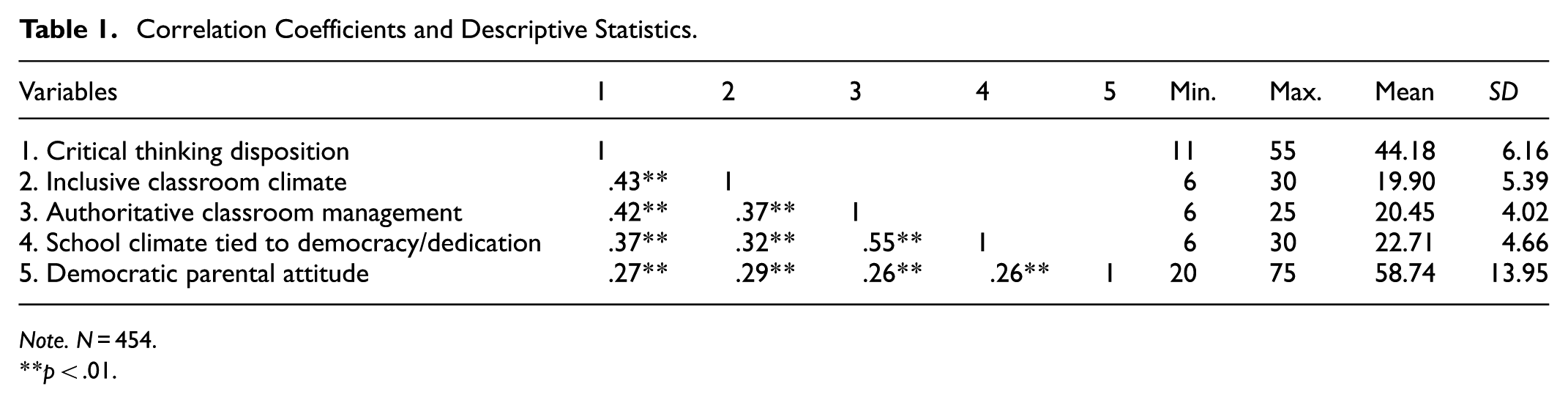
Table 1 presents the correlation coefficients and descriptive statistics for the study variables, including critical thinking disposition, inclusive classroom climate, authoritative classroom management, school climate tied to democracy/dedication, and democratic parental attitude.
Correlation Coefficients and Descriptive Statistics.
Note. N = 454.
p < .01.
A significant positive correlation was observed between critical thinking disposition and inclusive classroom climate (r = .43, p < .01), indicating that students who perceive their classrooms as inclusive tend to exhibit higher levels of critical thinking. Similarly, critical thinking disposition was significantly correlated with authoritative classroom management (r = .42, p < .01), school climate tied to democracy/dedication (r = .37, p < .01), and democratic parental attitude (r = .27, p < .01).
The highest correlation was observed between school climate tied to democracy/dedication and authoritative classroom management (r = .55, p < .01), suggesting that democratic school practices are strongly associated with an authoritative management style. Moderate correlations were also found between other variables, such as inclusive classroom climate and authoritative classroom management (r = .37, p < .01), and between inclusive classroom climate and school climate tied to democracy/dedication (r = .32, p < .01).
Measurement Model
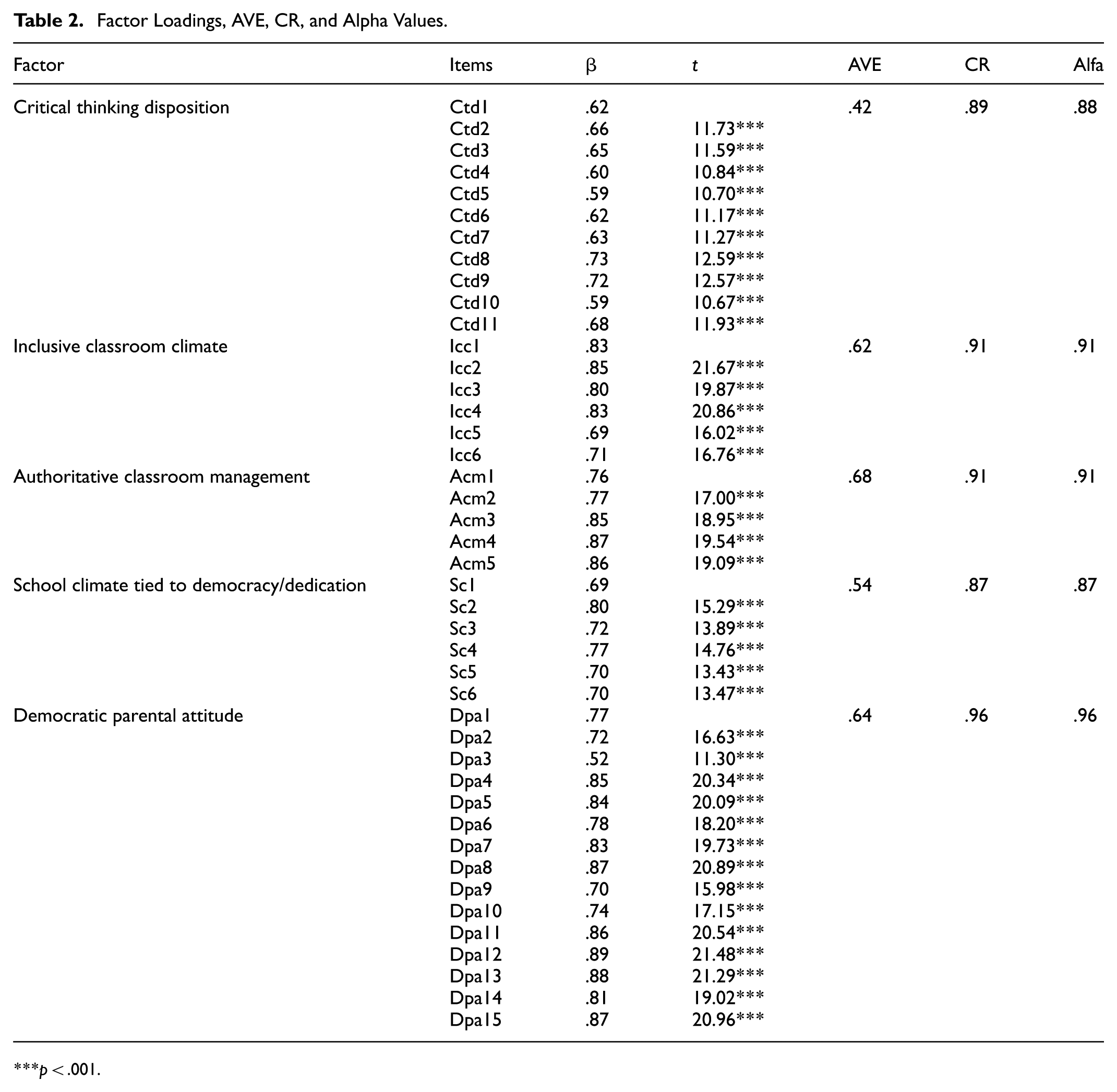
Confirmatory Factor Analysis (CFA) was employed to validate the five-factor measurement model, with results demonstrating an acceptable fit to the data (χ2/df = 1.98, TLI = .93, CFI = .94, RMSEA = .05, SRMR = .04). These indices met established thresholds, such as χ2/df < 3, TLI and CFI ≥ .90, RMSEA ≤ .08, and SRMR ≤ .08, confirming that the hypothesized model provided an adequate representation of the data (Hu & Bentler, 1999). This analysis supported the construct validity of the measurement model.
Average Variance Extracted (AVE) values were calculated to evaluate convergent validity (Table 2). Although most constructs exceeded the recommended threshold of .50 (Fornell & Larcker, 1981), the AVE value for Critical Thinking Disposition was 0.42, falling below this benchmark. Despite this, the construct’s Composite Reliability (CR) value was .89, well above the threshold of .70, indicating strong internal consistency. Malhotra and Dash (2011) argue that AVE can sometimes be overly strict and suggest that reliability may still be established if CR is robust. Factor loadings for this construct ranged between 0.59 and 0.73, with all t-values statistically significant (p < .001), further supporting convergent validity despite the low AVE.
Factor Loadings, AVE, CR, and Alpha Values.
p < .001.
Discriminant validity was assessed using the Heterotrait-Monotrait (HTMT) ratio. The HTMT values ranged from 0.272 to 0.610, well within the established thresholds of 0.85 for strict and 0.90 for liberal discriminant validity (Henseler et al., 2015). These results indicated that each construct was sufficiently distinct from the others. Additionally, the HTMT analysis revealed no warnings, confirming that discriminant validity was upheld across all constructs.
Structural Model
The structural model was established to test the study’s hypotheses and analyze the relationships between the variables. Structural Equation Modeling (SEM) evaluated the direct and indirect effects among the constructs, as illustrated in Figure 2. This approach enabled a comprehensive examination of how democratic parental attitudes, authoritative classroom management, and school climate influence critical thinking disposition through the mediating role of inclusive classroom climate. The fit indices for the tested structural model indicated a good fit with the data (χ2/df = 2.27, TLI = .91, CFI = .92, RMSEA = .05, SRMR = .06). These values satisfy commonly accepted thresholds (χ2/df < 3; TLI and CFI ≥ .90; RMSEA ≤ .08; SRMR ≤ .08), demonstrating that the structural model adequately represents the relationships among the constructs (Hu & Bentler, 1999).
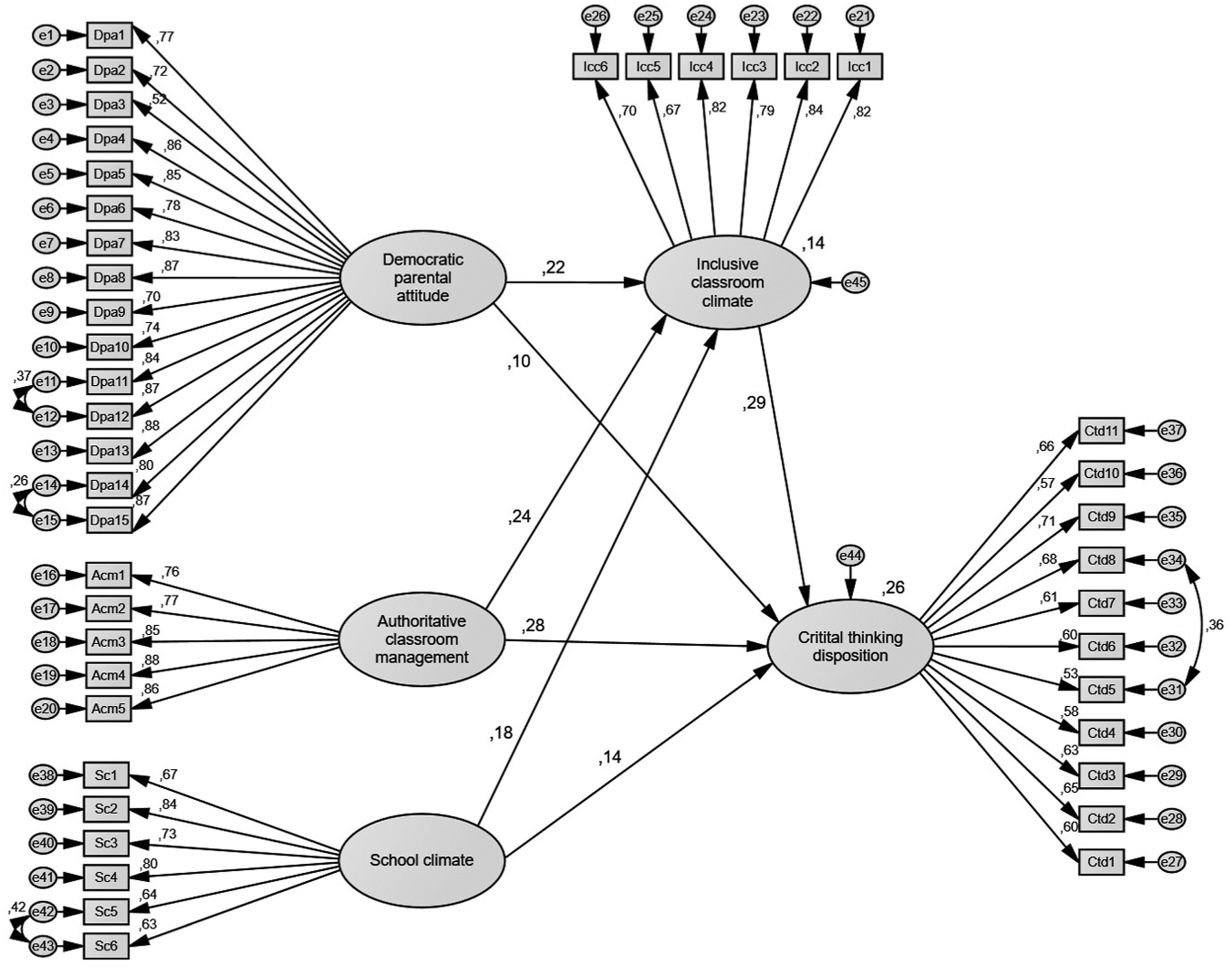
The mediating roles of an inclusive classroom in the effect of democratic parental attitude, authoritative classroom management, and school climate on critical thinking disposition.
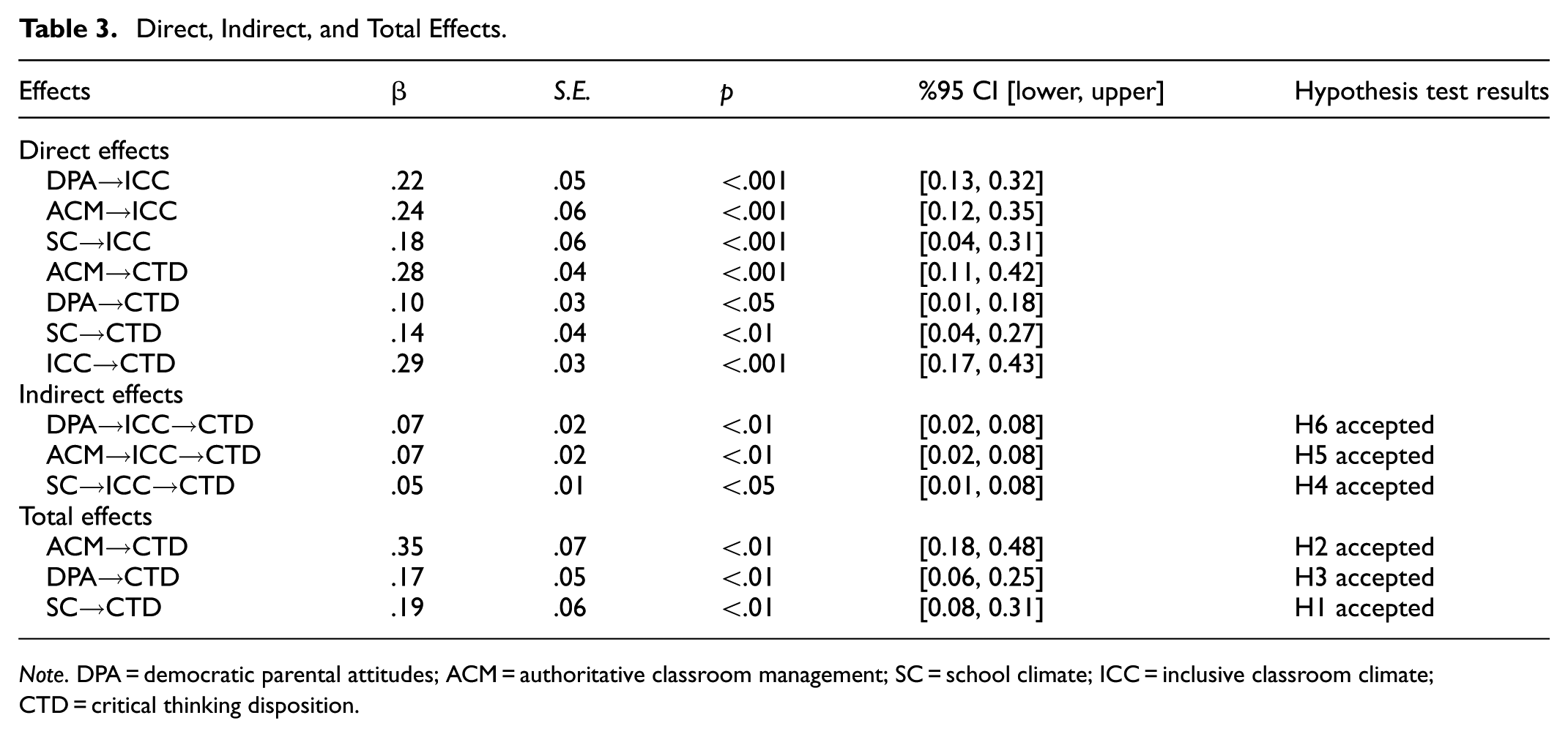
Table 3 reports the model’s direct, indirect, and total effects, providing statistical evidence for the hypothesized relationships. The direct effects analysis indicates that democratic parental attitudes (β = .22, SE = .05, p < .001, 95% CI [.13, .32]), authoritative classroom management (β = .24, SE = .06, p < .001, 95% CI [.12, .35]), and school climate (β = .18, SE = .06, p < .001, 95% CI [.04, .31]) significantly predict inclusive classroom climate. Furthermore, both ACM (β = .28, SE = .04, p < .001, 95% CI [.11, .42]) and SC (β = .14, SE = .04, p < .01, 95% CI [.04, .27]) directly predict CTD, while DPA (β = .10, SE = .03, p < .05, 95% CI [.01, .18]) also has a smaller but significant effect on CTD. The direct path from ICC to CTD is notably strong (β = .29, SE = .03, p < .001, 95% CI [.17, .43]).
Direct, Indirect, and Total Effects.
Note. DPA = democratic parental attitudes; ACM = authoritative classroom management; SC = school climate; ICC = inclusive classroom climate; CTD = critical thinking disposition.
The indirect effects demonstrate that ICC mediates the relationship between DPA and CTD (β = .07, SE = .02, p < .01, 95% CI [.02, .08]), ACM and CTD (β = .07, SE = .02, p < .01, 95% CI [.02, .08]), and SC and CTD (β = .05, SE = .01, p < .05, 95% CI [.01, .08]). These findings provide robust evidence for the mediating role of ICC, as all indirect effects are statistically significant.
The total effects combine direct and indirect pathways, confirming the overall impact of ACM (β = .35, SE = .07, p < .01, 95% CI [.18, .48]), DPA (β = .17, SE = .05, p < .01, 95% CI [.06, .25]), and SC (β = .19, SE = .06, p < .01, 95% CI [.08, .31]) on CTD. These results validate the importance of these variables in shaping critical thinking disposition through both direct and mediated pathways. DPA, ACM, SC, and ICC explained 26% of the variation in CTD.
In conclusion, the structural model analysis demonstrates that an inclusive classroom climate plays a critical mediating role in the relationships between democratic parental attitudes, authoritative classroom management, and school climate with critical thinking disposition. The hypotheses were supported by significant paths, as evidenced by the statistical results. These findings underscore the importance of fostering an inclusive classroom climate to enhance students’ critical thinking dispositions.
Discussion
This study investigated the factors associated with university students’ critical thinking dispositions, specifically examining the roles of school climate, classroom management, and parental attitudes mediated by inclusive classroom climate. Data were collected from 454 education faculty students, and analyses were conducted using structural equation modeling (SEM). The findings highlight the significant environmental factors related to critical thinking dispositions and establish an inclusive classroom climate as a crucial mediating variable. The discussion is structured according to the six tested hypotheses, and it integrates relevant theories, compares the findings with prior literature, and elaborates on practical and theoretical implications.
Discussion of Hypothesis 1: The Effect of School Climate on Critical Thinking Dispositions
The findings demonstrate that the democracy and school commitment components of school climate are positively associated with critical thinking dispositions. These results can be theoretically explained through Bronfenbrenner’s (1979) ecological systems theory, which emphasizes how environmental systems connect with cascading effects on individual development. At the microsystem level, democratic school climates function as cognitive incubators by providing psychological safety, intellectual freedom, and collaborative learning opportunities linked to higher-order thinking development (Thapa et al., 2013). The mechanism underlying this relationship operates through what Cohen et al. (2009) describe as the “quality and character of school life,” where values of openness, mutual respect, and intellectual engagement create optimal conditions for critical thinking cultivation.
These results align with recent empirical evidence from Kartal et al. (2024), demonstrating that positive teacher relations significantly predicted middle school students’ critical thinking dispositions. Similarly, Görür and Aybek (2024) found a significant positive correlation between high school students’ perception of school climate and their critical thinking tendencies, supporting the notion that participatory environments foster critical reflection. The theoretical foundation for these findings lies in King and Kitchener’s (1994) reflective judgment model, which posits that environments promoting epistemic cognition are associated with developing critical thinking skills. Furthermore, international evidence from Gómez and Suárez (2020), drawing on Colombian students in PISA 2015 data, reveals that school climate acts as a contextual amplifier, correlating with the effectiveness of instructional strategies promoting higher-order thinking.
However, the complexity of this relationship requires acknowledgment of potential threshold effects and contextual variations. Aston (2024) identified various factors that impede critical thinking development, demonstrating that excessive or overly restrictive school environments show connections with hindered development of critical thinking skills. This suggests that rigid educational structures may hinder cognitive growth rather than facilitate it.
In conclusion, these findings are grounded in Bronfenbrenner’s (1979) ecological systems theory, which posits that supportive and democratic microsystem-level environments are linked to students’ psychological safety, encouraging active learning and inquiry. These results underline the importance of promoting democratic values and commitment within school environments to relate to critical thinking dispositions effectively.
Discussion of Hypothesis 2: The Role of Authoritative Classroom Management in Supporting Critical Thinking
The analysis revealed a positive relationship between authoritative classroom management and critical thinking dispositions. Given the correlational nature of this cross-sectional study, these findings represent associational rather than causal relationships. Through social cognitive theory (Bandura, 1986), authoritative management creates optimal conditions for cognitive modeling, scaffolded learning, and self-efficacy development, providing the necessary balance between structure and autonomy that supports complex cognitive processes.
This supportive and participatory approach correlates with students’ confidence and engagement in higher-order thinking. Recent meta-analytic evidence from Putra and Yanto (2025), examining 14 studies, demonstrates significant connections between effective classroom management and student achievement, where effectiveness is defined by student support and engagement rather than mere order and discipline.
Consistent with these findings, the literature establishes strong links between effective classroom management and critical thinking (Cristo, 2023; Fitriyani, 2023; İhtiyaroğlu, 2019). Cristo (2023) emphasizes that authoritative approaches cultivate supportive environments correlating with students’ active participation and learning investment. İhtiyaroğlu (2019) highlighted that authoritative management creates atmospheres where students feel free to express ideas, while Alamban (2023) demonstrated that engaging management strategies show positive connections with student participation across demographic differences.
Building on this foundation, Fitriyani (2023) noted that secure classroom environments are linked to active critical thinking and discussion participation. The underlying mechanism operates through effective communication and intrinsic motivation (İhtiyaroğlu, 2019)—factors associated with developing “cognitive courage,” enabling students to engage in intellectual risk-taking and explore alternative perspectives. Ultimately, these findings suggest that constructive teacher-student relationships support cognitive development, as Marzano and Marzano (2003) highlighted regarding fair classroom practices fostering collaboration and critical thinking skill development.
Discussion of Hypothesis 3: Influence of Democratic Parental Attitudes on Critical Thinking Dispositions
The third significant finding is the positive relationship between democratic parental attitudes and critical thinking dispositions. The theoretical foundation for this relationship rests on attachment theory and cognitive developmental psychology, where secure, responsive relationships are linked to the emotional foundation necessary for intellectual exploration and independent thinking (Baumrind, 1991). Democratic parenting is associated with what can be conceptualized as “cognitive scaffolding at home,” where children learn to question, analyze, and evaluate information within a supportive framework. Democratic parents correlate with an environment where children can express their ideas, question different perspectives, and develop analytical skills (Kuzgun & Eldeleklioğlu, 2005). Recent empirical support comes from Deng et al. (2023), who demonstrate that democratic parenting positively connects children’s ability to question assumptions and reason through ambiguity—key dimensions of critical thinking. This effect operates through enhanced self-esteem and confidence, as Wang et al. (2020) demonstrated that democratic attitudes are related to students’ self-esteem, thereby fostering critical thinking dispositions.
This finding is consistent with the work of Deng et al. (2023), who emphasized the role of democratic parenting in being associated with critical thinking skills. Furthermore, Fadhil et al. (2024) found that democratic attitudes correlate with children’s analytical thinking and problem-solving abilities, while Althobaiti and Alzahrani (2024) report that parenting styles characterized by warmth and autonomy support are significant predictors of adolescents’ critical reflection skills. These findings are further substantiated by Opiyo et al. (2024), who found that authoritative parenting demonstrated a statistically significant positive influence on developing critical thinking skills in grade six learners, with class teachers supporting authoritative parenting approaches. Democratic parents provide opportunities for children to express their thoughts, participate in decision-making processes, and engage in discussions in a secure environment, thus showing connections with critical thinking dispositions.
However, the relationship is more nuanced than initially apparent. Contrasting evidence shows that authoritarian parenting—marked by low warmth and high control—has been associated with diminished critical reasoning and lower levels of independent thought (Sadeghi et al., 2022). Similarly, Yasira and Maksum (2023) reported that students with permissive parents exhibited the lowest critical thinking abilities, attributed to insufficient limits and lack of challenge, while Fadlillah and Fauziah (2022) found neglectful parenting to be most negatively related to analytical skill development. Notably, Opiyo et al. (2024) revealed that only slightly above 50% of learners received appropriate parenting attention, and many parents were uncertain about suitable parenting styles for critical thinking development, highlighting the need for parental education programs. The basis of this relationship lies in the open communication and supportive relationships offered by democratic parents. Baumrind (1991) noted that democratic parenting, acknowledging individual differences, is linked to children’s cognitive and emotional development. In the educational context, such supportive parenting correlates with students’ ability to express themselves comfortably in the classroom, relating to their critical thinking dispositions. These findings highlight how a supportive family structure may be connected to individual success in academic and social contexts.
Discussion of Hypotheses 4–6: The Mediating Role of Inclusive Classroom Climate
The final key finding of this study is that an inclusive classroom climate mediates the relationships between school climate, authoritative classroom management, and democratic parental attitudes with critical thinking dispositions. It is important to note that due to the cross-sectional design of this study, we cannot establish causal mediation but observe statistical associations that suggest potential mediating relationships. The theoretical mechanism underlying this mediation can be understood through Tinto’s (1997) integration theory and social identity theory, where inclusive environments are associated with reduced cognitive load associated with identity threat and stereotype anxiety, correlating with cognitive resources for higher-order thinking processes. This result underscores the role of inclusive classroom environments as a platform where students can freely express themselves and discuss diverse ideas.
Recent empirical evidence supports this mediating role. Alhassan et al. (2025) highlighted that perceived emotional and instructional support significantly correlates with students’ engagement levels, particularly among minority groups, emphasizing that inclusion is most effectively realized when students feel emotionally supported and intellectually challenged. The literature has consistently emphasized the positive connections between inclusive classroom climates and critical thinking (McAvoy et al., 2021; Mehta & Al Mahrooqi, 2024; Tinto, 1997). For example, McAvoy et al. (2021) reported that inclusive classroom climates are associated with student trust and correlate with higher-order cognitive processes. The four key components identified by McAvoy et al. (2021)—skills, confidence, openness, and inclusive climate—work synergistically to relate to what can be termed “cognitive inclusivity,” where diverse perspectives are not only tolerated but actively sought and valued as essential for comprehensive critical analysis. Similarly, Mehta and Al Mahrooqi (2024) found a robust relationship between inclusive classroom climates and critical thinking skills.
However, it is important to acknowledge the implementation challenges. Despite international mandates promoting inclusive education—such as UNESCO’s Salamanca Statement and the “Education for All” initiative—actual implementation remains inconsistent across countries and institutions. Deroncele-Acosta and Ellis (2024) argue that inclusive rhetoric often lacks concrete strategies, particularly in under-resourced contexts, highlighting the need for context-sensitive and operationalized approaches to measuring and correlating with school climates. The findings align with Bronfenbrenner’s (1979) ecological systems theory, highlighting the reciprocal interactions of environmental factors. Inclusive classroom climates are connected to the effects of democratic school climates and effective classroom management, relating to students’ individual and social critical thinking dispositions.
The current study’s focus on Turkish higher education students necessitates careful consideration of cultural and contextual factors that may be associated with the generalizability of findings. Turkey’s educational system, characterized by a blend of traditional hierarchical structures and contemporary democratic reforms, may correlate with unique dynamics in how students respond to democratic school climates and inclusive environments. The collectivist nature of Turkish society, where family connections remain strong well into adulthood, may be related to the observed effects of parental attitudes on university students’ cognitive dispositions compared to more individualistic cultures.
Furthermore, the Turkish higher education system’s recent emphasis on internationalization and critical pedagogy may be associated with particularly receptive conditions for inclusive classroom climates. However, institutional variations between universities, regional differences in educational resources, and socioeconomic disparities may moderate these relationships in ways that limit the direct applicability of findings to other national contexts.
Practical Implications
This study provides practical insights for educators, administrators, and policymakers supporting critical thinking dispositions. Following the confirmed school climate-critical thinking relationship (H1), institutions should implement democratic participation measures: regular student feedback mechanisms, cross-departmental committees with student representation, and transparent communication channels enabling student contribution to decision-making processes.
Targeted professional development is essential to build upon H2’s validation regarding authoritative classroom management. Teachers require training in balanced approaches combining clear expectations with supportive autonomy through collaborative rule-setting, structured peer feedback, and flexible assessment methods. In this context, implementing Values and Knowledge Education (VaKE) has been suggested as a practical approach correlating with critical thinking skills in higher education (Pnevmatikos et al., 2019).
Addressing the democratic parental attitudes-critical thinking association (H3), systematic parent education programs are necessary. Universities should collaborate with community centers offering workshops on democratic parenting: active listening, collaborative problem-solving, and methods fostering intellectual curiosity, which help children develop independent thinking and problem-solving effectiveness.
Given the mediating role of inclusive classroom climate (H4, H5, and H6), educators must prioritize environments where students feel valued. This requires structured discussion protocols ensuring equal participation, clear anti-discrimination policies, and culturally responsive teaching training. Specifically, teachers should create inclusive atmospheres through dialogue-based discussions, methods such as “fishbone diagrams” or “six thinking hats,” and problem-based learning activities. Consequently, policymakers should mandate inclusive education training and establish assessment tools to evaluate classroom climate effectiveness in critical thinking development.
Theoretical Contribution and Future Research Directions
This study contributes to the theoretical understanding of critical thinking by integrating multiple ecological and interpersonal factors into a unified framework. By adopting Bronfenbrenner’s (1979) ecological systems theory, the research highlights how environmental layers interact to be related to critical thinking dispositions. Moreover, identifying inclusive classroom climate as a mediator bridges existing research gaps, proving that environmental factors like school climate, classroom management, and parenting styles do not work in isolation but are associated with dynamic interactions. The complexity of correlating with critical thinking dispositions emphasizes the need for holistic educational models that address multiple connections simultaneously.
Future research should prioritize longitudinal designs to establish causal relationships and examine how these associations evolve. Cross-cultural comparative studies are particularly needed to understand how educational and cultural contexts moderate the observed relationships. Additionally, research should expand beyond education students to include diverse academic disciplines, as the cognitive demands and learning environments may vary significantly across fields such as engineering, medicine, humanities, and social sciences.
Incorporating objective measures of critical thinking, such as performance-based assessments, thinking-aloud protocols, or behavioral observations, would complement self-report measures and provide more robust evidence of the relationships identified in this study. Furthermore, future studies should examine additional ecological factors, including peer networks, social media connections, and broader sociocultural frameworks that may be significantly associated with critical thinking development in the digital age.
Additionally, the study enriches the field by focusing on the higher education context, which has been relatively underexplored in previous ecological critical thinking studies. It provides a nuanced understanding of how proximal environmental factors within university settings relate to advanced cognitive skills, offering a pathway for future research.
Limitations
While this study provides valuable insights, several limitations must be acknowledged. First, the cross-sectional design limits the ability to establish causal relationships among the studied variables. The correlational nature of findings means that while associations can be identified, definitive causal conclusions cannot be drawn. Alternative explanations, such as self-selection effects or unmeasured third variables, cannot be ruled out. Future longitudinal research designs are essential to investigate directionality and potential causal relationships, particularly to track changes in critical thinking dispositions and identify critical periods when environmental interventions might be most effective.
Second, the sample’s limited scope to education students from two Turkish universities raises significant generalizability concerns. Education students may be particularly predisposed to value democratic and inclusive environments due to their professional preparation, potentially inflating observed relationships. The findings may not generalize to students in other academic disciplines where different cognitive demands and learning cultures may moderate these relationships differently.
Third, the reliance on self-reported data introduces potential bias. Social desirability bias may lead participants to overreport positive attitudes toward democratic practices, while retrospective reports about parental attitudes may be susceptible to memory bias and current mood effects. Fourth, while the current model incorporates important environmental connections, it does not account for other potentially significant factors such as peer relationships, social networks, digital media associations, or broader sociocultural contexts that may substantially relate to critical thinking development. The explained variance suggests that unmeasured factors continue to play important roles.
Additionally, although convergent validity was supported by significant factor loadings and high composite reliability, the AVE value (.42) fell slightly below the recommended threshold of .50. While the construct demonstrated strong internal consistency (CR = .89), the lower AVE suggests that the construct explains less than half of the variance in its indicators, potentially limiting precision in interpreting critical thinking disposition.
Finally, the study does not adequately address how specific contextual, cultural, or institutional aspects of the Turkish higher education system may be associated with the observed relationships. Turkey’s unique position between European and Asian educational traditions, recent educational reforms, and specific institutional cultures may correlate with conditions that do not readily translate to other national or cultural contexts.
Conclusion
This study examined the interplay between school climate, classroom management, and parenting styles associated with critical thinking dispositions among university students. It identified significant positive relationships between these factors and critical thinking dispositions, with inclusive classroom climate as a mediating variable. The correlational findings demonstrate that supporting critical thinking requires a comprehensive ecological approach that simultaneously addresses institutional climate, pedagogical practices, and family influences, all mediated through creating inclusive learning environments.
The theoretical integration reveals complex mechanisms underlying critical thinking development, where democratic school climates provide cognitive incubators, authoritative classroom management is associated with optimal scaffolding for intellectual risk-taking, and democratic parenting correlates with foundational cognitive courage that enables students to engage in higher-order thinking processes. These findings emphasize the importance of creating democratic and supportive educational environments related to intellectual engagement and inquiry.
However, the study also highlights important limitations regarding generalizability, methodological constraints, and the need for a more nuanced understanding of cultural and contextual factors. While providing valuable insights, the Turkish higher education context may not directly translate to other educational systems or cultural settings. The study’s correlational results provide theoretical and practical insights into how educational institutions and families can collaborate to be associated with critical thinking skills. By addressing the complex interplay of environmental factors, this research offers a comprehensive approach to understanding and improving the connections with critical thinking dispositions in higher education.
Footnotes
Appendix
Instruments.

|
|
|
| Reflecting on this class’s discussions over the past month, which category best describes how often you experienced the following? (Never, Rarely, Sometimes, Most of the time, Almost Always) | |
| 1. | I hesitate to speak because I worry my peers would judge me. (Reverse). |
| 2. | I worry that my classmates will get angry if I share my true opinions. (Reverse). |
| 3. | I do not say what I am really thinking to avoid having people disagree with me. (Reverse). |
| 4. | I feel that people in class are not interested in what I have to say. (Reverse). |
| 5. | I do not participate because I worry that I will be misunderstood by classmates. (Reverse). |
| 6. | I do not participate because I worry that I will be misunderstood by the instructor. (Reverse). |
|
|
|
| Considering the Critical and Analytical Thinking course, evaluate the following propositions (Never, Rarely, Sometimes, Often, Always) | |
| 1. | Our instructor tries to understand how we learn as well as what we learn. |
| 2. | Our instructor explains the reasons for the decisions he makes and the rules he sets. |
| 3. | During the lesson, we can easily ask our questions by taking a break from what our teacher is explaining. |
| 4. | Our instructor encourages us to share our differing viewpoints during class. |
| 5. | Our instructor creates opportunities for every student in the class to contribute to the lesson. |
|
|
|
| Below are statements related to your faculty’s climate. Please read each statement carefully and select the option that best reflects how accurately it represents the general situation in your faculty (Never, Rarely, Sometimes, Often, Always). | |
| 1. | In our faculty, teacher-student relations are democratic. |
| 2. | In our faculty, the individual differences of the teachers are respected. |
| 3. | The employees in our faculty are understanding towards each other. |
| 4. | In our faculty, the individual differences of the students are respected. |
| 5. | The teachers in our faculty take ownership of the school. |
| 6. | The teachers in our department want to take responsibility in matters related to the school. |
|
|
|
| Below are statements about your critical thinking habits. Please read each statement carefully and select the option that best reflects how much it applies to you (Strongly disagree, Disagree, Neutral, Agree, Strongly agree) | |
| 1. | I usually try to think about the bigger picture during a discussion |
| 2. | I often use new ideas to shape (modify) the way I do things |
| 3. | I use more than one source to find out information for myself |
| 4. | I am often on the lookout for new ideas |
| 5. | I sometimes find a good argument that challenges some of my firmly held beliefs |
| 6. | It is important to understand other people’s viewpoint on an issue |
| 7. | It is important to justify the choices I make |
| 8. | I often re-evaluate my experiences so that I can learn from them |
| 9. | I usually check the credibility of the source of information before making judgments |
| 10. | I usually think about the wider implications of a decision before taking action |
| 11. | I often think about my actions to see whether I could improve them |
|
|
|
| Below are statements about your relationship with your parents. Please read each statement carefully and select the option that best reflects the attitudes and behaviors of your parents (Not at all appropriate, Slightly appropriate, Partially appropriate, Very appropriate, Completely appropriate) | |
| 1. | They have always given me a sense of trust and made me feel loved. |
| 2. | They have supported me to the extent of their possibilities for my multifaceted development. |
| 3. | They allow me to invite my friends home and treat them well when they come. |
| 4. | They take care to get my opinion on everything as much as possible. |
| 5. | I can easily talk to them about my problems. |
| 6. | They explain to me why I should or should not do certain things. |
| 7. | Our relationship is very friendly when we are together. |
| 8. | They encourage me to express my opinions when a topic is discussed at home. |
| 9. | They have helped me gain the habit of studying and reading since I was little. |
| 10. | They spent enough time with me when I was young; they never neglected to take me to the park or the cinema. |
| 11. | When I want to approach them, they always respond to me warmly. |
| 12. | They have instilled in me the belief that I am an important and valuable person. |
| 13. | They want to know my opinion when making decisions about the family. |
| 14. | They have accepted me as I am. |
| 15. | They listen to what I tell them about daily events with interest and give me explanatory answers. |

Funding
The authors received no financial support for the research, authorship, and/or publication of this article.
Declaration of Conflicting Interests
The authors declared no potential conflicts of interest with respect to the research, authorship, and/or publication of this article.
Data Availability Statement
The data that support the findings of this study are available from the authors upon reasonable request.