




Abstract
In Texas, there are different ways teachers can attain certification. Thus, teachers are entering the classroom through various certification routes with varying levels of training as the traditional and alternative programs differ in their requirements. Classroom management can determine the success or failure of teachers and students. The research involved in this study attempted to determine whether university-certified teachers differ from alternatively certified teachers in the area of classroom management as determined by referrals, while controlling for level of education, years of teaching experience, age, race, and gender at both middle and high school levels. The population for this study was the middle and high school teachers in one rural south central Texas school district. Data were collected from the school district’s personnel database as well as from the campus-level administrators. Hierarchical regressions were used to test null hypotheses and recommendations were suggested.
Introduction
The Texas Education Agency (TEA) reported that in 2010 there were 338,191 classroom teachers in Texas. The one common characteristic shared by all teachers is a teaching certificate. However, there are differences in certification type, which arise from the chosen type of state-approved route to certification that each teacher takes.
In Texas, traditional routes to certification consist of university-based non-education programs, university post-baccalaureate programs, and out-of-state certification (State Board of Educator Certification [SBEC]). Traditional routes to certification involve completing some form or combination of coursework, field-based experience, and the state-approved content area exams. For teachers receiving initial certification in 2010, 54% (15,471) were certified through traditional certification programs.
Prospective teachers can also choose non-traditional or alternative certification routes to achieve teaching certification. Alternative certification programs were designed to mitigate teacher shortages as well as fast track interested individuals into education (Heinen & Scribner, 2009). Alternative certification programs are expedited programs that place prospective teachers into the classroom after a brief introductory training and student support period (Jacobs & Walsh, 2007). Proponents of alternative certification programs argue that the benefit of alternative certification programs is the continuing professional development and support of beginning teachers, which has been identified as a key factor in teacher success (National Center for Education Information [NCEI], 2005).
Once in the classroom, teachers are responsible for the education of their students and must find the most effective way to teach them, maintain order, and build relationships with their students through the use of effective classroom management techniques (Harrison & Killion, 2007). Classroom management refers to the design and implementation of efficient classroom routines, policies, and procedures for participation in class discussions, forming cooperative learning groups, accomplishing class work, and various other classroom activities and interactions (Sterling, 2009). Classroom management can determine the success or failure of teachers and students.
Putman (2009) identifies student discipline and classroom management as areas of anxiety and concern for pre-service teachers. Schools across the United States are experiencing all time highs in behavior problems (Abede & HaileMariam, 2007). Principals note that to limit the number of office referrals, teachers must be able to distinguish between what constitutes a discipline infraction as opposed to an issue of classroom management (Wyatt, 2010). According to Baines (2006), university-certified teachers outperform alternatively certified teachers.
The research involved in this study attempted to determine which factors affect classroom management; more specifically, whether differences exist between the classroom management abilities of traditional and alternative certification teachers as measured by discipline referrals, while controlling for level of education, years of teaching experience, age, race, and gender at both middle and high school levels. As the teaching profession continues to expand, more research is needed to analyze the effectiveness of certification programs.
Review of Literature
The Teacher Center (2004) explains that individuals seek certification to teach for many reasons, including a feeling of wanting to have a greater impact on people and the decline of the business world. For individuals seeking teaching certification, there are not only many steps in the process but also many routes for accomplishing these steps.
The Texas SBEC has established several steps a person must complete before becoming a certified teacher. First, a person must hold a bachelor’s degree from an accredited college or university within this requirement is the stipulation that all teachers must have an academic major as well as teacher training courses because Texas institutions do not offer degrees in education. Subsequently, prospective teachers must complete an approved teacher training program, which can be completed through a college or a university, school district, regional service center, community college, or other entity such as an alternative certification program. Finally, pre-service teachers must complete and pass the appropriate teacher certification test for the subject and grade level that they wish to teach (SBEC, 2011).
The TEA has established two final steps a person must complete, once all other appropriate steps for certification have been completed, to become a certified teacher in Texas. First, a person must complete and submit the appropriate application and fees which are then filed with SBEC. Second, all first-time teachers in the state of Texas must submit to fingerprinting as part of a national criminal background check (TEA, 2010).
Types of Certification
One of the most controversial topics in education today is the hiring of teachers who were alternatively certified versus teachers who were certified through a traditional program. The types of teacher certification differ in terms of the requirements necessary for certification. Taking an even closer look at alternative certification versus traditional certification, one of the biggest differences is the practicum or field-based experience factor. While the field experience may not be extensive, teacher preparation programs may utilize intensive field experiences involving reflection and inquiry that link theories with personal learning experiences (Capraro, Capraro, & Helfeldt, 2010). For students to benefit from teachers, certification programs (alternative or traditional) must ensure that candidates are trained and practice under quality veterans from the very first day the candidate sets foot in a classroom (Darling-Hammond, Holtzman, Gatlin, & Vasquez Heilig, 2005).
Traditional
Traditional teaching certification encompasses a variety of different methods of obtaining a teaching certificate through a university. Traditional teaching certification can be obtained through a university undergraduate program, a university post-baccalaureate program, or through certification earned in another state. According to TEA (2010), universities offer certification to persons who either have graduated high school and are entering college seeking a teaching degree, or who have earned a degree and wish to become a certified teacher.
Proponents of traditional teacher certification programs argue that field-based aspects of these programs allow for teachers to experience more challenges before entering the teaching world, thereby allowing these teachers to prepare for the “real world.” It has been suggested that the current university-based system has been best suited to prepare teachers for the classroom (Lit, Nager, & Snyder, 2010). The idea that student achievement increases with the level of classroom experience a teacher has is supported by Buck and O’Brien’s (2005) research findings showing a positive relationship between teaching experience and teacher effectiveness (Marszalek & Odom, 2010). In some instances, traditionally certified teachers and alternatively certified teachers both performed adequately as a mixed group, but traditionally trained teachers performed significantly better in the area of quality student management practices (Brindley & Parker, 2010).
Alternative certification
Alternative certification has been a term used for a variety of programs that train and credential teachers in an expedited manner often by eliminating steps such as student teaching.
In Texas, specifically, alternative certification programs can come from universities, region service centers, and private organizations. While there are many alternative certification programs to choose from in Texas, TEA (2010) provides a set of guidelines and procedures for teachers who choose to seek certification through an alternative certification program. Prospective teachers must determine a grade level and subject area to teach and choose an approved alternative certification program. Once the alternative certification program is chosen, the prospective teacher must meet the required screening criteria of that program, which may include college grade point average, basic skills, and content knowledge. The next step in the process is to set a certification plan within the respective program.
Some alternative certification programs are self-taught and simply consist of online modules that must be completed within a specific time frame during the intern year. Other alternative certification programs require actual classroom time with an instructor, while still other alternative certification programs consist of a mixture of the two methods.
Another difference that exists between various alternative certification programs is requirement for internship training. Some alternative certification programs, usually university or service center based, allow students to obtain a paid internship or probationary teaching position based on coursework progress and the completion of appropriate certification tests. A student must obtain an eligibility statement from the program to be employed (TEA, 2010). There are also alternative certification programs, such as Texas Teachers, that will allow a student to accept a paid teaching position almost immediately after acceptance into the teacher training program (TEA, 2010). A candidate will need to secure a teaching assignment at the grade level and in the subject area of one’s target certificate. Once the prospective teacher secures a teaching position, the prospective teacher will follow the same process as prospective teachers acquiring certification through a post-baccalaureate certification program. Upon completion of the process, the candidate will be a certified teacher (TEA, 2010).
Some alternative programs are basically traditional programs under a different name, whereas other programs have very few admission standards or program requirements (Baines, 2010). Baines (2010) continues by saying that non-university-based alternative programs exist in two forms: the “learn while you earn program,” which has an expedited summer course preceding a full-time teaching position as an internship year, or the Internet-based programs, which have no field experience requirement.
There have been benefits from alternative certification programs, which include work experienced teachers entering the profession and addressing teaching fields that were considered critical needs areas (Mikulecky, Shkodriani, & Wilner, 2004). One of the central beliefs of the alternative certification programs is that continuous professional development and support offered to first-year teachers through these programs is more beneficial than a semester of classroom experience with no follow-up support or extension (NCEI, 2005).
Classroom management has been one of the areas where alternatively certified teachers have struggled. The biggest issues first-year alternatively certified teachers deal with are time and the managing of students (Samaras & Wilcox, 2009). In addition, alternatively certified teachers struggle with student achievement as students who had university-certified teachers outperformed students from alternatively certified teachers (Baines, 2006).
Method
Teacher demographic data were collected through the studied rural south central Texas school district’s Human Resource department. A spreadsheet containing teachers’ level of education and years of teaching experience, age, race, and gender on the district’s five middle school and three high school campuses was provided. All identifiable information was removed for confidentiality purposes. A printout of all discipline data in the Internet-based Texas Computer Cooperative System (iTCCS) were obtained from each campus administrator or Public Education Information Management System (PEIMS) clerk. Teacher demographic data, including age, gender, ethnicity, years of experience, and degree earned, and the number of discipline referrals written by each teacher were captured into a Statistical Package for the Social Sciences (SPSS) file.
The researchers input the dependent variable, classroom management as measured by discipline referrals. This was chosen as the sole dependent variable because of the lack of information pertaining to discipline referrals in the literature. The use of only discipline referrals as the dependent variable is a limitation of the study. The researchers do acknowledge that discipline referrals are only one aspect of classroom management that may affect instruction.
Once this variable was input, the researchers created the block of covariates: level of education, years of teaching experience, age, race, and gender for teachers at the middle school level and high school levels, individually. The researchers then added the remaining variable: route to teacher certification. The purpose of this was to discover how much variance this variable accounted for.
Results
For this study, 232 middle school teachers were examined; demographic data for these teachers can be found in Table 1. Also analyzed was the mean number of discipline referrals written by the combined (M = 5.54) and by each of the traditional (M = 5.62) and alternative (M = 5.27) routes (Table 2).
Frequency Statistics for All Middle School Teachers.

Descriptive Statistics for All Middle School Teachers.

Entry of the demographic variables of degree, age, gender, ethnicity, and years of experience accounted for 3.3% of the variance (R2) in the subjects’ discipline referrals. Entry of the certification variable resulted in an R2 change of .001, thus entry of the certification variable increased the explained variance in the subjects discipline referrals by 0.1% to a total of 3.4%. This increase was not significant as evidenced by the F change test, F(1, 225) = 0.30, p = .59 (Table 3). The results suggest that when adding the variable of certification to the demographic variables, there was no significant effect on the number of discipline referrals that were written.
Model Summary for Discipline Referrals by Certification Type for Middle School Teachers.

The ANOVA represented in Table 4 shows that entry of the set of demographic variables alone yielded an insignificant prediction equation, F(5, 226) = 1.56, p = .172. Addition of the certification variable resulted in an overall insignificant equation, F(6, 225) = 1.35, p = .28. There were no significant differences between the number of discipline referrals that were written for the traditional route (M = 5.62, SD = 6.90) and the alternative route (M = 5.27, SD = 6.05).
Analysis of Variance Summary of Discipline Referrals by Certification Type for Middle School Teachers.
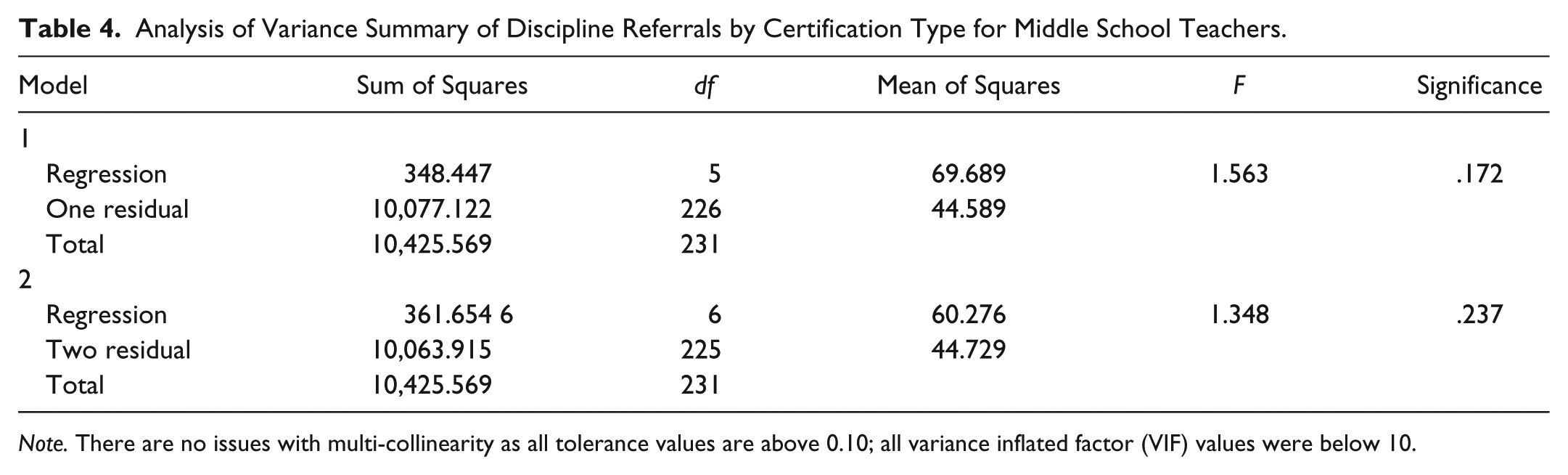
Note. There are no issues with multi-collinearity as all tolerance values are above 0.10; all variance inflated factor (VIF) values were below 10.
Similarly, 281 high school teachers were examined; demographic data can be found in Table 5. Also analyzed were the mean number of discipline referrals written by the combined (M = 5.86) and by each of the traditional (M = 6.01) and alternative (M = 4.92) routes (Table 6).
Frequency Statistics for All High School Teachers.

Descriptive Statistics for All High School Teachers.

Entry of the demographic variables of degree, age, gender, ethnicity, and years of experience accounted for 1.7% of the variance (R2) in the subjects’ discipline referrals. Entry of the certification variable resulted in an R2 change of .003, thus entry of the certification variable increased the explained variance in the subjects discipline referrals by 0.3% to a total of 2.0%. This increase was not significant as evidenced by the F change test, F(1, 267) = 0.78, p = .38 (Table 7). The results suggest that when adding the variable of certification to the demographic variables, there was no significant effect on the number of discipline referrals that were written.
Model Summary for Discipline Referrals by Certification Type for High School Teachers.

The ANOVA represented by Table 8 shows that entry of the set of demographic variables alone yielded an insignificant prediction equation, F(5, 268) = 0.94, p = .46. Addition of the certification variable resulted in an overall insignificant equation, F(6, 267) = 0.91, p = .49, this resulted in no significant difference between the number of discipline referrals written by the traditional route (M = 6.01, SD = 9.70) and by the alternative route (M = 4.92, SD = 7.56).
Analysis of Variance Summary of Discipline Referrals by Certification Type for High School Teachers.

Note. There are no issues with multi-collinearity as all tolerance values were above 0.10; all variance inflated factor (VIF) values were below 10.
SS=Sum of Squares; MS=Mean of Squares.
This study sought to examine the differences in the number of discipline referrals written and whether those numbers were affected by the type of teacher certification program. Secondary teachers at three high school and five middle schools in one south central Texas school district were selected as the focus of this study.
Analyzing the number of discipline referrals indicated that teachers who achieved certification through a traditional certification program did not have a significant advantage in terms of classroom management at both the middle school and high school levels while holding constant teachers’ age, gender, certification type, ethnicity, level of education, and years of experience. The result of the addition of the certification variable yielded no significant effect on the number of discipline referrals written throughout the school year as evidenced by comparing the means of discipline referrals written by traditionally certified middle school teachers (M = 5.62, SD = 6.90) with alternatively certified middle school teachers (M = 5.27, SD = 6.05), and by traditionally certified high school teachers (M = 6.01, SD = 9.70) with alternatively certified high school teachers (M = 4.92, SD = 7.56). In addition, the effect sizes yielded negligible results as evidenced by the 0.1% for middle school teachers and 0.3% for high school teachers.
The results support the notion that alternative certification programs have many benefits, which include work experienced teachers entering the profession, addressing teaching fields that were considered critical needs area, and combating the general teacher shortages around the nation (Mikulecky et al., 2004).
In summary, examining the effects of certification type on the number of discipline referrals written by secondary teachers in a rural south central Texas school district found that there were no significant differences or effects. The results of this study yielded no proof that traditional certification programs more adequately prepare future teachers in the area of classroom management as measured by discipline referrals. Teachers, regardless of their certification routes, hone their craft with age and experience. In addition, circumstances such as previous career and life experiences may be beneficial to teachers who achieved certification through alternative certification programs. For administrators and human resource personnel, the results of this study suggest that hiring practices should not attempt to avoid alternatively certified teachers as there is no significant difference in the ability to manage a classroom when comparing alternatively certified teachers with traditionally certified teachers. Additional research should be done to determine the effects of certification type on student achievement and teacher retention.
Footnotes
Declaration of Conflicting Interests
The author(s) declared no potential conflicts of interest with respect to the research, authorship, and/or publication of this article.
Funding
The author(s) received no financial support for the research and/or authorship of this article.