




Abstract
This study examined whether student gender and the type of student misbehavior affected the classroom management techniques of pre-service teachers. Participants were pre-service teachers who interacted with avatar students controlled by an actor in a mixed-reality environment. Avatar students’ behaviors were systematically coded along with their gender. Pre-service teachers’ responses were organized into four categories: coercion, retreatism, normative, and remunerative. Pre-service teachers’ use of proximity and tone of voice were also recorded. Data were analyzed using chi-square and ANOVA tests. Significant differences in pre-service teacher responses were found for type of avatar student misbehavior but not avatar student gender. Results and implications for future research are discussed.
Literature Review
Classroom Management
In order for effective instruction to take place, teachers must be able to maintain an orderly classroom environment. Teachers who prevent student misbehavior and redirect misbehavior quickly will spend less time off-task and be able to devote more time to quality instruction. Classroom management is often one of the greatest concerns for pre-service teachers before they enter the field. They often fear that they will not be able to manage student behavior and that students will not accept them as authority figures (Bromfield, 2006). This concern extends beyond pre-service teachers to practicing teachers. In fact, difficulty managing the classroom is the most common reason for a teacher-initiated transfer request and for teacher burnout (Gonzalez, Brown, & Slate, 2008; Ozdemir, 2007). Navigating a classroom full of different personalities is a skill that cannot be mastered without practice, and teachers’ self-efficacy tends to improve with years of experience. Typically, researchers have found that pre-service teachers feel less confident in their classroom management abilities than teachers who have experience in the field (Giallo & Little, 2003). However, even studies that found no difference in pre-service and in-service teachers’ confidence levels overall in classroom management reported that pre-service teachers may have naïve beliefs about specific techniques to be used (Rosas & West, 2009). Pre-service teachers often do not yet have an understanding of what techniques they can employ to redirect a student who is acting in ways that do not reflect expectation.
Classroom management represents a global approach encompassing diverse practices on the prevention-intervention spectrum. For example, Culturally Responsive Classroom Management (CRCM) is one framework for understanding classroom management that focuses on teachers identifying their own biases, understanding their students’ cultural backgrounds, being aware of broader social and political contexts (e.g., institutional discrimination), using culturally appropriate management strategies, and building caring classroom communities (Weinstein, Tomlinson-Clarke, & Curran, 2004).
Although we recommend teachers align their efforts with an overarching classroom management paradigm, such as CRCM, to guide prevention and intervention efforts and establish a positive classroom environment, even with a solid classroom management framework in place to create a culturally responsive and caring classroom context, teachers may be confronted with student behavior that is inconsistent with school expectations. At this point, specific behavioral techniques for responding to such behavior in an attempt to prevent further escalation of the situation may be employed.
Rather than broadly focusing on classroom management, this study focuses more narrowly on the use of such behavioral strategies to respond to student misbehavior when it does occur. Reupert and Woodcock (2010) looked specifically at such behavior management techniques that pre-service teachers reported they were most likely to use, were most confident in using, and found most effective. Pre-service teachers were most likely to use initial corrective strategies, such as proximity and saying the student’s name as a warning, and were least likely to use later corrective strategies, such as referring the student to another school professional. Pre-service teachers also felt more confident and found greater success using initial corrective and prevention strategies than they did using later corrective strategies or manipulating the rewards system. These findings indicate that pre-service teachers may not be well-prepared to handle situations in which students’ behaviors escalate or become violent.
Although teachers employ different behavioral strategies to influence student behaviors and ensure that their classroom environment is conducive for learning, researchers have grouped these strategies into categories (e.g., Little & Akin-Little, 2008). In this study, we chose to use the categories defined by Schlechty in 1976. Schlechty’s categories were chosen because they are succinct and encompass all of the types of pre-service teacher responses that we anticipated would be observed in the study. Schlechty outlined four different ways in which teachers could respond to student misbehavior. The normative strategy is used when the teacher asks the student to change his or her behavior and comply with directions or classroom rules. Teachers using a remunerative strategy refer to or manipulate the reward system to motivate the student to change his or her behavior. A coercion strategy indicates that the teacher uses force or threats to regain control over the misbehaving student or the classroom. Finally, retreatism is when the teacher ignores the behavior. Specifically, Schlechty defined retreatism as a failure to address problem behaviors rather than the strategy of purposefully ignoring misbehavior. For the purpose of this study, we looked at retreatism as both a failure to address the problem as well as a purposeful strategy. Schlechty’s original definition of retreatism was amended for this study because without asking additional follow-up questions it would be impossible to determine whether participants were ignoring misbehaviors purposefully or failing to respond due to lack of confidence or knowledge of how to handle the situation.
Gender Differences
Student gender is one variable that may influence the way teachers implement behavior management procedures. For the purpose of this study, “gender” refers to the attitudes, feelings, and behaviors that a given culture associates with a person’s perceived biological sex. It has been well documented that male students receive more feedback and attention in the classroom than do female students (Brophy, 1985; Kelly, 1988). There is evidence that this discrepancy exists regardless of teacher gender, grade, the subject of study, or the student’s ethnicity and socioeconomic status (Kelly, 1988). In addition, boys are more likely to receive both positive and negative teacher responses. These findings are confounded by evidence that male students are also more likely to misbehave in the classroom or to engage in behaviors that ensure that they receive this attention (French & French, 1984). There is some evidence that although boys tend to dominate classroom interactions, teachers’ responses and interactions with boys are more focused on management than on academics (Younger, Warrington, & Williams, 1999). In addition, Younger et al. (1999) suggested that teachers have a lower tolerance for boys’ misbehavior than for girls’.
Male students receive a disproportionate amount of exclusionary school discipline compared with their female counterparts (Wallace, Goodkind, Wallace, & Bachman, 2008). Boys are more likely to be expelled and suspended, which is linked with various negative long-term outcomes such as dropping out of school and becoming involved in the juvenile justice system (Skiba et al., 2003). The connection between students who are suspended or expelled later becoming involved in crime has been called the school-to-prison pipeline (see New York Civil Liberties Union, 2007).
It is important to note that the findings of disproportionate representation of males in discipline procedures are often confounded by student race. There is a vast and persuasive literature base demonstrating that African American students, for example, are disproportionately disciplined in schools (see, for an overview, Noltemeyer & Mcloughlin, 2012). Even when the same behavioral infractions are considered, African American students receive more severe consequences for less severe and more subjective offenses (Skiba, Michael, Nardo, & Peterson, 2002). Regarding the intersection of race and gender, some research has found that African American females are more likely to receive school discipline than White males, suggesting race may be a more influential factor than gender (Raffaele Mendez & Knoff, 2003). However, other research has found that even when controlling for race, male students receive a disproportionate amount of discipline compared to female students (Wallace et al., 2008).
Some research findings have also suggested that male students are more likely than females to behave in ways that warrant harsh punishment (Skiba et al., 2002). However, in some ways, teachers’ reactions to students’ behaviors may contribute to and perpetuate this imbalance. For example, Erdena and Wolfgang (2004), using vignettes describing student misbehavior, found that teachers responded to the same behavior in male and female students differently. They were more likely to exert greater power in trying to control male student behavior, whereas they were more likely to give female students an opportunity to correct their behavior. However, other research using a similar vignette-based approach has not revealed a differential response to behaviors based on student gender (e.g., Noltemeyer, Kunesh, Hostutler, Frato, & Sarr-Kerman, 2012). Consequently, there remain unanswered questions regarding the effect of student gender on teacher management style.
TeachMe™/TeachLivE™Lab Technology in Teacher Education
In an effort to more closely approximate a “real-world” situation, it is important to go beyond vignette-based approaches when studying teacher responses to student behaviors. One intermediary step between vignettes and actual observational studies involves virtual technology. An interdisciplinary team at the University of Central Florida developed virtual classrooms in which pre-service teachers can interact with avatar students in an effort to practice their skills before entering the field (Dieker, Hynes, Hughes, & Smith, 2008). The TeachMe™ (Teaching in Mixed-Reality Environments) lab was developed to provide novice teachers with a simulated and safe environment in which to practice their skills. One of the main reasons for its development was to provide “novice and practicing teachers the opportunity to ‘manage’ classroom behavior where failure does not influence the learning of real students” (Dieker et al., 2008, p. 6). In some regards, this is an ideal way to practice skills because it is not necessary to protect an avatar student. Pre-service teachers using this technology do not need to worry about the possibility of psychologically harming real students because they are interacting with an adult actor who is portraying five different avatar students. In this type of mixed-reality environment, it is possible for practicing teachers to have the option to start over without the “students” remembering the initial interaction (Andreasen & Haciomeroglu, 2009).
In the TeachMe™ lab experience, the pre-service teacher stands in front of a projection screen in which he or she can see the classroom of five avatar students. He or she can interact with the avatar students, each of which has assumed a different personality. The avatar students’ personalities were developed using the American Academy of Child and Adolescent Psychiatry’s description of adolescent development as well as the theories and framework of other researchers and earlier theorists such as Piaget and Erikson (Andreasen & Haciomeroglu, 2009). Because the avatars are being directly controlled by an actor, the actor can decide how to react or can follow a script that tells him or her whether to escalate or de-escalate the situation. The actors are professionals who are trained in acting, improvisation, and human psychology (Dieker et al., 2008). Teacher educators may design a scenario and session objectives to have the pre-service teachers practice certain skills. The pre-service teacher can step on specific markers on the ground that allow him or her to zoom in on a particular student or can step back to address the classroom as a whole. Thus, pre-service teachers get a realistic sense of what it is like to manage a classroom full of students with different personalities.
Andreasen and Haciomeroglu (2009) examined the TeachMe™ lab’s educational value by having pre-service secondary mathematics teachers deliver lessons to the virtual students. They found that the technology had practical implications for allowing teachers additional ways to practice and enhance their skills. Although the pre-service teachers were able to practice delivering lesson plans, the more unique benefit was that it allowed for practicing classroom management with a diverse and challenging group of students without repercussions (Andreasen & Haciomeroglu, 2009).
Another recent pilot study demonstrated how bug-in-ear in technology can be paired with TeachLivE™ (previously TeachMe™) technology to create an effective learning experience for teachers (Elford, Carter, & Aronin, 2013). The teachers who participated in the study were coached during their TeachLivE™ session through a Bluetooth device. This type of coaching not only increased the number of avatar student misbehaviors that the teachers addressed but also increased the teachers’ use of positive feedback to prevent disruptive behaviors before they occurred.
Dieker, Rodriguez, Lignugaris/Kraft, Hynes, and Hughes (2014) also discussed the potential benefits of the TeachLivE™ lab for enhancing the inclusiveness and cultural responsiveness of teachers. For example, they note that “The simulated environment focuses on teachers clearly understanding behavior, diversity, disability, and effective instruction in inclusive settings, holding teachers accountable for the practices and strategies expected in the real classroom” (p. 26). They proceed to discuss how this technology allows teachers to go beyond textbook learning about inclusion and diversity, and instead engage in modeling, practice, and feedback to refine their skills in this area. For example, teachers could have simulated experience working with culturally and linguistically diverse populations, and then be given the chance to reflect on their own practice while “. . . teacher educators could begin to make some statements about how to change bias exhibited in a simulated environment before a teacher enters into practice” (Dieker et al., 2014, p. 26). Therefore, the goal would be for this technology to enhance culturally responsive practice rather than reify existing stereotypes.
The TeachMe™/TeachLivE™ also has the potential to inform research. In a traditional classroom, it is difficult or impossible to manipulate certain variables such as student behavior. Although this technology allows researchers to have control and consistency in the classroom environment (Dieker et al., 2008), it should be noted that it is a contrived setting and may not be an entirely accurate indication of how pre-service teachers would naturally act in the classroom. However, researchers have noted that simulation technologies like this afford the opportunity for pre-service teachers to practice classroom management skills in a risk-free environment (Andreasen & Haciomeroglu, 2009; Barmaki, 2014; Judge, Bobzien, Maydosz, Gear, & Katsioloudis, 2013) and allow them to interact with avatar students representing a variety of abilities and backgrounds (e.g., Dieker et al., 2014). Furthermore, in one study, 80% of teachers who participated in TeachLivE™ sessions agreed that the simulated classroom felt like a real classroom and over 90% agreed that the avatar students accurately represented real students (Straub, Dieker, Hynes, & Huges, 2014). In addition, they found that after four 10-min TeachLivE™ training sessions, participants’ teaching behaviors were not only improved in the simulation session scenarios, but also transferred to their actual classroom settings. Therefore, there is emerging evidence that despite being an abstraction, interacting with an avatar in a simulation-based situation can be an experience that approximates and transfers to real-world behavior.
The Present Study
The objective of this study was to use mixed-reality technology to investigate whether pre-service teachers respond to avatar students engaging in the same misbehavior differently based on the gender of the avatar student and the types of behaviors exhibited. Specifically, the research questions were as follows:
Method
Setting and Participants
Participants were undergraduate students enrolled in teacher education classes at a public university in the Midwest. A total of 31 students (46% male, 54% female) participated. These students were all pre-service middle childhood or adolescent education majors. Sessions took place in the TeachLivE™ lab (previously referred to as the TeachMe™ lab) located on campus.
Materials
Coding form
The behaviors of the avatar students and pre-service teachers were coded using a form created for this purpose (see the appendix). The avatar students’ behavior was coded based on the type of behavior presented (i.e., non-compliance, calling out or talking out of turn, off-task commentary, inappropriate peer-to-peer conversation or interaction and off-task motor behavior). The race and gender of the avatar student was also recorded (these were described in the program materials and were visibly recognizable). The response to the student behavior was coded based on whether the pre-service teacher asked the avatar student to change his or her behavior, referred to the reward system, made threats, or ignored the behavior. The pre-service teachers’ tone of voice was rated using a 5-point scale from negative to positive. A score of “1” was the most negative score, “3” was considered neutral, and “5” was the most positive. Other studies have used a similar 5-point scale to rate participants’ tone of voice (Trachtenberg & Viken, 1994). Pre-service teachers’ use of proximity, defined as the teacher stepping on a student avatar’s space on the floor causing the camera to zoom in on that particular avatar student, was also recorded. Finally, the duration from initial confrontation by the avatar student to the resolution of the situation was recorded.
Research Design and Data Analysis
The study design is causal-comparative. We were interested in examining how naturally occurring independent variables (avatar student gender and type of misbehavior) affected the dependent variable (pre-service teachers’ responses). Data were analyzed using descriptive statistics. In addition, a chi-square test was used to determine if there were differences in the pre-service teacher responses based on student gender and type of misbehavior. Finally, due to the continuous nature of the dependent variables in the remaining analyses, an ANOVA was used to examine whether there were gender differences in the duration of the incident from onset to resolution and in the pre-service teachers’ tone of voice.
Procedure
All procedures were approved by the participating university’s institutional review board. The first author visited each class to explain the study, answer questions, and obtain written consent (course instructors left the room during these events) for those who wished to participate. To avoid social desirability effects, participants were not told that the researchers were interested in examining differences based on student gender.
After providing consent, each participant engaged in two to five TeachLivE™ lab sessions over the course of the semester, as part of the course requirements for two undergraduate education courses. Each session lasted approximately 5 to 15 min and was structured to allow pre-service teachers to practice their classroom management techniques. One session from each class was videotaped and only the videos of students who had provided written consent for this study (n = 31) were viewed. The first author coded the behaviors of the avatar students and pre-service teachers using the previously described coding form (see the appendix). All coded data were analyzed using SPSS.
To assess interrater reliability, a second graduate student also coded the behaviors for eight randomly selected sessions of the total 31 sessions recorded. This secondary rater was trained using didactic instruction, modeling, and corrective feedback during two practice sessions. After this training process, the primary and secondary rater watched the videos and coded them independently. Of these eight videos there was acceptable agreement (78%) on the number of behavioral incidences between the pre-service teacher and the avatar student that were coded. Interrater reliability between categories was compared between two videos that were reported to have the same number of incidences. These two videos were the only videos that could be compared across categories because we could be more certain that the incidences that the two coders saw were the same incidences. There were a total of seven incidences observed by both the primary investigator and the secondary coder for these two videos. The coders reported 89% agreement for identifying the race and gender of the avatar student, the avatar student’s behavior, and the pre-service teacher’s gender, use of proximity, and management style. Interrater reliability for the duration of each incident and the pre-service teacher’s tone of voice was assessed using Pearson correlation coefficients. The Pearson correlation coefficients were used for duration and tone of voice because they are continuous variables. Both measures of duration, r (7) = .908, p < .005, and tone of voice, r (7) = .881, p < .005, were found to have a strong correlation.
Results
Gender and Teacher Response
See Table 1 for variable descriptive statistics. Results revealed that male and female avatar students engaged in different types of misbehaviors. For example, off-task motor behaviors made up 29.8% of all male misbehaviors but 0% of all female misbehaviors (see Table 2). Consequently, gender and pre-service teacher response were compared only for the behaviors where the difference between male and female misbehavior was not statistically significant. These two behaviors were non-compliance, χ2(1) = .460, p = .269, and inappropriate peer-to-peer interaction, χ2(1) = .519, p = .069. For non-compliance, pre-service teachers’ use of proximity, normative management, remunerative management, coercive management, and retreatism did not differ based on the gender of the avatar student (see Table 3). Likewise, for inappropriate peer-to-peer interaction, pre-service teachers’ use of proximity, normative management, remunerative management, coercive management, and retreatism did not differ based on the gender of the avatar student with whom they were interacting (see Table 4). Furthermore, no significant results emerged for tone of voice or duration of the incident for either non-compliance or inappropriate peer-to-peer interaction (see Table 5). Collectively, these findings reveal no significant differences in pre-service teacher response based on the gender of the avatar student.
Descriptive Statistics.

Frequency of Female Versus Male Engagement in Misbehavior by Category.

Non-Compliance: Results of χ2 Tests for Avatar Gender (n = 27).

Peer-to-Peer Conversation: Results of χ2 Tests for Avatar Gender (n = 54).

ANOVA Results for Tone of Voice and Duration of Incident by Gender.

Note. SS = sum of squares; MS = mean square.
Type of Infraction and Teacher Response
Significant findings did emerge when considering pre-service teachers’ responses to avatar students based on the type of infraction (see Table 6). Specifically, pre-service teachers were significantly more likely to ignore avatar students engaging in non-compliance and avatar students who were calling out during the session. Pre-service teachers were less likely to ignore avatar students who were engaging in off-task motor behaviors, such as clicking a pen. In addition, pre-service teachers were more likely to control behaviors using proximity when the avatar student was engaged in an activity other than calling out. All other findings were non-significant.
Results of χ2 Tests for Teacher Response (Retreatism and Proximity) and Type of Infraction.

Discussion
This study examined whether pre-service teachers responded differently to student misbehavior based on the gender of the student or the type of misbehavior. Despite the value of TeachLivE™ for instructional purposes, the nature of this environment made the specific research questions of this study challenging to examine. The TeachLivE™ avatar students engaged in the same behaviors across sessions based on their characters. For example, one character engaged in off-task motor behavior during every session but did not engage in any other misbehavior. Due to this sometimes disproportionate frequency of behaviors, only behaviors where there was not a significant difference between the number of males and females engaging in the behavior were statistically analyzed. Of the behaviors observed, only non-compliance and inappropriate peer-to-peer interaction were found to not have a statistically significant difference in the frequency of engagement between genders. However, contrary to our hypothesis, the analysis of these two misbehaviors did not reveal significant differences in pre-service teacher responses based on gender. These findings are consistent with Noltemeyer et al. (2012) who reported that teachers’ responses did not differ significantly based on the gender of the student. Contrary to findings reported by Erdena and Wolfgang (2004), teachers in this study did not respond more harshly and punitively to male students than female students. This may be because pre-service teachers are taught to identify and eliminate bias based on the gender of the student and instead respond according to the nature of the infraction. Another possible explanation may be that the pre-service teachers modified their reactions to be more equitable because they knew they were being watched and evaluated by their course instructor.
When examining pre-service teachers’ responses to avatar students based on behavior, patterns did emerge. In partial support of the hypothesis, pre-service teachers were more likely to ignore avatar students who were displaying non-compliant or calling out behavior. This response may be a deliberate strategy used to address the behavior, rather than merely a failure to react. Weinstein (2003) suggested that deliberately ignoring behavior may be the best strategy for brief misbehaviors if the teacher feels that this is an uncommon occurrence and addressing the misbehavior would actually be more disruptive. Thus, pre-service teachers may have ignored non-compliance to not be drawn into an argument with an avatar student, consistent with Tileston’s (2004) recommendation that teachers stay calm and ignore students’ bating comments to avoid engaging in a power struggle in front of the class. Alternatively, as non-compliance and calling out were two of the most extreme behaviors that avatar students in the TeachLivE™ session engaged in, this response may reflect pre-service teachers’ lack of confidence in addressing more serious infractions (Reupert & Woodcock, 2010).
The findings relating to teacher retreatism and non-compliance are of particular interest due to the effects that retreatism may have on this type of student misbehavior. A previous study (Ratcliff et al., 2010), also using Schlechty’s classroom management categories, found that as teacher retreatism increased so did student rebellion, or failure to reply to the teacher’s directive. Though causation cannot be attributed from the results of the Ratcliff et al. (2010) study, there was a positive correlation between higher levels of student rebellion, teacher behavior-controlling interactions, and higher levels of teacher retreatism.
In this study, pre-service teachers were also less likely to ignore off-task motor behavior. In each of the sessions, off-task motor behavior manifested in the form of an avatar student clicking or drumming on the desk with his pen. It may be that teachers felt more confident in their ability to address this type of behavior due to its less confrontational nature. However, contrary to the hypothesis, pre-service teachers were not more likely to use a coercive strategy when addressing off-task motor behavior or inappropriate peer-to-peer interaction. The pre-service teachers were aware that coercive strategies existed such as sending the avatar student to the principal or writing the avatar student’s name on the board; therefore, it was not their lack of awareness of this option that explained these results. In addition, pre-service teachers were more likely to use proximity when managing inappropriate peer-to-peer interaction. This strategy may have been deemed most appropriate because the pre-service teachers could place themselves in-between the two avatar students to address the behavior and also block the avatar students’ access to each other.
The results of this study lend partial support to, and further extend, Reupert and Woodcock’s (2010) findings that pre-service teachers tend to be more confident in using early corrective strategies such as proximity and less confident using later corrective strategies such as manipulating the rewards system or referring the student to another professional such as the principal. Similar to these findings, we found that pre-service teachers were more likely to use proximity and retreatism when addressing non-compliant and calling out behaviors, and were more likely to use proximity for inappropriate peer-to-peer interactions. No significant results emerged for pre-service teachers’ use of normative or coercive strategies. Interestingly, we found that only one pre-service teacher used the remunerative strategy when handling avatar student misbehavior.
Limitations
There were many limitations to this study largely due to the virtual environment in which it was conducted. When observing sessions, it became apparent that the avatars each had a limited behavioral repertoire based on the personality of their character. As a result, for many behaviors, only one gender exhibited the misbehavior or exhibited the behavior at a more extreme level. There were only two behaviors that could be examined for gender differences due to the disproportionate engagement in misbehaviors. Therefore, a limited range of misbehaviors was able to be compared.
The study design presented additional threats to internal validity, including the setting and the instrumentation. Related to the latter, although interrater agreement in coding was acceptable, the observational instrument was not extensively piloted or studied prior to this study and it is likely that refinements to the operational definitions of the coding categories could have improved interrater reliability. Related to the threat of the setting to internal validity, the virtual environment may have affected the pre-service teachers’ responses. These individuals may have responded differently in a face-to-face interaction with an actual student rather than an avatar. Future researchers may benefit from using an experimental design with pre-service teachers randomly assigned to a real classroom or the avatar simulation to address this limitation.
In addition, pre-service teachers were aware that they were being recorded and often a course instructor was in the room watching the sessions and providing feedback at the end of each session. This may have made them more likely to react in a socially desirable way.
The findings of this study are further complicated by the gender of the actor who controlled the actions of the avatar students as well as the actor’s own biases that may have affected how the avatar student’s personality was portrayed. Future researchers may want to consider the possibility of having actors of both genders portray the avatar students.
Implications for Future Research
Despite some of the limitations, several implications for future research using the TeachLivE™ technology emerged. Though we did not make changes to the avatars for this study, the technology exists to change the gender of the avatar students. Future researchers could systematically change the gender of the avatar students and eliminate the problem of having students of one gender engaging in the same misbehaviors for every session. Thus, future studies may be able to examine more types of behaviors. In addition, the lab could be used with participants who were not being observed by a course instructor. Though participants would still know they are being observed, they may be more likely to act naturally than participants who are being observed by a course instructor.
Future researchers may also wish to further examine the relationship between certain student misbehaviors and pre-service teachers’ responses. In addition, this study focused narrowly on response to misbehavior. Future research should examine methods teachers use to proactively promote positive behaviors and prevent misconduct. Finally, follow-up studies should more comprehensively and systematically address the complex relationships between race and gender that were not addressed as part of this study but are critical issues within the educational and social justice discourse.
Footnotes
Appendix
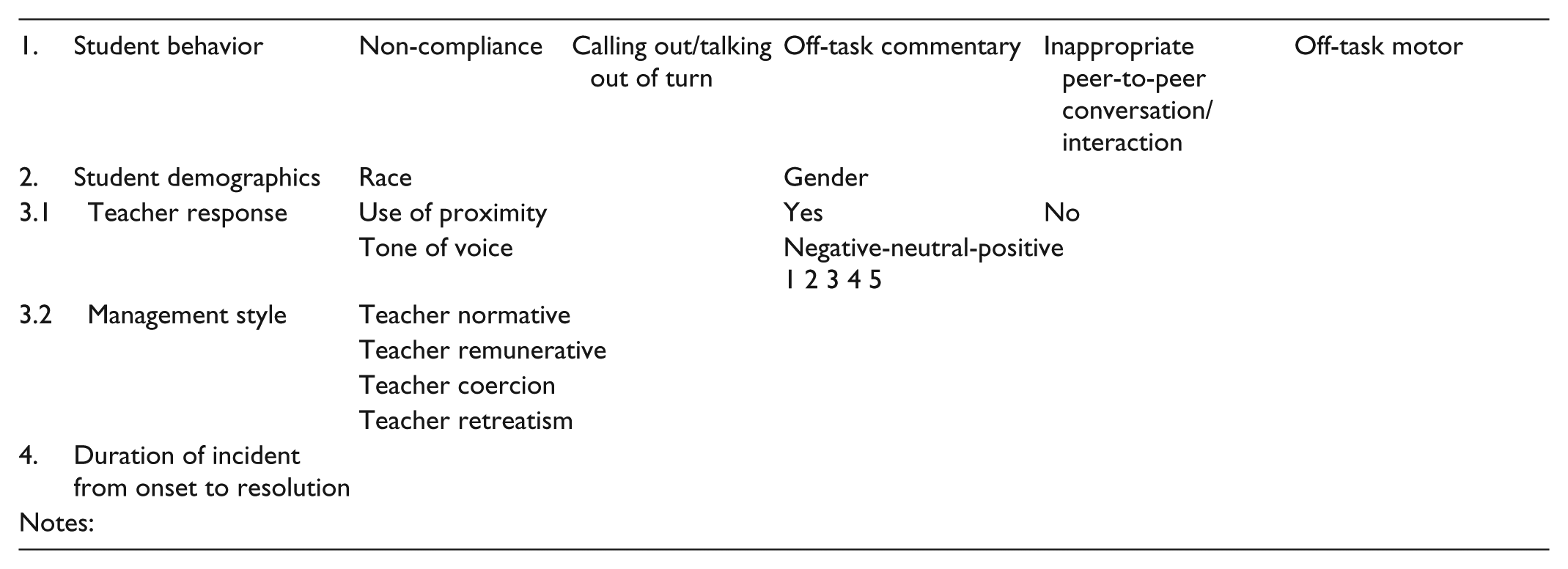
| 1. Student behavior | Non-compliance | Calling out/talking out of turn | Off-task commentary | Inappropriate peer-to-peer conversation/interaction | Off-task motor |
| 2. Student demographics | Race | Gender | |||
| 3.1 Teacher response | Use of proximity | Yes | No | ||
| Tone of voice | Negative-neutral-positive 1 2 3 4 5 |
||||
| 3.2 Management style | Teacher normative | ||||
| Teacher remunerative | |||||
| Teacher coercion | |||||
| Teacher retreatism | |||||
| 4. Duration of incident from onset to resolution | |||||
| Notes: | |||||
Declaration of Conflicting Interests
The author(s) declared no potential conflicts of interest with respect to the research, authorship, and/or publication of this article.
Funding
The author(s) received no financial support for the research and/or authorship of this article.