




Abstract
Spatial order refers to the perceived harmony, integrity, and completeness of the architectural heritage. Nevertheless, to the best of our knowledge, this concept has not been used yet to assess the heritage. This paper aims to demonstrate a multidimensional assessment of the architectural heritage value, in its urban environment, with the use of spatial order concept. We used field survey and statistical analysis to evaluate an example architectural heritage—Warsaw Ochota railway station in Poland—in four dimensions of spatial order such as architectural, esthetic, social, and functional. We found that the value of the heritage varies according to the spatial order dimensions and depends on the urban environment. Our findings could be useful for urban development policy, especially spatial planning. In particular, we postulate the need to focus on place-based approach to formulating policies for the protection and conservation of architectural heritage.
Introduction
The value of architectural heritage—for example the monuments—is difficult to measure due to its multidimensionality (Throsby, 2000). Although classifying the given monument as architectural heritage could be treated as the confirmation of the monument’s value for the society, it does not have to mean that the monument is perceived as valuable for all people. Therefore, in the previous studies various dimensions of monument’s value have been analyzed—depending on who and for what reasons evaluate the monument (De la Torre, 2002; Rizzo et al., 2002; Throsby, 2000). Nevertheless, what was missed in the majority of previous architectural heritage valuations is the fact that the urban environment (or context)—understand as all the features of surrounding of valuated object—affects the heritage value.
More recently this knowledge gap gaining attention which initiated the broad discussion on how do multiple values of architectural heritage depend on and co-constitute each other in different urban environment and how these values linked to processes of place-making (Avrami et al., 2019; Birdsall et al., 2021). While the perception of urban environment and further its evaluation can vary among people (Pretto, 2021; van der Hoeven, 2020), we may also expect that people perceive the cultural heritage, such as the monument, as more/less valuable according to its harmony and completeness (or their lack) in the given urban environment. It is because the monument and what surroundings this monument—urban environment—should form an urban and functional whole. This raises a question how can we refer to the to the mutual relations between them in the (e)valuation of architectural heritage?
This study address above question by proposing to link the evaluation of the perceived value of architectural heritage with the concept of spatial order. Spatial order raised in urban design and urban planning and means the esthetic, coherent, and harmonic organization of urban environment (Mikołajczyk & Raszka, 2019). The concept takes into account social, economic, environmental, cultural, political, moral, and esthetic aspects of space organization. These aspects also are used as the basis of spatial order categorization into four dimensions—urban-architectural, functional, esthetic, social, and ecological (Różycka-Czas et al., 2019). Following previous studies, spatial order might use to characterize the cities (Hatuka & Forsyth, 2005), street network (Boeing, 2019), or landscape (Różycka-Czas et al., 2019), to mention just a few.
According to above, spatial order refers to the mutual relations between the elements of urban environment which are expected to form the harmonic, rational, and intentional composition. This makes the concept is useful to provide the basis for valuation of architectural heritage from the perspective of general harmony in urban environment. In the broader sense, it could help to account for the interplays between architectural heritage and urban environment in the (e)valuation of the former. Despite above, to the best of our knowledge the spatial order concept has not been used yet for this purpose.
The purpose of this study is to demonstrate both theoretical and empirically how spatial order concept could be used to evaluate the perceived value of architectural heritage. We propose theoretical consideration on the evaluation of a monument, as an example of architectural heritage, through the lens of spatial order. In this way, we emphasize that a monument is part of a place, and the harmony of the space around it might influence the perception of its value.
In addition, we demonstrate how to assess the perceived value of the monument with the use of spatial order concept. In particular, we conducted a field survey that enables to capture respondent’s assessment of the monument—Warsaw Ochota railway station in Poland. The railway station was evaluated by each respondent in four dimensions of spatial order and in three spatial locations to capture heterogeneity of urban environment. With the use of statistical analysis we verify how perceived value of the railway station varies in four spatial order-related perceived values and how urban environment influenced these perceived values.
Using the Spatial Order Concept to Assess Perceived Value of Architectural Heritage
The Importance of Urban Environment in (E)Valuation of Architectural Heritage
The World Heritage Convention defined architectural heritage—such as monuments or group of buildings—as “architectural works, works of monumental sculpture and painting, elements or structures of an archaeological nature, inscriptions, cave dwellings and combinations of features, which are of outstanding universal value from the point of view of history, art or science” (UNESCO, 2019). This diversity of architectural heritage makes it difficult to determine its value; especially as each element forming architectural heritage can have multiple values in different categories, and what is more, these values can interact.
Depending on the scientific discipline there are various categories of values possible to derive for architectural heritage. For example, Throsby (2000, 2012), based on Total Economic Value, developed the Cultural Capital framework, in which he assumed that (architectural) heritage value can be divided into economic and cultural value, which together form total heritage value. Cultural value, in his concept, is multidimensional and consists of esthetic, symbolic, spiritual, social, historical, and authenticity value (Throsby, 2000). Multidimensionality of heritage value was also highlighted by others (Nijkamp, 1988; O’Brien, 2010; Sokołowicz & Przygodzki, 2020), however the possible interlinks between multiple values of heritage and the urban environment of architectural heritage were commonly missed or served indirectly.
For example, according to Throsby (2000, 2012), an assessment of cultural value of architectural heritage is possible only in the process of consuming it with its urban environment. Nevertheless, his Cultural Capital framework does not provide more detailed consideration how the cultural values of architectural heritage could be assessed taking into account the mutual relations between the heritage and its urban environment. In the response to the abovementioned needs, more recently more attention has been gain to assess—apart from the architectural heritage itself—its physical context, such as the esthetics scenery or scenic view (Rudokas et al., 2019; Sokołowicz & Przygodzki, 2020). Also, the influence of architectural heritage on the urban environment conditions has been also considered—for example from the environmental sustainability perspective (Philokyprou & Michael, 2020).
In the line with above, Rudokas et al. (2019) highlighted that one of the challenge in heritage (e)valuation is the necessity to include the diverse urban environment. They pointed out that “[architectural] heritage objects are inseparably linked with their context including adjacent heritage and non-heritage buildings and by co-existing create synergetic effects on values.” In the same manner, van der Hoeven (2020) proposed “an inclusive understanding of urban heritage,” which focuses both on isolated architectural heritage sites and their wider social physical and cultural context. This further means the necessity to develop unambiguous conceptual framework for heritage (e)valuation which includes the cause-effect relationships between architectural heritage and its urban environment.
To account for the links between architectural heritage and its urban environment we may refer to the integrity of heritage localities (Rudokas et al., 2019). The integrity implies the wholeness and refers to a state where architectural heritage is understand as the sum of material and non-material elements, including its urban environment, which are expected to form a harmonious unity (Taher Tolou Del et al., 2020). The integrity of architectural heritage can determined the heritage value or even could be treated as the separate value—in particular, the value of integrity functional, cultural, physical, spiritual (genius loci) arrangement of the architectural heritage, and its urban environment (Rudokas et al., 2019). Moreover, integrity is considered in conservation management and used as a precondition that must be met for inclusion of architectural heritage in the World Heritage List (Taher Tolou Del et al., 2020). One of the way to ensure the assessment of architectural heritage with its urban environment with the use of the integrity is to refer to the spatial order concept.
The Concept of Spatial Order
Spatial order is understand as the proper way to organize space, which should meet the criteria of social rationality, taking into account not only the social, but also the economic, environmental, cultural, political, moral, and esthetic aspects of space organization. Spatial order refers to a harmony—the compatibility or mutual complementarity of elements and properties—as the unchangeable canon of good quality space and a basic principle of shaping space (Mikołajczyk & Raszka, 2019). The assessment of architectural heritage, from the spatial order perspective, takes as the basis of the value the harmony, integrity, and completeness of architectural heritage elements.
Spatial order is commonly described as the esthetic of the place (Mikołajczyk & Raszka, 2019). The creation of esthetically pleasing character of the monument, in which the monument’s elements are integrated and form the visually harmonious monument’s unity, is one of the example how spatial order concept works (Halauniova, 2021). Nevertheless, such an approach is too narrow; not only an esthetic composition is the subject of spatial order. The spatial order is about refocus from thinking about the monument’s attributes separately towards treating the single monument’s feature as inseparable elements of the “bigger thing.”
At first glance, spatial order might be seen as a subjective construct because each person might see harmony or its lack differently. Despite such understanding of the concept, there are however arbitrary rules which decides about spatial order existence formation. They include economic, natural, social rules as well as political situation. Therefore, spatial order is not only the way of thinking about the proper composition of architectural heritage used by architects or scholars but also livable canon which was formally introduced in the spatial planning documents. In particular, spatial order has been introduced in the polish law in the Spatial Planning and Land Development Act (Journal of Laws, 2003). The act, which is the core document for urban planners, defines the spatial order concept and postulate to follow it in urban planning decisions.
Spatial order is multidimensional phenomenon which refers to the harmonious combination of heritage elements from the urban-architectural, functional, esthetic, social, and ecological perspectives (Różycka-Czas et al., 2019; Szczepańska & Pietrzyk, 2019). These dimensions of spatial order can be characterized as follows:
Social order is related to the existence of a network of social relationships, expressed by a sense of security, the symbolism of place and its importance in building the identity of a place/city, recreational values
Functional order is related to the usability of space, its saturation with service points, convenience/comfort of use, accessibility for users and business, and modernity of space
Esthetic order is related to the beauty of the space, its attractiveness, cleanliness, and neatness, and if it is pleasing or irritating to the senses
Architectural order is expressed through the composition of space, its legibility, the logic of the arrangement of its elements and their shape, size, diversity, adjustment to the image of the city, originality of the place
Ecological order refers to the value of the natural environment of space.
Although abovementioned dimensions are close to those delimitated by others to characterize urban space (Carmona, 2021; Cilliers et al., 2015), in contrast to various delimitations, they take into account the integrity, harmony, and complementarity of heritage elements. Therefore, the assessment of the architectural heritage, which follow spatial order dimensions, would be based on the perceived harmony and integrity of the elements of architectural heritage as well as the harmony and integrity between architectural heritage and its urban environment. Nevertheless, to the best of our knowledge, neither conceptual nor empirical examination of the assessment of architectural heritage through the lens of spatial order concept was proposed in the previous literature.
Linking Perceived Value of Architectural Heritage and Spatial Order Dimensions
In this study we propose to evaluate architectural heritage—in particular a monument—with the use of four dimensions of spatial order. This approach emphasizes that the monument’s elements, for example its color or shape, should form harmonious whole, and also such harmony and integrity is required for the monument and its urban environment. In other words, the basis of our assessment is the reference to the harmonious, integrity, and completeness in the spatial organization. We assume that good exposure of a monument and its harmony with the urban environment may positively affect the assessment of monument’s esthetic, architectural, social, or functional values. Simultaneously, we assume that a monument becomes an important element that creates the quality of spatial order in urban environment (see semi-circular arrows between architectural heritage and urban environment values in Figure 1). It is because the given person has capacity to experience a symbiosis and interdependence between the monument and its urban environment.

Dimensions of perceived value of architectural heritage.
In our approach the perceived value of the architectural heritage is formed by its harmony and integrity. However, the spatial order is constituted not only by the internal harmony of heritage elements but also by the external harmony formed by the relation between the heritage and its urban environment. This means that we allow the perceived value of architectural heritage in each dimensions of spatial order is indirectly determined by the value of its urban environment. For example, the value of a monument is driven mainly by the perceived harmony and integrity of its elements but this perceived spatial order might be weakened or strengthened by the integrity of a monument with its urban environment.
Materials and Methods
Case Study: Warsaw Ochota Railway Station
The monument—chosen for this study as an example of architectural heritage—is the Warszawa-Ochota railway station. It is a modernist building dating back to 1963, designed by Arseniusz Romanowicz and Piotr Szymaniak. The station is considered a classic example of modernist architecture in Central and Eastern Europe (Figure 2). It is characterized by a light structure, a glazed interior, and roof in the shape of a hyperbolic paraboloid, covered with a mosaic in black and white stripes. The two diagonal vertices were lowered, while the other two were raised 8.34 m relative to the base of the structure. It is a relatively small structure, with a side of 17.25 m2 (Ciarkowski, 2019). The station still serves its original function. The architectural solutions, based on modernist principles, are today regarded as an unique example of railway architecture. Therefore, in 2012, the railway station was declared a monument and entered in the communal register of monuments of the capital city of Warsaw.

(a) Sketch of the railway station and (b) a recent photo of the Warsaw Ochota railway station.
The choice of the Warszawa Ochota railway station for the analysis was dictated by two considerations. First, the station could be treated as an example of ambiguous heritage, whose value (esthetic or historical) is denied in many social circles. For the majority of society, especially among those with little knowledge of architecture and art history, the monument is perceived as a typical, unwanted relic of communism (Ciarkowski, 2019; Derek, 2020). At the same time, however, the monument is a tangible image of the city’s past and transformation, an important element of the city’s identity. For architects and urban planners, it is a valuable part of architectural heritage, an example of modernist architecture of the socialist era, worthy of protection and valorization (Ciarkowski, 2019; Sokołowicz & Przygodzki, 2020).
Second, the Warsaw Ochota railway station is located among heterogeneous urban environment, differentiated in terms of architectural forms and urban composition. At the time of construction, the station was harmoniously integrated into the existing urban fabric, forming a coherent composition of the urban landscape. The gradual evolution of spatial development led to deep changes in the urban composition of the station’s environment. At present, elements of secondary development strongly dominate it—the railway station is overwhelmed by the surrounding space, the condition and quality of which do not create spatial order. Moreover, there has been a far-reaching technical degradation of the station, leading to the eradication of its architectural values and a negation of its value as an architectural heritage.
Field Survey
To evaluate the perceived value of the monument in its urban environment, we carried out in field survey in which the respondents, who were placed in the real place where the monument is placed, had a twofold task (see Nowakowska et al., 2019). First, to assess the value of the monument from three different spatial views. Second, to choose the most favorable perspective of evaluation. The survey was preceded by a pretest carried out with 22 participants (May 2018). It constituted the basis for checking the correctness of the questionnaire—in particular, the readability of the measurement tool and the scope of the evaluated features of the monument. One hundred and nineteen people participated in the main part of the survey (May 2019). After verifying the collected material, 30 responses were rejected (due to incompleteness), and data for N = 89 were considered for further analysis.
Nonprobability sampling was used to create a homogeneous group of respondents. The respondents were aged 20 to 25. They are a generation of people born after 1990, who do not remember socialism or the socio-political transformation. Due to their young age, these people were not negatively prejudiced against the monument (i.e., the concrete modernist station as a socialist relic), which made it possible to eliminate one of the factors that could negatively influence the evaluation of the monument (Derek, 2020).
The Monument’s Urban Environment
We approximated heterogeneous urban environment by three spatial views in which the station was evaluated by each respondent. The choice of the spatial view, and, therefore, the choice of the evaluated urban environments, was determined by two criteria:
Spatial distance—sites were selected that are characterized by a similar distance from Ochota station so as to keep a similar perspective horizon and scale of the station;
Diversity of elements and composition—sites were selected that are characterized by a great diversity of landscape elements that form the surroundings of the monument.
Three spatial views were chosen as a result of the selection process (Figure 3):
- Spatial view A—the tops of the roof of the Ochota railway station are visible in this perspective. The urban environment have a metropolitan character. Although the composition is not coherent, it is not chaotic either. The development of the urban environment does not overwhelm the station but only emphasizes its significance in the surroundings. Although the monument is surrounded by younger buildings, it looks the most modern and “light” among them.
- Spatial view B—the entire structure of the building and its greatest assets—the hyperbolic curvature of the roof and the glazed walls—are visible in this perspective. From this vantage point, the monument is the distinguishing feature of the space, an element that identifies it. The composition of the urban environment is secondary to the object and does not harmonize with Ochota railway station. The buildings surrounding the station are chaotic, which could cause many impressions and thus distract attention from the monument itself.
- Spatial view C—it highlights the architectural values of the station and its body in the least prominent way. Only the tops of the station’s roof are visible, while the entire outline of the building is barely visible. The urban environment of the building are chaotic, with a great variety of elements. A large part of the building’s surroundings is constituted by greenery. The great diversity of the urban environment means there is no dominant feature in this perspective.
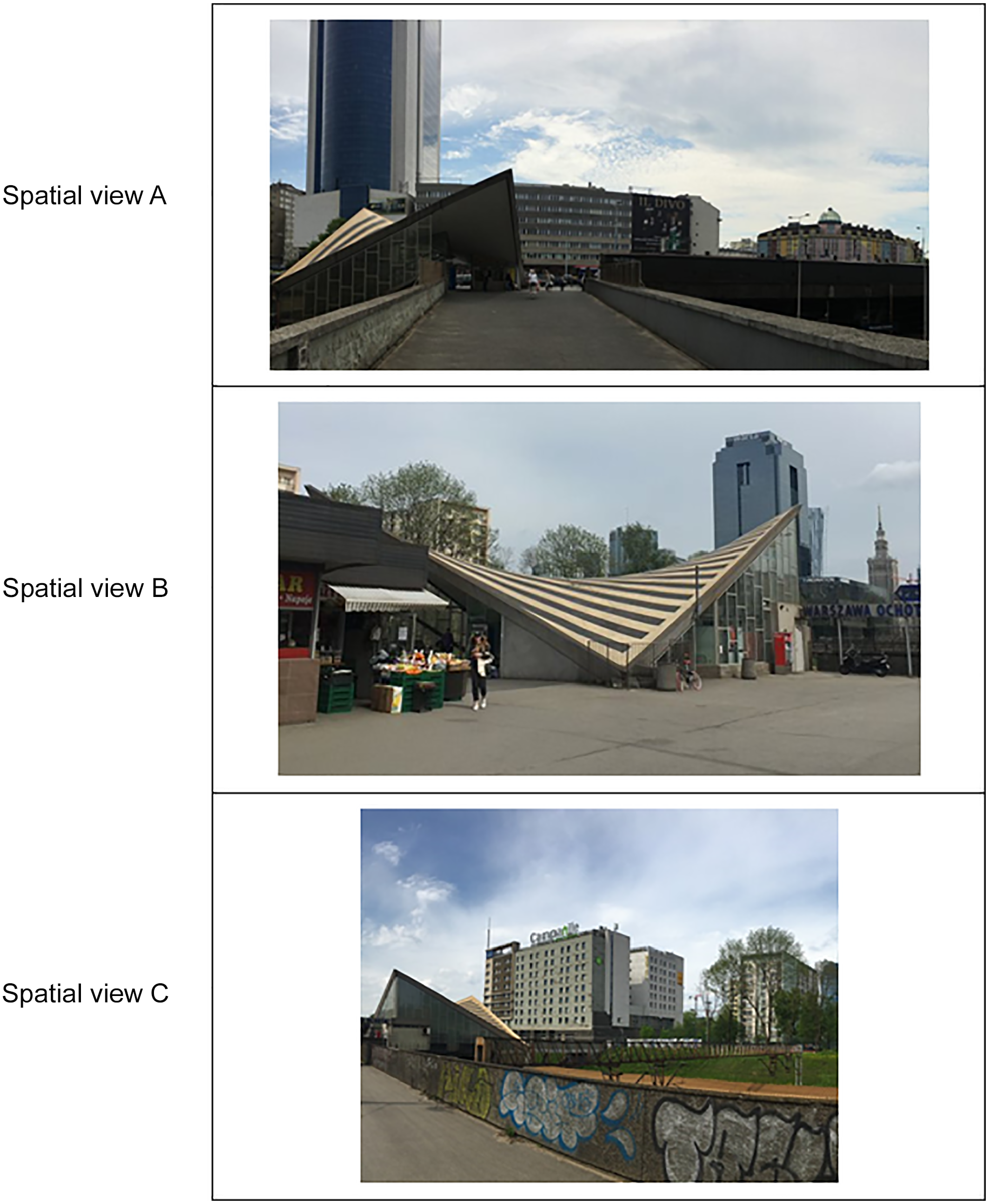
Heterogeneous urban environment of Warsaw-Ochota railway station.
Monument’s Perceived Values From the Spatial Order Perspective
The values of the monument’s features were assessed by respondents during the field survey in which they observed real monument. The values was quantified with the use of 10-point numerical scale. Each participant evaluated 17 features of the monument by giving a score from −5 assigned to the most negative characteristics (e.g., dirty, inaccessible, without historical value) to 5 assigned to the most positive characteristics, which were opposites (e.g., clean, accessible, with historical value). These 17 features were linked to four dimensions of the monument’s perceived value and spatial order, based on expert knowledge, as follows:
(1) Perceived social value—dangerous/safe, without historical value/with historical value, to be demolished/to be left, it does not build the identity of the place/it builds the identity of the place, a bad place for recreation/a good place for recreation;
(2) Perceived functional value—uncomfortable/comfortable, a bad place for business/a good place for business, inaccessible/accessible, useless/useful, dated/modern;
(3) Perceived esthetic value—irritating/pleasing, dirty/clean, visually unattractive/attractive;
(4) Perceived architectural value—inhuman/human, vanishing/dominant in the environment, mismatched/matched to the city, typical/unique.
The perceived value in each dimension was calculated as an arithmetic mean from the respective features.
Monument’s Perceived Values in Urban Environment
To link the perceived value of Warsaw Ochota urban rail station with the monument’s urban environment directly, we applied a random effect model (Rabe-Hesketh & Skrondal, 2008). The random effect model allows us to quantify how the perceived value of the monument (assessed by the respondents during the in-person filed visit) varies depending on the urban environment (approximated by observing the monument from three different spatial views during the field visit) and to control for the impact of respondent’s features on such a perceived value. The model was as follows:

where: yij is the dependent variable, which reflects the social, esthetic, functional, or architectural dimension of the perceived value reported by i respondents (i = 1,…, N) in spatial view j (j = A, B, C), which approximate the railway station urban environment;
We decided to apply the random effect model due to the structure of survey data, which consists of repeated measurements. Each respondent reported perceived social, esthetic, functional, or architectural value three times for the different urban environment, that is, the spatial views (A, B, and C—see Table 1). In the random effect model, we are able to capture both observed and unobserved respondent features. The former is represented by covariates, while the latter is captured by the random effect. We estimated the parameters of equation (1) separately for each dimension of the monument’s perceived value using the restricted maximum likelihood method in R Cran. The list of the dependent and explanatory variables with their descriptive statistics is in Table 1.
Variables Used in the Models.

Note. NA = not applicable.
Results
Dimensions of the Monument’s Perceived Value
The mean values of items evaluated by the participants are mostly negative. Only 4 out of 17 items have a mean value above zero—two items constitute functional and architectural values. This suggests that the monument belongs to ambiguous architecture—what could be further understand as an architecture that has the value from heritage perspective but whose value is not seen or widely accepted by the society. In our case, the respondents had difficulties in perceiving the monument positively and, in general, they declared its low perceived value.
The respondents characterized the monument as unique rather than typical (0.41), dominant in the urban environment rather than vanishing (0.09), accessible rather than inaccessible (0.61), and useful rather than useless (0.38). Other items that represented social and esthetic values were, on the whole, evaluated negatively.
The respondents characterized most negatively those items which described the monument’s esthetic value. In particular, they perceived the monument as visually unattractive, dirty, and irritating, resulting in the lowest value in the esthetic dimension (−1.75). When it comes to the social dimension, the low perceived value results primarily from the negative perception of the monument as a place for recreation (Figure 4).

Evaluation of monument’s features in four dimensions of spatial order.
Monument’s Perceived Value in Relation to Urban Environment
We applied the stepwise regression procedure to eliminate statistically insignificant covariates (p-value >.05) in the random effect models. The final estimates are presented in Table 2. Most of the respondents’ features do not affect the perceived value of Warsaw Ochota railway station in any dimension. The only two factors which were found to differentiate perceptions was educational profile and the frequency of using the urban railway station. The way they influence perception depends on the perceived value dimension. For the esthetic and functional dimensions, neither the educational profile nor the frequency of using the station influenced the participants’ perceived value. In contrast, those with an environmental science profile of education perceived the social value higher than the other participants. In addition, the architectural value was evaluated higher by those who visit the station occasionally or who were visiting it for the first time in comparison with those who visit the station more frequently.
The Random Effect Models—Results.

Note. Significance level: **.05. ***.01.
The spatial view, which approximates the Warsaw Ochota urban environment, is associated with the perceived value of railway station in each of the four spatial order dimensions. In each dimension, the respondents’ perceived value is lower when Warsaw Ochota is evaluated from spatial view C. Spatial view B is linked to a higher perception of Warsaw Ochota in social and architectural dimensions. When it comes to spatial view A, it negatively influences the perceived value of the railway station in social and architectural dimensions. However, the valuation of the monument in functional and esthetic dimensions does not differ statistically significantly between A and B. In summary, the perceived value of the railway station in all four dimensions is the highest for B and the lowest for C. Spatial view A is in between B and C in its impact on the perceived value of Warsaw Ochota.
Discussion
The Perceived Value of the Architectural Heritage: Spatial Order Perspective
This study supplements the knowledge on evaluating architectural heritage by proposing to differentiate their perceived value into four dimensions, which are linked to spatial order. This multidimensional approach—tested for a monument’s evaluation—follows the findings from previous research. In particular, previous studies on architectural heritage highlighted that the total value of a monument consists of the values of the monument’s various features (De la Torre, 2002, 2013; Sokołowicz & Przygodzki, 2020). Nevertheless, although many approaches to differentiating architectural heritage’s value have been proposed (Cilliers et al., 2015; Throsby, 2012), none of them was based on spatial order. In addition, the need to integrate different evaluation methods, especially across disciplines, has also been proposed as a way to explore more deeply the different notions of value (Della Spina, 2018; Ferretti & Comino, 2015; Özçakır et al., 2022). These cross-disciplinary integrated methods of evaluation (Ginzarly et al., 2019) leave open the possibility to link an object’s perceived value with spatial order.
Our results showed that the train station’s features are perceived more negatively than positively, which further suggests that it represents ambiguous architecture (Sokołowicz & Przygodzki, 2020). Although the value of the monument is relatively low in each dimension, it differs according to the dimensions of spatial order. This further confirms that the way the space or monument is organized, especially the perceived harmony and spatial cohesion of the monument, is seen by people and evaluated in four dimensions—social, functional, esthetic, and architectural. This is in line with Cilliers et al. (2015) who found that the various functions of public spaces translate into different dimensions—associated to the planning—including the virtual, marketing, social, sound, functional, visual, environmental, psychological, and movement dimensions. According to our findings, people intuitively feel spatial order, and its perception is further captured in the architectural heritage’s value.
This could mean that the concept of spatial order is not only a theoretical framework for architects and urban planners, but also a determinant of people’s preferences regarding a place or architectural heritage. In other words, people are able to recognize spatial order regarding the architectural heritage, and they are not indifferent to whether it exists or not. This contrasts with Popple and Levi’s (2005) finding about the human brain’s limited ability to perceive spatial order, understood as the principle of organizing visual areas. Our study demonstrated that people are able to perceive spatial order; they not only understand it visually or esthetically, but broader, for example, as the harmony or spatial cohesion of the monument’s social or functional features. In the wider sense, our findings are in line with Rasmussen’s observations described in the book “Experiencing Architecture” (Rasmussen, 1964). In particular, he highlighted that people not only see architecture, but they experience it in the broad sense. We showed that this wide range of experiences regarding a monument could be manifested in its evaluation, which cannot be simplified to one, standardized value—rather, it is a complex and multidimensional concept.
The Architectural Heritage’s Perceived Value in Relation to Urban Environment
As a result of the study, several interrelationships have been observed. First, the best-evaluated perspective, from which the respondents could see the monument in reality, was spatial view B. This might be due to its high attractiveness in the esthetic dimension, as it is from this perspective that the outline of Warsaw Ochota railway station and its most obvious asset (the curvature of the hyperbolic roof) are best visible. Apart from the exposure of the object itself, the highest ratings could also be influenced by both the immediate surroundings of the monument, as well as those further away. In this spatial view, the closer surroundings of the station include service points, and the entrance is visible, which makes it the most human-oriented and dynamic perspective of those evaluated. It can thus be assumed that the social and functional dimensions of the spatial order may have been important for the high evaluation of the monument. In the further surroundings of the station, one can see the contemporary buildings of the center of Warsaw and one of the best-known buildings of the capital, the Palace of Culture and Science. It is one of the symbols of Warsaw that builds the identity of the city, so it could be attractive to the respondents and contribute to the overall positive evaluation of this spatial view.
By contrast, seen from spatial view C, the railway station has a lower value in the social, functional, esthetic, and architectural dimension than when seen from spatial view A or B. Accordingly, it was evaluated the worst in this spatial view. The negative perception of this spatial view may have been influenced mainly by the development of the area in front of the station, with the neglected elements of the railway infrastructure (tracks, railway tractions, exposed platforms, shelters) and the unsightly concrete wall (the esthetic and architectural dimensions). The further surroundings of the monument (a modern hotel building and green area) did not reduce the chaos in the foreground, nor did they improve the negative perception. The fact that perspective C was the first to be evaluated by the participants may also be significant, as it was their first contact with the monument. The halo effect (the automatic attribution of positive or negative characteristics based on the first impression) may have been at work here (Nisbett & Wilson, 1977).
However, when comparing perspectives A and B, the respondents assigned lower social and architectural values in perspective A, where the body of the building is no longer so prominent, nor are its immediate surroundings characterized by high architectural value. Similarly, the lower evaluation of the social dimension in this perspective may be due to the lack of development in the immediate vicinity of the building, which has only a transportation function (a walkway over the tracks to the entrance to the station).
The study has shown that the urban environment of the Warszawa Ochota railway station determine its evaluation. This influence varies depending on the dimension of a perceived value but is visible in each of the analyzed dimensions: social, architectural, functional, and esthetic. The assessment of the monument’s value in these four dimensions is worse when the station is not a dominant element in its urban environment. By contrast, the value of the monument in the social and architectural dimension is assessed higher in those perspectives that highlight its architectural values (e.g., the curvature of the roof and glazed walls). In the broader sense, our results signalize that the “atmosphere” of the place is formed by the spatial order of heritage’s elements perceived in the given urban environment (Göbel, 2021).
Implications for Urban Planning
Our results provide practical recommendations for urban development policies. They show the necessity of a close connection between the policy of architectural heritage conservation and spatial policy, highlighting the need for an integrated and holistic view of architectural heritage and its urban environment (Del & Tabrizi, 2020). On the one hand, the urban environment should be shaped in such a way that the value of architectural heritage is strengthened by the composition and quality of its surroundings. On the other hand, conservation, protection, and the evaluation of heritage values should go beyond a simple analysis of the idea, form, or function of a monument itself, and it should be related to evaluating the condition and quality of the space around it (van der Hoeven, 2020). The urban environment is of particular importance when the values of architectural heritage are not obvious and are poorly perceived at first glance.
The results of the study confirm the need to change the way we think about heritage and its protection. The challenge is to move from focusing on a single monument to thinking about the whole place with its own specificity and identity (Camagni et al., 2020). Showing a monument in its best light in the space it inhabits, and integrating it into the urban environment, contributes to a better understanding of not only the value of the monument itself but also the place in which it is located, which in turn influences the sense of stability, rootedness, and social involvement in local activities (Brown et al., 2003; Vorkinn & Riese, 2001). In the broader sense, we are in the line of Muzaini (2021) who highlighted the need to pay more attention to heritage-making “from below” in valuations of urban environments. In particular, the use of spatial order concept in an evaluation of heritage perpetuates thinking about the architectural heritage as the sum of features which can strengthen the value of “bigger thing” thanks to the harmonious composition.
Consequently, changing the way in which architectural heritage values are constructed and managed becomes imperative. A place-based policy approach, which emphasizes a place and its understanding, is gaining importance. The focus is not so much on actions oriented toward eliminating the dysfunctions of a monument but on enterprises that focus on creating the capital of a place. This implies the need to apply an integrated approach to heritage management and the integration of activities undertaken by many entities contributing to decisions on the planning of the city’s development. These ideas are in line with the way of thinking about heritage and its protection, outlined by, among others, the Faro Convention (Council of Europe, 2005), according to which it is necessary to “promote an integrated approach to policies concerning cultural, biological, geological and landscape diversity to achieve a balance between these elements” and the UNESCO Recommendation (UNESCO, 2011), which recommends “to ensure that views from and to monuments and historic areas are not spoilt and that historic areas are integrated harmoniously into contemporary.”
Study Limitations
This study has limitations which may be addressed in future research. In the experiment, we did not randomize the order of spatial views in which the railway station was evaluated. This could affect the estimates of the impact of spatial views on the monument’s value in each dimension because of the potential, uncontrolled “reverse-halo effect”/“horn effect” (Pohl, 2016). In addition, we did not ask the participants of the field survey about detailed attributes of the urban environment that affect their perception of the monument in each spatial view. The spatial views, representing different urban environment, differed not only in terms of what was seen by the participants, but also by the level of noise or crowdedness, which was not controlled during the experiment. This further limits our possibilities to evaluate more deeply which attributes of the urban environment most affects the monument’s (e)valuation. The respondents were not asked for the reasons why they prefer one spatial view over the other. Therefore, the conclusions regarding the potential factors that affected their choices need to treated with the great cautious.
Conclusions
This study attempts to evaluate the possibilities to assess the multidimensional value of architectural heritage with respect to its urban environment. Using Warsaw Ochota railway station as an example of architectural heritage, we proposed assessing the monument’s value in four dimensions, which represent social, functional, esthetic, and architectural spatial orders.
We showed that although the perceived value of the monument is, in general, low, it varies in these four dimensions. In addition, we found that monument’s urban environment affects its evaluation in each dimension. This could mean that people are able to understand spatial order not only visually or esthetically, but broader, as the harmony or spatial cohesion of the heritage’s features. This further suggests that architectural heritage evaluation requires a complex approach that captures the multidimensional nature of value in a given urban environment. One way to do this is by referring to spatial order, understood as the perceived harmony and integrity of a monument’s features in its evaluation. We propose linking the multiple values of architectural heritage with the features of its urban environment, as the spatial context formed by the surroundings matters for how people perceive and assess the heritage.
In the broader context, out findings contribute to understanding the creation of heritage value by demonstrating the architectural heritage cannot be assessed independently from the complex spatial context and its value depends on how much such an architectural object fits to the urban environment. In addition, we contribute to the understanding of spatial order concept by demonstrating its importance for heritage evaluation. In particular, the concept of spatial order perpetuates thinking about the architectural heritage as the sum of features which can strengthen the value of “bigger thing” thanks to the harmonious composition.
Footnotes
Declaration of Conflicting Interests
The author(s) declared no potential conflicts of interest with respect to the research, authorship, and/or publication of this article.
Funding
The author(s) disclosed receipt of the following financial support for the research, authorship, and/or publication of this article: This work was supported by the European Horizon2020 project “InnovaConcrete. Innovative materials and techniques for the conservation of 20th century concrete-based cultural heritage” [grant number 760858].
