




Abstract
This study investigates the impact of globalization (defined as phasing-out of the multifiber arrangements [MFA]/agreement on textile and clothing [ATC]) on working conditions of textile and apparel workers in general and female workers in particular in Pakistan. We found that the impact of the elimination of the MFA/ATC on workers of the textile and apparel sector is negative and statistically insignificant. The working conditions of workers in the textile and apparel sector are not different relative to other sectors. The working conditions of females deteriorated as a result of the phasing out of the MFA/ATC in relation to the male working environment and compared with other industries. Our findings are robust in the sense that the direction of the impact remains the same and statistically significant even after performing sensitivity analysis. We also controlled for provincial heterogeneity, and the results showed minor correction in magnitude but remain negative and statistically significant. We also addressed treatment selection bias by performing propensity score analysis and found similar results.
Keywords
Introduction
Globalization (or increasing global economic integration) is defined as a reduction in barriers to international flows (i.e., investment, trade, and migration) and a rise in international trade, investment, and migration across borders. These international flows affect workers directly and indirectly in both developed and developing economies. While a chunk of international trade and investment is between developed nations, globalization has expanded drastically in many developing nations.
The merchandise trade to gross domestic product (GDP) ratio increased substantially in low- and middle-income economies between 1990 and 2003 based on the World Developed Indicators (WDI) database. Even some economies witnessed big changes in the ratio of trade in goods to their GDP. The world scenario of the textile and apparel trade changed considerably during the agreement on textile and clothing (ATC) and after elimination of the multifiber arrangements (MFA/ATC). The performance of Asian economies changed significantly after the elimination of the MFA/ATC. The MFA/ATC’s termination resulted in a dramatic redistribution of the provision of the world apparel production (Lopez-Acevedo & Robertson, 2012; Staritz, 2011).
The impact of globalization on working conditions is inconclusive in existing empirical research and only a few studies systematically evaluate this impact either within or across nations (Brown, 2009). However, there is support for the proposition that those workers from industries with small wages and adverse non-monetary environment move to industries with comparatively higher wages and better non-monetary working environment due to globalization (Jayasuriya, 2008). In reality, how trade liberalization affects working conditions also depends on the existing scenario of the economy. The impact of trade openness varies across industrial units, industries, and economies. The impact of globalization depends on the measure that is used for it, as different measures of globalization have different effects on the economy.
Trade theories forecast that free trade will boost the nation’s working environment indirectly by raising its per capita income. A country uses its resources in a more productive way in free trade as compared to autarky situation. The higher efficiency allows for bigger monetary and/or non-monetary compensation. Transfers of the latest technology that may go with increased trade flow as well as raise productivity and compensation. In both cases, openness should boost the working environment as it increases GDP per capita in the economy.
Ordinary people view rising global economic integration and the shifting of production from developed to developing economies to be associated with long working hours, low wages, and adverse working conditions. The general perception in developed nations about globalization is that child labor is common and labor does not have basic rights in developing economies. Generally, it is argued that females are particularly hurt by this process of globalization. The reasons given to justify the fact that individuals willingly take such jobs in developing nations are lack of better options and changes in traditional ways of life due to globalization.
Besides the fact that trade openness raises per capita income, trade itself develops into one mechanism for boosting an economy’s working environment and labor rights. A huge empirical literature examined and discussed the lines of causality between trade liberalization and GDP per capita. Key empirical studies conclude that trade openness tends to increase economic growth (Berg & Krueger, 2003; Wacziarg, 2008). This channel gives what Flanagan (2006) labels the indirect effect of globalization on working conditions. However, opponents of trade liberalization claim that foreign competition decrease monetary and non-monetary compensation in the country.
In reality, how trade liberalization affects working conditions also depends on the existing scenario of the economy. The impact of trade openness varies across the industrial unit, industries, and economies. The impact of globalization depends on the measure that is used for it, as different measures of globalization have different effects on the economy. Monetary and non-monetary compensation for formal workers in the textile and apparel sectors in El Salvador, Indonesia, and Cambodia are equal or more than the national average (Neak & Robertson, 2009; Robertson, Sitalaksmi, Ismalina, & Fitrady, 2009; Robertson & Trigueros-Argüello, 2009). More trade liberalization seems to be connected with better economic rights for females and smaller incidence on forced labor (Neumayer & De Soysa, 2007).
To keep cost low, the strategy of low wages and poor working conditions is adopted in most of the developing countries. This is true for workers in the informal sector where subcontracting is possible with local firms. It affected females more when compared with males due to their higher participation in the informal sector (Carr & Chen, 2004).
The connection between working conditions and globalization is not clear a priori in the sense that globalization has the potential to both hurt and help the workers. Globalization may raise exports and foreign investment in ways that would raise demand for labor. Outside the limits, liberalization may mainly be exhibited as a rise in the imports and a reduction in domestic protection, urging firms to curtail their costs by deteriorating the working environment. In either way, liberalization comprises adjustment and only a careful empirical work can help us in diagnosing the troubling factors that may influence the working environment.
A significant liberalization in textile and apparel trade has not been observed till the end of 2004 because the quotas eliminated in first three stages were mostly concerned with products “in which developing countries had no comparative advantage” (World Bank, 2004). In simple words, importing economies “liberalized” the imports of those products which were not sensitive (Barber, Gowthaman, & Rose, 2004), while they deferred openness in sensitive product categories. Therefore, the implementation of the fourth stage of ATC in January 2005 exhibited a breakthrough in the liberalization of international trade in textile and apparel.
Our empirical findings reveal that the impact of the elimination of the MFA/ATC on workers of the textile and apparel sector is negative and statistically insignificant. The working conditions of workers in the textile and apparel sector are not different relative to other sectors. The working conditions of females deteriorated as a result of the phasing out of the MFA/ATC in relation to the male working environment and compared with other industries. Our findings are in contrast to Savchenko and Acevedo (2012) for Cambodian and Sri Lankan cases, where the impact is positive but statistically insignificant. We also addressed treatment selection bias by performing propensity score analysis and found similar results. Our findings are robust after performing various sensitivity analyses.
The impact of globalization on working conditions for Pakistan in general and elimination of the MFA/ATC, in particular, has not yet been fully exploited by researchers. This study tries to fill this existing gap in empirical literature in the case of Pakistan. The textile and apparel sector is the backbone of Pakistan’s economy. There is a need to explore the impact of the MFA/ATC phasing out on working conditions of the textile and apparel workers. In this study, we investigate the impact of the elimination of quantitative restrictions (i.e., elimination of the MFA/ATC) on the working conditions in the textile and apparel industry for the workers in general and female workers in particular, using microlevel data of Pakistan labor force survey (LFS) for the years 2001 and 2007. We adopt the event study methodology for analysis and follow Savchenko and Acevedo’s (2012) approach of working conditions for this study.
Literature Review
This section discusses the literature review of both domestic and international studies on globalization and working conditions nexus.
Flanagan and Khor (2014) studied the impact of international flows (trade and investment) on working environment and rights of labor among Asian and non-Asian in the last few decades using cross-sectional regression analysis and 2005 data for 58 countries with different measures of working conditions. They found that working conditions improved as a result of rising globalization in the last few decades. Growth in real GDP per capita remains a significant source of a better working environment, and trade affects working conditions indirectly via its influence on GDP per capita.
Savchenko and Acevedo (2012) investigated the impact of MFA/ATC phasing-out on working conditions of workers in the textile and apparel sector in general and females workers in particular in Cambodia and Sri Lanka. They use microlevel data for the period 1996-2008 from Cambodia and Sri Lanka. They used event study methodology to investigate the impact of the MFA/ATC phase-out on working conditions of the textile and apparel sector. They used working conditions index which is an average of two dummies—a dummy for a worker older than 14 years and a dummy for working hours not more than 40 hr a week. They found that working conditions get worse for textile workers as compared to other industries post-MFA/ATC in Cambodia, while in Sri Lanka the index is positive but statistically insignificant. They also used another measure of working condition and household survey data for Sri Lanka, which showed an adverse effect of the elimination of MFA/ATC on working conditions in textile and apparel sector as compared to other sectors. Working conditions for female workers in the textile and apparel sector in relation to male working condition and compared to other sectors are positive but statistically insignificant in both Cambodia and Sri Lanka. While the other measure was positive and statistically significant for female workers in the textile and apparel sector in relation to male workers and compared to other sectors in Sri Lanka.
Warren and Robertson (2011) studied the relationship (a) among foreign ownership, wages, and working conditions; (b) among working conditions and wages of exporting firms; and (c) wage-working conditions association among foreign and domestically owned firm using comprehensive firm-level data for Cambodia. They found that foreign ownership raises compliance on both worker’s wages and working conditions, contrary to the argument that higher wages compensate workers for adverse working conditions in foreign-owned industrial units. Furthermore, they found a robust positive association among wages and working conditions in the sample altogether, suggesting that efficiency wages or alike theory as compared to compensating differentials can better explain the behavior of such exporting firms.
Amengual and Milberg (2008) studied the role of export processing zones (EPZs) in economic development and impact on working conditions in Bangladesh, Cambodia, Costa Rica, Dominican Republic, Honduras, Madagascar, and Sri Lanka. Their findings are summarized as follows: EPZ are paying higher in comparison to other sectors of the country (Bangladesh, Sri Lanka, Madagascar, Honduras, and Costa Rica); long working hours in EPZ as compared to other sectors (Sri Lanka, Madagascar, Bangladesh); adverse working conditions exist in EPZ when compared with the workers working outside (Dominican Republic, Honduras); and more health benefits as compared to those working in informal sector (Dominican Republic, Bangladesh).
Neak and Robertson (2009) studied the impact of globalization, measure as investment and trade, on working conditions using microlevel data of Household Socio-Economic Survey (HSES) for the 2003-2004 period for Cambodia. They found that the working conditions and wages are better in the garment industry as compared to the agriculture sector, indicating that the growth of this industry might be improving working condition throughout the economy.
Robertson et al. (2009) analyzed the link among globalization, defined as trade and investment, and working environment using microlevel data of labor force surveys for Indonesia for the 1990-2003 epochs. They found that monetary and non-monetary measures of working conditions are positively correlated at the sector level and that wages are positively connected to rise in foreign direct investment, indicating a positive connection between globalization and working environment in Indonesia.
Robertson and Trigueros-Argüello (2009) explored the effect of globalization, measured as investment and trade, on working environment using microlevel data of Encuesta de Hogares de Propósitos Múltiples (EHPM or Multipurpose Household Survey) for the period 1995 to 2005 for El Salvador. Their results showed that export-oriented and FDI-dominated apparel sector, relative to other sectors, has better conditions in El Salvador. They also found that remittances were positively correlated with wages and negatively associated with working conditions.
Marcouiller and Robertson (2009) investigated the link between globalization, defined as inflows of foreign investment, remittances, and changes in trade, and working environment using microlevel data of The Instituto Nacional de Estadística’s Permanent Household Survey (INEPHS) in Honduras for the period 1990-2004. They found that globalization resulted in rising monetary and non-monetary compensation in Honduras. Workers who were working in the clothing/apparel sector earned a positive premium as compared to other sectors in the economy. Globalization increased employment share of this sector and share of agricultural declined in the economy. Liberalization also played an important role in improving working conditions in the apparel sector in particular and in all sectors in general.
A few small-scale studies (e.g., Anjum, Mann, & Anjum, 2009; A. W. Khan, Kundi, & Moshammer, 2015; A. W. Khan, Moshammer, & Kundi, 2015; A. W. Khan & Nersesyan, 2014; S. A. Khan & Saadia, 2006; Nafees, Fatmi, Kadir, & Sathiakumar, 2013; Siddique, Shaheen, Akbar, & Malik, 2012; Tahir et al., 2012) have been conducted in different regions and segments of textile and apparel sector of Pakistan in medical sciences to explore the health issues of the workers. They observed belated improvements in the working environment in those industrial units that are producing for foreign markets and poor working conditions in the industrial units which are catering for domestic needs only. The workers of the textile and cotton sector are facing many serious health issues due to exposure to cotton dust and fiber dust. They found unhygienic working conditions and poor facilities at the workplace. Most industrial units in general and particularly the small units, lack protective measures (masks, earplugs, first aid box, etc.) in weaving factories (power looms). Several studies have found that continuous unprotected exposure to fiber dust and cotton dust caused many diseases in workers of small units (i.e., weaving units/power looms) in particular and overall cotton industry in general. Wages of the workers in small units are quite low as compared to large units and working conditions are very poor in small units.
They observed long working hours (i.e., a shift/duty of 12 hr) for workers engaged in power looms (i.e., a small weaving unit/factory) and in large industrial units working hours were 8 hr a day or in one shift. In small units, higher levels of dust and 12 hr of work were observed as compared to big units where working hours were 8 hr a day. These small units, mostly unregulated, have 5 to 30 workers and are built in small places. These small units lack basic safety measures and occupational hygiene. They found an adverse working environment in the cotton industry particularly the power looms. There were more complaints reported from small weaving units or power looms. They observed that the working environments of cotton mills were not up to standards in Faisalabad. Lack of safety procedures and unprotected exposure to cotton dust and other chemicals were creating different health issues in these workers. They also found poor ventilation, lack of awareness about safety measures, noisy environment, exposure to different types of dust, ineffective medical check-ups, and insignificant use of protecting apparatus at the workplace in cotton and textile units.
Summing up the literature review, all local studies were conducted on a small scale with specific reference to medical sciences. There is no study which tries to explore the impact of globalization in general and impact of the MFA/ATC phase-out in particular at the national level. This study used nationally represented data of all sectors.
Theoretical Framework
A useful point to start with is the most common Heckscher-Ohlin (H-O) model of a trade by comparative advantage. The H-O model, however, takes too many assumptions that make a strict application unrealistic. Relaxing a few of these assumptions permits focus to be positioned on the pertinent questions while safeguarding enough theoretical discipline to give specific forecasting and guidance to achieve meaningful empirical findings.
For instance, the neo-classical Heckscher-Ohlin (H-O) model presumes that factors of production are perfectly mobile among industries, which is only true in the long run. For nonwage working conditions, globalization measures will first have sector-specific effects before influencing the rest of the economy. In the short run, labor cannot shift easily between sectors, building a Ricardo-Viner (or Specific-factor) model is more suitable. If movement between sectors is costly, or if efficiency earnings (or wages) are permitted in the framework, short-run effects can take some time to disperse throughout the country. In the short run, maybe labor is immobile between sectors (Elliott & Lindley, 2006). So globalization may influence firms first within particular sectors. In the medium run, workers (and/or capital) start to shift between sectors and production methods may change due to the adoption of new ideas. Therefore, if someone is concerned with the medium run, then they should concentrate on shifts between-sector.
In addition to this, the basic H-O model does not specially include non-monetary working conditions, likely complicating the theoretical connection between overall working conditions and globalization. There are various measures of globalization and each of them has different implications on the working environment (or conditions). Furthermore, the basic H-O model does not generally add institutional elements (such as mandated benefits, minimum wages, or government application of labor laws) working at different stages in the economy (government, sector, and firm). Institutional factors usually materialize more clearly in the long run. In the long run, labor conditions may be influenced by global pressure and the country’s economic development.
From the supply side of the economy, firms are the main decision makers. The interactions between workers and firms determine labor-market outcomes in the economy. Globalization influences these interactions of labor and firms. For instance, a rise in economic activity (as a result of new export markets or the arrival of supporting foreign firms) may raise the demand for labor. On the other hand, firms may change labor conditions as a self-protective plan in a response to globalization, such as increasing import competition or entrance of foreign competitors.
The key point here is that costs of adjustment, in the short run, may be pretty high in many developing countries (Heckman & Pages, 2000). In the short run, costs of adjustment means that labor (and/or capital) could not move between sectors. The outcomes of globalization can be identifiable at the firm level and sector level.
For instance, a rise in the demand for labor can slant power toward the labor: labor can demand additional improvements in monetary and non-monetary benefits. As long as productivity is rising, firms might be willing to accept these demands and initiate steps toward the improvement of working conditions within afflicted industries. Or maybe firms are under pressure to decrease cost and raise output due to increased foreign competition. One way to reduce the cost for the firms is to reduce safety expenditures or expenditures for improving working conditions. As distressed firms initiate these steps, other competitors in the same sector will follow them due to existing pressure in the sector. These steps either attract labor (if demand for workers is rising) or reduce costs (if demand for labor is declining).
Theory forecasts that workers will move between sectors because of both trade and foreign investment. Export opportunities and inflows of foreign investment attract the workers into those sectors, while outflows of foreign investment and increased competition due to the import of final goods would induce workers to move out of those industries.
The effects of workers’ shifting between sectors on average working conditions are established on the assumption that nonwage working conditions vary across industries and are comparatively stable. When using wages as a measure of working conditions, this assumption has a strong foundation in the empirical literature of economics.
Background of the Textile and Apparel Sector of Pakistan
Globalization has many aspects (or facets) as it deals with a rise in volumes and values of trade in goods and services among economies. It also deals with the growth and expansion of latest technologies, particularly Information and Communication Technologies (ICT), which grant access to information throughout the world, and link with production, delivery, and networks of knowledge, boosting the potential for development around the world.
International migration among and with developed and developing nations is one of the important aspects of globalization. International migration changes economic relations and structures between and within economies. It also deals with the expansion and development of democracy and democratic institutions around the globe.
All these facets can influence the structure and behavior of the labor market in any economy. It is depending on the features which are more significant for a specific country and the peculiar (idiosyncratic) features of the economy that decides how it is ready (or not) to take benefits of the new opportunities and challenges generated by globalization.
Pakistan is the fourth largest cotton producer and contributes 5% to world spinning capacity. Pakistan is also the third largest user of cotton in the world. Pakistan has 521 units in the textile and clothing sector. Fifty of these are composite and 471 are spinning units. The cotton industry is a key sector that employs a chunk of the labor force. Majority of these workers are working in small industrial units called power looms (i.e., small-scale weaving units).
The performance of Pakistan’s textile and apparel sector from 1988 to 2009 in the world market is illustrated in Table 1. All these categories are aggregated in one industry in labor force surveys data set. This is one of the limitations of our study. There is an upward trend in the share of textile and apparel (T&A) exports in world export from 1988 to 2009. The textile sector is the backbone of Pakistan’s exports and a big source of FOREX earning. Pakistan was one of the countries that seemed to have benefited from the MFA/ACT phase-out in terms of textile and apparel production.
Pakistan’s Share of Textile and Apparel in World’s Export 1988-2009.

Source. Hussain (2010).
Now let us briefly describe the before and after scenario of the elimination of the MFA/ATC event. First see the performance of globalization-related macroeconomic variables of Pakistan, so that we can realize the scenario before and after of the said event. GDP per capita increased from $511.81 in 2001 to $953.79 in 2007. Almost in all variables, significant growth can be observed in Table 2, except total export to GDP ratio which decreased from 14.56% in 2001 to 13.22% in 2007. All indicators are explaining increasing globalization before and after the elimination of MFA/ATC (The complete details of the episode of liberalization are given in Table 5).
Comparison of International Flow-Related Variables (Before and After).

Source. WDI.
Note. GDP = gross domestic product; FDI = Foreign direct investment; WDI = World Developed Indicators.
Data was retrieved from All Pakistan Textile Mills Association (APTMA).
Table 3 throws some light on descriptive of the labor market of Pakistan using microlevel data of labor force survey. As our major focus of this chapter is the textile and apparel sector, we present its relevant descriptive only in Table 2.
Employment and Wage Levels of Pakistan.

Source. Author’s calculations based on LFS (2001 & 2007) datasets.
Note. T&A = textile and apparel; LFS = labor force survey.
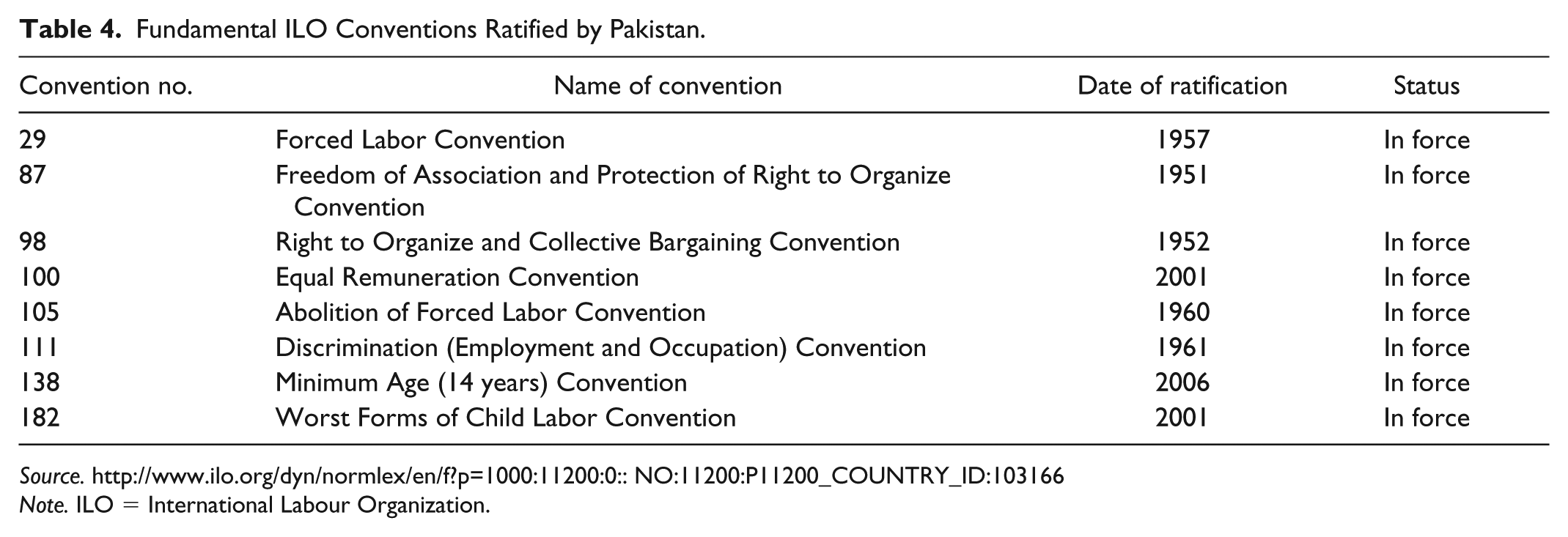
Among South Asian countries, Pakistan is the second country that affirmed and implemented all eight fundamental conventions as sanctified in the international labor organization (ILO) Declaration on “Fundamental Principles and Rights at Work.” The Government of Pakistan has affirmed and implemented a total of 34 ILO conventions, including 8 fundamental conventions (ILO). The details of fundamental conventions and their ratification date are presented in Table 4.
Fundamental ILO Conventions Ratified by Pakistan.
Note. ILO = International Labour Organization.
The Four Stages of ATC Liberalization.

Source. Reinert (2000).
Note. ATC = agreement on textile and clothing.
Empirical Strategies
Regression Analysis
Jayasuriya (2008) and Robertson (2009) sorted globalization studies into three methodological groups: (a) event studies, (b) price studies, and (c) quantity studies. Empirical event studies compare the scenario of working conditions before and after a well-identified event of liberalization while accounting for other confounding elements that may have changed simultaneously. The nature of our empirical study is event study and the well-identified liberalization event is the elimination of MFA/ATC.
Working environment (or conditions) can either be substitutes or complements for earnings. According to compensating differential approach, working conditions and earnings are substitutes: in this scenario, firms with poor working environment need to pay workers higher rewards to compensate them for bearing the poor (working) conditions (and, accordingly, pay less for better working conditions). Working conditions can be modeled easily in a regression framework. The simple way is to take working condition (wc) as a dependent variable like in the model given below. We follow Savchenko and Acevedo’s (2012) approach to working conditions.
We use national household survey data for the years 2001 and 2007 of the Pakistan Labor Force Survey (henceforth LFS) conducted by Pakistan Bureau of Statistics. The LFS is a nationally representative cross-sectional survey data. The LFS is an annual survey, carried out in four quarters which help to counter seasonal variations. The key objective of the labor force survey is to gather data on a set of wide-ranging statistics on the several aspects of the country’s civilian labor force. The LFS largely provides data on the various aspects of the labor force in the country. The demographics comprise information on variables such as age, gender, head of household, nuptial status, literacy, education level, occupation, industry affiliation, and movement of population. The aspects of workforce include information on (a) working force categorized by sector, informal and formal industry, profession, job status, number of hours worked and education level; (b) workplace safety and health statistics of working persons; and (c) jobless workers by education-level and prior work experience. The employment of the industries is reported at two-digit ISIC codes in LFS.
We construct the measure of working conditions using the information available in Pakistan labor force surveys. Working conditions are considered good to the worker if he or she (a) is older than 14 years, (b) works less than 40 hr a week (or works less than 6 days a week), (c) has a low in-kind compensation to cash work ratio, and (d) has a high benefits to cash pay ratio. These measures reflect only some aspects (i.e., no child labor and unpaid overtime or no mandatory work) of job quality. Unluckily, we cannot produce a comprehensive index of working conditions (wc) due to the data availability issue.
To empirically examine (average) working conditions, dummy variables equal to one for each good working condition and zero otherwise. Working condition dummy is average of two dummies. A first dummy variable is equal to one if the worker is older than 14 years and the second dummy is equal to one if the working hour is less than or equal to 40 hr a week. Working condition dummy is averaged across two conditions for each worker. The empirical regression model is illustrated in the equation given below where the dependent variable—the average working conditions (wckt) of worker k in period t—is a function of (a) years of schooling (Edukt), sex (using the dummy variable Femalekt that equals to one if the worker is female), Agekt,

Our coefficient of interest in this regression model is

Propensity Score Analysis
Propensity score matching (PSM), introduced by Rosenbaum and Rubin (1983) in their seminal work, has been extensively used in research to decrease bias in observational studies. PSM helps to correct treatment selection bias in observational studies (OS) which are non-random. As in OS, classification of subjects into the groups (i.e., control and treatment) is non-random. It causes bias in the estimation of treatment effects due to the presence of confounding factors.
PSM is a good technique to “correct” estimation of effects of treatment regulating for the presence of such confounding factors. It is based on the idea that estimation bias in treatment effects can be reduced by comparing the outcomes of similar subjects in control and treated groups. The PSM methodology generated a single index (the propensity score) from an n-dimensional set of attributes of the subjects which makes PSM feasible.
In the words of Lunceford and Davidian (2004), Estimation of treatment effects with causal interpretation from observational data is complicated because exposure to treatment may be confounded with subject characteristics. The propensity score; the probability of treatment exposure conditional on covariates, is the basis for two approaches to adjusting for confounding: methods based on stratification of observations by quantiles of estimated propensity scores and methods based on weighting observations by the inverse of estimated propensity scores.
The concept of double-robust estimators introduced by Robins and others (Bang & Robins, 2005; Robins, 1999; Robins, Rotnitzky, & Zhao, 1995) account for the propensity score model and the outcome model in the same estimator. Lunceford and Davidian (2004) derived the form for “Double Robust estimator.” This double-robust estimator provides researchers the freedom of getting unbiased inferences when acclimatizing for effects of selection, for instance, confounding by granting for distinct versions of model specification and offer improved efficiency when all the models are in correct specification.
We apply this technique to our data to further substantiate our findings from the previous methodology. The purpose of this methodology is to reduce treated selection bias if it is present in our case. As our study is observational study and assignment of treated and a control group to subjects is not random, it is recommended to use double-robust estimator for our causal effects.
The outcome model is the same as in Equation 7 and the propensity model is the same except the interactive variables in Equation 7 and treatment exposure variable which is year dummy.
Empirical Findings
Results and Discussion
The estimation results of Equations 6 and 7 are presented in Table 6. Columns 1 and 2 represent the result of two variations of Equation 6. Columns 3 and 4 represent the results of Equation 7. Before going into detailed explanation, a reader should keep in mind that working condition variable is the average of two dummy variables—a dummy for a worker older than 14 years of age (i.e., no child labor) and a dummy for a weekly working hours not more than 40 hr (i.e., unpaid overtime or no mandatory work). This working environment index reflects two distinct aspects (i.e., no child labor and unpaid overtime or no mandatory work) of the working environment. Pakistan Labor force survey data is pooled across 2001 and 2007 in every regression.
Estimates of Equations 6 and 7.

Source. Author’s calculations based on Pakistan labor force survey of 2001 and 2007.
Note. Standard errors are shown in parentheses, Additional control variables include age, age2, education, dummies for marital status, industry, and occupation. T&A = textile and apparel.
p < .1. **p < .05. ***p < .01.
The estimation results of Equation 6 show that the working condition index in the textile and apparel sector of Pakistan deteriorated after the MFA phase-out by 0.015%, compared to other sectors (see Table 6, Column 1). But it is statistically insignificant, suggesting that textile and apparel’s working environment were not disturbed differently than other industries as a result of the elimination of MFA/ATC. Our results are in contrast to Savchenko and Acevedo (2012) for Cambodian case, working conditions in the textile and apparel sector deteriorated after elimination of the MFA/ATC. Our findings in Column 1 are in contrast to Savchenko and Acevedo (2012) for the Sri Lankan case, where working conditions improved post-MFA. After controlling for provincial heterogeneity, a minor correction in magnitude in all models is observed but sign and statistical significance remain the same.
Our main coefficient of interest is the coefficient of the interactive variable of three dummy variables (i.e., Year, T&A, and Female) in the models presented in Columns 2 and 4. The coefficient is negative and statistically significant. The female working environment deteriorated by 26.1% (see Table 6, Column 2) in relation to the male working environment and compared with the other sectors. When we control for provincial differences, this deterioration increased by 0.8% (see Table 6, Column 4). Our findings are in contrast to Savchenko and Acevedo (2012) for Cambodian and Sri Lankan case, where the impact is positive but statistically insignificant.
The adjusted R2 improved by 0.60% as we added province dummies to control provincial heterogeneity in the model presented in Column 1 (comparing model presented in Column 1 and in Column 3) and it increased by 0.62% (comparing adjusted R2 in Column 2 and in Column 4) as we added province indicator variable in model.
Robustness Check
To check the robustness of our finding, we made various models with different control variables. We use the model presented in Columns 1 and 2 of Equation 6 and model presented in Columns 3 and 4 of Equation 7 in Table 6. The results of the model presented in Column 2 of Equation 6 in Table 6 [Note: all other models are available from authors upon request] are presented in Table 7. The signs of the interested coefficients remain the same in all models as we found in Table 6. In all models, our core variable of interest is the coefficient of the interactive variable of three dummy variables (year, textile and apparel sector, and female). The sign of the coefficient is negative and statistically significant suggesting that female working environment of textile and apparel sector deteriorated as a result of the phasing out of the MFA/ATC in relation to the male working environment and compared with other sectors in all models. The deterioration in working conditions ranges from 7.07% to 13.3%. The lowest deterioration (see Table 7, Column 1) is in the model where we did not account for industry, marital status, and occupational differences and the highest deterioration (see Table 7, Column 8) in the model where we accounted for the industry, marital status, and occupational differences. We also used the model presented in Column 4 of Table 6, where we accounted for provincial differences with all the models as we did in Table 7, and its results are available upon request. The results are almost similar to that given in Table 7.
Estimates of Equation 6.

Source. Author’s calculations based on Pakistan labor force survey of 2001 and 2007.
Note. Standard errors are shown in parentheses. Additional control variables include age, age2, education, dummies for marital status, industry, and occupation. T&A = textile and apparel.
p < .1. **p < .05. ***p < .01.
Results of Propensity Score Analysis
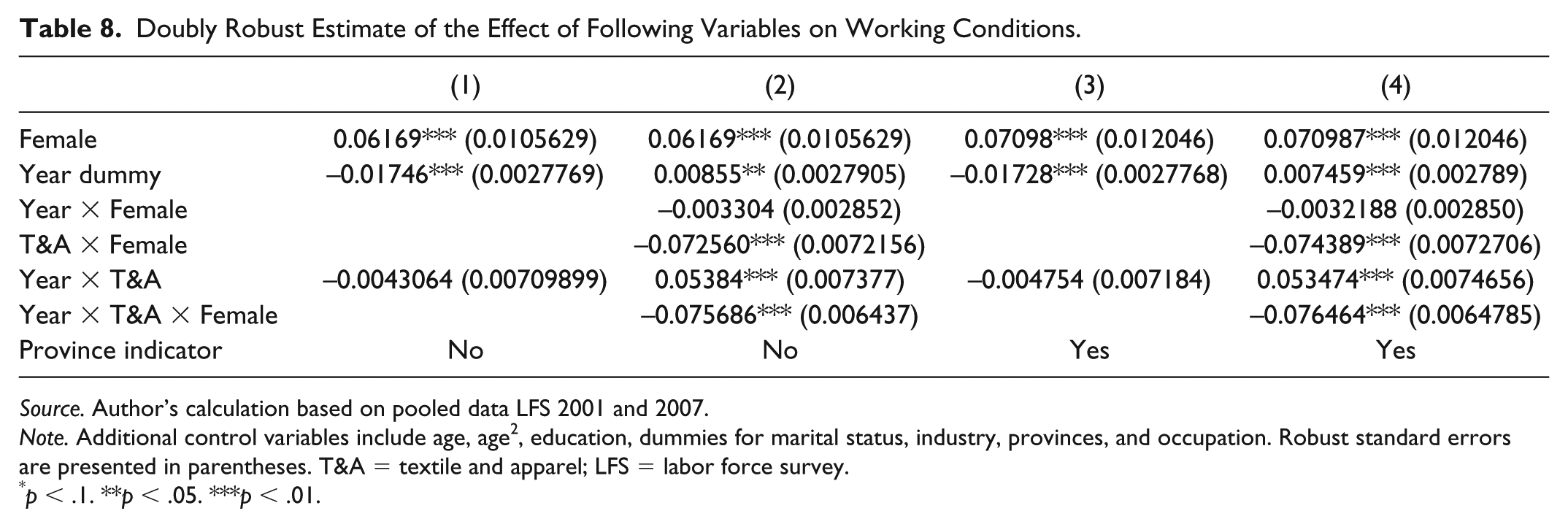
The results of propensity score analysis are presented in Table 8. We use double-robust estimator for causal effects of the elimination of the MFA/ATC on working conditions controlling for treated selection bias and other confounding factors. We applied robust standard errors in estimation. We estimated all models presented in Table 6 using propensity score analysis and results are presented in Table 8. Each row of the table represents one model. We combined all models that are our core variables in the analysis.
Doubly Robust Estimate of the Effect of Following Variables on Working Conditions.
Source. Author’s calculation based on pooled data LFS 2001 and 2007.
Note. Additional control variables include age, age2, education, dummies for marital status, industry, provinces, and occupation. Robust standard errors are presented in parentheses. T&A = textile and apparel; LFS = labor force survey.
p < .1. **p < .05. ***p < .01.
The working environment in the textile and apparel sector is not different after the MFA/ATC phasing-out as compared to other sectors. Our core variable is the parameter of the three interactive variables (Year ×T&A × Female). The female working environment worsens by 7.6% as compared to her counterparts and in relation to other sectors after the elimination of the MFA/ATC. Other coefficients maintain their signs and almost similar magnitudes with reference to the results presented in Table 6. The detailed comparison between propensity score estimates and regression estimates of core variables is shown in Table 9. Our results are not driven by sample selection bias. The findings of regression analysis are further substantiated by propensity score analysis.
Comparison Between Regression and Propensity Score Estimates.

Source. Author’s calculation based on pooled data LFS 2001 and 2007.
Note. Additional control variables include age, age2, education, dummies for marital status, industry, provinces, and occupation. PSM = propensity score matching; T&A = textile and apparel; LFS = labor force survey.
p < .1. **p < .05. ***p < .01.
Conclusion
Globalization, defined as the phasing-out of the MFA/ATC in 2005, played a significant role in the world trade of textile and apparel in general and in Pakistan in particular. The phasing-out of the MFA/ATC is one of the key policies which were governing the textile and apparel trade of the world. The MFA/ATC’s termination resulted in a dramatic redistribution of the provision of the world apparel production. We investigated the impact of the elimination of the MFA/ATC on the workers of the textile and apparel sector in general and female workers in particular in case of Pakistan. We adopted the event study methodology using labor force data of Pakistan for the years 2001 and 2007. We followed Savchenko and Acevedo’s (2012) approach of working conditions for the index of the working environment. Our limitation is the use of a narrow measurement for a working environment which is due to unavailability of comprehensive data on working environment indicators.
We found that the impact of the elimination of the MFA/ATC on workers of the textile and apparel sector is negative and statistically insignificant. The working conditions of workers in the textile and apparel sector are not different in comparison to other sectors. The female working conditions deteriorated as a result of the phasing out of MFA/ATC in relation to the male working environment and compared with other industries in case of Pakistan. Our findings are robust in a sense that the direction of the impact remains the same and statistically significant even after performing sensitivity analysis and magnitude lies between with no controls and with full controls. We also controlled for provincial heterogeneity, and the results showed minor correction in magnitude but remain negative and statistically significant.
We also accounted for treatment selection bias by performing propensity score analysis. We used double-robust estimator for the causal effects of our model that we used in the regression framework. We found similar results from propensity score analysis. Regression results are further substantiated by propensity analysis.
Footnotes
Declaration of Conflicting Interests
The author(s) declared no potential conflicts of interest with respect to the research, authorship, and/or publication of this article.
Funding
The author(s) disclosed receipt of the following financial support for the research, authorship, and/or publication of this article: This study was financially supported by China Scholarship Council (CSC No. 2013586101) and National Nature Science Foundation of China (No. 71433002).
