




Abstract
Although, written corrective feedback (hereafter referred to as CF) is applauded in many writing courses for fostering students’ quality writing, its impact on grammatical accuracy in L2 students’ writing remains a debated topic. Thus, this study looked into the effect of CF types on L2 students’ grammatical accuracy in writing. To achieve this objective, the design of this study was quasi-experiment. During the intervention of the study three groups: two experimental groups and one control group were participated with a total of 150 students. Over the intervention of 8 weeks, the students received pretest, immediate post-test and a delayed post-test was given. The data collected through the writing tests was analyzed using one-way ANOVA and Scheffe post hoc tests. The findings indicated that although CF types have positive effects during the immediate posttest scores, they did not have any positive effect on L2 students’ grammatical accuracy in writing context in the delayed posttest scores. This implies that CF alone is not sufficient for improving the grammatical accuracy of high school students in Ethiopia. Although the CF literature discussed its importance in the language acquisition, teachers are advised to focus on students’ additional exposures in writing accuracy rather than grammatical correction in their writing classes and use longer treatment to allow language learners’ engagement with the CF types provided.
Introduction
It has widely been recognized that CF in L2 writing should become a focal point for researchers. In recent years, there has been a call for more researches on CF effects on grammatical accuracy in L2 writing and it is regarded as a highly contentious topic study (Chong, 2022; D. R. Ferris, 2002, 2003, 2010; Zhang et al., 2022). Not only do researchers and L2 teachers of writing hold opposing views on the efficacy of CF (Rahimi, 2009; Yu et al., 2023). Many researchers have investigated the impact of CF on various levels of education regarding students’ writing achievement (Crossley et al., 2022; Wondim et al., 2023), writing accuracy (Almasi & Tabrizi, 2016; James, 2008; Miles, 2014; Seiffedin & El-Sakka, 2017; Wang, 2017), grammatical accuracy (Alharrasi, 2019; Baleghizadeh & Gordani, 2012; Chan & Yamashita, 2022; Khanlarzadeh & Nemati, 2016) and rhetorical patterns of writing (AL Harrasi, 2023). However, there has been compelling evidence that CF improves L2 writing, its impact on grammatical accuracy in L2 writing is a hotly debated topic (Ghoorchaei et al., 2022; Rahimi, 2021; Razali et al., 2021; Westmacott, 2017). A number of studies (e.g., Baleghizadeh & Gordani, 2012; Karim & Nassaji, 2020; Sarvestani & Pishkar, 2015) have argued that the CF is useful in improving the quality of L2 students’ writing, particularly grammatical accuracy.
Furthermore, over the last three decades, researchers have paid increasing attention to the effectiveness of CF in the critical area of language learners’ grammatical accuracy (Alharrasi, 2019; Kocaman & Maral, 2022; Sarvestani & Pishkar, 2015). The researchers were split on whether CF helps L2 students write more accurately. Some interventions focus on the methodological framework rather than how well the CF results influenced L2 learners’ writing. CF’s effectiveness in L2 writing has previously been studied (Khanlarzadeh & Nemati, 2016). The majority of them concentrated on the pretest and posttest method design and concluded that CF had either a positive or negative impact on L2 learners’ writing. According to Ghoorchaei et al. (2022) state that CF had no appreciable impact on the text revision before, during, or after intervention. The results of the post-test that was delayed, however, do not show the effects of CF on the writing performance of L2 learners over time. The majority of earlier study designs (such as, Gebremariam & Hiluf, 2023;; Hiluf et al., 2024; Kang & Han, 2015; Wendimu & Gebremariam, 2024; Woreta & Gebremariam, 2023) were carried out as quasi-experiments without the use of delayed post-test results (Kang & Han, 2015). In light of this, the primary goal of writing in Ethiopian general education is to provide students with the written communication skills necessary to deal with L1 and L2 writing issues on a local and global scale (Polio, 2012; Toria et al., 2015; Wondim et al., 2023). Despite the fact that writing is an essential component of language skills, it is frequently viewed as a component of grammar and syntax (Teo et al., 2023).
Although CF has received increased attention that owing to the conceptual controversy surrounding it as well as its practicality in L2 writing (Kang & Han, 2015), most CF studies lack ecological validity because they used a one-shot research design, such as providing feedback on a simple draft for grammar correction (Mashhadi et al., 2017). Hartshorn et al. (2010) discovered that the CF pedagogy had little effect on students’ rhetorical competence, writing fluency, or writing complexity, but that students’ writing accuracy had significantly improved. Siekmann et al. (2022) investigated the precision of student writing using the CF manipulation. The results show that the experimental class and the control class were compared in the post-test, and the experimental class’s score is clearly higher than the control class’s. A variety of error types must be targeted in a single study that includes delayed assessments (Ekiert & Gennaro, 2021; Kang & Han, 2015; Kim, 2012). A study of this nature will not only be able to provide more practical and approachable advice to L2 writing teachers (Al Zahrani & Chaudhary, 2020). In addition, Sarvestani and Pishkar (2015) proposed that similar studies could be replicated in the future with a large number of ecologists or students with various backgrounds to observe the impact of direct and indirect feedback types in order to produce more insightful study results (Al Zahrani & Chaudhary, 2020; Ito, 2023). In this case, it might make sense to logically elicit from the students what kinds of feedback they frequently receive and which of those is most beneficial. Kocaman and Maral (2022) also contend that in order to help L2 students succeed in their writing, it is necessary to explicitly implement various types of CF.
Previous research (Baleghizadeh & Gordani, 2012; Carless & Boud, 2018; Kim, 2012; Khodareza & Delvand, 2016; Rahimi, 2009) has shown that CF is effective during the implementation process, and revisions have contributed to the uptake and retention of new grammatical forms. However, the studies did not examine how much students responded to and shared feedback from teachers. Despite the possibility that some research findings may have a significant influence on error corrections (Ji, 2015; Troia et al., 2015; Shrestha, 2022). The results of these studies, at best, show that CF is effective when it is targeted, but they do not offer a conclusive response to the more general question of whether or not to correct learners’ grammatical errors (AL Harrasi, 2023; Almasi & Tabrizi, 2016; Jang, 2022; Rahimi, 2019; Siekmann et al., 2022). Additionally, CF only helps students in reducing grammatical errors of their L2 writing during the revision process and does not significantly affect their overall grammatical accuracy in the future on a new writing task, according to Khanlarzadeh and Nemati (2016). When the CF was implemented, there was a significant drop in student writing errors of 69.4%, according to Kocaman and Maral (2022), but the level of grammatical error reduction was unaffected by the delayed test. In order to overcome these constraints, several studies examined how students interpret teacher feedback (Zhenga & Yuc, 2018).
While studies on CF types and writing accuracy have been conducted, the findings may not be applicable to the context of this study. According to Wondim et al. (2023), the ecological focus of this study did not emphasize any of the previous studies’ ecological contexts. Given that in a natural classroom, both teachers and students expect to receive feedback on all grammatical errors. To this end, D. R. Ferris (2006) emphasized that additional research is necessary to examine the ecological validity and reliability of the feedback types that were the focus of this study. Based on this, the current study came to the conclusion that it was essential for learners’ overall writing ability to provide CF types on the grammatical accuracy of L2 students’ writing. Researching the impact of CF in writing classrooms and the results of their writing accuracy, as well as the uptake rate of each feedback type, was another suggestion made by Chong (2022). Overall, it can be said that this study responds to calls for longitudinal research on the function of various types of feedback because it was conducted semester-by-semester in real classrooms using a quasi-experimental design (Chong, 2022; Ghoorchaei et al., 2022) and focuses on L2 writing of non-English speakers (Wondim et al., 2023). Therefore, it can be said that the methodological and practical gaps left by earlier studies are anticipated to be filled in this study.
Moreover, the CF scope refers to the extent of error coverage in the text (Ghoorchaei et al., 2022; Wondim et al., 2023). Ellis (2009) also emphasized the feedback scope, which can be classified as direct or indirect error correction. Therefore, the current study seeks to investigate the role of CF in improving students’ grammatical accuracy of writing from the perspective of 10th grade Ethiopian high school students, and it includes the following research questions to that end:
Does participant groups are comparable as measured by the pretest?
Do CF types have any comparable effect on L2 students’ grammatical accuracy in writing, during the immediate post-test?
Do CF types have any comparable effect on L2 students’ grammatical accuracy in writing, during the delayed post-test?
Review Literature
Over the past three decades, there have been fruitless discussions about the impact of corrective feedback (hereafter, CF) on grammatical accuracy in L2 writing classes. Some studies focused on the drawbacks of CF and considered them to be a waste of time (Chandler, 2009; Ghoorchaei et al., 2022; Khanlarzadeh & Nemati 2016; Tayebipour, 2019). In particular, D. R. Ferris (2002, 2004), Truscott (2004, 2007, 2009) and Truscott and Hsu (2008) shared this opinion. According to Truscott (2007), error correction in language learning is both ineffective and possibly harmful. The validity of Truscott’s claims regarding the role of CF in error correction in language learning was debated by Bruton (2009) and D. R. Ferris (2002).
Theoretical Perspectives on CF Types
Along with the development of authentic strategies in language instruction, there have been significant changes in teachers’ and researchers’ self-efficacy regarding the role of CF in L2 writing classrooms (D. R. Ferris, 2003; Thi et al., 2023). Under the influence of behaviorism and structuralism theories, error correction was regarded as an important aspect of learning in the language classroom (J. Chen et al., 2016; Wondim et al., 2023). Later, during the 1970s and 1980s, language learning was viewed as a natural process (Erel & Bulut, 2007; K. Hyland & Hyland, 2006). Vygotsky (1978), an advocate of the sociocultural perspective, claims that communication between language learners and native speakers serves as a mediator for language learning. This concept is consistent with the learner’s zone of proximal development. In contrast, Vygotsky advocates using a scaffolding strategy to help students move from ignorance to understanding and independence. In addition, CF promotes students’ conversion of their deliberative knowledge into procedural knowledge (Bitchener & Ferris, 2012; Ranalli, & Yamashita, 2022). Researchers Polio (2012), Lim and Renandya (2020), and others advise conducting more research to ascertain the amount and type of feedback that is advantageous during learning practice.
Prior to the mid-1990s, there were few theoretical trends and empirical studies on CF in L2 writing (Baleghizadeh & Gordani, 2012; K. Hyland & Hyland, 2006, 2019; D. R. Ferris, 2010; S. Ferris et al., 2013). Based on previous studies that ranged a research with the distinct views of CF effectiveness on language learning, Truscott’s (2004, 2007, 2010a, 2010b) is well known that argues CF as ineffective on L2 writing classroom; error correction seen as a positive effect on language learning. Other scholars, such as D. R. Ferris (2009) and Ghoorchaei et al. (2022), share Truscott’s belief in grammatical accuracy in L2 writing. Sarre et al., discovered that when the CF on grammatical structure was compared to feedback on the content of students’ writing, those who received feedback on content performed better in their papers. Alharrasi (2019), one of the critics of the impact of CF on the grammatical accuracy of L2 students’ writing, reported a similar result. Kang and Han (2015) conducted a meta-analysis of previous research on the effectiveness of CF in improving L2 written accuracy and concluded that no empirical studies were directly available that examined the relationship between proficiency level and the effects of various CF. Later, such research began addressing problems with L2 writing by supporting the idea that error correction should be contextualized within the writing process (Elosua, 2022; Jang, 2022), focusing on the most common and serious errors, and paying attention to individual learners’ writing needs (Khodareza & Delvand, 2016; Teo et al., 2023). However, in L2 writing classes, CF has always been associated with negativity, and researchers occasionally confuse it with error correction.
Additionally, the mode of CF in L2 writing component is the context for this study’s research (Ellis et al., 2008; Ghasemi et al., 2021; Sarré et al., 2021; Thi et al., 2023; Yu et al., 2023). If it is done in a way to give the students feedback on their grammar mistakes, which can be a helpful experience for the students if the teacher also demonstrates their strong points, teaching L2 writing are an important productive skill and a helpful activity for students (Ji, 2015; Rice, 2021; Westmacott, 2017). Written CF is viewed as a vital component of teacher-student interaction in the context of L2 writing; it aids teachers in determining the L2 writing abilities of their students and needs to be aware of their present status (Baroudi et al., 2023; Brookhart, 2008; Dai et al., 2023; Truscott, 2004, 2007). Although CF calls for interaction with students, existing research shows that this interaction is frequently inaccurate (Baroudi et al., 2023); CF is still seen as a one-way response from teacher to students (Polio, 2012; Siekmann et al., 2022). Due consideration must be given to this drawback in order to show the type of feedback and its progressive improvement in L2 writing formative classrooms (Lee, 2008; Nassaji & Kartchava, 2017; Saadi & Saadat, 2015).
CF Types and Grammatical Accuracy in L2 Writing
Many studies are now being conducted on the contradictory role of CF in the development of grammatical accuracy in L2 students’ writing. It has been debated whether the CF types impact on grammatical accuracy is due to their direct or indirect nature (Ellis, 2009; Ferguson, 2011; D. R. Ferris, 2011; S. Ferris et al., 2013; Ghoorchaei et al., 2022; Matsumura et al., 2023; Razali et al., 2021; Rouhi et al., 2020). Direct CF, as advocated by Ellis (2009), allows language students to quickly internalize the correct form as advised by their teachers. Language learners are unsure if their estimated rectifications are correct when their errors are not immediately corrected. According to Bitchener and Knoch (2010), only direct CF provides language learners with the type of explicit data required for the test hypothesis. The indirect CF is an alternative to the direct CF. Different indirect feedback types, each with varying degrees of explanation, can be used (e.g., coding, underlying, etc.). According to D. R. Ferris (2002, 2003), indirect input performs better and has a greater impact than direct feedback. Furthermore, Sarre et al. (2019) argue that indirect feedback encourages the use of linguistic structures in L2 writing accuracy. Ghasemi et al. (2021) believe that CF has been proven to be a key tool to improve L2 students’ writing accuracy and that the teacher decides on their writing quality through the CF types. According to Wang (2017), there are numerous types of CF that can be used in the L2 writing classroom, including direct and indirect types.
While CF improves students’ written accuracy in general (Bitchener & Ferris, 2012; Chu, 2011; Rizkiani et al., 2019), many teachers are still unsure of the specific actions they should take to support their students’ writing accuracy (Forgie et al., 2022; Sanosi, 2022; Seiffedin & El-Sakka, 2017). Some findings suggest that CF is effective in assisting students in improving their writing abilities (Van Beuningen, 2010; Zhang et al., 2022).On the other hand Ghoorchaei et al. (2022) and Truscott (2007) concluded that error correction using any of CF is unnecessary, harmful, and ineffective and should be eliminated from L2 writing classrooms. According to Truscott (1996, 1999, 2004, 2007, 2010a, 2010b), Truscott and Hsu (2008), Hartshorn et al. (2010), and Liu (2008), it is not only ineffective but also potentially harmful to the development of students’ writing accuracy. Despite this debate, the efficacy of CF has been demonstrated for treating a few select simple rules-based errors, such as articles and prepositions (Khanlarzadeh & Nemati, 2016) among the L2 writing sub-skills (Bitchener & Ferris, 2012; Bitchener & Knoch, 2010; Bitchener et al., 2005; Hartshorn et al., 2010).
The CF has focused on direct and indirect forms of feedback (Banister, 2023; D. R. Ferris, 2003, 2004). The direct feedback is tends to correct mistakes by providing the proper linguistic forms above the incorrect form or in the margin of written work in order to provide the appropriate forms of errors (Bitchener et al., 2005; D. R. Ferris, 2006, 2010; S. Ferris et al., 2013; Lee, 2008; Zou et al., 2023). Contrarily, indirect feedback means that if there is a mistake in the writing, the teacher makes the students aware of it by providing general hints about the type and location of a mistake using a line, circle, mark code, or highlight, but they do not offer any correction (Forgie et al., 2022; Ghoorchaei et al., 2022). Learners also encountered difficulties when trying to correct errors based on prior knowledge during indirect feedback (Ellis, 2009; D. R. Ferris, 2006, 2010; Salami & Khadawardi, 2022; Sheen et al., 2009). Beginners may gain more from direct CF in this regard because they still need a lot of help developing their linguistic toolbox. As an alternative, giving indirect feedback is preferable for more seasoned students who are able to identify errors on their own (Kim, 2012; McMartin-Miller, 2014; Nel et al., 2020). Regarding indirect feedback, coded and un-coded signs are frequently used; coded signifies making a highlight with its indication of a grammatical error, while un-coded refers to making a line, mark, or highlight only.
Grammatical Accuracy in L2 Writing Skill
The most complicated and challenging skill to master as essential to L2 writing accuracy for learners is writing (Forgie et al., 2022; F. Hyland, 2003; Razali et al., 2021). Students learning L2 writing consequently find writing more challenging than students writing in their writing skill (Huisman et al., 2019; Nicol, 2010). The complexity and difficulty of writing are best summed up by the number of tasks that students must complete to guarantee that the final product satisfies the demands of the intended audience (Lim & Renandya, 2020; Nicol, 2010; Sanosi, 2022). In light of this, grammar and writing are interconnected, so learning writing also involves learning grammar, and vice versa (Carless & Boud, 2018; Sadler, 2010). As a result, the writing cannot convey its intended meaning if it is not grammatically correct. This is because proper grammar is a crucial component of the writing and cannot be ignored (J. Chen et al., 2016; Hattie & Timperley, 2007; Russell & Spada, 2006). Furthermore, L2 writers who want to improve their writing as a productive skill should consider studying contextualized grammar (Baleghizadeh & Gordani, 2012; Zhenga & Yuc, 2018).
In other words, writing can be studied in the context of ecology when viewed as a manifestation of authentic grammar study. Given this, it should be noted that, despite the fact that grammar is an essential component of any piece of writing, most students make mistakes when writing, whether in their L2 or in their native tongue (Erlam et al., 2013; D. R. Ferris, 2006, 2010). When grammar is missing, the reader may or may not understand the intended meaning, and the intended message cannot be delivered accurately. Producing writing tasks free of grammar errors is considered (Rizkiani et al., 2019), to some extent, a primary goal of writing students at all levels and stages, as the accuracy of written language in general and the intended message in particular is critical (Farrah, 2012; Karim & Nassaji, 2020; Van Beunnigen et al., 2012). Grammatical errors in L2 writing primarily affect the flow of communications and frequently impede the transfer of intended meaning (Ekiert & Gennaro, 2021; Ferguson, 2011). As a result, improving the accuracy of the grammatical aspect of writing is a necessary requirement in order to produce accurate written language and all aspects related to errors and their correction, as they are an unavoidable component of any authentic classroom (Frank et al., 2018; Huisman et al., 2019; Lira-Gonzales et al., 2021; Russell & Spada, 2006).
Methods
Research Design
To explore the effectiveness of CF in this study, a quasi-experimental research design with pretest, immediate post-test, and delayed post-test tests as data collection instruments was utilized that enabled to answer the research questions. The design was aimed to examine the Ethiopian high school students’ grammatical accuracy in L2 writing before and after receiving CF types. This was accomplished by using three intact groups, two experimental groups, and one control group. The first experimental group (hereafter referred to as the direct CF group) received direct CF, the second experimental group (hereafter referred to as the indirect group) received indirect CF, and the control group received no feedback throughout the course of the study.
Participants
Participants in this study were Ethiopian grade 10 high school students in the 2021/2022 academic year. The current study included 154 students in the pre-test of the study received the L2 writing test. Out of this number, 150 students found to be homogenous and were chosen for the intervention of the study divided into three intact groups of 52 students in the direct CF group, 48 students in the indirect CF group, and 50 students in another comparison group. Participants were also randomly assigned to three groups, two experimental and one control.
Instruments and Their Validity and Reliability
To collect data for this study, the instrument was used in pretest, immediately post-test, and delayed post-test tests. All the writing tasks were part of the students’ L2 writing curriculum and were not designed particularly for this study. As a result, the participants were required to complete story essays for the pretest, immediate post-test, and delayed post-test. Throughout the semester, each student was assigned four different writing assignments to complete in class. Each task included a scenario for a personal narrative, for which students had to write at least 150 words in 70 min.
Due to construct validity encompasses a wide range of validity types; the validity test was used in this study to examine the construct validity of the instruments. As a psychological and emotional concept that cannot be validated through statistical measurement, it was thought that construct validity could be assessed at various stages of the data collection process. As a result, construct validity can be said to be maintained if the data collection tool contains the necessary data for essay writing.
Concerning the inter-rater reliability of the data collection instrument, 30 papers were chosen at random from the written papers submitted by pilot study participants. Because there were three scorers, each essay was duplicated three times. After all, the correlation coefficient was calculated to be 0.906 in order to calculate inter-rater reliability. This demonstrates that the data collection instrument is both acceptable and trustworthy.
Research Procedures
The focus of the study was to investigate the effects of CF on grammatical accuracy of high school students’ L2 writing, but students also received writing instruction during the intervention. All of the participant groups were taught by the same teacher, who had been trained by the researcher to teach using CF types to the experimental groups and no feedback to the control group. During the intervention, the class met once a week for 8 weeks, with each session lasting 80 min. The classes focused on language components, but students also received CF-based writing instruction throughout the semester. During this time, the teacher in the direct CF group provided the students with proper grammatical accuracy by inserting the proper form for the errors above each learner’s linguistic errors and the students after receiving their papers, they were given at least 10 min to look over their errors and the correction carefully, whereas the teacher in the indirect CF group underlined and circled the students’ errors without providing the proper grammatical forms and the students were given at least 10 min to self-edit based on the teacher’s feedback type. The students in the control group did not receive any error CF. the teacher only gave very common and general comments (such as, good, it needs improvement) at the end of the learner’s papers. Both groups of students were told to write stories in class, revise them at home, and then turn them in during the next writing assignment. In terms of data collection, the study had three data collection phases: pretest, immediate posttest, and delayed posttest: (a) Before 1 week of the intervention the students received pre-test, (b) 1 week after the treatment of the two experimental groups, students were given the immediate post-test and (c) after 1 month of the immediate post-test they were given the delayed post-test. The primary goal of the delayed post-test was to determine whether the participants’ grammatical accuracy in L2 writing would maintain the results obtained in the immediate post-test. The procedure, content, and writing style of the students’ writing in the delayed post-test were the same as those in the pretest and immediate post-test.
Data Analysis
The study variables were direct and indirect CF (as independent variables) and grammatical accuracy (as dependent). To explore the role of the independent variables on the dependent variable, data were collected in three phases, and the normality related to grammatical accuracy results were calculated using the Kolmogorov-Smirnov test. The significance levels for grammatical accuracy scores in the pretest, immediate post-test, and delayed post-test were .26, .42, and .23, respectively, above .05. As a result, the parametric procedure of one-way ANOVA was used to answer the research questions raised in this study. To that end, the analysis was used to determine whether there were any differences in the mean scores from the pretest, immediate posttest, and delayed posttest, as well as whether the interventions had a statistically significant effect on the grammatical accuracy in writing of Ethiopian high school students. The Scheffe post hoc test was used to investigate potential group differences.
Ethical Consideration
The manuscript is unique, and the data reflect the actual effects of CF on Ethiopian high school students’ grammatical accuracy of L2 writing, who took part. This manuscript has not been published in any form or language, throughout portion or in entirety, anywhere else. The outcomes are presented clearly, truthfully and without improper data manipulation. There is no representation of information or a concept by others as though they were the author’s original, with appropriate acknowledgment of others’ works taken into account.
Furthermore, the informed written consent letter was taken from all the students and their parents before the study started and the students took part in the study voluntarily and based on their parents’ permission. In addition, before they participated in the study they were informed to the data were only for research purpose and would be handled coincidentally.
Findings
The analysis section focused on determining answers to the study’s research questions. During the data analysis, the independent variables of the two treatments (direct and indirect CF groups) and the dependent variable (grammatical accuracy) were revisited. The pretest, immediate posttest, and delayed posttest were used to answer the research questions, as shown below.
Findings Related to Pretest
The data from the pretest was used to answer the paper’s first research question. The descriptive statistics, including mean values and standard deviations of L2 students’ grammatical accuracy of writing scores, were used to analyze and determine the participants’ comparability prior to treatment, as shown in Table 1.
Descriptive Statistics of the Groups’ Pretest.
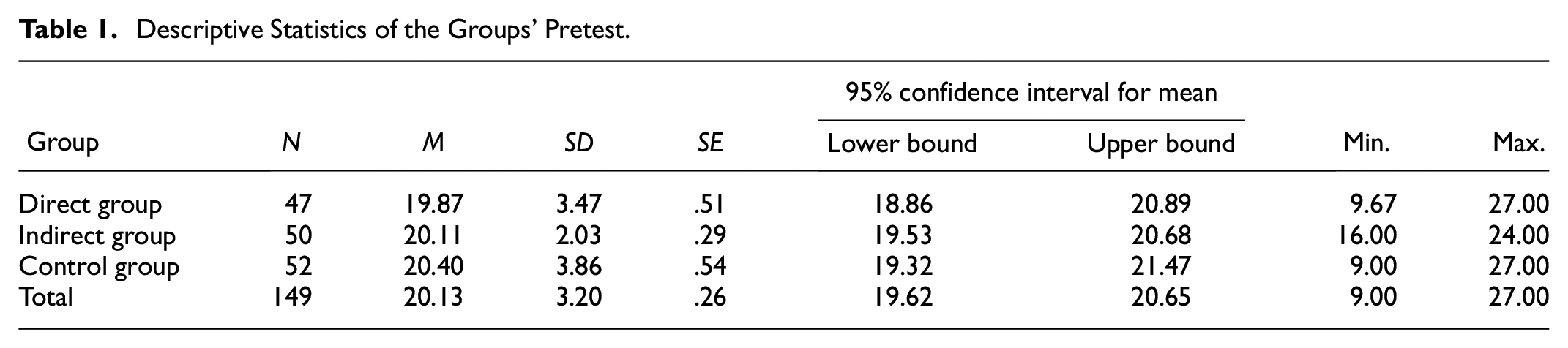
To see the participant groups’ homogeneity, pretest data were collected before the intervention. Depending on, Table 1 shows the descriptive statistics results for grammar accuracy in L2 wring achieved by participants during the pretest. The pretest participants’ mean scores and standard deviations were: direct group, M = 19.87; SD = 3.47, indirect group, M = 20.11; SD = 2.03, and control group, M = 20.40; SD = 3.86. However, the mean and standard deviation values cannot determine whether or not the groups are comparable. Thus, to see if there is a statistical difference or not between the mean values of the three participant groups in the study, the inferential statistics of one-way ANOVA was used as shown in Table 2.
One-Way ANOVA on the Pretest of the Three Groups.

Table 2 shows the one-way ANOVA used to determine whether there is a statistically significant difference or not between the mean scores of the pretest results of L2 students’ grammatical accuracy in writing. The pretest results of the three groups did not differ statistically significant at F(2,148) = .331, p = .719. This demonstrates that the participant groups were comparable in terms of grammatical accuracy of L2 writing achievement and treatment.
Findings Related to Immediate Posttest
Regarding, the intervention was carried out, and the grammatical accuracy of L2 students in writing test results was analyzed, as shown in Table 3.
Descriptive Statistics of the Immediate Posttest Groups.

Table 3 shows that the mean scores for grammatical accuracy of L2 high school students’ writing achieved by participants during the immediate posttest. The mean scores and standard deviations of the participants in the posttest were: direct group, M = 24.72; SD = 3.37, indirect group, M = 23.56; SD = 2.69, and control group, M = 20.77; SD = 3.33. In addition, the total mean score of the three groups was reported as M = 22.95; SD = 3.54. However, the mean and standard deviation values cannot determine whether or not there are statistically significant differences between the groups. Thus, one-way ANOVA was used to determine whether there is a statistical difference between the mean values of the three participant groups in the study, as shown in Table 4.
One-Way ANOVA on the Immediate Posttest of Three Groups.

A one-way ANOVA was also performed to see if L2 students’ grammatical accuracy in writing scores differed between experimental groups based on the CF types they received during the immediate posttest. The results in Table 4 show that both experimental groups were equally helpful in learners’ improving their L2 high school students’ grammatical accuracy in writing mean score in immediate posttest. An inference could be drawn from this that CF types influenced the immediate posttest result of L2 grammatical accuracy in different intervention approaches that were used to determine whether there is a statistically significant difference between the mean scores of the students’ posttest results. According to the findings, the posttest results of the three groups were statistically significant at F(2,148) = 20.96, p = .000. This indicates that the participant groups were statistically different in their grammatical accuracy of L2 writing achievement after the treatment of the direct and indirect groups. In this regard, the CF types had an effect on the grammatical accuracy of L2 students’ writing. Not only that, the post hoc analysis is provided to determine the effect of direct and indirect groups, as shown in Table 5.
Scheffe Post Hoc Multiple Comparisons on Immediate Posttest.

The mean difference is significant at the .05 level.
Although no statistically significant difference in L2 students’ grammatical accuracy was found in the pretest, a statistically significant difference was found in the immediate posttest, as shown in Table 4. The post hoc result in Table 5 also shows a significant difference between the direct and indirect group results, as determined by Scheffe pairwise comparisons at the .05 alpha level. Based on the statistical results, it can be stated that learners in the direct and indirect groups did not differ statistically significantly with a mean of 1.1634 and a p-value .193, which is greater than .05, implying that there was no statistically significant difference between L2 learners’ grammatical accuracy in the two intervention groups. The results show that when direct CF type is compared to indirect type, the effectiveness of Ethiopian L2 grammatical accuracy in writing is not different, even when learners lack direct responses to their error correction. Furthermore, the findings indicated that if the ultimate goal of CF type is to help learners improve their grammatical accuracy in writing; all CF types are effective during the immediate posttest. As a result, it should be noted that these changes were not observed at the start of the study, when the p-value = .719 indicated that there was no meaningful difference in learners’ grammatical accuracy in L2 writing prior to the intervention. This was automatically changed to the p-value = .000 in the immediate posttest, implying that CF types did not differ in improving L2 grammatical accuracy of writing in the classroom. Based on these findings, one can conclude that both CF types are equally important pedagogical tools for assisting L2 writing abilities in the classroom.
Findings Related to Delayed Posttest
Based on the results of a one-way ANOVA in Table 6, the estimated marginal means were similar, implying that different CF types influenced L2 learners’ grammatical accuracy in writing similarly, as shown in Table 5 post hoc comparisons. The estimated means and standard deviations for the direct group M = 22.43; SD = 15.20, indirect group M = 19.98; SD = 3.59, and control group M = 21.98; SD = 2.76, respectively. In addition, the total mean score of the three groups was reported as M = 21.45; SD = 8.93. The delayed posttest of L2 learners’ grammatical accuracy in writing was conducted 1 month after the immediate posttest, and overall, the mean values of the direct and indirect groups were lower (22.43 and 19.98, respectively) than they were in the immediate posttest (24.72 and 23.56, respectively). However, the standard deviation of the direct group (SD = 15.20) shows a high value than all standard deviations in this study. The control group’s mean value, however, increased from the immediate posttest result (20.77) during the delayed posttest (21.98), indicating that, despite the lack of a significant difference between the immediate posttest and the delayed posttest, the control group’s acquisition of writing was sound compared to the experimental groups. The fact that L2 students benefited equally from instruction in L2 writing classrooms alone must also be emphasized. Furthermore, because comparisons of mean and standard deviation values cannot determine whether there are statistically significant differences between groups, one-way ANOVA was used, as shown in Table 7.
Descriptive Statistics on Delayed Posttest.
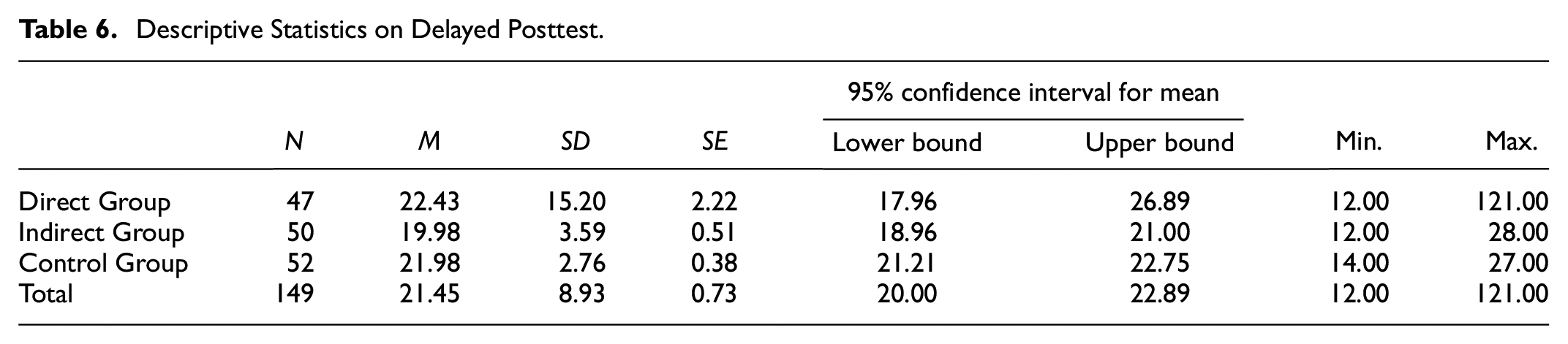
One-Way ANOVA on Delayed Posttest of Three Groups.

Table 7 shows the one-way ANOVA result of delayed posttest students’ grammatical accuracy is used to determine whether there is a statistically significant difference between the mean scores of the delayed posttest results. The delayed posttest results of the three groups were not statistically significant, according to the findings, at F(2,148) = 1.05, p = .353. This shows that the grammatical accuracy of the participant groups did not differ statistically after one month. The results show that the effectiveness of CF types is shown in a short period of time, as shown in Table 4, but there is no continuity of effectiveness in grammatical accuracy of L2 students in writing. In addition, post hoc analysis was used to determine the likelihood of effectiveness among the CF types, as shown in Table 8.
Scheffe, Post Hoc Multiple Comparisons on the Delayed Posttest Result.
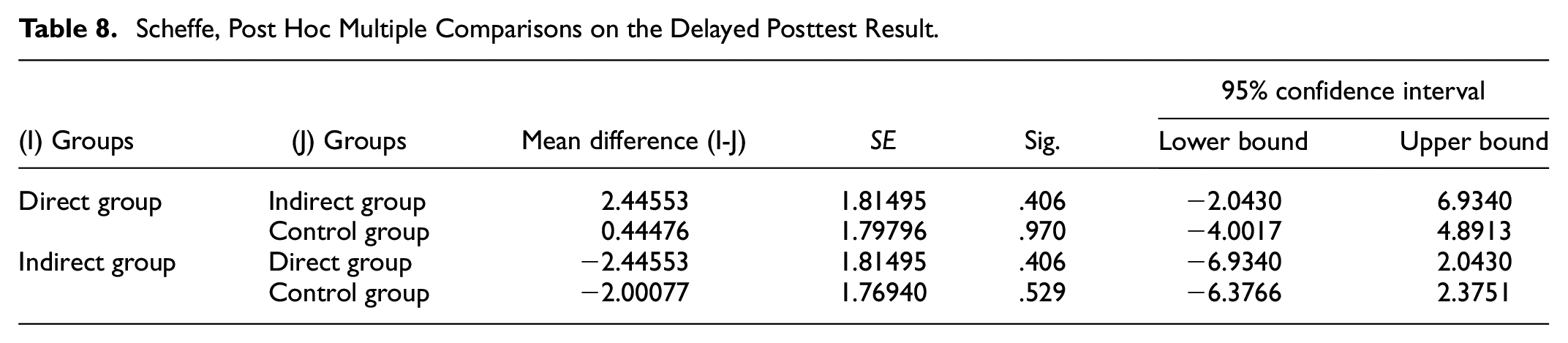
Table 8 shows that Scheffe’s results are used to identify the spots if there are significant group differences at the 0.05 alpha levels. Based on the statistical results, it can be stated that learners in all groups with a p-value 0.05, indicating that there is no statistically significant difference in L2 learners’ grammatical accuracy after 1 month of the immediate posttest, that is, delayed posttest. The results show that not only is there no effect of delayed posttest on Ethiopian L2 learners’ grammatical accuracy in writing, but there are also no differences in their effectiveness to the L2 grammatical accuracy of writing classroom between the intervention groups and the comparison group. As a result, no changes can be attributed to the experimental groups’ treatment in this study.
Finally, the overall results of L2 grammatical accuracy of Ethiopian high school students were calculated as the sum of the study findings that after 1 month of the immediate posttest of the interventions, the results of CF types in the direct and indirect groups did not show a statistically significant difference in comparison to the control group. The delayed posttest in estimated marginal means implies that CF types have no significant effect on high school students’ long-term learning of L2 grammatical accuracy in the Writing skill.
Discussion
Despite the fact that researchers continue to investigate these complexities and niches in the application of CF and have sufficient empirical data to support them, it is unknown whether some error types are more sensitive to CF types than others (Baroudi et al., 2023; Siekmann et al., 2022; Wondim et al., 2023). Thus, the primary goal of this study was to investigate the effects of CF types on L2 Ethiopian high school students’ grammatical accuracy in writing achievement because the theoretical implications of previous studies were unclear (e.g., Al Harrasi, 2023; Alharrasi, 2019; Chong, 2022; Kang & Han, 2015; Ghoorchaei et al., 2022; Salami & Khadawardi, 2022) as well as to compare the effectiveness of each CF type in improving students’ grammatical accuracy. Polio (2012) noted that a research agenda on the effects of CF types and the error correction connections is required. Thus, the purpose of this study was to take a step toward that end. Based on this, the first goal of the study was to see if the participant groups were comparable enough to carry out the intervention in the following steps. Because the study design was quasi-experimental, it was determined whether the participant groups were comparable prior to the intervention of the study. The findings revealed that there were no statistically significant differences between the experimental groups (direct and indirect) and the control group. This indicates that the three participant groups were very similar to the study purpose in the subsequent intervention steps.
The second research question investigated whether CF types have any comparable effects on L2 students’ grammatical accuracy in writing in the Ethiopian high school context, as measured by an immediate posttest. The one-way ANOVA test revealed that there is a significant improvement in the grammatical accuracy of writing scores of L2 learners in both direct and indirect experimental groups from the pretest to the immediate posttest. Based on this, it can be concluded that CF types have a significant impact on L2 Ethiopian high school students’ grammatical accuracy in immediate writing production. According to Ferris (2003), writing accuracy is a fundamental skill of the educational arts. It requires students to organize their thoughts in a grammatically correct manner. To accomplish this, prior to the intervention of the study, the participants had comparable results (p = .719) in their L2 grammatical accuracy in writing proficiency. Thus, the findings are consistent with those of Wondim et al. (2023), who reported that CF types had a significant effect on L2 writing achievement. Furthermore, Sarre et al. (2019) investigated the effectiveness of CF types on writing accuracy and discovered that any type of CF is better than no CF at all. Furthermore, Bitchener and Knoch (2010) found that providing CF is preferable to not providing it at all. Furthermore, the findings contradict Ghoorchaei et al. (2022), who conclude that CF types did not improve test scores and that exposure to CF types did not improve learners’ short-term retention in terms of subject-verb agreement. Furthermore, Alharrasi (2019) discovered that CF types had no positive effect on students’ writing accuracy when it came to spatial prepositions. Furthermore, Chandler (2003) discovered that CF types had no effect on students’ retention of grammatical accuracy in writing. Furthermore, the findings agree with those reported by Suhono (2017), who discovered that learners with low levels of performance may be unable to identify and correct their errors.
The third research question asked whether CF types have any comparable effects on L2 students’ grammatical accuracy as measured by the delayed posttest. The one-way ANOVA test found no improvement in the delayed posttest based on the different types of CF. According to Wang (2017), students believe that CF has a significant impact, despite the fact that there is a discrepancy between what students believe and what their teachers actually do in the authentic classroom. This study found no statistically significant group differences in L2 high school students’ grammatical accuracy in writing achievement between the two CF groups and the control group on the delayed posttest from the immediate posttest interval. Although the experimental groups did not significantly improve L2 students’ grammatical accuracy in comparison to the control group, the results showed that CF types had a significant negative effect on the grammatical accuracy of high school students in the delayed posttest. As a result, it was concluded that exposure to CF types did not improve L2 students’ grammatical accuracy. The findings are consistent with the findings of Alharrasi (2019), who discovered that CF types had no positive effect on students’ grammatical accuracy in the context of writing ability. Furthermore, the findings were consistent with Khanlarzadeh and Nemati’s (2016) study, which discovered that while the experimental groups significantly outperformed the control group in the three writing tasks, no significant difference was found when the two groups produced a new piece of writing after a 1-month interval. The study concludes that accuracy improvement caused by CF types during the intervention process does not extend to future L2 learning writing when no feedback type is available.
In contrast, the findings did not agree with those of Baleghizadeh and Gordani (2012), who discovered significant differences in the immediate and delayed posttest effects of CF types on L2 students’ overall accuracy of writing improvement. The study concluded that the type of feedback provided could be attributed to an improvement in writing accuracy in at least one way. Sanosi (2022) also revealed the effectiveness of CF types after 14 weeks of the intervention the experimental groups showed a significant improvement in their writing accuracy compared to the control group of the study. Furthermore, Bitchener and Knoch (2008) discovered that CF is effective in improving learners’ writing accuracy both before and after intervention. Furthermore, the findings are consistent with Kim (2012), who discovered positive effects of CF types in form-related writing accuracy in the posttest. Similarly, the findings contradicted the findings of Saadi and Saadat (2015), which discovered that CF types positively influenced learners’ writing accuracy, as well as Kocaman and Maral (2022), who concluded that CF types have a significant correlation with writing skill improvement. Furthermore, Rahimi (2009, 2021) discovered that using CF types resulted in writing instruction. Furthermore, Carless and Boud (2018) investigated CF in the writing accuracy classroom to see if students could identify their errors while writing and afterward. Students could recall and practice writing procedure knowledge, and they felt well prepared and confident in their writing performance.
The findings are also consistent with previous studies in the literature (e.g., Truscott, 2004, 2007, 2010a, 2010b, Truscott & Hsu, 2008), which found no significant effect for CF types on L2 students’ writing accuracy. The findings of this study indicate that CF types had no positive effect on L2 students’ grammatical accuracy in writing context in the delayed posttest scores. This suggests that CF alone is insufficient to improve the grammatical accuracy of Ethiopian high school students. Although the CF literature discussed its importance in language acquisition, teachers expected to focus on students’ additional exposures in writing accuracy rather than grammatical correction in their writing classes and use longer treatment to allow language learners were engagement with the CF types provided.
In general, the findings showed that CF types are important in the writing process in the authentic classroom, but they don’t play significant roles after a while (AL Harrasi 2023; Kang & Han 2015; Yu et al., 2023). The outcome of a delayed posttest to improve the effects of CF types on L2 grammatical accuracy in writing over a long period of time. Following the intervention of the study, an immediate posttest was given, which revealed that the effect of CF types had a significant effect on the L2 grammatical accuracy of the participant students. The obtained data from the two experimental and control groups were analyzed using one-way ANOVA, which revealed that CF types based instruction had no significant effect on the L2 high school students’ grammatical accuracy in writing. The findings agreed with Wang’s (2017) study, which found that after 10 weeks of intervention, students were given a delayed posttest, and the study found no statistically significant group differences between the two CF groups and the control group in L2 grammatical accuracy of students’ writing.
Conclusion
The purpose of this study is to demonstrate the effects of CF types on L2 students’ grammatical accuracy in writing context. The practical CF types were direct and indirect feedbacks displayed from the two experimental groups of this study. Despite the fact that the results were obtained using pretest, immediate posttest, and delayed posttest L2 writing tests, future studies could replicate similar studies with different ecological variations to obtain more meaningful research findings. Peer feedback, rather than teacher feedback, may be more beneficial and encouraging for improving writing accuracy. In conclusion, while CF may not be effective in correcting grammatical errors, it may be useful in new pieces of academic writing as well as studies of various proficiency levels and feedback strategies. The present study had several limitations. First, the students who participated as indirect and indirect groups were not measured by their revised writing texts. Especially the indirect group did not receive the exact form of their essays; it could be useful if the accuracy of the revisions were also measured. Second, some critics may think a 1 month after the immediate post-test interval for the delayed post-test is less likely to yield empirically robust findings in the long term and be pedagogically effective, thus, the delayed post-test time frame may not be sufficient: the delayed post-test was administered only 1 month after the immediate post-test, which may not be enough time to evaluate long-term effects of the intervention. Third, although the result of the delayed post-test displayed no effect of CF types on grammatical accuracy of L2 writing, due to the inconsistence of group sizes, the three groups have different numbers of students, which may impact the results and make group comparisons less reliable. Lastly, the teacher who implemented the CF types in the two experimental groups, due to lack of control over the teacher, such things may influence on the practice of the intervention results. Meanwhile, the same teacher taught all three groups, which could introduce bias in the treatment of each group, thus it was limited to state the effectiveness of the immediate post-test result.
To shed more light on this inconclusive area of study, the CF research agenda may provide deeper insight into L2 writing theories through future research investigations to be conducted in authentic classrooms. Hence, future research could be called for in order to acquire a more understandings of the effects of the CF types on grammatical accuracy of L2 writing. Furthermore, the CF is delivered as part of a larger instructional program, with ecologically valid writing tasks and revision that is meaningful for L2 language learners because it serves a purpose. The interaction of different learner variables such as L1 context, proficiency levels, and gender, which were not addressed in the current study, could be investigated in future research insights.
Footnotes
Acknowledgements
The authors would like to thank the students and teachers who participated as data sources in this research. Special thanks to Firehiwot Woreta Teshome for contributing to the draft of the paper and providing intellectual content during the review. Additionally, we appreciate the students who evaluated the tests during the study implementation for their constructive comments.
Author Contributions
The author designed the study proposal, collected the data, analyzed the data and worked in the writing of the final manuscript. Finally, read and approved the final manuscript.
Declaration of Conflicting Interests
The author declared no potential conflicts of interest with respect to the research, authorship, and/or publication of this article.
Funding
The author received no financial support for the research, authorship, and/or publication of this article.
Ethics Approval and Consent to Participate
I declare that this research design and data collection process has been proved by two reviewers assigned by College of Social Science and Humanities Research Coordination office, Arba Minch University. And all the participants have been informed that they could voluntarily take part in the study and the results would be conducted for the educational purpose.
Consent for publication
Not applicable.

Data Availability and Materials
All the data are available upon the request of the editors and the corresponding author can provide them.