




Abstract
Large-scale projects play an important role in social and economic development. Recently, large-scale projects are becoming more complex with more uncertainties and risks during the construction, which leads to more complex and extensive management problems. In a large-scale project, there is a principal-agent relationship between the contractor and owner. The contractor may take moral hazard behavior to pursue his/her own interests due to the information asymmetry and conflict of interest, which could damage to the public and owner’s interests. Based on the principal-agent theory, a dynamic incentive model combining explicit and implicit incentives was constructed in large-scale projects, after analyzing the mechanism of reputation effects. A comparison was made between two scenarios. One scenario considered reputation effects; the other did not consider reputation effects. The results show that the contractor would be more inclined to make optimal efforts in the large-scale project after reputation effects are introduced, and this optimal effort level will improve with the increased influence degree of reputation effects. However, the contractor’s degree of risk aversion will weaken the incentive effects. In addition, compared to an explicit incentive, the reputation mechanism of an implicit incentive will increase the owner’s benefits. The findings not only provide important support for the owner to formulate relevant incentive clauses in the construction contract, but also has important practical significance for the construction of the micro-institutional environment in construction projects. This study did not take into account factors such as regulatory efficiency when establishing the reputation incentive model. How to combine reputational incentives with the degree of supervision will be the direction of future research.
Introduction
Large-scale construction projects have important ancillary functions, namely promoting social and economic development and improving residents’ living standards. With the growth of China’s economy, more and more large-scale projects have been launched to increase the living needs of the people. These projects include the Hong Kong-Zhuhai-Macao bridge project and the Three Gorges project (Jiang et al., 2018). Large-scale projects have features including large engineering scales, long construction periods, and multiple uncertainties and risks during construction. In recent years, the management of large-scale projects has become more complex and expansive (Jia et al., 2013). In a large-scale project, there is a principal-agent relationship between the contractor and owner. Undoubtedly, the goals of the owner (as the principal) are not consistent with those of the contractor (as the agent) (Almarri & Blackwell, 2014; Kerkhove & Vanhoucke, 2016). Specifically, the owner is committed to achieving the construction goals of the large-scale projects, whereas the contractor is prone to pursue his/her own interests to take moral hazard behavior (Guo et al., 2014). For instance, East Asian Construction Company (with more information) did shoddy work and used inferior material during construction. This moral hazard behavior eventually resulted in the collapse of the Holy Water Bridge in South Korea (Müller & Turner, 2005).
Stakeholder management is listed as the tenth knowledge domain in the Project Management Body of Knowledge Guide (PMBOK) (PMI Standards Committee, 2018). In a large-scale project, stakeholder management is critical to the successful implementation of construction goals (Xia et al., 2018). Large-scale projects are frequently faced with complex stakeholder management problems, including the contractor’s moral hazard behavior and the conflicts of interests between the owner and the contractor (Hwang & Ng, 2016). In the construction process of large-scale projects, the principal-agent relationship is established between the owner and the contractor through the link of the contract. According to the principal-agent theory, the contractor has a tendency to take moral hazard behavior under the advantage of information. In order to curb the moral hazard behavior of contractor, the owner usually adopts increased supervision to solve the contractor’s agency problem (Moosa, 2018). However, the scattered construction sites and longer construction periods of the large-scale projects make it difficult for the owner to supervise. The supervision effect of large-scale project construction is not good (Han et al., 2020; Liu et al., 2011). Relevant research shows that the incentive mechanism is one of the most effective measures to eliminate the moral hazard behavior of contractors and improve the efficiency of supervision and construction performance (Bubshait, 2003). Incentive clauses introduce to reduce the difficulty of supervision. There is a good linkage and complementary effect between the incentive mechanism and the regular supervisory mechanism (Liu & Ma, 2021). Incentive mechanism plays a good complementary role to existing supervision mechanism (Gil & Fu, 2022). As a principal, the owner can motivate the contractor to work hard by establishing a reasonable incentive clause in the contract. Therefore, it is of great practical significance to apply scientific theory to the formulation of a reasonable incentive mechanism.
The principal-agent theory was first proposed by Jensen and Maclean (Jensen & Stonecash, 2005). The central task behind the theory is to study how a principal can formulate the optimal contracts to encourage the agent to work hard (García, 2014; Sappington, 1991). The incentive theory has become an important part of the principal-agent theory (Delreux & Adriaensen, 2018). In a market economy environment, a contractor’s behavior is driven by the motivation to maximize his/her own interests, which may lead to moral hazard behavior. The owner will usually formulate an incentive mechanism to ensure the project is completed on time and as required (Mol et al., 2004). Up till now, from the contractual perspective, scholars have conducted abundant research on the incentive mechanism in construction projects. For example, Suprapto et al. (2016) maintained that incentives for contractor behavior can promote significant improvements in project performance. Hosseinian and Carmichael (2013a) established the contractor’s optimal linear incentive model to deal with project duration and cost targets. Liu et al. (2016) examined the incentive mechanism in public-private partnership (PPP) projects by increasing the proportion of investors’ income distribution. Kerkhove and Vanhoucke (2017) proposed a multi-objective salary incentive that would significantly increase the contractor’s construction speed. Existing research on the inclusion of incentive mechanisms in engineering projects mainly focuses on the construction period, quality, and cost objectives, examining how best to coordinate the interests of owner and contractor through incentive contracts.
In addition, several studies have shown that reputation effects can stimulate the agent’s behavior and therefore optimize the incentive mechanism to a certain extent in fierce competitive markets (Cho et al., 2016; George et al., 2016; Wolitzky, 2011). In the 1980s, Fama put forward the idea that reputation can be used as a governance mechanism. Since then, reputation has received extensive attention as a potential mechanism of relationship governance (Cole et al., 2014). Kreps et al. (1993) established the classic Kreps, Milgrom, Roberts and Wilson (KMRW) reputation model, which is mainly used to study the cooperative behavior in repeated games with incomplete information. This model has become the standard theory of repeated game models. In terms of reputational incentives, Feng et al. (2016) found that reputation incentive can positively influence the service module provider’s effort level in manufacturing enterprises. Özdogä an (2014) constructed a repetitive game model with incomplete information. The model considered the reputation effects of both players. Li et al. (2017) discussed the reputation incentive mechanism of banks in their inventory financing dealings with logistics companies. Li (2017) pointed out that reputation effects can effectively persuade the private sector to make conscious efforts to improve the quality and service of public facilities in PPP projects. In the field of construction projects, the quality of a construction project not only represents the comprehensive strength and construction technology of the contractor, but the build quality also reflects the credibility and responsible behavior of the contractor toward the owner and society.
These existing research achievements about incentive mechanisms provide a reference for this study. However, the incentive mechanism of how owner incentive contractor hard work in large-sale projects still exists the “incentive absence.” Specifically, an owner’s incentives, as used to motivate the contractor’s behavior in the course of the project, are mostly influenced by certain explicit factors appearing in the contract terms. These incentives typically ignore the influence of implicit factors (such as reputation). Indeed, in a large-scale project, a dynamic staged-incentive process of owner to the contractor can be seen a process of repeated games. Therefore, according the classic KMRW model, the reputation mechanism can be used to govern the cooperative behavior of owner and contractor in a large-scale project. Compared to explicit incentives, the reputation incentives that exist in large-sale projects have the characteristics of implicit self-motivation, which in turn have a good implicit incentive effect. However, the implicit incentive effect of reputation is usually ignored in the setting of incentive mechanisms for large-scale projects.
We focus on reputation-based dynamic incentive of large-scale projects for two reasons. First, compared with common construction projects, large-scale projects have longer construction periods and larger scope of construction sites, which bring greater uncertainty to the implementation of the projects. These characteristics of large-scale projects make them difficult for the owner to supervise and management. Large-scale projects face greater risks and management problems. The dynamic reputation mechanism can help solve the management problem of “incentive absence” in large-scale projects. Second, reputation has been considered to play an important role in stakeholder management (Ferris et al., 1994). The longer construction periods of large-scale projects provide more space for the formation of contractor’s reputation.
Based on this, this study establishes a dynamic incentive model by adopting the reputation mechanism and incentive theory to stimulate the contractor. This incentive model organically combines explicit and implicit incentives, which fully considers the implicit incentive effects of internal reputation effect and external reputation effect. This two-stage dynamic incentive model aims to explore the impact of reputation effects on the contractor’s behavior by comparing the incentive model with reputation effects and that without reputation effects. The main contributions of this study are: (1) According to their different influences, the reputation effects are divided into the categories of internal reputation effect and external reputation effect. Then, the mechanisms of the different reputation effects in large-sale projects are analyzed. (2) A reputation-based dynamic incentive model combining explicit and implicit incentives is constructed in this study, which analyzes the incentive effect of reputation mechanism. This process can optimize owner’s optimal incentive contract, which can theoretically provide new insights for the owner’s supervision. (3) This incentive model explores how to coordinate the interests between the contractor and the owner through incentive mechanism in a large-scale project to the greatest extent, which provides more new insights for the development of stakeholder management in PMBOK.
Firstly, this study analyzes the economic features of the principal-agent relationship between the owner and the contractor. This is then followed by analyzing the mechanism of reputation effects on large-scale projects. Secondly, a dynamic incentive model for a contractor—based on reputation effects—is put forward, and the incentive models that have introduced the reputation effects are compared to those models that have not introduced the reputation effects, followed by a discussion of the different models. Finally, a case study is given to verify the rationality of the reputation effects incentive model.
Principal-agent Relationship Analysis
Owner typically launches a large-scale project to meet the need of social development. The owner grants the construction right to the contractor by signing a principal-agent contract. The owner attains social benefits through the large-scale projects, and contractor gains benefits from constructing the project. According to the theory of information economics, the characteristics of the principal-agent relationship between the two parties are shown as follows:
The owner’s investment ownership is separate from the contractor’s control right. The implementation of large-scale projects is a complicated process. As large-scale projects are continually becoming more complex, the requirements for project construction and management are constantly improving. With the development of construction technology, for an owner, it is not necessary to operate the construction project by himself/herself (Han et al., 2019; Liu et al., 2016). The scientific choice is that the owner entrusts the contractor to implement the construction by signing a principal-agent contract. In this process, the owner’s ownership and the contractor’s control right are separated (Jensen & Stonecash, 2005).
There is a serious information asymmetry between the contractor and the owner. Large-scale projects feature a large construction scale and are set in complex and scattered construction sites. The contractor has sufficient information and may engage in moral hazard behavior. However, the owner has minimal information and cannot accurately observe contractor’s behavioral choices and effort level (Iossa & Legros, 2004; Liu et al., 2016). This will increase the owner’s supervision costs.
There is an uncertainty in the construction environment and agency results. Due to the long implementation process in a large-scale project, all the circumstances during the construction process cannot possibly be covered in the contract. In addition, due to the great number of uncertainties that will be confronted in large-scale projects, the contractor ’s agent outcome is also easily affected by uncertain environmental factors. The rigid contract clauses do not and cannot cover every detail (Suprapto et al., 2016).
The owner and contractor have different benefit goals. Both owner and contractor are in pursuit of their own benefit and their benefit goals are different, the owner pursues the project benefits, by finding and maximizing the “best combination” of time, cost, and quality, whereas contractor wants a bigger income.
In the implementation of a large-scale project, it is the key to designs the incentive contract to ensure that, while maximizing its own economic profits, contractor can also maximally pursue the benefits of the project, thus inhibiting the occurrence of moral hazard behavior by incentive contractor.
Theoretical Analysis and Basic Assumption
Theoretical Analysis
Reputation effects are divided into the categories of external reputation effect and internal reputation effect, based on their different roles (Cao et al., 2016). The external reputation effect is the spontaneous evaluation effect on a participating entity in a market’s competitive environment. This type of effect originates directly from the forces of market competition and information display mechanisms. The internal reputation effect, on the other hand, stems from the rational expectations of both the principal and the agent. The principal pays incentives to the agent. The principal makes these payments based on the expected behavior of the agent, and these incentives ultimately affect the agent’s efforts. Both external and internal reputation effects can, by increasing the agent’s income, be used to incentive the agent (Tadelis, 2002).
In a large-scale project, the external reputation effect is basically the construction market’s evaluation of the contractor’s past behavior, due to a fierce market competition mechanism and a transparent information display mechanism, both of which have a direct effect on the contractor’s behavior (Holmstrom, 1999). The incentive role played by the external reputation effect mainly covers two aspects. On the one hand, the fierce competition in the construction market can produce the evolutionary effect of “the survival of the fittest” (Cao et al., 2016). This will coerce the contractor into constraining his/her behavior, under the pressure to survive. The contractor also has the additional motivation of improving his/her reputation. On the other hand, a transparent information display mechanism can reduce information asymmetry between the two parties. In such cases, the contractor will have the motivation to participate less in morally hazardous behavior (Kong & Zhang, 2014). In general, a contractor with strong construction capabilities, rich management experience and good market performance is likely to gain a good external market reputation. The construction market’s external reputation effect can prompt contractors to constrain their own behavior and strive to improve their credibility within the market.
With a multi-stage incentive, the internal reputation effect in the construction market refers to the effect of the principal’s evaluation of the agent in the principal-agent contractual relationship. This evaluation effect is an expected effect that is formed by the owner, based on the contractor’s previous performances (Desai et al., 2006). Based on this expected effect, the principal can formulate later incentive measures for the agent. The basis of the internal reputation effect is the existence of the rational expectations of the participants in the dynamic game. Due to the asymmetry of information, the owner cannot directly observe the contractor’s effort level. The owner can only infer the effort level through the contractor’s final performance output (Liu et al., 2016). However, with multi-stage incentives, the owner can form an expectation of what will happen during the next stage, based on the contractor’s performance in the previous stage. The owner can then formulate the next stage incentive measure based on that expectation. In turn, contractor knows that the owner will form an expectation based on his/her own effort level during one stage and pay incentives for the following stage based on that expectation. Therefore, the contractor will make a greater effort to induce higher expectations and thus obtain greater benefits (Lai et al., 2015). In large-scale projects, based on comparison of effort levels between different contractors, owner can formulate different incentive coefficients according to each contractor’s previous stage performance, whereas the contractor will also improve his/her effort level in this comparison. The internal reputation effect, therefore, plays a role based on the expected effects of both parties.
In summary, reputation is one of the contractor’s most important intangible assets in construction projects. A well-reputed contractor has a good competitive advantage in the fiercely competitive construction market. Both external reputation effect and internal reputation effect can incentive a contractor’s behavior. Of the two types of effects, external reputation effect plays a role in the competitive mechanism of the construction market. A good internal reputation effect can be achieved simply by meeting the expected goals of both the owner and the contractor. Therefore, this study takes the contractor’s reputation effects as an incentive measure and establishes a dynamic incentive model that considers the reputation effects.
Basic Assumption
The basic assumption used to analyze the incentive model can be set as follows:
Assumption 1
In a large-scale project, the owner’s incentive to contractor has two stages,

Assumption 2

Where
Assumption 3
Linear incentive is considered to help achieve the ideal incentive effect (Holmstrom & Milgrom, 1991). Weitzman (1980) has proved the rationality of linear excitation. The current formulation of incentive clauses in contracts is mostly in the form of a linear incentive (An et al., 2018; Chan et al., 2011). Therefore, this study also adopts linear incentive to incentive the contractor. The linear incentive function can be expressed as:

Where
Assumption 4
The owner can be considered risk-neutral, whereas the contractor is risk averse. The risk aversion coefficient of the contractor is
Assumption 5
In order to introduce the implicit incentives of reputation effects in the incentive mechanism, the following assumptions are made:
Firstly, the existing competition mechanism and information transmission mechanism of the construction market are sufficient to provide a basis for the external reputation effect. In a two-stage incentive clause, the production output of the contractor in the first stage will form a reputation effect in the market.
The development and transmission of external reputation is based on the theoretical foundations of social comparison theory and communication theory. It refers to a collective perceptual identity formed from the perceptions of others, which reflects a complex combination of individual or organizational significant achievements and behavioral outcome, and which appears over some periods of time (Commerce et al., 2002; Zinko et al., 2007). The formation of external reputation is based on the comparison and dissemination of past behaviors outcome. Holmstrom (1999) points out an “implicit incentive” for reputation links today’s performance with future expected profits, and external reputation effect is a function of production output. Based on the analysis of the classic reputation theory, the greater the contractor’s production output in the current period is, the better the external reputation effect will be. According to Cao et al. (2016), the external reputation effect model can be set as:

Where
Secondly, in a two-stage incentive clause, the owner can incentive the contractor based on the contractor’s production output at each stage of the project. Due to the owner’s rational expectations, the owner can optimize the next incentive clause based on his/her individual expectations. The contractor also has rational expectations, and he/she knows that more rewards will be forthcoming in the future, depending on his/her own efforts during the present stage. The quality of a contractor’s internal reputation is essentially determined by the effort level put into the construction project.
The development of internal reputation effect is mainly based on self-regulation theory. Self-regulation refers to the effort made by people in order to change their own expectation, including both attitudes and efforts (Carver & Scheier, 1982). Several internal reputation assessment models are established based on observation of past behavior and effort of the agent (Pinyol & Sabater-Mir, 2013; Sabater & Sierra, 2005). The internal reputation mechanism shows that the internal reputation of an individual or organizational is revealed over time through observations of its effort (Nunes et al., 2019). Based on the Diamond (1989)’s finding, Cabral and Hortacsu (2004) indicates that in equilibrium there is a positive correlation between reputation and the effort level. Therefore, the internal reputation effect

Where
Two-stage Incentive Model Without Reputation Effects
The target for establishing the incentive model in a large-scale project is to realize the functional goals of the project and the optimal allocation of resources, all of which occurs under certain constraints. Since the benefit goals between the two parties are different, the owner should therefore design reasonable incentives within the overall contract to ensure that the contractor’s efforts are in line with the owner’s benefits. In this section, incentive model that does not include reputation effects to single contractor is discussed.
In an actual construction project, the owner entrusts the contractor to complete the project. The total benefits for both the large-scale project and the owner are the contractor’s production output (
(1) The contractor’s net benefit. For the contractor, the total benefit is

The contractor’s certainty equivalent benefit can be expressed as follows (Chan et al., 2011):

(2) The owner’s net benefit. The owner’s expenditure is

The owner’s single-period expected net benefit is:

(3) Incentive model. The incentive of contractor in a large-scale project is equivalent to solving the following problems:


According to the solution method of the incentive model, incentive coefficient, target cost, and the optimal level of efforts, respectively, are:



Equation (13) shows that the incentive coefficient
Two-stage Incentive Model With Reputation Effects
In a two-stage dynamic incentive model that does introduce reputation effects, the owner first formulates an incentive clause and then provides the first-stage incentive to a contractor. The contractor determines his/her effort level according to the incentive clause. The owner will then formulate the second-stage incentive clause, based on the contractor’s productive efforts during the first-stage. That is, the owner determines the second-stage incentive coefficient

The owner’s dynamic incentive process for the contractor.
Incentive Model in the Second Stage
Since the game only has two stages, the contractor does not pay any attention to the influence of the internal reputation effect in the second stage. The contractor, in fact, only considers the external reputation effect. The contractor’s choices in terms of the effort expended during the second stage is only related to the payment currently being offered by the owner.
(1) The contractor’s net benefit in the second-stage. For the contractor, under the influence of the reputation effects, the contractor’s expected net income would increase external reputation effect, the level of external reputation effect is:

The contractor’s deterministic equivalent income can be set as:

(2) The owner’s net benefit in the second-stage. The second-stage net benefit of owner is:

Therefore, the owner’s expected net income in the second-stage can be expressed as follows:

(3) Incentive model. The incentive model with reputation effects in the second-stage is equivalent to solving the following problems:



According to the solution method of the incentive model, incentive coefficient, target cost, and the optimal effort level in the second-stage, respectively, are:


Incentive model in the first stage
The incentive model that introduces the reputation effects fully considers the reputation effects in a large-scale project. The contractor knows that the owner would design
(1) The contractor’s net benefit. Assume that the contractor exhibits hard work behavior during the first-stage. According to the analysis of the reputation effects, the contractor’s expected net income will increase due to both the external reputation effect and internal reputation effect. With regard to reputation effects, the level of external reputation effect is:

(2) The owner’s net benefit. The owner’s expected net income in the first-stage can be expressed as follows:

(3) Incentive model. The incentives of contractor with reputation effects is equivalent to solving the following problems:



Where


Model Result
According to the results of the incentive model considering reputation effects, the following analyses are obtained:
(1) Equation (23) proves that owner’s incentive coefficient in the second stage (
(2) Equation (25) shows that the optimal effort level of the contractor in the second-stage (
(3) When comparing the incentive coefficients
Discussion
Based on the results of the incentive models in two scenarios, the following main discussions can be obtained:
(1) After the introduction of reputation incentives, contractors are more inclined to pay the optimal level of effort. According to the results of the two scenarios, the contractor’s optimal effort levels are compared. From the results of equations (15), (25), and (31), it can be seen that, when
(2) According to the results of equations (13), (23), and (32), we can see that
(3) According to the functional relationships between the incentive coefficients and reputation effect impact coefficients (equations (23) and (32)), the greater the impact degree of reputation effects is, the higher the owner’s incentive coefficients should be. Therefore, in the negotiation stage of a large-scale project, the owner should set a larger incentive coefficient for contractor who pays more attention to his/her reputation. Given that the total benefit of a large-scale project is
Case Study and Numerical Calculations
Owner A plans to implement a large-scale project to meet the needs of social development. Owner A signs an incentive contract with contractor B. Contractor B is granted the right to operate and construct in a certain section of a large-scale project, and the incentive clauses and related construction indicators are covered in the contract. At the negotiation stage of the large-scale project, the owner formulates the reputation-based dynamic incentive rules, and the owner pays the contractor when the construction indicators meet the demonstrative standards at each phase.
At the beginning of the construction, owner A can set the first phase incentive coefficient (
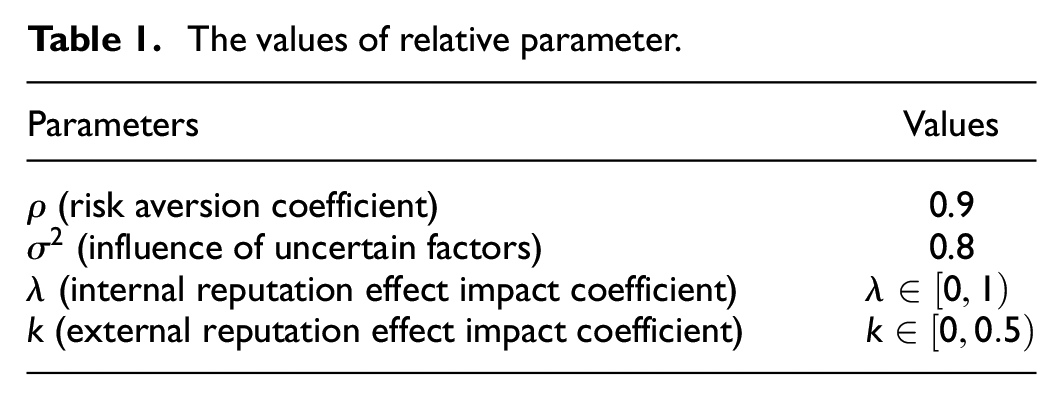
The relationships between the contractor’s optimal effort level (
The values of relative parameter.

The contractor’s optimal effort level in the first stage (

The owner’s net income in the first stage (
As depicted in Figures 2 and 3, the overall trend of
Compared to the incentive model without reputation effects, the effort level of the contractor improves after considering reputation effects. Also, the effort level of the contractor will increase in line with an increasing external reputation effect and the internal reputation effect. In addition, the reputation effects can increase the owner’s net income, that is, the reputation can increase the project benefit. Also, the owner’s net income will increase as the impact degrees of reputation effects increase.
Practical Implications
Based on the findings of this study, the following suggestions are put forward:
(1) Formulate a reasonable reputation incentive contract clause. The results of the case study show that the external reputation effect and internal reputation effect of reputation incentives have a positive impact on the contractor’s effort behavior. As manager and decision-maker of large-scale projects, it is very important for owner to formulate reasonable terms of reputation incentives in construction contract. Contract clauses are an important means to standardize and institutionalize reputation incentives, so it is necessary to design reasonable, accurate and complete reputation incentive clauses. Before project bidding, the owner needs to specify the internal and external reputation incentive coefficients in the special clauses of the contract and submit it to the superior for approval. In addition, the reputation incentive contract also needs to clarify the risk sharing rules of both parties and the connotation of the reputation incentive contract. Once the reputation incentives contract is signed, it will have legal effect, so as to ensure the standardization of the incentive implementation process. In the construction process of large-scale projects, the owner can determine the internal and external reputation coefficient of the contractor by constructing a relevant reputation evaluation system.
(2) Establish a good, fair, and accurate reputation performance evaluation system. The reputation of the contractor depends on his/her effort level and construction effect. The evaluation of contractor’s construction results is the basis for incentive in a large-scale project. How to make a fair and effective assessment of the construction effect is also very important. The establishment of a good reputation performance evaluation system can help make a comprehensive evaluation of the contractor’s effort level and production output. The establishment of a good reputation performance evaluation system could encourage and spur contractors to increase their effort levels and improve their behavior. Therefore, it is necessary to establish a good reputation performance evaluation system to ensure the smooth implementation of the reputation incentive plan. Before the implementation of the reputation incentive, the owner should clarify the cycle, implementation and evaluation methods of the reputation performance evaluation system in the construction contract terms according to the incentive objectives of the large-scale project, so as to ensure the rationality of the reputation incentive evaluation system.
(3) Establish a good reputation information disclosure system. The realization of the implicit incentive effect of reputation effects needs to be in a perfect market competition environment. Owner should establish an information disclosure platform to announce any bad behavior exhibited by a contractor during a construction project. This type of information-sharing platform could help the market to constrain the contractor’s bad behavior. The establishment of a reputation information disclosure system provides a prerequisite for the exertion of the internal effect of reputation incentives. Establishing a reasonable reputation information disclosure system is not only conducive to the supervision and management of contractors’ behavior by the government and other social entities, but also the exchange and transmission of construction information, so as to promote the play of the role of reputation incentives.
Conclusion
In a large-scale project, due to the different benefit goals and asymmetry of information between the two parties, the contractor is likely to take moral hazard behavior, which damages to the project’s benefits. A scientific incentive mechanism used by the owner can effectively restrain the contractor’s moral hazard behavior, which is an important step in guaranteeing the efficient operation and timely completion of a large-scale project. Reputation has been shown to be an important factor in behavior management. The adjustable contracts and EPC transaction model have been widely used in the construction and management of large-scale projects, which provides application foundation for the reputation-based dynamic incentive model. In order to restrain the moral hazard behavior of large-scale project contractors. This study uses reputation mechanism and incentive theory to establish a dynamic incentive model. The results suggest that both internal reputation effect and external reputation effect can motivate a contractor to increase the effort level they are making. The contractor would be more inclined to invest an optimal effort level after the reputation incentive is introduced. Also, the contractor’s optimal effort level will improve as the impact coefficients of the reputation effects increase. In addition, incentive model considering the reputation effects can indirectly improve the total benefit of a large-scale project. Thus, the reputation-based incentive measure can help optimize the incentive clauses. This system can provide new insights into the improvement of the owner’s supervision efficiency in actual construction management of large-scale projects. The reputation-based incentive model proposed in this study can enrich the application of incentive model from a theoretical perspective, which adds a subject to stakeholder management in PMBOK.
In the design of the incentive model, this study pays more attention to the impact of the reputation effects on the contractor’s optimal effort level, without considering other variables, such as the contractor’s resource investment level, the supervision efficiency and cost, et al. How to fully consider these factors to update the dynamic incentive model will be the focus of future work. In addition, when carrying out the reputation incentive plan, the owner mainly obtains the reputation effect impact coefficient through certain questionnaires and interviews. How to use big data information to obtain a more accurate reputation effect impact incentive coefficient will be the future research direction.
Footnotes
Acknowledgements
The research is supported by Zhang Kaize. This study would not have been possible without his important intellectual content for this article. We are particularly grateful to the anonymous reviewers for their perceptive comments.
Declaration of Conflicting Interests
The author(s) declared no potential conflicts of interest with respect to the research, authorship, and/or publication of this article.
Funding
The author(s) disclosed receipt of the following financial support for the research, authorship, and/or publication of this article: The research is supported by the National Natural Science Foundation of China (# project No. 71801130), Fundamental Research Funds for the Central Universities of China (No. B200203014), and Water Conservancy Science and Technology Projects in Jiangsu Province of China (No. 2020069). This study would not have been possible without their financial support.
