




Abstract
A misincentive is characterized as an incentive producing the opposite effect of motivating or preventing some specific action. In some circumstances, contract penalties such as sanctions and fines on late delivery or low-quality software encourage the irregularities instead of preventing them from occurring. The present study models misincentive behaviors in Information Technology Outsourcing (ITO) transactions as a Principal-Agent problem. Considering the non-linear relationship in software vendors’ cost structure and the client’s sensitivity to the product/service quality and delivery time, we offer theoretical modeling elucidating the best responses on agreements under incomplete and asymmetric information. Some empirical evidence of contractual misincentives is reported in outsourcing arrangements between private institutions and public administrations in Portugal. The contracts were divided into three categories: pure contracts with no incentive clauses, contracts with no explicit monetary penalties, and contracts under explicit sanctions. The results suggest that the knowledge of the penalty reduces the Agent’s uncertainty about the Principal’s cost structure and might lead them to intentionally delay the delivery of the technology.
Keywords
Introduction
The expansion of outsourcing is a worldwide trend highlighted by the labor reforms in France, England, Portugal, and most recently in Brazil. Outsourcing agreements offer a particular type of dependent autonomy for business (Lair, 2019), which can be strategic for the core activities motivated by expanding legal opportunities (de Carvalho et al., 2016). Especially in Europe and North America, an investigation on the outsourcing dynamics provides an interesting perspective for big “companies” strategic planning. According to Deloitte (2016) Global Outsourcing Survey, more than 80% of the outsourcer clients are composed of organizations with over $1 billion in annual revenues, operating mainly in North America (90%) and Europe (65%) and mainly offering Information Technology solutions for various business functions (about 72%).
From an Agency Theory perspective, Information Technology Outsourcing (ITO) is characterized by a client (a firm or industry) as the “Principal” who decides to delegate the responsibility to produce, manage, and control the technological infrastructure to another firm (a software vendor). The vendor represents the “Agent” in this arrangement providing the technology solution. According to Bush et al. (2008), a variety of factors related to the cost of production, knowledge, skills, and outsourcing feasibilities drive managers to transfer the responsibility in creating or supplying internal technological infrastructures. A strategic investigation on ITO interactions can aid both clients and vendors in identifying guidelines for a successful ITO (Silva et al., 2020).
In the design of outsourcing agreements, there is a common understanding of bonus clauses working as an incentive to obtain the best efforts from the provider, and penalty clauses, such as fines or legal sanctions, working as a disincentive for delays, unacceptable performance, or low-quality products (de Almeida, 2013; Falk & Kosfeld, 2006). Contractual misincentives occur when specific incentives result in the contrary effect from the desired one (Neus, 1996). Nepomuceno and Costa (2019b) provide an instance of the misincentive effect on the political behavior of Brazilian voters. The authors state that low-cost punishments (such as small fines) for abstentions in national elections were one of the motivators for decreasing turnout instead of increasing political participation as desired.
We contribute to the discussion of misincentives in the design of ITO agreements providing a game-theoretical modeling, similar to some settlements of economic behavior (Dey et al., 2010; Nepomuceno et al., 2018; Nepomuceno, Daraio, & Costa, 2020; Yang et al., 2019; Zhong et al., 2019). This approach comes from the point of view of both the software vendor and the customer cost structure. Managerial implications for this approach and discussion contribute to optimal outsourcing agreement designs, identifying different information scenarios in which incentive clauses work and those which are prone to turn into a misincentive. One interesting prospect from the following analysis is that undetailed sanctions (with larger ranges) provide significant advantages for the client, while (small) detailed fines encourage delays by the vendor. This strategic information can aid decision-making in many similar circumstances as modeled in this work.
The next two sections review the literature on misincentives and ITO, discussing game theory modeling applications in the outsourcing context. Section 4 is dedicated to the Principal-Agent theoretical formulation, deriving the best response an Agent provides for the Principal in two contexts of information technology outsourcing (incomplete and asymmetric information). Section 5 offers some preliminary empirical evidence considering ITO agreements of Portugal’s public institutions with private software vendors. The conclusion summarizes the main arguments and discussions from the modeling.
The Problem of Misincentives
Misincentives represent controversial results from strategies adopted to stimulate cooperation in attaining a given prospect. They are incentive (or disincentive) structures resulting in the opposite effect.
The most common example of misincentive in the market is the moral hazard insurance problem. Life-insured individuals often engage in riskier activities or jobs, knowing they will be protected against losses. Lending out vehicles to friends also generates an increased risk for car insurance companies, and for many firms, directors often undertake risky projects than those shareholders would prefer. Insurance companies impose additional policy fees to disincentivize such behaviors. When agents are willing to pay additional fares or insurance to cover those situations, we have a problem of misincentive. Krishnaswami and Pottier (2001) and Garven and Pottier (1995) investigations based on Agency Theory offer an interesting participating policy modeling to support participation rights in insurance policies as an optimal response to the risk-shifting problem due to the shareholder-policyholder conflict.
According to Nepomuceno, Nepomuceno & Costa (2020), the influence of extrinsic incentive structures of sanctions and rewards is investigated in many sectors of economic activities, public governance, and works on information systems. Nevertheless, there is a gap in proper quantitative modeling on IT services. The problem of false incentives and misincentives in Information Technology Outsourcing agreements is the topic of this investigation. Despite the importance incentives and disincentives have to establish good practices in the ITO relationship, the discussion seems controversial and theoretically under-investigated in some aspects. For instance, Alvarez-Galvan (2012) presents cases where the economic incentives of bonuses were insufficient to induce the desired behavior, and Bhattacharya et al. (2013) present evidence that some clients avoid punishments to induce providers to deliver the right service on time.
Some controversies can also be associated with inadequate contract elaboration, reading, and enforcement. Gilb (2005) argues that in order to avoid false interpretations of the outcome and to guarantee the expected results and payments from the IT outsourcing process, the contract must be as detailed as possible, with detailed requirements concerning each issue; otherwise, the client may find legal troubles to determine responsibility for failures or property rights. Incomplete or vague requirements have a considerable effect on the prosperity of the outsourcing arrangement (Morgan et al., 2018). Software vendors are often elastic to changes in the expected gains and become uncomfortable accepting extra costs for a requirement that has not been adequately specified.
Yu (2020) developed a study on monitoring and contractual incentive pay, determining that they are not necessarily positively associated. Both mechanisms can interact with each other, but if a manager has not received incentives correctly, monitoring helps increase the use of incentive pay. Monitoring means more information gain, which leads to lower incentive pay since the value of the pay ends up being determined by the value of the additional information obtained. In addition to the monitoring-incentive relationship, Alonso-Paulí (2022) developed a model to link two control mechanisms in a firm: performance-based contract and monitoring. By studying the isolated mechanisms, they derived the optimal contract as a combination that uses both instruments, concluding that both are complementary and that the ownership structure is an important characteristic when designing favorable contracts.
Lo et al. (2022) developed a theoretical model incorporating key contracting frictions in transaction cost economics (costly haggling, non-contractible adaptation, and the risk of acquiring the company’s infrastructure that pre-exists the arrangement). The authors commented that their work is the first analysis on how contractual pricing clauses conduct and shape suppliers’ incentives to make specific contributions. Their conclusions can be divided into two axes: (i) the contractual forms increase or decrease the supplier’s incentive for specific investments is at first ambiguous, depending on the relative importance of bargaining and adaptation frictions; and (ii) the conventional governance role of contracts is potentially reversed when specific investments facilitate the appropriation of pre-existing resources from buyers, implying that different buyers with different pre-existing resources sought different forms of governance based on the relationship with the supplier.
The framework proposed in this work differs from the proposed solutions in this literature by modeling and considering all those contractual aspects, not imposing additional incentive structures or constraints for obtaining a social optimum. From a Contract Theory perspective, we offer insights on how the information status on the cost structure of software vendors contributes to the best responses and equilibrium.
The ITO Context
According to Hall (2005), Information Technology Outsourcing (ITO) is the transference of responsibility to third-party vendors, consultants, or suppliers for the production, management, or control of information technology assets and staff. This definition also comprehends the delivery of IT services such as network solutions, software development, packages, programs, applications, websites, data entry or operations and maintenance of database centers, and repair errors and bugs.
Outsourcing the responsibility for creating or supplying internal technological infrastructure enables public and private administrations to take more effort into the core and more profitable competencies for the company (Lacity & Hirschheim, 1993; Willcocks & Feeny, 2006), reduces uncertainty and permits cost savings (Lacity & Willcocks, 1998; Watjatrakul, 2005) and reduces risks with the acquirement of ability and expertise (Bustinza et al., 2010). In addition to such benefits, the accessibility to external skills and technologies, the minimization of staff fluctuations, and the quality expectation perform solid arguments favoring outsourcing decisions.
On the other hand, outsourcing can be a less attractive option than in-house processes for some products characterized by concentrated capabilities, knowledge, and base of clients. Dekkers (2011), through reviews on manufacturing case studies, reports that all the companies investigated in the study had problems with in-time deliveries coming from reactive interventions. Herath and Kishore (2009) also discuss some undesirable factors that compromise the success of outsourcing processes, such as unexpected costs, litigations, and loss of organizational competencies. The success of the ITO contracting, according to Misra (2004), comes from an appropriate system of incentives and rewards, aligning the perspectives of the client, supplier and final customers. Ching et al. (2011) found that high penalty levels induce a higher outsourcing capacity and are always beneficial to the client.
de Carvalho et al. (2022) provides an interesting multicriteria investigation on the successful relational factors for outsourcing information technology in small and medium-sized Brazilian companies, both from the supplier and contractor perspectives about the importance of ITO relational factors and sustainable governance. Using the ELECTRE IV rankings of the relational factors according to the defuzzified judgments by applying Fuzzy Sets Theory, the authors suggest that, for contractors, the customer relationship management is the most important ITO feature, followed by costs and managers’ commitments, which are strictly related to the organization’s relational development.
Pakpahan et al. (2021) also developed a multicriteria analysis in Indonesian Public Sectors to understand the relative importance of ITO critical success factors, categorized according to four groups: Organizational Environment, Contract/Project Characteristics, Project Management, Partnership Management. They applied the Analytical Hierarchy Process (AHP) method to create a ranking of the factors in these groups. For Organizational Environment, the management support was the most relevant; for Contract/Project Characteristics, they obtained the project budget and size in the first position; for Project Management, the highest rank was the project management skill; and for Partnership Management, the knowledge transfer was the most crucial factor.
Jain et al. (2021) studied two firm competitions for the ITO requirements of a client, discovering in the process that the software houses are discrepant in their unit costs and the customer has asymmetric information about the software vendor’s cost structures. They also found that: (i) that when the potential for vendor’s cost savings due to learning-by-doing is very low, the customer’s best outsourcing strategy is to choose a vendor by bidding, awarding the entire IT outsourcing contract to the winner; (ii) when the potential for vendors to reduce costs due to learning-by-doing is very high, the customer should adopt the dual-source strategy in the initial period, outsourcing the remaining requirements to a supplier selected by bidding; (iii) as the average distribution of private cost information decreases, the client company tends to adopt the single-source strategy; and (iv) as the average degree of uncertainty during the cost improvement phase increases, the client company tends to adopt the dual-source strategy initially, followed by the single-source strategy.
Prawesh et al. (2021) examined the impact of social influence perspective on ITO decisions using regression models to test two hypotheses based on positive and negative deviations of a firm from the industry average of outsourcing expanses, with a sample of 77 ITO contracts. They found that the average levels of outsourcing distinguish the firm’s behavior, demonstrating the benefits of adopting social influence in the ITO decisions studies: firms with above-average levels of ITO further increased outsourcing; firms with below-average showed no measurable trends in outsourcing levels.
Handley et al. (2022) analyzed an extensive IT service contracts database, using a knowledge-based perspective to construct their study hypothesis focusing on the influence of emerging technologies, vendor location, and experiential learning on the choice between single and multisourcing IT services. They found some interesting trends: some kinds of services are less likely to be multisourced, as in the case of cloud-based ones; the more experienced the client firms are, the more likely to adopt multisource; the more experienced vendors and offshore vendors are, the less likely to be part of multisource arrangements.
The relational development is associated with meeting the client’s specifications and requirements which define the “quality” of an agreement. During pre-contractual arrangements, they are often described, which explicit the bargaining power between the client and the supplier. This proxy for contract quality is crucial to prevent contract litigations and legal processes. It is assumed that clients have a dominant strategy to demand high quality, that is, the most detailed contract, relating to issues of performance standards, software or service requirements, risks and costs, intellectual property, transfer of assets, conflict resolution, delivery time, technical support and other issues considered in the design of the agreement (Domberger et al., 2000; Lee, 1996; Whang, 1992). In the next section, these concepts are taken into consideration in the Principal-Agent theoretical modeling.
Theoretical Modeling
Knowledge and information sharing between economic agents or organizations can aid the management of resources, mitigate intrinsic risks, reduce production costs and increase team performances (Xiao et al., 2021). Operational Research methodologies are common to model and evaluate information structures, contract designs and information technology prospects such as customer-knowledge enabled innovations (Wen et al., 2019), sustainability and green IT practices (Nepomuceno & Costa, 2019a; Silva et al., 2013), delay-time (Scarf et al., 2019), work in process levels (Pergher & Vaccaro, 2014), risk management (Cavalcante et al., 2017; Mendonça Silva et al., 2016) and IT and service products such as web-pages (Nepomuceno, Nepomuceno, & Sadok (2020)) resources and storage assignments (Fontana & Cavalcante, 2014; Nepomuceno & Costa, 2019a; Pergher & de Almeida, 2018).
Game theoretical approaches are robust tools in the Operations Research to aid decision making in the design of valuable business agreements (Zhang, Fu et al., 2019; Zhong et al., 2019), portfolio planning (Goswami et al., 2016), and business procedures under the most common contexts of information (Jensen & Meckling, 1976; Keil, 2005; Nepomuceno et al., 2018). Dey et al. (2010) provide an interesting game contract-theoretic model that incorporates a variety of interrelated issues regarding information sharing, quality of software, delivery time, the effort and cost associated with the project, contract payments, and postdelivery supports. Among the results, the authors support fixed-price contracts for simple projects and time-and-materials agreements for complex auditable projects.
Yao et al. (2010) explore contract selection, negotiation and outsourcing timing of fixed-price, cost-plus, and gain-sharing ITO agreements. Under complete (and sufficient) information, no type of contract performs significantly better. Under asymmetric information, however, the contractor may obtain sub-optimal results and different values for each type of agreement. Zhang et al. (2014) consider a dynamic optimization problem to maximize the supplier’s profit based on Pontryagin’s maximum principle. The asymmetry in both models resides in information concerning the manufacturer’s cost structure. The supplier’s profit is maximized by updating their beliefs concerning these costs.
This literature highlights important aspects of how software outsourcing contracts can be designed based on game-theoretical modeling under knowledge sharing and asymmetric information. However, the asymmetry in information may work in the vendor’s favor depending on the beliefs of both the client and the IT vendor. This perspective may lead to misincentives during contract designs and service responses, which have not been modeled in the current ITO literature to the best of our knowledge.
The next sub-sections attempt to model such behavior reflected by clauses of incentives in ITO transactions. First consider agreements with incomplete information (neither the client nor the vendor knows the counterpart cost structure). The reasoning reaches an equilibrium where the producer meets the client’s interests. Later, the scenario is characterized by asymmetric information and suboptimal agreements with the introduction of misincentives.
Agreements Under Incomplete Information
The Agent (software vendor) maximizes welfare by choosing a delivery time based on: (1) the payment for the IT project (
In the traditional software engineering literature (see Boehm, 1981; Sommerville, 2011), the vendor’s cost structure can be expressed as an exponential function of the overall effort provided. This cost structure, as it represents the vendor’s efforts on labor (L) and capital (K), does not usually increase linearly with the software quality type (represented by Q in equation (1)). This is mainly because of side effects observed in project testing, that is, changes in prior specifications or error resolutions that lead to other unexpected problems—side effects of the original one. As the software requirements increase in quality, the project becomes more complex, leading to more potential anomalies during the development code phase.
Thereby, the Agent welfare function

Considering

The decision variables from (1) and (2) are summarized as follows:
Q is the product or service quality;
T is the difference (in terms of utility) between the effective date the software agent delivers the product (T2) and the date they must deliver (T1). A positive T means that the vendor delays the delivery (adds some utility by slacking efforts), and a negative T means that the vendor anticipates the delivery (loses utility by applying more resources).
The Agent production function often reports decreasing returns to scale due to side effects of the development code. The exponent b represents this nonlinear relation. It is usually estimated a value between 1 and 1.5 (Boehm, 1981; Sommerville, 2011). The exponent is sensitive to the project’s innovative nature and levels of uncertainty. This can be related to the development team’s inability to understand or use existing codes. The fact that b ≥ 1 implies that positive changes in the product quality cause favorable variations in the overall variable cost (δ
The Principal (outsourcer client) derives welfare from the quality of the software system (Q). Thus, a contract that specifies high-quality software (e.g., extra features, increased safety, or a more comfortable user interface) is always preferable for the client than a contract with few requirements, resulting in a low-quality product. The client’s welfare decreases as the Agent attempts to delay the software delivery (positive T). It also decreases with the current payment and future payments. Thereby, the problem the client faces is summarized by choosing Q, such as:

The Agent may report low or high productivity by delaying or not delaying the technology delivery. These characteristics are represented by the probabilities
The Principal (customer) chooses the system’s quality or service, and its delivery date. The Agent (vendor) responds by choosing the level of effort and resources that results in the effective delivery date. The client must describe clauses of quality for the non-general purpose software contract (e.g., features and applications, sophisticated graphic user interfaces, and as many precise details as necessary to the client’s business), and the vendor must deliver the software in the time ordered by the client which, at this moment, does not impose penalties for late delivery. The timing of the information technology outsourcing with incomplete information is as presented in Figure 1:

Timing of the ITO arrangement under incomplete information.
In order to interpret the performance of the outsourcing contract, the total social profit or surplus (Dey et al., 2010; Nepomuceno et al., 2018) is obtained by combining the best response from each party (client and vendor) into a first-best solution, defined by the client’s choice of quality (Q) and the vendor’s time of delivery (
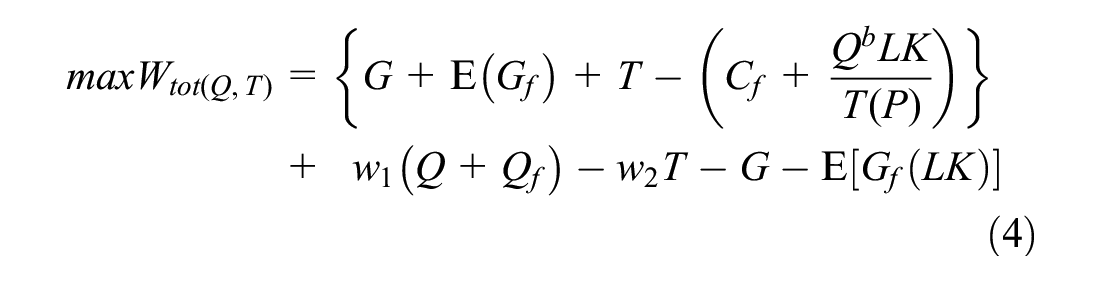
Where

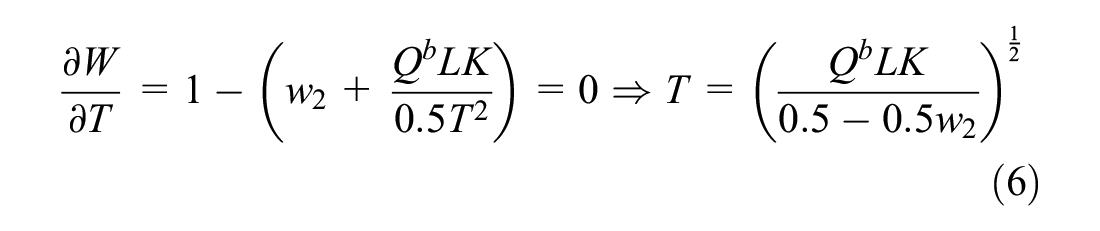
Those are the optimal choices a priori for the Agent and the Principal. Using backward induction, the Agent’s best response to the Principal’s optimum choice of quality can be obtained by substituting (5) in (6):

Assigning b = 1.5 (Boehm, 1981; Sommerville, 2011) and simplifying the equation:

Equation (8) suggests that the decision on whether to delay the delivery (a high
Agreements Under Asymmetric Information
The asymmetry occurs when the customer imposes a penalty (such as a fine) for each day the vendor delays the software delivery—or a bonus for early delivery days. The incentive signs the client’s evaluation regarding the delivery time and provides the vendor with the strategic knowledge of how much the client cares for delays, that is, the client type. An adapted model from (4) can be represented as follows:
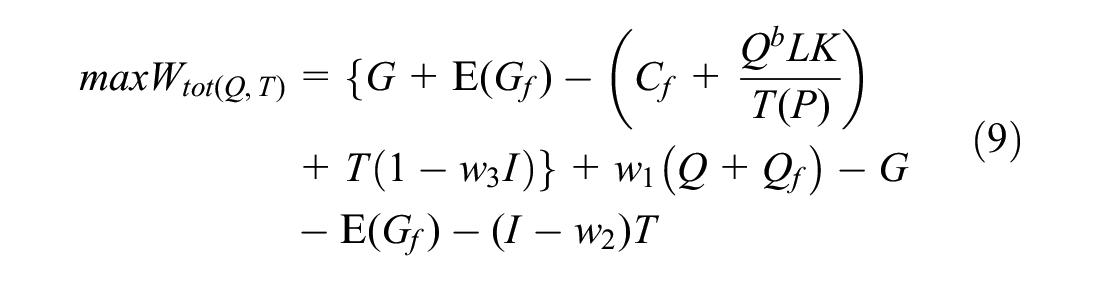
Once again,

And equation (9) is summarized to:

The timing of this information technology outsourcing arrangement is presented in Figure 2:

Timing of the ITO arrangement under asymmetric information.
Enforcing fines or rewards leads to an asymmetric information scenario by changing the vendor’s beliefs from an uncertain situation where the client’s value about the delivery time was not available to a situation where the client reports their evaluation of time, which is the incentive in the form of a bonus or penalty. Using the same optimization process, we find the decision about the time:

The difference between the results from equations (8) and (12) is that the vendor’s decision-making to a choice of time is no longer on unknown parameters (
When the customer enforces costly fines (big I >> 1) but the supplier considers it not expensive (small
Empirical Evidence
Sixty-four contracts collected from a database of ITO transactions among public administrations of Portugal’s government (schools, universities, hospitals, city halls, insurance and pension supervision entities, banks, libraries, directorate for defense infrastructures, social security, unions, among other public organizations) and many software vendors were analyzed. Information can be accessed at http://www.base.gov.pt/. The ITO transactions are composed of acquisition of software, platforms, storage servers, hardware and computer equipment, backup licenses and acquisition and renewal of general licenses for operating systems, security anti-virus, development of decision support systems, provision of services such as database management, technical support for maintenance and development, after-sales support and assurance, digital paper management solutions, and repair of collapses, among others.
The contracts are divided into three categories. The first group belongs to the agreements with no incentive clause (i.e., neither bonus for anticipation nor penalty for the delay). The second group has contracts with monetary penalties that the software vendor does not directly know. The third group belongs to the agreements with specified sanction clauses, for example, describing a fine equivalent to exactly 5% of the contract value per day of delay. The arrangements have 59 clients contracting 48 software vendors to perform the IT service. Table 1 summarizes the results. Contracts with monetary penalties for late delivery are those having a higher percentage of delay. The difference is considerably higher toward those agreements where the penalties are detailed (60% of vendors under detailed penalties delay the delivery compared to 22% without the misincentive).
Summary of the Main Statistics and Results of Wilcoxon-Mann-Whitney Hypothesis Tests.
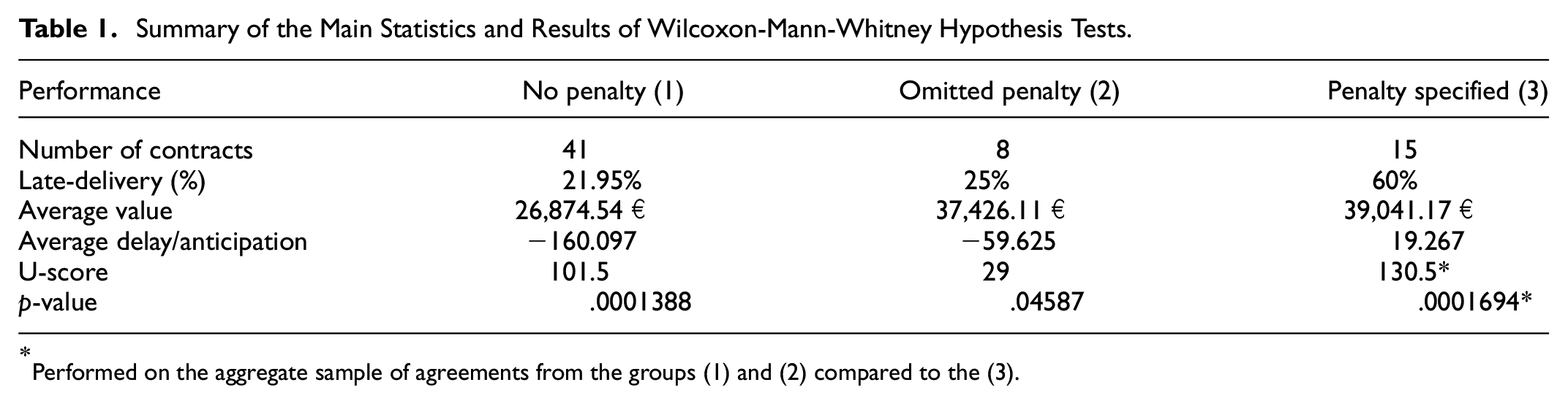
Performed on the aggregate sample of agreements from the groups (1) and (2) compared to the (3).
Wilcoxon’s Mann and Whitney rank-sum test with continuity correction is used to evaluate the difference in data distribution. The following hypotheses are considered:


The U-scores and p-values support the rejection of the null hypothesis in favor of the alternative that the means of delays differ at a confidence level of 0.05 (95% of confidence). The highest differences belong to the comparisons between contracts with and without penalty clauses (p-value ≃ .00014) and between incentive contracts with penalties specified and the remaining agreements (p-value ≃ .00017). Delay differences in contracts with omitted penalties compared to contracts without penalties also have statistical support (p-value = .04587). The box-plot representation in Figure 3 illustrates those differences.

Box-plot representation on delays/anticipations (pure and incentive contracts).
The number of delays/anticipations is broader in the bottom of the first box with outliers that reach 2 years of anticipation, while contracts under penalty clauses concentrate in the upper bound of the second box, which barely anticipates. Different information scenarios provide different strategies for the public administrations and for the vendors. For the public administrations, pure contracts and incentive contracts with omitted penalty values can be strategic for keeping unknown the client’s cost structure and driving vendors to anticipations. Almost the entire set of arrangements have this characteristic, reporting on average 160 days of anticipation in the case of pure contracts and 59.6 days of anticipation in the case of contracts with omitted value for penalties.
From the vendor’s point of view, the asymmetry in information created by incentive contracts with specified fines can be responsible for delays in 60% of vendors in this type of agreement. On average, this sort of business arrangement has the most expensive transactions (39,041.17€), which justifies the necessity for penalty clauses. However, the delay strategy becomes dominant with low-cost fines (in the vendor’s perspective) and other penalties of non-monetary nature, resulting in an average 19 days delay. Nevertheless, the design of contracts for dedicated software can benefit from this prospect, reaching an optimal solution for both the client and the vendor.
Conclusion
This work considered ITO arrangements as a sequential game of incomplete and asymmetric information between a client (the Principal) and a software vendor (the Agent) to determine the optimum operational behavior of software vendors in response to the client’s choice for quality. The meaning and value of this approach lead to an understanding that the previous knowledge of contract penalty decreases the vendor’s uncertainty about the client’s cost structure, leading to intentionally delaying the product delivery during the IT outsourcing.
We evaluated 64 agreements of 59 public administration clients contracting 48 software vendors in Portugal. The contracts were divided into three categories: pure contracts with no incentive clauses (i.e., neither bonus for anticipation nor penalty for the delay), contracts with no explicit monetary penalties (e.g., agreements with penalties that can range inside a certain percentage to be defined after delivery) and contracts under explicit sanctions (e.g., the exact fine amount per day is described). The findings support the misincentive argument due to the asymmetry in information: there is an average of 160 days anticipation in the case of pure contracts and 59.6 days anticipation in the case of contracts with omitted value for penalties, but in the case of incentive contracts (with explicit penalty clauses), vendors delay 19.2 days on average.
Management Implications
The practical management interpretation is that when the software supplier has strategic information about the customer’s cost structure (the value of the incentive, i.e., the fine or the bonus), the prior outsourcing scenario characterized as a sequential game of incomplete information becomes a sequential arrangement with asymmetric information. The vendor’s delay strategy is adjusted, resulting in a different equilibrium. If the monetary penalty compensates the loss in the client’s utility (satisfaction), both the Principal and the Agent have no incentive to move from the new misincentive equilibrium. This conclusion has statistical support from the analysis of ITO agreements in Portugal.
Considering elements from Game Theory, the study guarantees decision-making support to managers interested in understanding their suppliers’ behavior (software vendors) for decisions related to the maintenance or design of the outsourcing contracts/relationships. An interesting fact highlighted by de Carvalho et al. (2018) is the need for the client (contractor) to carry out a post-integration analysis of the outsourced service, meaning that the integration process with the seller needs to be under constant evaluation by both sides, to verify the feasibility of its maintenance, or whether it is better to end the relationship and move on to the selection of a new supplier, from the client’s perspective.
Study Limitations
One most evident limitation is the size of data in this analysis. We expect to expand these results to a large dataset and provide interesting prospects for practitioners to design optimal outsourcing agreements in future assessments. In addition, besides the strategic economic knowledge of operational behaviors within the theory of contractual misincentives, the precise elicitation of client and vendors utility on quality, time, future expectations, technical capabilities, technological infrastructure, expertise, and other proxies can be interesting exogenous variables to be considered in the design of optimal outsourcing agreements.
Another two limitations which deserve to be highlighted are the geographical restriction of the study (covering a single country) and the focus on single-sourcing. Both can be overcome, for example, by considering the use of offshore outsourcing relationships and even taking into account multisourcing (Handley et al., 2022), greatly expanding the possible implications that can be derived. Note that in these cases, the expansion of the database is essential to ensure greater significance to the results of future studies.
Footnotes
Declaration of Conflicting Interests
The author(s) declared no potential conflicts of interest with respect to the research, authorship, and/or publication of this article.
Funding
The author(s) disclosed receipt of the following financial support for the research, authorship, and/or publication of this article: We acknowledge the support from the Brazilian Coordination for the Improvement of Higher Education and the Federal University of Pernambuco through the Grant “Edital PROPESQI n0 09/2021.
