




Abstract
Globally, e-commerce offers unlimited opportunities for corporate organizations to flourish as its customers reside in all parts of the universe. However, given the fluid nature of the cyberspace, black-hat hackers have enormously taken undue advantages of such mobility to perpetrate numerous financial frauds against individuals and corporate organizations. The impact of their attacks on the economic sustainability of corporate organizations is of obvious policy relevance, but little is empirically known about it. This study examined the role cyberspace plays in aiding the criminal activities of black-hat hackers and the impact of such malicious attacks on the economic sustainability of corporate organizations in Cross River State, Nigeria. An exploratory cross-sectional survey research design that allows the triangulation of quantitative and qualitative methods was adopted. Questionnaires were distributed to 1,074 respondents purposively selected from 18 financial institutions, 4 telecommunication network providers, and 2 manufacturing companies, while an in-depth interview was conducted on 13 participants across the selected corporate organizations. The presentation of data was done using frequency distribution tables, charts and relevant narratives. Chi-square was used to test the hypothesis, and content analyzing was adopted to analyze the qualitative data. The study found that corporate organizations with previous hacking experience are more likely to perceive black-hat hacking as affecting the productivity of their organization. The study, therefore, recommends that corporate organizations should strengthen their firewalls; educate their staff on the dangers of visiting unsafe websites, and downloading unverified attachments or clicking on links in unfamiliar emails.
Introduction
Cybercrime is one of the most complex, widespread, and persistent social problems ravaging the cyberspace, and Africa is not immune from the ensuing treachery because of her weak legal and regulatory cyber policies (Abdul-Rasheed Ishowo et al., 2016; Ajah & Onyejegbu, 2019; Jaishankar, 2010; Ndubueze et al., 2013; Odo & Odo, 2015; Quarshie & Martin-Odoom, 2012). The cyberspace is driving business innovations and growth globally, and at the same time, exposing corporate organizations to new and emerging internet-assisted crimes (Longe et al., 2009; Makeri, 2017; Quarshie & Martin-Odoom, 2012). Today, the negative frontiers of the cyberspace that corporate organizations are contending with include: hacking, malware attacks, cyber-terrorism, spoofing, phishing, spam, virus attacks, child pornography, cyber vandalism, cyberstalking, data modification, email bombing, and cybersquatting (Fanawopo, 2004). The alarming increase in “incidents of cyber-attacks and the resultant economic implications have made the management and security of the cyberspace a paramount concern to multi-stakeholders, driving the process, from the public to the private corporate institutions” (Agugoesi, 2014, p. 8).
Hacking is a complicated technical activity aimed at exploiting systems’ vulnerabilities to subvert security checks, geared toward compromising digital devices such as computers, smartphones, tablets, and networks of organizations for financial gains, corporate espionage, and for fun. Hackers are broadly classified into the Black Hat, White Hat and Gray Hat hackers. The Black-hatters are the malicious hackers who hack for economic reasons. The White hatters are the “good guys” in the cyberspace who hack for ethical reasons, while, the Gray hatters hack for ideological reasons (Manne, 2020). The Black-hat hackers sometimes known as crackers are criminals, who use their skills to modify computer hardware or software for malicious intents. These groups of individuals use their programming skills to exploit target systems’ weaknesses and invade the networks of organizations, steal personal and corporate data for personal aggrandizement.
Black-hat hacking is committed by a diverse spectrum of actors (lone actors and organized crime syndicates), with different motivations and affiliations (Peters & Jordan, 2019). Their motivations range from economic gains to stealing and damaging sensitive data, disabling networks, establishing a command and control server, or using the system as a base to wreak future havoc. “Attacks can be active, such as a brute-force attack that determines a user’s password, or passive, such as a web-based attack that waits for a user to visit a malicious webpage in an attempt to infect the user’s computer with malicious codes through which they gain access into the target organisations’ networks” (Peters & Jordan, 2019, p. 6). These groups of digital opportunists usually cause mayhem in organizations by engaging in Distributed Denial-of-Service (DDoS), identity theft, vandalizing networks and creating worms to damage institutional and personal files. Studies have shown that fraudulent emails remain the most widely-used strategy by black hatters to attack corporate organizations. Most such attacks begin with phishing emails, which exploit staff vulnerabilities in order to infect computers with malware. Once the malware is downloaded into the network, black-hat hackers through this medium gain access to the user’s database to forge personal data with which they exploit an organization. The malware ignorantly downloaded into the network by staff could maliciously delete or transfer information, download destructive programs, providing hackers with unauthorized access to the computer, and more. Black-hat hackers also use psychology to trick staff into clicking on a malicious attachment or providing personal data. Despite differences in hackers’ profiles and drives, the majority of the attacks by these groups of cybercriminals have been found to be trans-national in nature (Peters & Jordan, 2019). This suggests that a single hacking attack can hit countless victims in different countries independent of the location of the source of the attack.
Estimating the global economic impact of black-hat hacking is difficult since most organisations do not report or publish their financial losses. However, The Council of Economic Advisers (2018, p. 8) estimated that “malicious cyber activities cost the U.S. economy between $57 billion and $109 billion in 2016.” “In Kenya, several government websites came under hackers’ attacks, putting huge amounts of citizens’ data and even government revenue collection systems at risk. In 2012, over one hundred (100) Kenyan government websites were defaced by an Indonesian hacker with an estimated loss of $22.4 million. In South Africa, ATMs were massively compromised and huge sums of funds lost to the activities of the hackers in South Africa” (Tobiko, 2014, p. 7).
Similarly, every successful attack, no matter how insignificant, attracts disastrous consequences for corporate organizations. The abuses of the cyberspace by black hatters portend danger and have stalled the developmental contributions accruable from a well-harnessed ICT adoption, diffusion and utilization by corporate organizations in Nigeria. This development has widened the digital divide, crumbled the information infrastructure and affected consumer’s confidence in online transactions in Nigeria (Longe et al., 2009; Oumarou, 2007; Salifu, 2008). Corporate organizations in Cross River State that are victims of black-hat hacking frequently report substantial losses among previously loyal clientele, loss of revenues, massive loss of quality production time, overhead loss, as well as, immeasurable damages to their brand’s corporate image and reputation. These attacks have become worrisome due to their destructive nature and ability to affect the networks of high-profile corporate organizations in the State with relative ease.
The disturbing rise in incidents of black-hat hacking and the resultant economic implications have caused Akinsehinde (2011) and Odumesi (2014) to argue that “more than 80 percent (80%) of organisations in Nigeria are prone to black-hat hacking, which consequently, threatens their existence and survival. These scholars argue that web portals and web-based applications of the Central Bank of Nigeria, Nigeria Stock Exchange, banks, shopping malls, pension fund administrators, and switching/electronic payment companies are vulnerable to attacks due to inadequate security measures for safeguarding their platforms.” The cost of black-hat hacking is expected to grow exponentially in the distant future, as reliance on networked technology increases.
Black-hat hacking in Nigeria is “largely perpetrated by both young and old adults; however, most of the young adults are students in various institutions of higher learning in the country, as well as, unemployed graduates and school dropouts” (Hassan et al., 2012, p. 12). They explore the liberty offered by the cyberspace to defraud, steal and engage in mind-boggling atrocities that impact negatively on the economic sustainability of corporate organizations in Nigeria. With the current high unemployment rate ravaging the nation, more young people across the country live below the poverty line, thereby; pushing them into internet-assisted crimes like hacking, phishing and other related vices (Ibrahim, 2016).
Several attempts have been put in place by corporate organizations to check the menace of black-hat hacking in Nigeria over the past few years, with minimal effect. Some of such attempts are the adoption of multi-factor authentication, role-based access control and hardware-based password management to keep sensitive data safe (Fanawopo, 2004; Frank & Odunayo, 2013; Gercke, 2013). With more than 80% of organizations in Nigeria are prone to black-hat hacking attacks, the impact of these attacks on corporate organizations are of obvious policy relevance, but little is empirically known about it. Similarly, much has been written about the threats posed by hacking generally in literature (Ajah & Chukwuemeka, 2019; Barber, 2001; Bratus, 2007; Das & Nayak, 2013; Duah & Kwabena, 2015; Dzomira, 2014; Jaishankar, 2007; Kamini, 2011; Karim, 2016; Kubina & Koman, 2016; Leukfeldt, 2015; Mohurle & Manisha, 2017; Ndubueze et al., 2013; Nnam et al., 2019; Okeshola & Adeta, 2013; Olson, 2013; Ragucci & Robila, 2006), but there has been comparatively fewer discussions on the extent black-hat hacking affect the economic sustainability of corporate organizations. A common denominator in these studies is the acknowledgment of black-hat hacking as part of the larger technological fallout, which has fostered a new dimension of crime and risks. Nonetheless, the pace at which corporate organizations subscribe to e-commerce, irrespective of the dangers posed by black hatters, provided the researchers with the motivation to examine the impact of black-hat hacking on the economic sustainability of corporate organizations in Cross River State, Nigeria. This was premised on the assumption that the financial loss often reported does not adequately account for the cost of black-hat hacking and without an insight on how corporate organizations’ overall economic development is impacted, empirical knowledge of the impact of black-hat hacking cannot be holistic. Thus, the study examines the impact of black-hat hacking on the economic sustainability of corporate organizations in Cross River State, Nigeria.
Methods
Study Design and Location
“The study adopted an exploratory cross-sectional design that allows the use of qualitative and quantitative data. This design is considered appropriate for this study because it provides a better and comprehensive understanding of the problem under study. The study area is Cross River State, Nigeria. Cross River State is a coastal State in the South-South region of Nigeria with its capital in Calabar. The area has three senatorial districts namely: Southern, Central and Northern Senatorial Districts, with eighteen Local Government Areas and one hundred and ninety-three (193) wards. The choice of Cross River State rests on the fact that reliable data on the incidence of cybercrime generally in the State is lacking, but news reports and statements by police and government officials give credence to the increase of the problem in the State” (Okpa et al., 2021, p. 463).
Participants and Procedures
“The target population for this study is 1,940 which were gleaned from financial institutions, telecommunication network providers, and manufacturing companies in the study area. Of this population, 1,056 (54%) are the staff of eighteen financial institutions (see Enukoha & Angioha, 2019), 91 (5%) are the staff of four telecommunication network providers (see www.ncc.gov.ng), and 793 (41%) are the staff of two manufacturing industries (see Manufacturers Association of Nigeria, Cross River State Chapter year bulletin, 2018). The study population was limited to permanent staff working in these selected corporate organisations in Cross River State, Nigeria. Using a Survey Monkey sample size determinant, with a 95% confidence level and level of maximum variability (P = 0.02), a sample of 1,074 was computed—out of which—1,002 respondents were finally used for analysis” (Okpa et al., 2021, p. 463).
The research adopted the stratified proportional and purposive sampling techniques in the selection of respondents. Stratified proportional sampling was used in delineating the study elements into 24 strata. “These are the eighteen (18) financial institutions, four (4) telecommunication network providers and two (2) manufacturing companies, based in the three senatorial districts of Cross River State (see Table A1 in the appendix for details). Respondents were purposively selected from each of the strata. The inclusion criteria were that respondents must have an internet enabled computer set attached to their desks and that they must be ICT staff, or engineers working in the selected organisations” (Okpa et al., 2021, p. 463).
Data Collection and Procedures
For triangulation, “the mixed methods of scientific investigation, consisting of quantitative and qualitative approaches of data collection were adopted. The instruments for data collection were a structured questionnaire and unstructured ‘In-Depth Interview (IDI)’. The research instruments were administered by four researchers. The questionnaire facilitates the collection of a large amount of information from a large number of people in a short time and in a relatively cost-effective way” (Okpa et al., 2021, p. 463). “The study observed all known ethical principles guiding social research such as informed consent, specific permission required for audio or video recording, voluntary participation, participants right to withdraw and cultural sensitivity. Ethical clearance was obtained from the ethical committee of the University of Nigeria Teaching Hospital; Ituku-Ozalla. The instruments were exposed to a pre-test. The pre-test was conducted using 5% of the sample size from respondents working in different corporate organisations from the ones studied. The essence was to ensure that the data and findings of the study reflect their set target. The reliability of the questionnaire was determined using Cronbach alpha, and a reliability coefficient of 0.86 was obtained. The reliability coefficient was high enough for the instrument to be considered reliable for the study. Of the 1,074 questionnaires distributed, 1,002 copies were returned and used for analysis, while 72 copies were either not properly completed or not-returned” (Okpa et al., 2021, p. 463).
“The questionnaire return rate was put at 93.3% and was, therefore, considered suitable to be used for the data analysis. Qualitative data was elicited using the in-depth interview guide. The IDI provides valuable data far beyond the limit of the quantitative instrument and was used to support the findings of the quantitative data. The in-depth interview was conducted among thirteen (13) purposively selected participants from selected corporate organisations. The selection of these participants was based on two criteria which were the relevance of a participant’s official position and the reputation for being knowledgeable on cybercrime-related issues in the organisation in the study area. Again, participants were selected based on the principle of confidentiality of data, beneficence to participants and voluntariness. Each respondent’s interview lasted between 40 and 65 minutes” (Okpa et al., 2021, p. 463).
Data Analysis
“In analysing the data, a proper check was carried out on both the quantitative and qualitative components of the data collected to ensure that all items used for the analysis were properly responded to. Responses from the quantitative data were edited, coded and analysed using appropriate descriptive statistics like frequency distribution tables, bar charts, pie charts, and Chi-square through the Statistical Package for Social Sciences (SPSS). Qualitative data were analysed using content analysis after proper editing and transcription were done by the researchers. Catchy phrases and expressions gathered were identified and organised under distinct themes” (Okpa et al., 2021, p. 463).
Nature of Organization
Data presented in Figure 1 show that “41.8% of the respondents work in manufacturing companies such as Flourmills and Lafarge. Also, 4.5% of the respondents work in telecommunication organisations such as 9mobile, Airtel, Glo, and MTN. The remaining respondents (53.7%) work in financial institutions, which are the 18 commercial banks that operate in Cross River State (See Table 1). This finding implies that more than half of the respondents (53.7%) were from financial institutions. Furthermore, this composition is considered favourable for the study, as financial organisations are more attractive to cybercrime perpetrators” (Okpa et al., 2021, p. 464).

Nature of organization.
Cross Tabulation of Respondents’ Gender and Nature of the Organization.

Source: Field Survey, 2019.
Length of Service
Data presented in Figure 2 show that “2.4% of the respondents have worked in their current organisations for 16 years and above. This was followed by 6.8% of the respondents that have worked in their organisations for 11–15 years. Also, 36.8% of the respondents indicated that they have worked in their organisations for 6–10 years, while, 54% indicated that they have worked in their current organisations for 1–5 years. This implies that more than half of the respondents (54%) have worked in their organisations for a period of 1-5years” (Okpa et al., 2021, p. 464).

Length of service.
To enable deeper insight on the structure of the respondents in light of their distinct organizations, key aspects of their socio-demographic characteristics were cross-tabulated with the nature of the organizations they work with, as well as, the primary function of their organizations. Respondents’ age and level of education were re-coded into two categories. Respondents who were below 31 years were re-coded as “younger respondents,” while, those that were 31 years and above were re-coded as “older respondents.” Additionally, the respondents’ level of education was re–coded into two groups; Respondents who had B.Sc./HND or Masters/PhD were re-coded as “higher education,” while, those with First School Leaving Certificate, GCE/SSCE, and NCE/OND were classified as “lower education.” The outcome of the cross-tabulation is presented in Tables 1 to 3.
Table 1 shows that 52.2% of the male respondents work in financial institutions, which is 4.3% less than the proportion of female respondents that work in the same type of organization. This was not the case with telecommunication organizations, as 5.1% of male respondents indicated that they work with telecommunication organizations, while, only 3.4% of the female respondents work in the same organization. With regards to respondents in the manufacturing institutions, the finding shows that 42.7% of the male respondents work in manufacturing company, while, 40.1% of the female respondents work in the same organization. This implies that there were relatively more males in the telecommunication and manufacturing organizations than females.
Data presented in Table 2 show that a greater percentage of respondents with higher education (64.6%) work in financial institutions, while, 20% of respondents with lower education work with financial institutions. The reverse is the case with manufacturing companies, which shows that 77.1% of respondents with lower education work in manufacturing companies, while, 30.4% of respondents with higher education work in the same organizations. This further reiterates the fact that manufacturing organizations in Nigeria are largely labor intensive, and as a result rely more on personnel with lower educational qualifications.
Cross Tabulation of Respondents’ Education and Nature of the Organization.

Source: Field Survey, 2019.
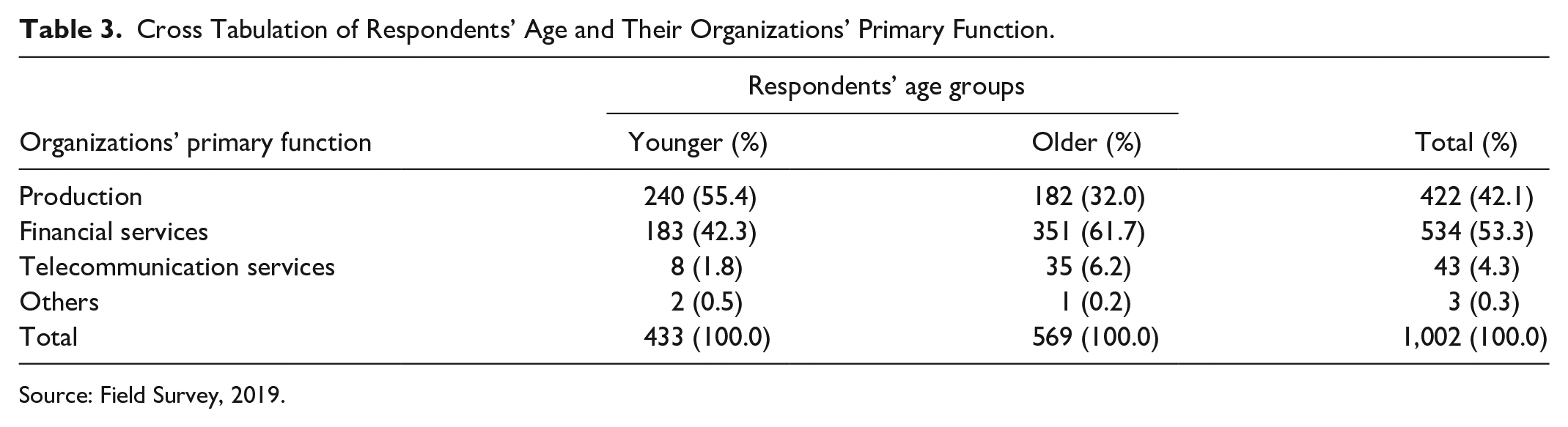
Table 3 demonstrates the age disparity of respondents in different organizations. It shows that the majority of younger respondents (55.4%) are in organizations whose primary function is that of production, while, the majority of older respondents (61.7%) are in organizations with financial services as their primary function. Also, a disparity was observed between younger respondents in organizations with telecommunication services as their primary function (1.8%), compared to older respondents in a similar organization (6.2%).
Cross Tabulation of Respondents’ Age and Their Organizations’ Primary Function.
Source: Field Survey, 2019.
Hacking Experience
The majority (85.5%) of the respondents work in an organization that has been attacked by black-hat hackers in the past, while, 14.5% indicated that their organization has not been attacked by black-hat hackers in the past. This implies that majority of the respondents were of the view that their organizations have been attacked by black-hatters in the past. This goes further to suggest the high nature of black-hat attack on corporate organizations in Cross River State. However, it is possible that some of the respondents who claimed their organizations have not been attacked by black-hatters in the past could simply be unaware that the attacks occurred or existed. This is because, in some of the organizations, especially the financial institutions, a specialized unit exists that manages cyber-related attacks; consequently, an average staff in another department might not know that the various changes in the banks’ software or cyber platforms are in response to anticipated or real hacking attack. This was deduced from one of the participants in the qualitative interview. Responding to whether his organization has been hacked by black hatters, he said: Sure, though banks have their hackers (ethical hackers), who identify vulnerabilities and patch them to forestall any attack from the bad guys. This effort has not prevented the black hatters from hitting our ICT equipment. In the bank, there is a specialised unit known as the Information Security Department that manages information relating to cyber-attacks on the bank. If there is a hacking attack, staff are usually not informed of the incident, but are directed and compel to take certain actions to mitigate future occurrence. Such actions include change of password in the middle of the month or deploring new software, which requires staff to log in afresh (IDI: Male Banker, 48, First Bank Plc).
Another participant from a different financial institution who claimed that the activities of black-hatters are routinely experienced by corporate organizations, especially the financial institutions, further corroborated the previous submission. According to him, “banks on daily basis experience breaches on their security networks by cybercriminals” (IDI: Male Banker, 39, GT Bank).
Other corporate organizations in the State are not exempted from the incessant attacks of black-hatters on their computers. Though there are variations, some of them perceived themselves as the most prone targets of black hatters as they stand a chance of losing their organizations’ biggest asset in the form of the intelligence on which the organization is founded. One of the participants from a manufacturing organization affirming that their organization has been attacked by black-hatters in recent time expressed his views thus: Yes, we have been attacked and you see, manufacturing organisations like Lafarge are often at the biggest risk of hacking attacks because of the vast and easily transferable intellectual property they possess. This is contrary to the assumption that cyber threats are aimed only at financial institutions or organisations, where data could be monetized (IDI: Male ICT Staff, 39, Cement Manufacturing Company).
A participant from a telecom organization also confirmed that telecom corporations are exposed to a large number of cyber-attacks as they are the gateway to other organizations’ access to the internet. According to her: Telecom companies like the one I work with experience a whole lot of hacking attacks. The reason why telecom industries suffer heavily from the activities of black-hat hackers is that they manage and operate a data-bank that is largely used to communicate and store large amounts of sensitive information, and also serve as the connecting platform for some organisations’ networks. The wide range of services offered and huge data in their custody make them attractive to black-hat hackers (IDI: Female Staff, 36, Airtel Telecom).
A triangulation of these responses reveals the reality of black-hatters attack against corporate organizations in Cross River State. Again, while, the attacks are dominantly perceived as focusing on financial organizations because they transact mostly on liquidity, other organizations are also having their fair share of the attacks. These organizations do not lose cash, but when vital information about the organization is stolen through an attack like hacking, the hacker could sell it to their rivals for a fortune or use it to bring down the organization.
Strategies Used by Black-Hat Hackers to Attack Corporate Organizations
Data presented in Table 4 below show that 41.1% of the respondents indicated fraudulent emails as the most widely utilized method by black-hat hackers to attack organizations in the State, 27.0% indicated viruses/spyware/malware, while, 17.6% indicated ransom ware. Again, 10.3% of the respondents were of the view that browser hijacks are the most commonly used method in attacking corporate organizations, while, 4.5% indicated denial-of-service attacks. This implies that majority of the respondents (41.1%) indicated fraudulent emails as the most widely adopted strategy of attacking corporate organizations in Cross River State, Nigeria.
Distribution of Respondents on How Black-Hat Hackers’ Attack Corporate Organizations.

Source: Field Survey, 2019.
The qualitative data indicated that fraudulent emails and viruses/spyware/malware attacks are the most frequently applied approaches by black hatters in attacking corporate organizations in the State. One of the participants who identified fraudulent emails as the most commonly used medium of attack has this to say: Fraudulent emails remain the most commonly used approach by the dark guys to attack financial institutions. They attack both the institution and her customers, usually, through phishing mails. They impersonate the bank and send bulk SMS to the banks’ customers’ phone numbers and/or emails requesting them to provide personal sensitive information, such as card numbers, passwords, ATM Pins, and so on. Once they can exploit customers’ vulnerabilities to their advantage, the institution becomes weak to their attacks. Also, they infect computers with malware in order to easily gain access to steal confidential information with which they attack the institutions (IDI: Male Banker, 48, First Bank Plc).
A participant from a manufacturing firm narrated how manufacturing industries have been hacked by black-hat hackers through fraudulent emails and malvertising. The participant has this to say: From experience, I can say to you that the widely used methods by black-hat hackers are malvertising and fake email spread. These are not the only methods used by hackers in their operations. Through successful malvertising and fake email spread, hackers inject malicious contents that can damage and, most often, siphon off important organisational data (IDI: Male ICT Staff, 39, Lafarge Cement).
In some organizations, fraudulent emails and virus attacks were not much emphasized; rather other techniques of attacks like unauthorized access, botnets attacks, browser hijacks, ransom ware and denial-of-service attacks were evident. Some of the participants, while responding to the strategies used by black hatters in attacking corporate organizations said, “We have been attacked by a black-hat hacker via ransom ware and denial-of-service. Cyber robbers through denial-of-service gain a foothold on staff’s computers and consequently, the financial institution in which they work” (IDI: Male Banker, 41, UBA). Fraudulent emails and virus attacks were also indicated by participants from other corporate organizations, making both the most widely reported strategies adopted by black-hatters in attacking corporate organizations in Cross River State, Nigeria.
The Impacts of Black-Hat Hacking on the Organizational and Economic Sustainability of Corporate Organizations
The underlying objective of this study, aside from evaluating the hacking activities perpetrated against corporate organizations in Cross River State, is to ascertain the economic impacts that such sophisticated crime has on corporate organizations in the State. The black-hat hacking was evaluated against specific forms of organizational and economic implications on corporate organizations (Table 5).
Distribution of Respondents by the Various Organizational and Economic Implications of Black-Hat Hacking.

Source: Field Survey, 2019.
Measuring the organizational and financial implications of black-hat hacking on corporate organization’s activities, six identifiable impacts were scaled to enable the respondents “agree” “strongly agree” “disagree” or “strongly disagree” on whether the impact is obtainable in their organizations. In presenting the responses, “strongly agree” and “agree” options were merged and re-coded as “agree,” while, “strongly disagree” and “disagree” responses were merged and presented as “disagree.” The merging is to enable ease and meaningful descriptive interpretation and analysis. As can be deduced from the first row, 95.5% of the respondents agreed that black-hat hacking takes productive time away from staff that make use of these computers, while, 4.5% disagreed. It is, therefore, evident that in the majority of corporate organizations, black-hat hacking affects the productive time of staff that rely on computers to carry out their duties. In the second row, 92.8% pointed out that black-hatters attack affects their organizations’ activities by reducing the pace at which their ICT equipment perform, and also make their server to be inaccessible or cause network jam. This was, however, disagreed with by 7.2%, which implies that majority of the respondents acknowledged the economic impact of black-hat hacking in their organizations as it slows down the performance of ICT equipment, which could negatively affect performance and overall output.
This was also the case with data presented in the third row in which 91.4% of the respondents agreed that black-hat hacking affects the organizations’ finance negatively given the cost of restoring the damaged files or the re-installment of the networks. These huge financial losses affect the economic sustainability of these organizations. However, this was not upheld by 8.6% of the respondents who disagreed that such financial loss is not applicable in their organizations. In the fourth row, 94% of the respondents agreed that black-hat hacking creates difficulty in system booting, results in failure of hardware functions, leads to loss of data and corrupts the operating system, thereby, hampering their organizational activities. On the contrary, 6% of the respondents disagreed, noting that such is not applicable in their organizations.
In the fifth row, 90.2% of the respondents agreed that black-hat hacking in their organizations result to inability to access data from removable disks and as a result, the organization’s reputation is at stake. On the contrary, 9.8% of the respondents disagreed that black-hat hacking in their organizations has not resulted in the inability to access data from removable disks and consequently loss of an organization’s reputation. The sixth row equally shows that majority of the respondents (88.6%) agreed that black-hat hacking results in huge finances carted away from the organizations as penalties and other compensatory payments made to customers by the organizations, while, 11.4% of the respondents are of the contrary opinion on that viewpoint. A summation of all data presented in this section shows that majority of the respondents were of the view that black-hat hacking has serious economic and organizational impacts on affected corporate organizations, which in a worst-case scenario could cause the organizations’ reputation damage with attendant huge financial losses.
Test of Hypothesis
Corporate organizations with previous hacking experience are not likely to perceive black-hat hacking as affecting the productivity of their organizations more than those without previous hacking experience.
H1 The productivity of corporate organizations will be affected by previous experience of black-hat hacking attack more than organizations without previous experience of black-hat hacking attack.
This hypothesis was tested with Chi-square statistics. The productivity implication of black-hat hacking scores was summed, and the mean score obtained. Scores that equaled to “disagree” and “strongly disagree” (<12) were coded as “do not affect productivity,” while, scores that equaled to “agree” or “strongly agree” (>12) were coded as “affects productivity.”
Table 6 shows that among respondents who have worked in organizations that have experienced hacking, 20.7% perceived black-hat hacking as not affecting productivity, while, the figure increased to 36.1% for respondents in organizations that have not experienced hacking. On the other hand, 79.3% of respondents in organizations where hacking has been experienced perceived black-hat hacking as affecting the productivity of their organizations, while, the figure decreased to 63.9% for respondents in organizations that have not experienced hacking. This suggests a form of relationship as dominant responses toed the hacking experience line of the organizations’ productivity being impacted.
Organizations’ Previous Experience of Hacking and Impact of Black-Hat Hacking on Organizations’ Productivity.

χ2 = 19.58a; df = 1, p = .000 N/B: critical χ2 = 3.841.
Source: Field Survey, 2019.
The chi-square value was χ2 = 19.58; df = 1; with a p-value of .000. This is less than the alpha value of .05 adopted as the study’s level of significance. Consequently, the null hypothesis, which states that corporate organizations with previous hacking experience are not likely to perceive black-hat hacking as affecting the productivity of their organizations more than those without previous hacking experience is rejected, while, the substantive hypothesis is retained. The study, therefore, concludes that corporate organizations with previous hacking experience are more likely to perceive black-hat hacking as affecting the productivity of their organization than those without previous hacking experience.
Discussion of Findings
The findings from this study show that black-hat hacking portends danger to the organizational and economic sustainability of the corporate organizations in Cross River State, Nigeria. These findings are consistent with the views of Ayofe and Irwin (2010), as they submit that computer hacking committed against a person, property, institution and government claims huge sums of money and has affected up to 56% of e-commerce globally. Again, the results show that corporate organizations lose unquantifiable amount of resources, which range from loss of consumer confidence to being held legally responsible for losses incurred by customers after such attack has occurred. Meanwhile, the real cost of black-hat hacking cannot be ascertained because the effects of such attacks can linger for years after the actual incident. Consequently, and in line with the research objective, the impact of black-hat hacking on the economic sustainability of corporate organizations was analyzed to show that black-hat hacking has six key impacts on the organizations’ management and finances.
On the organization, generally, black-hat hacking hampers access to data from removable disk and affects the reputation and image of the organizations as indicated by the majority of the respondents (90.2%). Again, 95.5% of the respondents showed that organizations when attacked by black hatters lose productive time. Such attacks also slow down the performance of ICT equipment in organizations, making servers inaccessible and causing network jam (92.8%). Other financial impacts include the cost of restoring the damaged files, and the re-installment of the networks involves huge finances, which affect the economic sustainability of organizations (91.4%). Also, the huge finances carted away from the organizations as penalties and other compensatory payments made to customers by the organizations are adverse (88.6%). This in some ways corroborates the position of extant studies, which highlights various economic and other implications of black-hat hacking to include financial losses (Lee & Song, 2007), loss of data due to files being deleted or changed (Alsayed & Bilgrami, 2017), decreased privacy (Oyelere & Oyelere, 2015), and damaged reputation (Olusola et al., 2013).
Conclusion and Recommendations
Cyberspace plays a crucial role in building, promoting and sustaining organizations’ brand and reputation. This is because most customers rely on cyberspace like organizations’ websites, social media pages and applications (apps) to interact directly with the organizations. However, when these platforms are notably hacked by the dark guys in the cyberspace, the brand and reputation of the organizations become questionable, making customers lose trust and confidence in them. The regularity of black-hat hacking is currently on the rise as almost all the respondents (85.5%) indicated that they work in a corporate organization that has been hacked by black-hatters. This confirms the argument of Akinsehinde (2011) and Odumesi (2014) that “more than eighty percent (80%) of organisations in Nigeria are prone to black-hat hacking, which consequently, threatens their existence and survival’’. And also verifies the report by Sophos, a UK-based cyber security company that 86% of Nigerian organizations surveyed said they suffered cyber attacks in the last 12 months (Idris, 2020). Thus, the study recommends that corporate organizations should spread their data across smaller sub-networks to help contain attacks to only a few endpoints instead of the entire ICT infrastructure. In addition, corporate organizations should strengthen their firewalls and educate their staff on the dangers of visiting unsafe websites, and downloading unverified attachments or clicking on links in unfamiliar emails. Big corporations should hire ICT security experts to carry out a penetration test on their network, with the intent of identifying what vulnerabilities exist, and carry out necessary reparations to forestall possible forms of attack or breach on the organization’s ICT infrastructure.
Footnotes
APPENDIX A: Proportional Distribution of the Study Sample Size as Collated from Field Survey
A Sample Breakdown of Manufacturing Industries.

| S/N | Manufacturing | Branch | Manufacturing company population size (N) | Proportion of staff | Sample size (N) |
|---|---|---|---|---|---|
| 1 | Flour Mills | Calabar | 384 | 0.48 | 213 |
| 2 | Lafarge | Calabar | 409 | 0.52 | 226 |
| Total | 793 | 439 |
Source. Authors’ compilation.
Declaration of Conflicting Interests
The author(s) declared no potential conflicts of interest with respect to the research, authorship, and/or publication of this article.
Funding
The author(s) received no financial support for the research, authorship, and/or publication of this article.
