




Abstract
This article examines how Korean leaders in a hierarchical society would trigger employees’ creativity and voice behavior through an indigenous leadership style: Korean leadership style (KLS). KLS exhibits heavily relationship-oriented behaviors, including attending to superiors’ needs and requests, building a positive reputation and trust of peers, and embracing and sheltering subordinates. Jeong, a shared group affect ingrained in Korean society, and woori, a shared feeling of belongingness dedifferentiating individuals constituting the collective, provide a fertile ground for this unique leadership style. Building upon the literature on group affect and collective energy, we explore how the affective mechanism mediates the positive relationships between KLS and employees’ creativity and voice behaviors. The findings from the empirical study of 340 leader–follower paired data points confirm the positive relationships between relationship-oriented Korean leader behaviors and employees’ creativity and voice behavior and that, for creativity, the link is partially mediated by positive affect with high energy.
Keywords
Introduction
The literature on leadership has accumulated a wide range of theories on what constitutes effective leadership over a century of study. Each of these theories and conceptualizations of leadership aims at defining the source of leadership, that is, the source where leadership emerges, and the mechanism by which leadership is transmitted (Hernandez, Eberly, Avolio, & Johnson, 2011). One stream of literature examines leaders, followers, and the relationships between leaders and followers as the source of leadership (e.g., trait theories, behavioral theories, transactional leadership, transformational leadership, leader–member exchange [LMX], authentic leadership), whereas another stream emphasizes context, “situational opportunities and constraints that affect the occurrence and meaning of organizational behavior as well as functional relationships between variables” (Johns, 2006, p. 386), as the source of leadership (Hernandez et al., 2011; Tsui, 2004; X. Zhang et al., 2012). For instance, the GLOBE (Global Leadership and Organizational Behavior Effectiveness Research) project was initiated to examine how leadership effectiveness is embedded in the societal and organizational norms, values, and beliefs of the people being led. In the flagship work of GLOBE, House, Hanges, Javidan, Dorfman, and Gupta (2004) pointed out that leaders are accepted when their attributes and behaviors match leadership styles that are culturally endorsed. Hence, research on indigenous leadership is becoming a necessity in understanding leadership within the unique societal and cultural context of a particular region or country (Kempster & Parry, 2011; Tsui, 2004). Addressing this need, the primary goal of this research is to contribute to the advancement of the indigenous leadership research inherent within the local cultural context by focusing on the Korean leadership style (KLS)—a set of relationship-oriented leader behaviors (Baik, Seo, Koo, & Kim, 2010; H. K. Kim & Baik, 2015)—built upon a shared group affect, jeong, a nurtured inner state of filial affection, closeness, and empathy in relationships that dissolves interpersonal boundaries, and woori, a strong feeling of belongingness to a group where imperfect interdependent individuals become whole and complete (I. J. Choi & Choi, 2002; Rhee, Uleman, & Lee, 1996; Yang, 2006; Yang & Horak, 2019).
The secondary goal of this article is to examine the mechanism through which KLS affects employee outcomes. Similar to other relationship-based leadership styles such as LMX, authentic leadership, servant leadership, and transformational leadership, positive employee outcomes can be attributed to Korean leaders’ supporting and facilitating behaviors (Detert & Burris, 2007; Mumford, Scott, Gaddis, & Strange, 2002; Shalley & Gilson, 2004; Zhou & George, 2003). What distinguishes KLS from other relationship-based leadership styles is that the effectiveness of KLS hinges upon the level of collective energy and positive affect as well as leaders’ supporting behaviors. KLS is based on two types of shared group affects—jeong and woori—and plays a critical role in motivating employees through a positive group affect with attendant high energy (Barsade, 2002). Various leadership theories have long presumed that affect, mood, and emotions are “deeply intertwined with the process of leading, leader outcomes and follower outcomes” (Gooty, Connelly, Griffith, & Gupta, 2010, p. 979). Moreover, recent studies have examined how leaders’ affect, mood, or discrete emotion has an influence on followers’ moods and emotions, which, in turn, affects follower outcomes (Cherulnik, Donley, Wiewel, & Miller, 2001; Erez, Misangyi, Johnson, LePine, & Halverson, 2008). However, with a few exceptions (Barsade, Ward, Turner, & Sonnenfeld, 2000), most studies have examined the effect of leaders’ affect, emotions, and mood, and the role of affect shared by larger group of members on follower outcomes has been rarely discussed (Menges & Kilduff, 2015). Hence, by introducing KLS and its effectiveness, we aim at expanding the literature on affective leadership mechanism by studying how affect predominantly experienced by members can convey relationship-oriented leader behaviors to employees.
Theoretical Background and Hypotheses Development
KLS: Relationship-Oriented Behaviors Founded on Jeong and Woori
According to Hofstede’s cultural dimensions, Korea is a hierarchical society with high power distance (Hofstede, 1980). In the organizational context, this characteristic has manifested itself in the form of centralization and formalization, and organizational members value seniority highly, take orders from their superiors blindly, and rarely challenge their leaders (Chang & Chang, 1994; Cho, Shin, Billing, & Bhagat, 2019; Hong, Cho, Froese, & Shin, 2016; Koo & Nahm, 1997). However, respected leaders of Korean companies are perceived as fair and kindhearted people who value harmonious interpersonal relationships with their subordinates (E. A. Kim, 2015). Similar to how leaders behave in a high-quality LMX relationship, Koreans value loyalty from their subordinates and reciprocate subordinates’ loyalty with care and support. However, in contrast to the LMX relationship that can be sustained by high performance by subordinates, leader–follower relationships in the Korean context entail empathy and guardianship with low performers as well as high performers (H. C. Lee, 1998). Similar to paternalistic leadership, KLS identifies leaders’ benevolent behavior toward employees, that is, “the leader’s individualized care and holistic concern for the well-being of employees (and their families)” (Hiller, Sin, Ponnapalli, & Ozgen, 2019), as a distinct dimension. However, KLS differs from paternalistic leadership because KLS does not limit the discussion to leader–follower hierarchy. KLS extends the types of relationships to include those with superiors, those with peers, and those with subordinates. Furthermore, a leader deploying KLS is perceived as a role model with warmth and generosity, whereas a leader with a paternalistic leadership style is perceived as a relatively authoritarian figure in the context of supervisor–subordinate relationship. KLS is more of a full-fledged, flexible, and expansive model than paternalistic leadership; Korean followers respect their leaders, and leaders show benevolence and empathize with their needs and conditions. In the Korean organizational context, leaders and followers each have their own parts to play, benevolence and loyalty, respectively, and underneath these mutual obligations are two types of group affects which are fundamental bases of collective Korean relationships (S. C. Choi & Choi, 2001; Lim, 1993). These group-based affects distinguish the KLS-based relationship from other leader–follower relationships.
Jeong is a subtle emotional phenomenon, which has its roots in combined emotions of paradoxical elements such as happiness, anger, worry, sadness, joy, hate, and fear (Yang, 2006). Jeong is best defined as a feeling of filial affection, a high degree of closeness, and empathy in a relationship nurtured with history and shared experiences, and individuals can experience jeong regardless of the quality of relationship, that is, whether individuals have a positive or negative feeling toward each other in the relationship (K. O. Kim, 1993). The duration of relationship is one of the critical elements of jeong, and people interconnected in this jeong can look out for each other and go through the challenges together (H. K. Kim & Baik, 2015). Jeong is developed and nurtured through time and shared events, and one can still feel jeong toward a coworker who clashes with them on every matter if the conflicting relationship has been sustained for many years. Irrespective of the number of common traits and interests, parties become more engaged and committed to each other, even at the cost of self-sacrifice, inequity, and unfairness because of jeong.
Another unique feature in this jeong-based relationship is that individuals would deindividualize their identities and psychologically bond with others, integrating into a cohesive collective unity. Hence, individuals bond into one or share the feeling of woori (we-ness) with the collective group (I. J. Choi & Choi, 2002; Yang, 2006). As the boundaries between individuals become unclear, members are expected to build a strong identification as a collective group and feel obliged to stand for the benefit of the group regardless of their self-interests. This woori is not simply “we” in a sense of an individual feeling group solidarity in a collective group as interpreted within cultures that respect individualism, but it is a feeling of the self dissolving into the unity and harmony of the group (I. J. Choi & Choi, 2002; H. K. Kim & Baik, 2015). The woori feeling is deeply embedded in the Korean context, and a Korean hardly refers to himself as “I” as found in more individualistic cultures (Chai, Jeong, Kim, Kim, & Hamlin, 2016; H. K. Kim & Baik, 2015) and instead uses “we” and “our” or woori when speaking in the Korean language (e.g., “our” spouse instead of “my” spouse in the monogamous Korean society) (Yang, 2006). Hence, one can say at work that an issue becomes everybody’s problem, as it is not “my” issue but “our” issue. The group members would take responsibility for the action of any individual in the group, and they look out for each other and care for each other’s problems as “our” problems. This woori affect is what greases the wheels so that members can work in harmony, get involved collectively, and rely on their seniors to give them support (E. A. Kim, 2015).
In this respect, Baik et al. (2010) defined KLS which embodies jeong and woori cultural phenomena. These scholars explain that KLS is grounded in the underlying collective emotional spirit of jeong and woori, which is manifested through the leaders’ relationships with three parties: superiors (upward adaptability), peers (lateral harmony), and subordinates (downward benevolence). These indigenous affects shared by Koreans override any other relationship quality with these three parties (Lim, 1993). Korean leaders would show high-quality relationship-based behaviors toward their low-performing or personality-clashing subordinates in situations where a low-quality LMX relationship is expected. They may even overlook and forgive these subordinates when they make mistakes and perform inefficiently because of the shared affects (Baik et al., 2010). Toward their superiors, Korean leaders show deference and loyalty and even ascribe the credit to their superiors when they have contributed more to a certain achievement. With peers, Korean leaders build positive and trusting terms, working in harmony in a family atmosphere (Yang, 2006). Leaders of an organization guide and shelter their subordinates because that is how their supervisors treated them when they were juniors. These self-sacrificial, unbounded relationship-oriented behaviors toward peers, subordinates, and supervisors can be maintained and passed on to the next generation of organizational members because of the shared affects omnipresent in Korean society.
Affective Mechanism of KLS
How, then, do these indigenous affect-based relational behaviors influence followers’ outcomes? To understand the mechanism through which relationship-oriented Korean leader behaviors affect employee outcomes, we draw on literature on positive affect and supervisory support. Literature on positive affect shows that positive relational connections with others energize individuals at work (Atwater & Carmeli, 2009; Dutton, 2003). Because of positive affect and trust in the relationships (Son & Kuchinke, 2016), employees are energized and motivated to ensure that organizational goals are met, regardless of how difficult the process may be. When Korean leaders show enthusiasm for working in harmony with the three parties—superiors, peers, and subordinates—accompanied by jeong and woori, subordinates would uphold a high level of commitment and identification with the group because they feel energized. This increased energy—spirit, morale, and enthusiasm at work—acts as a fuel that motivates members to perform beyond their capabilities (Levy & Merry, 1986). Furthermore, once a certain high level of energy is reached, it can be maintained for a longer duration even without a series of specific positive events (Cole, Bruch, & Vogel, 2012). As jeong matures over time, there emerges a sense of woori, which, in turn, works to reinforce nurturing of jeong within individuals’ hearts and minds. In sum, Korean leaders’ relationship behaviors heighten the level of two types of indigenous positive affects, which, in turn, can motivate and positively influence followers by uplifting the energy level of members.
The positive affect of Korean leaders’ jeong- and woori-based relationship-oriented behaviors can also be explained by organizational support theory (Eisenberger, Cummings, Armelia, & Lynch, 1997; Eisenberger, Huntington, Hutchinson, & Sowa, 1986). The theory argues that employees develop views concerning the degree to which the organization values their contributions and cares about their well-being. Korean employees who feel valued by the wider group continue to generate an excitement for being part of the group. Subordinates are motivated when they recognize that their leaders are good role models who build high-quality relationships with supervisors, receive recognition and trust from peers, value employees’ contributions, protect individuals and teams, show confidence and trust in their employees, and, moreover, engage in these activities with enthusiasm (Shalley & Gilson, 2004). Because of jeong and woori, Korean leaders show respect to their supervisors, demonstrate trustworthiness in their peers, and show affection, benevolence, protection, and support for their subordinates’ well-being, and these relationship behaviors play a critical role in boosting employee outcomes (Son & Kim, 2016). Leaders’ role-modeling in relational behaviors affects employees because employees feel safe when they work with leaders who know how to handle interpersonal relationships with the three parties. Leaders who know how to manage relationships with supervisors, peers, and subordinates are recognized as a supportive supervisor, and as Wayne, Shore, and Liden (1997) state, perceived supervisory support motivates the employees to complete their tasks with enthusiasm and to engage in tasks beyond their job descriptions. In the Korean context, these high-quality relationships and support are perpetuated in other levels of the organization, and followers are likely to build an even higher level of commitment and motivation at work because of the positive spiral effect of widespread jeong- and woori-based relational behaviors at all three levels (Walter & Brunch, 2008).
The Effect of KLS on Employee Outcomes
Based on this linkage between Korean leaders’ behaviors and positive employee outcomes, we further examine the effectiveness of KLS by looking specifically into two types of individual outcomes in this article: creativity and voice. Creativity—a response, product, or solution, which may be novel or improved on to an open-ended individual or group task (Amabile, 2012)—and prosocial voice behavior—an extra role behavior whereby employees express and share their concerns and express constructive viewpoints about issues at work (Tangirala & Ramanujam, 2008; Van Dyne & LePine, 1998)—are becoming ever more important in today’s turbulent work environment (Shalley & Gilson, 2004). Various studies have shown that leaders play a critical role in motivating employees to be creative (Mumford et al., 2002) and to voice their thoughts (Detert & Burris, 2007). When members share positive emotion with high energy, this positive affect becomes contagious and transforms into a group-level positive affect, which, in turn, increases cooperation and improves the task performance of individuals and groups (Barsade, 2002; Bierhoff & Müller, 2005). As jeong and woori are positive affects shared by members of the organization in Korea, these positive affects can further boost the energy level of the organization and positively influence employee outcomes (Baik et al., 2010; Shim, Baik, & Kim, 2014a). Korean leaders’ relationship-oriented behaviors toward peers, subordinates, and supervisors can increase employees’ creativity and voice behaviors because members experience positive affect with high energy (Barsade, 2002). KLS increases the level of positive affect shared by the members, and this positive affect increases creativity and voice behavior by broadening the scope of cognitive skills (Fredrickson, 2001) and through psychological safety (Edmondson, 1999). Specifically, individuals in positive affective states can pay more attention to people around them or their tasks or problems encountered, actively engage in the organizational process, are determined to get things done, and thus, in the end, find creative solutions to problems (Amabile, Barsade, Mueller, & Staw, 2005). When people are in a positive mood, they transcend their limits and engage in active, creative, and altruistic behaviors (George & Brief, 1992; Hsiung, 2012). Furthermore, relationship-oriented Korean leaders’ behaviors are the driver for how Korean employees can speak up and share their ideas in the high power distance culture. On the surface, due to Korea’s high power distance culture (Hofstede, 2001), a high respect for authority is expected in various work contexts, and most of the formal communication is top down. When observing everyday office conversations in Korea, leaders receive group goals set by their supervisors, and their subordinates, in turn, accept those goals. Especially in the owner-led companies like chaebols, owners who have a strong control over the company can easily implement new strategies with this top-down approach because of this highly hierarchical culture. However, Koreans still have a channel to voice their ideas and share their creative thoughts from the bottom up because of informal social gatherings outside workplace settings and often after working hours. Koreans sometimes do not talk in formal meetings, because they have already solved the problems informally by having in-depth discussions with woori members. Formal meetings are often considered a ritual to formalize the informal ones. Jeong and woori foster the environment where leaders who enact KLS-based behaviors can invite their followers to speak up and share their insights. Without this indigenous leadership style, Korean followers would not have the channel to voice their opinions regardless of the number of informal gatherings they attend.
The relational nature of KLS allows employees to be personally engaged with their supervisors. Informal social gatherings play a critical role in reconfirming jeong and woori between supervisors and subordinates, and during these occasions, leaders and followers share work information and solve issues creatively (Yang, 2006). In these meetings, which normally include company-sponsored meals and drinks, the atmosphere is more relaxed than in the formal meetings at workplace, creating a psychologically safe setting for employees to express themselves (Edmondson, 1999). Furthermore, employees at all levels join these informal gatherings, and members at the bottom observe how their immediate supervisor challenges his own supervisor’s opinions in these meetings and learn that these informal channels are the ones to deliver their creative ideas and voice their concerns and thoughts.
Another reason why Koreans can share their ideas and concerns in the hierarchical culture is because of their strong commitment toward the group entity through the woori affect. Several studies have pointed out how strong identification with the group and the supervisor can increase employee creativity and voice behaviors (Tangirala & Ramanujam, 2008). Korean employees with a strong affective attachment to their group, underpinned by jeong and woori, would be motivated to share their creative solutions and voice their thoughts and ideas because they have one strong purpose to benefit the entire group. They prioritize the interests of the group and tend to speak up (Tangirala, Kamdar, Venkataramani, & Parke, 2013), whether in a formal workplace setting or in informal social gatherings as with most cases in Korea. One’s pursuit of self-interest is overruled by the organizational needs and the subordinates’ desire to fulfill their duty as loyal group members for the benefit of the group. Based on the above discussions, we hypothesize the following:
Furthermore, as we discussed in the previous section on the affective mechanism of KLS, jeong- and woori-based leader behaviors boost positive affect with high energy, and this positive affective state can increase various types of employee productivity and outcomes including voice behaviors (Liu, Song, Li, & Liao, 2017) and creativity (Kahrobaei & Mortazavi, 2016). When individuals experience a highly energizing positive affect, they benefit from this psychic boost and engage in behaviors that go beyond their job descriptions (Levy & Merry, 1986). Positive affect with high energy is the proxy for the extent to which KLS fostered psychologically safe environment in the hierarchical organizational culture, and positive outcomes of KLS can be generated through this mediating mechanism. This affective mechanism plays a critical role in linking relationship-oriented Korean leader behaviors and employee outcomes: creativity and voice behaviors.
Specifically, the positive affective state has a signaling effect on the other members of the organization and allows the other members to feel safe to voice their concerns and thoughts (Fredrickson, 2001; Liu et al., 2017). Jeong and woori are displayed in leaders’ relationship-oriented behaviors toward supervisors, peers, and subordinates, and other members of the organization, especially followers, may feel comfortable to engage in voice behaviors. Similarly, according to the broaden-and-build model (Fredrickson, 1998), a positive affective state pushes individuals to go beyond their comfort zone and engage in nonroutine thoughts and behaviors. Korean leaders’ relationship-oriented behaviors foster jeong and woori in the organization, and their followers can experience positive affect with high energy, thinking freely and creatively. Therefore, based on our extensive discussion on the affective mechanism of KLS, we hypothesize on the mechanism of positive affect with high energy as follows (see Figure 1 for the hypothesized research model):

Hypothesized research model.
Method
Data Collection
We deliberately chose one company to minimize the effects of other unforeseen influential factors that could possibly blur the focus of study. A multinational family restaurant company with 76 restaurants and a supporting back office located in Korea was selected for the research. All the staff, including the CEO and the rest of the employees, were Koreans, born and raised in Korea.
The sample includes restaurant managers and their subordinates. Managers oversee the overall restaurant floor and kitchen operations, and are accountable for the profit and loss of their business units. Restaurants have a staff of 30 to 60 people, and five to 12 employees reporting directly to each restaurant manager. Restaurant managers report to regional managers and regional managers work with back office managers, that is, marketing, finance, and supply chain managers, who are accountable for assisting and supporting the restaurant managers to meet their business goals. Restaurant business knowledge and skills are relatively easier to acquire than other businesses. However, due to the competitive nature of the industry (National Restaurant Association, 2017), restaurant managers are expected to constantly promote sales volume, increase return visits, maintain restaurant ambience, improve work processes, reduce costs, develop new products to meet changing customer needs, and present finished products with speed and efficiency. Hence, restaurant managers primarily focus on improving team performance through delivering high-quality services and products at the optimal speed for their customers.
We received the complete list of managers and their employees through the human resource (HR) department, chose supervisor–subordinate pairs at random, and sent online survey links directly to each member of the organization to protect the confidentiality of the participants. Furthermore, to reduce the risk of common method variance (Podsakoff, MacKenzie, Lee, & Podsakoff, 2003), the questionnaire for managers and that for subordinates included different sets of variables. The subordinates reported on their supervisors’ KLS and self-reported on their positive affect with high energy, and the supervisors reported on their subordinates’ creativity and voice behavior. Unreliable data were removed from the data set of 355, and 340 supervisor–subordinate pairs of the total survey participants were set as final data for analysis. In sum, multiple data sources were used and matched, and the final sample size was 340.
Measurements
KLS, positive affect with high energy, employee creativity, and employee voice behaviors are key variables of this study. Because all the participants were Korean, all the questions in the survey were written in Korean. We used existing measures of creativity and voice behavior written in English and translated these scales into Korean by following a translation/back translation process (Brislin, 1980). For KLS and positive affect with high energy, we implemented the existing measures available in Korean, validated through multiple studies previously conducted (e.g., Baik et al., 2010; Kang & Kwun, 2013); thus, no translation step was taken. All items were measured on a 5-point Likert-type response scale ranging from 1 = strongly disagree to 5 = strongly agree.
KLS
The relationship-oriented behaviors of Korean leaders are composed of three dimensions: upward adaptability, lateral harmony, and downward benevolence. Because jeong and woori affects drive leaders not only to take care of their followers but also to build strong connections with their supervisors and peers, Baik et al. (2010) developed a KLS scale that includes relationship-oriented behaviors toward subordinates, peers, and supervisors. Four items from each subdimension, totaling 12 items, which had passed several reliability tests in other previous studies, were used.
Several studies in the past 8 years have shown the robustness of this scale in the context of team satisfaction, team innovation, team effectiveness, and other positive outcomes (H. K. Kim & Baik, 2015; Shim et al., 2014a; Shim, Baik, & Kim, 2014b), and the reliability of the scale was also confirmed in this study (Cronbach’s α: upward adaptability = .94, lateral harmony = .92, and downward benevolence = .82). Subordinates assessed leaders’ KLS, and the detailed items are shared in Table 1. All items’ factor loading was more than 0.6, which is higher than Stevens’s (2002) suggestion of a minimum of 0.4. All three dimensions’ secondary factor loading was also higher than 0.6. Moreover, all three dimensions showed Cronbach’s alpha at .8. The construct validity and reliability of KLS were confirmed as shown in Table 1.
Factor Analysis and Reliability Results of Korean Leadership Style and Positive Affect With High Energy.
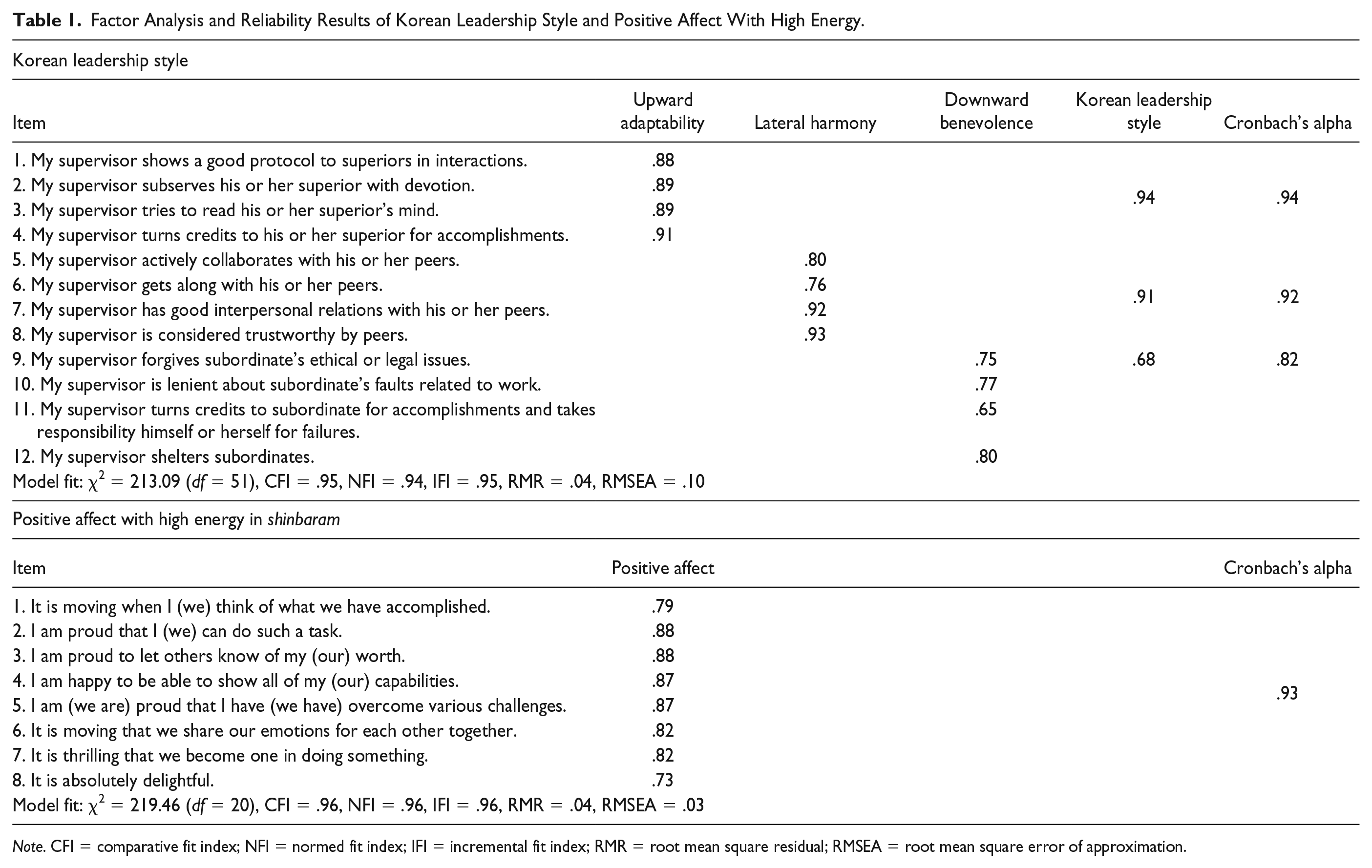
Note. CFI = comparative fit index; NFI = normed fit index; IFI = incremental fit index; RMR = root mean square residual; RMSEA = root mean square error of approximation.
Employee creativity and voice behavior
Subordinates’ creativity was measured with Zhou and George’s (2001) 13-item scale by their supervisors (Cronbach’s α = .96), including “My subordinate exhibits creativity on the job when given the opportunity” and “My subordinate suggests new ways to achieve goals or objectives,” and voice behavior was measured with a six-item voice scale by Van Dyne and LePine (1998) (Cronbach’s α = .93), including “My subordinate speaks up and encourages others in this group to get involved in issues that affect the group” and “My subordinate communicates his or her opinions about work issues to others in the group even if his or her opinion is different and others in the group disagrees with him or her.” Two outcome variables were found to be distinctive and separate concepts. All items of each variable showed a factor loading above 0.6, demonstrating the validity of the constructs. Both variables showed Cronbach’s value of more than .9. Hence, the construct validity and reliability of the dependent variables were confirmed.
Positive affect with high energy
Subordinates self-reported on eight items from shinbaram measurement, developed by Kang and Kwun (2013). Shinbaram is a Korean term that captures the positive affective state with high energy and is composed of three subdimensions: a positive experienced affect with high energy (pride, enthusiasm, excitement, delight; Cronbach’s α = .94), a cognitive focus (absorption and engagement at work; Cronbach’s α = .78), and emotionally expressive behaviors (Cronbach’s α = . 88). Because our interest was on the affective mechanism, we focused on the first set of eight items on positive affect with high energy in the analysis (see Table 1 for the detailed items).
Control variables
To rule out the effects of irrelevant variables that could erode the degrees of freedom (Atinc, Simmering, & Kroll, 2012), we controlled for age, gender, and the tenure of leader–follower relationship, which could determine the relational commitment of both supervisors and subordinates (Landry & Vandenberghe, 2012).
Results
The results of all variables’ means, standard deviations, and correlations are provided in Table 2. Hierarchical regression analyses were conducted to examine the effectiveness of KLS on employee outcomes. We followed Baron and Kenny’s (1986) regression analysis for mediation hypotheses using SPSS and AMOS Version 21. In addition, the Sobel (1982) test was run to reconfirm the mediator’s positive significance on the relationship between the independent and dependent variables.
Means, Standard Deviations, and Correlations.

Note. Sample size: 340.
p < .05. **p < .01. ***p < .001.
The effects of KLS on creativity and voice behaviors are shown in Step 2 (left section) of Tables 3 and 4, respectively. In Step 2, when creativity was a dependent variable, we observed that KLS had a positive relationship with employees’ creativity (B = 0.24, p < .001). Moreover, it is observed that KLS had a positive relationship with creativity, compared with when the control variables were input (ΔR2 = .05, p < .001) in Step 1. In Step 2, when voice behavior was a dependent variable (Table 4), KLS was found to have a positive significant relationship with prosocial voice behavior (B = 0.24, p < .001). The model with KLS had a higher explanatory power than the model with only controlled variables (ΔR2 = .05, p < .001). Hence, the results supported both Hypotheses 1 and 2 and imply that the more the subordinates perceived their supervisors as engaging in relationship-oriented Korean leader behaviors, the more their creativity and prosocial voice behavior increased.
Hierarchical Regression Analysis of Korean Leadership Style on Creativity.
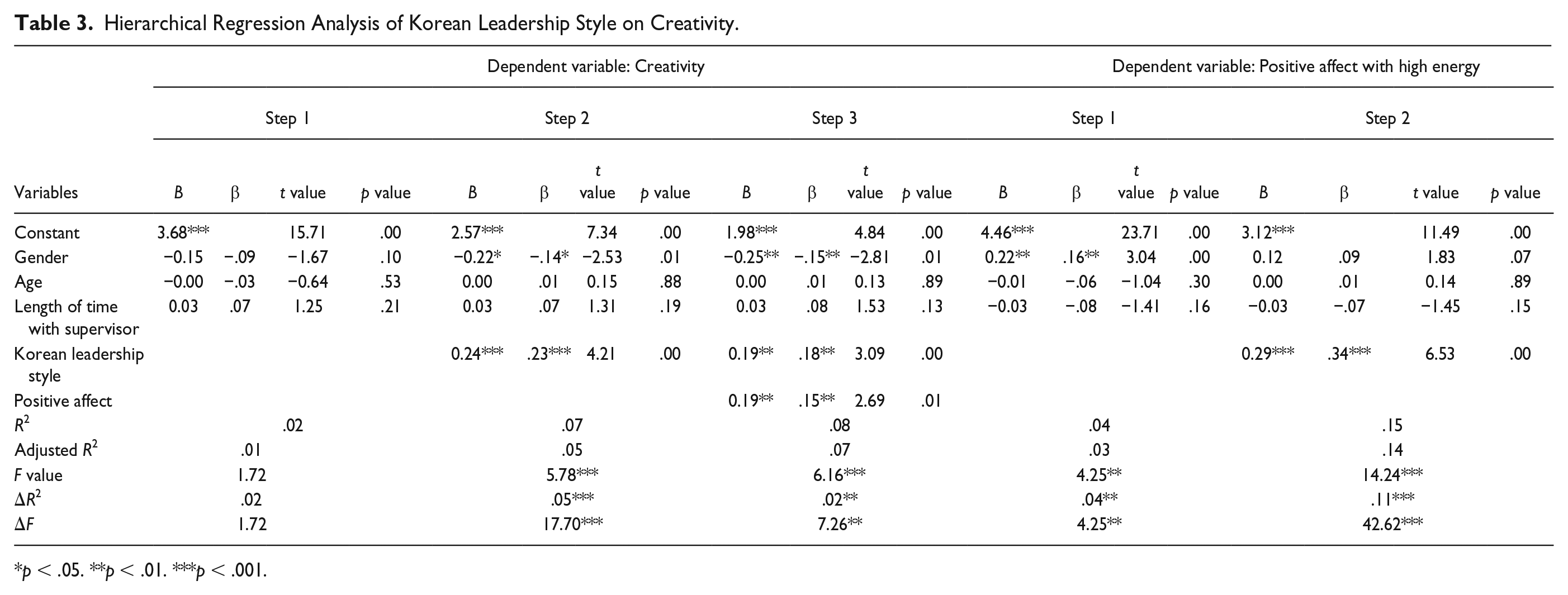
p < .05. **p < .01. ***p < .001.
Hierarchical Regression Analysis of Korean Leadership Style on Voice Behavior.

p < .05. **p < .01. ***p < .001.
As Hypotheses 1 and 2 were supported, the first criterion of Baron and Kenny’s (1986) mediation test was satisfied. Next, we checked whether KLS has a positive relationship with the mediator, positive affect with high energy measured with the first dimension of shinbaram. When positive affect with high energy was a dependent variable, the regression analysis showed that KLS had a positive relationship with positive affect with high energy (B = 0.29, p < .001) as shown in Step 2 (right sides) in Tables 3 and 4. This meets Baron and Kenny’s (1986) second criterion. Compared with when the controlled variables were input in Step 1, KLS showed an increase in relationship with positive affect with high energy (ΔR2 = .11, p < .001).
Moreover, the results from Step 3 of Table 3 showed that positive affect with high energy had a positive significant relationship with creativity (B = 0.19, p < .05), meeting Baron and Kenny’s (1986) third criterion. It is also observed that the explanatory power of the model including positive affect with high energy was higher than in Step 2 (ΔR2 = .02, p < .05). The Sobel test also confirmed that positive affect with high energy acted as a mediator (ΔR2 = .05, p < .05) in the relationship between KLS and creativity. Hence, Hypothesis 3 was supported. Also, positive affect with high energy was a partial mediator because even having had controlled positive affect with high energy, KLS continued to show a positive significant relationship with creativity (B = 0.19, p < .05). This implies that KLS influenced employees’ creativity directly and through the mediator. However, the mediating role of positive affect with high energy in the context of the relationship between KLS and employee voice behavior (Hypothesis 4) was not supported (B = 0.13, ns). Moreover, adding a positive affect with high energy to the model did not contribute to the increase in explanatory power (ΔR2 = .01, ns).
Discussion
Theoretical Implications
The purpose of this research is twofold: introducing KLS based on jeong and woori and examining the effectiveness of KLS on employee outcomes. Overall, the current study contributes to the literature on context-based leadership and on the affective mechanism of leadership. First, the indigenous notion of KLS extends the emic approach on leadership and culture. Although the etic approach explains that certain types of leadership can be generalized and universally found in all cultures, over ruling bias and diversity, the emic approach argues that some leadership types are unique and need to be interpreted by their own local customs, meanings, and beliefs (Hofstede, 1993, 2001), proposing that the leader can exist within the specific unique culture. The way people think and act is the reflection of what is “embedded” in their cultures (Bruner, 1996; Graen, Hui, & Taylor, 2004; Pepitone & Triandis, 1987; Shweder, 1991), and people’s emotions are linked to their cultures (Kashima, McKintyre, & Clifford, 1998). Leadership deals with the hearts and minds of people and the cultural context, “a shaper of meaning” (Johns, 2006, p. 388), where these people belong can shape what it means to be a good and effective leader. House et al. (2004) highlighted the intricate relationship between culture and leadership and addressed the idea that leaders’ attributes and behaviors are effective when they are culturally endorsed by members of that culture. Several works on guanxi in the leadership literature (Chen, Yu, & Son, 2014; L. Zhang, Lam, & Deng, 2017) are another example of the emic approach, capturing the unique leader–subordinate relationship in the Chinese context. The notion of KLS, the set of jeong- and woori-based relationship-oriented behaviors, encapsulates how Korean leaders affect their followers through upward, downward, and lateral relationships and echoes the need for a more emic approach to leadership (Hernandez et al., 2011; Kempster & Parry, 2011; Tsui, 2004).
Second, jeong and woori are underlying affects that shape leaders’ behaviors in the Korean context, and these affects are, to our knowledge, the first types of context-unique affects that were explored to understand relationship quality between two or more parties. While other context-specific constructs such as guanxi are mainly considered as norms, jeong and woori are primarily affects shared by the members of the context. Furthermore, these group affects are the forms of affect that benefit members of a group regardless of the quality of the relationship. Guanxi, on the contrary, affects a social tie or a connection that benefits individuals in that relationship (Leana & Van Buren, 1999). While guanxi is a norm that emphasizes how an individual can personally benefit from that relationship, jeong and woori are affects that can contribute to the collective’s interests (Yang, 2006). The current study on jeong and woori contributes to the literature on leadership and context by introducing collective affects as bases of indigenous leadership style.
Furthermore, the jeong- and woori-based relationship can extend the literature on social exchange. Lawler (2001) introduced the affect theory of social exchange and argued that emotions and feelings are shared by exchange partners and groups and that these emotions can affect collective-oriented behaviors and commitments to the relationship. This postulate aptly explains KLS which is heavily embedded by the jeong affect shared collectively. The Korean leaders’ effectiveness is defined by how well they share jeong psychological emotions in their relationship with these three parties as they build the woori sense. Baik, Shin, and Kim (2016) explain that jeong is far from rational, and the behavior arising from jeong is not transactional. Jeong is more comprehensive than the feelings that emerge from being considerate of others, demonstrating affection and concern to take care of others. This emotion overrides any relationship quality, whether it is liking or disliking (K. O. Kim, 1993; Lim, 1993). Transactional relationship is, in fact, viewed to be unlike jeong, because within jeong, the group’s interest is to take care of the group members regardless of the quality of the relationship. A leader can also give special attention and empathy toward a member that he or she dislikes working with because of the woori nature of the relationship. Hence, jeong- and woori-based relationships are different from other exchange relationships (e.g., LMX) where the relationship is based on mutual obligation, reciprocity, and exchanges (Liden, Sparrowe, & Wayne, 1997). While the quality of the exchange relationship is based on how each party in that relationship perceives his or her dyadic counterpart (Engle & Lord, 1997; Lord & Maher, 1991), jeong- and woori-based relationships override the quality of the exchange relationship.
Third, the current study adds to the literature on creativity and voice behaviors by examining how the indigenous KLS can motivate employees through positive affect with the high energy experienced by the members. Korean leaders are found to form relationships collectively with three parties in the workplace, specifically, giving strong support for their superiors, working in harmony with their peers, and sheltering their subordinates. Through these relationships, group members experience the organizational support that they are being well cared for (Eisenberger et al., 1997; Eisenberger et al., 1986) as they support one another in reaching the interests of the group (Baik et al., 2016; J. W. Lee & Lee, 1995). The shared overarching affects create the sense of energized positive affect, and members become fully motivated to collectively achieve extraordinary business results that are explained beyond rationality. The positive affect with high energy is experienced as inner celestial joy and happiness and also expressed through enthusiasm in behaviors. Subordinates with positive affective states are persistently motivated to find better and creative ways and voice their ideas to meet the group goals, at any cost, as this is their commitment to the organization (Amabile et al., 2005; Tangirala & Ramanujam, 2008) and shows their loyalty. Hence, a group of people are bonded collectively by jeong and woori, and the group would put the interests of the group as their priority over their individual selves, but it is the positive energy that engulfs and motivates the group to perform beyond rational comprehension.
Practical Implications
There are also implications for business managers and HR consultants to consider. KLS involves relationships with three different parties, and HR managers and leadership trainers may consider these three types of relationships to be baselines for leadership training, focusing on the importance of the relationship with all three parties: supervisor, peers, and subordinates.
This would require a mind-set paradigm shift from leadership training focusing between the leader and member to developing leader competency in all three types of relationship. This new approach can allow members to build jeong and woori, leading to higher team-level and individual performances. This indigenous set of relationship-oriented leader behaviors prompts leaders to be humble and supportive of their superiors, work cooperatively with the peers with whom they feel like a family, and protect their subordinates, even at the cost of self-sacrifice. Ultimately, leaders who value people in three different relationships, and the affect that they share with each other, would perform, for the group and the whole organization, above their individual interests, however hard the goals are to be met.
Furthermore, to boost the jeong and woori emotions, social emotions such as emotional intelligence (Goleman, 1998) can work hand in hand, because it awakens individuals to be sensitive to others and manage and adjust their emotional senses to guide thinking and behavior, as they work together in achieving the common business goals. As a mechanism, coaching is highly commended as it sets the stage for the leaders to work in collaboration with the people around them, in setting goals and, in particular, inspiring people to learn, grow, and contribute toward business (Grant & Stober, 2006; Heslin, Vandewalle, & Latham, 2006). Moreover, this caring is inherent in coaching as it is about connecting and building an engaging relationship and emotionally investing in others, and encourages another person’s success (Kroth & Keeler, 2009). Caring is characterized in terms of emotional attachment (Skovholt, 2005) and empathy (Kahn, 1993) and resonates with jeong and woori emotions. The guidance, facilitation of learning, and inspiring of employees brought about by coaching may well achieve the purpose. It is construed that in the coaching process, the employees are encouraged to be creative and use their voice to come up with solutions as they meet the organization’s goals. Hence, their priority in contributing to the overall organizational goals to which they feel personal attachment to fulfill (Eisenberger et al., 2010) is satisfied. In other words, the more the employees receive coaching, the more their confidence to be creative and proactively voice their thoughts and ideas would be boosted, contributing positively to the business. Coaching also induces the leaders to self-reflect on their inner self: the emotions, the motivation, and the view of their three-party team, relationships, and work. They would then also realize how their feelings could affect their behaviors and actions on themselves and others, and also possible behaviors that might disrupt the jeong and woori are detected earlier. This, again, is a powerful tool to minimize the risk of de-energizing the teamwork, and instead promote the positive affect with high energy to lead to performance expectations beyond imagination.
In a similar stream of thought, HR practices would need to encourage and recognize these relation-oriented attributes. Selecting people with high jeong and woori spirit at the recruiting stage and for promotion opportunities is a consideration. People who have shown prior effective relationship with three parties are recruited. Also, to ensure that the teamwork heavily governed by the jeong and woori is understood to benefit the organization and the business, leaders with strong relationship with three parties would be included in the leadership pipeline for future succession. Then, a rewards and recognition program to promote leaders to bond and work effectively with the three parties would need to be implemented to again nurture the relationship-oriented behaviors. Regarding non-Korean expatriates who join Korean organizations (Bader, Froese, & Kraeh, 2018), induction programs explaining how to manage and work with the Korean employees within the KLS context, jeong and woori, would be very effective as they adjust to the foreign environment. As a final note, due to a strong desire to protect the emotional attachment between the leader and the follower, the leader may shelter their employees who have taken a route that is outside the principles and standards to meet the goals (Baik et al., 2016), in which case HR systems also need to be in place to prevent the wrong behaviors.
Limitations and Future Research
As with any other studies, there are limitations in the current study; we propose several avenues for future research to resolve some of these limitations. First, the study data revealed findings from one multinational company. Tests on more companies, local and global, from different industries are recommended. We could also group sample who share similarities, for instance, companies from the same industry category, organization age, and cultural background. In a similar vein, because organizational culture and climate govern how an organization’s members should behave (Robbins & Coulter, 1999), the implications and interaction with the four variables covered in this study in different organizational cultural contexts are suggested.
Second, while KLS had a positive impact on the employees’ prosocial voice behavior, positive affect with high energy did not function as a mechanism linking relationship-oriented leader behaviors and employee voice behavior. Extant literature proposes several reasons for employees refraining from voicing their opinions and thoughts. Studies showed that employees anticipate that their supervisors could take their verbal statements as negative and challenging; hence, employees fear a personal risk (Morrison, 2014). When employees observe the organization climate of fear or silence (Morrison & Rothman, 2009), they develop implicit beliefs that it is futile to speak up or that there is danger in voicing in a hierarchical organization (Detert & Edmonson, 2011). Within the Korean cultural context, it is postulated that subordinates’ face-saving for the leaders still remains strong in the Korean culture (K. O. Kim, 1993), and expressing an idea that could be perceived as a better or challenging option may be seen as disrespectful (Yang, 2006). Moreover, Koreans are found to avoid being direct and confrontational (Meyer, 2015) because confrontation is interpreted as being rude and disrespectful in the Korean culture. This is similar to Van Dyne, Ang, and Botero’s (2003) notion of prosocial silence, a constructive behavior whereby individuals withhold work-related ideas, information, or opinions, with the aim of benefiting other people or organizations, and future research can examine how Koreans engage in prosocial voice or prosocial silence depending on the nature of context—whether they are in a formal or an informal setting.
Third, Korean organizational cultures are allegedly known to be hierarchical (Cho et al., 2019; Dastmalchian, Lee, & Ng, 2000; Hofstede, 2001; Hong et al., 2016), and it is worthwhile exploring how KLS can ameliorate any negative effects caused by hierarchical organizational culture. Hierarchical culture tends to prevent employees from sharing their thoughts and opinions and limit the scope of their cognition (Shalley & Gilson, 2004). However, it is possible that the leaders’ behaviors that focus on building respect and trust from supervisors, peers, and subordinates, based on positive group affects, may lessen the negative effects of hierarchical culture on employee outcomes.
Conclusion
KLS can function as a competitive advantage to support companies to be and remain competitive because leaders can build strong relationships with all three parties: superiors, peers, and subordinates. Organizational members are highly motivated as jeong and woori bring the whole collective group together to carry out tasks and achieve with excellence beyond expectations. KLS is shown to influence employees’ creativity and prosocial voice behavior and arouse employees’ positive affect with high energy. This indigenous leadership research has hopefully shed some light on the affective mechanism which scholars claim is one of the most needed areas of study for the expansion and enrichment of the understanding of leadership (Hernandez et al., 2011).
Footnotes
Authors’ Note
This paper is based on the first author’s doctoral dissertation.
Declaration of Conflicting Interests
The author(s) declared no potential conflicts of interest with respect to the research, authorship, and/or publication of this article.
Funding
The author(s) received no financial support for the research, authorship, and/or publication of this article.
