




Abstract
The aim of the present study is to examine the relationship between paternalistic leadership (PL) and organizational attitudes, namely, job satisfaction and organizational commitment. The effect of positive/negative affectivity (PA/NA) as a mediator was analyzed in this relationship. The questionnaires were distributed to a total of 550 MBA students who are employed in companies located in Istanbul with a 61.45% return rate. Multiple regression analyses were performed to test the hypotheses. The results of regression analysis indicated that PL was positively associated with both affective commitment and job satisfaction. PA/NA functioned as a mediator between PL and organizational attitudes. This study advances the understanding of PL with affective states and organizational attitudes. The current literature focuses on PL for different cultures and its relationship with different variables. Research in PL and affectivity is relatively limited. This study contributes to the literature by enhancing the understanding of PL with affective traits.
Introduction
In the last few decades, leadership research has gained momentum to understand whether all the leadership theories can be applicable in all countries or organizations of different origin (Agarwal, DeCarlo, & Vyas, 1999; Gelfand, Erez, & Aycan, 2007; House, Hanges, Javidan, Dorfman, & Gupta, 2004; Ronen, 1986). One of the leadership styles deriving from a specific cultural context is paternalistic leadership (PL). The field of leadership focuses not only on leadership characteristics, but also on dyadic dynamics and followers’ responses, including their work attitudes and behavior. The association of leadership style and employee attitude is important to study (Avolio, Walumbwa, & Weber, 2009). On the contrary, because there is still conflicting or sometimes inadequate knowledge regarding different leadership theories in different cultural contexts, researchers try to delineate the PL to provide useful information for the cross-cultural leadership literature (Aycan, 2006; Aygün & Gümüşlüoğlu, 2013; Cheng et al., 2014; Cheng, Chou, Wu, Huang, & Farh, 2004; W. Chou, Sibley, Liu, Lin, & Cheng, 2015; Liang, Ling, & Hsieh, 2007; Lok & Crawford, 2004; Niu, Wang, & Cheng, 2009; Pellegrini & Scandura, 2006). The present study will attempt to contribute to the leadership literature by investigating the relationship between PL and organizational attitudes through followers’ emotional states. There is scant research regarding individual affectivity, PL, and employees’ satisfaction and organizational commitment, especially in the Turkish context. Despite its importance in the literature, there is not enough research linking emotional states to PL and work-related attitudes. Cultural value orientations may determine an individual’s implicit expectations about a superior’s behavior. The realization of personal expectations about the leader may affect the emotional states of the self as well as work attitudes. For instance, in a high power distance culture, a subordinate might interpret leader inclusion into nonwork domain as acceptable. This interpretation might trigger positive affectivity (PA) in the person, which may influence commitment and satisfaction levels accordingly (Den Hartog et al., 1999). In contrast, in cultures emphasizing individual autonomy, the same behavior is likely to be perceived as intrusive. Such a perception may cause negative affectivity (NA) and thus lower levels of commitment and satisfaction (Bass, 1990; Hofstede, 1993). However, Aycan (2015) argued PL might be understood as coercive and abusive. The present study contributes PL literature by differentiating the role of PA/NA in association with this leadership style.
Walumbwa, Lawler, and Avolio (2007) argued that without involving the followers’ characteristics into the leadership process (e.g., employee attitudes linkage), it will not be sufficient to explain leader’s success. According to trait activation theory, “PA and NA are expressed as responses to trait relevant cues” (Bouckenooghe, Raja, & Butt, 2013, p. 109). Individuals interpret the treatment as a signal in judging their situations based on their level of affectivity. That is why, another contribution of this study is to investigate whether PL may be more effective in fostering subordinates’ work attitudes (organizational commitment and job satisfaction) due to their affectivity levels named as PA/NA.
According to affective events theory (AET), emotional states mediate relations between perceptions and evaluations of the workplace and also affective or dispositional traits moderate relations between perceived work events and emotional reactions to them (Bowling, Hendricks, & Wagner, 2008). AET proposes that affective experiences contribute to the explanation of job attitudes. Also, Cole et al. (2006) argued that individuals’ dispositions and emotions will have a significant role in predicting employee attitudes.
Collectively, the underlying premise for the current study is that the relationship between PL and work attitudes (organizational commitment and job satisfaction) is mediated by PA/NA. This research investigates whether PA/NA mediates PL and work attitude relationship in the Turkish context or not. Therefore, the current study hopes to contribute to the leadership literature by involving followers’ affective states.
Theory and Hypothesis
PL
One of the definitions is provided by Farh and Cheng (2000) as “combined strong discipline and authority with fatherly benevolence and moral integrity” (p. 84). Aycan (2006) defined the term as “the role of the supervisor for providing care, protection, and guidance to the subordinate both in work and non-work domains, while the subordinate, in return, is expected to be loyal and deferential to the superior” (p. 446). In early writings on paternalism, its autocratic side was emphasized and followed by descriptions of other dimensions (Ronen, 1986). Pellegrini and Scandura (2008) stated that the definitions of PL have some conflicting views resulting in insufficient construct clarity. Beyond these definitions, there are two basic models that describe the dimensions and the characteristics of the PL style.
The first model was conceptualized by Farh and Cheng (2000). According to their definitions, PL consisted of three elements: authoritarianism, benevolence, and moral leadership (Cheng et al., 2004). In authoritarianism, the leader has absolute power over the control and directs the subordinates. In exchange for that power, subordinates should indicate great obedience and loyalty to their superiors (L. F. Chou, Cheng, & Jen, 2005). Benevolence implies a leader who cares for the subordinates’ well-being and maintains a personal relationship with them. This personal relationship’s scope is beyond the organizational context and is involved in the individualized concern regarding family issues or personal problems (Cheng et al., 2004). Moral leadership is identified by the authenticity of the leader and encompasses self-cultivation and selflessness. These values create congruence between the leader and the subordinates’ values (Niu et al., 2009).
Aycan (2006) stated that PL is comprised of five dimensions. These factors distinguish PL from other leadership theories. They are presented below:
Creating a family atmosphere in the workplace: behaving like a father to his subordinates.
Establishing close and individualized relationships with subordinates: establishing close relations with every subordinate individually, knowing every subordinate in person (personal problems, family life, etc.)
Getting involved in the nonwork domain: attending important events (e.g., wedding and funeral ceremonies etc.) of his subordinates as well as their immediate family members, providing help and assistance (e.g., financial) to subordinates if they need it.
Expecting loyalty: expecting loyalty and commitment from subordinates, expecting employees to immediately attend to an emergency in the company.
Maintaining authority/status: giving importance to status differences (position ranks), and expecting employees to behave accordingly.
Paternalism is most salient in Pacific Asian, Middle-Eastern, and Latin American countries (Paşa, Kabasakal, & Bodur, 2001). This leadership type is congruent with collectivist and high power distance cultural values. Paternalistic leaders protect and care for their subordinates by involving in their personal lives, which is accepted in collectivist cultures. Furthermore, subordinates perceive their superiors like surrogate parents who create a high power distance (power inequality) in their relationship (Pellegrini & Scandura, 2008). Paternalistic approaches are accepted by employees working in China, Pakistan, India, Turkey, United States, Mexico, and Japan (e.g., Aycan et al., 2000; Uhl-Bien, Tierney, Graen, & Wakabayashi, 1990). Furthermore, paternalism is rooted in the feudal structure of a country. In these structures, the country has to protect and take care of its citizens (Aycan, 2015). According to GLOBE study, which is conducted in 62 nations with the aim of understanding the cultural differences in leadership behaviors (House et al., 2004), Turkey is a humane oriented as well as high power distance and collectivistic country. Altruism, benevolence, kindness, love, and generosity are salient as motivating factors guiding people’s behavior in societies characterized by a strong humane orientation (House et al., 2004). That might be the reason why employees look for a father figure also in their job environment.
Similar to paternalistic relationship, Chinese culture has a guanxi quality, which is defined as “a close relationship between people of different relations that is based on mutual interests and benefits” (Yang, 1994; p. 1). Three dimensions of guanxi have corresponded with the PL characteristics. The first dimension is affectivity. The affectivity level between two parties (supervisor–subordinate) can be enriched through social activities and good relationships (Yen, Barnes, & Wang, 2011). Pellegrini, Scandura, and Jayaraman (2010) argued that paternalistic leaders frequently involve in social transactions with their followers. These transactions create personal commitment that is driven by the leader’s obedience and loyalty expectations. The second dimension is reciprocal exchange of favor. This involves experiencing a feeling of obligation in return of a favor that is received by the leader. Paternalistic leaders expect mutual obligation that is considered as the indication of strong ties between the supervisors and subordinates. Paternalistic leaders expect loyalty from their employees in return to the favor they received. Third dimension is personal-life inclusion. To illustrate, it is the degree to which subordinates and supervisors are included in each other’s private or family lives (Zhai, Lindorff, & Cooper, 2013). This dimension of guanxi corresponds with the establishment of a close, individualized relationship between the leader and subordinate and getting involved into private life domains in PL.
There are some variations in the conceptualization of PL depending on cultural differences. For example, the Asian type of PL is rooted in the Confucian philosophy, which covers patriarchal tradition emphasizing hierarchical order, leaders’ authority, control, and responsibility over their subordinates (Cheng et al., 2014). On the contrary, Turkish PL emphasizes Ottoman culture and Islamic attributes in explaining the concept (Cheng et al., 2014; Song, 2016). Consequently, Turkey’s historical background originates from the Ottoman Empire; feudal structure and Islam foster collectivistic, high power distance and human-oriented values. Therefore, PL is an essential element and accepted leadership style for Turkish organizations and employees. The current study is designed to implement the PL theory in the Turkish work context. Aycan, Shyncs, Sun, Felfe, and Saher (2013) validated the PL scale for countries with high power distance such as Turkey. Because the PL theory is fundamental for the entire paper and the sample consists of Turkish participants, Aycan’s PL theory was used.
The Relationship Between PL, Affective Commitment (AC), and Job Satisfaction
Numerous studies found positive relationships between paternalistic leaders’ benevolent treatment and employee attitudes (Aycan, 2006; H. Y. Chen & Kao, 2009; Cheng, Huang, & Chou, 2002; Erben & Güneşer, 2007; Farh, Cheng, Chou, & Chu, 2006; Lok & Crawford, 2004; Pellegrini et al., 2010). Implicit leadership theory (ILT) gives an important insight in understanding employees’ different perceptions and attitudes. According to ILT, individuals hold different beliefs about how leaders behave in general and what is expected of them. The better the fit between the perceived person (the manager) and the leadership prototype, the more likely this person will be seen as the ideal leader of the employee (Den Hartog et al., 1999). That perception is strongly influenced by the cultural background of the individual. Therefore, the expected characteristics or prototypes for leaders may also strongly vary in different cultures. Thus, in collectivist cultures, employees expect their supervisors to be concerned about their personal problems and to support them in their job issues. Otherwise, they evaluate their supervisors as ineffective (Kozan, 1993). Based on the results of Paşa et al. (2001), “paternalistic and considerate” leaders who care for and support their subordinates are preferred by Turkish employees, and in turn, these leaders are expected to receive respect by them. Pellegrini and Scandura (2006) stated that there is an emotional bond between paternalistic managers and subordinates. Leader’s high concern toward employees creates reciprocity in subordinates’ minds. That reciprocity fosters both their commitment and job satisfaction levels.
The close interpersonal interaction between supervisors and subordinates in paternalism serves as a way to enhance the employees’ own needs (Dale & Fox, 2008). Paternalistic leaders treat their employees with care, which fosters their level of identification with and emotional attachment to the organization (Göncü, Aycan, & Johnson, 2014; Hakimian, Farid, Ismail, & Ismail, 2014). When employees perceive their organization as a family rather than a company, they feel emotionally attached and committed because of their implicit attribution for ideal leader prototypes. This is also supported by studies conducted in South Africa and Indonesia (Irawanto, Ramsey, Rochman, & Rosita, 2016; Veloen, 2016). One research done in Brazil found that employees working with paternalistic leaders tend to experience their work–family conflict as less harmful; this results in an increase in their level of AC (Meyer, 2016). Thus, they will exert an effort to achieve organizational goals and be committed to their organizations to keep that valuable relationship. Moreover, Paternalistic leaders create a family atmosphere in which employees feel comfortable and satisfied with their jobs. They evaluate the environment that they belong to as suitable for them; hereby, their confidence and well-being are enhanced and reinforced (Anwar, 2013; Deng, 2016; Sheer, 2012). Thus, it is hypothesized as follows:
The Mediating Role of PA and NA
People differ from others by their dispositional traits, which may affect their behaviors at work. These traits facilitate individuals to interpret their work environment in different perspectives and ways (Bowling et al., 2008). PA and NA are among the traits that help scholars to understand several relations in respect to personality.
PA is defined as a trait “that reflects pervasive individual differences in positive emotionality and self-concept” (Chiu & Francesco, 2003, p. 284). Higher levels of PA are likely to increase the level of positive evaluation of people’s experiences. NA indicates the extent “to which an individual is sad, disengaged, or feeling distressed by the environment, exposing their inclination to experience destructive emotions” (Hochwarter, 2005, p. 508). Individuals with high levels of NA view their environment, the situations, and the interactions in general negatively (Watson, 1988).
PA and NA can be observed by discovering individuals’ attitudes when
evaluating their own states,
interpreting the situation and the information, and
experiencing their interactions.
High PA individuals have high self-efficacy that makes them evaluate uncertain and challenging situations in a positive way and engage in effective problem-solving strategies (Chiu & Francesco, 2003; Kaplan, Bradley, Luchman, & Haynes, 2009). They experience more pleasant emotions across time and situations. On the contrary, high NA individuals tend to be nervous in experiencing ambiguous conditions and frequently feel dissatisfied and less capable across time and situations (Cropanzano, James, & Konovsky, 1993). They are predisposed to interpret demanding situations as negative, which might result in negative attitudes.
Leader’s style triggers employees’ emotional states during their interaction at work. Because PA/NA is classified as a state-like trait, the leader’s behavior influences the follower’s level of PA and NA (Epitropaki & Martin, 2005).
Paternalistic leaders create a relationship between their subordinates basing on the assumption of power inequality. They make decisions for their subordinates because they assume that they have superiority over their subordinates in basic capabilities such as knowledge, skills, and experiences (Aycan, 2006; Chan, 2014). Besides, subordinates are expected to conform and show respect toward their leaders’ behaviors and actions. However, high PA individuals feel capable of doing their job and may favor empowered treatment instead of supervisor intervention on their decisions.
Interpersonal interactions covered by PL dimensions determine the level of affectivity and work attitudes. According to the AET, individuals experience specific emotions in response to daily work events, which directs their level of job attitudes (Weiss & Cropanzano, 1996). Paternalistic leaders care about their employees and try to bond to have a close relationship with them. Subordinates assume that when they experience any difficulty or problem, their superiors will support them and show benevolence. Also, they know the reciprocity condition, which is seen as expected behavior by the leader in return of their treatment. For example, Song (2016) found a positive effect of PL on teachers’ self-efficacy, which is the belief of individual capability in handling and completing the job tasks. High PA individuals have high self-efficacy and so they perceive the support they are provided with from the managers as a drive to increase their job performance. When there is a quality relationship between high PA individuals and their leaders, the employees feel capable and confident. Based on this premise, employees might commit to their organization in a more emotional way. In contrast, high NA individuals have a self-schema that makes them anxious in uncertain and challenging situations. Instead of compensating the conditions, they are predisposed to feel less capable and not able to cope with such situations. According to Snyder (1983), “individuals provide themselves with interpersonal settings ideally suited maintaining their characteristic behavioral orientations” (p. 507). Because of that, high NA individuals may feel less comfortable when working with a paternalistic leader who gives support and care whenever they need. This kind of treatment may be evaluated as a threat that will increase their anxiety. Affective tendencies identify the way people create their attitude and react to specific situations (Bouckenooghe et al., 2013). Based on this discussion, the way paternalistic leaders treat their employees might be perceived and evaluated depending on the level of affectivity. The relationships and interactions influence individuals’ affectivity, which stimulate their information processing regarding the workplace (Zhai et al., 2013). The higher the anxiety, the lower the commitment and satisfaction will be experienced.
The psychological contract theory discusses the violation of the implicit expectations of employees resulting with unpleasant reactions leading to employees’ negative emotions. When an employee perceives the leader as threatening or supportive, he or she might react with negative or positive emotions. Individuals with NA are more likely to have negative attitudes toward their jobs and organization than those with positive ones. Lawal and Babalola (2017) pointed out this issue as leadership-induced stress that is caused by low-quality paternalistic relationship. On the contrary, benevolent relationship includes concern and high-quality exchange relationship. Such relationships may stimulate positive emotions resulting in high AC among employees (Y. Chen, Zhou, & Klyver, 2018). Individuals working with benevolent leaders may have a closer relationship with the leader. This engenders a greater individual effort that ends up in positive work outcomes (Wang et al., 2018).
One more argument regarding felt affectivity is related to the perception of the employees about the paternalistic treatment. Based on the “norm of reciprocity,” individuals who enjoy father-like care and support of their leaders will reciprocate with positive emotions and reactions. In contrast, such a treatment might be perceived as intrusive or toxic that results in unpleasant emotions (Bhandarker & Rai, 2019). Therefore, paternalistic leaders might have varying degrees of effects on employees’ attitudes through felt affectivity. Thus, it can be hypothesized as follows:
The hypothesized model is shown in Figure 1:

The research model.
Method
Sample and Procedure
The target population of the present study was MBA students who are currently working professionals in Istanbul, Turkey. The questionnaires were distributed to MBA students who are attending different universities located in Istanbul. Thus, convenience sampling was used. Data were collected during the 2015-2016 Fall semester. Some of the questionnaires were personally given to respondents and some were sent to their e-mails. It took approximately 20 min for each participant to complete the survey form. They were informed about the anonymity and confidentiality issues. Totally 550 questionnaires were distributed, of which 338 returned with a 61.45% return rate.
Male respondents comprised 58.3% and females 38.2% of the sample. The distribution of the departments of the participants is as follows: 28.7% administrative affairs, 18.9% finance, 17.2% sales and marketing, 14.2% human resources, and 10.7% information technologies. The majority of the participants are working in various sectors such as health, banking and finance, manufacturing, public administration and education. Participants’ average tenure was 2.5 years and average working experience was 4 years and the average age was 29 years.
Instruments
PL
Aycan et al.’s (2013) research validated the PL scale in terms of both convergence and divergence. Convergence and divergence of PL means that it is theoretically distinct from transformational, authoritarian, participative, and nurturant-task leadership but conceptually related to PL. PL was measured by Aycan et al.’s (2013) Paternalistic Leadership Questionnaire (PLQ). Responses to this scale were made on a 6-point Likert-type scale, with anchors of totally agree to totally disagree. The scale is comprised of three factors. These are creating a family environment at work, involvement in nonwork domain of employees’ lives, and expectation of loyalty and deference. The reliability score of this measure is .83 (see the appendix).
AC
Affective organizational commitment was measured by Meyer, Allen, and Smith’s (1993) scale. The original scale’s reliability is .79. The Turkish adaptation of this scale was done by Wasti (2003). Wasti found that the scale reliability was .84. AC questionnaire consisted of six items. The responses were given on a 6-point Likert-type scale totally disagree to totally agree. Sample item for AC is, “I would be very happy to spend the rest of my career with this organization.”
Job satisfaction
The job satisfaction scale was composed of four items selected from Hackman and Oldham’s (1974) Job Diagnostic Survey. The instrument’s original reliability is .76. The items were translated into Turkish by the researchers and two independent experts back-translated the instrument. A 6-point Likert-type scale, with anchors of totally agree to totally disagree, was used to collect responses.
PA/NA
The PA and NA were measured with 20 items developed by Watson, Clark, and Tellegen (1988). The instrument’s original reliabilities are .88 for PA and .87 for NA. The respondents were asked to indicate the extent to which they generally experienced each feeling on a 5-point scale (1 = not at all; 5 = extremely). All the instruments are presented in the appendix.
Results
In Table 1, the means, standard deviations, and correlations are demonstrated for all variables. As presented in Table 1, the hypothesis regarding PLQ is indicated in a general sense, instead of its specific dimensions; thus, the measure was used as a single construct. With this manner, this procedure indicated high reliability of the PL scale (α = .86).
Descriptive Statistics and Correlation Matrix of the Variables.

Note. PL = paternalistic leadership; PA = positive affectivity; NA = negative affectivity; JS = job satisfaction; AC = affective commitment.
p < .05. **p < .01.
Initial data analyses were performed with SPSS 20.0 (SPSS, 2012). Structural equation modeling (SEM) was applied to test paths in a structural model. The model fit criteria included the χ2 likelihood ratio statistic, the comparative fit index (CFI; Bentler, 1990), and the root mean square error approximation (RMSEA).
The χ2 value measures the closeness of fit between the sample covariance matrix and the fitted covariance matrix, serving as an indicator of the overall fit. The higher the probability value, the closer the fit between the hypothesized model and the perfect fit. The CFI index that adjusts for degrees of freedom ranges from 0 to 1.00. A CFI value of 0.90 has served as the rule-of-thumb lower limit cut point of acceptable fit (Byrne & Shavelson, 1996); however, a fit of 0.94 is more recently seen as acceptable (Barbara, 2001). The RMSEA estimates the discrepancy between the predicted and observed covariances per degree of freedom, thus making the index sensitive to the number of estimated parameters in the model and values less than 0.05 indicate good fit (Barbara, 2001). A structural equation model was constructed and tested based on the hypotheses of the study. All nonsignificant paths were removed, resulting in a final model. The fit indices were χ2 = 263.50, p < .000, RMSEA = 0.07, CFI = 0.95, and the Tucker–Lewis index (TLI) = 0.93. These results indicate that the overall fit of the model was acceptable. Table 2 offers an overview of the results achieved through testing of the research hypotheses. These results indicate that the overall fit of the model was acceptable. Table 2 offers an overview of the results achieved through testing of the research hypotheses.
Confirmatory Factor Analysis.

Note. AGFI = adjusted goodness of fit; RMSEA = root mean square error of approximation; CFI = comparative fit index; TLI = Tucker–Lewis index; PL = paternalistic leadership; PA = positive affectivity; NA = negative affectivity; JS = job satisfaction; AC = affective commitment.
Tests of Hypotheses
In H1 and H2, it was assumed a positive relationship between PL, AC, and JS. Based on the regression analyses, PL significantly predicts both AC and JS positively. Employees who work with a paternalistic leader have higher levels of AC and job satisfaction than those who do not (Table 3). Thus, H1 and H2 were supported.
The Relationship Between Paternalistic Leadership, Affective Commitment, and Job Satisfaction (N = 338).

Note. Independent variables: age, gender, paternalistic leadership; dependent variables: affective commitment and job satisfaction.
p < .05. **p < .01. ***p < .001.
In testing H3, H4, H5, and H6, the mediating role of PA/NA was analyzed by a three-step regression analysis (Baron & Kenny, 1986). Baron and Kenny (1986) indicated that to test for mediation, three regression equations should be conducted. First, the mediator should be regressed on the independent variable; second, the dependent variable should be regressed on the independent variable; and third, the dependent variable should be regressed both on the mediator and on the independent variable. To have a mediating effect, the following conditions should be met. The independent variable should predict the mediator in the first equation. It should also predict the dependent variable in the second equation. Then, the mediator should not only predict the dependent variable in the third equation but also reduce the effect of the independent variable on the dependent variable. For full mediation, the independent variable should become insignificant; for partial mediation, the independent variable should explain less variance than the mediator.
In accordance with the above-mentioned method in the first level, the effect of paternalism on PA/NA was analyzed, and the positive significant effect of PL on PA (B = .246, β = .336, F = 41.74, p < .001) and PL on NA (B = .205, β = .237, F = 19.11, p < .001) was found. Due to the first-level results, the mediation analysis for PA/NA on both AC and JS were conducted. According to the results, PA and NA fully mediate AC with approximately 22% of the total effect of PL on AC. On the contrary, PA and NA both partially mediate PL for JS due to PL’s significant (although reduced) effect on job satisfaction with approximately 30% of the total effect of PL on job satisfaction. Working with a paternalistic leader fosters PA, which leads to an increase in levels of job satisfaction and AC. Oppositely, individuals who are high in NA will perceive benevolent treatment as negative, which affects their work attitudes in a negative way. Hypotheses 3, 4, 5, and 6 were all accepted. Results are indicated in Table 4.
The Mediating Role of Positive Affectivity/Negative Affectivity.
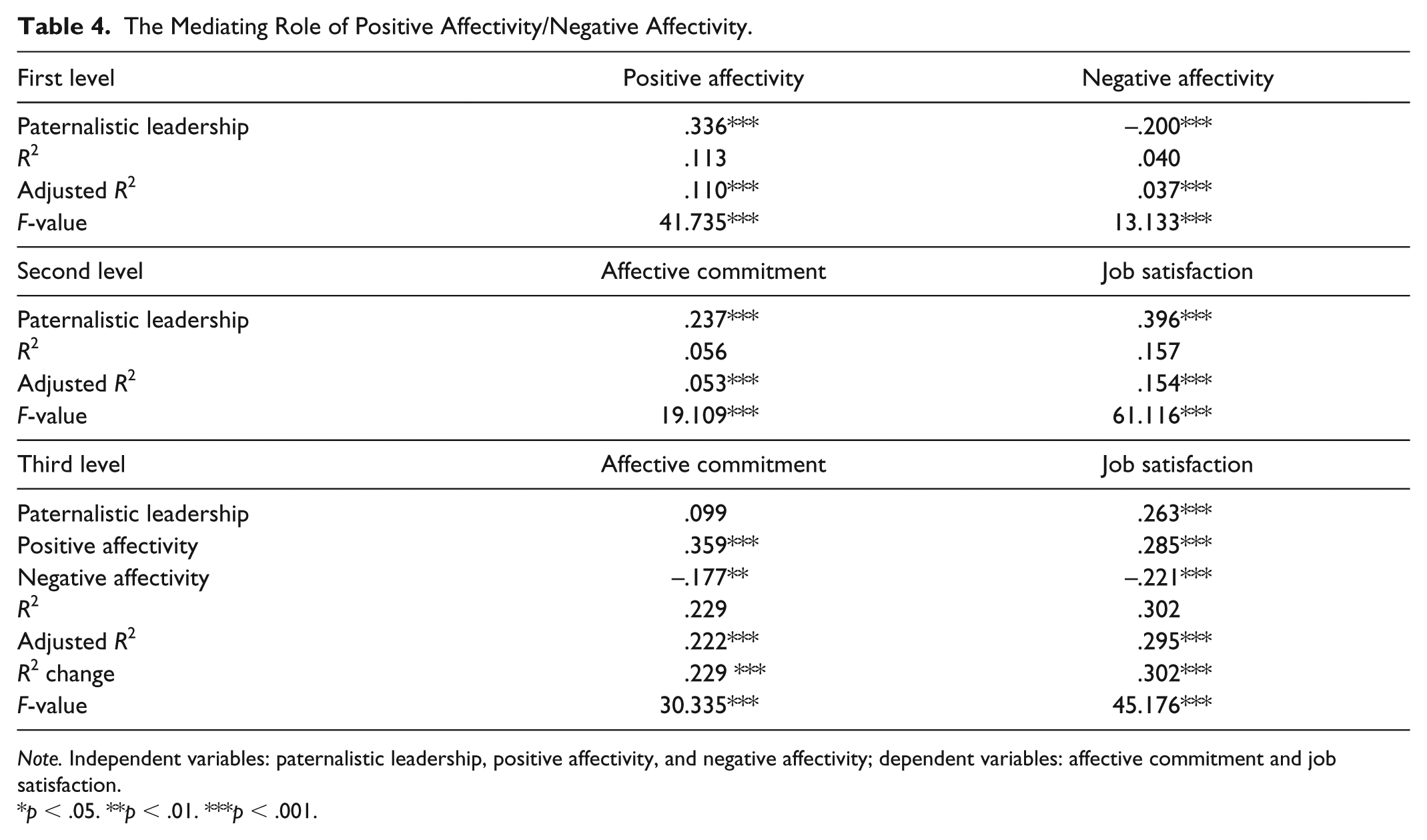
Note. Independent variables: paternalistic leadership, positive affectivity, and negative affectivity; dependent variables: affective commitment and job satisfaction.
p < .05. **p < .01. ***p < .001.
The research model of the current study hypothesized that the relationship between PL, AC, and JS would be mediated by PA. The indirect path between PL, AC, and JS through PA showed that PA positively and fully mediated the relationship between PL and AC, and positively but partially mediated the relationship between PL and JS.
Second, it was hypothesized that the relationship between PL, AC, and JS would be mediated by NA. The indirect path between PL, AC, and JS through NA showed that NA negatively and fully mediated the relationship between PL and AC, and negatively but partially mediated the relationship between PL and JS. Figure 2 shows the summary of the path analyses of the mediation model.

The mediation model for positive affectivity–negative affectivity.
Discussion
The purpose of the study was to test a PL model from both a follower and affectivity-based perspective. It aims to understand the effect of PL on employee work outcomes: job satisfaction and AC with the mediation of PA/NA. The statistical analyses showed that PL significantly predicted both AC and job satisfaction. Furthermore, PA/NA’s mediation role was captured between PL and both AC and job satisfaction. Paternalistic leaders may arouse PA and diminish the level of NA in their employees, and this results in better employee attitudes toward both their job and organization.
Theoretical Implications
This study contributes to the PL literature by adding new insights. It emphasizes the importance of individuals’ emotional states in the PL and work attitude relationship. According to trait activation theory, individuals modify and control their emotional states to adjust their behavior to the specific situation (Bouckenooghe et al., 2013). Based on this theory the research model highlights the importance of the level of affectivity in understanding employees’ attitudes with regard to leadership style. Subordinates’ emotional states are triggered, which ultimately shapes their work attitudes when they interact with a paternalistic leader. Thus, being aware of employees’ emotions may help leaders to effectively manage their work attitudes, namely, AC and job satisfaction.
Pellegrini and Scandura (2008) stated that the number of empirical studies regarding PL is not sufficient in offering consistent findings. The present study contributes to the PL literature by conducting an empirical analysis. Moreover, previous studies did not address the question how employees react to their leader’s benevolent behavior in terms of the level of affectivity. It was found that employees who have high PA respond to PL in a positive manner, which results in higher AC and job satisfaction levels. The study confirmed previous PA/NA research in that positive supervisor support triggers positive emotion in followers, which in turn leads to increased positive job attitudes. Managers who are empathetic and understand their employees’ needs are perceived as supportive and this generates positive emotions at work. Paternalistic leaders’ benevolent style covers caring and understanding behavior. When employees are cared for, their positive emotions will be triggered; in this way, their attitude toward work will be positive as well (Cole, Bruch, & Vogel, 2006). Liang and Chi (2012) recommended considering PA level of followers in leadership research; therefore, the current study linked PA and PL. Thus, the findings of this study implicate the significance of paternalistic leaders paying attention to their employees’ affectivity.
On the contrary, high NA individuals are affected negatively by PL style in terms of their job attitudes. This linkage may be explained by “emotional contagion,” which is defined as “a process in which a person or group influences the emotions or behavior of another person or group through the conscious or unconscious induction of emotion states and behavioral attitudes” (Schoenewolf, 1990, p. 50). According to Barsade’s (2002) proposed model regarding emotional contagion, people are influenced by the person they encounter and this affects their behavioral attitudes. They perceive other people’s emotion as a comparison point and behave or feel accordingly to fit the environment. This process might be valid for paternalistic leaders. Their benevolence may be seen as a positive response by employees who are high in PA. Just the contrary may be true for individuals with high NA. These individuals may interpret the supportive or caring behavior of a paternalistic leader as a threat. A typical paternalistic leader expects loyalty and deference from his subordinates. He believes he knows what is best for his employees and provides limited space for them to become autonomous. Individuals with high NA might pay more attention to the negative aspects of a paternalistic leader and thus they become demotivated.
Consequently, individuals who are high in PA will have higher levels of AC and job satisfaction and those who are high in NA will have lower levels of satisfaction and commitment. Cole, Bruch, and Vogel’s (2006) model emphasized that supervisors who are sensitive to followers’ needs are successful at managing their followers’ emotional states. This approach triggers employee attitudes toward organization in a positive way.
Few studies have tried to understand the effect of leadership on followers’ emotions or affective states (Agote, Aramburu, & Lines, 2016; Edelman & Knippenberg, 2018). One other contribution of the present study is its effort in analyzing emotion–leadership linkage in respect of employee job attitudes. The mediating role of Positive and Negative Affect Schedule (PANAS) in association with PL and job attitudes delivered significant but different results for each attitude. Both PA and NA have full mediation for AC but partial mediation for job satisfaction. This result might be explained by AET, which posits affection triggering events as the precondition for affective reactions of employees. Because AC represents the emotional component of the attitude, it might be affected by PA and NA more than job satisfaction.
Many researchers state the impact of culture on leadership styles. They argue that specific cultural values and norms are more important than structural factors in differentiating societies. Their studies explain this differentiation as bringing distinctive employee outcomes such as commitment or satisfaction (House, Javidan, Hanges, & Dorfman, 2002). Our study provides knowledge about Turkish leadership styles in predicting employee attitudes. Specifically, the major contribution of the present study on current literature is to introduce PA/NA as new mediators in the relationship between leadership and job attitudes.
Research regarding the relationship between PL and affectivity should be explored. This study shows the importance of individual dispositions, leadership perceptions, and job attitudes. In other words, this study suggests that PA/NA is an important explanatory mechanism for the relationship between PL and job attitudes. Organizations that are able to create an awareness about PL attitudes among their leaders will be likely to increase employee commitment and satisfaction.
In addition, PA/NA’s mediating role emphasizes the significance of individuals’ emotional states in PL. Paternalistic leaders can mutually learn to develop an understanding of their followers’ individual dispositions to regulate their management or leadership strategies. Moreover, the study provides insight about the significant role of leaders in generating positive and negative emotions among followers, which result in positive and negative job attitudes, respectively. Therefore, supervisors should care about the importance of behavior–emotion interaction in a dyadic relationship/context. This implicates taking responsibility of the leadership role in being aware of the impact of their behavior on subordinates’ affective states.
The contribution of the present study on current literature might be counted as moderate level of theory building according to Colquitt et al. (2007). The present research adds a new mediator into existing relationships. Therefore, theoretical insights are gained with the addition of a new variable or new directions. They contribute to our understandings of the phenomena by expanding our causal maps (Corley & Gioia, 2011).
Practical Implications
The present study has the following practical implications and contributions to this research stream. It provides practical utility in addressing managerial and organization specific problems. The model of the current research is developed based on real-life phenomena that blend scholarly known with practical one. The positive association between PL and job attitudes indicates that leaders who especially establish benevolent relationships with their followers have a positive influence on the levels of AC and job satisfaction of the followers. Paternalism is one of the default cultural norms within Eastern, Middle-Eastern (i.e., Turkey), and Latin cultures (Jackson, 2016). Although, in this study, PL was measured as a single construct, one of the dimensions of PL is involvement in nonwork domain. Unclear boundaries between professional and personal lives of employees are a salient cultural dynamic of collectivistic societies (Hofstede, 2001; House et al., 2004). Therefore, a paternalistic leader may get involved in his or her followers’ personal issues. This can be perceived in a positive way by the employees so that PL might positively influence job attitudes.
Although the involvement in nonwork domain is one of the important aspects of PL, it also implicates violation of personal boundaries and thus might trigger NA among subordinates. Paying attention to privacy and personal space is an essential dynamic to maintain healthy and sustainable work relationships (Malin, 2002). Research shows that young employees may not prefer to work with paternalistic leaders who are high in involvement in nonwork domain. Nonwork domain involvement is not only a PL attribute but also a cultural value and assumption. In general, people in Turkish society can easily dare to ask questions regarding privacy. No matter the context of the relationship, the awareness of personal boundaries is relatively low. This might also originate from the collectivistic values and life styles.
Limitations and Implications for Future Research
Although the current study makes several contributions to the literature, it is not out of limitations. First, single source of data collection creates common method variance. The collection of answers from only subordinates increases the occurrence of social desirability. Future research should aim to collect data from various sources, including both supervisors and subordinates. However, self-report data may provide critical information on organizational constructs and individual dispositions (Spector, 1994). Comparative evaluation of employee perceptions and leaders self-ratings can be more accurate than single source evaluation (Zhai et al., 2013).
Second, the generalizability of the findings may be limited. The study was conducted with Turkish employees who were MBA students. Due to the fact that the sample was single cultured, the results are culturally specific and cannot be generalized. Third, although a few key demographic variables were used in the analysis, others such as organizational tenure or manager’s tenure were not included. Future research should include additional demographic variables. Fourth, because PA/NA is a state-like attribute that might affect the mood of the participants at the moment of responding to the scale, recent events may affect the way the participants fills out the survey. To illustrate, if one individual experiences a negative event with her manager before answering the questionnaire, she may reflect her negative mood in her answers. Future research should consider such issues.
Footnotes
Appendix
Declaration of Conflicting Interests
The author(s) declared no potential conflicts of interest with respect to the research, authorship, and/or publication of this article.
Funding
The author(s) received no financial support for the research, authorship, and/or publication of this article.
