




Abstract
This paper investigates the positive influence of perceived organizational support (POS) on employees’ knowledge sharing behavior through their affective commitment. Moreover, it examines the moderating effect of task interdependence, as a situational factor, on this mediating relationship. The results from a total of 222 supervisor-subordinate dyads showed that POS was positively related to affective commitment, leading to knowledge sharing behaviors. Besides, the mediation effect of affective commitment was stronger when task interdependence was low than when it was high. These results imply that employees receiving high organizational support would share their knowledge when they perceive knowledge sharing as a voluntary behavior. Theoretical and practical implications are discussed.
Keywords
Introduction
To succeed in the competitive business market, organizations need to acquire and maintain knowledge and motivate employees to share knowledge within organizations (Wang et al., 2014). Knowledge sharing refers to the degree to which employees exchange their information and know-how with other employees to develop ideas, execute work procedures, and complete their tasks (Srivastava et al., 2006). That is, as many scholars suggested, knowledge sharing captures the extent to which employees discuss and exchange their explicit and tacit knowledge to create new knowledge and improve the utilization of knowledge exchanged (Cummings, 2004; Lin et al., 2012; Van Den Hooff & De Ridder, 2004). Knowledge sharing not only contributes to individual and team’s routine task performance but also enhances adaptive task performance such as creativity and innovation (Hislop et al., 2018). However, despite these benefits, some employees are reluctant to share their knowledge with other employees because knowledge sharing is labor-intensive (Oliveira et al., 2019) as well as employees tend to think their knowledge is too valuable to share with others (Davenport & Prusak, 1998). Hence, researchers have investigated various ways to facilitate employee knowledge sharing behaviors (Ritala et al., 2018; for details, see meta-analyses by Jalili & Ghaleh, 2020; Nguyen, Nham, Froese et al., 2019; Nguyen, Nham, & Hoang, 2019; Witherspoon et al., 2013).
Along with employees’ characteristics (e.g., motivation and commitment) and organizational climate, employee’s perception of organizational support has been studied as one of the most promising ways to encourage employee knowledge sharing behaviors (Lim & Ok, 2021), Perceived organizational support (POS) denotes the degree to which employees believe their organization cares their well-being and respects their contributions to organizations (Eisenberger & Stinglhamber, 2011). Previous studies on POS reasoned that POS would allow employees to be more comfortable in collaborating with their coworkers (Chen & Cheng, 2012) and participating in decision making processes which, in turn, facilitate their knowledge sharing behaviors (Yang, 2010).
Despite the plausible theoretical reasoning, our knowledge about how, specifically, the organizational support translates into knowledge sharing behaviors and what contextual factors affect the processes is still in a nascent state and researchers has called more empirical support to the relationship between organizational support and knowledge sharing (Bartol et al., 2009; Lu et al., 2006). Given that employees’ willingness to share knowledge depends on not only the social relationships at work (e.g., Su, 2021) but also the context which knowledge sharing behaviors occur (e.g., Van Den Hooff & De Ridder, 2004), it is necessary to investigate the mechanisms through how perceived organizational support facilitates employees’ knowledge sharing and what contextual factors affect the mechanisms (Sergeeva & Andreeva, 2016).
Thus, this study has two purposes. First, we investigate a mediation path between organizational support and knowledge sharing behaviors. Particularly, we focused on the role of affective commitment in mediating the path, which has been known vital to enhance employee engagement (Gellatly et al., 2006). Previous studies showed that affective commitment leads to knowledge sharing within an organization. Matzler et al. (2011) found that employees who are affectively committed to their organizations engage in knowledge sharing more because affective commitment increases one’s motivation to involve in the knowledge process (Nahapiet & Ghoshal, 1998). Moreover, Jeung et al. (2017) demonstrated the mediating role of affective commitment in the link between perceived organizational support and knowledge sharing intention. However, empirical evidence about the role of affective commitment on the pathway from perceived organizational support and knowledge sharing behaviors is still lacking and more research is needed to enhance our knowledge of what situational factors intervene in the relationship between affective commitment and knowledge sharing (Han et al., 2019).
Second, we investigate a moderating role of a contextual factor on the relationship among organizational support, affective commitment, and knowledge sharing behaviors in South Korean companies. Affectively committed employees would share their knowledge with others because they believe that knowledge sharing is distinctive and above-and-beyond the norm in an organization. However, it is plausible that affective commitment may not lead to knowledge sharing behaviors if employees have less discretion in exerting such behaviors. Said differently, employees share their knowledge with other organizational members not only because they are attached to their organization but also because they follow the implicit or explicit expectation toward knowledge sharing. Such an expectation would be represented by job characteristics, which could play a pivotal role in either strengthening or weakening the mediated relationship between perceived organizational support knowledge sharing behaviors. (Eisenberger & Stinglhamber, 2011; Foss et al., 2009). Specifically, we test whether affective commitment’s mediation effect on knowledge sharing is moderated by a job-related factor—task interdependence.
This study contributes to the literature on knowledge sharing by advancing our understanding of the mechanism through how POS increases knowledge sharing in the following ways. First, we deepen our understanding by illuminating the social exchange processes explaining employee knowledge sharing behaviors. Our study explores the affective mechanism, with an emphasis on the role of affective commitment, through how perceived organizational support energizes an employee’s knowledge sharing behavior. Second, we extend our knowledge about boundary conditions of knowledge sharing behaviors. Employees’ voluntary behaviors are influenced by situational characteristics including job characteristics and coordination requirements (Chatman & Barsade, 1995). Our findings provide implications for situational factors that help organizational efforts toward employees’ knowledge sharing to be more efficient. Lastly, we measure actual knowledge sharing behaviors evaluated by immediate supervisors rather than knowledge sharing intention. The intention of knowledge sharing, as well as self-rated knowledge sharing behaviors, can be indicative of actual knowledge sharing, but these variables are not free from the effect of the same source bias (Podsakoff et al., 2003). These immediate supervisor ratings allow us to examine the relationship between organizational support and employee knowledge sharing behaviors more rigorously.
Theoretical Reasoning and Hypotheses Development
Perceived Support and Knowledge Sharing in an Organization
In the workplace, employees establish social relationships with organizational members and maintain such relationships by supporting each other (He et al., 2009). Employees are supported by various social partners including family, friends, and neighborhood, and social support also can be provided by their colleagues (Lakey & Orehek, 2011). Social support has been largely classified into four main types: emotional, appraisal, instrumental, and informational (House et al., 1988). Instrumental forms of social support involve resources that help employees accomplish specific tasks or objectives. These resources include information, expertise, professional advice, political access and advocacy, equipment, and supplies. On the other hand, emotional forms of social support include approval, praise, intimacy, and emotional closeness and are important for fulfilling emotional and social identity needs (Ibarra & Smith-Lovin, 1997). The exchange of instrumental and emotional resources encourages social interactions, the development of trust, and responsiveness to socio-emotional needs (Coleman, 1988), leading to the development of social relationships.
The social relationship is not limited to the interpersonal relationship: employees can establish and develop the social relationship with their own organization as well (Cropanzano & Mitchell, 2005). Organizational support theory (Rhoades & Eisenberger, 2002) suggests that employees personify the organization, forming a general belief concerning the extent to which the organization values their contribution and cares about their well-being. Employees receive different types of support from their organization such as financial, career, and adjustment support (Baranik et al., 2010), but employees evaluate organizational support with general perception of the overall support from the organization (Rhoades & Eisenberger, 2002). The perception of organizational support is positively related to greater psychological well-being, a more positive orientation toward the organization, and behavioral outcomes helpful to the organization (e.g., Allen et al., 2003; Rhoades & Eisenberger, 2002). For instance, when employees perceive that they are valued and supported by their organization, they will believe in organization values and attempt to return their organization’s support by enhancing favorable attitudes toward organizations.
Central ideas for the POS-outcome relationships come from social exchange theory (Kurtessis et al., 2017). According to social exchange theory (Blau, 1964), individuals have certain forms of exchange relationships with others in a group and an exchange relationship might be one of two types: a pure economic exchange or a social exchange relationship. A pure economic relationship is a discrete give-and-take relationship. Each party in the relationship specifies and exchanges the expected outcomes and mainly focuses on the short-term outcomes from the exchange. In contrast, a social exchange relationship is more frequently a long-term oriented relationship. Each party relies on mutual trust in the relationship and focus on the long-term outcomes from the exchange. In a social exchange relationship, neither party specifies any exact contribution from the other party but voluntarily reciprocates the other party’s treatment with valuable inputs to the relationship. The inputs from one party need not necessarily be comparable to the inputs from the other party. As long as each party sees the inputs as beneficial in the long term, they are motivated to maintain their social exchange relationship. From the social exchange theory perspective, POS is an input from the organization to the social exchange relationship, and favorable attitudes and behaviors would be returned from the employee. Such return can serve as another input to the social exchange relationship with the organization, and the organization would pay back such beneficial input by providing more support to their employee.
Knowledge sharing requires extra effort that goes beyond explicit job obligations (Cabrera & Cabrera, 2005). From the social exchange perspective, knowledge sharing behaviors can be seen as a direct return from an employee to an organization: an employee engages in knowledge sharing behaviors to pay back positive support from an organization. Employees’ knowledge sharing enables an organization to leverage the knowledge and information of an organization, which is the most valuable asset in a knowledge-intensive economy (Jeung et al., 2017). Researchers suggested that the quality of social exchange relationships in organizations motivates employees to exercise knowledge sharing behaviors (Kurtessis et al., 2017; Yang et al., 2018).
However, recent studies have found that organizational support would indirectly facilitate knowledge sharing by shaping employees’ attitudes toward their organization. Before employees perform or act any action, they shape certain types of attitudes toward their organization. Shaping positive attitudes provides a convenient but powerful return for the social exchange relationships with their organization. In this regard, employees who are supported by their organizations will shape the positive attitudes toward their organization as a part of the social exchange processes. Accordingly, these employees are more likely to share knowledge with other employees (Chen et al., 2012; Jeung et al., 2017). Our next question is that which types of positive attitudes may be associated with knowledge sharing behaviors.
The Mediating Role of Affective Commitment
We propose that employees’ affective commitment can explain how POS facilitates knowledge sharing behaviors. Among the three dimensions of organizational commitment (i.e., affective, normative, and continuance commitment; Meyer & Allen, 1991), we focused on affective commitment. Meyer and Allen (1997) argue that, of the three dimensions of organizational commitment, affective commitment is most positively related to one’s willingness to go extra miles at work. Thus, consistent with past studies exploring the roles of organizational commitment in the context of knowledge sharing (e.g., Jo & Koo, 2011; Van Den Hooff & De Ridder, 2004), rather than normative and continuance commitment, we propose that affective commitment would play pivotal roles in explaining one’s knowledge sharing behaviors which are beyond one’s formal job requirements (i.e., making an extra effort to help colleagues). Supporting this, Ouakouak and Ouedraogo (2019) showed that, whereas affective commitment increases one’s knowledge sharing behaviors, continuance commitment did not either increase or decrease one’s knowledge sharing behaviors. Organizational support engenders norms of reciprocity and trust in long-term relationships with employees; they feel that they ought to have positive attitudes toward their organizations to repay organizational support. Therefore, employees can be emotionally attached to their organization (Rhoades et al., 2001). Meta-analyses result also supports the positive relationship between POS and affective commitment (Kurtessis et al., 2017).
Affective commitment is integral to enhance employees’ extra effort to complete organizational goals (Gellatly et al., 2006). Specifically, affective commitment produces a collective sense of identity among individuals within an organization, increasing one’s willingness to go the extra mile (Cropanzano & Mitchell, 2005) such as knowledge sharing (Cabrera et al., 2006). Affective commitment energizes the employees to engage in knowledge process (Nahapiet & Ghoshal, 1998) and emotional attachment can increase one’s confidence in sharing one’s knowledge while increasing psychological ownership of an organization, which is a feeling of having a stake in it due to commitment and contribution (Li et al., 2015). A recent meta-analysis supports that the more employees are committed to their organizations, the more they are willing to share their knowledge with other organizational members (Witherspoon et al., 2013).
Accordingly, although both POS and affective commitment are vital determinants of knowledge sharing behaviors (Kurtessis et al., 2017), we propose that affective commitment is the mechanism through which POS influences the extent to which employees share their knowledge with other organizational members. Supporting our prediction, prior studies on the relationship between POS and extra-role behaviors, such as organizational citizenship behavior, suggest that organizational commitment serves as a critical construct in explaining the mechanism (Gupta et al., 2016). Note that our study is not the first to propose the relationship between POS, affective commitment, and knowledge sharing. Jeung et al. (2017) also supported our prediction that affective commitment mediated the relationship between POS and the intention to share knowledge with other employees. However, our study focuses on knowledge sharing behaviors of employees, which would extend their findings.
Hypothesis 1: Affective commitment mediates the positive relationship between perceived organizational support and knowledge sharing behavior.
The Moderating Effect of Task Interdependence
By adopting social exchange theory (Blau, 1964), research on organizational support (e.g., Eisenberger et al., 1986) has stipulated that employees act according to the norm of reciprocity, trading their effort and dedication to their organization for POS and its promise of future benefits. Interestingly, the social exchange processes under the relationship between POS and extra-role behaviors are not universal but depend on the context where employees have discretion in exerting additional efforts. For instance, Rhoades and Eisenberger’s (2002) meta-analysis on POS studies found that POS was more strongly related to extra-role performance than in-role performance. One of the plausible explanations for this result is that employees’ role perception would substitute the effect of POS on employee behaviors that contribute to organizational success but exceeds work requirements (Van Dyne et al., 2008). When employees are required to perform certain activities as a part of their jobs, they feel that they should perform such activities regardless of their favorable attitudes toward their organization. Therefore, the mediation effects of affective commitment would be less distinctive in situations that employees share their knowledge and information on their jobs as a part of their work processes.
We expect that the situations would be represented by the degree of task interdependence. Task interdependence describes how employees interact with other employees to complete their tasks (Kiggundu, 1983). While interacting with others, employees need to share information and materials with team members for successful performance (Guzzo & Shea, 1992; Jehn, 1995). Accordingly, task interdependence would influence employees’ role perceptions, defining what tasks should be completed and what behaviors are expected from employees (Griffin et al., 2007). Thus, task interdependence would establish the contexts where employees regard knowledge sharing as a part of their job activities, mitigating the effects of affective commitment on knowledge sharing.
The interactional perspective on the attitude-behavior relationship would support the moderating effect of task interdependence. Previous studies have found that attitudes would not predict behaviors in strong situations such as high social conformity pressure for the behaviors (Wallace et al., 2005). Strong situations dictate certain types of behaviors, and in such situations, employees are supposed to act no matter how they feel about their organization. Particularly, attitudes toward organizations were not strongly related to in-role behaviors (Riketta, 2008). Employees engage in in-role behaviors because they should do: the additional benefits from the positive attitudes are not critical to facilitate in-role behaviors. Thus, it is plausible that an employee’s positive attitudes toward an organization would predict knowledge sharing behaviors when knowledge sharing is not a part of essential tasks or expected by other employees for their job accomplishment. For them, knowledge sharing is working beyond the job description, and thus they are willing to share their knowledge voluntarily (Morrison, 1994; Van Dyne & LePine, 1998).
From the situational perspective on the social exchange processes and the interactive perspective on the attitude-behavior relationship, we propose that task interdependence will moderate the path between affective commitment and knowledge sharing behaviors (a second-stage moderator in the mediation model) so that high task interdependence will serve to weaken the positive effect of affective commitment on knowledge sharing behaviors. A high level of task interdependence indicates that it is almost not possible for employees to complete their tasks without other members’ information and input. Thus, it is likely that employees think that they are explicitly required to share knowledge with others because the extent to which they share knowledge directly impacts others’ and their own performance. No matter whether employees are emotionally attached to their organization or not, they almost have to share knowledge to fulfill their job responsibilities and to complete their tasks. Thus, employees’ affective commitment boosted by POS may not necessarily enhance knowledge sharing behaviors of employees.
On the other hand, when task interdependence is low, employees are not formally required to share their knowledge and information. They may consider knowledge sharing as an extra-role behavior. In this case, the affective commitment will influence employees’ willingness to and subjective choice to share their knowledge. Collectively, we hypothesize that POS will enhance affective commitment and, in turn, influence knowledge sharing among employees, and this indirect effect of POS depends on task interdependence (Figure 1). Specifically, task interdependence will weaken the indirect effects of POS through affective commitment on knowledge sharing.
Hypothesis 2: Task interdependence will moderate the mediating effect of affective commitment in the relationship between perceived organizational support and knowledge sharing behavior. That is, the mediating effect of task interdependence will be weaker when task interdependence is high than low.

Conceptual model.
Methods
Sample and Procedures
We collected multisource data from 222 full-time employees and their immediate managers in 11 small-medium-sized South Korean companies (i.e., 6 computer software developers, 3 electronic component manufacturers, and 2 retail corporations). By using a convenience sampling technique, we contacted HR department of small and medium-sized companies to recruit participants. Convenience sampling was used mainly because of the benefits of its speed, cost-effectiveness, and ease of availability of the sample. However, we ensured that potential participants’ jobs were cognitively demanding enough to be benefited from knowledge sharing and provided autonomy for knowledge sharing at a general level (Sergeeva & Andreeva, 2016; Van Den Hooff & De Ridder, 2004). Upon agreement, we administered surveys in the conference rooms located in each company during regular work hours to enhance the response rates. About 270 employees were invited, and 222 usable employees’ surveys were returned, giving a response rate of 82.22%. Among employee participants, 59.7% were male, and 90.5% held at least a 2-year degree. Their average age was 28.92 years (SD = 4.39). On average, their organizational tenure was 25.69 months (SD = 23.44).
All the survey items, except knowledge sharing behaviors, were completed by employee surveys. The managerial surveys, which measures employees’ knowledge sharing behaviors, were delivered to each employee’s immediate supervisor by the research team. On the managerial surveys, each subordinate’s name was provided so that managers could provide their ratings for each subordinate’s knowledge sharing behaviors. After completing the surveys, we asked managers to remove the subordinates’ names from research records. We included random matching codes on every employee and managerial surveys, so we could match a dyad of an employee and his or her manager while keeping the identity of the participants anonymous. Managers returned their surveys to the research team using provided sealed envelopes. As a result, 50 managers returned the surveys, of whom 88.0% were male, and 90.0% held at least a bachelor’s degree. Their average age was 34.90 years (SD = 4.35). They had an average job tenure of 43.61 months (SD = 28.49). On average, a manager evaluated 4.44 subordinates.
Measures
Items for our study variables were originally written in English. Thus, following Brislin (1980), we translated the items into Korean by using back-translation procedures. Participants provided their responses on a 7-point Likert scale ranging from 1 (strongly disagree) to 7 (strongly agree).
Perceived organizational support
POS was measured using nine items by Eisenberger et al. (1986). Sample items include “The organization really cares about my well-being” and “The organization cares about my general satisfaction at work.” The Cronbach’s alpha reliability coefficient for the scale (α) was .91.
Affective commitment
The affective commitment was measured using the eight items by Meyer and Allen (1991). Sample items read, “This organization has a great deal of personal meaning for me” and “I really feel as if this organization’s problems are my own.” The α was .87.
Task interdependence
We used a 10-item measure of task interdependence from Pearce and Gregersen (1991). Sample items include “I frequently must coordinate my efforts with others” and “My work requires me to consult with others fairly frequently.” The α was .87.
Knowledge sharing behavior
Knowledge sharing behavior was measured using the seven items from Srivastava et al. (2006). Sample items read, “The subordinate shares his/her special knowledge and expertise with others” and “The subordinate shares lot of information with others.” The Cronbach’s alpha reliability coefficient for the scale was .92.
Analytical strategies
The hypotheses were tested with the moderated mediation analysis with Hayes’s (2018) PROCESS Model 14. Moderated mediation paths were examined with the estimation of regression coefficients from the regression equation of the mediation and moderation.


In equation (1), X represents POS, and M represents the affective commitment. In equation (2), Z represents task interdependence, and Y represents knowledge sharing. In equation (1), a1 represents the effect of POS on affective commitment. In equation (2), b2 represents the effect of affective commitment on knowledge sharing. The value of (a1 × b2) represents the mediation effect of affective commitment, and Hypothesis 1 will be supported when b2 is significant, and the value of (a1 × b2) is significant. The value of (b2 + b4Z) represents the moderating effect of task interdependence on the relationship between affective commitment and knowledge sharing behavior. The value of a1(b2 + b4Z) captures the moderated mediation effect (Hypothesis 2), describing that the indirect effect of POS depends on the value of Z. Hypothesis 2 will be supported when the value of a1(b2 + b4Z) is smaller when Z is +1 standard deviation than when Z is −1 standard deviation.
The combinations of the estimated regression coefficients were calculated with bootstrapping analysis with 5,000 bootstrapped samples (Preacher & Hayes, 2004) and used to plot the direct, indirect, and total effects of organizational support on knowledge sharing at ±1 SD of task interdependence. We also calculated the variance inflation factor (VIF) scores; VIF scores of all variables were below 10 (Chatterjee & Hadi, 2013).
Results
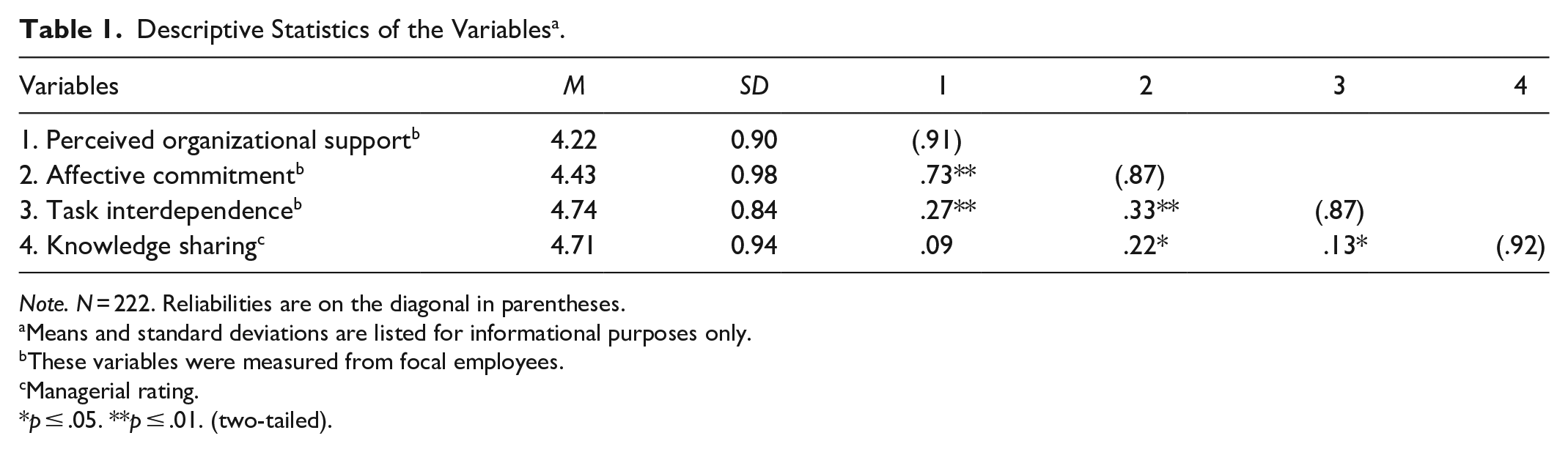
Table 1 shows the means, standard deviations, and correlations among variables.
Descriptive Statistics of the Variables a .
Note. N = 222. Reliabilities are on the diagonal in parentheses.
Means and standard deviations are listed for informational purposes only.
These variables were measured from focal employees.
Managerial rating.
p ≤ .05. **p ≤ .01. (two-tailed).
Confirmative Factor Analysis
We conducted a confirmatory factor analysis (CFA) for POS, affective commitment, and task interdependence to examine the possibility of the common method variance issue in our model. Given the number of the parameters of the CFA, our sample size was relatively small to test CFA for these variables. Therefore, we parceled these variables by following the recommendation for the item parceling in the CFA (Little et al., 2002). Three parceling items for each variable were created to reflect the corresponding variables. In Table 2, the result from the CFA showed that the three-factor model was acceptable (χ2 = 49.28, CFI = 0.98, RMSEA = 0.07, RMSR = 0.05): The three-factor model presented the best-fit indices score compared to the alternatives. The difference of χ2 between the three-factor model and the one-general-factor model was significant as well. Thus, three measures and the measure of knowledge sharing were used to test our hypotheses.
Confirmatory Factor Analysis.

Note. N = 222.
CFI = comparative fit index.
RMSEA = root-mean-square effort of approximation.
SRMR = standardized root mean square.
Two factor model: the items for perceived organizational support and affective commitment were loaded on one factor.
One factor model: all items were loaded on a common factor.
p ≤ .001 (two-tailed).
Moderated Mediation Test
Hypothesis 1 predicted that affective commitment would mediate the relationship between organizational support and knowledge sharing behavior. In Table 3, the coefficient of affective commitment was significant (B = .27, p < .01), and in Table 4, the indirect effect of affective commitment was significant (a1 ×b2 = 0.22, p < .05). Thus, Hypothesis 1 was supported.
Regression Analysis Results.

Note. N = 222. Entries under columns are unstandardized coefficients.
p ≤ .05. **p ≤ .01. ***p ≤ .001.
Direct and Indirect Effects of Perceived Organizational Support on Knowledge Sharing Behavior.

Note. N = 222. Tests for the indirect and total effect were conducted with the bias-corrected confidence intervals extracted from bootstrapping estimates with 5,000 sample.
BootLLCI = lower limt of confidence interval.
BootULCI = upper limit of confidence interval. −0.84, 0, and 0.84 for low, medium, and high task interdependence, respectively (i.e., ±1 SD).
Hypothesis 2 proposed that task interdependence would moderate the effect of POS on knowledge sharing mediated by affective commitment. In Table 4 and Figure 2b, differences in the effects of POS for low and high task interdependence indicated that the indirect effect of POS with low task interdependence was significant (.33). On the other hand, when task interdependence was high, the 95% confidence interval of the value of the indirect effect included 0, indicating the indirect effects became insignificant (0.11, p = n. s.). Lastly, the confidence interval of the index of moderated mediation did not cross the zero (Bootstrap Lower Level Confidence Interval = −0.23, Bootstrap Upper Level Confidence Interval = −0.03). Thus, Hypothesis 2 was also supported.
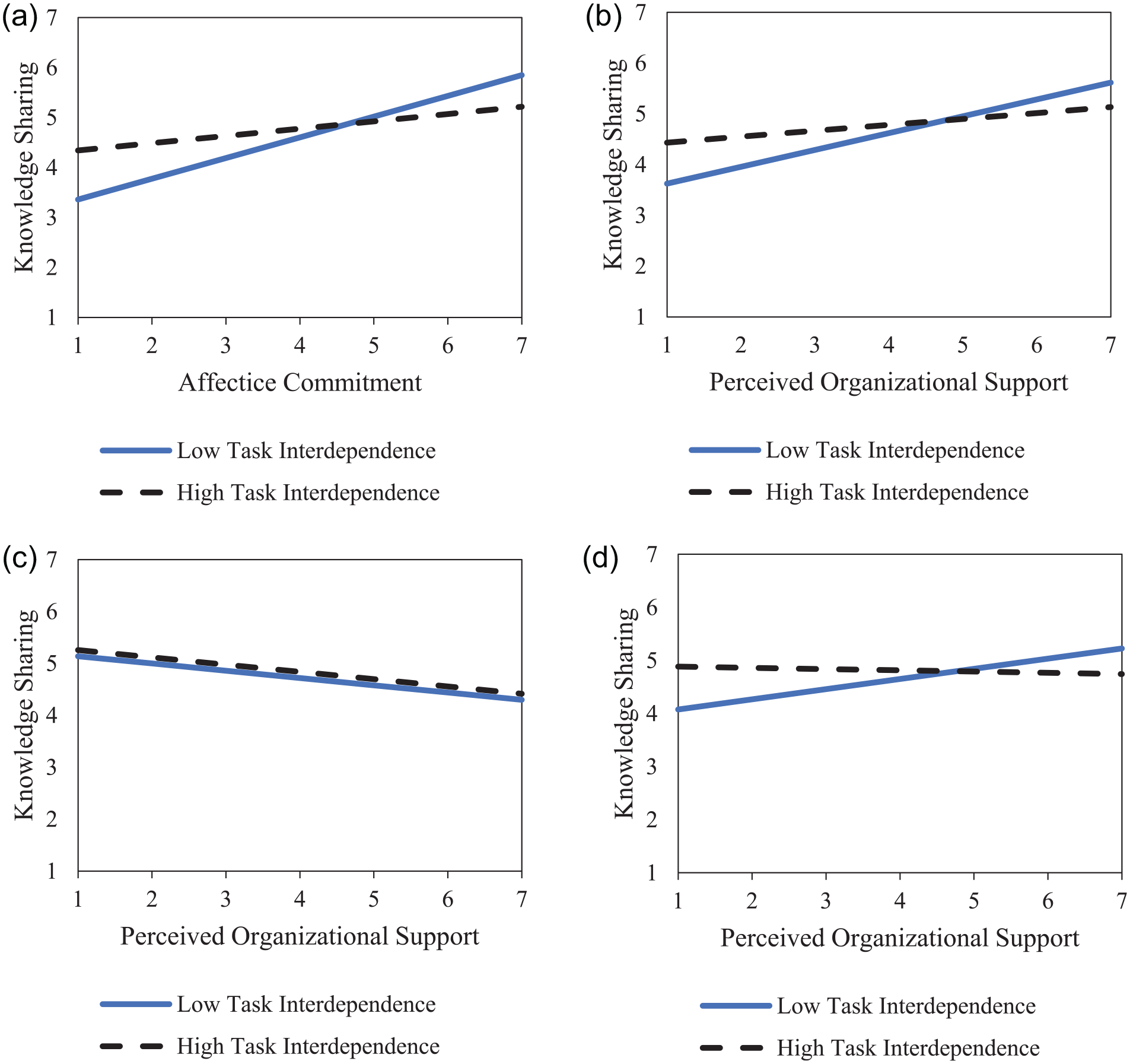
Plots of simple paths and effects of perceived organizational support and affective commitment with task interdependence: (a) second stage moderation, (b) indirect effect, (c) direct effect, and (d) total effect.
Discussion
This study investigated the relationship between organizational support and knowledge sharing behavior via affective commitment along with the moderating effect of task interdependence in the mediated relationship. Generally, the results were consistent with our theoretical reasoning. The results showed that organizational support was positively related to affective commitment, and indirectly related to knowledge sharing behaviors. This finding is associated with the organizational support theory (Eisenberger et al., 1986) that employees would exhibit positive attitudes toward organizations when they receive favorable treatments from their organizations. Results also showed that the relationship between affective commitment and knowledge sharing behavior was moderated by task interdependence. When task interdependence was high, the relationship became insignificant, implying that employees’ in-role and extra-role perceptions of knowledge sharing moderate the impact of social exchange relationships on knowledge sharing.
Theoretical Contributions
First, this study contributes to the literature on knowledge sharing by demonstrating that organizational support is vital for enhancing knowledge sharing behaviors in the workplace. Previous studies have focused on organizational support as one of antecedents of knowledge sharing in the workplace (e.g., Wang et al., 2014). Lim and Ok’s (2021) recent meta-analysis showed that organizational supportiveness is positively related to knowledge sharing behaviors. Specifically, given that knowledge sharing behavior within an organization is relatively discouraged due to a Confucian culture in South Korea (Kang et al., 2008), our results confirmed the importance of organizational support as a knowledge sharing facilitator.
Second, our findings expand the theoretical perspectives on knowledge sharing by examining the social exchange process in knowledge sharing. The previous research on knowledge sharing has used social exchange theory to explore the antecedents of knowledge sharing but has not examined enough the potential mechanisms through which social exchange relationships increase knowledge sharing. Resonating with Jeung et al. (2017), which was conducted using South Korean sample, our study found that organizations support enhanced knowledge sharing by increasing affective commitment, which indicates social exchange relationships. Consistent with Kang et al. (2008), our findings suggest that organizational support strengthens the quality of social exchange relationships with employees and motivate employees to share their knowledge in the South Korean culture.
Third, and more importantly, the results on the moderating effects of task interdependence suggest that the context of knowledge sharing should be considered. The extra-role perspective of knowledge sharing implies that employees will share their knowledge with colleagues when they have high-quality social exchange relationships. However, if employees perceive knowledge sharing as an in-role behavior, a high-quality social exchange relationship may not be as predictive of knowledge sharing as it can be. That is, contextual factors may cancel the positive effects of social exchange processes on knowledge sharing. Our results from the South Korean sample imply that even in a collective culture, which emphasizes the goals of the group over the needs of each individual. (Brewer & Chen, 2007), social exchange relationship would not necessarily assure knowledge sharing among employees.
Practical Implications
Today’s organizations have taken various measures to enhance knowledge sharing and information transfer in the workplaces (Su, 2020). However, many organizations often find their employees are reluctant to share what they know, and even hide their knowledge from their coworkers (Connelly et al., 2019). First, a primary implication of this study is that management should demonstrate compassion and support for their workforce. To energize employees’ knowledge sharing behaviors, our findings shed lights on the importance of providing adequate support with employees to develop positive attitudes toward their organizations. Specifically, our results imply that employees who receive support from their organizations are committed to their organizations and thus share their knowledge with organizational members. To do so, organizations could develop various practices to show they value their employees’ opinions and ideas. For instance, as representatives of organizations, managers can provide their subordinates with momentary reward or career advice so that they are more willing to share their valuable knowledge with other colleagues. Supervisor support and organizational rewards are two of the three common antecedents of perceived organizational support (Rhoades & Eisenberger, 2002). Thus, it will be effective to develop organizational reward systems that are useful for encouraging knowledge sharing among organizational members.
Second, our finding of how organizational support enhances employees’ knowledge sharing provides insight into designing knowledge management practices more effective. We suggest that managers should consider the influence of the context on knowledge sharing, such as where and why employees share their knowledge (Sergeeva & Andreeva, 2016). For instance, HR practitioners may want to monitor different levels of task interdependence across various departments and recommend mangers particularly in a low task interdependence condition provide adequate support for employees. In the situation that knowledge sharing is less required, affective commitment influences more knowledge sharing. Thus, considerable attention should have focused on monitoring the level of task interdependence, thereby indicating managers to enhance their subordinates’ affective commitment by providing more support when their jobs are less interdependent at work.
Limitations and Future Research Directions
First, we measured knowledge sharing with the agree-disagree scale points but did not control the types and quality of knowledge shared among employees. It is possible that some employees may share new and unique knowledge with their colleagues, whereas other employees may continue to share existing knowledge, which is already recognized in teams. It may be interesting to investigate whether high-quality social exchange relationships enable employees to share high-quality knowledge.
Second, we defined knowledge sharing as the exchanges of both tacit and explicit knowledge. Accordingly, our measurement did not specify the types of knowledge (i.e., explicit and implicit knowledge). However, it is plausible that the processes of knowledge sharing could vary across the types of knowledge. For example, whereas implicit knowledge is usually exchanged through social interactions, explicit knowledge exchange usually does not require social interactions (Rutten et al., 2016). Supporting this, past studies showed that, compared to cognition-based trust, affective-based trust is much more important for the exchange of tacit knowledge (Holste & Fields, 2010; Rutten et al., 2016). Thus, future research could benefit by taking the two types of knowledge (i.e., tacit and explicit knowledge) into account to further extend our findings.
Third, our theory suggests that the extent to which employees share their knowledge is contingent upon one’s cognitive processes in social exchange (i.e., felt obligation) and attribution process (i.e., perception of in-role and extra-role behaviors). However, we acknowledge that we did not explicitly explore these underlying mechanisms. Specifically, future research could examine how task interdependence affects employees’ role perceptions (i.e., extent to which employees perceive knowledge sharing as part of their jobs; e.g., Van Dyne et al., 2008) ultimately, their knowledge sharing behaviors at work.
Fourth, we examined our model with the sample in South Korea, and one may raise a concern about the generalizability of our findings in different cultures. Given that South Korea is collectivistic (Park et al., 2015; Kim et al., 1990), the meaning of discretionary behaviors, such as knowledge sharing behaviors, may be different from other cultures (Goo et al., 2019). However, our reasoning and results are consistent with those from the previous studies, and we believe that sample-specific characteristics (e.g., collectivism, long-term orientation, etc.) might not critically change the relationships among variables we tested. To address the raised concern, future research may replicate our study with the sample from the Western culture and/or develop a cross-cultural study to test our model.
Fifth, we examined our model at the individual level but could not count out the impact of team-level phenomena on the variables in our model. For example, employees in the same team would have structured patterns of interpersonal relationships and the shared norms, which facilitate knowledge sharing among team members as a collective action. Also, team leaders can shape the attitudes and behaviors of their followers as a whole. However, most variables in our model have been theorized and examined at an individual level (e.g., individual attitudes and perceptions toward the organization), so it may be inadequate to aggregate our responses at the team level without the proper reasoning. Practically, we have only 11 teams in our sample, and this small number of groups limited our analysis to the individual level. Still, it may also be interesting to expand our model by using multilevel modeling.
Sixth, we measured all variables simultaneously, and thus we may not have captured the temporal relationship among variables from our results. However, a previous longitudinal study found that POS predicted affective commitment (e.g., Rhoades et al., 2001), and conceptually, attitudinal variables (e.g., affective commitment) are predictive of behavioral outcomes (i.e., knowledge sharing). Nevertheless, future research should apply a longitudinal design to test the causal relationship among variables.
Lastly, common method variance (CMV) may be a concern because POS, task interdependence, and affective commitment were measured from a single source (Conway & Lance, 2010). However, these variables are about employees’ perceptions or subjective feelings, and, we believe, employees themselves are adequate to measure these variables. Also, we measured knowledge sharing from the supervisory perspective, and CMV may not be a concern in the relationship between attitudinal variables and knowledge sharing (Podsakoff et al., 2012).
Conclusion
Given that the importance of knowledge sharing is exponentially increasing in the workplaces, this study showed that employees who perceive organizational support highly likely to engage in knowledge sharing behaviors through the increases in organizational commitment. Furthermore, our results showed that task interdependence serves as an important contextual factor by demonstrating that the indirect effect of POS on knowledge sharing behaviors via affective commitment is stronger when task interdependence is low than when it is high. Overall, our findings provide more comprehensive knowledge about the social exchange processes through how and when POS becomes more vital for facilitating employees’ knowledge sharing behaviors.
Footnotes
Declaration of Conflicting Interests
The author(s) declared no potential conflicts of interest with respect to the research, authorship, and/or publication of this article.
Funding
The author(s) disclosed receipt of the following financial support for the research, authorship, and/or publication of this article: This publication was partially supported by 2018 Summer Research Grant from the College of Business Administration at the University of Detroit Mercy.
