




Abstract
Previous studies have established the relationship between service innovation orientation, open innovation and innovation performance in context of manufacturing firms. However, studies explore service innovation orientation, open innovation and innovation performance in context of medium and small private hospitals are scarce. The main objective of the study is to investigate the relationship between service innovation orientation, open innovation and innovation performance in medium and small private hospitals in India. A quantitative study using cross-sectional survey method was performed and the data were collected from 173 medium and small private hospitals in three northern states in India using purposive sampling. The findings suggest that there is a positive relationship between service innovation orientation and open innovation. It also shows that there is a positive relationship between open innovation and innovation performance. The findings also reveal that open innovation mediates the relationship between service innovation orientation and innovation performance. The study contributes to the understanding of health practitioners and policymakers about the usefulness of service innovation and open innovation to improve the innovation performance of medium and small private hospitals.
Introduction
World Health Organization (WHO, 2017) stated that around 80% of the total population of India prefers treatment in private hospitals, which shows that on average US$ 75 per capita health expenditure comes from the people’s own pocket. India comes under the low middle-income group of nations however it is the sixth biggest out of pocket health spender. The private health sector is booming in India (Yadavar, 2018) and in private health sector, private hospitals is the largest segment providing services to the people. These private hospitals comprise of large hospitals and medium and small hospitals. About 80% of the total healthcare services are provided by the medium and small private hospitals (Kate, 2013), and around 70% of India’s population receive healthcare services from medium and small private hospitals (Ahmed et al., 2018).
Despite providing services to 70% of population, questions arise on the performance of medium and small private hospitals. Though, people prefer getting treatment from medium and small hospitals due to low treatment cost, easy access, quick response to an emergency, and personal care of the treating doctor (Kate, 2013), services provided by medium and small private hospitals are not as good as services provided by large private hospitals. Nevertheless, researchers suggest that there are lots of improvements needed for medium and small hospitals in terms of service quality, technology, medical staff and equipment (Bhate-Deosthali et al., 2011).
Deloitte (2012), recommended that to improve and enhance the performance of hospitals innovation is the only way out, due to which people will get quality services. Researchers (Mazumdar-Shaw, 2018; Nanath, 2011) argued that medium and small private hospitals in India are involved in innovation however their innovation performance is low. The low innovation performance in medium and small private hospitals is due to insufficient technological knowledge, poor relationship between staff, inadequacy of learning, less focus on internal and external collaboration with patients, competitors, and suppliers, and unskilled manpower (Pachouri & Sharma, 2016; Robinson, 2017; Sharma, 2017). Hence, innovation practices can provide assistance to medium and small private hospitals to overcome the challenges they face in providing quality services. As such, the healthcare delivery system in India should take this matter seriously to put more focus on innovation among medium and small private hospitals.
The available literature shows that large and small firms in different parts of the world have improved their overall performance by adopting innovation practices (Anser et al., 2020; Bianchi et al., 2010; Colombo et al., 2014; Hochleitner et al., 2017; Hung & Chou, 2013; Kanwal & Awan, 2021; Laforet & Tann, 2006; Lichtenthaler, 2008). Innovation practices include the adoption of new technological knowledge, market knowledge and business models which result in new products, services, improved products or services, or more value for money for consumers. Plenty of literature available in relation to innovation practices in manufacturing as well as service firms (Ahuja & Katila, 2001; Ancarani et al., 2016; Awan, Nauman et al., 2021; Cheng et al., 2021; Damanpour & Evan, 1984; Länsisalmi et al., 2006; Terziovski, 2010; Thakur et al., 2012; Tsai & Wang, 2008; Wang et al., 2015). However, literature explores innovation performance in relation to medium and small private hospitals is scarce. On the basis of thorough literature review and the statements of researchers (Ahmad, 2019; Bawaskar & Bawaskar, 2012; Bhate-Deosthali et al., 2011) it can be wisely concluded that despite providing services to large section of population in India, medium and small private hospitals received little attention from the scholars. As a result, very little is known about how the medium and small private hospital sector functions and what more could be done to improve the overall performance of medium and small private hospitals (Chattopadhyay, 2013; Muraleedharan, 1999). Therefore, this research work seeks answers to the following research questions:
Does service innovation orientation has an impact on open innovation in medium and small private hospitals?
Does open innovation has an impact on innovation performance of medium and small private hospitals?
Does open innovation mediate the relationship between service innovation orientation and innovation performance in medium and small private hospitals?
Literature Review
Service Innovation Orientation
In several disciplines such as organizational behavior, marketing, operational management, technology management, strategic management and economics, innovation has become the most important and a broad topic to be addressed (Hauser et al., 2006). In the previous literature of innovation, emphasis is given to innovation and organizational performance (Damanpour & Evan, 1984; Miles & Snow, 1992). Most of the firms innovate at different levels such as products, services, processes, business models, and distribution channels. For a firm to ensure long-term survival, growth and takeover of new markets innovation is important (Hauser et al., 2006).
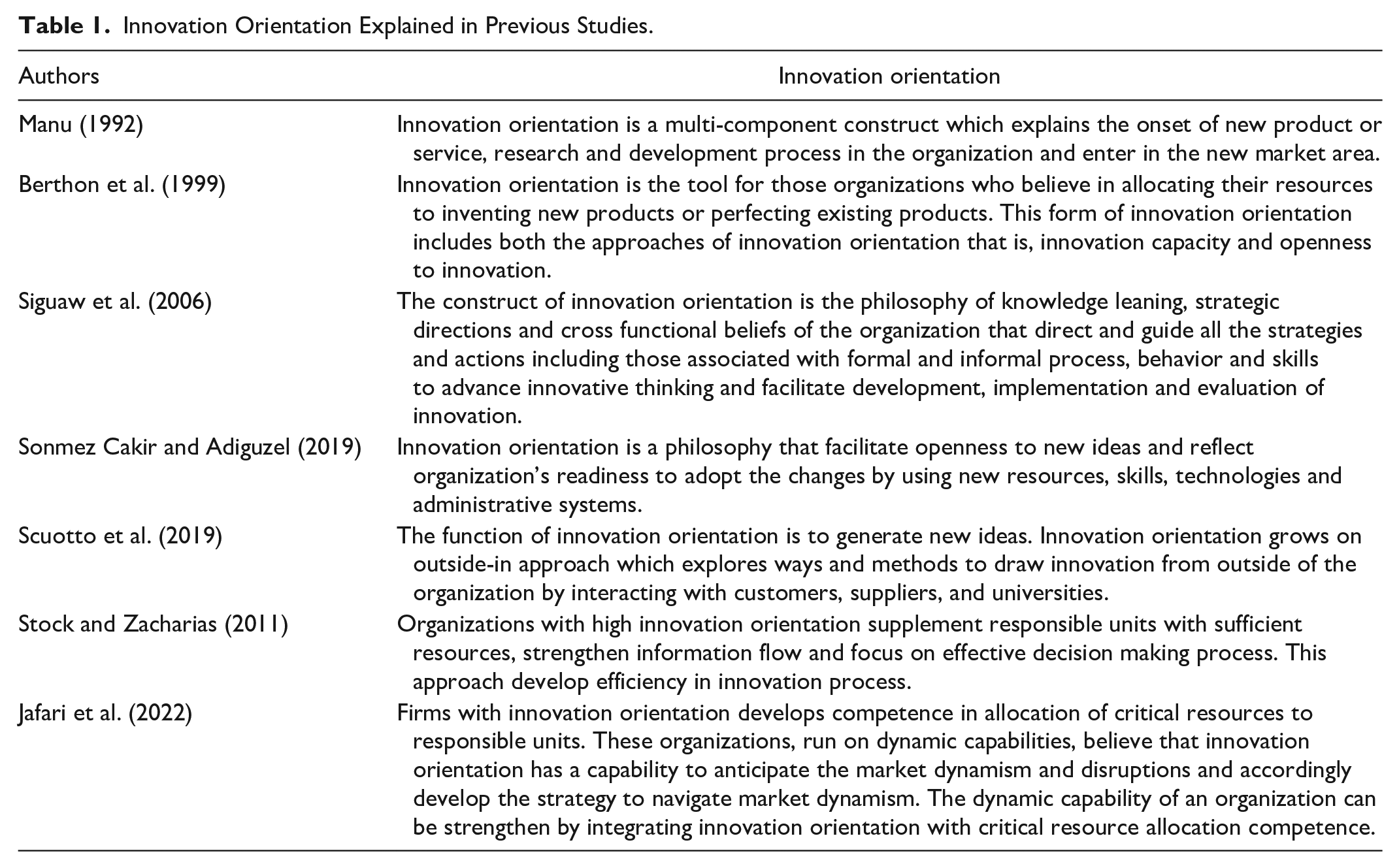
Innovation has become an important part for every organizations. But Tushman (1997) stated that it is not necessary that only innovation will lead organizations to long term success. Further, he claims that for long term success organizations need to focus on the innovation orientation. Therefore, for the continuous innovation capabilities innovation orientation is necessary which improves the performance both internally and externally of the organization (Ionescu & Ionescu, 2015). Chuang and Lin (2017), emphasize that organizations need to put more focus in determining and addressing the preferences of customers and this could be performed through service innovation orientation. As in the definition of service innovation orientation serve as introduction of service for the development or improvement in the existing service which meets customers’ present and future requirements for the improvement of business performance (Chuang & Lin, 2017). Table 1 listed some of the important studies explained innovation orientation.
Innovation Orientation Explained in Previous Studies.
Service orientation emphasizes more on determining and addressing customer preferences rather than emphasizing on other concerns. Service innovation is a new service and new invention which has not been introduce to the present market (Chuang & Lin, 2017; Prahalad & Ramaswamy, 2004). Several researchers provide various aspects of service innovation such as new service to the world and the company, enhancement of actual service, and modification in delivery and service process (Avlonitis et al., 2001).
In the past studies researchers found that innovation orientation has been empirically related with innovation performance (Dobni, 2010; Grawe et al., 2009; Siguaw et al., 2006). Researchers found that the concept of service orientation is useful for firms in solving customers’ problems until they feel satisfied and their findings reveal that innovation orientation influence performance of organizations (O’Cass & Ngo, 2012; O’Cass & Sok, 2013). In healthcare industry, service innovation orientation plays a significant role. A study has enclose the link with innovation orientation and performance (McDermott et al., 1993) and found that innovation orientation is a vital link to improve the performance of hospitals. Also, innovation orientation has a positive relationship with the financial performance of hospitals.
Open Innovation
Ever since the concept of open innovation was introduce by Chesbrough (2003) it has been growing undoubtedly. He introduces open innovation as “the use of purposive inflows and outflows of knowledge to accelerate internal innovation and to expand the markets for external use of innovation” (Chesbrough et al., 2006). In the competitive environment the word innovation has been recognized as an important part and one of the key sources for business and manufacturing firms (McDermott & Prajogo, 2012). Over the past several years, the term innovation is the fastest growing segment in the economic world. In simple words, the term innovation means something new or improved such as new methods of marketing, new process and new practices which has not been introduced before (Verbano & Crema, 2016). It is the formation and ratification of new ideas and process. it is an on-going process learning, searching and exploring which conclude in new ideas, practices, and new forms (Marques, 2014).
Most of the studies on open innovation focused on large firms and it results shows that it is profitable in enhancing performance (Awan, Arnold et al., 2021; Bianchi et al., 2010; Laursen & Salter, 2006; Spithoven et al., 2013; van de Vrande et al., 2009; Weng & Huang, 2017). Open innovation is used by many large firms and the results were successful but same concept of open innovation is less attracted to smaller firms because of such characteristics like culture and strategy (Colombo et al., 2014). However, Gassmann et al. (2010) identified that concept of open innovation is favorable for firms like large, medium and small in terms of overcoming challenges and enhanced performance. Innovation is a two-way flow of knowledge which helps firms environment to be flexible (Hochleitner et al., 2017). Therefore, it can be said that open innovation is a very useful concept which increases the performance of organization.
Innovation Performance
At present, the business environment is effective and changing extremely. To compete and continue in business, it become important for a manufacturing organization to introduce innovative product continuously (McDermott & Prajogo, 2012). The concept of innovation is the creation and adoption of ideas which are new to the world (Gopalakrishnan & Damanpour, 1997). The indicators of innovation performance in small and medium firms are use of technology for development, emphasizing knowledge building, focus on the core competence and develop culture in the organization (Johannessen et al., 1997). Some important basic sources for a firm to innovate and improve performance are the process needs, innovation orientation, industry and market structure, demographics, changes in perception, and technology (Johannessen et al., 1997). Innovation performance is a multidimensional construct which includes monetary and practical measures. Monetary measures include sales expansion, credit, capacity, and cost productivity. Whereas, practical measures include customer satisfaction, customer loyalty, employee satisfaction through teamwork, openness toward customer needs, product quality and service quality (Johannessen et al., 1999). However, Verbano and Crema (2016) argued that innovation performance of small firms should be measured on improved competence, improved main product/service, and improved effectiveness of product/service and should not be measured on monetary measures. Therefore, this study used innovation performance as uni-dimension.
Tidd and Bessant (2020) have posited that the organization innovation performance depends not only on the technical resources but also on the ways how these resources are managed and organized. The organizational structure, routines, incentive system, managerial tools and creativity must also be managed in the organizations (Johannessen et al., 1997). The performance is the foremost tool of “the potential for future successful implementation of actions to reach objectives and targets” (Lebas, 1995). Objectives are setting goals, time frames and detailed means to achieve targets (Awan, 2019; Moreira et al., 2017). The organization which continuously look for achievements are very innovative about their quality and quantity of ideas. Though, the quality and quantity of ideas are two independent parameters, but when combined they form the definition of innovative performance (Halim et al., 2014). See Figure 1 for the framework of the research study.

Research framework.
Relationship Between Service Innovation Orientation and Open Innovation
“Service innovation orientation represents a service orientation for developing new solutions or improving existing services that meet customers’ current and future requirements to improve business performance” (Chuang & Lin, 2017). It is a part of innovation where it helps the organization to meet the customers’ requirements which lead to performance. Studies have shown that innovation orientation has a significant positive relationship with innovation (Chatterji & Fabrizio, 2014; Schweisfurth & Raasch, 2015; Von Hippel, 2006). Chatterji and Fabrizio (2014) investigated on how innovation orientation influences firm innovation capability. They found that innovation significantly improved generating, accepting and implementing of new ideas, processes, products or services. Therefore, innovation orientation is closely related to organizational innovation. In their studies, several researchers have emphasized the importance of orientation to enhancing innovation (Damanpour, 1991; Deshpande et al., 1997; Khan et al., 2020; Verona, 1999). Findings of their studies reveal that there is a positive relationship between orientation and innovation. From the above mentioned studies it can be hypothesized that:
H1: Service innovation orientation has a significant and positive influence on open innovation.
Relationship Between Open Innovation and Innovation Performance
The open innovation has become a major strategic decision for firms toward the performance (Chesbrough, 2006). Although, the major question is that how innovation performance is affected by the open innovation. However, some studies have empirically investigated the positive effect of open innovation on innovation performance.
Caloghirou et al. (2004) have argued that openness to external sources of knowledge not only enhanced a firm’s research and development competency, but also had a positive effect on its innovation performance. van de Vrande et al. (2009), investigate the effect of open innovation on the small and medium enterprises. Findings of the study reveal that small and medium firms are engaged in many open innovation practices. However, the study finds no major difference between manufacturing and service industries toward adoption of open innovation. But medium sized firms are on average in adopting open innovation, whereas small sized firms are still not involved in the activity of open innovation. Previous studies (Awan et al., 2019; Damanpour & Evan, 1984; Lopez et al., 2005; Rosenbusch et al., 2011), indicates that firm’s with open innovation activity respond faster to environmental pressures, and therefore they have superior performance and also report that innovation has a positive effect on SMEs performance. As the above studies have found a positive relationship between open innovation and innovation performance. Therefore, on this basis it can be hypothesized that:
H2: Open innovation has a significant and positive influence on innovation performance.
Open Innovation Mediates the Relationship Between Service Innovation Orientation and Innovation Performance
Previous studies have adopted market orientation, learning orientation and strategic orientation in the context of innovation, and their findings reveal that they have a significant positive relationship with performance (Agarwal et al., 2003; Chatterji & Fabrizio, 2014; Ripolles Meliá et al., 2010; Simpson et al., 2006). Researchers have defined that service innovation orientation has a relationship with innovation (Chatterji & Fabrizio, 2014; Hidalgo & D’Alvano, 2014; Ionescu & Ionescu, 2015; Siguaw et al., 2006; Von Hippel, 2006). Studies in the context of hospitals have also found a positive relationship between innovation orientation and performance (Awan, 2021; Dobrzykowski et al., 2015; Länsisalmi et al., 2006; Lonial et al., 2008). From the above-mentioned studies, it can be hypothesized that:
H3: Open innovation mediates the relationship between service innovation orientation and innovation performance.
Methods
Data Collection Procedure and Sampling
A cross sectional study was performed and the survey method was used to collect the data. The unit of analysis of the study was organization, that is, medium and small private hospital and the respondent of the survey was owner/doctor of the hospital. Due to unavailability of sampling frame, purposive sampling was used to select the hospitals and respondents were requested to voluntarily participate in the survey. According to Sekaran and Bougie (2016), “purposive sampling is confined to specific types of people who can provide the desired information, either because they are the only ones who have it or conform to some criteria set by the researcher.”
As no official document or list was available, google search was performed for the location and contact numbers of medium and small private hospitals in major cities of Uttar Pradesh and Uttarakhand and in Delhi by using keywords like small hospitals in Lucknow, medium and small hospitals in Bareilly, small and medium hospitals in Dehradun, small hospitals in Delhi and so on so forth. Phone calls were made on the numbers obtained from the google search and hospitals were requested to provide email or cell phone number of the doctor responsible for the administration of the hospital. Electronic survey questionnaire was forwarded to those doctors with a request to take part in study survey. The inclusion criterion was hospitals with less than 100 beds as Kate (2013) identified those hospitals as small and medium which have less than 100 beds. The data were collected from the medium and small private hospitals in three states of north India which were Uttar Pradesh, Uttarakhand, and Delhi. Informed consent was obtained on data collection from the representatives of the hospitals, who were the respondents of the study. In total 186 medium and small private hospitals responded to the study survey and after thorough scrutiny of the returned questionnaires 173 were used for data analysis. Harman’s single factor test was performed to identify the common method bias in the survey data. The test result found that 44.60% of total variance was explained by the first factor which was below than the limit of 50% of the total variance.
In estimating the sample size of a study performed with structural equation modeling, Chin (2010) explained that sample size should be equal or larger than 10 times of number of structural paths pointing to an endogenous variable. Further, according to Reinartz et al. (2009) the sample size of 100 is adequate for a study performed with partial least square-structural equational modeling (PLS-SEM). Therefore, the sample size of 173 was sufficient to perform PLS-SEM analysis
Measurements
The survey instrument was developed using well established scales and items were adapted from the previous studies (Chuang & Lin, 2017; Prajogo & McDermott, 2011; Verbano & Crema, 2016). For service innovation orientation and open innovation, items were measured on a seven-point Liker scale that ranged from (1) strongly disagree to (7) strongly agree. Innovation performance was measured on a five-point Likert scale as Podsakoff et al. (2012) suggested that eliminating common scale properties will reduce common method bias. The variable service innovation orientation has four items adapted from Chuang and Lin (2017), open innovation has six items adapted from Prajogo and McDermott (2011) and three items for innovation performance were adapted from Verbano and Crema (2016)
Results
The respondents of the study were doctors/owners for all 173 medium and small private hospitals. Male respondents were slightly higher (57.2%) than the female respondents. The age group of majority of the respondents (41.6%) was 25 to 35 years. In total 67.7% hospitals were individually owned by the doctors. Table 2 explains the profile of surveyed hospitals and the respondents.
Socio-demographic Profile of the Respondents (N = 173).

Descriptive Statistics of the Latent Variables
The mean values of the study variables were varied from maximum 6.051 to minimum 5.679 on 7-point Likert scale. The dependent variable of the study model, that is, innovation performance was measured on 5-point Likert scale and the mean value was 4.466. Table 3 shows the results of descriptive analysis of the study variables.
Descriptive Statistics of the Latent Variables.

Assessment of Measurement Model
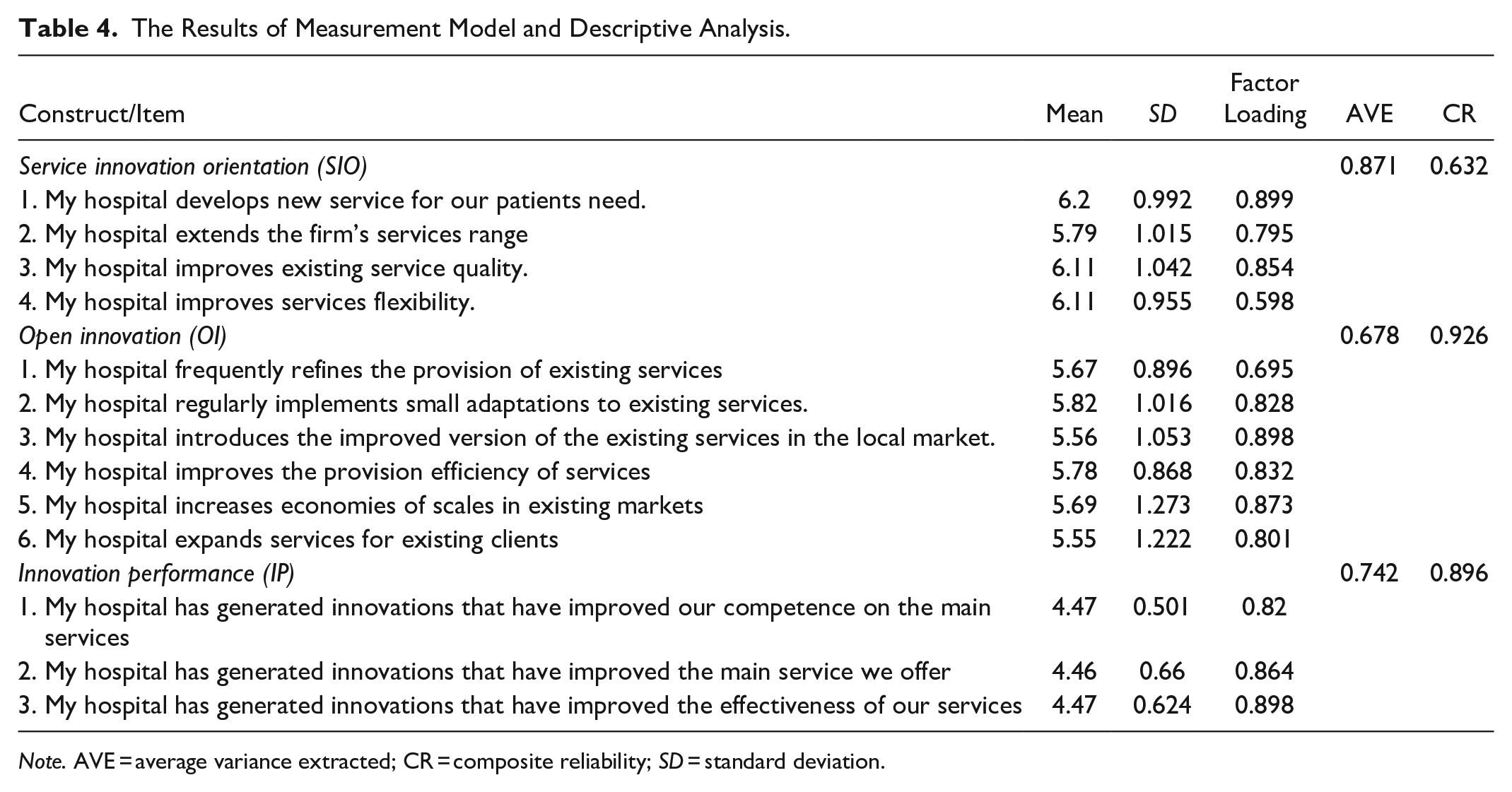
Factor loading, composite reliability (CR) and average variance extracted (AVE) were checked to establish the convergent validity of the research model. The cut-off value of factor loading, CR and AVE were 0.708, 0.70, and 0.50 respectively as recommended by Hair et al. (2021). Table 3 shows mean, standard deviation and factor loadings of all the items as well as AVE and CR of latent variables. The factor loadings of two items SIO4 (0.598) and OI1 (0.695) were below the recommended value of 0.708. However, the items were not deleted from the analysis as AVEs of the latent variables of these items were above the recommend value of 0.50. Table 4 details measurement model as well as mean and standard deviation of study variables.
The Results of Measurement Model and Descriptive Analysis.
Note. AVE = average variance extracted; CR = composite reliability; SD = standard deviation.
To establish the discriminant validity of the research model Heterotrait–Monotrait (HTMT) ratio was used. Recent research recommend use of Heterotrait–Monotrait (HTMT) over Fornell–Larcker method to check discriminant validity as HTMT consider more powerful criterion (Henseler et al., 2016). The study preferred use of stricter cut-off value of 0.85 of HTMT and found that all HTMT values were below 0.85 (see Table 5). Therefore, the discriminant validity of the study model was established.
Discriminant Validity (HTMT.85 Criterion) of Measurement Model.

Assessment of Structural Model
In PLS-SEM, the goodness of the structural model should be established by significance of path coefficient (β-value) and the coefficient of variance (R2) (Hair et al., 2011). According to Cohen (1988), R2 value between .02 and .12 is considered weak, between .13 and .25 moderate and .26 and above substantial. The R2 values of open innovation and innovation performance were moderate (.235) and substantial (.297) respectively which means the 23.5% of the total variance of open innovation was explained by the service innovation orientation. Similarly, 29.7% of the total variance of innovation performance was explained by the open innovation.
The significance level of path coefficient explains the hypothesized relationship between variables (Hair et al., 2021). Therefore, boot strapping analysis with re-sampling of 1,000 was run to obtain the significance level of path coefficients of the structural model. The boot strapping analysis found that service innovation orientation has a positive and significant effect on open innovation, that is, H1 as β = .485, p < .01. Open Innovation has significant positive influence on innovation performance, that is, H2 as β = .545, p < .01. The analysis results also show that open innovation mediates the relationship between service innovation orientation and innovation performance, that is, H3 as β = .264 and confidence interval lower limit = 0.194 and upper limit = 0.315. Table 6 shows the results of boot strapping. Figure 2 shows the significance level of hypothesized relationships.
Results of Structural Model Analysis.

Note. SIO = service innovation orientation; OI = open innovation; IP = innovation performance.

PLS output of structural model.
Discussion
The main goal of the research study was to investigate the effect of service innovation orientation on open innovation and innovation performance in context of medium and small private hospitals. Further, available literature lack in studies tested the mediating effect of open innovation. Therefore, present study is an attempt to bridge the gap in literature by investigating the direct and the mediating effect of variables used the research framework. Thorough literature review reveals that previous studies have tested the effect of service innovation on innovation performance (Dobrzykowski et al., 2015; Länsisalmi et al., 2006) however, studies investigated the mediating effect of open innovation in context of medium and small private hospitals is scarce. Literature review also reveals that due attention is required from the researchers on medium and small private hospitals in India as these hospitals provide services to the 70% population of the country. However, very few studies were conducted focusing on innovation performance of this category of hospitals. Therefore, this study empirically tested an innovation model by combining the factors as service innovation orientation and open innovation and their effect on innovation performance. The findings of this study will enlighten the policy developers and the hospital managers about the importance of innovation strategies and how innovation performance can be improved by using service innovation orientation and open innovation in context of medium and small private hospitals.
The data analysis findings revealed that H1 was supported (β = .485, p-value = .000) as service innovation orientation has significant and positive influence on open innovation. This result was consistent with the previous research studies (Chatterji & Fabrizio, 2014; Franke & Shah, 2003; Schweisfurth & Raasch, 2015) in which it was argued that innovation in the form of open, inward or outward leads to improvement of innovation orientation such as service innovation orientation, orientation capability and organizational innovation. Service innovation orientation in organizations is understood as beliefs and attitude toward developing innovative solutions to existing problems and further improving services to the customers and fulfilling their current and future needs that ultimately improve the organizational performance (Chuang & Lin, 2017). Service innovation orientation emphasizes more on needs of customers rather than other aspect of organizational process. However, open innovation mainly focuses on willful exchange of knowledge with external partners to speed up the internal innovation and expand the market of the organization to use external innovation at fullest (Chesbrough et al., 2006). There is two way exchange of knowledge in open innovation. In outside-in flow of knowledge, organization utilize the external knowledge shared by the partners as input for the innovation process whereas, in inside-out flow of knowledge, organization shares its unused or underutilized knowledge to partner organizations so that they can use it in their innovation process (Chesbrough, 2017). The finding of this study suggests that organization should further enhance the creative skills of employees to solve the issues of customers and provide improved services by exposing them to open innovation. Knowledge exchange occurs in open innovation will further enhance the knowledge of employees and strengthen the service innovation orientation in the organization.
The data analysis results also find that open innovation has significant and positive influence on innovation performance of medium and small private hospitals with β = .545 and p-value = .000 (H2 supported). This finding of the study is also consistent with previous studies which argued that one of the crucial sources to support innovation performance is external knowledge resources (Parida et al., 2012). Open innovation develops capability among organizations to connect and collaborate with outside partners as well as competitors and helps organizations to obtain new technology and knowledge and improve, enhance, and achieve innovation performance.
Lastly, data analysis results found that open innovation has mediating effect between service innovation orientation and innovation performance (β = .145, p-value = .000) which means H3 was also supported. This finding is similar with the findings of previous studies as innovation orientation or strategic orientation has positive influence on service orientation (inward/outward innovation activities) and innovation performance (Chatterji & Fabrizio, 2014; Hidalgo & D’Alvano, 2014; Von Hippel, 2006). Service innovation orientation enhances current services by developing new solutions which ultimately improves the innovation performance of the organization and meet current and future needs of the customers. Service innovation orientation emphasizes more on customers’ preferences than other aspects of the organization.
Conclusion and Limitations
As per the conceptualized research model of this study, innovation performance of medium and small private hospitals is positively influenced by the service innovation orientation and open innovation. Studies on open innovation have taken place in both manufacturing and service sector. However, studies focusing on medium and small private hospitals of India are scarce. Therefore, the current research should focus on medium and small private hospitals rather than large private hospitals. For that reason, the authors’ interest lies on the area of open innovation and medium and small private hospitals that have minimal research.
The scope of the study encompasses the investigation into the relationship of variables such as service innovation orientation as the factor that has influence on open innovation and its relationship to innovation performance. The study identified three research question to answer. RQ1 Does service innovation orientation has an impact on open innovation in medium and small private hospitals? The study found that service innovation orientation has a positive effect on open innovation. RQ2 Does open innovation has an impact on innovation performance of medium and small private hospitals? The findings of the study revealed that open innovation has significant positive effect on innovation performance of medium and small private hospitals. Therefore, it is utmost importance for the hospitals to take service innovation orientation into consideration while adopting open innovation toward the enhancement of innovation performance of medium and small private hospitals. The RQ3 was, does open innovation mediate the relationship between service innovation orientation and innovation performance in medium and small private hospitals? Study found that open innovation mediates the relationship between service innovation orientation and innovation performance.
In conclusion, the findings of the study enrich the existing literature related to the subject. Although, the process of open innovation in medium and small private hospitals needs to be thoroughly understood, this study will help medium and small private hospitals to understand the role of service innovation orientation and open innovation on enhanced innovation performance. This study also contributes toward improved understanding of policy maker and healthcare managers on service innovation orientation, open innovation and innovation performance.
Although, this study is a sincere attempt to understand the innovation process in medium and small private hospitals, study has few limitations. This study used non-probability purposive sampling to collect the data due to the unavailability of the sample frame. Therefore, the generalizability of the study findings is limited. Second, the sample size of 173 could be considered as modest, however, the sample size appeared to be adequate for the study framework when examined on G*power in a priori power analysis (Faul et al., 2007).
Footnotes
Acknowledgements
Authors thank study respondents for proving the responses on survey questionnaire.
Declaration of Conflicting Interests
The author(s) declared no potential conflicts of interest with respect to the research, authorship, and/or publication of this article.
Funding
The author(s) disclosed receipt of the following financial support for the research, authorship, and/or publication of this article: The research study did not receive any funding from any source.
Ethical Approval
An ethics statement (including the committee approval number) for animal and human studies. If this is not applicable, please state this instead. As the study was designed as cross sectional survey study, no ethical approval was obtained. Informed consent was taken from the respondents before responding to the survey questions.
