




Abstract
The aim of the study is to describe factors influencing the feeling of safety which significantly influences also the subjective well-being and life satisfaction among Czech seniors. The sample consisted of seniors in the age 55 and above, the total number of respondents was 3,071. In the beginning of presented study two crucial questions were asked. Do the Czech seniors feel safe? What are they mostly afraid of? The reported feeling of safety was higher in seniors who perceived their health as good or very good, almost 90% of these seniors reported they felt safe. The survey results showed that the seniors’ sense of safety was also influenced by the fact whether they lived with someone or alone where the living alone decreased the feeling of safety significantly. Hypothesis testing revealed that also gender affects the reasons why seniors do not feel safe, as well as household’s members and by the place of residence. The survey results have brought an intriguing finding that more than one fourth of Czech seniors reported that one of the reasons why they feel insecure is their fear of migrants. A detailed analysis of the primary data set is focused on factors determining Czech seniors’ feeling of safety and identification of possible specific features of the senior group with concerns about migrants.
Introduction
Seniors’ feeling of safety is one of the areas frequently mentioned in connection with discussions about the quality of seniors’ lives. Nešporová et al. (2008) define the need for safety as one of the basic “alpha needs”. Even Maslow (1943) put the need for safety on the second layer of his pyramid representing the hierarchy of human needs, that is, he believed the need for safety immediately followed after basic physiological needs. However, some authors, such as Ryan and Deci (2000), argue that the feeling of safety is not a basic need, but a deficient motive, it means it is rather a psychic reaction to an insufficient satisfaction of real needs. Younger and older people perceive the feeling of safety differently—according to Pichaud and Thaereau (1998), elderly people may perceive even saturated needs as deficient ones, while the need for safety is a typical example of this. Furthermore, these authors point out that aging strengthens interconnections of certain needs—for example, safety is becoming more associated with physical well-being. Elderly people are more concerned about things they did not perceive in younger age, for example, Arfken et al. (1994), Howland et al. (1993, 1998), or also Tinetti et al. (1994, 1995) conclude that seniors fear falls (and the consequent injuries). Also, Gagnon et al. (2005) found out that depressive disorders and depression severity are in a strong relationship with fear of falling. Nešporová et al. (2008) state that research of elderly persons’ needs to address the question of individual needs’ changes in different stages of life, including identification of persons and actions satisfying different needs. Pichaud and Thaereau (1998) divide the need for safety into the need for economic security, need for physical security, and the need for psychological safety. It is therefore obvious that the feeling of safety is determined by multiple factors, not only the feeling of security (i.e., absence of threat) in one’s own apartment, house, or place of residence. However, feeling of safety at the place of residence is a very important factor in the overall seniors’ satisfaction (Kubíčková et al., 2019; Tedre & Pehkonen, 2014). This is evidenced by the findings of Kahana et al. (2003) which clearly indicated that seniors perceived the feeling of safety at their place of residence as a very important component of their overall satisfaction.
According to Fonad et al. (2006), elderly people prefer the feeling of safety above the feeling of independence. Novac et al. (2002) emphasize that another important factor of seniors’ satisfaction is the feeling of social acceptance at their place of residence. Van Bilsen (2007) also mentions the safe living environment as an essential aspect of quality of seniors’ lives. The need for physical safety is greatly influenced by the senior’s health. Kuchařová (2002), who analyzed psychic safety, concluded that negative responses to questions about the feeling of safety correlated with the seniors’ feelings of loneliness. In their study, Jakobsson and Hallberg (2005) found out, that the feeling of loneliness is more frequent among elderly women. Haškovcová (1991) states that “Old people need to feel safe and satisfied within their family or other integrated community; this can be achieved only if they’re sufficiently healthy and have a certain level of material security.” Regarding the feeling of safety, some studies suggest that people from different social groups perceive safety differently. According to Borooah and Carcach (1997), people with higher income are less afraid of criminality; according to Pradhan and Ravallion (2003), people with higher income are subjectively more satisfied with public security. On the other hand, Nielsen and Smyth’s (2008) study showed that income and education have no influence on the feeling of safety. The results clearly indicated that the feeling of safety is influenced by individual attitudes toward migrants. One of the older studies—Braungart et al. (1980)—states that although seniors (60 years and more) are slightly more concerned by criminality than other age groups, much greater differences in the perceived fear, as reported by the US respondents, were found when comparing genders—the study showed that criminality is more worrying for women. People living in large industrial areas were more afraid of criminality than people living in smaller towns. The study also showed that people living alone were more afraid of criminality—the greatest concerns were reported by the group of seniors, both men and women, who have never been married. Also, De Donder et al. (2005) found out that loneliness relates with higher fear of crime. Their study also showed that women are more afraid then men.
Therefore, the authors’ comprehensive survey of quality of life of Czech seniors explicitly focused on the feeling of safety. The survey results have brought a rather surprising finding that more than 25% of Czech seniors reported that one of the reasons why they feel insecure is their fear of migrants. The Czech Republic is not a sought-after destination for people migrating due to the global refugee crisis, there is no massive influx of refugees to Czech Republic, unlike other European countries such as Germany, France, Italy, and Belgium (e.g., according to the Ministry of the Interior, only 1,477 asylum applications were submitted in 2016 and 1,450 applications in 2017), therefore, the authors were surprised by the survey respondents’ concern about migrants.
Therefore, the paper’s objective is to find out which seniors are concerned about migrants and whether these seniors have some common features, or whether seniors across all socio-demographic groups are concerned about migrants.
Given the very low probability that the questioned seniors would have experience with migrants, the question arises whether the respondents’ views could be influenced by the media. For example, Thomas et al. (2018) accentuated the media’s influence in the context of the refugee crisis. The importance of the media’s role has been described in various other studies, such as the study published by the Church Commission for Migration in Europe and the World Organization for Christian Communication for Migrant in Europe (2017), or the Moving Stories White (2015) study, which claim that the media are trying to nurture hate moods toward refugees. In their study, Moravec et al. (2016) states that the trust in media comes from the age, education, etc. However, they found out that people, who are less-educated media consumers, do not believe in the presented information as much.
In order to determine whether all seniors are equally afraid of migrants, and whether, for example, younger or older seniors are better able to process information obtained from the media and do not share concerns about migrants, the authors performed a detailed analysis of the primary data set. The analysis focused on factors determining Czech seniors’ feeling of safety. The authors also aimed at identification of possible specific features of the senior group with concerns about migrants. In addition, the paper presents a detailed analysis of subjective perceptions of safety—as reported by the interviewed seniors—in relation to their health, household members, and places of residence.
Materials and Methods
In order to fulfil the paper’s objective, the authors analyzed the data obtained from TAČR Beta project No. TB05MOSV004 “Survey on the Quality of Life of Elderly Citizens in the Czech Republic.” Primary data was obtained through a questionnaire survey performed in 2016. The questionnaires were distributed both in electronic and paper formats, especially with regard to the diversity of the basic respondent sample and the aim to obtain information from different groups of seniors. Data collection was performed by the use of the Umbrella system. The total respondent sample consisted of 3,071 respondents, which included 3,045 completed questionnaires. The sample covered all socio-demographic categories of seniors. About 36.39% of respondents were men and 63.61% of respondents were women. The respondents’ age was 55 years and more. The biggest part of respondents (39.38%) were aged 66 to 70 years, about a third (33.20%) of respondents fell into the youngest category of 55 to 65 years, less than a fifth (18.19%) of respondents were aged 71 to 75 years, and almost 10% of respondents were older than 76 (3.05% of respondents were older than 81). Most respondents were married or lived with their civil partners (63.97%), less than one fifth of respondents were widowed (17.14%), and a similar part of respondents (16.19%) were divorced. Only 2.69% of respondents were single. More than half of the seniors had secondary education (50.34%), and almost one third had college education (31.43%), there were 18.23% seniors without the secondary school-leaving exam. All regions of the CR were represented in the sample and there were also several respondents (0.33%) from Slovakia. The respondent sample consisted mainly of urban population, most of the respondents (82.1%) spent most of their lives in cities, while 39.47% respondents lived in regional capitals and 4.50% in the Capital City of Prague. Less than one fifth of respondents (17.90%) reported they had spent most of their lives in rural areas. The data obtained was processed by the use of the STATISTICA software by StatSoft, SPSS Statistics, and MS Excel. The data were first categorized, it means the authors created an arranged data set which allowed them to describe and derive certain knowledge from the values obtained. The data analysis was performed by the use of descriptive statistics. Since the survey was focused on finding subjective opinions, the authors worked with the nominal characteristics. In selected cases, frequencies were described by the use of pivot tables, which allowed subsequent identifications of possible relations between two verbal characteristics. The strength of dependencies between relevant relations were then tested by Pearson coefficient (P). The closer the value was to 1, the greater the dependence. The relations between variables were verified by comparing empirical coefficients called square contingencies χ2 with the chosen significance level p = .05 (or P = 0.01).
Results
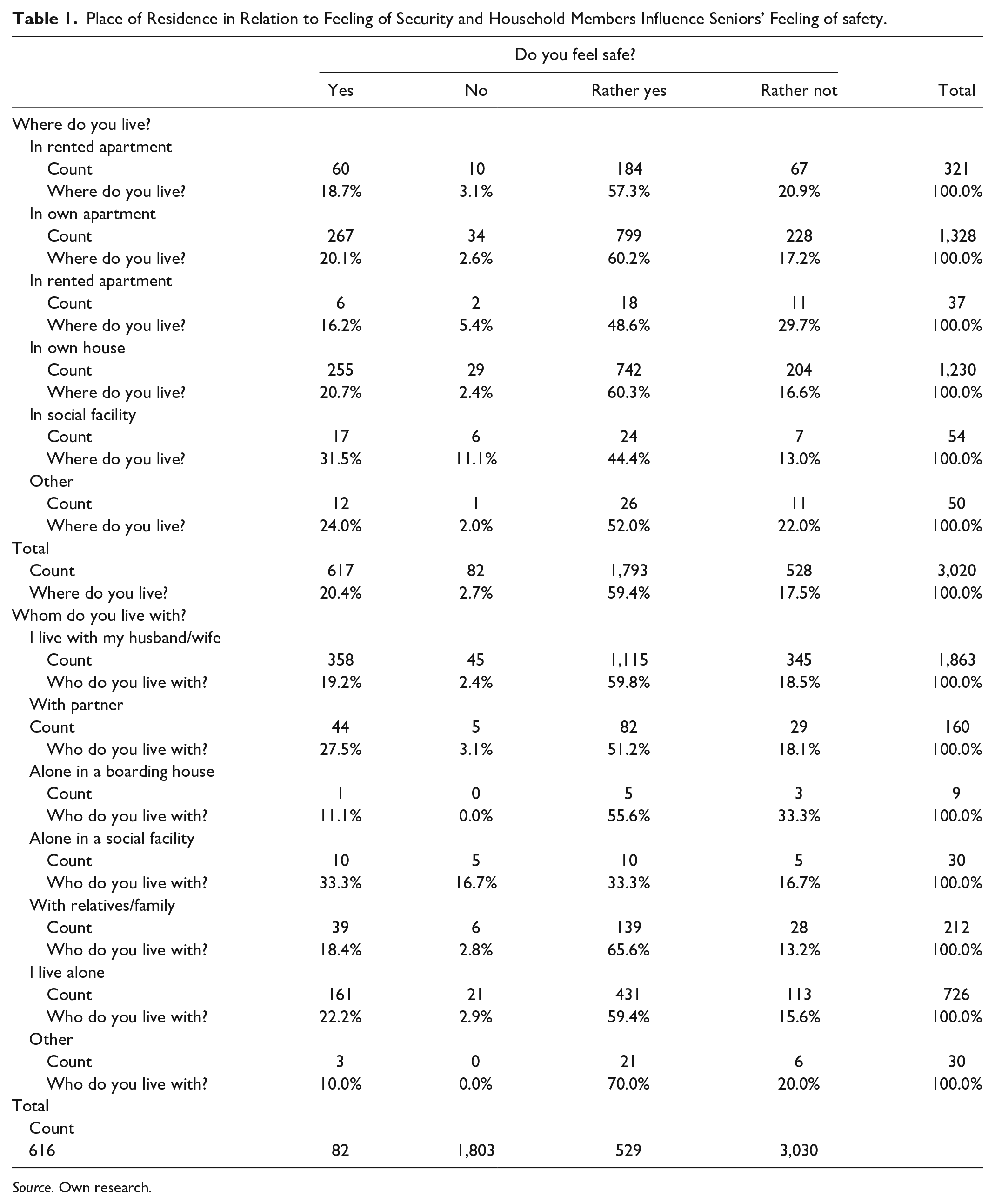
The simple analysis of the collected primary data showed that the seniors’ health is a proportional factor to the perceived safety. The reported feeling of safety was higher in seniors who perceived their health as good or very good. About 89.20% of these seniors reported they felt safe. As for the seniors who perceived their health as acceptable, 75.20% of them reported they felt safe. In the group of seniors who perceived their health as bad or very bad, more than one third (38.0%) reported they didn’t feel safe. The survey results showed that the seniors’ feeling of safety was also influenced by the fact whether they lived with someone or alone. Data analysis has shown that a third (33.33%) of seniors living alone in a social facility or in a boarding house didn’t feel safe. The group to most often report they felt safe were the seniors who lived with their relatives or families (84.28%). According to the survey results, the size of the municipality the seniors lived in was not relevant to the perceived safety. The feeling of safety was further examined in relation to the seniors’ place of residence (see Table 1). The following hypotheses were tested: H0: Feeling of safety is not influenced by the place of residence. H1: Feeling of safety is influenced by the place of residence. Chi-square test was performed—see the results in Table 2. Good approximation conditions were met. The p-value was lower than the chosen significance level of .05, therefore, we rejected the zero hypothesis. The influence of place of residence over the feeling of safety has been proven. Most often, people feel safe in their own houses or apartments. The relationship’s strength is weak (Cramer coefficient of .059).
Place of Residence in Relation to Feeling of Security and Household Members Influence Seniors’ Feeling of safety.
Source. Own research.
Chi-Square: Place of Residence in Relation to Feeling of Security.

Source. Own research.
3 cells (12.5%) have expected count less than 5. The minimum expected count is 1.00.
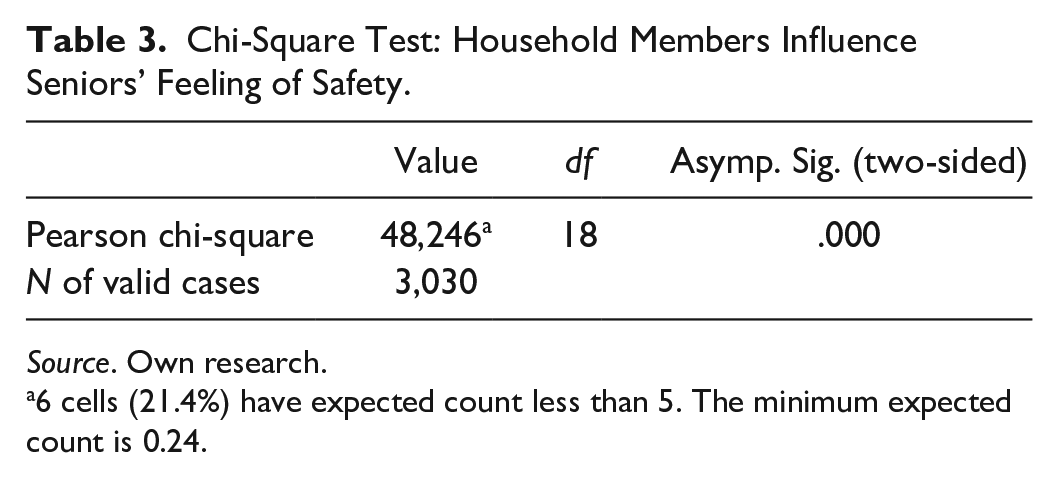
The authors further examined the seniors’ feeling of safety in relation to the persons with whom they live (see Table 1). The following hypotheses were tested: H0: Feeling of safety is not influenced by our household’s members. H1: Feeling of safety is influenced by our household’s members. Good approximation conditions were met. Chi-square test was performed (see Table 3). The p-value is lower than the chosen significance level of .05, therefore, we rejected the zero hypothesis. Household members’ influence over the feeling of safety has been proven. The relationship’s strength is weak, as indicated by the Cramer coefficient value of .073.
Chi-Square Test: Household Members Influence Seniors’ Feeling of Safety.
Source. Own research.
6 cells (21.4%) have expected count less than 5. The minimum expected count is 0.24.
The seniors were asked about why they didn’t feel safe. There are several reasons why seniors don’t feel safe (see chart in Figure 1). Most often, seniors are worried about health deterioration or injuries (health condition was mentioned by about 38% of respondents), specifically, almost 12% of respondents said they were afraid of injuries caused by bad weather, almost 19% or respondents said they were afraid of acute health deteriorations, and almost 7% of respondents reported they didn’t feel safe for health reasons. Approximately a quarter of seniors said they didn’t feel safe because of the fear of migrants, and nearly 15% of seniors didn’t feel safe because they believed people in our country did not treat seniors well. About 5% of seniors reported they didn’t feel safe because they felt lonely. Only 2% of seniors said they did not feel safe because they considered the location they lived in dangerous.

Reasons why seniors do not feel safe.
The authors examined the relationship between individual reasons why seniors did not feel safe and the respondent seniors’ gender (see Tables 4 and 5). The following hypotheses were tested: H0: Gender does not affect the reasons why seniors do not feel safe. H1: Gender affects the reasons why seniors do not feel safe. Chi-square test was performed. We can conclude that the conditions of good approximation were fulfilled. p-Value was lower than the chosen significance level of .05, therefore, we rejected the zero hypothesis. The influence of gender on feeling safe has been confirmed. Women are more often worried about injuries than men and the same applies to feelings of loneliness. The strength of the relationship between gender and the reasons for not feeling safe is weak (Cramer coefficient of .140).
Reasons Why Seniors Do Not Feel Safe in Relation to Gender.

Source. Own research.
Dichotomy group tabulated at value 2.
Chi-Square Test of the Reasons Why Seniors Do Not Feel Safe in relation to Gender.

Source. Own research.
0 cells (0.0%) have expected count less than 5. The minimum expected count is 36.88.
Out of the 3,071 seniors questioned, 1,313 (43%) reported that one of the reasons why they didn’t feel safe was the “fear of the migrants coming to our country”. As can be seen from Table 4, both sexes fear migrants equally (26.5% of men and 24.8% of women). Who are those seniors who are afraid of migrants? Do they differ in education, residence, or other characteristics from other seniors? Figure 2 clearly shows that there are no significant differences in age, nor the place of residence between those who are afraid of migrants and those who are not.

Who are the people who are afraid of migrants?
Further comparisons of survey answers (Figure 3) clearly showed that the perception of health status differed between the seniors who were and were not afraid of migrants. Comparison of subjectively perceived life situations brought the same results, see Figure 4.

How do seniors afraid of migrants perceive their health?

How do seniors afraid of migrants perceive their life situations.
No differences between the analyzed group and the total respondent set were found even when comparing attained qualifications, see Figure 5. An interesting finding brought by the survey data analysis was that the two groups did not either differ in their involvement in volunteering activities. It means that seniors who were afraid of migrants participated in volunteering activities in the same proportion as the rest of the seniors questioned (see Figure 6).

Seniors’ levels of education

Engagement in volunteering activities.
The only area where differences were found between the seniors who reported they were afraid of migrants and the set of all respondents was the question of whether seniors felt safe (see Figure 7). Only 6% of the seniors who reported they were afraid of migrants said they felt safe (as for the entire data set, 20% of respondents said they felt safe). A minor difference was also found in the second positive answer: 61% of respondents who were afraid of migrants felt rather safe (59% for the whole data set). The negative answers differed as well: 28% of the seniors who expressed their concerns about migrants said they “rather didn’t feel safe” (18% for the whole data set) and 5% said they “didn’t feel safe” (3% for the whole data set). When we add the two negative answers, we find that 33% of those who were afraid of migrants did not feel safe. As for the entire data set, however, negative answers to this question accounted only for 21%.

Feeling of safety.
Discussion
In the beginning of presented study two crucial questions were asked. Do the Czech seniors feel safe? What are they mostly afraid of? Perceived safety is one of the crucial elements of life satisfaction among seniors according to the results of the extensive survey among Czech seniors (cit. analýzy předchozích výsledků). Also, Canadian surveys such as the Canadian Community Health Survey (CCHS) and the General Social Survey (GSS) have long included a question on life satisfaction (Uppal & Barayandema, 2018). Of the nine domains of life examined in this study, seniors were most satisfied with their safety (with an average score of 8.4, where minimum was 1, maximum 10), the quality of their local environment (8.3), and their personal relationships (8.3). Seniors, however, were least satisfied with their own health (7.2; Uppal & Barayandema, 2018).
The majority of studies on feeling safe focused primarily on the link of life satisfaction or location, housing condition, etc. (Lindahl et al., 2018; Mao & Wang, 2020; Zhang et al., 2018).
The presented study provides analysis on factors which influence the feeling of safety which are (ordered from the most influencing factors to the least influencing factors): seniors health (incl. the fear of injuries), migrants, the behavior of other people toward seniors, feeling alone, location. In compliance with former researches it turned out that feeling of safety is mostly linked with the perception of health. Those who perceive their health as good or very good also feel safe (89.0%) compared to only 38% of seniors who perceive their health as bad and very bad regardless of their gender. There are no comparative studies published so far which would deal with the relation between feeling of safety and perception of health, however, there are studies proving that life satisfaction is in old age assumed to be inevitably affected by health (Gwozdz & Sousa-Poza, 2010). According to the results of the current study we can assume that health is a moderator between safety and life satisfaction in older age, however, this needs further research. Minor factors which influences the feeling of safety is the fear of people who do not behave well toward seniors, location (potentially dangerous regions or places), and feeling alone. An intriguing and surprising findings was that one quarter of Czech seniors is afraid of migrants. As stated above, the Czech Republic is a country with almost no refugees applying for asylum (only 1,477 asylum applications), even though, these applications would have been approved, it would mean less 0.01% of the Czech population. The Czech seniors most probably have never in their life met or even seen any refugee. Still, about one quarter of them states that they are seriously afraid of migrants and do not feel safe. The explanation of such fear might be complicated, especially because it seems to be resistant to the respondents’ characteristics: the structure of respondents’ afraid of migrants in terms of their education, residence, perception of their health, life situation, and even volunteering did not differ from the whole sample of respondents. There was found the negative tendency of seniors afraid of migrants and their feeling of safety, the more afraid they were the less safe they felt.
There is a strong evidence of the power of media. Crime often ranks at the top of public concern, and a majority of the public report they sometimes worry about crime (Cohen, 2008).
Also, the presented results proved that seniors watch media on the regularly basis and mostly are influenced by internet, TV, and radio. Authors, for example, Thomas et al. (2018) state that the media have a strong influence on the issue of migration and perceived impacts of the refugee crisis. The importance of the media’s role is also described in various other studies, such as the study published by the Church Commission for Migration in Europe and the World Organization for Christian Communication for Migrant in Europe (2017), or the Moving Stories White (2015) study, which claim that the media are trying to nurture hate moods toward refugees. For example, the study of the Church Commission for Migration in Europe and the World Organization for Christian Communication, 2017 showed that the media from the monitored European countries referred to refugees/migrants as perpetrators of terrorist attacks in 45% of cases, as perpetrators of nationality, race, or ethnic-based violence in 14%, as perpetrators of domestic violence in 12%, as offender in 9%, as perpetrators of sexual violence in 7%, etc. It is therefore possible that seniors’ fear of migrants is caused by the fact that Czech media bring and cover migration-related problems from other countries. Tkaczyk et al. (2015) analyzed media coverage of the refugee crisis and confirmed that the Czech TV broadcast focused primarily on security issues associated with refugees. The study showed, for example, that refugees were mostly presented as an administrative problem (51% in Czech TV and 60.1% in TV Nova), as an object requiring police interventions (31.6% in Czech TV and 29.9% in TV Nova), and as a security threat (18.7% in Czech TV and 22.7% in TV Nova). Heřmanová (2018) drew attention to the fact that the Moving Stories Ethical Journalism Network 2015 study showed that the media coverage of refugees in the Czech Republic is similar to Bulgaria and that “there were actually no consequences of the fact that the Czech TV station Prima TV was rightfully accused of ordering its editors to inform in negative terms only about refugees.” Therefore, it is possible that the media could have a major influence on the seniors. Moravec et al. (2016) states that trust in the media depends on age, education, and the “media consumption” factor (i.e., how often the respondent follows a specific medium). These authors presented findings that the average age of respondents who were sceptical about media-presented information decreased over the last 10 years, and that the distrustful respondents did not belong to the most educated segments. On the contrary, Moravec et al. (2016) found out that the less-educated media consumers believed the presented information the least (these authors reported that the distrust in media increased from 19% to 49% between 2004 and 2016). However, we need to add that these authors identified a much greater increase in distrust in the media among young people aged 18 to 29 years. In this segment, the distrust in media rose from 18% in 2004 to 53% in 2016. Among respondents over 60, the increase in distrust accounted for 17.5% in 2004 to 44% in 2016.
What was the influence of place of residence, household member, and gender on feeling safe in older age?
According to the results all three factors matter, even though the relationship’s strengths were weak. The influence of gender on feeling safe has been confirmed. Women are more often worried about injuries than men and the same applies to feelings of loneliness. Also, the influence of place of residence over the feeling of safety has been proven. Most often, people feel safe in their own houses or apartments and with relatives, least safe are feelings of seniors living in social facilities.
Conclusion
Presented study contributes to the theories of life satisfaction in older age which is influenced by the feeling of safety (Cohen, 2008; Maslow, 1943).
In compliance with a number of published studies (see above) we confirmed that perception of health, loneliness, place of residence, household members as well as gender influence the feeling of safety among seniors. These are findings important for regional as well as national policy makers when considering, for example, building of senior houses and increase of institutional care vs support of informal care and higher involvement of family carers. An absolutely unique finding based on the results of this study is the influence of fear of migrants on the feeling of safety which seems to be general over all groups and categories of seniors regardless their education, perceived health, life situation, volunteering, etc. That is an outcome which has not been published yet might be understood as the threat of increased populism and xenophobia in the Czech Republic, especially among the group of older population. The influence of media and general discourse regarding migrants is expected to be absolutely crucial regarding the seniors’ fear from migrants. The major limit of our study is linked to the quantitative approach which on one hand allows us to generalize the results to a group of seniors in the Czech Republic, on the other hand does not allow an easy interpretation of results. To understand the principles and factors staying beyond the particular fears of Czech seniors would require further research applying qualitative methods which enable to uncover the complicated structures of fear nets.
The results bring possible implication for HR managers who are dealing with employees in the age group 55 plus especially in multinational and or culturally diverse companies.
Footnotes
Declaration of Conflicting Interests
The author(s) declared no potential conflicts of interest with respect to the research, authorship, and/or publication of this article.
Funding
The author(s) disclosed receipt of the following financial support for the research, authorship, and/or publication of this article: This work was supported by Technology Agency of the Czech Republic which funded the project Increasing the effectiveness of the National Action Plan supporting positive aging for the period of 2013 to 2017 (TB02MPSV019).
