




Abstract
The convergence of population aging and rapid digitalization of tourism has underscored the need for more inclusive and accessible services for older adults. Despite the extensive research on e-service quality, limited attention has been paid to how e-services meet the specific needs of senior tourists. This study validates a construct, age-friendly e-service quality, to assess e-service quality from the perspective of senior tourists. Building on established literature in e-service quality and aging-related user needs, it comprises four dimensions: accessibility, supportability, usability, and safety. A survey was conducted among 804 senior tourists in Guilin, China, using a questionnaire adapted from validated scales. The sample was divided for exploratory and confirmatory factor analysis. Results confirm a four-factor structure, with each dimension showing strong reliability, convergent validity, and discriminant validity. Accessibility was found to have the strongest influence, followed by supportability, safety, and usability. The findings suggest that while accessibility is central, all four dimensions collectively shape senior tourists’ perceptions of e-service quality. Finally, this study concludes the findings as the ASSU Model as age-friendly e-service quality that addresses a significant gap in the e-service literature. It provides a theoretical basis and practical tool for designing and evaluating age-friendly digital tourism platforms, supporting more equitable access to e-services for aging populations. It is worth noting that the model shows alignment with the ideas of the ISO 25556:2025 standard. This match supports the value of our work and makes the ASSU model a practical tool for applying international guidance in the tourism industry.
Plain Language Summary
As more tourism services become digital, older adults may face challenges when using online platforms due to age-related limitations. While online service quality has been widely studied, little attention has been given to how the service quality affects senior users. This study introduces a new model to evaluate the age-friendly e-service quality of
older adults, based on feedback from over 800 senior tourists in Guilin, China. We developed and tested a model called the ASSU model, which includes four important factors: accessibility (how easy it is to access the service), supportability (how much help users can get), usability (how easy the system is to use), and safety (how secure it feels). The results showed that accessibility was the most important factor, followed by supportability, safety, and usability. These findings can help travel companies, website designers, and policymakers improve digital services to better meet the needs of older users and make tourism more inclusive. The research results are consistent with the new ISO 25556:2025 standard.
Introduction
Against the backdrop of global population aging (Chen et al., 2024; United Nations Department of Economic and Social Affairs, 2022), the senior tourism market is experiencing rapid growth (F. Hu et al., 2023). Recent industry data indicate that its global market size reached 1.72 trillion US dollars in 2024 and is projected to grow at a compound annual rate of 7.3%, reaching 2.62 trillion by 2030 (grandviewresearch.com, 2024). The Asia-Pacific region, driven by demographic shifts in countries such as China, India, and Japan, currently accounts for 54.9% of the market share, positioning this segment as an increasingly influential component of the tourism economy (Balderas Cejudo, 2019). As this demographic continues to grow, tourism services must evolve to meet the unique needs and preferences of senior travelers.
Simultaneously, the tourism sector is undergoing a digital transformation (Bekele & Raj, 2025; Bondarenko et al., 2025). In parallel with broader digital transformation trends, the tourism industry has increasingly adopted electronic services as a core driver of innovation and operational change (Cuomo et al., 2021; Volo & D’Acunto, 2021). These services incorporate advanced technologies, including artificial intelligence, the Internet of Things, and big data, to enhance user experience and improve operational efficiency (Ceccotti et al., 2024). Their integration has fostered new business models and capabilities, strengthened the competitive positioning of tourism enterprises, improved consumer convenience, and contributed to the sector’s long-term growth and sustainability (Polukhina et al., 2024). While digitalization offers clear benefits in terms of convenience and efficiency, it also presents accessibility and usability challenges for older users (Tuomi et al., 2023). Prior study has highlighted how digital service platforms often marginalize older adults due to reduced digital literacy and slower cognitive responses, thus emphasizing the need for tailored usability and support systems (Demirel, 2023). In response to these challenges, the concept of “age-friendly” has emerged across various domains, promoting inclusive design that supports older individuals (Costa et al., 2025). However, the notion of “age-friendly e-service quality” has not been formally defined or empirically validated in existing literature. This absence highlights a persistent academic gap in addressing how digital services meet the specific needs of senior tourists.
Although the term “age-friendly” originates from definitions proposed by the World Health Organization (2007, 2023), and “e-service quality” stems from established models such as SERVQUAL or E-S-QUAL (Blut, 2016; Blut et al., 2015; Parasuraman et al., 1988, 2005), the integration of these two concepts remains unexplored in existing literature. Moreover, most tourism e-service quality studies use universal tools (Çetİnsoz, 2013; Fan et al., 2022; Nguyen et al., 2023), validated mainly on general populations. These tools measure responsiveness, reliability, tangibility, assurance, and empathy but ignore age-related psychological factors. Standardized questionnaires also overlook elderly needs. Senior tourists’ emotional needs, such as reassurance, trust-building cues, and emotional support, get buried under broad concepts like “empathy” (Rubio-Escuderos et al., 2021; Sedgley et al., 2011). For a 65-year-old traveler, unclear interfaces or inadequate support may cause anxiety or transaction abandonment (Tuomi et al., 2023; Xia & Qiu, 2025). Without age-specific perspectives, current assessment tools are facing risk on underestimating elderly expectations and missing market opportunities (Liew et al., 2021; Patterson & Balderas-Cejudo, 2023).
By integrating traditional e-service quality models with the needs of elder adults, this study would try to first propose a conceptual framework of “age-friendly e-service quality” consisting of four dimensions: safety, supportability, usability, and accessibility. By defining core dimensions of this concept, the study fills the theoretical gap in “age-friendly” attributes within e-service quality research and provide practical measurement tools for future studies on senior tourism. To address this task, this study develops and validates a multidimensional measurement model of age-friendly e-service quality through confirmatory factor analysis based on survey data from senior tourists in Guilin, China.
Interestingly, in May 2025, upon the completion of our data collection and initial analysis, we noted that the International Organization for Standardization (ISO) had released the latest standard ISO 25556:2025: Ageing societies—General requirements and guidelines for an age-inclusive digital economy (ISO, 2025). It aims to provide a high-level framework and principles for building a digital ecosystem that includes older adults. The introduction of this standard highlights the urgency and importance of addressing the digital divide among older adults and points out the direction for related research (ISO, 2025). This international guideline demonstrate a remarkable convergence with the dimensions of our independently conceived model. This alignment not only provides external validation for our theoretical framework but also positions our study as an empirical contribution to the operationalization of these global standards in the tourism sector.
Literature Review
Age-Friendly and Age-Friendly Service
The term “age-friendly” originated from a milestone document published by the World Health Organization (WHO) in 2007 titled Global Age-Friendly Cities: A Guide (World Health Organization, 2007). This Guide first systematically proposed and defined the concept of an “age-friendly city,” laying the foundation for subsequent age-friendly policies and practices. It stated: “An age-friendly city encourages active aging by optimizing opportunities for health, participation, and security to enhance quality of life as people age” (World Health Organization, 2007).
Following the introduction of “age-friendly city,” related concepts such as “age-friendly service,”“age-friendly hospital,” and “age-friendly workplaces” quickly emerged. Among these, “age-friendly service” was defined as “services designed to be accessible, usable, and responsive to the needs and preferences of elder adults” (World Health Organization, 2023).
The United Nations launched the “Global Database of Age-Friendly Practices” (United Nations Department of Economic and Social Affairs, n.d.), which collected age-friendly practice cases worldwide, including services, policies, and programs aimed at promoting the well-being of elder adults and inclusive social development. These practices covered multiple fields such as transportation, housing, healthcare, and social participation, reflecting the diversity and importance of “age-friendly services.”
In recent years, Loke (2024) proposed the concept of “age-tech service” from the perspective of urban services, defining it as “an urban function that integrates smart assistive technologies with city infrastructure to enable public services (such as transportation, public safety, and community interaction) to actively sense, adapt to, and respond to the diverse needs of elder adults” (Loke, 2024). This established a conceptual model containing four elements: “demand sensing, barrier-free access, personalized response, and continuous iteration,” providing a theoretical framework for practical applications across various fields (Loke, 2024). Li et al. (2025) developed the FAP-CD framework based on graph diffusion models to optimize community service facility layouts, emphasizing two core principles: “fair service distribution” and “multimodal interaction support.” They defined age-friendly service as “an intelligent public service network at the community level that integrates fairness, accessibility, and efficiency for older populations” (J. Li et al., 2025). Rahman et al. (2025) investigated age-friendly service strategies in aviation through interviews, successfully developing a comfort, safety, and health-centered system for older passengers. This system significantly improved passenger satisfaction and brand loyalty, providing an innovative model for healthy aging in aviation and demonstrating age-friendly service application in tourism (Rahman et al., 2025).
E-Service Quality
Service quality was considered a key factor influencing customer satisfaction. Its classic definition emphasized the gap between user perceptions and expectations (Parasuraman et al., 1985). The SERVQUAL model, with its five dimensions (Tangibles, Reliability, Responsiveness, Assurance, Empathy), provided a general framework for measuring service quality. However, this framework mainly focused on traditional offline service scenarios like banking and hotels, and failed to fully reflect the fundamental changes brought by digital technology to service interaction patterns (Zeithaml et al., 2002). This limitation encouraged researchers to explore service quality in technology-mediated environments, known as electronic service quality (E-Service Quality).
E-service quality was defined as users’ overall evaluation of digital service delivery processes (Parasuraman et al., 2005). Different from traditional services, its core dimensions placed greater emphasis on technical usability (such as website efficiency and privacy security) and user autonomy (including self-service functions; Fassnacht & Koese, 2006).
In the tourism industry, the impact of e-service quality proved particularly significant. High-quality e-services showed direct correlation with improved customer satisfaction, and dimensions like interactivity and reliability were demonstrated to notably influence satisfaction levels (Potjanajaruwit, 2023). E-service quality also affected loyalty through satisfaction and trust. Satisfied customers exhibited higher likelihood of repeat purchases and recommendations, thereby enhancing loyalty (Jindal, 2012; Mohammed et al., 2016).
On the other hand, E-service quality, as consumers’ subjective evaluation of service quality provided by tourism platforms in virtual environments, has evolved from an initial focus on website functionality and information accuracy as a single dimension to a comprehensive concept covering three high-level dimensions: process, technical output, and hedonic elements (O’Connor & Assaker, 2024). Research showed these three dimensions not only reflect core elements such as website information quality, security, booking accuracy, and cancelation policies, but also consider users’ interactive experiences and emotional satisfaction during browsing, making the theoretical framework of e-service quality more complete (O’Connor & Assaker, 2024). In online tourism contexts, e-service quality directly positively affected e-loyalty and can indirectly enhance user engagement by strengthening platform trust (Karaca & Baran, 2023; O’Connor & Assaker, 2024). Furthermore, Karaca and Baran (2023) confirmed in online travel agency scenarios that e-service quality significantly improved e-trust and e-satisfaction. Their study particularly noted that when brand image was weaker, e-service quality played a more prominent role in enhancing trust and satisfaction, suggesting that operators needed to balance technical process optimization with brand building to achieve optimal customer loyalty outcomes (Karaca & Baran, 2023).
However, existing studies have consistently overlooked the specific needs of elderly users in digital service contexts, particularly in terms of simplified interactions, emotional support, and accessibility. This theoretical gap highlights the need to develop a service quality construct that explicitly addresses age-related concerns. In response, this study introduces the concept of age-friendly e-service quality to better reflect how older adults perceive and evaluate digital service experiences.
Dimensions of Age-Friendly E-Service Quality
Existing research on e-service quality presented a diverse range of dimensional structures, which suggested that these dimensions generally fall into two core categories: functional and experiential.
The functional dimension highlights aspects related to technical performance and system efficiency, encompassing reliability, defined as the accurate fulfillment of service promises and platform stability (Ighomereho et al., 2022; Mohammed et al., 2016), security and privacy, referring to the protection of user data and transaction safety (Pitchayadejanant et al., 2019; Rahahleh et al., 2020), and responsiveness—characterized by timely issue resolution and communication efficiency (Ighomereho et al., 2022; Pourabedin, 2021).
The experiential dimension focuses on users’ perceptual responses during interaction, including ease of use, reflecting interface clarity and operational simplicity (Pitchayadejanant et al., 2019; Rahahleh et al., 2020), information quality, relating to the accuracy and timeliness of service content (Mohammed et al., 2016; Pourabedin, 2021), and personalization, reflected in the ability to tailor services to individual preferences (Ighomereho et al., 2022). In addition, several studies have introduced recovery-related subdimensions, such as compensation and contact mechanisms, to address service failures (Pourabedin, 2021).
From the perspective of senior tourists’ engagement with e-services, their needs can be grouped into four primary domains: accessibility, safety, usability, and support. Accessibility features are essential to address age-related visual, auditory, motor, and cognitive limitations (Demirel, 2023). Liew et al. (2021) confirmed its critical role in shaping senior tourists’ destination experience. Recommended solutions include adjustable text sizes, high-contrast visual schemes (De Paoli et al., 2023; Patsoule & Koutsabasis, 2012), screen reader compatibility, simplified navigation, voice control functions (Michopoulou & Buhalis, 2014), and customizable interface settings (L. Zhou, 2024; C. Zhou et al., 2024). Safety considerations emphasize enhanced protection of personal data and transactions through encryption technologies, privacy safeguards (Puddu et al., 2021; L. Zhou, 2024; C. Zhou et al., 2024), biometric authentication (Puddu et al., 2021), and anti-fraud mechanisms (Liang et al., 2025; Teixeira et al., 2024). These should be supported by transparent service policies and reliable customer communication to strengthen user trust. Usability design focuses on interface clarity and operational simplicity, including large interactive elements, well-organized layouts (Liang et al., 2025; Patsoule & Koutsabasis, 2012; Rosman et al., 2023), and error-prevention functions (Michopoulou & Buhalis, 2014). Support services should offer accessible technical assistance through multiple channels (Teixeira et al., 2024; L. Zhou, 2024; C. Zhou et al., 2024), digital concierge support (Cassia et al., 2020; Puddu et al., 2021), real-time travel information (Tahir et al., 2023), and comprehensive details regarding destination accessibility (Cerutti et al., 2020; H. Hutter et al., 2020) to address the diverse service expectations of elder travelers. Table 1 shows the formation process of latent variables of age-friendly e-service quality.
The Formation Process of Latent Variables of Age-Friendly E-Services Quality.

Synthesis, Research Gap and Theoretical Alignment
The aforementioned review synthesized foundational literature on age-friendly services (2.1) and e-service quality (2.2), and explored emerging discussions at the intersection of these two fields (2.3). Despite these valuable contributions, a significant gap remains: the lack of a recognized and validated multidimensional framework specifically designed to define and measure the age-friendly e-service quality in the context of tourism.
This gap existed against a backdrop of increasing global urgency. Therefore, to directly address the academic gap mentioned above, this study proposed the ASSU model (Figure 1): a conceptual framework that posits age-friendly e-service quality is composed of four core dimensions: Accessibility, Supportability, Safety, and Usability. The following sections will elaborate on the development and validation process of this model.

The proposed ASSU model for age-friendly e-service quality.
Interestingly, the recent published ISO 25556:2025 standard on age-inclusive digital economies (ISO, 2025) also strongly underscored this necessity. Integrating international expertise, it provided high-level principles to address the digital divide faced by older adults (ISO, 2025). Although this study was independently conceived to address the identified academic gap, the subsequent release of this international standard offers a coincidental yet powerful external validation of our theoretical direction.
Methods
Research Design
This study employed a quantitative, cross-sectional research design to develop and validate the multidimensional construct of age-friendly e-service quality tailored to senior tourists. The research focused exclusively on the conceptualization and measurement of this construct, which was theoretically defined through four dimensions: safety, supportability, usability, and accessibility.
A survey-based approach was adopted to collect empirical data from senior tourists in Guilin, China. Guilin was selected as the research site due to its status as one of the Chinese National Demonstration Zone for Active Population Aging (NDRC, 2021) and its reputation as a top domestic tourist destination attracting a large number of travelers (Cao et al., 2024). This makes it an ideal context for investigating the age-friendly e-service quality constructs under examination, providing access to a relevant and substantial population for model development and validation.
The instrument was developed based on prior literature related to e-service quality and aging in digital contexts. Exploratory factor analysis (EFA) and confirmatory factor analysis (CFA) were conducted to examine the reliability, validity, and dimensional structure of the proposed construct (DeVellis & Thorpe, 2021). This methodological design was intended to ensure empirical rigor in the development of a context-specific measurement scale.
Measurement Instrument
Guided by established e-service quality measurement frameworks and adapted to the specific needs of senior tourism, all questionnaire items were developed through theoretical synthesis and age-sensitive modification. The instrument included 23 items representing four dimensions: safety (6 items), supportability (5 items), usability (6 items), and accessibility (6 items), as shown in Table 2. All items were adapted from previously validated scales in the literature and revised to fit the context of digital tourism services for older adults.
The Questionnaire of Age-friendly E-Service Quality in This Study.
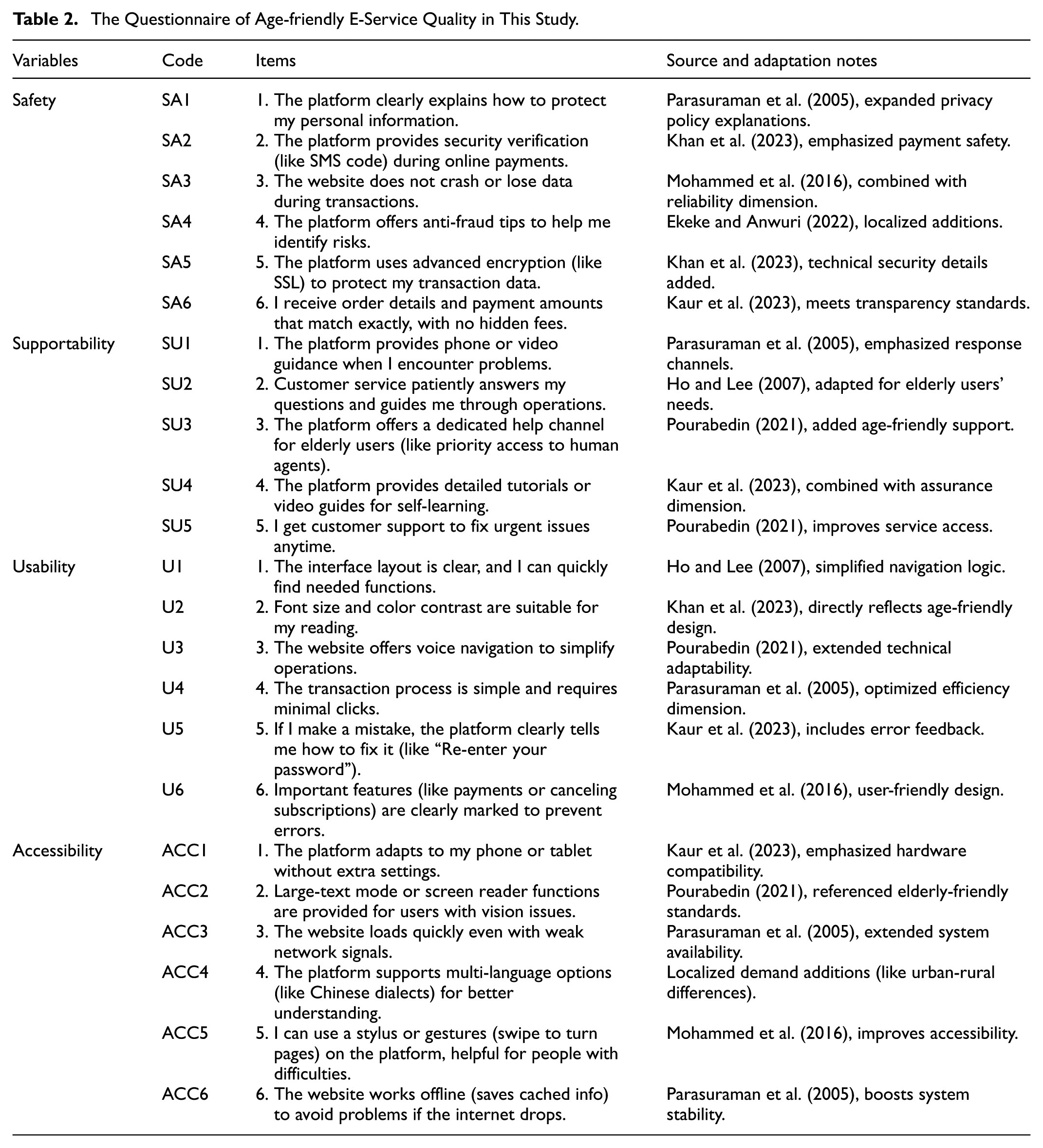
The safety dimension was constructed by integrating the privacy component from Parasuraman et al. (2005), such as protection of credit card information, and the reliability factor relating to website stability from Mohammed et al. (2016). These were further supported by Khan et al. (2023), who identified privacy protection as a primary concern for elderly users. The supportability dimension drew upon the E-S-QUAL subdimensions of responsiveness, compensation, and contact (Parasuraman et al., 2005), as well as the customer service construct proposed by Ho and Lee (2007), emphasizing prompt problem resolution and human support. The usability dimension was grounded in the information quality and usability factors outlined by Kaur et al. (2023), focusing on interface simplicity, and the website functionality construct from Ho and Lee (2007), which emphasizes intuitive navigation. The accessibility dimension combined system availability, particularly website stability, as described by Parasuraman et al. (2005), with physical accessibility design considerations such as adjustable text and visual adaptability, aligning with age-related functional needs.
A seven-point Likert scale (1 = strongly disagree, 7 = strongly agree) was employed to optimize measurement sensitivity while minimizing the cognitive burden for older respondents (Kaur et al., 2023). This approach ensured methodological robustness in capturing e-service quality perceptions and integrates age-appropriate design elements to enhance respondent accessibility.
A small-scale pilot test with 30 senior respondents (Bujang et al., 2024; Kunselman, 2024) was conducted to ensure the clarity and readability of the questionnaire items. Minor wording adjustments were made based on feedback from senior participants.
Sampling and Data Collection
This study adopted a purposive sampling strategy to ensure that the target population, senior tourists in Guilin with experience using electronic services, is appropriately represented. In the absence of a comprehensive sampling frame, purposive sampling was considered suitable for identifying respondents who meet clearly defined criteria (Ahmed, 2024). Data collection was conducted across multiple high-traffic scenic areas, including the Li River, Elephant Trunk Hill, and Longji Terraces, where trained surveyors directly approach potential participants. Individuals aged 60 or above with prior use of tourism-related e-services were invited to complete the questionnaire. While purposive sampling is more commonly associated with qualitative research, its application in quantitative studies is valid when specific eligibility conditions are required and probability-based methods are infeasible (Ahmed, 2024). To strengthen sample diversity, data were collected across different locations and time periods within the study region.
A mixed-mode data collection strategy was employed, integrating both online and offline channels to reach senior tourists with prior experience in electronic service usage. Online responses were gathered through WenJuanXing (WJX), a widely utilized Chinese survey platform that offers automated data capture, logic-based routing, and real-time synchronization to enhance accuracy and efficiency. Offline data were collected using a delivery-and-retrieval method at major tourist sites in Guilin, such as the Li River and Elephant Trunk Hill, where trained research assistants distribute printed questionnaires. To accommodate participants with visual or motor limitations, on-site support was provided through verbal explanation and assisted completion, ensuring data quality and response validity.
In addition to the core measurement items, the questionnaire included three demographic variables: age, gender, and education level. These were incorporated to describe the sample characteristics and ensure alignment with the inclusion criteria. All questions were closed-ended and designed to minimize respondent burden. As the sample was restricted to elderly tourists in Guilin who had previously used electronic services, no further screening or location-based variables were included.
The research strictly followed ethical standards to fully protect participants’ rights and well-being while ensuring scientific reliability. All participants read a consent statement before completing questionnaires. This statement clearly explained the research purpose, data usage, anonymity guarantees, and voluntary participation rules. Online participants confirmed agreement by selecting “I agree,” while offline participants signed written consent forms after verbal explanations. Those wishing to withdraw midway (due to discomfort or changed decisions) were allowed immediately exit by closing webpages or returning unfinished paper questionnaires. Anonymity and confidentiality got ensured through multiple methods. No identifiable information (names, contact details) was collected. All data used coded labels (like “ID001”). Digital data was encrypted on separate hard drives with limited researcher access. Paper questionnaires got destroyed after digital recording. During analysis, demographic data (age, gender) got presented as group statistics to prevent individual identification. No deceptive methods got used, and participants fully understood the study’s purpose and process.
Between May 1st and June 1st, 2025, a total of 830 questionnaire responses were collected, including 300 questionnaires off-line and 530 questionnaires on-line. Due to the face-to-face nature of the offline surveys, which ensured high-quality and complete responses, all 300 offline questionnaires were retained. However, 26 online questionnaires were removed because of incomplete or invalid responses, such as those with excessively short completion times or highly uniform answer patterns. Finally, 804 valid responses (300 + 504) were retained for analysis.
Data Analysis Procedure
All data analyses were performed using SPSS 26.0 for preliminary procedures and exploratory factor analysis (EFA), while AMOS 26.0 was employed for confirmatory factor analysis. Before conducting the analyses, the data underwent screening for missing values, outliers, and normality. Cases with excessive missing data or inconsistent responses were excluded from the final dataset.
To ensure methodological rigor in construct validation, the total sample of 804 respondents was randomly divided into two subsamples. The random function in SPSS 26.0 was used to split the data. Each of the 804 responses was assigned a random number and all responses were then re-arranged based on these random numbers. The first 200 responses were selected for EFA, and the remaining 604 were kept for CFA. This method ensured that the selection was completely random and unbiased.
The first subsample (n = 200) was used to conduct exploratory factor analysis (EFA) to identify the underlying factor structure of the age-friendly e-service quality construct, which meets the commonly recommended threshold for stable factor solutions when item communalities are high and factor loadings are well defined (Hair et al., 2010; Worthington & Whittaker, 2006). The rest subsample (n = 604) was used to perform confirmatory factor analysis (CFA) to validate the proposed four-factor model, which exceeds the minimum requirements for structural model validation and provides sufficient statistical power for multi-dimensional latent variable models (Hair et al., 2010; Kyriazos, 2018). This split-sample approach helps minimize the risk of common method bias and overfitting, and aligns with best practices in scale development and validation research (DeVellis & Thorpe, 2021; Hair et al., 2010).
Exploratory factor analysis (EFA) was conducted using principal axis factoring with varimax rotation to identify the underlying factor structure (Kaiser, 1958). The suitability of the data for factor analysis was assessed using the Kaiser-Meyer-Olkin (KMO) measure of sampling adequacy and Bartlett’s test of sphericity (Kaiser, 1974). Confirmatory factor analysis (CFA) was employed to evaluate the measurement model’s fit by using AMOS (Jöreskog, 1969). Model fit was assessed using multiple indices, including chi-square/df, comparative fit index (CFI), Tucker-Lewis index (TLI), and root mean square error of approximation (RMSEA; Hu & Bentler, 1999). Construct reliability and validity were evaluated through Cronbach’s alpha, composite reliability (CR), and average variance extracted (AVE; Fornell & Larcker, 1981). Discriminant validity was examined by comparing the square root of AVE with the inter-construct correlations (Fornell & Larcker, 1981).
Results
Descriptive Statistics and Demographic Profile
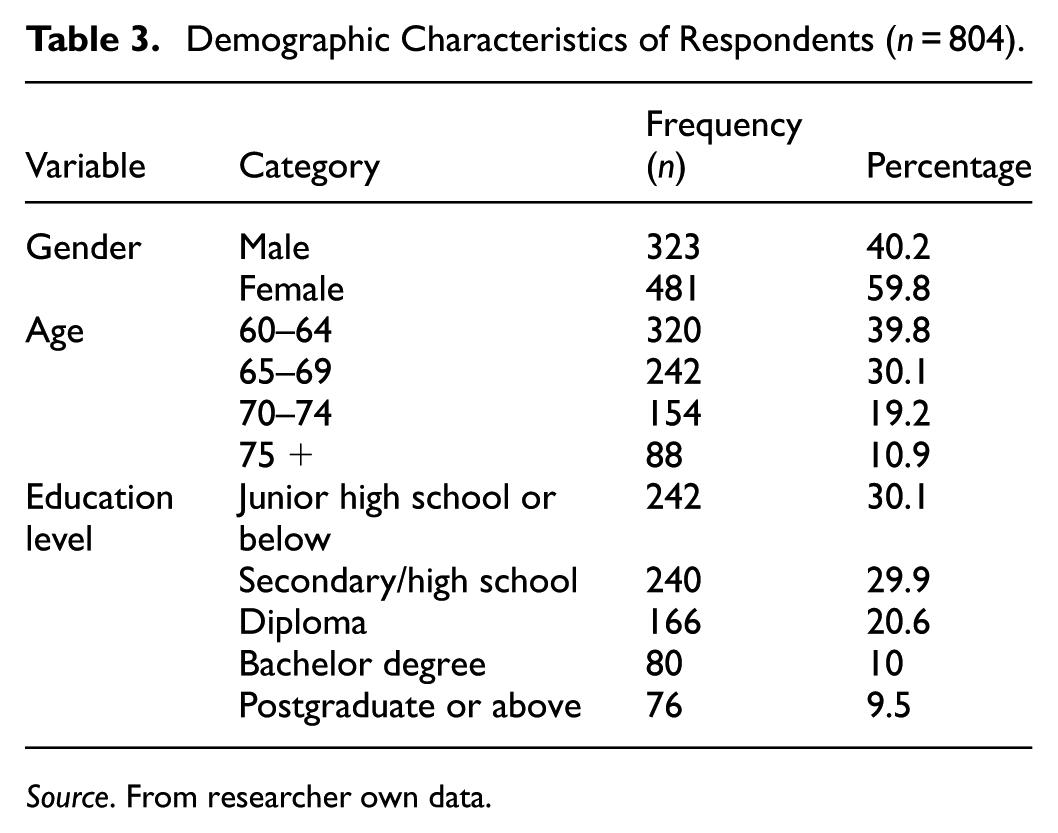
The participants within 804 valid responses, as shown in Table 3, 481 were female (59.8%) and 323 were male (40.2%). In terms of age distribution, 320 respondents (39.8%) were aged 60 to 64, 242 (30.1%) were between 65 and 69, 154 (19.2%) were aged 70 to 74, and 88 (10.9%) were 75 or older. With regard to educational attainment, 242 participants (30.1%) had completed junior high school or below, 240 (29.9%) held a high school diploma or vocational secondary school qualification, 166 (20.6%) had an associate diploma, 80 (10.0%) held a bachelor’s degree, and 76 (9.5%) had attained a postgraduate qualification or higher. This distribution reflects a demographically diverse sample of older adults, suitable for investigating perceptions of age-friendly e-service quality in the context of senior tourism.
Demographic Characteristics of Respondents (n = 804).
Source. From researcher own data.
It is important to note that the gender distribution in our final sample (40.2% male and 59.8% female) may at first seem unbalanced. However, this result is not unusual. In fact, it matches common trends in research on aging and tourism. Many studies have shown that older women are more likely to take part in leisure travel, especially in group tours within Asia. Li et al. (2024) have found that older women in China often travel actively and prefer going with companions. Huang et al. (2025) studied older people in Chinese cities and noted their strong group-oriented travel behavior, which supports the idea that older women like traveling in groups or with friends. Zhang et al. (2023), by tracking travel habits of older adults in China, also pointed out that women tend to retire earlier and join social and leisure activities more often. This helps explain why there are more active female travelers in this age group. Therefore, the gender distribution in our sample does not mean there was a selection bias. Instead, it fairly represents the actual gender makeup of the population we are studying.
Exploratory Factor Analysis (EFA)
To examine the underlying factor structure of the proposed age-friendly e-service quality construct, exploratory factor analysis (EFA) was conducted using a randomly selected subsample of 200 respondents, drawn from the full dataset of 804 valid responses. This approach is consistent with best practices in scale development, where separate datasets are used for exploratory and confirmatory analyses to avoid overfitting and ensure model generalizability (Hair et al., 2010; Worthington & Whittaker, 2006).
The analysis employed principal component analysis with varimax rotation, a commonly used orthogonal method suitable for identifying uncorrelated factors (Hair et al., 2010). The suitability of the dataset for factor analysis was confirmed by the Kaiser-Meyer-Olkin (KMO) measure of sampling adequacy (Table 4), which yielded a value of 0.838, and Bartlett’s test of sphericity, which was statistically significant (p < .001), indicating sufficient correlations among the variables.
KMO and Bartlett’s Test.

Source. From researcher own data (n = 200).
Based on the Kaiser criterion (eigenvalues > 1.0), four factors were extracted, which collectively explained 61.583% of the total variance (Table 5). All items demonstrated satisfactory loadings (≥0.5) on their respective factors, and no item was removed during the analysis. The rotated factor matrix revealed a clear and interpretable structure that aligned with the theoretical framework of age-friendly e-service quality.
Total Variance Explained.

Source. From researcher own data (n = 200).
Note. Extraction Method: Principal Component Analysis.
The rotated component matrix indicated a clear and interpretable factor structure (Table 6). Items designed to measure safety loaded strongly on the first factor, while items related to supportability, usability, and accessibility loaded on the second, third, and fourth factors, respectively. This result aligns with the theoretical expectation that age-friendly e-service quality comprises four distinct but conceptually related dimensions. The absence of significant cross-loadings and the high factor loadings further support the construct validity of the scale.
Rotated Component Matrix a .


Source. From researcher own data (n = 200).
Note. Extraction Method: Principal Component Analysis; Rotation Method: Varimax with Kaiser Normalization. The highest factor loading for each item is shaded in grey to indicate its primary component affiliation.
Rotation converged in five iterations.
Therefore, the EFA results support the proposed four-factor structure of the age-friendly e-service quality model, providing a strong empirical foundation for subsequent confirmatory factor analysis.
The Hypothesized Measurement Model
Based on the clear factor structure emerged from the EFA on the first subsample (n = 200), we developed a hypothesized four-factor measurement model for confirmatory testing. The model specifies that the 23 items load exclusively onto their respective latent constructs: Accessibility (ACC1-6), Safety (SA1-6), Supportability (SU1-5), and Usability (U1-6). It is hypothesized that these four factors are distinct but correlated dimensions of age-friendly e-service quality.
Confirmatory Factor Analysis (CFA)
To validate the four-dimensional structure of the age-friendly e-service quality construct identified in the exploratory factor analysis, confirmatory factor analysis (CFA) was conducted using the remaining subsample of 604 respondents, drawn from the original dataset of 804. This cross-validation approach follows established best practices in scale development by ensuring that the factor structure is stable across independent datasets (Hair et al., 2010; Kyriazos, 2018).
To further test the hierarchical nature of the age-friendly e-service quality construct, a second-order CFA model was estimated, in which the four first-order dimensions (Safety, Supportability, Usability, and Accessibility) were specified as indicators of a single higher-order latent construct .
The results demonstrated an excellent model fit (Figure 3). Specifically, the fit indices were as follows: χ2/df = 1.312, CFI = 0.993, TLI = 0.992, RMSEA =0.023, GFI = 0.959, and AGFI = 0.951. All values met or exceeded commonly accepted thresholds (Hu & Bentler, 1999), indicating that the proposed four-factor model of age-friendly e-service quality provides a satisfactory representation of the observed data.
As shown in Table 7 and Figure 2, the standardized factor loadings from the second-order factor to the first-order dimensions were
Standardized Regression Weights.

Source. From researcher own data (n = 604).
p < 0.001. **p < 0.01. *p < 0.05.
Reliability and Validity Assessment
The internal consistency reliability of the age-friendly e-service quality construct was evaluated using Cronbach’s alpha based on the CFA sample (n = 604). All four dimensions demonstrated excellent reliability (Table 8), with Cronbach’s alpha values of .935 for Safety, .920 for Supportability, .931 for Usability, and .930 for Accessibility, all of which are well above the recommended threshold of .70. The overall Cronbach’s alpha for the full age-friendly e-service quality scale was .885, indicating strong internal consistency across the entire instrument.
Internal Consistency Reliability of Age-Friendly E-Service Quality Dimensions.

Source. From researcher own data (n = 604).
Convergent validity was assessed by examining the standardized factor loadings, composite reliability (CR), and average variance extracted (AVE) for each construct. All standardized factor loadings exceeded the recommended threshold of 0.70, ranging from 0.811 to 0.866, indicating that each item was strongly associated with its underlying construct. In addition, all CR values were above the recommended cutoff of 0.70, with scores of 0.935 for Safety, 0.920 for Supportability, 0.931 for Usability, and 0.930 for Accessibility, suggesting excellent internal consistency. Similarly, all AVE values exceeded the minimum requirement of 0.50, ranging from 0.689 to 0.705 (Table 9), thereby demonstrating sufficient convergent validity for all four dimensions of the age-friendly e-service quality construct (Fornell & Larcker, 1981; Hair et al., 2010).
Composite Reliability and Average Variance Extracted.

Source. From researcher own data (n = 604).
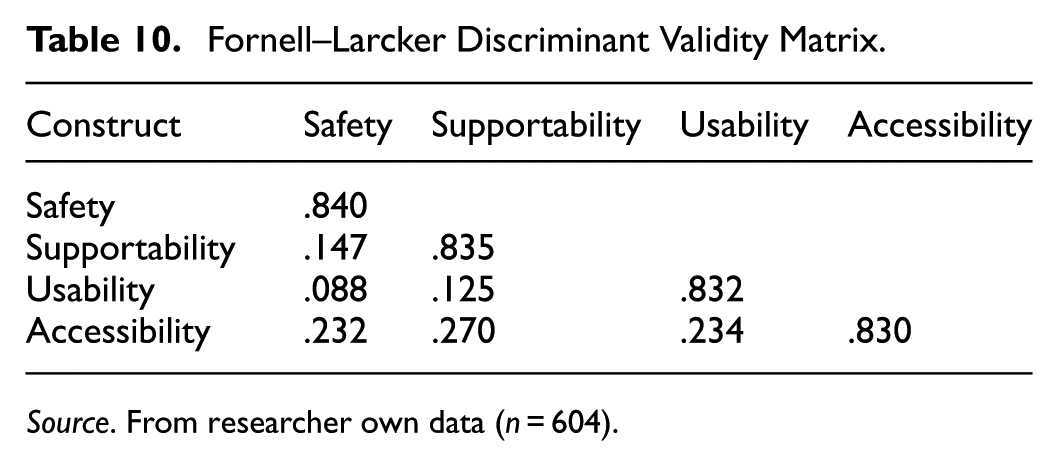
Discriminant validity was assessed using the Fornell–Larcker criterion (Table 10). The square root of the average variance extracted (AVE) for each construct was greater than its correlations with the other constructs, indicating adequate discriminant validity (Fornell & Larcker, 1981). Specifically, the √AVE values were 0.84 for Safety, 0.835 for Supportability, 0.832 for Usability, and 0.83 for Accessibility, all of which exceeded the corresponding inter-construct correlations. These results confirm that the constructs of the age-friendly e-service quality model are empirically distinct from one another.
Fornell–Larcker Discriminant Validity Matrix.
Source. From researcher own data (n = 604).

Second-order confirmatory factor analysis model of age-friendly e-service quality.

Measurement model for validity assessment.
Discussion
This study aimed to create and test a model for age-friendly e-service quality, specifically for senior tourists’ digital experiences. Building on past research about e-service quality and the needs of older people, a model with four dimensions was developed: safety, supportability, usability, and accessibility. Study used a survey of 804 senior tourists in Guilin, China, and applied both the exploratory and confirmatory factor analyses. The results showed the model worked well, with high factor loadings, good reliability, and a strong model fit. All four dimensions were statistically confirmed, proving the strength of the proposed age-friendly e-service quality structure. These findings provide solid evidence for the idea of age-friendly e-service quality and prepare for its theoretical and practical uses.
Although e-service quality has been widely studied in digital service research, little focus has been given to older adults’ specific needs in tourism area (Costa et al., 2025; Ye, 2024). Current models often ignore important features for the old people like physical ease of use, digital access, and emotional support (Tuomi et al., 2023). This study tackles this problem by presenting the idea of age-friendly e-service quality, which combines standard e-service quality principles with special considerations for the old. The development and empirical validation of a four-dimensional model advance the conceptual understanding of how digital services can be effectively tailored for senior users. These results contribute to the theoretical literature on e-service quality, age-friendly design, and senior tourism by offering a validated framework to guide future studies in age-inclusive digital service research.
A particularly noteworthy finding is that the four dimensions demonstrate strong alignment with the core principles of the newly released ISO 25556:2025 standard (ISO, 2025). Although our model was independently developed and validated, this consistency provides robust external validation for our theoretical framework. It indicates that the dimensions not only captures the key aspects of age-friendly e-service quality in tourism but also aligns with internationally recognized best practices. Therefore, our study can be regarded as providing both an empirical foundation and a specialized tool for implementing these broad international guidelines.
In practical terms, the framework provides a valuable tool for tourism service providers and policymakers aiming to enhance digital accessibility for older adults. As tourism services become increasingly digitalized, senior users often face challenges related to safety concerns, interface complexity, and insufficient support (Costa et al., 2025; Pacheco, 2024). By incorporating safety, supportability, usability, and accessibility, service providers can systematically assess and improve their digital platforms. For instance, improving usability can reduce cognitive load, while enhancing supportability ensures that seniors receive timely assistance when encountering difficulties. The age-friendly e-service quality model can also inform the design of age-inclusive smart tourism platforms and public e-services, offering practical guidance to promote digital equity among aging populations.
On the other hand, this study’s conceptualization of age-friendly e-service quality introduces four dimensions that extend beyond traditional e-service quality constructs like SERVQUAL and E-S-QUAL, which emphasize reliability and responsiveness (Parasuraman et al., 1988, 2005). According to the recent research which supports the unique challenges faced by older adults in digital environments, for example, the platform ElderWander has demonstrated the importance of improved accessibility and simplified interfaces for senior tourists (Costa et al., 2025), similarly, studies in digital payment systems show that older adults prioritize security and privacy, echoing our “safety” dimension, by preferring simpler authentication methods to reduce complexity (Das, 2024; Sheil et al., 2025), the findings align with recent social-cognitive research on older adults’ digital competencies. Research on online health information seeking indicates that older users’ self-efficacy and cognitive load heavily influence usability perceptions, mirroring our “supportability” and “usability” dimensions (X. Wang et al., 2024). Additionally, studies in digital cultural tourism reveal that older tourists require simplified, humanized platforms that reduce cognitive effort (Tuomi et al., 2023), a pattern also seen in our validated model. While frameworks for age-friendly systems exist in healthcare and urban environments (World Health Organization, 2023), age-friendly e-service quality uniquely addresses digital service quality in tourism contexts. Consequently, our study bridges a critical gap in the literature, by offering a rigorous, measurement-based foundation for assessing digital service inclusivity in aging populations.
Conclusion
This study was motivated by the aging and growing need to address the digital service experiences of older adults in an increasingly digitalized tourism environment. While existing e-service quality frameworks have provided valuable insights into general consumer perceptions, they have largely overlooked the unique expectations and challenges faced by aging users. To solve this problem, we suggested and tested the idea of age-friendly e-service quality, made for senior tourists’ needs. Analyses helped understand the structure and prove the statistical strength of age-friendly e-service quality. The results supported a four-dimensional structure including safety, supportability, usability, accessibility, and demonstrating strong construct validity and reliability.
Finally, based on the validated four-dimensional structure, ranked by their relative empirical importance,
Implications
Theoretically, this research introduces age-friendly e-service quality as a new construct that integrates traditional e-service quality models with age-friendly design principles, thereby bridging a critical gap in the literature on digital services for older adults. While the ISO 25556:2025 provide an important high-level framework and principles, their implementation requires specific, proven, and measurable tools. This research addresses the gap by developing the ASSU model, which turns the broad goals of ISO into concrete and measurable dimensions that can be directly applied and evaluated.
Practically, the validated four-dimensional model offers a reliable tool for tourism service providers, system designers, and policymakers to assess and improve the age-friendliness of their digital platforms. As the aging population continues to grow, age-friendly e-service quality can serve as a foundation for developing more inclusive and supportive digital environments in the tourism industry and beyond.
Limitations
While this study has been conducted with theoretical and empirical rigor, several limitations should be acknowledged when interpreting the findings and considering future research directions. First, the data were collected exclusively from Guilin, a distinctive tourist destination, where the technological adaptability and cultural background of senior tourists may differ from those in other regions. As an early adopter of digital tourism, Guilin may not represent broader socioeconomic contexts, limiting the generalizability of the results across China.
Second, the use of cross-sectional data restricts understanding of the temporal dynamics of seniors’ adaptation to e-services. Changes in technological proficiency influenced by ongoing exposure, personal learning, or social support are not captured in this single-time survey. Future research may benefit from longitudinal approaches to explore these evolving patterns.
Third, the model does not include other influencing factors, such as education level or family support, which may affect both adaptability and satisfaction. Leaving these out means future studies should consider more controlled designs or group comparisons.
Lastly, the framework’s usefulness may reduce over time due to fast technology changes. As new tools like artificial intelligence and virtual reality join digital tourism, older adults’ expectations and behaviors will change. This will require regular updates to the model.
Despite these limitations, this study provides a foundational step toward conceptualizing age-friendly e-service quality. Future work should broaden regional diversity, incorporate time-sensitive research designs, and apply multi-source data strategies to further examine how older adults engage with evolving digital service environments in tourism.
Footnotes
Acknowledgements
The authors would like to thank all senior tourists who participated in the survey in Guilin, China. We would also like to thank the faculty members at Asia Pacific University of Technology & Innovation (APU), Malaysia, for their support of this research. The constructive feedback from anonymous reviewers and editorial staff is highly appreciated.

Ethical Considerations
Ethical approval was obtained from the academic research committee of Asia Pacific University of Technology & Innovation, Malaysia. This study was conducted as part of the first author’s doctoral research at Asia Pacific University of Technology & Innovation (APU), Malaysia. Ethical approval was granted by the university’s research ethics committee prior to data collection.
Consent to Participate
Informed consent was obtained from all participants before they took part in the survey. Participation was voluntary, and respondents were assured of the confidentiality and anonymity of their responses.
Consent for Publication
Not applicable. This study does not contain any individual person’s identifiable information in any form (images, voice recordings, personal identifiers, etc.).
Author Contributions
Fan Yang led the survey, data collection, and data analysis, and was responsible for drafting the manuscript. Ahmad Albattat contributed to the data analysis and writing of the manuscript. Both authors jointly contributed to the conceptualization and design of the study, reviewed and revised the manuscript critically for important intellectual content, and approved the final version for submission.
Funding
The authors received no financial support for the research, authorship, and/or publication of this article.
Declaration of Conflicting Interests
The authors declared no potential conflicts of interest with respect to the research, authorship, and/or publication of this article.
Data Availability Statement
The data that support the findings of this study are not publicly available because this research forms part of the first author’s ongoing doctoral work. To preserve the integrity of the broader dissertation project and associated future publications, the dataset will remain confidential at this stage. However, the data may be made available by the corresponding author upon reasonable request and subject to institutional approval.