




Abstract
This study aims to identify the tourists’ expectation and satisfaction of destination attributes from the perspective of senior tourists in Malaysia. Two groups of tourists were chosen as the study sample, that is, future seniors (40–54 years old) and seniors (55 years old and above). It is hoped that, through recognizing and raising awareness on the need for equal traveling opportunities, senior tourists and future senior tourists will be encouraged to undertake more tourism activities. An importance-performance analysis (IPA) and paired sample t tests were employed to investigate senior tourists’ perceptions of senior-friendly destination attributes. Measures of destination attributes included the “4As” (i.e., attractions, accessibility, amenities, and ancillary services). The findings from a survey of 227 respondents revealed that the most important attributes for a senior-friendly destination are safety and cleanliness. Other attributes deemed important by senior tourists include the availability of leisure facilities and barrier-free public transportation. The findings also highlight attributes that tourism industry practitioners may use to improve tourists’ satisfaction and develop into competitive advantages against other tourist destinations. Both theoretical and practical implications of these important findings are discussed.
Keywords
Introduction
The global demographic is experiencing a significant transition toward an aging population. This transition creates various opportunities to provide senior-friendly products and services, including tourism products and services (Lee & King, 2016). However, as things stand, the tourism sector still lacks senior-friendly products and services, and so needs to focus on providing equal rights for senior people through products with universal designs (Alén et al., 2012; Wan, 2015). With the emerging senior market predicted to comprise nearly a quarter or more of the population by 2050 (World Population Prospects, 2017), there is a growing body of evidence indicating that seniors are the most important and steadily growing tourist group (Wang et al., 2013)—they are now more critical than ever to the industry.
Although the idea of successful aging has been embraced in many developed countries (Alén et al., 2017; Lee & King, 2016), it has only begun to gain attention in emerging countries (Hsu et al., 2007). In 2017, the senior Asian population was 549.2 million and has been projected to grow to 1,273.2 million by 2050 (Department of Economic and Social Affairs of the United Nations, 2017). This rapid growth in the Asian senior population forecasts a fast-growing demographic. Studies conducted in Asian countries have shown that Asian seniors are increasingly educated and independent, and have more time and discretionary income for travel (Huang & Tsai, 2003). For example, Asian countries such as China, Korea, Taiwan, and Japan have reached remarkable economic positions that contribute to the senior travel market globally (Patuelli & Nijkamp, 2016).
In the empirical literature, numerous scholars (Abooali et al., 2015; Esichaikul, 2012; Johann & Padma, 2016; Lee, 2016) have recently examined seniors’ perceptions of destination attributes. Most of these studies have treated the senior travel market as a homogeneous group across generations (Lehto et al., 2008). However, studies have concluded that senior tourists from distinct generational cohorts differ along many dimensions, including their travel preferences, travel behaviors, and destination choices (Reece, 2004; You et al., 2000). This is further supported by another study that found that tourists’ demands and travel behaviors are not necessarily determined by age, but by generation (Lohmann & Danielsson, 2001).
Future seniors are individuals who are about to enter the senior age phase in a few years (Mohamed et al., 2016). Research has revealed that future senior generations will behave more like the current population of the same age and show no decline in travel propensity as they move from their late middle to early senior years (You et al., 2000). This highlights the need for a comparative analysis of the future senior group to understand their travel perceptions better and thereby guide effective policy formation (Mohd et al., 2019). Moreover, linking the continuity theory of aging to seniors’ behavior, seniors aim to maintain consistency in roles and behaviors along their life course to reflect an image of their past (Atchley, 1989). Therefore, the homogeneous and unchanging patterns of humans in later life imply that the current behaviors of future seniors act as indicators of their future lifestyles (Lohmann & Danielsson, 2001). This study thus focuses on future seniors along with seniors, to have a better understanding of the heterogeneity that exists between these two groups.
One way tourism destinations can ensure success in the booming tourism industry is to develop a positive image through activities catered to the aging population. Given the importance of the experiential components of a destination’s attributes, tourism destination marketers are highly sensitive to the image perceived by potential or actual tourists because the perceived image is known to determine tourism demand (Pike et al., 2018). This provides an opportunity for tourism marketers to act strategically as “future creators” rather than “future takers.” Instead of asking “what will the future be?,” future creators ask, “what should the future be?” and “how will we meet that future?”
In an attempt to attract more tourists, tourism destinations such as Malaysia regularly compete with each other to provide tourists with the experiences and products they desire (Pezeshki et al., 2019). Malaysia stands above its competitors due to its ideal location at the crossroads of Asia, as depicted by its renowned slogan, “Malaysia, Truly Asia” (Tourism Malaysia, 2018). Like many other countries (e.g., Japan and Italy), Malaysia is now facing an aging population due to fertility rates declining faster than mortality rates (Hamid et al., 2012). By 2030, Malaysia will be categorized as an aging nation, where senior people aged 60 years and above will constitute more than 14% of the population (Department of Statistics Malaysia, 2017). In 2019, Tun Dr. Mahathir, the former Prime Minister of Malaysia, stated that “if seniors do not stay active, they will become weak” (New Straits Times, 2019). In this context, traveling is a crucial achievement of senior people’s aspirations and enjoyment, which ensures the quality of life in the later stages of life (Graham et al., 2018). Research has proved that a relaxing holiday enhances mental and physical well-being through a reduced level of activity and an increased level of calmness (Anantamongkolkul et al., 2017). Therefore, to ensure senior tourists remain active and productive, greater emphasis should be directed toward senior mobility, community support, and environmental and social support in tourist destinations, such as through reliable public transport and senior-friendly outdoor spaces and buildings (Mohd et al., 2019).
However, despite Malaysians’ longer life spans due to advanced medical treatment and improvements in hygiene and food supply (Thomas et al., 2011), the quality of public infrastructure and services in the country has not kept up with the needs of seniors (The Star, 2019). This is a growing issue in emerging countries such as Malaysia that lack time to adjust and establish the infrastructure and policies necessary to meet the needs of their rapidly shifting demographics (Chand & Tung, 2014). With the steady increase of seniors moving into retirement both in Malaysia and around the world, leisure travel engenders continuous growth of the senior travel market (Mohd et al., 2019). Hence, there is a need for more studies on Asian senior tourism in terms of how to cater to their needs and wants.
Therefore, this study has two main objectives. First, we aim to utilize a modified nine-quadrant importance-performance matrix (Dwyer et al., 2016; Wu & Shieh, 2009) based on 21 items of senior-friendly destination attractiveness related to the 4As—attractions, accessibility, amenities, and ancillary services—that are considered to promote long-term destination competitiveness. Second, we aim to determine the similarities and differences between senior tourists and future senior tourists in terms of their preferred attributes of successful tourism destinations. As such, this study offers valuable insight into this debate by asking these research questions:
The contributions of this research are twofold. First, the importance-performance analysis (IPA) technique used to study the performance of senior-friendly tourism destinations in Malaysia allows the identification and rectification of areas that are currently lacking in senior support (New Straits Times, 2019). Second, considering the dearth of comparative studies on generational cohorts in tourism studies, contrasting seniors’ and future seniors’ perceptions of tourism destinations adds significant value to tourism research.
The remainder of this article is structured as follows. First, a review of the literature discusses extant knowledge on the senior travel market and senior-friendly tourism destination features. Second, the process of data collection and sampling techniques are discussed. This article then presents and infers the analysis results on senior and future senior tourists’ perceptions of senior-friendly tourism destination attractiveness in Malaysia. Finally, the article concludes with its implications and closing remarks.
Literature Review
Defining Future and Senior Tourists
The definition of the term “senior” is a notable issue in the literature. Although their calendar age usually identifies seniors, there appears to be no consensus on the minimum age of a senior (Patuelli & Nijkamp, 2016). A United Nations’ (2013) report provided the following classification: children and adolescents are those below the age of 20 years; young adults are those between the ages of 20 and 39 years; middle-aged adults are those between the ages of 40 and 59 years; and older persons are those more than the age of 60 years. Researchers find that various cutoff ages, ranging from 50 to 65 years, have been used to define seniors, whereby increasingly younger age groups are being considered seniors (Patterson, 2006). Alternatively, the generation literature refers to seniors as “baby-boomers” (born between 1946 and 1966) and “generation X” (born between 1967 and 1982), whereas studies on senior gay men have cutoff ages ranging from 35 to 65 years (Hughes & Deutsch, 2010). In short, there are multiple viewpoints on the age range that defines seniors (C. F. Chen & Wu, 2009).
In the tourism context, the term “senior tourist” has been used broadly in previous studies, with seniors being considered to be those more than 35 years old (Hughes & Deutsch, 2010), 50 years old (C. F. Chen & Wu, 2009; Pezeshki et al., 2019), 55 years old (Losada et al., 2019; Patterson, 2006), and 60 years old (Esiyok et al., 2018; Jang et al., 2009; Johann & Padma, 2016). Some distinguish between “younger seniors,” that is, those from 65 to 79 years old, and “seniors,” that is, those above 80 years old (Möller et al., 2007). Others have suggested that the average age of senior tourists is expected to rise. Thus, the traditionally defined “young senior” age range of 55 to 60 years should no longer be considered a senior (S. C. Chen & Shoemaker, 2014). In light of this, one study clustered age into two groups made up of “middle-age tourists” aged between 40 and 65 years, and “senior tourists” aged above 66 years (Esiyok et al., 2018). In fact, according to experts, around the age of 40 years, the level of anabolic hormones and neuromuscular alterations decrease along with muscle protein turnover, thus beginning the ageing process (Speakman & Westerterp, 2010). Towards this end, the key market segments targeted by this study are Malaysian future seniors and seniors, that is, aged above 40 years, who have experienced travelling in Malaysia.
Senior Travel Market
The senior travel market has become an attractive global phenomenon (Patterson & Balderas, 2018; Jang & Wu, 2006; Sellick, 2004). In 1999, approximately 593 million international tourists were more than 60 years old; by 2050, this number is projected to exceed 2 billion (World Tourism Organization, 2001). This growing propensity for seniors to travel will continue to rise due to an active generation of seniors that benefit from higher disposable incomes, more advanced medical treatment, greater familiarity with traveling, and changing attitudes toward the use of lifetime savings and disposable time (Möller et al., 2007). However, despite the growth of the aging population, the senior travel market has generally been neglected by the tourism industry (Alén et al., 2012).
Taking the life cycle theory into account, the needs and preferences of individuals change significantly as they grow older (Horna, 1994). However, there is a dearth of information on the behavior of senior tourists by generation, leading tourism marketers to make a costly marketing mistake by treating senior consumers as a homogeneous market (Esiyok et al., 2018; Le Serre & Chevalier, 2012; Moschis et al., 1997). Demographic studies in the area of travel and tourism indicate differences between senior, future senior, pre-senior, and non-senior tourists (Javalgi et al., 1992; Mary et al., 2019; Reece, 2004; Shoemaker, 2000; Sund & Boksberger, 2007). Specifically, seniors need special care and more accessible facilities (Lee & King, 2016; Mary et al., 2019). Researchers have revealed that seniors prefer traveling with their spouses to destinations with quality service, ideal weather, various events or attractions, and the opportunity to meet new friends (Kuo et al., 2019).
Seniors and future seniors also tend to be less willing to spend money on their holidays (Sund & Boksberger, 2007), despite even low-income seniors having a higher spending power than non-seniors (Shoemaker, 2000). Seniors were found to have less financial constraints than younger groups due to fewer demands on their financial resources (Nielsen, 2014). In particular, as older people age (75 years and above), they have faced health issues whereas younger age groups (59 years and younger) are more likely to be constrained by time and money (Nyaupane et al., 2008). Further proving that seniors are not a homogeneous group, scholars have discovered that senior tourists, on average, travel greater distances than non-senior tourists (Reece, 2004) and differ in their reasons for traveling and their lengths of stay (Esiyok et al., 2018). Meanwhile, younger seniors have been indicated to give more importance to the climate, events, and attractions in a destination than older seniors (Norman et al., 2001). Overall, the empirical evidence on senior travel behavior establishes that the senior population’s travel perceptions are distinct from other age groups.
As mentioned earlier, future senior tourists will differ from today’s traveling seniors in their travel behavior and preferences (S. C. Chen & Shoemaker, 2014; Sellick, 2004). The travel behavior of a particular generation is relatively rigid and does not change significantly because of factors such as retirement (Lohmann & Danielsson, 2001). To date, tourism markets and tourism product developers have tended to treat the senior market as one homogeneous segment of the travel market population. Hence, the tourism industry needs to be prepared to meet the associated challenges (Lee & King, 2016), and there is the need to consider Malaysia’s distinctive attributes and verify them using the most current samples of senior Malaysian tourists.
Senior-Friendly Destination Attractiveness
There is no universally accepted set of attributes of a destination (Beerli & Martı́n, 2004). As defined by Buhalis (2000), destination as “amalgams of tourism products, offering an integrated experience to consumers” (p. 97), which can be subjectively perceived by tourists. A destination also comprised several multidimensional attributes of its unique sources that tourists may choose to visit and experience (Hu & Ritchie, 1993). Earlier, Lew (1987) described attributes as a combination of a variety of components of a destination, including not only physical environments but also services and amenities which satisfy tourists’ needs. Furthermore, Cooper et al. (1993) grouped attributes as four main categories as attractions, access, amenities, and ancillary services. Later, Buhalis (2000) proposed the 6As frameworks: attractions, accessibility, amenities, available packages, activities, and ancillary service. The latter study was based on the conceptual model of destination competitiveness developed by Crouch and Ritchie (1999). Crouch’s studies (2011) offered more segmented 36 elements for a destination. For example, the 36 elements are clustered into five major groups: supporting factors and resources, core resources and attractors, destination management, destination policy, and qualifying and amplifying determinates.
In senior tourism context, multiple studies have been conducted on destination attractiveness for seniors summarized in Table 1. However, their findings are limited by the use of general destination attributes and the exclusion of factors that seniors, in particular, perceive as important when traveling, such as barrier-free public transport, accommodation, tourism sites and services, and tour programs (Batra, 2009; W. Y. Chen et al., 2014; Wretstrand et al., 2009). More recently, Lee and King (2016) explored the factors that determine the attractiveness of a senior-friendly destination by drawing upon an expert panel in Taiwan. The analytic hierarchy process (AHP) results revealed that accessibility is the major contributor to the tourism attractiveness of a senior-friendly destination, followed by amenities and complementary services, whereas tourism resource is the least important factor. They concluded that the most significant factors are those associated with the availability and variety of accommodations, transport, barrier-free facilities, and services. Indeed, research has demonstrated that public transportation is fundamental in promoting and protecting seniors’ quality of life in the future. Based on prior studies (Lee, 2016; Lee & King, 2016), this study also adopts multiple attributes based on Cooper et al.’s (1993) 4As frameworks to access the Malaysian senior tourists’ expectation and satisfaction of senior-friendly destination attributes.
Literature on Destination Attractiveness for Senior-Friendly Tourism.

Nevertheless, concerning senior travel studies in Asia, scholars believe that much remains to be done on seniors’ concerns and special care (Mary et al., 2019). Thus, there is an urgent need to analyze senior tourists’ preferred attributes of tourism destinations, notably in the case of Malaysia which is soon approaching a third aged population (Sanmargaraja & Ta Wee, 2015). To the best of our knowledge, limited studies have examined senior-friendly destination attributes across two generations, that is, future seniors and seniors, especially in the context of seniors’ tourism needs and preferences in Malaysia. Although studies exist on tourism destination attractiveness and the travel behavior of seniors, these are plagued with disagreements on the definitions of terms such as “expectation.” For this reason, based on previous theoretical foundations, this study evaluates the performance and importance scores of tourism destinations in Malaysia.
Method
Data Collection and Sampling
To gather data, a quantitative approach was chosen. Data collection was conducted through a self-administered questionnaire over 2 months, from September 1, 2019, to October 30, 2019, in Malaysia’s central region, namely in Selangor and Kuala Lumpur. These two sites were selected because they attract the most domestic tourists in the country. For instance, Selangor received 25.5 million domestic tourists (first place), and Kuala Lumpur received 19.0 million domestic tourists (third place) out of 205.4 million domestic tourists in 2017 (Department of Statistics Malaysia, 2018). Report by the Department of Statistics Malaysia stated that a majority of domestic tourists in 2017 were between 25 and 39 years old (39.1%). This was followed by domestic tourists aged 40 to 54 years old (26.3%), 15 to 24 years old (19.6%), and above 55 years old (15.0%) (Department of Statistics Malaysia, 2018). Meanwhile, the number of domestic tourists recorded with 239.1 million with a growth of 8.1% in 2019 compared with 2018 (221.3 million with a growth of 7.7% compared with 2017; Department of Statistics Malaysia, 2019, 2020). Respondents were selected randomly at different tourism attractions recommended by Trip Advisor Malaysia. The data collection locations in Kuala Lumpur were the Petronas twin towers, the National Museum, and Batu Caves, whereas data were collected in Selangor in Bukit Melawati, Kuala Selangor, and i-City Shah Alam.
Questionnaires were distributed to the domestic tourists and collected immediately after completion. Each questionnaire was administered in person so that respondents were able to ask the researcher if they encountered any difficulty in answering the questions. The survey was conducted on subjects who could spare 15 to 20 min to fill in the questionnaire in their preferred language (Malay, English, or Mandarin). If a chosen respondent was unwilling to participate in the survey, the next available individual was approached. All respondents were told that their responses would be kept anonymous and confidential.
Several screening questions were first asked to identify suitable respondents. For this study, the selection of target respondents was based on three inclusion criteria: (a) must have travel experience to any tourism destination in Malaysia, (b) must be aged between 40 and 54 years old (future seniors), or aged 55 years old and above (seniors), and (c) must be in good health. In regard to the age of the respondents, there is no agreed age definition for seniors; however, several studies have defined people more than 55 years old as senior (Alén et al., 2014; Losada et al., 2019; Patterson, 2006), while others have used a lower limit of 40 years old to define future seniors as those aged 40 to 49 years old (Esiyok et al., 2018; Mohd et al., 2019). The health status of tourists was measured by the number of prescribed drugs taken and the existence of chronic illnesses. Fewer prescribed drugs taken and the absence of chronic illnesses indicate better health (Moschis et al., 2003).
Ultimately, a total of 227 usable responses were received. Although bigger sample sizes lead to more reliable results, the sample size of a study must be determined based on the population size and the complexity of factors in the proposed research framework (Hair et al., 2014). As statistics on the total population of senior tourists in Malaysia were unavailable, a sample size higher than 200 was deemed large enough to produce accurate results when estimating unknown parameters (Hair et al., 2006).
Measurement Instruments
A structured questionnaire was developed to identify the underlying importance and performance of senior-friendly attributes among Malaysian senior and future senior tourists. The survey questionnaire consisted of four main sections that examined 21 items specific to senior-friendly tourism attributes based on previous studies (i.e., Lee, 2016; Lee & King, 2016). Figure 1 shows the list of 21 senior-friendly attributes that were considered favorable for the development of senior-friendly tourism destinations in Malaysia. These items were subsequently grouped into the 4A dimensions, that is, attractions (or tourism resources), access, amenities, and ancillary services (Cooper et al., 1993). Attractions measured seven items, accessibility measured four items, amenities measured four items, and complementary service measured six items. The questionnaire also solicited demographic information from the respondents through 15 questions.
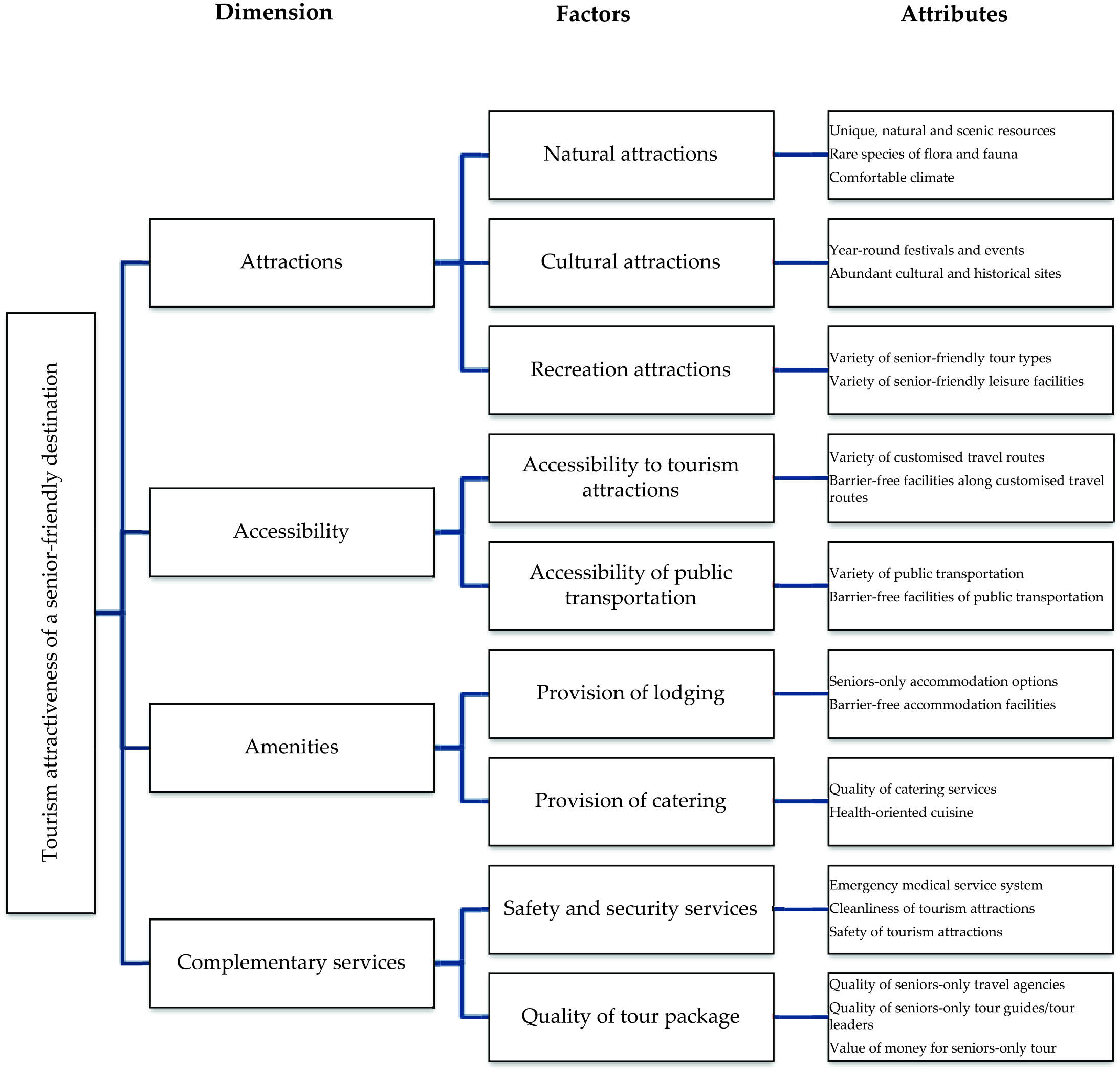
Destination attractiveness of senior-friendly destinations (Lee, 2016; Lee & King, 2016).
In line with previous research on the importance of destination attributes (Esichaikul, 2012), respondents were asked to rate the importance and performance of each attribute on a 5-point Likert-type scale ranging from 1 (completely unimportant) to 5 (completely important) for importance and 1 (strongly disagree) to 5 (strongly agree) for performance. The questionnaire was initially prepared in English and was pretested on 10 postgraduate students aged 40 years and above as well as three subject experts from the fields of management, linguistics, and human ecology in Universiti Putra Malaysia (UPM). Minor changes were made before the questionnaire was translated into Chinese and Malay using the back-translation method (Mcgorry, 2000). Prior to formal survey administration, a pilot test was conducted on a convenience sample of 30 tourists (18 future senior tourists and 12 senior tourists) in Kuala Lumpur. No particular critical issues emerged from the pilot test, and the questionnaire was ascertained to be fit for use.
Data Analysis
The collected data were coded and analyzed using the Statistical Package for the Social Sciences (SPSS) 25.0 software program. First, to define the demographic profile of the respondents, descriptive statistics including frequencies and distributions were established. Second, pairwise t tests were conducted for a statistical comparison of the attributes’ importance and performance between senior tourists and future senior tourists. Then, an Important Performance Anlaysis (IPA) was performed, with attributes being graphically displayed on a modified nine-quadrant importance-performance matrix.
IPA was first created by Martilla and James (1977) as a framework to analyze the critical performance attributes of products and services in the marketing literature. The interpretation of IPA findings suggests specific strategies based on the scores of importance and performance of the selected attributes. Generally, IPA displays results in four quadrants by combining the mean scores of importance and performance into a two-dimensional grid to form the overall mean scores of a product’s or service’s attributes (Dwyer et al., 2016). Each of these four quadrants represents specific meanings. Attributes in Quadrant I, evaluated high in performance and importance, represent opportunities for gaining or maintaining competitive advantage. In this area, the strategy is to keep up the good work. Attributes in Quadrant II are rated high in performance but low in importance, implying that resources committed to these attributes would better be employed elsewhere (i.e., possible overkill). Quadrant III contains attributes low in both performance and importance. Typically, it is not necessary to focus additional effort here, as it is considered of low priority. Finally, attributes in Quadrant IV are low in performance but are highly important, and thus demand immediate attention (Sever, 2015).
For the purpose of this study, a confidence interval-based IPA was employed to improve the accuracy and efficiency of IPA and to reduce variability (Wu & Shieh, 2009). This enabled easier identification of strategic options based on the sample size used. At the same time, this study considered an unequal variance population in the IPA analysis, so that items located in different quadrants could be detected when a different sample size was used. On the new grid, only points that fall in Areas 6, 7, 8, and 9 are to be considered by managers for developing appropriate strategies. On the other hand, the points plotted in Areas 1, 2, 3, 4, and 5 are not viable to be considered for the development of future management agenda. This is based on the Paired Sample t test results. Figure 2 shows the findings of the modified IPA with nine areas.

Importance performance analysis (IPA) based on confidence intervals (Wu & Shieh, 2009).
Results and Discussion
Respondents’ Profile
In total, 400 respondents were approached, of which 271 agreed to participate in the study, yielding a response rate of 67.75%. For analysis purpose, 227 usable questionnaire was used. The profile of respondents is as shown in Table 2.
Respondents’ Profile.

Descriptive Statistics and Paired Sample t Test Results
Cronbach’s alpha was calculated to test the internal consistency of the 21 items measured in the study. For future senior tourists, the Cronbach’s alpha for the importance scale of senior-friendly attributes was .896 whereas it was .922 for the performance scale. High internal consistency and validity of the instrument were shown in the case of senior tourists as well. The Cronbach’s alpha for the senior-friendly attributes’ importance scale and performance scale were .858 and .918 respectively, for senior tourists. To construct confidence intervals, the calculations for future senior tourists and senior tourists were computed separately based on the results shown in Table 3. A paired sample t test was then employed for each performance and importance item to compare senior-friendly attributes from the perspectives of future senior tourists and senior tourists.
Descriptive Statistics and Paired Sample t Test Results.

Significant at the .05 level.
The results reveal that the mean values for importance and performance were 4.10 and 3.57, respectively, for future seniors, whereas the means for importance and performance for seniors were 4.17 and 3.37, respectively. “Safety of tourism attractions” had the highest rating on the importance score for both groups, followed by “cleanliness of tourism attractions.” Considering the importance of senior-friendly attributes for senior tourists, it can be concluded that “safety of tourism attractions” (4.81), “cleanliness of tourism attractions” (4.76), and “emergency medical service system” (4.45) were perceived as the most important senior-friendly attributes for senior tourists in Malaysia. Meanwhile, for future seniors, the findings show that “safety of tourism attractions”(4.63), “cleanliness of tourism attractions” (4.56), “quality of catering services” (4.34), “comfortable climate” (4.31), and “emergency medical service system” (4.3) were perceived as the most important attributes. It is not surprising that a majority of tourists, especially seniors, are concerned about the safety and cleanliness of tourism attractions as these are basic factors for traveling (Abooali et al., 2015; Esichaikul, 2012; Jang & Wu, 2006). Moreover, seniors are more concerned about medical and health treatment, which is consistent with the inevitable decline of health and the physical barriers that are universal consequences of aging (Mohamed et al., 2016). Notably, both senior and future senior tourists valued “seniors-only accommodation options” as the least important attribute (seniors = 3.68, future seniors = 3.58). Indeed, studies have shown that seniors hold high expectations of lodging service quality, which involves staff behavior and attitude rather than seniors-only options (Callan & Bowman, 2000). Therefore, seniors and future seniors may be more concerned about the service quality of accommodations.
As presented in Table 3, in terms of performance, “comfortable climate” (4.04) had the highest rating from future senior tourists, followed by “abundant cultural and historical sites” (4.03). The attribute “variety of senior-friendly tour types” (2.99) had the lowest performance score for future seniors. From the perspective of seniors, “abundant cultural and historical sites” (3.78) had the highest mean rating on performance, followed by “emergency medical service system” (3.63), “comfortable climate” (3.61), “safety of tourism attractions” (3.6), and “quality of catering services” (3.6). The weakest performance scores were given to the attributes of “seniors-only accommodation options” (2.84) and “variety of senior-friendly tour types” (2.92).
The results of the paired sample t tests for mean differences between senior tourists’ and future senior tourists’ ratings of performance and importance attributes are presented in Table 3. When the significance level is less than .05, we can conclude that there is statistical significance among the mean values (Pallant, 2007). For future senior tourists, t tests showed that 20 out of 21 pairs were significantly different (p < .05), with 20 items measuring senior-friendly attributes being significantly lower in performance than in importance. Similarly, t tests for senior tourists indicated that 20 out of 21 pairs were significantly lower in performance than in importance, whereby senior tourists considered the attributes to be performing at a level below their assigned importance. In both cases, the attributes’ performance did not meet tourists’ expectations, and thus must be improved.
IPA Results
IPA was conducted to measure Malaysia’s performance as a senior-friendly tourism destination for future senior and senior tourists. Based on the mean values of senior-friendly attributes’ importance and performance evaluations and the results of the paired t tests, Figures 3 to 5 show the relationships among the 21 items with the assumption of unequal population variances at a 95% confidence level.
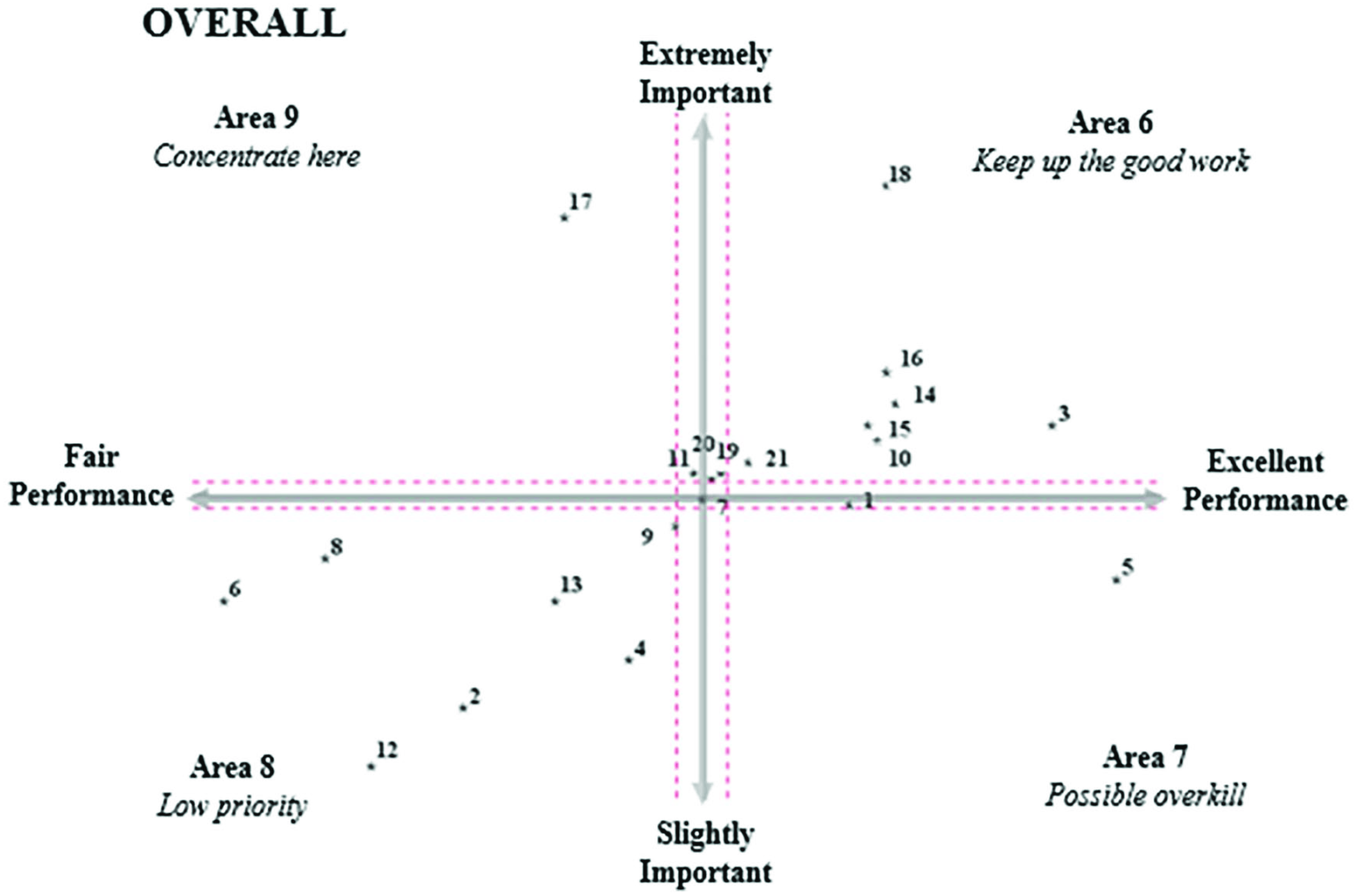
Importance-performance analysis plot for all respondents (N = 227).
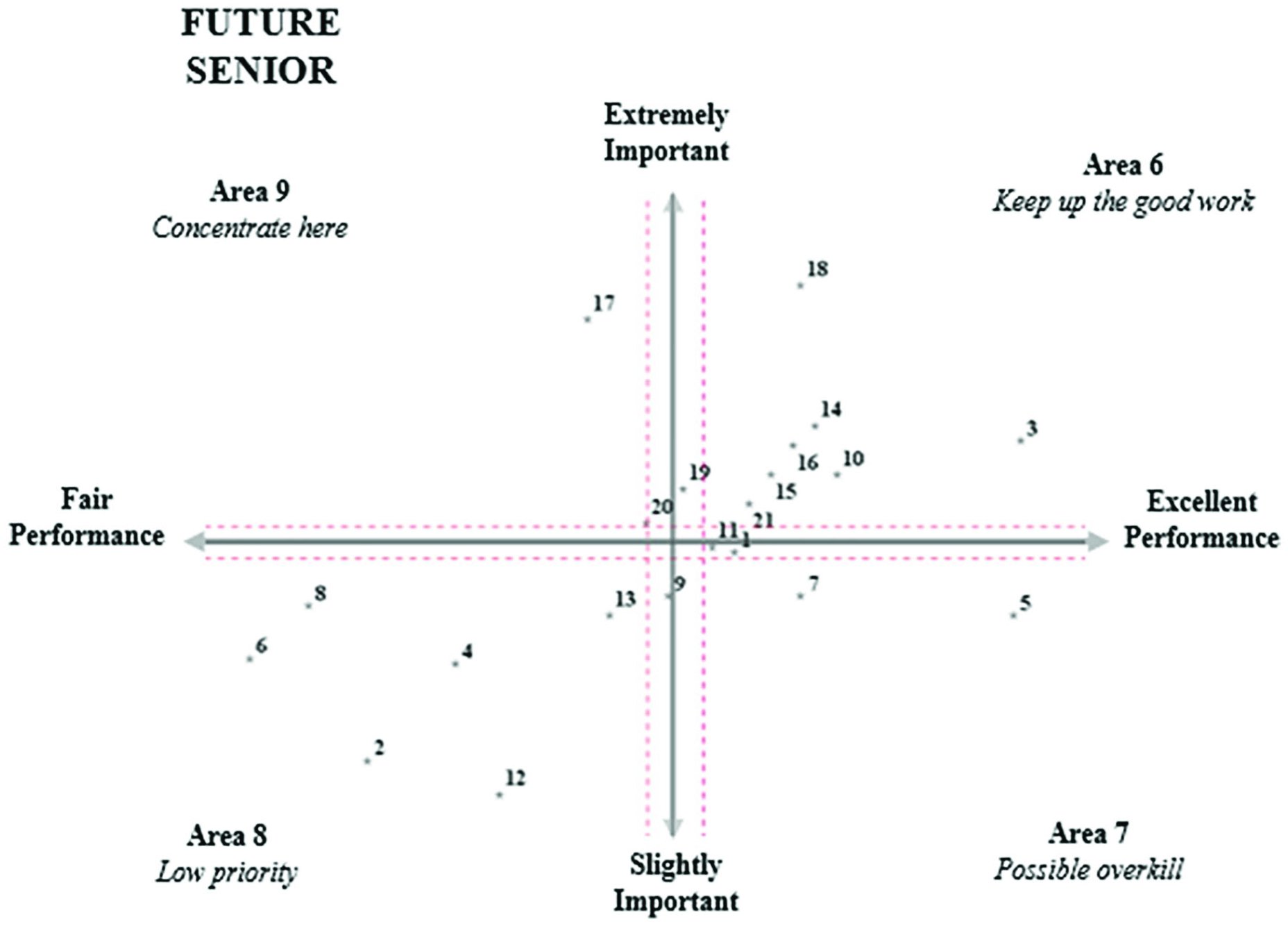
Importance-performance analysis plot for future senior tourists (N = 131).

Importance-performance analysis plot for senior tourists (N = 96).
The first importance-performance grid (Figure 3) presents the overall results for the 227 respondents surveyed. Cronbach’s alpha for the senior-friendly attributes’ importance scale was .883 and .921 for the performance scale. The overall mean of performance (3.48) is not close to that of importance (4.13).
In the top right quadrant, Area 6 (keep up the good work), respondents allocated Item 21 (value of money for seniors-only tour), Item 15 (health-oriented cuisine), Item 10 (variety of public transportation), Item 16 (emergency medical service system), Item 18 (safety of tourism attractions), Item 14 (quality of catering service), and Item 3 (comfortable climate). These items scored high overall in the Malaysian context. The bottom right, Area 7 (possible kill) had only Item 5 (abundant cultural and historical sites). Malacca City and George Town in Malaysia hold statuses as UNESCO World Heritage Sites since 2008, and both cities are important contributors to the nation’s per capita income (Mohd et al., 2019). However, such sites appear to be less important to senior tourists, which is similar to the findings of Abooali et al. (2015).
Moving clockwise to the next quadrant, Item 9 (barrier-free facilities along customized travel routes), Item 4 (year-round festivals and events), Item 13 (barrier-free accommodation facilities), Item 2 (rare species of flora and fauna), Item 12 (senior-only accommodation), Item 8 (variety of customized travel routes), and Item 6 (variety of senior-friendly tour types) comprise Area 8, the low priority group. These items have the lowest performance and importance scores, thus are of low significance to Malaysian tourism.
The top left quadrant, Area 9 (concentrate here) consisted of Item 17 (cleanliness of tourism attraction), the only item that is of high importance but mediocre performance. The importance-performance grid indicates that Malaysia has room to improve in aspects of cleanliness. Indeed, Malaysia has an enormous problem with garbage, as even so-called beautiful destinations are despoiled by visitors’ open littering. In line with the national mission of Malaysia to ensure the success of “Visit Malaysia 2020,” cleanliness and concern for public property is a priority that must be emphasized at all times (BERNAMA, 2019). Overall, the results show that Malaysia’s image among senior and future senior tourists is that it has the attributes of value of money for seniors-only tours, health-oriented cuisine, variety of public transportation, emergency medical service systems, safety of tourism attractions, quality of catering service, and comfortable climate.
The IPA results also suggest that respondents nominated Item 1 (unique, natural, and scenic resources), Item 7 (variety of senior-friendly leisure facilities), Item 11 (barrier-free facilities of public transportation), Item 19 (quality of senior-only travel agencies), and Item 20 (quality of senior-only tour guides/tour leaders) to Areas 2, 3, and 5, which may lead to false decisions because we considered variability in this study (Wu & Shieh, 2009).
Similarities and differences between senior tourists and future senior tourists
Based on the IPA analysis, senior and future senior tourists are somewhat similar in terms of their ratings of the importance and performance of Malaysian tourism destinations, as shown in Figures 4 and 5. In Area 6 (keep up the good work), both sets of respondents nominated two ancillary services items (safety of tourism attractions and emergency medical service system), two amenities items (quality of catering services and health-oriented cuisine), and one accessibility item (variety of public transportation). Future senior tourists also believed that destinations perform well in terms of “value of money for seniors-only tour.”
On the other hand, in Area 7 (possible kill), “abundant cultural and historical sites” was considered to be overkill. Senior tourists and future senior tourists also felt that Malaysia performs best in recreating authentic cultural and historical attractions. However, senior tourists emphasized that an additional possible overkill area was “year-round festivals and events,” whereas future senior tourists considered “variety of senior-friendly leisure facilities” to be performing well but do not hold importance for them.
Furthermore, for both respondent groups, Area 8 (low priority) had two amenities items (senior-only accommodation options and barrier-free accommodation facilities), two attraction items (rare species of flora and fauna and variety of senior-friendly tour types), and one accessibility item (variety of customized travel routes). Interestingly, “year-round festivals and events” was considered by future senior tourists to be underperforming in destinations.
For senior tourists, only three items landed in Area 9 (concentrate here), namely “cleanliness of tourism attractions,” “variety of senior-friendly leisure facilities,” and “barrier-free facilities of public transportation.” In Malaysia, the outdoors, transportation systems, and public buildings are generally not senior-friendly (Sanmargaraja & Ta Wee, 2015). It is thus reasonable that senior tourists allocated these three elements to this area. Conversely, for future senior tourists, only “cleanliness of tourism attractions” and “quality of seniors-only tour guides/tour leaders” were placed into this quadrant.
Overall, the critical issue of hygiene and cleanliness in Malaysian tourism destinations has been raised by this study’s results. In addressing this issue, the local community plays an important role in looking after the environment (Ministry of Housing and Local Government Malaysia, n.d.). Malaysia’s public places, such as shopping mall restrooms, remain horribly unclean. This has been a source of great discomfort for any and every person needing to use them, including the many tourists who flock to the country during holidays. Therefore, marketers and managers in the travel industry should concentrate on the cleanliness of tourism attractions, along with senior-friendly leisure facilities and barrier-free facilities of public transportation for seniors. These parties must also exert efforts to improve service quality, particularly the quality of senior-only tour guides or tour leaders, as senior tourists are concerned with the quality of tour staff service (Abooali et al., 2015; Huang & Tsai, 2003). Together, these initiatives may improve the senior travel market in Malaysia.
Implications and Conclusion
In pursuit of becoming the destination of choice for senior tourists from all over the world, Malaysia needs to identify and understand the needs and preferences of senior tourists. Toward this end, it is important that industry and government players listen to the target market, that is, both senior tourists and future senior tourists. This study attempted to shed light on the needs and preferences of seniors and future seniors in travel destination decisions. It also compared future seniors’ and seniors’ perceptions of the importance and performance of senior-friendly attributes in Malaysian tourism destinations. In doing so, this research provides several implications for research, practice, and society that can benefit diverse stakeholders.
This study contributes to the literature by extending the destination attractiveness literature to the senior travel market in Malaysia. As there is a major demographic shift toward an aging population, understanding seniors’ perceptions, needs, and preferences pertaining to tourism destinations are crucial. By examining the performance and importance of senior-friendly attributes of tourism destinations from the point of view of senior tourists and future senior tourists, this study directs future improvements in tourism destinations, with a special focus on the senior travel group. By following the continuity theory is that in adapting to aging, people attempt to preserve and maintain long-term patterns of behavior (Atchley, 1989). This provides an understanding of the factors affecting seniors’ decision-making process when evaluating a destination. It is hoped that, through recognizing and raising awareness on the need for equal traveling opportunities, senior tourists and future senior tourists will be encouraged to undertake more tourism activities. Thus, in focusing on senior-friendly destination attributes in an emerging country, this study offers valuable insights on senior and future senior tourists. Furthermore, the IPA method of comparing distinct groups of senior tourists by tapping their underlying importance and performance perceptions of senior-friendly attributes has revealed findings that enable decision makers to identify useful strategies unique to the sample groups used.
Practically, this study provides several noteworthy areas for tourism industry practitioners such as policymakers and destination managers within the tourism sector in Malaysia. To increase the quality of senior tourists’ travel experiences, the findings of this study can help tourism industry practitioners access the information presented in this study to take advantage of the market opportunities that senior tourists and future senior tourists represent. First, the participation of both policymakers and destination managers should put effort into making tourism destinations more welcoming, accessible, and inclusive for senior people, and a senior-friendly tourism environment enables not only seniors’ but all tourists’ active participation in community and tourist activities. This way, seniors can stay connected to people who are important to them as well as stay healthy and active through traveling. With an increasing number of tourism destinations offering senior-friendly facilities and greater accessibility, families can travel together with more ease. Thus, predicting senior tourists’ future behavior is crucial for destination positioning and for designing appropriate product and service strategies to meet seniors’ needs.
Second, this study has contributed to this effort by identifying the attributes deemed important and satisfactory by senior and future senior tourists. Finding in this study not only provides an overview of strength and weaknesses but also provides an update of the current state of the destination. Therefore, destination managers should be proactive in terms of destination planning by considering to what extent to organize the overall destination. For example, a well-managed destination (e.g., cleanliness of tourism attractions, variety of senior-friendly leisure facilities, and barrier-free facilities of public transportation) as fundamental elements of Malaysia should not be ignored due to their effect on senior tourists’ expectation. One suggestion for the destination managers is the need to maintain the optimal level of the destination.
Limitations and Future Suggestions
Despite the contributions of this study, its nature and scope mean it is not without limitations. First, respondents may not have divulged their actual travel experiences in Malaysian tourism destinations, as factors such as environment, lifestyle, and travel behavior may have influenced their on-site assessments. Future studies should thus include larger and more diverse samples that represent a larger population of senior tourists. In addition, research should explore the impact of personal factors on senior tourists and future senior tourists in making travel decisions. Another possible limitation lie in the allocation of attributes to the “keep up the good work” quadrant. This may be caused by the way respondents perceived these attributes according to the destination’s performance, which could have been overrated. More studies on the safety of tourism attractions, emergency medical service system, quality of catering services, health-oriented cuisine, and variety of public transportation are needed to further explore the significance of these factors in senior travel decisions.
Footnotes
Declaration of Conflicting Interests
The author(s) declared no potential conflicts of interest with respect to the research, authorship, and/or publication of this article.
Funding
The author(s) received no financial support for the research, authorship, and/or publication of this article. The author(s) received waiver for the publication fees.
Ethics Statement
The research project was approved by Ethics Committee for Research Involving Human Subjects Universiti Putra Malaysia with the reference number: JKEUPM-2019-058.
