




Abstract
Industry 4.0 represents an enormous potential for organizations, but its successful implementation requires a thorough analysis of Technology Transfer (TT) activities. This paper’s purpose is (1) to build on the state-of-the-art literature on Industry 4.0 and Technology Transfer, (2) to identify key characteristics of recent studies, (3) to develop a framework illustrating the relationship between Technology Transfer and Industry 4.0 and demonstrate its practical application in companies. For that purpose, the databases Web of Science, ScienceDirect, and Scopus were selected for the search of relevant papers on industry 4.0 and technology transfer. This search encompassed the 2010 to 2022 period and, after the application of the Methodi Ordinatio, a total of 70 papers were analyzed. The review examined the publication timeline, leading publishers, geographical distribution, keyword co-occurrence, and clusters. Based on this literature review, a framework that presents how the influence of technology transfer facilitates the Industry 4.0 implementation process was elaborated, named the I4.0-TT framework. The results show that Technology Transfer, jointly with 4.0 concepts and technologies, acts in five dimensions (People, Process, Technology, Strategy and Organization, and Integration). Applying these five dimensions and their respective components leads to the so-called Industry 4.0. Therefore, the conclusion reached is that Technology Transfer reveals itself as a support to apply 4.0 concepts and technologies in the organization.
Introduction
The competition among manufacturing companies has become increasingly fierce, intensifying day by day, leading to various efforts to seek new production paradigms to integrate their manufacturing processes (Khan & Turowski, 2016). Industry 4.0 (I4.0) stands out as one of the most prevalent concepts in advanced manufacturing domains and has been regarded as a future trajectory (Prause & Weigand, 2016). Industry 4.0 represents the fourth industrial revolution, employing the principles of cyber-physical systems, the internet, visionary technologies, and intelligent systems while incorporating paradigms of human-machine interaction (Fu et al., 2018).
The conceptualization of Industry 4.0 goes beyond solely the technological aspect of the future factory. It encompasses broader organizational dimensions such as strategy, personnel, and culture. While the third industrial revolution, known as Digital Transformation, introduced the concept of a “digital business ecosystem” reliant on the company’s existing IT capabilities and within the analytics ecosystem, Industry 4.0 surpasses mere connectivity. Its implementation extends beyond the confines of a single company or a limited set of information technologies. Industry 4.0 capitalizes on the convergence of autonomous technology ecosystems and data-driven approaches, integrating the human element. Its objective is to bolster interconnection and facilitate the real-time exchange of production data among individuals, processes, services, intelligent products, and production machinery (Nayernia et al., 2022). This approach goes beyond mere technological connectivity, seeking deeper integration and effective collaboration among the various involved elements. Industry 4.0 encapsulates significant potential across diverse spheres. Its implementation engenders extensive impacts throughout the value chain, augmenting both engineering and production processes while elevating the standards of products and services. The relationship between customers and organizations is optimized, bringing business opportunities and economic benefits (Pereira & Romero, 2017).
However, to apply the Industry 4.0 concept in organizations approaches to processes, operations, and activities in the Technology Transfer (TT) area must be analyzed (da Silva et al., 2019; Kusma & Chiroli, 2021).
Technology transfer is regarded as an active process in which technology is transferred between two different entities, be it as knowledge, technology, or products (Autio & Laamanen, 1995; Bozeman, 2000; Bozeman et al., 2015; Cormican & O'connor, 2009).
The adoption of approaches to technology transfer plays a relevant role as a facilitator in the process of digital transformation and is directly related to the importance of expanding the knowledge base in Industry 4.0 technologies (Mello et al., 2024; Zangiacomi et al., 2018).
Few works in the literature connect Technology Transfer to Industry 4.0. Different directions and approaches regarding these two themes were found. Some authors (Gjeldum et al., 2016; Karre et al., 2017; Teichmann et al., 2020) presented the importance of Learning Factories for Industry 4.0 learning. Other authors examined the human-machine interface, and how companies link 4.0 technologies to human resources management (Ansari et al., 2020; Berdal et al., 2019; Hannola et al., 2018; Liboni et al., 2019; Rauch et al., 2020; Veile et al., 2019). The university-industry relationship is also discussed by different authors (Cianfanelli et al., 2019; Karre et al., 2017; Kruger & Steyn, 2020; Veile et al., 2019). Other scholars (Feng et al., 2017; Kashyap & Agrawal, 2019), examined knowledge transfer and/or management in Industry 4.0. Studies on Technology Transfer activities in the Industry 4.0 scenario were also found (da Silva et al., 2019; Flores Ituarte et al., 2018; Kruger & Steyn, 2020; Tourk & Marsh, 2016).
The existing works reveal a strong impact of TT on I4.0. The research by da Silva et al. (2019) aims to contextualize Technology Transfer in the supply chain of the Industry 4.0 Scenario, focusing on the supply, manufacturing industry, and final consumer stages. Its limitation is that it is restricted to the technological aspects related to Industry 4.0, not addressing other aspects that should be discussed for the maturing of industries.
Another literature review on TT and I4.0, by Alkhazaleh et al. (2022), presents how technology transfer occurs in Industry 4.0 and identifies factors that can enhance the effectiveness of technology transfer processes in Industry 4.0. The authors suggest that future research should determine how each component influences the success of technology transfer and how they all interact.
This way, none of them present the actual influence between these two factors. Moreover, no works have developed models or frameworks describing this influence, and how this union may be beneficial for organizations.
While the literature extensively explores these two themes individually, their fusion could prove significant in integrating innovations that have not yet been explored, presenting trends, ongoing research, and adherence to the themes.
To fill in these gaps, this study aimed to conduct an up-to-date investigation closely aligned with current realities, which is particularly noteworthy due to the scarcity of studies on a similar scale. The primary inquiry guiding this research is: What is the interaction between Technology Transfer and Industry 4.0, to provide substantial contributions to this field? To address this question, this study intends to (1) build on the state-of-the-art literature on Industry 4.0 and Technology Transfer, (2) identify the key characteristics of recent influential studies, and (3) formulate a framework that illustrates the influence between Technology Transfer and Industry 4.0, considering all its necessary aspects.
For that purpose, a search was carried out across three databases. The Methodi Ordinatio (Pagani et al., 2020) was applied to assess the studies that were subsequently analyzed. The review reveals that the studies found present different directions for Industry 4.0 and Technology Transfer. Therefore, the novelty of the present study lies in analyzing, from every angle, how the two themes interact, and how organizations can benefit from said mutual influence to facilitate the Industry 4.0 implementation process.
The following section presents the methodological procedures conducted in this study. The papers found in the literature and their characteristics are displayed in Section 3. Section 4 presents a discussion of the results and proposes the I4.0-TT framework. The last section the final considerations and future research opportunities.
Methodological Procedures
The systematic literature review used the methodology Methodi Ordinatio proposed by Pagani et al. (2015, 2020). This research follows the methodological procedures proposed in Figure 1.

Steps of methodological procedures.
Selection of Database
The search strategy was formulated by initially examining pertinent data sources. To access a comprehensive array of academic and conference publications, the Web of Science (WoS), Scopus, and Science Direct (SD) databases were chosen. This search was executed in March 2023.
Keyword Selection
The keywords used were the combinations of words related to (“Industry 4.0”) AND (“Technology Transfer”), described below:
• Industry 4.0—related keywords: (i) Industry 4.0, (ii) Industrie 4.0, (iii) Factories of the Future, (iv) Advanced Manufacturing, (v) Smart Manufacturing, (vi) Smart Factory, (vii) Intelligent Manufacturing, (viii) Industrial Internet, (ix) Fourth Industrial Revolution, (x) Digital Manufacturing.
• Technology Transfer—related keywords: (i) Technology Transfer, (ii) Knowledge Transfer, (iii) Knowledge and Technology Transfer.
The research was carried out with the combination of all the referred terms (one related to Industry 4.0 and the other to Technology Transfer). Altogether, there were 30 combinations.
Collection of Articles and Filtering
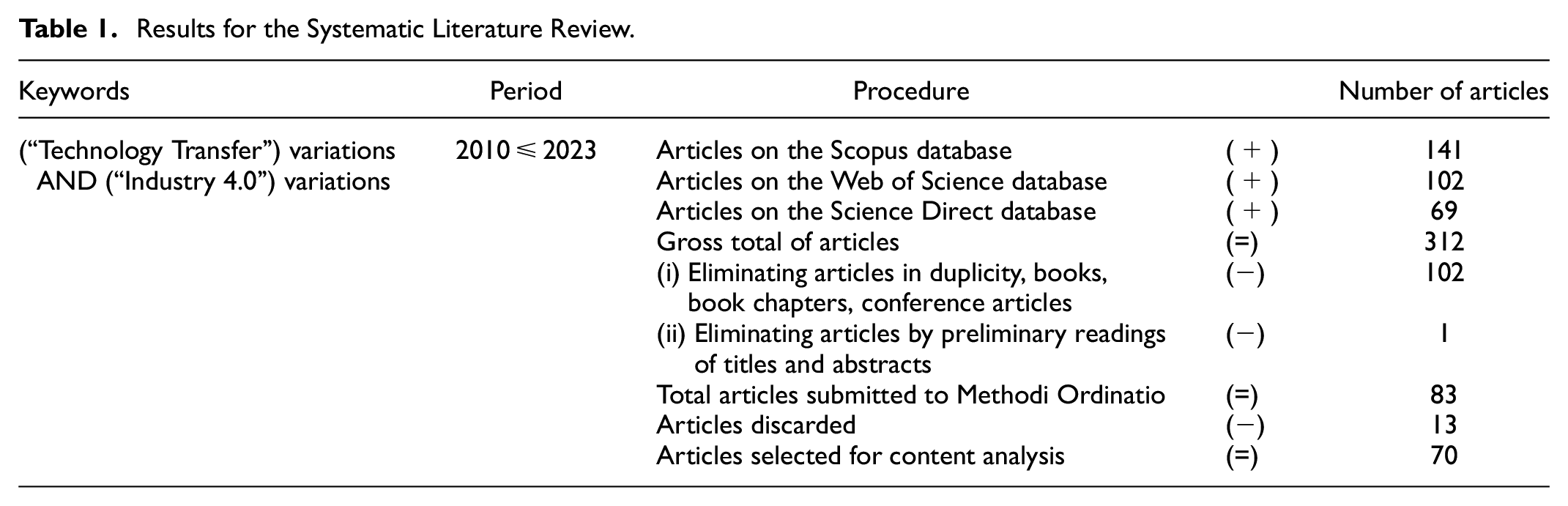
The initial search queries yielded a total of 312 publications. To refine the findings, the authors implemented a set of quality criteria. Initially, a relevant time frame was established, focusing on the period from 2010 to 2022 to ensure up-to-date results. To ensure the inclusion of scholarly sources, duplicate articles, books, book chapters, conference articles, letters, abstracts, and similar documents were excluded from the search. Additionally, a thorough analysis of titles, keywords, and abstracts was conducted to exclude papers not aligned with the research theme.
Following this process, 83 documents remained for the final analysis. These 83 documents underwent evaluation using the Methodi Ordinatio, referred to as InOrdinatio, to rank them in order of relevance (Pagani et al., 2015, 2020).
Methodi Ordinatio
The objective of this method is to assess articles based on their scientific significance, considering key factors pertinent to scientific papers: the impact factor of the journal where the document was published, the citation count, and the publication year. Various studies, including those by Bail et al. (2021), Soares et al. (2020), Henrique de Moura et al. (2020), and Pinto et al. (2019) have adopted the Methodi Ordinatio as a systematic approach to conduct literature reviews and analysis, enabling a comprehensive examination of relevant literature within their respective fields. Following the application of quality criteria, the InOrdinatio method was utilized to further rank and select the final articles, resulting in 83 papers that underwent thorough review.
To construct the InOrdinatio, a reference manager and an electronic spreadsheet were employed. This method uses three factors—publication year, citation count, and the impact factor of the journal—to rank scientific papers. Thus, to rank the papers based on their scientific relevance, the InOrdinatio equation (Pagani et al., 2015, 2020), denoted by equation (1), is applied using an electronic spreadsheet.
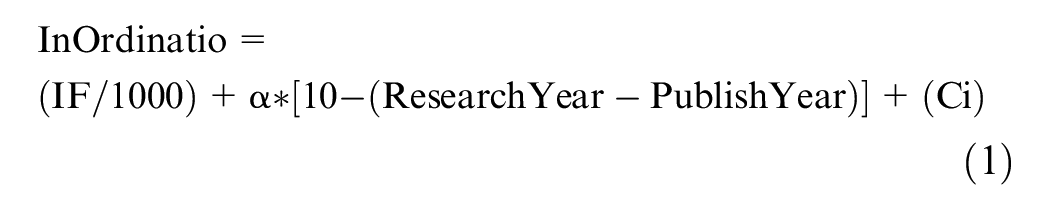
IF is the impact factor; α is a weighting factor ranging from 1 to 10 to be attributed by the researcher (The closer the number is to one, the lower the importance the researcher will attribute to the criterion year, while the closer to 10, the higher is the importance of this criterion); Research Year is the year in which the research was developed; Publish Year is the year in which the paper was published; and Ci is the number of times the paper has been cited (Pagani et al., 2015, 2020). The researcher may attribute importance to the year of the papers’ publication according to the search needs. For this study, the value of α was defined to be 10, considering that the timeliness of the articles is quite relevant in this research case.
After that, the papers were collected and stored using the reference manager Mendeley. Only after all these steps, all works were read and analyzed in full. After this analysis, it was found that 70 articles fit exactly the subject referred to in this work, these being the articles selected for content analysis. Table 1 presents a summary of all these steps followed to reach that final number of articles.
Results for the Systematic Literature Review.
The bibliometric mapping and content analysis were used to evaluate the papers. This literature review enabled us to describe the conceptual framework of Industry 4.0 and Technology Transfer.
The following sections describe Industry 4.0 and the technology transfer nexus through the analysis of studies found in the literature.
Literature Exploration
The papers were chosen according to the process detailed in Section 2. The usefulness of this section of the study may be significant for several reasons, revealing when these studies occurred, their locations of origin, the leading publishers in the field, the main keywords, and their clusters.
Firstly, the papers were divided according to their year of publication (Figure 2). The temporal scope used for the research was from 2010 until December 2022. According to the graph in Figure 2, it can be observed that articles relating to Industry 4.0 and technology transfer were only found from 2014 onward. The number of papers on this topic began to increase in 2016, coinciding with the launch of numerous initiatives worldwide aimed at accelerating the transition to Industry 4.0. In the same year, the European Union published the report “Industry 4.0—European Parliament.” Additionally, the 2016 Annual Meeting of the World Economic Forum, themed “Mastering the Fourth Industrial Revolution,” emphasized the transition of technology from a supportive role to a primary focus (Alkhazaleh et al., 2022). Subsequently, there was a noticeable upward trend in the number of studies in 2019, reflecting an increasing recognition of the importance of Technology Transfer in this context (da Silva et al., 2019; Kruger & Steyn, 2020). This upward trajectory continued in subsequent years, highlighting the growing significance of the field. Such analysis underscores the sustained interest of researchers in this subject.

Year of publication of the papers.
Figure 3 displays the contributions made by various publishers. Notably, Elsevier leads with the highest number of publications, totaling 23 papers, trailed closely by MDPI and Emerald, each with 12 papers. This indicates a broad coverage of the subject of Industry 4.0 and Technology Transfer across diverse publishers.

Contributions by publishers.
Figure 4 illustrates the distribution of publications based on nationality. Germany leads the number of publications with 22 papers out of the selected 70 papers. Some German studies are described as follows. Lessons learned from Industry 4.0 implementation in the German manufacturing industry, present specific and concrete actions that need to be taken to accelerate the realization of Industry 4.0 (Veile et al., 2019). Serious games in learning factories: perpetuating knowledge in learning loops by game-based learning, introducing an instrument of technology transfer for the topic of Industry 4.0 (Teichmann et al., 2020). Virtual Reality Models and Digital Engineering Solutions for Technology Transfer, which examines a means by which digital engineering, virtual and augmented reality technologies can support the creation of sustainable smart manufacturing and smart logistics processes as well as on-the-job training and qualification and knowledge transfer (Schumann et al., 2015).

Publications per nationality.
Italy and Brazil are next on the list with contributions of nine papers each. It can be seen in Figure 4 that there is a large concentration of these studies in Europe. The complex vision of Industry 4.0 is based on the approach of strengthening the conventional manufacturing industry in Europe and especially Germany—as described in the high-tech strategy that the German government initiated (Schumacher et al., 2016).
The research was categorized into three groups: Case studies, Literature reviews, and Studies centered on model development. Figure 5 illustrates the number of documents published yearly according to the study type.

Types of publications per year.
Case studies were the predominant type of paper, appearing in 27 studies, followed by literature reviews, in 26, and models, in 17. The first works regarding the theme were literature reviews that showed how TT is connected to I4.0. Ilie and Gheorghe (2014) report the importance of innovation and technology transfer in the intelligent manufacturing process. Liboni et al. (2019) review the central potential impacts of Industry 4.0 on human resources management, addressing the human-machine interface. Rauch et al. (2020) conducted a systematic literature review, from an anthropocentric perspective, on production before and after the implementation of Industry 4.0. da Silva et al. (2019) contextualize TT in the supply chain in the Industry 4.0 scenario, focusing on the stages of supply, industrial transformation, and final customer.
In 2016, case studies connecting TT to I4.0 started to arise, a tendency that grew over the following years. Gjeldum et al. (2016), focusing on open innovation in the Fourth Industrial Revolution, conducted a study on three aerospace manufacturers in Korea. Karre et al. (2017) conducted a case study in a learning factory (LeanLab) at the Graz University of Technology, whose purpose is to enable practice-oriented learning in an environment close to industrial reality for facilitating effective knowledge transfer. The case study by Feng et al. (2017) provides a few examples of knowledge objects to allow smart manufacturing. The majority of case studies conducted in this context were implemented within organizational settings.
Only in 2019 did a study focus on model development in TT and I4.0. The paper “Academia a New Knowledge Supplier to the Industry! Uncovering Barriers in the Process” employs a model to identify barriers that obstruct the progress of higher education institutions in becoming prominent knowledge suppliers for the industry (Kashyap & Agrawal, 2019). The second paper of this nature was published in 2020: “A knowledge-based approach for representing jobholder profile toward optimal human-machine collaboration in cyber-physical production systems” comprises semantic modeling and quantitative methods focusing on measuring and correlating the level of human competencies and machine autonomy to identify the extension of the human-machine complementarity in the execution of a given task (Ansari et al., 2020). Also in 2020, the paper “Model Compression for IoT Applications in Industry 4.0 via Multi-scale Knowledge Transfer” introduces multi-scale representations to knowledge transfer, making students suitable for IoT applications (Fu et al., 2018).
Keyword Co-occurrence
The next analysis to be conducted was the keyword co-occurrence (also known as co-word analysis), using the VOSviewer software to visualize the relationships between keywords or topics in the documents. Co-word analysis is a text mining technique that examines how frequently pairs of keywords appear together in review documents. This approach assumes that keywords that frequently appear together in the same review documents are related to each other (Narong & Hallinger, 2023).
Figure 6 provides a detailed representation of keyword co-occurrence, highlighting terms that appeared at least twice within this analysis. In the keyword co-occurrence network, each node represents a potential search term and the edges are co-occurrences of two terms in the title, abstract, or tagged keywords of a study. Our co-occurrence of keywords revealed five clusters: (1) Industry 4.0 technologies—red color; (2) Technology Transfer relations—blue color; (3) Knowledge in organizations—green color; (4) Antropotechnology—yellow color; (5) Industry 4.0 variations—purple color.

Co-occurrence of keywords.
The central keyword is Industry 4.0, but it is possible to identify ramifications linked to technologies, technology transfer, knowledge, and the human-machine relationship. It should be emphasized that keyword categorization can be helpful for other researchers, highlighting emerging topics and their interconnections. In this regard, Table 2 provides a complete list of keywords by cluster.
Keywords Per Cluster.

Clusters 1 (Industry 4.0 technologies) and 5 (Industry 4.0 variations) are centered on the Fourth Industrial Revolution, its technologies, and its required attributes. Industry 4.0 is a generic term for a new industrial paradigm that encompasses a set of future industry developments related to technologies like Cyber-Physical Systems (CPS), Internet of Things (IoT), Internet of Services (IoS), Robotics, Big Data, Cloud Manufacturing, and augmented reality. The adoption of these technologies is essential for the development of smart manufacturing processes, which include devices, machines, production modules, and products capable of exchanging information independently, activating actions, and controlling themselves (Weyer et al., 2015).
Clusters 2 (Technology Transfer relations) and 3 (Knowledge in organizations) focus on Technology Transfer itself, its economic aspects, university-industry relations, knowledge exchange, and innovation. Technology transfer is not only a simple way to negotiate technology but also a source of useful information. Through technology transfer, the company can improve its market share and its current technological state (Park & Lee, 2011). Knowledge Transfer is “the process through which a unit (for instance, a group, department, or division) is affected by the experience of another” (Argote & Ingram, 2000). It also refers to a didactic exchange between individuals, groups, or organizations, in which a recipient can understand, learn, and apply the knowledge transmitted by a source (Hamid & Salim, 2011; Ismail, 2015).
Cluster 4 (Anthropotechnology) presents the relationship between human labor and the technologies of this new industrial revolution, the necessary knowledge transfer, and its consequences for the future. According to Liboni et al. (2019), besides the industry developments geared toward manufacturing digitalization, the technological boost of Industry 4.0 forces organizations to adopt an adaptive behavior, leading them to new management processes promoted by learning advances. The 4.0 sector will affect how companies related to human resources management and human tendencies are regarded. In this context, the development of new technologies can generate new business models, which will consequently change employment standards and create new opportunities (Rajnai & Kocsis, 2017).
This section, therefore, presented the statistics and characteristics of the studies found in the literature. The subsequent section offers a comprehensive discussion of the findings and proposes an Industry 4.0-Technology Transfer framework.
Proposed I4.0-TT Framework
Based on the literature, industries typically embark on both internal and external technology transfer processes as an initial step toward embracing the concept of Industry 4.0. Internal technology transfer involves issues within the company itself, encompassing the utilization of its resources, such as knowledge exchange between seasoned colleagues and newly recruited staff. External processes, on the other hand, entail interactions with resources from external entities like suppliers, research institutions, governmental bodies, and other organizations (da Silva et al., 2019).
According to Zangiacomi et al. (2018), the adoption of TT approaches plays a relevant role as a facilitator in the digital transformation process, and it is directly linked to the importance of expanding the knowledge basis in I4.0 technologies. Developing specific abilities for the proper use of technology and overcoming the resistance to change and lack of knowledge must be priority objectives. Internal knowledge needs to be generally enhanced, also promoting the integration between digital and traditional abilities to avoid obstacles that might arise from fragmentation.
When it comes to I4.0, innovation is at the forefront of the discussion. Indeed, to keep pace with the Fourth Industrial Revolution, Technology Transfer (TT) becomes an indispensable necessity. The development and transfer of new technologies are imperative to meet the demands of an ever-growing and competitive market (I. V. Carvalho & Cunha, 2013).
The implementation of Industry 4.0 requires a process of evolution, which in turn demands the presence of Technology Transfer. 4.0 concepts by themselves are not enough to ensure the implementation of this new industrial revolution (da Silva et al., 2019).
Based on the literature review conducted, it is possible to affirm that to have an Industry 4.0, various concepts, technologies, and approaches must be present to characterize it as such. All of these concepts, technologies, and approaches can be divided into five dimensions (People, Process, Technology, Strategy and Organization, and Integration). In other words, Industry 4.0 is a combination of these five dimensions.
People: It refers to the Human-Machine interaction and all the training, knowledge, and development of abilities required for I4.0 (Kopp et al., 2019; Schumacher et al., 2016; Sjödin, 2018);
Processes: It refers to the I4.0 and TT processes required for the development of products and/or services (Akdil et al., 2018; Sjödin, 2018);
Technology: It refers to technologies (materials and knowledge) that must compose the transformation process of the product and/or service (Kopp et al., 2019; Schumacher et al., 2016; Sjödin, 2018);
Strategy and Organization: It refers to the adaptation to the new Business Models and the organizational culture in the company (Akdil et al., 2018; Schumacher et al., 2016; Veile et al., 2019);
Integration: It refers to how the systems are interconnected in the Industry and Supply Chain 4.0 (Veile et al., 2019).
These dimensions highlight the different aspects that must be considered at the intersection of Technology Transfer and Industry 4.0, ranging from the skills and empowerment of people to the integration of systems in a holistic and integrated approach.
The five dimensions were defined through a literature review, based on the maturity model proposed by Sjödin (2018). Their model identifies three dimensions within a smart factory: People, Process, and Technology. To complement, Veile et al. (2019) mention the importance of Integration, Strategy, and Organization in Industry 4.0 implementation. Other authors (Akdil et al., 2018; Kopp et al., 2019; Schumacher et al., 2016) have also confirmed the importance of these dimensions.
Through a comprehensive literature review, we identified all components (concepts, technologies, and approaches) constituting Industry 4.0 and Technology Transfer. These components were then meticulously categorized into five dimensions. Table 3 presents this categorization along with the authors who highlight these components as essential for both Industry 4.0 and Technology Transfer.
Components of Each Dimension.

By this, the developed framework asserts that there is an influence between Technology Transfer and 4.0 concepts and technologies. These two factors applied jointly in five dimensions (People, Process, Technology, Strategy and Organization, and Integration) facilitate the Industry 4.0 implementation process. In that sense, Figure 7 presents the I4.0-TT Framework, which illustrates this new concept.

I4.0-TT Framework.
Technology Transfer (TT) mechanisms play a crucial role in overcoming barriers to the implementation of Industry 4.0, facilitating the process of adopting and integrating new technologies. Similarly, the concepts and technologies of Industry 4.0 also require changes and updates in Technology Transfer to make it more effective and aligned with current demands.
In summary, this proposed framework offers an approach to facilitate the adoption of the Industry 4.0 acquisition process within an organization: Technology Transfer, along with Industry 4.0 concepts and technologies, operates within five dimensions: People, Process, Technology, Strategy and Organization, and Integration. With these five dimensions and their respective components applied, we have what is referred to as Industry 4.0. Technology Transfer plays a pivotal role in providing support for the implementation of Industry 4.0 concepts and technologies within the organization.
The Use of the Framework in Companies– PDCA Cycle
It is believed that every innovative company wants to transfer its technology to the market, and Industry 4.0 contributes to speeding up this TT process. Similarly, TT serves as assistance for the effective implementation of Industry 4.0 in organizations. In this sense, companies can use the proposed framework following the logic of the PDCA (Plan-Do-Check-Act) cycle.
The PDCA cycle, also known as the Deming circle, goes beyond being just a quality tool. It is an essential concept for continuous improvement integrated into the organizational culture. Its simplicity makes it accessible to a large number of people within the company. The PDCA method allows for continuous improvements without interruption, being future-oriented, flexible, logical, and reasonable in describing elaborated plans (Taufik, 2020).
The use of the PDCA cycle was motivated by three main reasons: (1) its widespread familiarity in the market, increasing acceptance among users; (2) its ability to summarize the fundamental concepts of management, making it easier to understand the sequential logic of the method; and (3) its cyclical nature, which promotes the idea that the adoption of Industry 4.0 and Technology Transfer should occur progressively. This approach is supported by the perspective of Schuh et al. (2019), emphasizing the importance of a gradual and systemic transition, respecting the organizational structure.
The steps to be followed are presented in Figure 8 and described below:

PDCA cycle.
Plan
• Identification of Needs and Objectives: The first step for companies is to identify their specific needs and objectives related to the implementation of Industry 4.0. This involves understanding which areas of the organization can benefit from the adoption of 4.0 technologies and what are the main challenges to be overcome.
• Assessment of Current Situation: Companies should assess their current situation about the five dimensions of the framework: People, Processes, Technology, Strategy and Organization, and Integration. This includes a detailed analysis of how each dimension is structured and functioning within the organization.
• Mapping of Framework Components: Based on the assessment of the current situation, companies can map the specific components of the framework that apply to their reality. This involves identifying which elements of each dimension are relevant to their Industry 4.0 implementation goals.
• Development of an Action Plan: With the mapping of components in hand, companies can develop a strategic action plan. This plan should address how the components will be implemented and integrated throughout the organization to achieve the goals of Industry 4.0.
Do
• Resource Allocation: Companies will need to allocate appropriate resources, such as budget, personnel, and technology, to implement the action plan. This may include investments in new technologies, staff training, and adjustments to internal processes.
• Communication and Employee Engagement: Successful implementation of Industry 4.0 requires the involvement and commitment of employees at all levels of the organization. Communicating the objectives, benefits, and progress of implementation is crucial.
• Gradual Implementation: The framework implementation should be done gradually and carefully. Companies can start with pilot areas before expanding to the entire organization. This allows for testing and adjusting approaches as they progress.
Check
• Ongoing Monitoring and Evaluation: As implementation progresses, it is crucial for companies to constantly monitor and evaluate their progress. This involves measuring the impacts on the five dimensions and making adjustments as necessary.
Act
• Adaptation to Changes: The business environment is constantly evolving, and companies must be prepared to adapt to changes.
• Maturity Assessment and Continuous Improvement: The framework can also be used to assess the maturity of the company in Industry 4.0. Based on this assessment, companies can identify areas for continuous improvement and adjust their strategies as needed.
The framework provides a flexible structure that can be adjusted to meet new demands and challenges. Companies can use the proposed framework as a structured guide to plan, implement, and monitor the adoption of Industry 4.0 in their operations. It provides a comprehensive framework that addresses all essential dimensions, allowing companies to effectively and strategically reap the benefits of the fourth industrial revolution.
Concluding Remarks
This study’s purpose was (1) to build on the state-of-the-art literature on Industry 4.0 and technology transfer, (2) to identify the central characteristics of the most relevant recent studies, and (3) to develop a framework that presents the influence between Technology Transfer and Industry 4.0, and to demonstrate how it can be applied in companies. With the development of this study, it was possible to analyze how the influence of technology transfer on Industry 4.0 facilitates the implementation process of this new industrial revolution in organizations.
The review found papers connecting I4.0 and TT only after 2014, a rising tendency that shows that the researchers’ interest in the subject has been increasingly growing. The publications of studies regarding the theme focused on European countries, especially Germany, the most prolific location. Most studies found were case studies or literature reviews.
The analysis also revealed the co-occurrence of keywords that appeared at least twice. The central keyword is Industry 4.0, but it is possible to identify ramifications linked to technologies, technology transfer, knowledge, and the Human-Machine relationship. It is worth stressing that the categorization of keywords may be useful for other researchers, drawing attention to the emerging topics and how they are related.
Afterward, based on the entire literature review conducted, it was possible to note that the presence of Technology Transfer is essential for the implementation of Industry 4.0 and that only 4.0 concepts do not ensure the implementation of this new industrial revolution. Thus, a framework that presents how the influence of technology transfer facilitates the implementation process of Industry 4.0 was elaborated, named the I4.0-TT framework.
The components that characterize Industry 4.0 and Technology Transfer were identified and listed. Each one of them belongs to at least one of the five dimensions: People, Process, Technology, Strategy and Organization, and Integration.
Thus, the proposed framework reveals a method to facilitate the Industry 4.0 acquisition process in an organization: Technology Transfer, jointly with 4.0 concepts and technologies, acts in five dimensions (People, Process, Technology, Strategy and Organization, and Integration). The application of these five dimensions and their respective components leads to the so-called Industry 4.0. Technology Transfer reveals itself as a support to apply 4.0 concepts and technologies in the organization.
Industry 4.0 and Technology Transfer play fundamental roles in the current business landscape, offering significant advantages for competitiveness, efficiency, and innovation. In the present scenario, where the pace of technological changes is high and competition is intense, both Industry 4.0 and technology transfer are critical factors for the success of companies. They enable companies to adapt quickly, enhance their processes and products, meet market demands, and stay relevant in an ever-evolving business environment. In this sense, companies can use the proposed framework following the logic of the PDCA cycle.
This study holds contributions in both academic and managerial realms. This framework can assist organizations in adopting Industry 4.0 more efficiently and effectively. Furthermore, this framework can be transformed into a model for assessing companies’ maturity, analyzing these two factors.
Recommendations for Future Research
Any piece of research has limitations. One of the limitations of this work concerned the keywords employed, seeing that other similar words could be used for result comparisons. Another limitation was employing a macro approach to the theme, as both themes are quite wide-ranging. This framework, when applied, could be directed at specific problems existent in an organization.
Other studies could broaden the research to build roadmaps for the implementation of Industry 4.0, employing Technology Transfer as the support. Moreover, technology transfer mechanisms could be inserted with more details into the model, specifying where each one fits. Besides, tools and models that measure technology transfer management in Industry 4.0 are an opportunity for future research reports.
This study can be applied in different organizations to perform a statistical analysis of correlation between I4.0 and TT factors. Additionally, the model can be adapted and restructured for SMEs (Small and Medium-sized Enterprises).
Footnotes
Declaration of Conflicting Interests
The author(s) declared no potential conflicts of interest with respect to the research, authorship, and/or publication of this article.
Funding
The author(s) disclosed receipt of the following financial support for the research, authorship, and/or publication of this article: This research was funded by Conselho Nacional de Desenvolvimento Científico e Tecnológico – CNPq and Fundação Araucária de Apoio ao Desenvolvimento Científico e Tecnológico do Estado do Paraná (FA).

Data Availability Statement
Data sharing not applicable to this article as no datasets were generated or analyzed during the current study.