



Abstract
Exchange programs have been found to have a positive impact on regional economic growth, university cooperation, and student academic, and professional development. However, there has been limited analysis of the factors that influence the quality of these programs. In this study, a mixed-methods approach was used to examine regional exchange programs in China. Qualitative research was conducted using Octopus Big Data Crawler software, Timdream.org software, and 33 interviews to develop a questionnaire that covers student expectations, service quality, and satisfaction. Using SPSS 22 and Amos 21, the study analyzed the interactive relationships among expectations, perceived service quality, and satisfaction in the context of regional education integration based on a sample of 246 questionnaires. The results demonstrate that perceived service quality plays an intermediary role in the relationship between expectations and satisfaction, with students’ perceptions of learning quality and interpersonal quality at the receiving university influencing their satisfaction levels. This study provides important insights into the factors that impact the quality of regional exchange programs in China.
Keywords
Introduction
Higher education plays a critical role in the regional economy, and the integration of regional higher education is an inevitable trend in many regions worldwide, including the European Union, Southeast Asia, the western United States (Kunaviktikul et al., 2019), and China (Cinkir et al., 2022; Masserini et al., 2019). Inter-regional university cooperation has emerged as an essential pathway for regional higher education integration in recent years, facilitated by government funds and policies (Quan et al., 2017). To promote regional university cooperation, exchange student programs have become a strategic initiative, resulting in a gradual increase in the number of exchange students (European Commission, 2019).
Numerous studies have demonstrated the significant benefits of exchange programs for regions, universities, and students. Specifically, the exchange of college students has been found to enhance the knowledge-based economy of a region (EENEE, 2007), while universities can leverage exchange programs to foster academic exchange and cooperation between higher education institutions, facilitate frequent and purposeful communication, and share responsibilities (Cosmin, 2023; Nada & Legutko, 2022). Moreover, evidence indicates that exchange programs improve academic knowledge, increase maturity and confidence (DeGraaf et al., 2013), and enhance competence and preparedness for the job market (Bryła, 2015). As a result, attracting more exchange students and universities to participate in exchange projects and promote the development of regional higher education has become a pressing challenge.
China’s educational system differs from that of the West Country, with the government exerting the most significant influence on the quality of tertiary education in the country. In contrast, the quality of tertiary education in Western countries is shaped by a variety of stakeholders, including individual students (Zha, 2011). This aspect is similar to the education systems of other developing countries, which resemble that of China. The regional integration of China’s key economic areas, such as the Yangtze River Delta, Beijing-Tianjin-Hebei, Guangdong-Hong Kong-Macao Greater Bay Area, and Chengdu-Chongqing, has been identified as a crucial national strategy, necessitating the integration of higher education in these regions. Exchange projects have been a key driver of university cooperation in these regions. Chinese universities began initiating exchange programs in the 1990s, and by the early 2000s, these programs had entered a formal phase of development. Several policies have been issued by the Chinese government and regional authorities to facilitate regional integration in education, highlighting the importance of such efforts.
As there is no universally accepted definition of service quality in higher education or a model to measure it, scholars often use the SERVQUAL model to derive or design their own models suitable for higher education. While many studies have been conducted on the quality of overseas exchange projects under the Western educational system, quality has been categorized into six areas: life, learning, personal, cultural, foreign language, and financial. However, in a region, where there are no cultural or linguistic differences, the existing quality scale for overseas exchange projects in Western countries cannot be applied to regional exchange projects.
Therefore, it is necessary to establish a service quality scale for regional exchange projects. Literature shows that exchange project expectations, service quality, and satisfaction often have a pairwise relationship. Studies have found that students are satisfied when outcomes meet their expectations (Chen & Yang, 2021; Kotler & Clarke, 1987), that high expectations improve students’ evaluations of services, and that quality has a significant positive effect on satisfaction. Although most of these studies use qualitative research methods, it is still worthwhile to investigate whether there is a mediating path between expectations, quality, and satisfaction, and how strong the mediating effect is in relation to them.
Compared to prior research, this paper has two distinctive features. Firstly, the research method is innovative. The emergence of information technology has transformed the way students communicate and document their experiences (Gentina & Chen, 2019; Yuan et al., 2021). Thus, the existing service quality scale needs to be adjusted to adapt to the changing behavior of students (Y. Yang et al., 2020). In this study, public internet sources were used to analyze data from various stages of the exchange process, including before, during, and after the exchange. Secondly, this study explores the intermediary effects that were overlooked in previous research. Previous studies that used qualitative research methods to examine the relationship between exchange expectations, quality, and satisfaction found that there was a significant positive relationship between these variables. However, this study uses empirical evidence to explore the intermediary role of service quality in the relationship between expectation, quality, and satisfaction. Additionally, this study is unique in that it focuses on the education system of developing countries, specifically in China, and explores how to establish an appropriate service quality scale for exchange projects and analyzes the mechanism of service quality (Roy et al., 2019). This study provides insights into developing countries’ mobility programs, an area that has received less attention in previous studies.
The rest of this paper is structured as follows. Section 2 discusses three distinct areas of literature. Section 3 clarifies the theoretical background and then presents the research model. Section 4 introduces the Methodology. Section 5 uses SPSS 22 and Amos 21 for empirical tests and analysis. Section 6 concludes the paper and discusses future research avenues.
Theoretical Background and Research Model
This Section of the paper discusses three distinct areas of literature. Firstly, it covers literature on the benefits of exchange programs for regions, universities, and students. Secondly, it examines literature on the development of service quality models in higher education, with a particular focus on the SERVQUAL model. Finally, it discusses literature on the use of mixed-methods research in studying service quality in higher education and the factors that influence student satisfaction in exchange programs. By synthesizing these three streams of literature, the section provides a comprehensive theoretical framework for the study of regional exchange programs in China.
Regional Higher Education in China
The promotion of regional education integration is a national strategy in China aimed at integrating the country’s various regions, including the Yangtze River Delta, Beijing-Tianjin-Hebei, Guangdong-Hong Kong-Macao Greater Bay Area, and Chengdu-Chongqing. To support this strategy, the government has issued several policies, such as Opinions on Deepening the Reform of the Higher Education System (1995), Outline of the National Medium- and Long-Term Education Reform and Development Plan (2010–2020), and Opinions on Improving the Quality of Higher Education. These policies reflect the formal structure of the national education system and demonstrate the government’s recognition of the importance of education.
In response to national policies, local governments have developed plans such as the Three-year Action Plan for the Development of Education Integration in the Yangtze River Delta (2021–2023), the Beijing-Tianjin-Hebei Education Coordinating Plan (2018–2020), and the Outline of the Guangdong-Hong Kong-Macao Greater Bay Area Development Plan (2019). These plans aim to strengthen regional education integration and provide milestones for achieving goals. However, full implementation of these plans may be challenging, making this study valuable. Furthermore, regional integration is a common practice in regional development worldwide, making the lessons learned applicable to other countries.
Measuring Service Quality
The SERVQUAL model is widely used for evaluating service quality in higher education, with five dimensions including responsiveness, assurance, tangibility, empathy, and reliability (Borishade et al., 2021; Datta & Vardhan, 2017). However, its applicability to higher education has been questioned, and Cuthbert (1996) found that it cannot be directly applied to assessing service quality in higher education. Some scholars have developed frameworks based on the SERVQUAL model, including Abdullah’s (2006) five determinants of service quality (non-academic aspects, academic aspects, reputation, access, and program problems), Annamdevula’s (2012) five-factor scale (teaching and course content, administrative services, academic facilities, campus infrastructure, and support services), and Latif et al.’s (2019) six factors (teacher quality, administrative services, knowledge services, activities, continuous improvement, and leadership quality). Additionally, research has shown that cultural atmosphere and social environment can influence students” evaluations of service quality in higher education (Kwan & Ng, 1999).
Scholars have extended the use of the SERVQUAL model and quality scales to measure the quality of exchange projects in higher education, as shown in Table 1. The service quality of these projects includes various aspects, such as actual course design, implementation, and evaluation (Deans, 2011), logistical planning for study tours, lectures, company visits, and cultural experiences (Sachau et al., 2010), program format and cost discussions (Mills et al., 2010), resources for students seeking study abroad immersion service learning experiences, faculty support, including fundraising, emotional, or academic support (Long, 2016), as well as potential solutions to linguistic and intercultural communication barriers (Chaiyasat, 2020; Yusup & Gemiharto, 2022). The Erasmus program is a significant student exchange initiative that has contributed to the integration of higher education in the European Union. The European Commission (2019) emphasizes the need to enhance the socio-academic experience of Erasmus students. Likewise, Bryła (2015) and Senci et al. (2022) highlight the significance of social integration as a crucial element of quality in Erasmus programs.
Quality Services of Exchange Projects.

Extensive literature has examined the service quality of overseas exchange projects, with scholars in marketing and higher education identifying several key aspects including life, study, personal, cultural, foreign language, and financial considerations. However, exchange projects within a country or region do not typically involve differences in language and culture, and financial support is usually provided by the sending institution, thus these dimensions are not relevant to assessing service quality in the receiving location. Instead, this study will focus on three dimensions of service quality within the receiving area: life, learning, and interpersonal factors.
Expectation, Service Quality, and Satisfaction in Higher Education
Student Satisfaction Model
There are various definitions of the satisfaction concept in literature, with Oliver and Linda (1981) offering their own interpretations. Elliott and Healy (2001) introduced a new concept of student satisfaction, suggesting that it is a short-term attitude stemming from how students evaluate their educational experiences.
The disconfirmation of expectations model (Oliver, 1977, 1980) is an influential theory in customer satisfaction research. According to this model, customer satisfaction is a result of comparing their expectations with their actual experiences. However, measuring customer expectations can be complex and unreliable, and even if accurately measured, its impact on satisfaction formation may be minimal (Kristensen et al., 1999; Y. Yang et al., 2023).
Perceived disconfirmation provides a framework to explain the disconfirmation concept. Perceived disconfirmation refers to customers’ subjective evaluation of the difference between their expectations and their perceived quality (R. E. Anderson, 1973; Bearden & Teel, 1983; Churchill & Surprenant, 1982; Oliver, 1977, 1980; Oliver & DeSarbo, 1988; Spreng & Olshavsky, 1993). It has been shown that perceived quality is a primary driver of customer satisfaction (Cronin & Taylor, 1992; Grönroos & Christian, 1993; Liljander & Strandvik, 1993). Therefore, a conceptual model can be established where customer expectations and perceived quality are the main determinants of customer satisfaction.
The Relationship Among Expectation, Service Quality and Satisfaction
Numerous scholars have investigated the relationship between expectation, quality, and satisfaction. While some studies have suggested that customer expectations have a negative impact on satisfaction (Alves & Raposo, 2007), more recent empirical research has highlighted the positive influence of expectation on satisfaction (E. W. Anderson & Sullivan, 1993; Oliver, 1997). Moreover, it has been demonstrated that expectation is positively correlated with perceived quality (E. W. Anderson & Sullivan, 1993; Lim & Tkaczynski, 2017; Oliver, 1977). Generally, higher (lower) expectations should lead to higher (lower) quality.
The influence of expectation on quality and satisfaction has also been examined empirically in the context of exchange programs. Student expectations in exchange programs may encompass personal experiences (Nilsson, 2015), communication skill improvement, learning about foreign cultures, and making new friends among local university students (Costas and Singco, 2016; Yang et al., 2023), community involvement attitudes, future professional work, personal reflection (Pereira et al., 2017), social, and academic development, improvement of foreign language skills (Küçükçene & Akbasli, 2021), transfer of theoretical knowledge to practice, and a supportive learning environment (Dursun Ergezen et al., 2022). These studies have concluded that there is a positive correlation between expectation and satisfaction, as well as expectation and quality. Therefore, this study operates on the assumption that:
In general, perceived quality has a more significant impact on satisfaction than expectations (Ali et al., 2021; Oliver & DeSarbo, 1988; Yılmaz & Temizkan, 2022). Several scholars have also found that service quality affects the satisfaction of exchange students, such as teaching methods and intercultural experiences (Van der Beek et al., 2014), physical environment, price/fee, personal safety, and student-lecturer attachment (Chelliah et al., 2019), economic, communication, cultural, prejudice, and transportation factors (Acikgoz et al., 2020), and proposed extracurricular activities (Chaiyasat, 2020), Erasmus Student Network (ESN), online media use, among others (Senci et al., 2022). Therefore, perceived quality may play a more direct role in influencing satisfaction. Accordingly, we make the following assumptions:
Service quality consistently acts as a mediator in various situations (Marimon et al., 2019; Merdiaty & Aldrin, 2021). Expectations not only directly affect satisfaction but also indirectly through perceived quality. Perceived quality can fully mediate the impact of expectations on satisfaction (E. W. Anderson & Sullivan, 1993; Kristensen et al., 1999). Based on previous literature, we make the following assumptions:
This section outlines the variables associated with the research model, and presents the hypotheses formulated based on existing literature. The research model, which falls within the scope of this study, is depicted in Figure 1.

The research model.
In summary, the previous discussion of the exchange project has several limitations that need to be addressed. Firstly, most of the studies adopted qualitative research methods instead of quantitative methods, as shown in Table 2. Secondly, these studies were conducted mainly in Western countries, whereas developing countries have different mobility plans that have not been fully explored, as noted by Roy et al. (2019). Therefore, the service quality of exchange programs in developing countries, such as China and other countries with similar education systems, needs to be evaluated. Thirdly, most of the studies focused on assessing the quality of service provided by international exchange projects, while the quality of service provided by interregional exchange projects that do not involve language or cultural barriers needs to be explored further. Fourthly, existing literature suggests that the pairwise relationship between exchange project expectations, service quality, and satisfaction is prevalent. However, it is crucial to determine whether there is a mediation pathway among the three variables for the exchange project and how strong the impact of the three variables is. Therefore, the aim of this study is to address these gaps by developing a new service quality scale for intra-regional exchange projects in developing countries and quantitatively examining the relationship between expectation, service quality, and satisfaction.
The Relationship Between Expectation, Service Quality and Satisfaction.

Methodology
Methodology Design
This study adopts a second-order time series design based on Creswell’s mixed methodology. The research comprises two stages: a first-stage qualitative study to establish a service quality scale and a second-stage quantitative study to explore the mechanism of service quality, expectation, and satisfaction. Qualitative analysis is necessary for two reasons. Firstly, the previous methods of establishing quality scales have been limited, and there is a need to develop innovative methodologies to adjust existing service quality scales. Secondly, with the proliferation of information technology, students are expressing themselves in diverse ways, and their life records are becoming increasingly digital. Therefore, this study seeks to establish a new methodology to measure service quality in intra-regional exchange projects. The second-stage quantitative study is primarily aimed at empirically confirming the relationship between expectations, perceived service quality, and satisfaction, as previous research on this topic has been predominantly qualitative. To this end, the study collects data from Chinese exchange students and teachers to provide a more diverse perspective on service quality and satisfaction.
Data Collection
In our study, we utilized four prominent Chinese platforms as the primary sources of information for our big data crawlers. We then employed the Octopus Big Data Crawler software to extract 1,853 data sets from these platforms, using “exchange student” as our search term. Our search yielded 1,156 messages from Baidu Encyclopedia, 508 messages from Baidu Information, 103 messages from Toutiao, and 86 messages from Phoenix.com. Next, we used Timdream.org to identify key terms and their frequency, selecting 90 high-frequency words based on their frequency in ascending order after deduplication. These words were then used to identify key dimensions of service quality. Given that participants in the regional exchange project will experience two universities and two cities, we recognized that their perception of quality and satisfaction will likely be diverse. To address this, we collected main text materials from interviews to check for potential deviations and omissions from the big data crawler. We conducted two types of interviews, including focused group interviews and in-depth (individual) interviews. While only one focused group interview took place in Quzhou, a city in Zhejiang province, individual phone interviews became the primary method of collecting data due to pandemic restrictions.
Our researchers interviewed 17 university teachers in charge of exchange projects from 15 universities with a relatively large scale of exchange and a relatively long period of exchange. The interviewed teachers then recommended exchange students who were willing to participate in surveys and interviews, and we sent online questionnaires to the selected students. The 15 universities included in the study are located in nine provinces of China, including Zhejiang, Shanghai, Jiangsu, Anhui, Beijing, Liaoning, Gansu, Guangdong, and Fujian. All participants were Chinese, and the questionnaire and interview were conducted in Chinese. Our study included 33 interviews, 16 with students and 17 with teachers, creating a triangulation of data to offset subjectivity. Based on the data obtained from big data crawlers and interviews, we developed scales for expectations, quality, and satisfaction regarding exchange projects in China. In total, these scales consisted of five components and 24 items (See the questionnaire in the appendix). We distributed online questionnaires to these participants between April 20 and May 30, 2021, and collected 260 questionnaires in total. After deleting incomplete questionnaires, highly consistent scores, and those that took less than 90 s to complete, we were left with 246 valid questionnaires, resulting in an effective rate of 95%.
Variable Measurement
The study identifies three key variables: expectations, quality, and satisfaction, which are measured using a 7-point Likert-type scale ranging from 1 to 7. Expectations refer to exchange students’ beliefs and hopes about the future outcomes of the project, with four expectations related to future plans. Quality is measured through 12 items that assess students’ perceptions of the services provided, which are grouped into three dimensions: perceived quality of life service, perceived quality of learning service, and perceived quality of interpersonal service.
Satisfaction, which refers to the psychological state experienced after meeting educational needs, is measured using eight items that assess students’ overall satisfaction with the exchange experience. To obtain data, 246 valid questionnaires were collected from a total of 260 questionnaires distributed online between April 20 and May 30, 2021, resulting in an effective response rate of 95%. Table 3 presents the results of the survey, indicating that 161 respondents were female and 85 were male, with most respondents majoring in science, engineering, or literature. The receiving universities were primarily located in Shanghai, Zhejiang, Liaoning, Jiangsu, Gansu, and Guizhou.
Respondents’ Information on the Questionnaire (N = 246).

An exploratory factor analysis was conducted due to the questionnaire items being derived from a self-built scale. The principal component analysis revealed that quality perception should be categorized into three components: life quality perception, learning quality perception, and interpersonal quality perception. The measurement model includes five components and 24 items, all of which have a common value higher than 0.4, a KMO value of 0.915 (>0.6), and a cumulative variance of 76.6% (>50%), demonstrating that the items’ information can be efficiently extracted.
Next, a confirmatory factor analysis was performed. The factor loading of the item “postgraduate recommendation” in the component “exchange students’ expectation” was 0.59 < 0.6, leading to its deletion. Moreover, the items “Joining the academic group in receiving school” in the component “interpersonal quality perception in the receiving university,” and “Contacting the professional frontier knowledge,” “Better ability to adapt to the environment,” “Making full use of the resources from the receiving university,” and “Preparing for graduate students in the receiving university” in the component “Student Satisfaction” have greater MI values than 20, indicating a strong correlation with each other. Hence, all of these items were removed. Finally, the hypothesis model of this study was established, including five latent variables and 18 measurement items.
Empirical Test and Analysis
Reliability and Validity Analysis
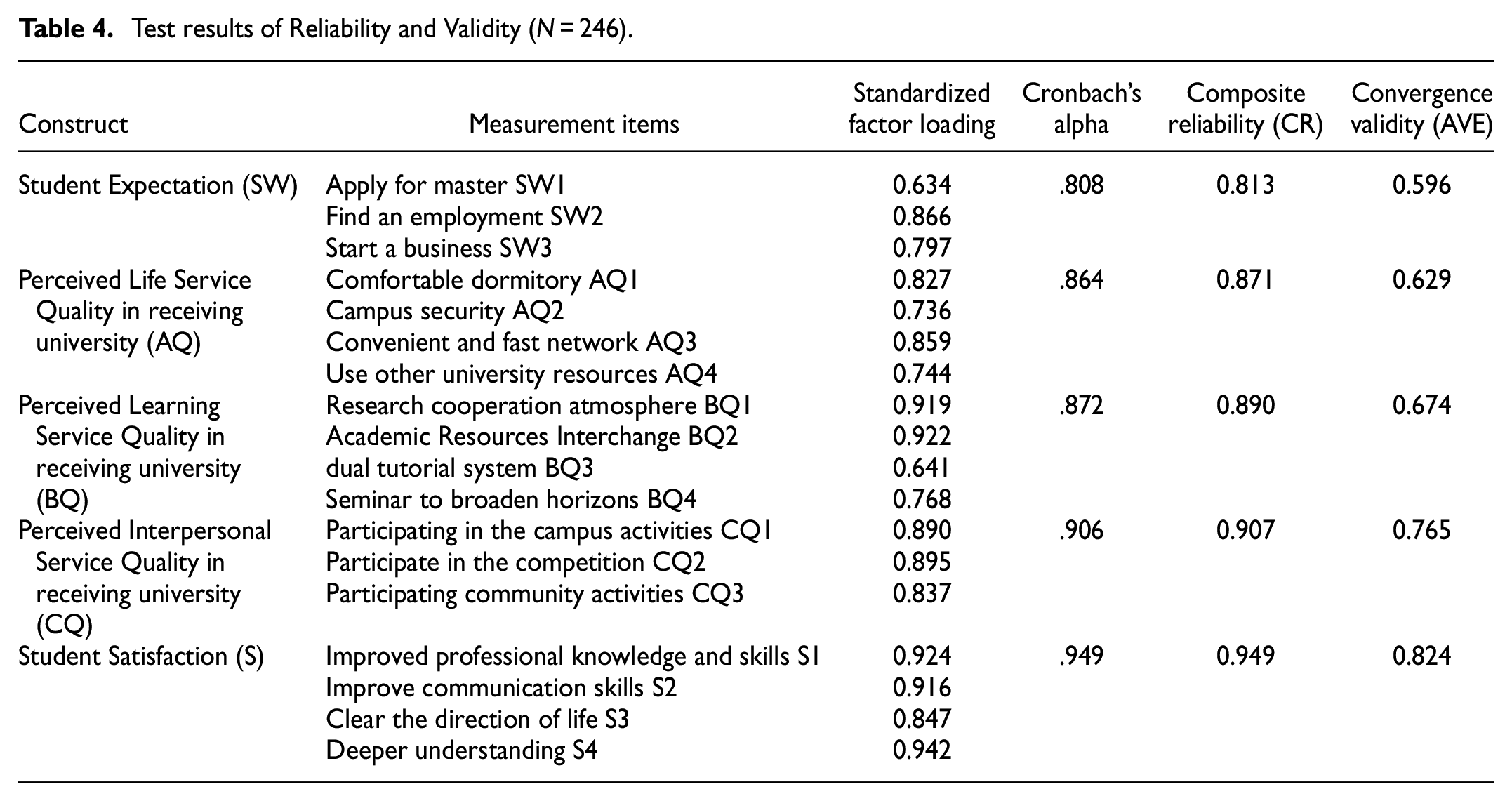
This study utilizes SPSS 22 and Amos 21 to conduct empirical tests and analysis. The initial step involves testing the reliability and validity of the measurement model, and the corresponding results are presented in Tables 4 and 5. The factor loading for all measurement items surpasses 0.6, indicating that the measurements are highly reliable. Moreover, the reliability CR values for all six components exceed 0.7, and their AVE values are above 0.5, providing evidence for their high reliability.
Test results of Reliability and Validity (N = 246).
Test of Distinguishing Validity.

Note. The bold font on the diagonal is the square of AVE.
The correlation coefficient matrix presented in Table 5 demonstrates that the coefficients on the diagonal are larger than those between each respective component and other components. This observation indicates that the measurement model exhibits good internal consistency, convergent validity, and discriminant validity. Additionally, the model’s main fit indices were evaluated, and the results indicate that they satisfy the recommended criteria. Specifically, the CMIN/DF value is 2.704, RMSEA is 0.083, GFI is 0.901, CFI is 0.940, NFI is 0.908, and TLI is 0.926. These values confirm that the measured data fit the model well and are appropriate for the subsequent structural model test.
Path Coefficient Test
Table 6 presents the results of hypothesis testing, wherein the p values for hypotheses H1, H2a, H2b, H2c, H3a, H3b, and H3c are all significant, leading to the acceptance of all seven hypotheses. Subsequently, we employed the Bootstrap method to examine the hypothesis regarding the mediating effect of students’ perception quality in the receiving universities.
Path Coefficient Test.

Mediation Test
Using the Bootstrap method, we extracted 1,000 samples and set the confidence level to 95% to test the significance of the mediation effect of life service quality, learning service quality, and interpersonal service quality. Figure 2 and Table 7 present the results, where the path coefficient of AQ→S is found to be insignificant (p = .148), and the percentile method confidence interval at the 95% confidence level for the indirect effect includes 0([−0.038, 0.179]). Therefore, the mediating effect of life perception quality is deemed insignificant, and hypothesis H4a is rejected. Regarding the mediating effects of learning quality perception and interpersonal quality perception, the path coefficients of SW→BQ and BQ→S, SW→CQ and CQ→S are all significant, and the total effect TE is also significant. The indirect effects BQIE and CQIE have the same sign as the total effect TE, indicating that learning quality perception BQ and interpersonal quality perception CQ have some mediating effects between students’ expectation SW and students’ satisfaction S, leading to the acceptance of hypotheses H4b and H4c. Furthermore, the mediation effects of learning quality perception BQ and interpersonal relationship quality perception CQ were found to be insignificantly different.

Path coefficient.
Test of Mediating Effect.
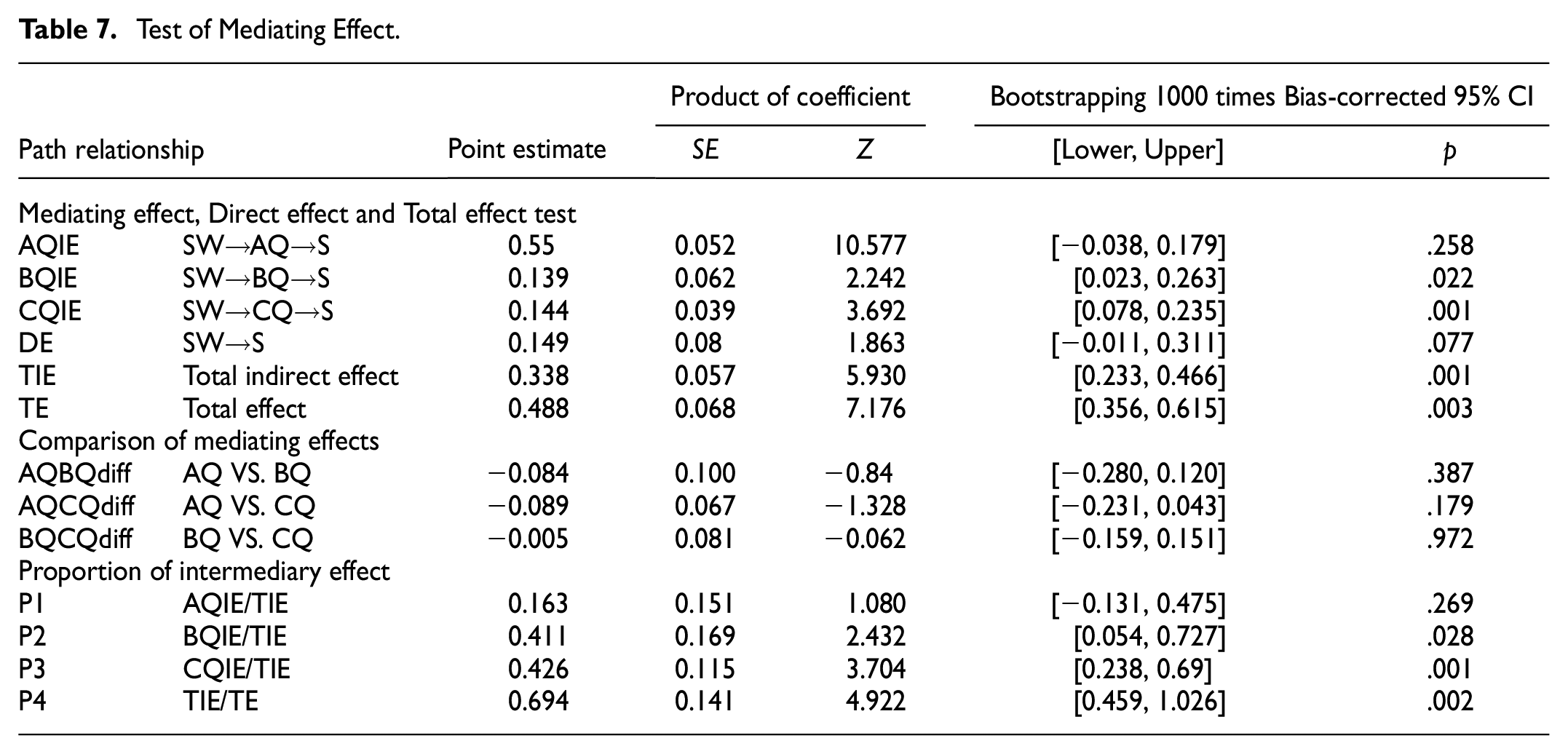
According to Table 7, the mediation analysis reveals that among the factors affecting students’ satisfaction, the mediating effect of learning quality perception in the receiving university accounts for 41.1% (0.139/0.338), while the mediating effect of interpersonal quality perception in the receiving university accounts for 42.6% (0.144/0.338). These results suggest that students’ expectations can impact exchange students’ satisfaction through learning quality perception and interpersonal relationship quality perception in the receiving university.
T-Test
We hypothesized that there may be differences in student expectations, quality perception, and student satisfaction based on gender, the region of sending universities, the region of receiving universities, and students’ majors. To test this, we conducted a t-test to compare differences between men and women in gender. We also divided the region of sending universities into whether it belongs to the Yangtze River Delta (YRD) or not, and the region of receiving universities into whether it belongs to the YRD or not. Finally, we divided students’ majors into whether they belong to science and engineering. The results are presented in Table 8.
T-Test Results.

p < .001. **p < .01. *p < .05.
The study examined the potential differences in student expectations, quality perception, and satisfaction across various sample attributes. The findings indicated no significant difference between student expectation and satisfaction across the different sample attributes. However, a significant difference emerged in the perception of life quality and interpersonal relationship quality in the receiving universities based on gender. Specifically, the male group reported a better perception of life quality and interpersonal relationship quality than the female group. Additionally, significant differences were observed in the perception of the quality of life based on the region of sending universities, the region of receiving universities, and the majors. Students whose sending universities were located in the YRD, students whose receiving universities were located in the YRD, and students majoring in science and engineering reported a better perception of the quality of life in the receiving regions.
Discussion and Conclusion
This study employs a mixed methodology approach, using Chinese exchange projects as a case example. In the initial qualitative research stage, both big data crawling and small sample interviews were utilized to establish the scope of expectations, service quality, and student satisfaction. In the subsequent quantitative research stage, various tests were conducted including analyses of reliability and validity, path coefficient, mediation, and t-tests. These examinations were aimed at evaluating the interrelationships between expectations, service quality, and student satisfaction.
Expectation, Perceived Service Quality and Satisfaction
In this study, all seven hypotheses (H1, H2a, H2b, H2c, H3a, H3b, H3c) were confirmed. Results showed that expectations have a significant positive impact on satisfaction, supporting H1, which is consistent with Kotler and Clarke’s (1987) assertion that students are satisfied when their expectations are met. Additionally, higher expectations improve students’ evaluations of services, supporting H2, consistent with the findings of Ming Cheng et al. (2016).
Moreover, all three dimensions, namely learning service quality, interpersonal service quality, and life service quality, were found to have a significant positive effect on satisfaction, confirming H3. The quality of facility service is closely linked to exchange student satisfaction as a physical factor, in line with Chelliah et al.’s (2019) findings. Better learning services will enable students to interact with academics and gain cutting-edge knowledge in class, resulting in higher satisfaction levels, consistent with Küçükçene & Akbasli’s (2021) results. Social integration can alleviate pressure, improve academic performance, and increase student satisfaction, in line with the findings of Spencer Oatey and Dauber (2019) and Senci et al. (2022). As customers of higher education, exchange students pay close attention to all aspects of the services provided by the receiving university, making service quality a critical factor in university decision-making processes.
The Mediating Effect of Perceived Service Quality
To evaluate the quality of exchange services, this study employed qualitative and principal component analyses, which divided quality perception into three dimensions. The 11 items within these dimensions help to elucidate how students assess the quality of exchange services. The expectations of exchange students for the project were notably high, with an average rating of 4.97 for Applying for a Master’s degree SW1, 5.24 for Job Search SW2, 4.71 for Starting a Business SW3, and 4.37 for Postgraduate recommendation SW4 (on a 7-point Likert scale). While expectations are critical, this study found that the perception of service quality acts as a mediator between expectations and satisfaction. The intermediary mechanism suggests that perceptions of learning quality and interpersonal relationships partially mediate between student expectations and satisfaction, supporting the validity of H4b and H4c. However, perceived quality of life does not demonstrate a significant mediating effect. Given that China’s educational infrastructure is relatively similar, perceived life quality does not play a significant mediating role.
Although quality of life services cannot modify the impact of students’ expectations on their satisfaction, perceived learning quality and perceived interpersonal relationship quality can. Exchange students’ primary expectation is to establish a foundation for planning their future (Nilsson, 2015), and it is evident that an effective foundation for future planning begins with the perception of learning quality and perceived interpersonal quality. Additionally, this study found no significant difference between the mediating effect of perceived learning quality and perceived interpersonal relationship quality. The mediating effect of perceived learning quality is 41.1%, while the mediating effect of perceived interpersonal relationship quality is 42.6%. Therefore, students’ expectations of learning quality and interpersonal quality both significantly influence their satisfaction. The importance of interpersonal relationship quality lies in the fact that interpersonal relationships provide the means for adapting to an unfamiliar environment and ultimately improve students’ satisfaction (Kim, 2001).
Conclusion and Implication
While previous research has demonstrated the positive impact of student exchange on the regional economy, universities, and individuals, little attention has been paid to the quality of exchange programs in relation to various influential factors. In this study, we identified the key factors of expectation, service quality, and satisfaction for exchange projects in China using big data crawling and small sample interviews, and developed a questionnaire. Quality of service was found to consist of three constructs: life, learning, and interpersonal. Based on 246 questionnaires, we empirically verified the interactive relationships among expectation, perceived service quality, and satisfaction in the context of regional education integration. The study found that perceived service quality played an intermediary role. Specifically, through the perception of learning and interpersonal quality at the receiving university, students’ expectations can influence exchange satisfaction.
According to the results, the qualitative analysis method was effective in obtaining a quality scale. The study confirms the pairwise relationship between expectation, quality, and satisfaction, which is consistent with previous research. The study contributes to the existing literature by adding a novel element, that is, the mediating role of learning and interpersonal service quality between expectations and student satisfaction. However, there are some limitations to this study that should be noted. The sample size is relatively small, and the study focuses on regional exchange programs in China, which may limit the generalizability of the findings to other contexts. Additionally, the study only examines the factors that affect student satisfaction and does not explore other potential outcomes of exchange programs, such as intercultural competence or language proficiency. The present study could be extended to include all regional exchange programs in China or to compare similar programs in China with those abroad. Future research could also examine differences in sample characteristics, such as major and gender. Furthermore, as both sending and receiving universities are involved in implementing exchange programs, it is important to examine the scale and mechanism of quality in the sending place. Collaboration between the two places to improve service quality is also an area that warrants further investigation.
Theoretical Implication
Previous studies on expectations, service quality, and satisfaction have primarily relied on literature and self-constructed scales, such as those by Chelliah et al. (2019), Senci et al. (2022), and Dursun Ergezen et al. (2022). However, this study employs qualitative research methods, such as big data crawling and interviewing, to capture customers’ feelings. The results of the study demonstrate the effectiveness of measuring service perception, indicating that this qualitative research method is feasible and can be applied to various situations.
The integration of expectations, service quality, and satisfaction in a model reveals their mechanism, highlighting the mediating effect between students’ expectations and their satisfaction. The United Nations Statistical Office (CPC), the World Trade Organization (WTO), and the International Organization for Standardization (ISO) classify higher education as a service industry (W. Yang et al., 2022), with higher education institutions embracing the concept of students as consumers (Kotler & Levy, 1969). As higher education is primarily characterized by its intangible nature, the theoretical model presented in this study has broader applicability to modern service industries with intangible characteristics, such as consulting, entertainment, and healthcare, providing researchers with valuable insights.
Practical Implication
Receiving universities must prioritize the improvement of their learning services to meet the contemporary challenges and needs of the market, thereby enhancing their reputation and gaining a competitive edge (Minta & Dia, 2021). However, it is essential to recognize that social integration is crucial for exchange students, and mere physical proximity is not sufficient to ensure it. Students who engage in social activities such as study organizations and sports clubs tend to perform better academically and socially integrate more effectively (Rienties et al., 2012). Receiving universities should implement well-planned interventions that promote both formal and informal integration to facilitate interpersonal interaction (Vaccarino et al., 2021). These findings highlight the need for receiving universities to view service quality and customer satisfaction as critical strategic objectives, as student satisfaction directly impacts their willingness to participate in exchange programs.
Regional integration policymakers should consider exchange students’ satisfaction when assessing the development of regional integration. The conceptual framework and service quality scale can be used as diagnostic tools and benchmarks to evaluate the quality of service performance, enabling policymakers to prioritize and allocate resources accordingly. Moreover, policymakers should encourage receiving universities to improve the quality of learning and interpersonal relations. Finally, a framework for regional education integration that incorporates all three qualities of service should be developed to promote comprehensive integration.
Limitations and Future Research
The research scope can be extended to encompass all regional exchange programs in China, or to enable comparisons between such programs in China and those implemented overseas. Future studies may further explore differences in sample characteristics, such as major, gender, and other relevant variables. The exchange program typically involves both the sending and receiving universities, and hence both institutions are responsible for ensuring the quality of service. However, this study focuses solely on the quality of service provided by the receiving university, and thus it is recommended that future research also examine the scale and mechanisms of quality in the sending institution.
As the exchange program relies on the cooperation of universities in both locations, it is essential to consider how the two places can work together to improve service quality. Therefore, future research should investigate the ways in which the sending and receiving universities can collaborate and coordinate to enhance the overall effectiveness of the program.
Footnotes
Appendix
Acknowledgements
We thank the editors and any reviewers for their helpful comments.
Author Contributions
Conceptualization and Formal analysis, Qi Chen and Yunpeng Yang; Writing—discussion of the original draft, Qi Chen and Nan Chen; Data curation, Qi Chen and Nan Chen; Methodology, Qi Chen, Nan Chen and Yunpeng Yang; redrafting and editing, Qi Chen, Nan Chen and Yunpeng Yang; discussion of reviewer(s)’ Comments and giving important suggestions, Qi Chen, Nan Chen and Yunpeng Yang.
Declaration of Conflicting Interests
The author(s) declared no potential conflicts of interest with respect to the research, authorship, and/or publication of this article.
Funding
The author(s) disclosed receipt of the following financial support for the research, authorship, and/or publication of this article: This research was funded by the National Education Sciences Planning of China under Grants of Research on the Integration of Higher Education in Yangtze River Delta from the Perspective of Function Driver (DIA200347).
