




Abstract
Network size, network density, and tie strength together determine the function of social network and affect the growth of entrepreneurial enterprises. However, how the role of network size, network density, and tie strength on the growth of entrepreneurial enterprises remains inconsistent, as well as the effect of organizational and personal network remains unclear. To solve these relationships, we employ meta-analysis to reach study goals by researching 31 independent samples from 28 references with 5,259 observations. Results have shown two main findings: (1) Both network size and tie strength have a positive and significant impact on the growth of entrepreneurial enterprises, while network density does not correlate with the growth. (2) Organizational network mainly plays a positive effect between network size and growth, while personal network plays a more significant role in the relationship of tie strength and growth than organizational network. These results promote managers to take productive strategies for entrepreneurial enterprises’ growth. Our study provides a meta-analysis to merge different sounds about the relationship of network properties to the growth of entrepreneurial enterprises, emphasizing moderators of organizational and personal networks among these above relationships. Thus, these findings make significant contributions to the field of entrepreneurship.
Keywords
Introduction
Resources obtained from social network can assist entrepreneurs to overcome difficulties, challenges, and even survival (Drummond et al., 2018). Social network provides low-cost, fast access to resources, including information technology, financial capital, physical assets, etc. (Bratkovic et al., 2009; Cantner & Stützer, 2010; Hillman & Dalziel, 2003). Social network also provides a convenient communication channel between entrepreneurial enterprises and external organizations for timely and valuable information (Diánez-González & Camelo-Ordaz, 2019), achieving high growth and good performance (Ge et al., 2009).
However, some scholars hold different views on the role of social network. Not all social networks could generate positive social capital. The key is how to excavate the properties of social network (Bratkovic et al., 2009). A larger network made it more likely to provide rich information (Singh et al., 2000) and cooperate with its suppliers, customers, and competitors (Galkina & Lundgren-Henriksson, 2017). But Hansen (1995) thought a larger network made less time to keep with members, and it may offset the incremental benefits. While Ostgaard and Birley (1996) and Batjargal (2005b) obtained a different result, network size negatively correlates with growth. As for network density, sparse networks helped identify entrepreneurial opportunities to capture non-repetitive information (Bhagavatula et al., 2010; J. Yang & Zhang, 2015) and increase the chances of creating competitive advantages. However, dense network led to redundant information (Singh et al., 2000), limited its access to a wide range of information, and hindered its growth and progress. Whereas, Bhagavatula and Elfring (2010) considered dense network increased mutual benefit between venture enterprises and other members. Cantner and Stützer (2010) believed family or friends could help entrepreneurial enterprises increase the chances of success and reduce their distrust because weak ties led to arbitrage on potentially high-margin ideas (Bradley et al., 2012). Bhagavatula and Elfring (2010) held opposite ideas. Weak ties could increase the possibility of obtaining more scarce resources, reduce the redundancy of information, and enhance the chances of successful entrepreneurship. Therefore, it would be inconsistent views about the influence of network properties-growth relationship.
So far, some scholars have used meta-analysis to research the effect of some network properties on firm performance, but further research still exists. Stam et al. (2014) focused on small firms and selected control variables for firm type, industrial type, and economical type, and the variables are personal network’ structural holes, strong ties, weak ties, and diversity. Rauch et al. (2016) mainly researched network cohesion and diversity with control variables as firm age, firm size, industry. However, the effectiveness of entrepreneurs’ personal network to entrepreneurial performance is usually measured as organizational performance, neglecting influences of organizational network (Bratkovic et al., 2009; Stam et al., 2014). Some scholars considered social networks individual resources (Arroteia & Hafeez, 2020), while it also referred to organizational resources. Few ventures could operate successfully without the relationship between organizations and other organizations (Donnell et al., 2001). Whether personal or organizational network plays a more significant effect on the growth of entrepreneurial enterprises should be further studied. Also, social network of entrepreneurial enterprises and that of entrepreneurs are not identical, while this problem has been neglected. Both organizational and personal networks impact social networks (Donnell et al., 2001), and they may influence differently on the growth of entrepreneurial enterprises. The existing research focused on the influence of network types on new venture internationalization (Manolova et al., 2010), on the process of entrepreneurship (Turner & Pennington, 2015), and reviewed different network types (Donnell et al., 2001). It needs to be further researched about the impact of network types between network properties and the growth, and it may explain why there existed different ideas about the influence of network properties on the growth of entrepreneurial enterprises. This paper devotes itself to answering the following questions. (1) How do network properties (network size, network density, and tie strength) influence the growth of general entrepreneurial enterprises? (2) Do network types (organizational and personal network) have impacts on the network properties-growth relationship?
We try to research the positive influence of network properties on the growth of entrepreneurial enterprises. Network size, network density, and tie strength are three key properties of social network (Heirati et al., 2013; Mbura, 2015; Rooks et al., 2014). There were also different sounds about the relationship between network properties and the growth of entrepreneurial enterprises. While network properties also refer to two dimensions of personal network and organizational network. So we have provided six hypotheses, trying to build a framework for network type, network properties, and the growth of entrepreneurial enterprises.
The contributions of this paper consist of two points. Firstly, this paper enriches the literature and responds to the calls to research the relationships between network properties and the growth of entrepreneurial enterprises at a greater depth. Secondly, we have investigated the moderator of organizational and personal networks on the network properties-growth relationship.
The structure of this paper is as follows: In Section 2, we review the theories of social network and the growth of entrepreneurial enterprises. Section 3 presents the basic hypotheses of the research. Section 4 introduces the methodology and analytical procedure. Section 5 discusses theoretical insights and managerial implications. Finally, Section 6 presents limitations and suggestions for future research.
Literature Review
We review the theories of social network and the growth of entrepreneurial enterprises in four parts: the growth of entrepreneurial enterprises, network properties, network types, and gaps identified from the literature review.
The Growth of Entrepreneurial Enterprises
Social network can provide valuable resources that entrepreneurial enterprises need to acquire, including tangible resources and knowledge, advice, and emotional support (Arregle et al., 2015). It can affect an entrepreneurial enterprise’s economic performance through many channels (Casson & Giusta, 2007). An entrepreneurial enterprise could not grow well without contacting other entrepreneurs or organizations (Donnell et al., 2001). If an entrepreneurial enterprise wants to build a new venture, entrepreneurs or entrepreneurial teams should contact the government to apply for new ventures’ qualifications, do relevant procedures, obtain entrepreneurial policies, etc. Social network can give birth to entrepreneurial enterprises, and their network properties play an important role in the growth of entrepreneurial enterprises (Fernández-Pérez et al., 2016; H. Yang & Dess, 2007).
Entrepreneurial enterprises often face numerous restrictions on access to or control over resources. Even without a clear concept of the source of competitive advantage, the speed and probability of failure may be faster than that of mature enterprises. Entrepreneurs have a challenging period to find venture capital, get governmental approval, study customers etc. which all were growing venture needs in their social network (Cui et al., 2018). Social network is a crucial mechanism for entrepreneurial enterprises to collect resources, information, and assets. Social network required for the growth of an entrepreneurial enterprise includes all kinds of resources embedded in and derived from a network owned by an individual or a social institution. It promotes entrepreneurial action operating well (Ndofor & Priem, 2011). It helps enhance enterprises’ opportunities to obtain potential customers’ demands, new sales markets, or market segmentation. The ability to obtain resources has a decisive effect on the growth of entrepreneurial enterprises (Ge et al., 2009). While the sources of entrepreneurial resources are largely dependent on the supply of social network, and the environmental impact seems to be secondary (Volpe & Biferali, 2008).
Network Properties
Social network has many properties, such as network size, network density, tie strength, etc. When Arregle et al. (2015) studied family ties in entrepreneurs’ social networks and new venture growth, they thought network size was one of the most important control variables. When it comes to family ties, scholars thought tie strength was divided into strong ties and weak ties, that family ties belonged to the former ties (Jenssen & Greve, 2002). Besides, network density was another valuable network control (Bahlmann, 2014; Zhou et al., 2020). Network properties also include network diversity, structural holes, and network cohesion, but network size, network density, and tie strength were the three main properties. For instance, network diversity was changed by adding and dropping numbers of partners to increase the diversity of information (Demirkan et al., 2013), and it was based on the existence of network size. The distant or non-existent relationship between two network members is called structural holes closely associated with network density and tie strength (Batjargal, 2005b; Tang et al., 2020).
Hansen (1995) studied entrepreneurial network earlier, employing network size, network density, and tie strength to describe the entrepreneurial action set variables. It was the same with Mbura (2015) ideas that this kind of network analysis could consider both social network structure and content. Rooks et al. (2014) believed that social network should fall into network level and relational level, which meant the structure and content of the network. From the content of their studies, that was to say, social network could be composed by network size, network density, and tie strength. Therefore, we take network size, network density, and tie strength as our main network properties.
Network Types
According to the characteristics of a network, entrepreneurs may need a competitive or supportive network (Das & Goswami, 2019; Prajapati & Biswas, 2011) that refers to personal network. If we want to achieve the growth of entrepreneurial enterprises, we should focus on the enterprises’ formal organizational structures and more individuals’ and groups’ informal relationships (Hemphälä & Magnusson, 2012). Under the status of small resources without the effect of brand or company’s value, entrepreneurs’ personal network promotes the growth of entrepreneurial enterprises in the early stage of entrepreneurship. While in the middle stage, an enterprise needs to develop its partnerships network (Gu & Su, 2018) or alliance network (Goerzen, 2007) to extend its business, which refers to organizational network. Relatively speaking, inter-organizational network connects different organizational networks and spans different organizations. There is not a clear boundary of inter-organizational network (Bergenholtz & Waldstrøm, 2011). Elements of social network are usually people, either individuals or social units, for instance, families and clubs (Casson & Giusta, 2007). Compared with prior research, all network types could be categorized as personal and organizational networks.
Personal network is sometimes called individual network, such as entrepreneurs’ network (Klyver & Christensen, 2007), or personal contact network (Donnell et al., 2001). The availability and value of personal network could explain why some people could build a new venture and others not. Personal network usually helps entrepreneurs look for buyers and suppliers, which could promote the growth of entrepreneurial enterprises (Batjargal, 2005a), for example, enterprises’ revenue growth. While organizational network means a firm’s network, an entrepreneurial team and so on (Demirkan et al., 2013; Omri & Boujelben, 2015), it refers to an entrepreneurial team or a sub-company or different department of a firm, the tie between them may occur in an internal network. Sub-organization is one part of organizational network, and it contains joint ventures, franchise chains, strategic alliances, and so on (Turner & Pennington, 2015). These styles of the new organizational network bring more advantages to increase original entrepreneurial enterprises. It is usually described as a special system that connects units, divisions, and networks. It plays a vital role in the growth of entrepreneurial enterprises and personal networks.
Hypotheses Development
Referring to our study, we propose six hypotheses: the effects of network properties on the growth of entrepreneurial enterprises, and the moderators of personal network, organizational network between these two variables.
As for correlation, we followed three steps: In the first step, we put forward our idea and then explain why the positive side exists. In the second step, we explain why its opposition from its opposite side is not good. In the third step, we offer opinions on how the positive side influences and what benefits can create for the growth of entrepreneurial enterprises.
As for the moderator, the first and third steps are similar to the steps for correlation mentioned above. In the second step, we put forward the reason for both organization network and personal network having a moderating effect on the growth of entrepreneurial enterprises and explain why the moderating effect of organization network and personal network was greater.
Network Size and the Growth of Entrepreneurial Enterprises
Expansion of network size of social network can increase the extent to which entrepreneurial enterprises gain access to resources through the network (J. Yang et al., 2011). The size of network becoming large means more contacts, and the combined amount of information every member carries will be multiple quantities. More network members might explore more new knowledge and increase the knowledge they receive (Fernández-Pérez et al., 2016). Research has shown that a large network provides a greater possibility to collect information than a small one (Fernández-Pérez et al., 2016). Expanding the size of social network can promote access to more quantity and quality of entrepreneurial resources, thereby improving the efficiency of access to entrepreneurial resources and thus achieving sustainable competitive advantages (Ge et al., 2009). While with little contact with others, the quantity of information and resource brought by a network member is limited as well as the total quantity. From the upstream perspective of stakeholders, little information about suppliers may increase the operation cost of the start-ups. From the downstream perspective of stakeholders, seldom information about customers may lead to a tiny market share. All of these would result in low impeding the growth of entrepreneurial enterprises. In fact, entrepreneurial enterprises whose broad networks are more successful and may have a greater possibility of growth (Lamine et al., 2017). A large network brings more chances for entrepreneurs to increase their creativity and improve their ability to implement innovative ideas (Fernández-Pérez et al., 2016). Thus, we proposed:
Hypothesis 1: Network size has a significant positive effect on the growth of entrepreneurial enterprises. Personal network refers to the network of entrepreneurs, CEOs, and managers, while organizational network refers to networks of entrepreneurial teams and sub-organizations or cooperation partners, such as joint ventures and franchise chains (Turner & Pennington, 2015). Both personal and organizational networks provide the possibility of members’ contact, while their effectiveness may go through different ways in an entrepreneurial enterprise. From the perspective of quantity, organizational network may produce much more contacts than personal network. A firm with a larger size of the alliance network could help itself get access to more resources (Milanov & Fernhaber, 2009), including resources from sectors, suppliers, or alliances. Organizational network can help the firm to connect with buyers (R. P. Lee et al., 2011), suppliers (Bergenholtz & Waldstrøm, 2011), and partners (Goerzen, 2007; Karamanos, 2012). Although personal network can also get in touch with some buyers, it gives buyers smaller trust than organizational network. The status and reputation of organizational network may bring more cooperation and market share. To some extent, personal network’s size is limited to family and friends, relatives, government, and financial institutions (Das & Goswami, 2019; Prajapati & Biswas, 2011). While organizational network that concluded with alliance networks could provide more firm’s competitive activities (Chi et al., 2010), making the enterprise build its competitive network to grow fast. Thus, we proposed:
Hypothesis 2: Network size is more positively related to the growth of entrepreneurial enterprises in organisational network than personal network.
Network Density and the Growth of Entrepreneurial Enterprises
Network density measured whether the link of entrepreneurial enterprises is dense or sparse. When the possible contacts are fixed, density depends on the number of current ties. The network density becomes great, and the number of members at a certain time could contact other people is huge (H. Yang & Dess, 2007). Numerous contacts may offer the necessary resources that enterprises need. An intensive network generates redundant information (Granovetter, 1973), and overlapping information is useless to foresee trends in products and markets for entrepreneurial enterprises (H. Yang & Dess, 2007). Rather than helping entrepreneurial enterprises grow, it consumes resources and hinders enterprises’ growth, bringing fewer consumers. Sparse network provides access to new, valuable information (Jenssen & Greve, 2002). Although few ties exist, people or organizations could not create a close or monopolistic network, and entrepreneurial enterprises could seek resources without market threat. Diverse resources from sparse network make entrepreneurial enterprises more likely to enter the dominant market (Ndofor & Priem, 2011). However, dense network tends to give rise to exclusive rights among leaders, and it is easy to lead to arbitrary decision-making. Although dense network helps form a normative network and enhances trust and cooperation among network members, the consistency of dense network often hinders enterprise creativity that is harmful to the development of enterprises (H. Yang & Dess, 2007), reduces the probability of effective information appearing, and restrains the growth of entrepreneurial enterprises (H. Yang & Dess, 2007). Thus, we proposed:
Hypothesis 3: Network density has a significant negative impact on the growth of entrepreneurial enterprises.
Based on the above hypothesis, personal network’s density impacts more positively on the growth of entrepreneurial enterprises than organizational network’s density does. From the perspective of stakeholders theory, personal network refers to entrepreneurs’ close ties such as friends and family (Jenssen & Greve, 2002), and their current ties provide a dense network. Such a tight network tends to weaken employees’ enthusiasm for work, which is not conducive to the growth of entrepreneurial enterprises. While organizational network refers to an enterprise’s external network that could bring the chance of cooperation with customers, suppliers, government, and competitors. Too tight ties between organization networks are likely to bring unfair competition or increase the dependence of the entrepreneurial enterprise on the other organizations, but on the contrary, weaken their competitive advantages and bargaining power. Personal network in dense network bringing overlap and obsolete information tends to be a barrier to entry of new information (Prajapati & Biswas, 2011), while organizational network being dense may enhance the degree of barrier existing, for a reason that dense network causes the enterprise’s operations transparent which may lead itself to be passive for product pricing or profit capture. Sparse personal network could bring more different information for enterprise’s innovation and development, as well as sparse organizational network. There exist many personality differences among network links in organizational network (Turner & Pennington, 2015). Differences are bigger than personal networks’. Dense network is easier to overlap information (Singh et al., 2000), organizational network can mitigate this overlap. Through organizational network, entrepreneurs could catch opportunities easily in sparse network (Batjargal, 2005b). Thus, we proposed:
Hypothesis 4: Network density is more negatively related to the growth of entrepreneurial enterprises in organisational network than personal network.
Tie Strength and the Growth of Entrepreneurial Enterprises
Many scholars believe that tie strength is necessary for the acquisition and growth of early resources in the primary period of establishing an enterprise. Strong ties make enterprises expand the market or purchase fixed assets (Ge et al., 2009). They come from the closest circle of friends and family members (Cantner & Stützer, 2010), bring higher emotional intensity and closer ties (Zhang & Cao, 2007), and promote the identification, development, and utilization of information (J. Yang & Zhang, 2015). Repeated collaboration gives entrepreneurs closer trust (J. Yang & Zhang, 2015) and enhances potential cooperation (Demirkan et al., 2013), which reduces the cost of information assessment and validation. While weak ties weaken connections between members, there is no trust among companions. How to complete production transaction and profit distribution have become a controversial problem. Conflicts between interest subjects will affect the growth of entrepreneurial enterprises. Closer trust has many additional functions. First, it can enhance information exchange and integration; promote close communication and mutual learning among network members. Then, it can help member enterprises improve the results of risk identification, reduce the probability of failure and promote an increase in entrepreneurial income (J. Yang & Zhang, 2015).
Hypothesis 5: Tie strength has a significant positive impact on the growth of entrepreneurial enterprises.
Based on the above hypothesis, personal network’s tie strength impacts more positively on the growth of entrepreneurial enterprises than organizational network does. Personal network’s closest relationship among members could operate their network to tap into the advice network (Manolova et al., 2010). Advice network often occurs in mutual trust among network members, through intimate, long-time, and frequent communication. That is to say, tie strength could help offer more believable advice. In a limited amount of time, organizational network may tend to be weak ties, and it may take much more time to keep up with organizational network’s members than personal’s (Hansen, 1995). Personal network tends to be direct ties with network members, and they may have known each other before. It increases the trust of network links, can enhance interaction with network members, and is easy for entrepreneurs to build emotions with them in a short time (Bratkovic et al., 2009). However, organizational network always represents its enterprise to contact buyers, suppliers, government, banks, or others, before it gets the brand’s effectiveness. It might be hard to get trust with them getting commercial transactions from a new organization. While personal network has been most frequently employed in a newly created firm, personal network based on entrepreneurs’ egocentric network that provides advice could serve as an informal safeguard against potential opportunistic behaviours from mutual acquaintances (Mahmood et al., 2011), compared with organizational network, it could save more time, money, resources, or other energies in information search. Thus, we proposed:
Hypothesis 6: Tie strength is more positively related to the growth of entrepreneurial enterprises in personal network than organisational network.
Conceptual Model
As mentioned above, we could propose a conceptual model, as shown in Figure 1. (we employ Visio software to create the artwork throughout our study). Both network size and tie strength are positively related to the growth of entrepreneurial enterprises. Network density is significantly negative for growth. The relationship between network size and growth is stronger for organizational network and network density. While the relationship between tie strength and growth is stronger for personal network.
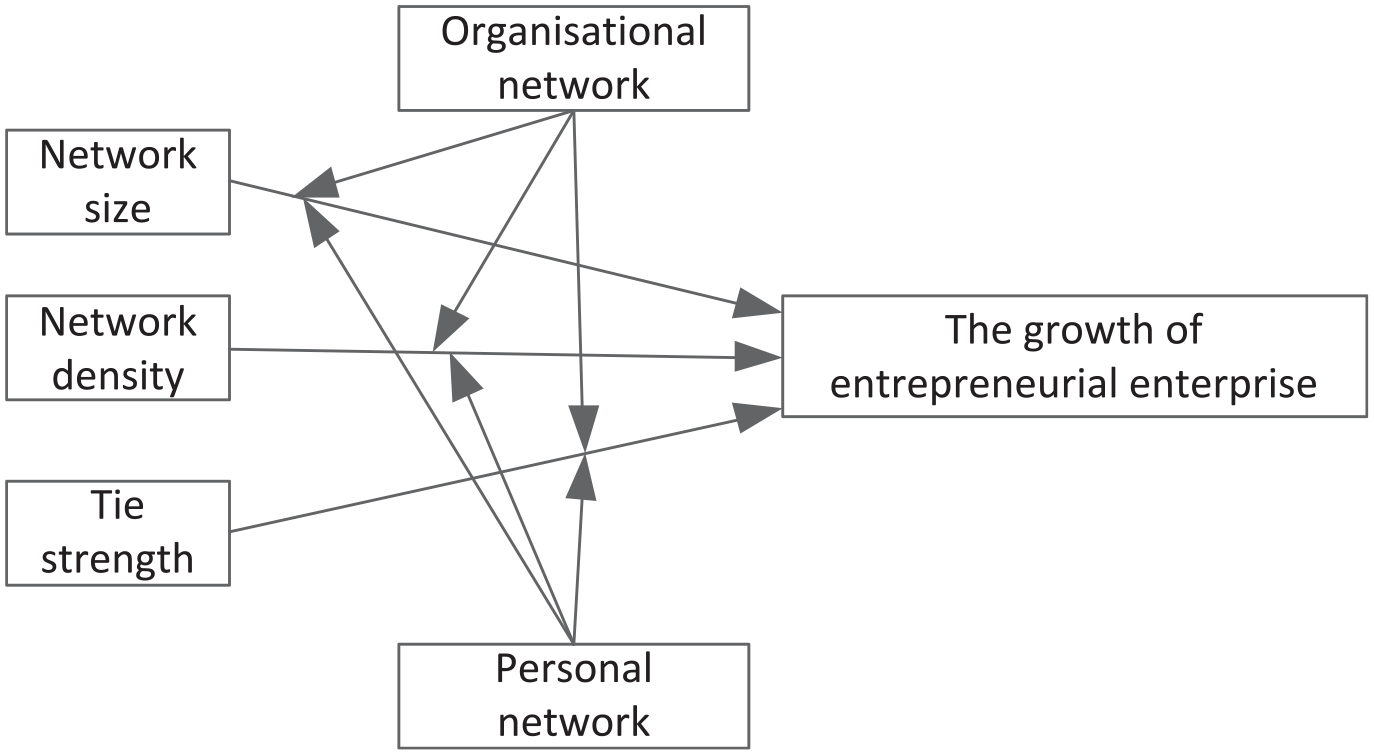
Conceptual model.
Methods
This study employs meta-analysis to research the relationship between social network and the growth of entrepreneurial enterprises. We used the meta-analytic approach for two reasons. Firstly, there are different sounds about the relationship of social network to the growth of entrepreneurial enterprises based on the sight of network type. While meta-analysis is a tool of merger statistics, it can be used to aggregate and process independent research results with the same research objective (Bierwerth et al., 2015; Schwens et al., 2018; Stam et al., 2014; Zhao et al., 2021). The meta-analytic approach can evaluate the total correlation between variables and offer us the size of variables’ relationship. Secondly, the meta-analytic approach has been widely applied in the field of entrepreneurship research by many scholars. It is a new comprehensive literature analysis method combining qualitative and quantitative analysis (Bierwerth et al., 2015; Schwens et al., 2018; Stam et al., 2014; Zhao et al., 2021). Through the secondary analysis of the existing research data, combined with the existing development environment and situation, effective suggestions and solutions suitable for modern development can be obtained. In addition, the number of hypotheses does not influence the application of the meta-analytic approach. There were more than six hypotheses in the previous study by Stam et al. (2014) and Rauch et al. (2016). Their studies also focused on firm performance. As for our study, we set two steps. At first, we define search strategy and inclusion criteria, including network size, network density, tie strength, and the growth of entrepreneurial enterprises. Then, we describe meta-analytic procedures and illustrate selected data that we need to calculate.
Search Strategy and Inclusion Criteria
First of all, we need to define search strategy and inclusion criteria. We followed the idea of Stam et al. (2014) and Rauch et al. (2016) for the study. We used combinations of keywords related to network size (e.g., the size of network, network size, network range, and network scale), network density (e.g., the density of network and network density), tie strength (e.g., network strength and tie strength), and the growth of entrepreneurial enterprises (e.g., firm growth, sale growth, and profit growth). By reading through downloaded references, we got the definitions and measurement indicators of previously selected keywords, expanded the range of keywords combined, and searched databases again until there were no new related references. The search terms help us to collect a number of references and to collect a number of references and understand the relationship between social network attributes and the growth of entrepreneurial enterprises.
Then we set five steps to get related empirical articles that we need. Firstly, we searched official databases: Elsevier Science Direct, Web of Science, Google Scholar, EBSCOhost, JSTOR, and Psyclnfo by combining keywords (Mrabet & Ellouze, 2014). Secondly, we manually went through the principal entrepreneurship, management, and business journals, such as Small Business Economics, Entrepreneurship Theory and Practice, Academy of Management Journal, and Academy of Management Review. This step aims to supplement the scope of reference retrieval and make the retrieval more comprehensive. Because some studies may be unpublished in UTD and FT, but they were already online. And we were searching the selected journals for other cited articles that may be helpful. Thirdly, we searched databases of SSRN, conference proceedings of the Academy of Management and Babson College Entrepreneurship Research Conference, searching for unpublished literature to reduce publication bias. Fourthly, we used the correlation coefficient to respond to effect sizes of network properties, network types, and the growth of entrepreneurial enterprises. This paper tries to use the harmonic average, and the algorithm has been extensively used in the field of entrepreneurship (Rosenbusch et al., 2013; Schwens et al., 2018). Fifthly, if two or more references were used for the same samples, we chose the earlier one. If a reference reported multiple independent samples, we code them several times. Finally, we got 28 quantitative empirical articles containing 31 independent samples with 5,259 observations shown in Table 1, and the retrieval process was illustrated in Figure 2.
Literature Screening Results.


Flow chart of the references search process.
We mainly searched keywords according to the following criteria. At first, we searched the selected combined keywords such as network size and the growth of entrepreneurial enterprise. We ensure the definition and measurement by reading the selected journals. And then, we explicitly include and exclude keywords by reading their definition and measurement carefully. For example, when we searched data on network size to the growth of entrepreneurial enterprises, we used network range to search for related network size references. In reference Ge et al. (2009), network range meant the number of network members, while in reference Collins and Clark (2003), network range meant the different connections or network diversity.
Network size
It reflects the number of relationships individuals maintain in the social network or organization they did business with (Prajapati & Biswas, 2011; Premaratne, 2002). We can measure it by calculating the total number of possible contacts. We used the following keywords: network size (Batjargal et al., 2013; Scholten, 2006), network range (Ge et al., 2009), network scale (J. Yang et al., 2011), breadth of external communication and number of partners (D. Y. Lee & Tsang, 2001), etc. It should note that network range represented the different connections or network diversity (Collins & Clark, 2003), while network size indicated the number of connections(Batjargal et al., 2013).
Network density
It is a proportion of identified contacts present out of the total possible contacts (Premaratne, 2002). We can measure it by calculating the total number of identified contacts divided by the total possible numbers of network members, while the total number of possible ties equals network size. So network density ranges from 0.0 to 1.0. It tended to measure the collective social capital available to all members of the network, which could be divided into sparse and close networks (Ge et al., 2009). Meanwhile, it was measured by the degree to which social networks are closely connected (Hoang & Antoncic, 2003). When the network density was relatively high, all network members communicated and interacted with each other (Liu et al., 2009). The main keywords found in the retrieving process were as follows: density (Bhagavatula et al., 2010; Prajapati & Biswas, 2011; Scholten, 2006), network density (Batjargal et al., 2013; Scholten, 2006), degree (Hansen, 1995).
Tie strength
It is measured by the duration of the relationship, the intimacy of the relationship, the frequency of communication, etc. (Ge et al., 2009; Jenssen & Greve, 2002). Tie strength was related to the communication time and the degree of emotional intimacy and mutual trust of the members of the network (J. Yang et al., 2011). Tie strength usually comes from the closest circle of friends and family members (Cantner & Stützer, 2010), which refers to the direct ties, including trust, reciprocity, embedding, etc. (Granovetter, 1973; Scholten, 2006). We used keywords as follows: network strength (J. Yang et al., 2011), network intensity (Bratkovic et al., 2009; Ge et al., 2009), tie strength (Musteen et al., 2013; Scholten, 2006) etc. We excluded descriptions about weak ties among tie strength.
Organizational and personal network
As for personal network, we chose keywords including CEOs’ external social network (Fernández-Pérez et al., 2016; Musteen et al., 2010), employees’ network (Hemphälä & Magnusson, 2012), firm owners’ network (Manev et al., 2005), and entrepreneur’s network (Klyver & Christensen, 2007). As for organizational network, we chose keywords including firms’ initial networks (Demirkan et al., 2013), entrepreneurial team’s network (Omri & Boujelben, 2015), a network in collectivistic context (Rooks et al., 2014), external partnerships (Gu & Su, 2018). Following with ideas of Turner and Pennington (2015), organizational network also contained alliance networks (Rowley et al., 2000), and cluster ties (Li et al., 2013).
The growth of entrepreneurial enterprises
The success of entrepreneurial enterprises can be measured by survival and growth (Semrau & Werner, 2014), while survival tends to be a minimum criterion of success. Growth is a vital entrepreneurship performance outcome because it confers entrepreneurial enterprises with increased abilities, powers, and profits (Vissa & Chacar, 2005). Prior studies referred to five ways to measure it. They are, firstly, conceptualizing related indicator growth, such as sales growth, profit growth, market share growth, employ/employment growth, organization growth, and stock growth. Secondly, taking the growth rate to measure venture/firm growth, such as sales and profit growth rates. Thirdly, employing growth speed, sales growth speed, new employees increase speed, market share growth speed, and net earnings growth speed. Fourthly, when referring to the growth, scholars collected data by collecting a new venture’s first year’s performance, such as first year and first 5 years. Fifthly, entrepreneurship performance was measured in the venture-growth stage.
To improve coding reliability, the first and second authors both coded the studies. Characteristics of 28 quantitative empirical articles are shown in Table 2.
Independent Samples.

Note. Pub = published; Unpub = unpublished; PN = personal network; ON = organizational network.
Meta-Analytic Procedures
First, we test whether we could research by meta-analysis. We follow the research role of meta-analysis. No less than 20 documents are recommended for inclusion in the analysis. No less than three papers for single group inclusion analysis of combinatorial meta-analysis are used as criteria. We test the statistical heterogeneity of the study with Q statistics. After that, we quantise it with I-squared (I2) to test the effects of heterogeneity among studies. If p-values (p1) < .05, I2 > 50%, indicating that there is heterogeneity (I2 > 75%, the extent of heterogeneity is high), the random effect model is selected. On the contrary, the fixed-effect model is selected (Stam et al., 2014). However, if p-values (p1) < .05, I2 < 50%, indicating a low heterogeneity among studies. That is to say, the research result of these variables is consistent.
Since publication bias may be a serious problem in the meta-analysis (Schwens et al., 2018), we use Duval and Tweedie’s trim and fill tests, Begg and Mazumdar test, and Egger test to test the potential publication bias, in which Duval and Tweedie’s trim and fill tests need to be adjusted to achieve symmetry in the funnel plot. The funnel graph is not symmetric, indicating that the difference between observed and adjusted values is more than 0.1 (i.e., Δr > .1). The Egger test uses the slope of the regression line to represent the normalization effect, and the regression intercept value is significant (i.e., p2 > .1). Begg Mazumdar test uses the level correlation between the effect size and the standard error, and the rank correlation is significant (i.e., p3 < .1). Only when all results of the three tests meet the above values, indicate the existence of publication bias that this study is considered to have a serious impact on publication bias (Schwens et al., 2018).
Results
First, the heterogeneity test results showed that the p-value of the relationship between three network properties and the growth of entrepreneurial enterprises was less than .01. Results of all organizational network properties to the growth in I2 were less than 50%. Most scholars’ current views on organizational network were consistent. I2 of personal network and overall network were almost closest to 75%, so there exists high heterogeneous between these variables.
From Table 3, all results indicated that there was no obvious publication bias.
The results of comparative analysis.

Note. k = the number of samples; N = the number of observations; r = weighted mean observed correlations; 95% CI = 95% confidence interval; p1 = the p-value of test about variables; I2 = the I-squared of heterogeneity test; ik = the number of studies trimmed; Δr = difference between observed values and adjusted values; p2 = the p-value of Egger’s regression intercept test; p3 = the p-value of Begg and Mazumdar rank correlation test.
Next, we assessed the impact of network size, network density, and tie strength on the growth of entrepreneurial enterprises. The overall relationship between the social network and the growth of entrepreneurial enterprises was positively significant (rng = .115, png < .001), it was recognized by Stam et al. (2014). The paper analyzed the significance of the relationship between social network and the growth of entrepreneurial enterprises. Also, social network would be more positively related to the growth of entrepreneurial enterprises in personal network than organizational network (rog = .097 < rpg = .129, pog = .000 < .001, ppg = .002 < .01). Network size and tie strength had a positively significant impact on the growth of entrepreneurial enterprises (rsg = .164 > 0, psg < .001; rtg = .100 > 0, ptg = .002 < .01), while network density had no significant negative effect on the growth of entrepreneurial enterprises (pdg = .901 > .1). Hypothesis 1 and Hypothesis 5 were accepted, while Hypothesis 3 and Hypothesis 4 were rejected.
Finally, network size was more significantly positive related to the growth of entrepreneurial enterprises in organizational network than personal network (rosg = .174 > rpsg = .146, posg < .001, ppsg = .014 < .05), tie strength was more significantly and positively related to the growth of entrepreneurial enterprises in personal network than organizational network (rotg = .077 < rptg = .132, potg = .037 < .01, pptg = .004 < .01). Hypothesis 2 and Hypothesis 6 were supported.
Discussion
In the end, we obtained these results shown in Table 4.
The Results of Hypotheses.

From Hypothesis 1, we find that the impact of network size on the growth of entrepreneurial enterprises is significant positively. This is in line with the many views of the academic community. Fernández-Pérez et al. (2016), Diánez-González and Camelo-Ordaz (2019), Sullivan and Marvel (2011), and others believed that network size determined the scope of activities of entrepreneurs or entrepreneurial enterprises, and it was consistent with the research results of Milanov and Fernhaber (2009), R. P. Lee et al. (2011), and Bergenholtz and Waldstrøm (2011). A larger network opens the possibility of more information and resources for entrepreneurial enterprises. However, it contradicted the results of Hansen (1995) because every time a network member was added to the social network, the overall benefit of the enterprise would be reduced. When an entrepreneur builds a firm, a larger network will not promote growth in the first 3 years (Batjargal, 2005a). A network with a low rate of strangers tended to enhance the growth (Ostgaard & Birley, 1996), and entrepreneurs expanding their network may attract more strangers to join them. Keeping a large network leads to an increased potential for goal and value conflicts among additional network members, and it is challenging to manage effectively (Demirkan et al., 2013). Therefore, there might be a threshold of network size for the growth of entrepreneurial enterprises. When it exceeds this threshold, network size would weaken the effect on the growth and even hinder entrepreneurial enterprises’ growth. Network size extending under this threshold can promote growth significantly. Besides, the expansion of network size is the increase in the network members and the quality.
From Hypothesis 2, we find that organizational network enhances the influence of network size on the growth of entrepreneurial enterprises is larger significant positively than personal network. A larger network contained more information about the top management team’s organizations (Collins & Clark, 2003). Three years after start-up, entrepreneurs should expand their network size into developing businesses (Ostgaard & Birley, 1996). Organizational networks include many types of relationships, such as strategic partners, suppliers, and customers. A larger network size made other customers believe that the current firm might create more possibilities for benefits (R. P. Lee et al., 2011). Besides, organizational network likes to build alliances to increase the enterprises’ performance (Raz & Gloor, 2007). While some scholars might hold different ideas (D. Y. Lee & Tsang, 2001; Musteen et al., 2010). An entrepreneurial enterprise with many founders may have higher opportunities of succeeding (D. Y. Lee & Tsang, 2001), and cooperation with other partners is only for entrepreneurs’ charisma. But personal network may produce contradictions among arbitrary decisions, for example, it may occur complacency, and some information spots could hinder the development of entrepreneurial enterprises (Musteen et al., 2010).
From Hypothesis 3 and Hypothesis 4, it indicated that network density does not correlate with the growth of entrepreneurial enterprises. This conflicts with the ideas of Batjargal et al. (2013), Scholten (2006), etc. Comparing with these studies, differences may come from structural holes embedded into social network. Musteen et al. (2013) took structural holes into the attribute of network density and thought that network density reflected structural holes to a certain extent: High density, few structural holes. Different structural holes may be in the same density network. There was a stronger possibility in a sparse network with many structural holes that provided more heterogeneous information (Scholten, 2006). As for scholars Batjargal (2005b) and Das and Goswami (2019), network centrality, network heterogeneity, or structural holes were embedded into social network, and they positively affected the function of network density to promote the growth of entrepreneurial enterprises. It would be some influences between network density and centrality, heterogeneity, and structural holes. They all contribute to diverse information and resources. From scholar Batjargal (2005b) and his team’s two studies, they concluded two different results. The literature in 2005 held that network density positively correlated the growth, while the literature in 2013 held the opposite. Compared with the different results, maybe family ties and internal ties easily tend to tie strength that influences the function of network density to the growth. We forecast that tie strength may affect the relation between network density and the growth of entrepreneurial enterprises.
From Hypothesis 5, tie strength encourages the growth of entrepreneurial enterprises significantly. Extensive interaction and high trust were conducive to obtaining sufficient, accurate, timely, and useful information (J. Yang & Zhang, 2015), beneficial to developing enterprises’ products (Scholten, 2006). However, some scholars held the opposite view (Bradley et al., 2012; Mahmood et al., 2011; Ostgaard & Birley, 1996; Raz & Gloor, 2007; X. Zhao et al., 2010). Bradley et al. (2012) believed that the information exchanged with friends and relatives overlapped with the information obtained in other ways, and overlapping information raised the cost of its acquirement. Traditional methods by family and friends also reduced the sensitivity of entrepreneurial enterprises to innovation discovery (Bradley et al., 2012). Entrepreneurs preferred to take much time and money to contact others to obtain values, while this connecting cost would counteract the values of strengthening their networks (X. Zhao et al., 2010), it constrained enterprises’ development (Castro et al., 2014). Maintaining tie strength costs much time and money it reduces current assets and strains the capacity of growing businesses. We believed that tie strength also has a threshold to enhance the growth of entrepreneurial enterprises.
From Hypothesis 6, personal network increasing the utility of tie strength in the growth of entrepreneurial enterprises is larger and significantly positive than organizational network. It was the same with the view of many scholars. Many scholars researched personal network’s properties, and either in a personal network or an organizational network, tie strength had a significant positive correlation to the growth. Strong ties helped to obtain much trust among members containing suppliers and customers (J. Yang & Zhang, 2015). Personal network was often closely linked to acquaintances, families, and friends which were usually considered a strong tie (Rooks et al., 2014). Ties in an open network were related to different organizations from each other (Assudani, 2009). An open network was usually along with weak ties (Mahmood et al., 2011) that led the entrepreneurial enterprise to grow slowly. Based on personal network, advice sharing relied on trust among entrepreneurs’ closely individual network, which would decrease the cost of information acquisition (Manolova et al., 2010). Information travelled faster through personal network, and it was easier for a person to identify the valuable and potential suppliers or customers or linkers than an organization to do, and then take time and energy to catch this relationship to apply for creating values.
Practical Implications
From a practical point of view, our research has two considerable implications for managers. These measures are as follows:
First, the network size has a positive and significant correlation with the growth of entrepreneurial enterprises, and organizational network plays a positive moderator between social network and the growth of entrepreneurial enterprises. There exists a threshold of network size when considering its effect on the growth of entrepreneurial enterprises. In the early stage of entrepreneurship, entrepreneurs should take measures to expand their network size. Managers can allow employers to participate in other activities to know more people who may become potential buyers, suppliers, or partners. Then, managers should divide all network relationships into different groups, such as new or old relationships. Besides, managers should hold annual meetings, thank customer meetings, and competitive promotions. They should participate in investment conferences to obtain innovative ideas and get in touch with different partners. Afterwards, they could set up an access system to allow external organizations to register for regular business exchanges. Finally, they should participate in various activities organized by different external organizations and then identify potential buyers or suppliers to establish regular visiting relationships.
Second, tie strength has a significant positive impact on the growth of entrepreneurial enterprises. Tie strength will be more positively significant to the growth of entrepreneurial enterprise in personal network than organizational network. There exists a threshold of tie strength when being given influence on the growth of entrepreneurial enterprises. In the first stage, entrepreneurs should adopt measures to enhance tie strength, and in the second stage, entrepreneurs should take ideas to get sparse networks to get much diverse information and resources. Managers should take certain measures to make network size large when in the early of entrepreneurship and utilize personal network’s function to strengthen its tie strength to enhance entrepreneurial enterprises’ growth. When in the growth of entrepreneurship, managers should keep the current tie strength and dig the potential value of weak ties. At first, managers should permit network members to contact members’ individual networks and keep all network members informed of the progress of projects or other activities in each department. They should also offer extra fees for network members to regularly visit existing and potential contacts, such as their indirect and direct friends. Next, managers should work closely with employees. Every employee is required to turn in a weekly report to the head of the department, letting the head know their behaviour every day. Afterwards, managers should regularly hold monthly meetings where the department head can report monthly work and share information or resources to deepen their relationship through activities. Besides, managers should know the cost of developing tie strengths and maintaining them according to a different relationship. When it appears that contacts cost could not create values for enterprises when keeping much tie strength, managers should change strategies, visit customers regularly, and explore weak ties. Managers should set up a special department to monitor performance and cost generated by entrepreneurs’ personal networks at any time and focus on contacting members who create 80% performance. They can invite these members to participate in annual or other activities and create values by utilizing their status or resources.
Conclusions
A project with insufficient research is investigated, and the influence of network characteristics and network types on the growth of entrepreneurial enterprises is studied. Both network size and strength positively impact the growth of entrepreneurial enterprises, while network density may not correlate with the growth. Also, we find that it plays a moderator role between network properties and growth. Finally, we discuss the causes of these results and put forward theoretical and management enlightenment.
There are some limitations in the study of this paper. Firstly, we explore the relationship of three main network properties to the growth of entrepreneurial enterprises, yet the other network (centrality, network heterogeneity, and structural holes.) are still not researched. Secondly, how network properties influence each other also deserves research.
Given the limitation of our study, the future research scope includes: to conduct a similar study to explore the relationship among centrality, network heterogeneity, and structural holes, to explore the characteristics and mutual influence between the properties, especially tie strength and network density.
Footnotes
Declaration of Conflicting Interests
The author(s) declared no potential conflicts of interest with respect to the research, authorship, and/or publication of this article.
Funding
The author(s) disclosed receipt of the following financial support for the research, authorship, and/or publication of this article: This research was funded by the National Social Science Project Foundation (20FGLB007).
