




Abstract
This study examines the relationships between university graduates’ HEXACO traits and networking behavior for finding a job through job search network size. We integrate individual difference theory and social network theory to explain these links in two manners. We use individual difference theory to demonstrate that graduates with HEXACO personality traits have different job search network sizes, and we apply social network theory to test whether job search network size affect the networking intensity of graduates. The sample of 773 graduates was collected at two points with a 3 months-lagged time. Our results suggest that three HEXACO traits had an effect on job search network size. At the same time, job search network size play role in increasing networking behavior. Specifically, job search network size served as partial mediator in the relationships between HEXACO traits and networking behavior. The findings, theoretical, practical implications, and future research are discussed further.
Keywords
Introduction
Job search is now seen as a necessary component of everyone’s working life because it has become so common and normal. Previous research have revealed a variety of outcomes of job search activities, including a better salary, a positive work environment, prospects for advancement, and positive social connections (Forret, 2014; Lin & Le, 2019). As a result, academics from all over the world frequently focus their attention on the issue of finding employment. Researchers are concentrating on figuring out an efficient job search strategy that not only cuts down on job search costs and time but also assures successful job search outcomes. Prior studies confirmed that networking behavior is an informal job search method and effective career management strategy (Batistic & Tymon, 2017; Forret, 2014; Mowbray & Hall, 2019; Mowbray et al., 2017, 2018). Wanberg et al. (2000) defined networking behavior as contacting other people such as family, friends, or acquaintances to ask for job information. Networking behavior is positively related to a number of job interviews and job offers, employment outcomes, and organization-person fit (Forret, 2014; Lin & Le, 2019). A study of using the network for job search in 27 countries by Franzen and Hangartner (2006) stated that finding a job through social networks is popular. The percentages of job seekers who use the social network are 39%, 51% in Switzerland and Italy, respectively. Although networking contributes to an increase in employment opportunities, it is surprising that many people tend to avoid using this method.
Accumulated research evidence suggests personality traits have been one of the most important factors that influence job seekers’ networking intensity in the job search process (Forret, 2014; Le, 2022; Le & Dang, 2022). Le (2022) demonstrated that people who are high in extraversion are inclined to express a higher intensity of networking than counterparts who are introverted. Lin and Le (2019) found that job seekers with high-emotionality tend to have less networking behavior in looking for a job. Le (2022) studied the effect of personality on unemployed individuals during the job search and evidenced that people who score high on extraversion, agreeableness, conscientiousness, and openness to experience and low on neuroticism express a higher intensity of networking behavior for finding employment. The question which received much attention is why personality can affect job seekers’ networking intensity. Consequently, this seems to make confusion for job seekers and prevents the effort of mentors and counselors in guiding individuals in the job search process. To date, however, the mechanism explaining the effect of personality traits on networking intensity is unclear.
The purpose of this study is to fill this gap by investigating the mediating effect of job search network size on the relationship between personality traits and networking behavior for finding a job. The study uses two theories to construct the research model (Figure 1). First, individual difference theory is employed to explain the effect of personality traits on the structure of job seekers’ social networks. Second, the study will explain the structure of the social network influencing job search networking behavior by social network theory. The current study is the first to use a quantitative research approach to investigate the mediating mechanism between job searchers’ networking behavior and HEXACO personality characteristics in order to find out about job vacancies. Particularly, this study will show the significance of job search network size in the relationship between personality characteristics and networking behavior for finding employment. Our findings will significantly advance our understanding of how job seekers use networking.
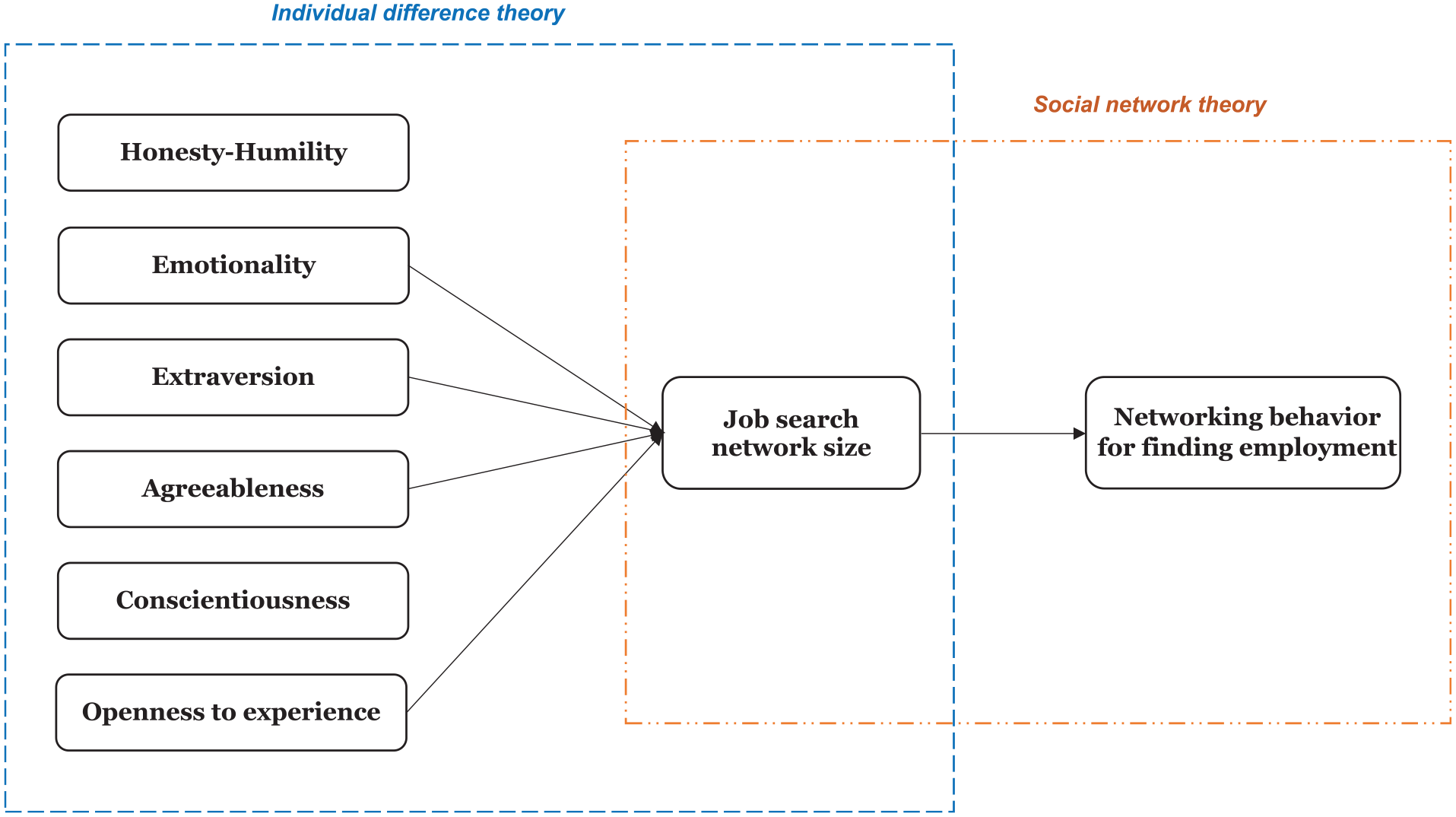
The research model.
Literature Review
HEXACO Model of Personality Traits
Costa and McCrae (1992) introduced the Big Five model or Five-Factor model, which is one of the best-known models for explaining personality dimensions, consisting of extraversion, neuroticism, openness to experience, agreeableness, and conscientiousness. Recently, the HEXACO model constructed by Ashton et al. (2004) emerges as an alternative model to the Big Five model because of interpreting consistently personality traits. Based on lexical research of personality structure in many languages, Ashton et al. (2004) developed six personality traits including honesty–humility (H), emotionality (E), extraversion (X), agreeableness (A), conscientiousness (C), and openness to experience (O) (Ashton, Lee and Visser, 2019). Ashton et al. (2014) defined honesty-humility by five aspects honesty, sincerity, fairness, lack of greed, and modesty. The emotionality dimension is characterized by fearfulness, anxiety, dependence, and sentimentality, which is quite similar to the neuroticism trait of the Big Five model (presented by anxiety, depression, and anger) (Costa & McCrae, 1992). The HEXACO extraversion is presented by expressiveness, social boldness, sociability, and liveliness. Agreeableness is described as forgiveness, gentleness, flexibility, and patience. Conscientiousness trait refers to prudence, and organization, whereas openness to experience is presented by aesthetic appreciation, inquisitiveness, creativity, and unconventionality. Finally, openness to experience is characterized by aesthetic appreciation, inquisitiveness, creativity, and unconventionality. A major difference between the model of HEXACO and Big Five is one specific factor in the HEXACO model, being Honesty-Humility, which was unexplored by the Big Five model. Honesty-humility is characterized by sincerity, fairness, greed avoidance, and modesty. Furthermore, two HEXACO factors (agreeableness and emotionality) were derived from a re-rotation of two Big Five factors (agreeableness and neuroticism) (Ashton et al., 2019). Three factors (extraversion, conscientiousness, and openness to experience) of the HEXACO and Big Five frameworks were highly correlated.
Individual Difference Theory
Individual difference theory states that individual difference is one important factor directly formatting social skills (Costa & McCrae, 1992), organizational citizenship behavior (OCB) and counterproductive work behavior (CWB) (Anglim et al., 2018), and positively contributing to job performances of both individual and group (Fullarton et al., 2014), job satisfaction and career success (Smidt et al., 2018; Sutin et al., 2009). Anglim et al. (2018) confirmed that individuals who are high in the personality trait of honesty-humility, extraversion, agreeableness, and conscientiousness are inclined to show high OCB and low CWB in their organizations. High extraverted people are positively associated with high job performance, particularly in occupations that require social interaction (Fullarton et al., 2014). In the job search context, personality traits significantly influence networking intensity (Le, 2022; Lin & Le, 2019) as well as job search outcomes (Le, 2022; Mai et al., 2020). Lin and Le (2019) demonstrated that job seekers with high extraversion express a high level of networking behavior, while people who are emotionality tend to have a low intensity of networking for looking for a job. This research proposes that personality traits cause the differences in terms of job seekers’ job search network size as well as the tie strength of the social network. Job search network size is defined as the number of people that an individual can contact and exchange information in his social network (Seibert et al., 2001). Cannata (2011) believed that a larger job search network size is beneficial, however, job search tie strength seems to be more important than the overall size. The strength of a tie is characterized by the amount of interaction time, the emotional intensity as well as the level of intimacy (Granovetter, 1973).
Social Network Theory
The social capital literature suggests that social networks can provide members with access to information, knowledge, resources, and technology (Liu et al., 2017). At the individual level, social capital positively influences individual creativity, job performances, and career success (Phelps et al., 2012). At the organizational level, social capital brings information, knowledge, preferential opportunities for new business, and advanced understanding (Del-Castillo-Feito et al., 2022; Fisher, 2013). In the job-search context, social capital can help job seekers to approach job information, and employment positions (Lin & Le, 2019; Shen, 2015). Social network theory explains that people’s social capital is expanded by the structure and compositions of the social network, which is positively associated with networking intensity (Adler & Kwon, 2002). In this current research, we expect that job search network size correlate with the job search networking behavior of job searchers.
HEXACO Personality Traits and Job Search Network Size, Job Search Tie Strength
Lin and Le (2019) indicated that people with high emotionality, in particular, high anxiety appear to lack social skills such as communication, and interaction with others due to they are often socially anxious. Furthermore, those who are emotionally unstable tend to rarely initiate to maintain friendship relationships and frequently have conflicts with others. As a result, they are likely to have fewer social relationships or smaller job search network sizes than counterparts who are emotionally stable. Based on the logical evidence, we propose that job seekers high in emotionality seem to lack communication skills and frequency in connection to others, subsequently, have a small size of the social network.
There is a growing body of literature that recognizes extraversion trait is directly proportional to the scope of social network (Iveniuk, 2018; Molho et al., 2016; Selden & Goodie, 2017; Wagner et al., 2014). Unlike emotionality traits, individuals with high extraversion seem to prefer social engagement and activity, which contribute to developing their social skills (Costa & McCrae, 1992). Compared to introverted people, those who are extraverted are motivated to find out as well as attend social stimuli (Fishman et al., 2011; Li et al., 2010). Moreover, they actively find out social interaction and connect with others (Smółka & Szulawski, 2011). It is unsurprising to see that they have a larger personal network. In addition, agreeable people have smooth personal interaction, which helps them to build and maintain relationships with others (Ozer & Benet-Martínez, 2006). Thus, agreeableness positively influence the size as well as the quality of their relationships, especially friendship. Openness to experience is characterized by aesthetic appreciation, inquisitiveness, creativity, and unconventionality (Ashton et al., 2014). Previous studies evidenced that openness to experience is related to a higher number of social relationships (Molho et al., 2016; Wagner et al., 2014). For example, individuals with high openness to experience tend to be more curious about new experiences and environments and interact with diverse new partners (Wagner et al., 2014), which can increase their number of social relationships. Based on the above logic evidence, we expect that job seekers who are high in extraversion, agreeableness, openness to experience, and low in emotionality are inclined to have a large job search network size in finding employment.
Hypothesis 1: Job seekers with high emotionality are related to the small size of the network.
Hypothesis 2: Job seekers with high extraversion are related to the large size of the network.
Hypothesis 3: Job seekers with high agreeableness are related to the large size of the network.
Hypothesis 4: Job seekers with high openness to experience are related to the large size of the network.
Job Search Network Size and Job Search Networking Behavior
Intuitively, an increase in job search network size or number of people to consult with leads to an increase in networking intensity, despite an unchanged amount of networking effort. For example, Van Hoye et al. (2009) found evidence that job seekers’ time spent on networking is positively proportional to their job search network size (Le & Lin, 2021). Based on the above logic, we propose that job seekers who have larger job search network sizes are inclined to express a higher level of networking behavior than counterparts who own smaller job search network sizes.
Hypothesis 5: Job seekers’ job search network sizes are positively related to their networking behavior for finding employment.
Job Search Network Size as Mediator on the Link Between HEXACO and Job Search Networking Behavior
We argue that job seekers who are high emotionally unstable are likely to lack skills in terms of social communication, interaction, and frequently meet conflicts with others (Demir & Weitekamp, 2007). In contrast, individuals with high extraversion traits seem to own good social skills, and actively develop their social relationships. While agreeable people are positively associated with both the quality and quantity of the social ties because of their smooth personal interaction (Ozer & Benet-Martínez, 2006). Finally, job seekers high on openness to experience tend to be attracted to join the new experience, environment, and relationship (Wagner et al., 2014). Consequently, it is possible to assume that job seekers score low on emotionality and high on extraversion, agreeableness, and openness to experience tend to have a larger size of the social network, which in turn is positively related to the level of networking behavior for finding a job (Lin & Le, 2019). Thus, we hypothesize that:
Hypothesis 6: Job search network size has the mediating effect on the relationship between emotionality and networking behavior for finding a job.
Hypothesis 7: Job search network size has the mediating effect on the relationship between extraversion and networking behavior for finding a job.
Hypothesis 8: Job search network size has the mediating effect on the relationship between agreeableness and networking behavior for finding a job.
Hypothesis 9: Job search network size has the mediating effect on the relationship between openness to experience and networking behavior for finding a job.
Method
Participants
Through the student administrator, we gathered student email addresses. Additionally, we met with students from three institutions in North Vietnam to discuss the study’s objectives and obtain their consent. An email invitation to participate in the survey was sent to 982 bachelor’s degree students (Time 1) around a month before they graduated. After graduating, around 3 months after they took part in Time 1, they would get a new questionnaire (Time 2). At Time 1, the HEXACO personality characteristics, job search network size, and job search tie strength were assessed, whereas at Time 2, networking behavior was measured. We expected that a respectable amount of time would pass before graduates could look for work—3 months. A reminder was sent to everyone who signed up at Time 2. We offered a pre-paid mobile card as a motivation for participation to people who finished two surveys. To guarantee that respondents comprehended and provided accurate answers, survey questions were translated into Vietnamese. We took two procedures to make sure the Vietnamese translations matched the original content accurately. Translating the document into Vietnamese was the first stage. The translation from Vietnamese to English was the following stage. An institutional review board was created to assess the techniques and ethics of the research in order to guarantee the rights and welfare of the people who volunteered to be the study’s subjects. Members of the board served as representatives for the universities. Examining student job seeking strategies after graduation was the major goal of this study. As a result, we were granted approval for this study by the institutional review board.
There were 850 respondents answering the survey questions in the first time (87%). At the second time, 773 of 850 respondents participated in the survey (91%). The survey results showed that 96.4% of respondents are single. Participants had a mean age of 23.22 years, with SD = 0.523. The studying majors were 23% of business administration, 26% of accounting, 18% of finance, 28% of engineering, and 5% of other areas (Table 1).
Summary of the Sample Profile.

Measures
The survey questions included four parts. The first part was to collect demographic information, such as gender, age, marital status, occupation, working experience. The second part contained a 60-item scale of the HEXACO personality traits, including honesty-humility, emotionality, extraversion, agreeableness, conscientiousness, openness to experience. The third part was to measure participants’ structure and composition of the social network, consisting of job search network size and tie strength. Finally, the part included nine items investigating the level of networking behavior for looking for a job. All items in the current study were measured by 5-point Likert scale ranging from 1 = strongly disagree to 5 = strongly agree. Table 2 presented the operational definition of constructs.
Operational Definition of Constructs.

HEXACO Traits
In the current study, we employed the HEXACO model of personality traits developed by (Ashton & Lee, 2009). This model consists of six dimensions such as honesty-humility (H), emotionality (E), extraversion (X), agreeableness (A), conscientiousness (C), openness to experience (O). One dimension was measured by 10 items. In this study, we used 40 items to measure emotionality (E), extraversion (X), agreeableness (A), openness to experience (O). The example statements of emotionality, extraversion, agreeableness, openness to experience are respectively followed as “I feel strong emotions when someone close to me is going away for a long time,”“On most days, I feel cheerful and optimistic,”“I am usually quite flexible in my opinions when people disagree with me,”“I would enjoy creating a work of art, such as a novel, a song, or a painting.” The Cronbach’s alpha of these dimensions were .89, .91, .90, and .89, respectively.
Job Search Network Size
Job search network size reflects the number of relationships for whom job seekers might contact to ask for job information. We applied for four items of Van Hoye et al. (2009) to measure the network size scale. An example statement is “I have connections I can talk to help me find a job.” The reliability coefficient for this scale was .88
Networking Behavior
The scale of networking behavior was measured by nine items designed by Wanberg et al. (2000). An example statement is “Contacted people you know to ask for their advice or leads regarding your job search,”“Called or visited someone just to get more information about a certain job or place to work,”“Asked for a referral to someone who might have helpful information or advice about your career or industry.” The reliability coefficient for this scale was .93.
Control Variables
Based on past studies (Batistic & Tymon, 2017; Le, 2022; Lin & Le, 2019; Van Hoye et al., 2009), gender, age, and university major were used as control variables. Despite having a similar level of networking, men likely have more promotion, and compensation than women (Forret & Dougherty, 2004). As such, gender is related to networking behavior. Besides, Le (2022) suggested that university major affects networking intensity. Job information about accounting, marketing, and business administration seems to be more popular to people than employment vacancies related to engineering or technology. To lower the likelihood of erroneous connections based on unmeasured factors, we added four control variables in our assessment of predictive validity. Graduated students provided information on their age (four categories), gender (0 = male, 1 = female), and major at university (five categories).
Results
In this study, the hypothesized model was tested via the implementation of SPSS 22 and AMOS 22. According to Anderson and Gerbing (1988), two steps will be conducted. The first step was to assess the reliability of the items and the convergent and discriminant validity of the measurement model. Second, after the assessment of the measurement model, the validity of the structural model was examined. In this step, we tested the path coefficient and the mediation effects. According to Kline (2011), indices fit the data well when: χ2/df ratio (the chi-square statistic divided by the degree of freedom) <3, SRMR (standardized root mean square residual) <0.08, TLI (Tucker–Lewis index) >0.90, RMSEA (root mean square errors of approximation) <0.06, CFI (comparative fit index) >0.90.
Assessment of the Reliability, the Convergent and Discriminant Validity
Kline (2011) explained that to test univariate normal distribution, the two most commonly used descriptive statistics are skewness and kurtosis. If the skew is less than three, and the kurtosis is smaller than 8, there is no evidence of univariate normality. The results revealed that the values of the skewness extend from 0.015 to 0.741, while the values of the kurtosis extend from 0.078 to 1.995. Therefore, there is no univariate normality in this study.
According to Hair et al. (2010), Cronbach’s alpha (α) and composite reliability (CR) are two commonly listed values to assess the reliability of the items. Hair et al. (2010) indicated that the value of both Cronbach’s alpha (α) and composite reliability (CR) should be higher than .7. As the results of Table 3, the CR values of emotionality, extraversion, agreeableness, openness to experience, job search network size, and networking behavior were 0.89, 0.91, 0.90, 0.89, 0.88, 0.93, respectively. While the Cronbach alpha value of the items was higher than .8, particularly emotionality (.89), extraversion (.91), agreeableness (.90), openness to experience (.89), job search network size (.88), and networking behavior (.93) (Table 3). Thus, the reliability of the factors was at a very good level.
Confirmatory Factor Analysis.

Note. N = 773. AVE = average variance extracted; α = Cronbach’s alpha; CR = composite reliability; EM: emotionality; EX: extraversion; AG: agreeableness; OP: openness to experience; NS: job search network size; NB: networking behavior.
p < .001.
Next, the convergent and discriminant validity of the measurement model was examined by running the confirmatory factor analysis (CFA). Hair et al. (2010) suggested that the model fit the data well when it has a group of criteria of goodness-of-fit indices as follows: the value of χ2/df is smaller than three, the value of RMSEA is lower than .08, and the cutoff value of CFI and TLI is larger than .90, and p < .05. The result from Table 3 showed that all the values fit the data well: χ2 = 1274.275, df = 870, χ2/df = 1.465, RMSEA = .025, CFI = .980, TLI = .979, and p < .001; the proposed model was acceptable.
To demonstrate the convergent validity of the items, Fornell and Larcker (1981) proposed that the value of the average variance extracted (AVE) is larger than 0.5. Besides, the factor loadings of these items are higher than 0.5, with p < .05. The results confirmed that the convergent validity was quite reliable because the AVE values of emotionality, extraversion, agreeableness, openness to experience, job search network size, and networking behavior were 0.51, 0.52, 0.60, 0.53, 0.64, 0.65, respectively, and the standard factor loadings were larger than 0.50 (p < .001) (Table 3). Besides, Fornell and Larcker (1981) indicated that the constructs have discriminant validity when the inter-construct correlation coefficients of the constructs are smaller than the square root of AVE. The results showed that the constructs of the model had discriminant validity.
Descriptive Statistics
The mean, standard deviation, and correlations between measures were exhibited in Table 4. The results of Table 4 presented that all personality traits were correlated with job search network size. While the personality of extraversion (r = .21, p < .01), agreeableness (r = .23, p < .01), openness to experience (r = .13, p < .01) were positively related to job search network size, emotionality was negatively related to job search network size (r = −.19, p < .01). Besides, all personality traits were found to be correlated with networking behavior, particularly, emotionality (r = −.52, p < .01), extraversion (r = .43, p < .01), agreeableness (r = .28, p < .01), openness to experience (r = .26, p < .01). Finally, there was a strong association between networking activity and the size of the job search network (r = .41, p < .01).
Correlations Among Research variables.

Note. N = 773. SD: Standard deviation.
p < .05. **p < .01.
Hypothesis Testing
Testing the direct effect
In the current research, we used the structural equation model (SEM) to test the direct effect of exogenous variables on endogenous variables with unstandardized and standardized regression weights by using AMOS 22.0 edition. The results of the data analysis indicated that the proposed model fits the data well: χ2 = 1274.275, df = 870, χ2/df = 1.465, RMSEA = 0.025, CFI = 0.980, TLI = 0.979, and p < .001. The unstandardized and standardized regression weights were summarized in Table 5.
Unstandardized and Standardized Regression Weights.

Note. N = 773. Unstand.: unstandardized, Stand.: standardized.
p < .001.
As predicted in Hypothesis 1 to 3, the relationship between emotionality and job search network size (β = .179, S.E = 0.029, p < .001), the relationship between extraversion and job search network size (β = .181, S.E = 0.041, p < .001), the relationship between agreeableness and job search network size (β = .157, S.E = 0.042, p < .001), were significant. Hypothesis 4, however, the effect of openness to experience on job search network size was not significant (β = .060, S.E = 0.028, p > .05).
As predicted, job search network size (β = .202, S.E = 0.025, p < .05) had a positive effect on networking behavior, which is supported to prior research (Van Hoye et al., 2009). Hypothesis 5 were supported.
Testing the Indirect Effect
In the mediation model, it was hypothesized that job search network size and tie strength mediated the relationships between personality traits and job seekers’ networking behavior (Figure 2). We employed the percentile bootstrap confidence interval to examine the mediating effects. Scholars confirmed that bootstrapping is based on multiple replacement resampling to test the indirect effect, which is used popularly (Bollen & Stine, 1990; Shrout & Bolger, 2002). In this line, a confidence interval is applied to confirm whether there is an indirect effect among variables or not. If zero exists in the confidence interval, the indirect effect happens (Kenny, 2018).

The standardized path coefficient of the hypothesized model.
Shrout and Bolger (2002) suggested three conditions 1, The independent variable has a significant total effect upon the dependent variable; 2, The indirect effect of the independent variable upon the dependent variable through a mediator is significant; and 3, The direct effect of the independent variable upon the dependent variable is not significant. If these three conditions are satisfied simultaneously, there is a full mediation. However, when conditions 2 or 3 were met simultaneously, a partial mediation exists.
Job search network size mediates HEXACO traits and job search networking behavior. As is presented in Table 6, the total effect of emotionality (p < .001), extraversion (p < .001), and agreeableness (p < .001) on networking behavior was significant. Besides, the relationship between emotionality, extraversion, agreeableness and networking behavior through job search network size was significant, (p < .001), (p < .001), and (p < .01), respectively. The direct effect of emotionality (p < .001), extraversion (p < .001), and agreeableness (p < .01) upon networking behavior were significant as well. Therefore, it can be concluded that job search network size partially mediates the relationship between emotionality, extraversion, agreeableness, and networking behavior. However, the indirect effect of openness to experience on networking behavior via job search network size was not significant (p > .05). Thus, hypotheses 6 to 8 were supported, but hypothesis 9 was rejected.
Standardized Specific Indirect Effects Among Latent Variables.

Note. N = 773. EM: Emotionality; EX: Extraversion; AG: Agreeableness, OP: Openness to experience; NS: Job search network size; NB: Networking behavior.
p < .001.
Discussion
Based on individual difference theory (Box et al., 2019; Lin & Le, 2019) our study suggests that job seekers with different personality traits might be differentially motivated to use networking behavior for finding employment. However, the existing job search networking behavior literature has mainly focused on antecedents and outcomes, explaining little about how personality traits affect networking intensity. We would like to note that in the current research the correlation among variables might have been tested previously, yet little attention has been paid to investigating the mechanism linking personality traits and networking behavior. Prior studies indicated that networking behavior for employment is positively related to the number of job interviews and offers, employment status (e.g., salary), person-job fit, and person-organization fit (Forret, 2014; Le, 2022; Lin & Le, 2019; Rodríguez-Villalobos & Rangel-González, 2020). However, the absence of studies about mediating mechanisms between personalities and networking behavior may be the reason preventing managers from understanding how to promote job seekers with different personalities to apply for job search networking behavior. We found that the HEXACO personalities had a significant effect on the mediating structure of job seekers’ social networks, which in turn had a significant unique effect on networking behavior for looking for a job. As such, we contribute both theoretical and practical insight to explain why employees are likely to have different social networks as well as different levels of job search networking behavior.
First, we found a negative effect of emotionality on expanding job seekers’ social network size. In particular, emotionality was positively related to the smaller size of the social network. This job search network size then was related to a small level of networking behavior. These findings may help explain why the negative relationship between emotionality and networking was found in the prior research (Lin & Le, 2019). An extroverted person reflects expressiveness, social boldness, sociability, and liveness (Ashton et al., 2014). Consistent with previous research findings reveal that extraverted individuals tend to expand their social network scope for their job search purpose. By social skills and proactive engagement, these individuals are inclined to own a large job search network size, which in turn is positively associated with high intensity of networking. Results of this study also show that an agreeable person was positively related to job search network size, and job search network size had the mediating effect on the relationship between agreeableness and job seekers’ networking behavior. Our findings are consistent with previous research (Demir & Weitekamp, 2007), individuals who have characteristics such as cooperation, sympathy, and forgiveness tend to develop more relationships than their counterparts.
A second key contribution of our study indicated that the HEXACO model is a useful framework for the prediction of job seekers’ scope of the social network of the social relationships. One advantage of the HEXACO model is as a taxonomic structure for traits of building and developing social relationships. All of the HEXACO traits were not equally useful in predicting job search network size. Of the HEXACO personalities, three personalities of extraversion, agreeableness, and emotionality affected job seekers’ network size. While emotionality was found to be negatively related to job search network size, extraversion and agreeableness are positively associated with the scope of the social network.
Last but not least, our findings are consistent with social network theory (Liu et al., 2017) on the role of structure and composition of the social network on networking behavior. The findings reconfirmed that the scope of the social network is positively proportional to networking intensity in the job search process (Le, 2022; Lin & Le, 2019).
Theoretical and Practical Implications
This study has contributed many theoretical implications. First, our results have reaffirmed the relationship between personality traits and informal but effective job search method, networking behavior, by testing a sample of 773 graduated students. In particular, job seekers who are high in extraversion, agreeableness, openness to experience, and low in emotionality are likely to express a high level of job search networking behavior, which is consistent with the previous studies (Le, 2022; Lin & Le, 2019). Besides, our findings contributed to individual difference theory by demonstrating the effect of personality traits on job seekers’ network structure and composition. While emotionality negatively influences the network scope of job seekers, extraversion, and agreeableness might contribute to developing individuals’ number of relationships. Next, our study supported the findings of Van Hoye et al. (2009) and Gee et al. (2017) about the influence of job search network size on job seekers’ networking behavior. Finally, the important contribution of the current study is to explore the mechanism linking personality traits and job search networking behavior through developing network scope. Our study provided a clear understanding of the effect of traits on job seekers’ job search network size, which in turn positively affect the level of networking behavior in the job search process.
Some practical implications can be listed. The current research showed that the relationship between personality and job search networking behavior is more complex than simply a main directional effect. Although recent studies (Le, 2022; Mai et al., 2020) suggest that networking behavior is affected positively for extraversion, and agreeableness but negatively for emotionality, the present study indicates the mediating effects that will help to explain these relationships clearly. Therefore, though individuals who are high on emotionality or low extraversion, and agreeableness tend to express a low level of networking behavior for finding a job, educators, or counselors can find feasible ways to increase networking behavior. For example, our findings indicate that job seekers with high emotionality are likely to be related to a low level of networking behavior, suggesting that if high emotional job seekers are psychologically unstable and have conflicts with others, they may have fewer social relationships who support in finding employment opportunities, which directly reduce their networking behavior. Previous studies suggested that people’s conflict in the task, as well as the relationship, is related to low self-control traits (Hofmann et al., 2012; Jimmieson et al., 2017). Hofmann et al. (2012) offered that some effortful interventions such as self-control, and effortful control play a role as an essential goal-directed behavior in solving such conflicts. Thus, educators and counselors should train job seekers to improve their self-control and reduce the conflicts that hurt their relationships.
Regarding extraversion and agreeableness, our findings indicate that job seekers with these traits tend to have more advantages in developing their social network. Educators should combine instructional strategies for teaching social skills (e.g., communication skills) to reinforce the ability to build social relationships (Seevers & Jones-Blank, 2008).
Limitations and Future Directions
Despite the theoretical and practical implications, there are still some limitations in this study. First, common method variance may be an issue in the current study due to the variables being collected by self-report. An important advantage of this research was that the data was collected at different time points, which supports reducing concerns related to common method variance (Podsakoff et al., 2003) for the main outcome of interest. However, the mediating variables and dependent variables were measured at the same period, which may reduce the advantage of a time-lagged time. The primary reason for common method variance is that respondents may be inclined to provide consistent answers to survey questions due to the variables collected from the same method or source (Richardson et al., 2009; Tehseen et al., 2017). Consequently, the correlation among variables may be inflated or deflated. Therefore, future researchers should collect the data from different sources or employ the participants in three waves to avoid the common method variance and confirm the causality variables.
Second, the limitation of this study might come from the sample who have graduated from universities for 3 months, which reduces the generalizability of these findings. Students who have started the transition from school to the employment market are likely to have fewer social relationships and need skills such as relational skills, networking than people who experience for years (Seah et al., 2011). While family, friends, or relatives are the main relationships of graduates, re-employ employees can contact more relationships such as partners, colleagues, or customers, which significantly influence job information or employment opportunities. Future research could study these findings to re-employ people. Finally, the data was collected and measured at three universities in Vietnam, thus these findings could be limited to generalize for other student samples. The future research direction might study these findings in other contexts. Future research should also choose participants from a wider range of universities and occupations. To increase the generalizability of the study, sample quality should be considered.
Conclusion
By using social network theory and individual difference theory, the present study explained the mechanism linking HEXACCO personality traits and job seekers’ networking behavior for finding employment. To demonstrate the proposed model, the study surveyed 773 graduated students in universities in the North of Vietnam and applied CFA-SEM for data analysis. The results showed that the personality traits of extraversion, agreeableness, and openness to experience had a positive effect on individuals’ networking behavior in the job search process, which is positively related to job search outcomes, while emotionality negatively affects networking intensity. The study indicated that the scope of social networks played a key role in job seekers’ level of networking behavior. Job seekers who own a larger network tend to have more people to ask than counterparts with smaller ones. While at the same job search network size, individuals who keep more close ties are likely to have a high level of networking.
Our findings provided a clear understanding of the effect of personality traits on networking behavior via job search network size. The results explained that individuals who are high in extraversion, and agreeableness tend to have more relationships and larger social networks, which in turn positively affect the level of networking behavior. Finally, job seekers who are high in emotionality have less networking behavior for looking for job information due to they seem to frequently express conflict with others, which negatively influences their relationships and social network size. Our findings illuminate earlier studies on the relationship between a person’s personality and their networking behavior by explaining the mediating mechanism of personality traits and networking through job search network size. It supports job searchers in understanding the benefits and drawbacks of each personal trait in developing both the quantity and quality of social relationships necessary for the job search.
Footnotes
Acknowledgements
To complete the study “The mechanism explaining the effect of HEXACO traits on Vietnamese university graduates’ networking behavior for finding employment,” I would like to say “many thanks” to Vietnam Maritime University, HaiPhong University, Foreign Trade University for supporting and funding me in this study. I am grateful to my supervisor, Prof. Lin Shang Pin as well as my colleagues for helping me during I study. Finally, thank you to all students who participate in the survey of this study.
Declaration of Conflicting Interests
The author declared no potential conflicts of interest with respect to the research, authorship, and/or publication of this article.
Funding
The author disclosed receipt of the following financial support for the research, authorship, and/or publication of this article: This research was funded by Vietnam Maritime University
