




Abstract
As the ability to respond and adapt to crises, we conceptualize and examine organizational resilience through four components (active, temporal, posture, and performance). This multidimensional view of resilience combines the perceptions of senior managers and other indicators including the presence and nature of formal business continuity management. This study examines whether relationships with neighboring firms in a business park substitute wider network relationships. Relationships between locational attributes (locational contiguity within a business park), entrepreneurs’ social networks, and the perceived resilience of small- and medium-sized enterprises (SMEs) in the United Kingdom are examined using data collected from 268 SMEs. Locational attributes are positively associated with organizational resilience (in both aggregated and constituent forms) while revealing an inverse relationship between social networks and perceived resilience. Importantly, the study contributes to a place-based view of resilience to explain why the impact of social networks differs from the positive associations that are found in prior theoretical and empirical work.
Keywords
Introduction
The role of location in the success of small- and medium-sized enterprises (SMEs) has captured the attention of scholars interested, inter alia, in local economic development (Gordon & McCann, 2000; Ybarra et al., 1991) and technology development requirements (Cooper & Park, 2008; Patton, 2014; Sonfield, 2014). Since the time when German supplier parks were established in the late 1890s to serve the nascent automotive industry (Pfohl & Gareis, 2005), supplier/business parks more broadly continue to reflect the clustering of SMEs operating within the same sector. In this article, we investigate perceived resilience in SMEs and the influences of a specific geographical setting (business parks) and the social networks of the firm’s managing director. Organizational resilience represents the ability to respond and adapt during and after a crisis (Sutcliffe & Vogus, 2003). We consider whether and how location influences the perceived resilience of single businesses compared with other previously claimed determinants of organizational resilience.
Studies of social capital have highlighted the importance of social networks in facilitating access to know-how and resources without recourse to formal systems and relationships (Field, 2008) and this is particularly salient in the case of SMEs whose limited resources in general have been found to correspond with a lack of formal preparedness for crises (Herbane, 2019). Despite generally being observed as a large enterprise activity (Järveläinen, 2013), the response and management of SMEs to a crisis through risk management and business continuity management has received more attention of late (Doern, 2016; Herbane, 2019) along with the impact of natural disasters on these organizations (Corey & Deitch, 2011). Such studies, among others, highlight the importance of studying the resilience of SMEs given their vulnerability and economic importance.
The intersections between place, social networks, and perceived resilience are hitherto underexplored in the context of SMEs. Despite the general agreement about the influence of these individual three factors on firms, no prior study has examined the relationship between perceived resilience, social networks, and a firm’s locational attributes (the term used in this study to examine the characteristics of place). To this end, and using data collected from 268 SMEs subjected to the ordinary least squares (OLS) regression generalized linear modeling technique, we address this gap by focusing on SMEs that have their activities based in business parks. By virtue of this, the study explores whether locational attributes influence the type and quality networks and relationships that the entrepreneur/business owner has within and beyond the business park, and how locational contiguity (proximity within the boundaries of a business park) to other businesses has influenced the perceived resilience of the individual business. In referring to the findings of this study, we prefix resilience with perceived to indicate that the measures used combine individual respondents’ evaluations of their organizations resilience and other related constructs. A senior decision maker’s understanding and interpretation of these constructs may shape actions and behaviors that will influence organizational resilience at firm level.
This study makes three important contributions. First, the study examines how locational attributes associate with both aggregated and constituent views of perceived resilience for SMEs located in U.K. business parks. The study offers the scope to extend the place-based perspective of resilience, as an SME’s perceived resilience may reflect locational contiguity with other businesses and the experiences and relationships tied to that location. Second, it further develops the understanding of the nature of the relationship between social networks and perceived resilience as we unpack resilience into four dimensions (active, temporal, posture, and performance). We do so to develop a more comprehensive picture of organizational resilience than has otherwise been the case in the literature. Third, the study examines the firm-level characteristics that may predict SME resilience in terms of these four dimensions of organizational resilience. To develop the three hypotheses to be tested, the article considers the context of the study in relation to crisis management in SMEs, location, and business parks, followed by a review of literature on social networks (including how these are situated within broader conceptualizations of social capital) and its connections with organizational resilience and improved organizational performance. The article continues by presenting the research methodology, the empirical study itself, leading to the discussion, contribution, and implications of the work to our understanding of SME resilience.
Literature Review—Resilience, Location, and Social Networks
Organizational Resilience for Business Continuity
Organizational resilience describes the ability to “adapt to and recover from circumstances that are perceived within the system to fall outside the range of normal and expected disturbances” (Comfort et al., 2010, p. 9). Resilience also incorporates the speed and ability to respond, robustness under “enormous stress” (Coutu, 2002, p. 52), and a rapid and innovative response to a crisis (Boin & Lagadec, 2000) that results in lower downtime and reduced impact and losses to affected organizations. Resilience is not seen as merely a short-term property but as a dynamic one rooted to organizational advantages and dynamic capabilities (Hamel & Valikangas, 2003). In addition to the underlying capabilities of the organization to provide resilience (Sullivan-Taylor & Branicki, 2011), resilience may be actively developed through emergency planning (Crichton et al., 2009). At this point, we note that the concept of organizational resilience does not meet with universal agreement over its constituents and measurements. Indeed, several extensive reviews have highlighted this (including, for example, Annarelli & Nonino, 2016; Barasa et al., 2018; Korber & McNaughton, 2018; Linnenluecke, 2017). Annarelli and Nonino (2016) note that “the literature is still far from reaching consensus about . . . static and dynamic resilience” (p. 10). This study addresses four quadrants in their classification of the academic literature and offers an integrated approach to empirical assessment of the two conceptual continua in the literature, namely, from single organizations to supply networks and industries and from static resilience to dynamic resilience.
To provide an operational basis to explore organizational resilience, we unpack organizational resilience into four dimensions—active, temporal, posture, and performance (Figure 1). Active (i.e., formal) interventions such as business continuity and risk management and temporal dimensions such as experiences and organizational learning, performance benefits, and senior management posture in relation to planning for crises emerge as key themes that underscore the importance and presence of resilience within organizations. Active (i.e., formal preparedness) resilience features in other work on resilience (Somers, 2009) and work that focuses on active approaches such as business continuity management (Herbane, 2010; Järveläinen, 2013; Sahebjamnia et al., 2015).

Dimensions of resilience unpacked.
The temporal dimension of resilience can be an outcome of learning from failures and experimentation (Sitkin, 1992) and can originate from the experiences of the organization itself (which has been found to influence the adoption of formal planning for interruptions in Spillan and Hough (2003)). Building resilience is a learning–planning–responding process, and organizational learning from crisis is a central constituent of change management (Buchanan, 2011) and learning for prevention and improvement (Deverell, 2009). Crucially, managers’ own experiences of a crisis provide inputs into processes of recursive learning (Elliott & Macpherson, 2010). The performance dimension of organizational resilience is associated with improved business continuity and recovery in the event of a crisis alongside reduced operational downtime (British Insurance Brokers’ Association, 2012; Musgrave & Woodman, 2013; Sahebjamnia et al., 2015).
The posture of managers in relation to the commitments and investments in resilience (such as formal crisis management planning, risk management, and business continuity management) has been identified in prior work. For example, the core values and beliefs of senior managers may undermine the potential benefits of formalizing planning for crises (Mitroff & Alpaslan, 2003), thereby making the organization more vulnerable to a crisis. Further research has supported associations between formalized planning for general business activities and crisis management planning (Sheaffer & Mano-Negrin, 2003), and notwithstanding the significant attention on resilience and also the role of social networks in a large firm context within the academic literature, the primacy of the entrepreneur’s influence in a smaller firm context is all the more greater given their personal stake in formation and ownership of the business, and due to the simpler organizational structures that prevail in smaller businesses. Businesses may learn for the crises experienced by others, including those in close proximity (Doern, 2016; Toft & Reynolds, 1997)
Benefits of Locational Contiguity
The salience of place has grown with the concerted focus to understand what makes firms resilient or vulnerable to crises. Prompted by large-scale disasters such as Hurricane Katrina and the New Zealand earthquakes (Battisti & Deakins, 2017; Josephson et al., 2017; Josephson & Marshall, 2016), research has explored the impact of location on organizational resilience. Size and age have been identified as determinants of postnatural disaster survival in the same location, with smaller and younger firms more likely to fail where facility and equipment damage and the loss of employees and inventory had occurred (Sydnor et al., 2017). Furthermore, Mississippi and Christchurch serve as examples of how urban landscapes and their mix of spatial, residential, and commercial spaces are significantly affected by natural disasters (Lee et al., 2013).
A focus on place in the context of resilience thus considers how a firm’s vulnerability is shaped by geographical location in addition to internal and historical firm-level attributes. Underlying our interest in place is the proposition that locational contiguity (i.e., spatial proximity) enables or constrains organizational actions, capabilities, and successes. In addition to the benefits of access to modern and dedicated infrastructure and financial support, scholars have found that the effect of clustering SMEs together influences opportunity recognition prior to innovation (Cooper & Park, 2008), open innovation effects (Oakey, 2013), relationship quality and knowledge exchange (Fang et al., 2010), and mimetic adoption (Delerue & Lejeune, 2012). As Delerue and Lejeune (2012) note, scale, network, and spillover effects may combine to produce agglomeration economies enjoyed by firms that are clustered geographically within business parks, hence the spatial focus of this study on business parks. In 2020, 6.9% of active companies (not in receivership nor dormant) in the United Kingdom had a primary trading address in a business park. Moreover, 61.5% of companies located in business parks are considered to be SMEs in having fewer than 250 employees and turnover of less than €50 million. 1
The spatial level of this study is more focused than the regional or city level of prior work that examines resilience (Albers & Deppisch, 2013; Cabras & Mount, 2016; Kotilainen et al., 2015; Wink et al., 2016). We focus on business parks as they reflect the benefits of agglomerated economic activities that have been central to the development of early urban centers and more recent urbanization (Scott & Storper, 2015) and business parks are an important locational, social, and economic feature of the urban environment. Furthermore, business parks may characterize the industrial competencies and specialisms of the local area (food, biotechnology, space technology, etc.). Business parks have been used as a local and national economic policy instrument to concentrate economic development in specific geographical areas (Dimou, 1994). Ybarra et al. (1991) propose that industrial concentrations such as technology parks enable businesses to generate additional growth and reduce macro-environmental uncertainty, whereas business parks have been associated with a reduction in the urban economic shrinkage in several cities in the United States and Europe (Wiechmann & Pallagst, 2012). In summary, given that context, locality, and resource accessibility have separately been associated with resilience in past empirical and theoretical research, the following hypothesis is proposed:
Social Networks and Organizational Resilience
Our focus on social networks and resilience in this study is informed by Field’s (2008) contention that “the central idea of social capital is that social networks are a valuable asset” (p. 14). The importance placed on networks and relationships is a precursor to two additional dimensions of social capital, namely, norms of reciprocity and the development of trust between actors (Putnam, 2000). With its basis as forms and accumulations of exchange and relationship-centered resources, the importance and value of social capital for organizations is represented through the creation of resource combinations that result in new intellectual capital (Nahapiet & Ghoshal, 1998). Social networks underpin the social capital that has been used to explain how organizations acquire external resources (Inkpen & Tsang, 2005), sustain performance (Danchev, 2006), and enhance performance outcomes in supply chain relationships in contrast to traditional economic contracting approaches (Carey & Lawson, 2011). Forrest and Kearns (2001) add that social capital is important “for what one does with it, or can attain with it” (p. 2141, emphasis added). Industrial districts offer a type of unstructured vertical and horizontal network that has the potential to enable “repeated and enduring exchange relationships between actors in the network” (Inkpen & Tsang, 2005, p. 147) and through which a network of weaker ties (Granovetter, 1973) could develop.
Prior work on community-level risk preparations and postincident recovery has found that social capital and social networks influence positive preparations and outcomes to crises (Aldrich, 2012; Freitag et al., 2014; Magis, 2010; Wickes et al., 2015). Social capital is itself established as an important dimension of social cohesion and subsequent policy action within urban communities (Williams & Shepherd, 2016) and for small businesses (Doern, 2016). Social capital may not necessarily be universally important across businesses and across predisaster, disaster (emergency), and postdisaster phases. Martinelli et al. (2018) found that social capital was most important for small businesses in the emergency phase of the disaster (the 2012 Emilia earthquake in Italy). Their data point to the solidarity of shared experience as salient in instances where social capital is evident. The sharing of the experience, in this case, comes from the geographical proximity of firms to their suppliers and customers.
Social networks and social capital are related but not synonymous. Instead, the attributes of a network precede and determine the quality of information and knowledge that organizations can acquire. Prezelj and Doerfel (2017) assert that resilience is “an adaptive quality of the people and organizations that enact it” that involves, inter alia, “leveraging social networks” (p. 118). As knowledge about enhancing organizational resilience and business continuity management could be lacking or unfamiliar to the managers, social capital theory would posit that such knowledge can be acquired through this actor’s position within a network (Inkpen & Tsang, 2005) and efforts to acquire information and support from networks during a crisis have been noted in prior work (Sutcliffe & Vogus, 2003). Powley (2009) highlights the nonrational and emotional dimensions of networks in the context of organizational resilience and how existing networks may give way to nascent networks as actors use their social capital to “enlarge informational inputs” (p. 1318) resulting in relational redundancy (surplus connections in the actor’s network) that form a safety net to enable recovery, despite the loss of other resources. Johnson et al. (2013) found that networks facilitate rapid access to resources and are important in four formative capabilities for supply chain resilience (flexibility, velocity, visibility, and collaboration). As prior literature has identified potential connections between social networks and organizational resilience, we therefore propose the following hypothesis:
Beyond the potential links between social networks and perceived resilience (i.e., that firms that lack knowledge about organizational resilience may use their networks to acquire such knowledge and attendant resources), empirical associations between social capital, organizational advantage, and performance have been posited (Dimov & Shepherd, 2005; Lengnick-Hall & Lengnick-Hall, 2003) because knowledge, understanding, and trust between actors groups result in a better use of resources and greater effectiveness in achieving organizational goals (Adler & Kwon, 2002; Clopton, 2011). Monavvarian et al. (2013) found that networks (and other dimensions of social capital including trust, social norms, obligations and expectations, and identity) have a positive impact on knowledge management. In a supply chain context, Yim and Leem (2013) identify a strong association with significant supply chain integration (information and resource sharing; collaboration), social capital, and performance. Social capital has also been examined in the context of the internationalization processes of SMEs (Pinho, 2013) and relational embeddedness and performance was a focal point in Batjargal (2003). Given that studies of the empirical association between social capital and performance outcomes have identified moderating effects and with the role that social networks play in the accrual of knowledge and resources through these social structures noted above, in the specific context of the present study, the following hypothesis is proposed:
Method
Participants and Measures
Data were collected through a postal questionnaire sent to the Managing Directors of 1,200 SMEs located within business parks in the United Kingdom during 2014 and 2015. To develop the data collection instrument, an initial item pool was developed to provide multiple dimensions for social networks, locational attributes, and perceived resilience. Pretesting sought to identify whether the rubric and questions were clear and unambiguous in terms of relevance, comprehension, and logic, and a small number of revisions resulted from this exercise to enhance clarity and layout. With the exception of dichotomously scored items, polytomous responses were sought using 5-point Likert-type scales as reliability increases up to a 5-point scale, after which the improvements to reliability are minimal (Hinkin, 1995).
The dependent variable in this study is perceived organizational resilience. Building on the conceptualization of organizational resilience presented above (Figure 1), perceived resilience was measured using a combined score (i.e., index) for active, temporal, posture, and performance dimensions/elements of resilience. The active measures of resilience included the presence of plans for major interruptions, the testing of plans, employee roles, awareness, and training (Stephenson et al., 2010), whether the business had certification business continuity/risk management (such as BS25999 or ISO31000) and/or had been contractually required to have plans as part of its supply chain obligations. The temporal measures of resilience included items that indicated whether the business had suffered a major interruption in the past 5 years, and respondents’ assessments of whether the business had recovered successfully and would be better prepared to do so in the future (Deverell, 2009). The posture dimension included items that indicated whether the respondent had been influenced by media reporting of major business interruptions and whether they believed that interruptions could be prevented or shortened (based on items used by Sheaffer and Mano-Negrin (2003)). Performance measures of resilience included respondents’ assessments of whether the business had benefited from reduced insurance premiums and operational downtime, and from improved overall business performance due to the ability to respond effectively to a major interruption (Musgrave & Woodman, 2013). Because organizational resilience is a multidimensional construct (Stephenson et al., 2010), the study uses several items to indicate the extent and formality of preparedness for interruptions to avoid what the Sheaffer and Mano-Negrin (2003) refer to as “dichotomization of firms into crisis prone and prepared” (p. 586). Lee et al. (2013) propose that measurements of resilience should include a combination of lagging indicators (such as the firm’s prior experience of crisis) alongside leading indicators of resilience that include “processes, actions, and practices that are thought to contribute to the organization’s resilience” (p. 30, emphasis added). For perceived organizational resilience, a higher score indicates a greater presence of active, temporal, posture, and performance dimensions of resilience reported by the respondent—hence reference in the hypotheses to perceived resilience. The use of multiple constructs to measure a specific item reduces both the influence of response bias (Harrison et al., 1996) and a misalignment between perceived resilience and measures of resilience that indicate a successful response to a crisis. Reliability for this measure is good (α = .87) indicating internal consistency (Nunnally, 1978). Furthermore, because correlations between subjective and objective measures of performance have been found to correlate (Powell, 1992), subjective measures within the dependent and independent variable are considered suitable.
Social networks and locational attributes are the independent variables in this study. Subjective measures of interorganizational and interpersonal relationships have been found to be valid measurements in previous studies (Kale & Singh, 2007; Thorgren et al., 2010). To measure social networks, items were developed so that respondents could indicate the scope, quality, and benefits of their networks. This indicates the social embeddedness of the actor (the respondent) with a network and measures the perceived benefits gained by the actor as a result of their place within a network (Inkpen & Tsang, 2005). Network scope captured the extent to which respondents belonged to associations, groups, and other networks, along with their assessment of whether their personal network was large. Network quality comprised items that evaluated the quality of networks in pursuing activities to reduce their operational vulnerability along with the role of staff networks and reciprocity in network quality. Network benefits were determined by several items measuring the extent to which the respondents’ networks gave them access to information, physical resources, expertise, or support that they would not otherwise have access to. The composite of these network attributes is used with higher scores for this measure indicated a larger and more beneficial network. Reliability for this measure is very good (α = .90). Locational attributes was measured using items that focus on the firm’s location in a business park (specifically location value, history, and experience), thereby providing some measures of characteristics relating to the immediate place of operation. Specifically, respondents were asked to indicate whether the decision to locate to a business park was taken with resilience in mind (i.e., historical assessment of locational resilience), and a current assessment of the extent to which the business park location is considered to be resilient. Respondents were also asked whether the business park had been the location of an interruption in the previous 5 years that had not affected the firm itself, and whether the respondent was influenced by major interruptions encountered by nearby firms. For this measure, higher scores indicated a higher importance of location in the context of organizational vulnerability or otherwise to a crisis. Reliability for this measure was acceptable (α = .70). The items used to measure the dependent and independent variables, along with their correspondent aggregation into the variables of resilience, social networks, and locational attributes, are shown in Table 1.
Variables, Dimensions, and Constituent Items.

The regression models presented in the next section include five control variables: firm age, number of employees, respondent age, respondent gender, and the number of computers (including laptops and tablets computers owned by the business to proxy technology intensity). These variables were included to control for their effect on the main variables in the study. The demographic characteristics of respondents’ gender and age, along with the number of employees, are included due to their primacy in SME research. Firm age is included as the longer operational history of a business may present a greater number of opportunities to accumulate exposure to crises (Vargo & Seville, 2011). Technology intensity is included because of the long-standing association between information technology and formal disaster recovery planning (DRP) in larger firms (Herbane, 2010) and the association between technology threats and formal interventions in business continuity resources and processes (Niemimaa et al., 2019).
Data Collection and Response
A cross-industry sample was derived from the Bureau van Dijk FAME database and the inclusion criteria for firms were that they needed to have fewer than 250 employees, turnover less than £41m/€50m, and their location would be a named business/industrial/science/technology park or trading estate (where at least five additional businesses could be identified). This screening process produced a sampling frame with a total of 1,965 firms, each with a named Managing Director. The final questionnaire was mailed to a random selection of 1,200 companies in the sampling frame database, followed by a reminder after 2 weeks. A total of 100 questionnaires were returned to the researcher as undelivered indicating that databases may lag a little behind actual firm relocation or closure at a particular address. Responses were received from 268 firms representing a response rate of 24.4% which compares favorably to other studies that suggest that questionnaire response rates from owner managers and executives are usually in the 10% to 15% range (Wales et al., 2013). Following Armstrong and Overton (1977), checks were made for nonresponse by comparing a sample of responses from early responders and late responders. No statistically significant differences were found. Further comparisons were made for firm age and the number of employees between 100 respondent firms and 100 firms from the sample frame that had not been sent a questionnaire. Using independent samples Kolmogorov–Smirnov tests, no significant differences between respondent and nonrespondent firms were found.
To address the issue of common method variance (CMV), we used ex ante measures relating to questionnaire design an administration and ex post statistical measures (Chang et al., 2010). Specific ex ante measures employed and recognized to remedy CMV were assurances of anonymity and confidentiality, a glossary of terms to prevent ambiguity or misinterpretation, different scale formats for dependent and independent variables, and the inclusion of factual variables (Brannick et al., 2010; Chang et al., 2010; George & Pandey, 2017). Ex post measures to mitigate the potential for CMV include complex model specifications that go beyond respondent’s cognitive maps (Chang et al., 2010) and the interpretation of near-zero or nonsignificant correlations as indications that CMV is not present (Brannick et al., 2010). Furthermore, we argue that CMV is not problematic in this study because the variables involve the perceptions of the same group—the senior-most manager of the SME, often referred to as the “owner-manager” or “entrepreneur” (Friedrich et al., 2009). Indeed, there is support for the use of a self-reported instrument as perceptual variables can only be measured through surveys (Brannick et al., 2010; George & Pandey, 2017; Meier & O’Toole, 2013). Temporal separation of measurement would not have not have been appropriate as the focus is on the relationship between current perceived organizational resilience and perceptions relating to predictors. As noted above, and following Podsakoff et al. (2003), we incorporated methodological separation of measures by using different response formats between independent and dependent variables.
Results
Descriptive statistics and correlations are presented in Tables 2 and 3. Intercorrelations are well below the .7 level that might indicate the presence of multicollinearity and the variance inflation factors (VIFs) for each regression model are at acceptable values. Furthermore, tolerance indices are no smaller than 0.37, thereby further indicating that multicollinearity is not observed as a problem. Hypotheses 1, 2, and 3 were tested using three OLS regression models, presented in Table 4. OLS was used to analyze the relationship between the independent variable and the dependent variable. The scales used prevent outliers and multicollinearity is not evident. By specifying a simple model with a large number of observations, the proneness to overfitting is considerably reduced. The F statistics for all three models are significant (p < .001) and the results show that the models explain between 17% and 36% of the variance in perceived resilience.
Descriptive Statistics.

n = 268.
Number of devices.
Correlations.
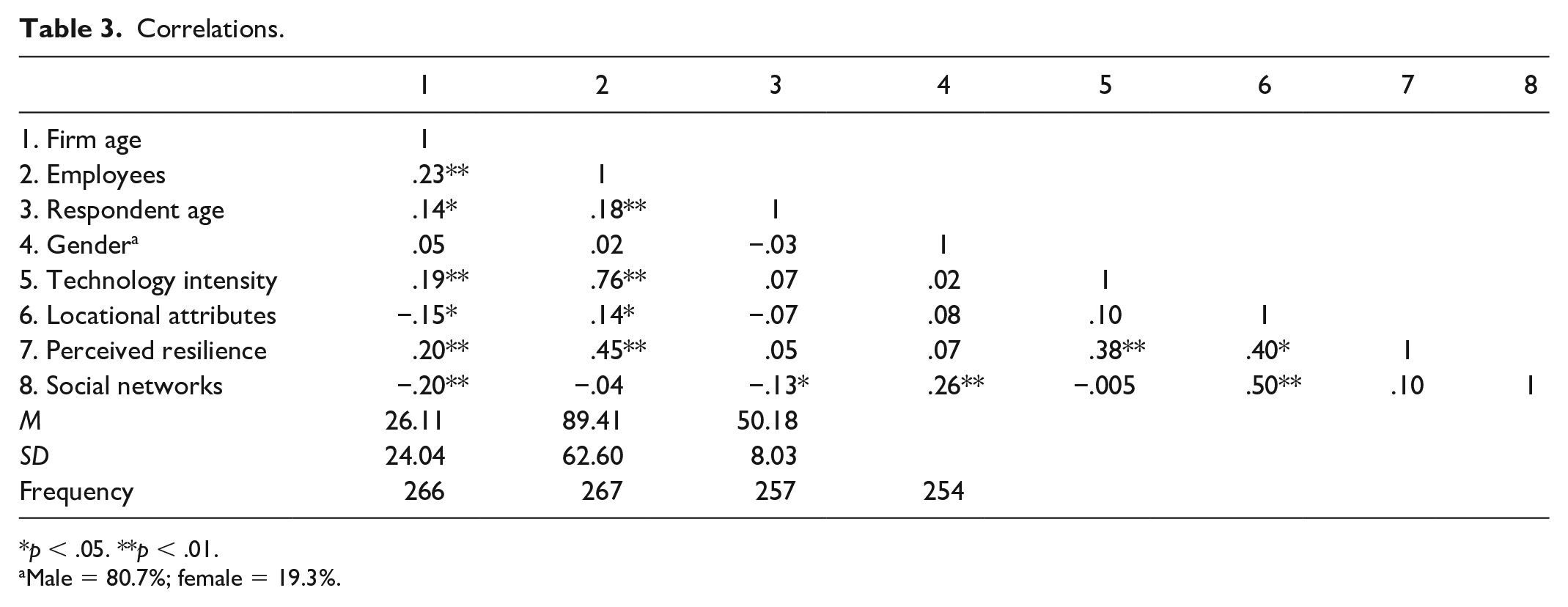
p < .05. **p < .01.
Male = 80.7%; female = 19.3%.
Ordinary Least Squares Regression Results: Predictors of Perceived Resilience.
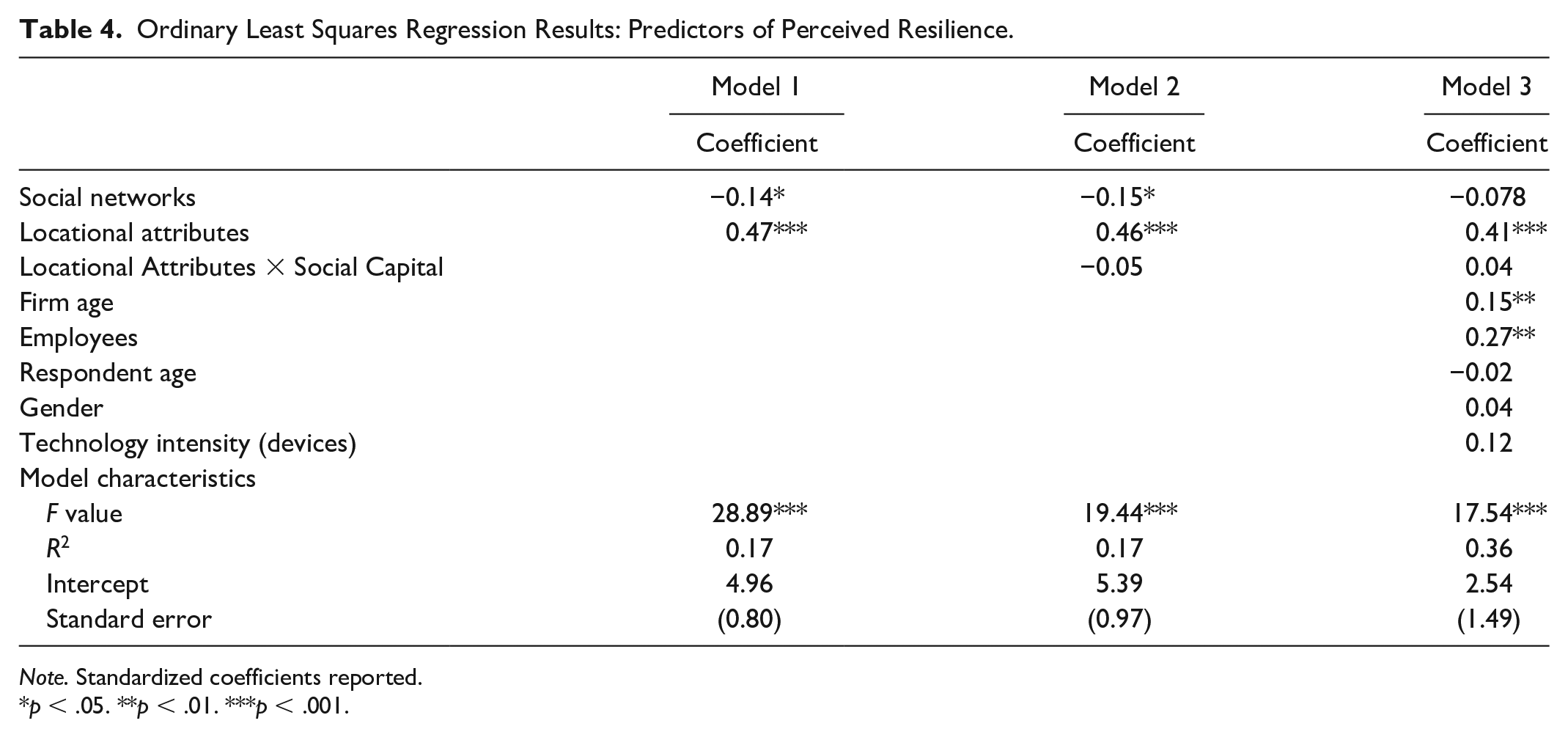
Note. Standardized coefficients reported.
p < .05. **p < .01. ***p < .001.
Hypothesis 1 predicted that there would be a significant positive relationship between locational attributes and perceived resilience. Model 1 regresses perceived resilience on social networks and locational attributes and shows a positive significant relationship between local attributes and perceived resilience (β = 0.47; p < .001) but the negative standardized coefficient for social networks indicates an inverse relationship in which higher values for social networks are associated with lower values for perceived resilience (β = −0.14; p < .05). Model 1 provides support for Hypothesis 1 but Hypothesis 2 that predicted a significant positive relationship between social networks and perceived resilience cannot be supported. Correspondingly, Model 2 confirms that the hypothesis (H3) that social networks will enhance the relationship between locational attributes and perceived resilience cannot be supported (β = −0.05; p > .05). Of the five control variables, the number of employees (β = 0.27; p < .01) followed by firm age (β = 0.15; p < .01) contribute to perceived resilience, whereas respondent age, respondent gender, and technology intensity do not (Model 3). In the presence of the control variables in Model 3, social networks are no longer significant.
Additional regressions were computed (Table 5), this time using the separate dimensions of resilience (active, temporal, posture, performance) as the response variable to examine whether the explanatory and control variables were significantly associated with these individual dimensions of resilience and thereby examine the possibility that some of the variables might be statistically significant determinants beyond the models that use an aggregated perceived resilience outcome variable (Models 1–3). Models 4 to 7 in Table 5 (p < .001) show that no single variable has a significant relationship across all four dimensions of resilience. The significant negative relationship of social networks remains for active resilience (β = −0.16; p < .05) but not for temporal, posture, and performance dimensions of resilience. Locational attributes continue to play a vital role in temporal (β = 0.52; p < .001), posture (β = 0.35; p < .001), and performance (β =0.17; p < .05) dimensions of resilience, but not for active resilience.
Predictors of the Four Dimensions of Resilience.
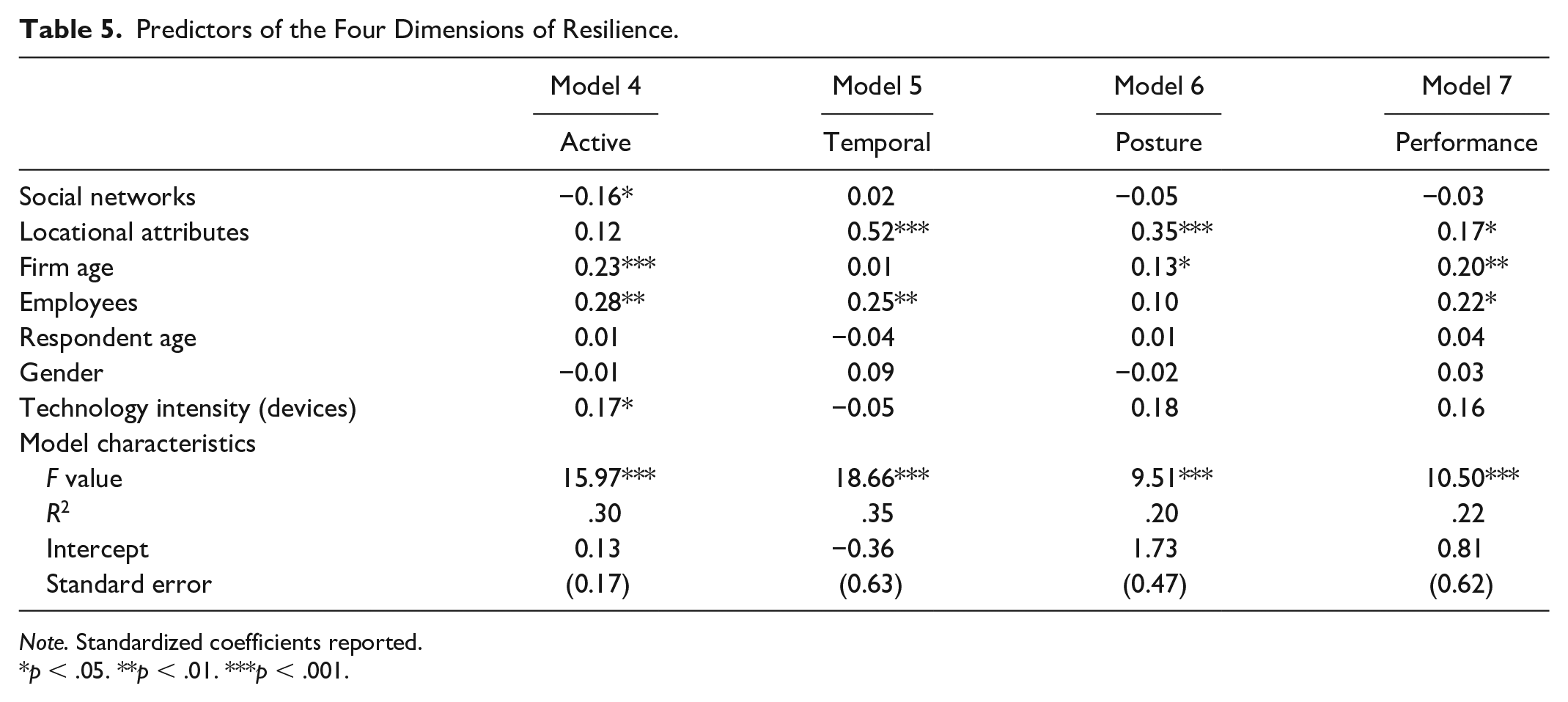
Note. Standardized coefficients reported.
p < .05. **p < .01. ***p < .001.
Firm age was positively associated with active (β = 0.23; p < .001), posture (β = 0.13; p < .05), and performance (β = 0.20; p < .01) dimensions of resilience but not temporal resilience, and the number of employees was significantly and positively related to active (β = 0.28; p < .01), temporal (β = 0.25; p < .01), and performance (β = 0.22; p < .05) dimensions of resilience. The only remaining control variable to be significantly related to any of the dimensions of resilience was technology intensity (β = 0.19; p < .05), specifically in relation to active resilience. Locational attributes explain more of the variation in temporal and posture dimensions of resilience (Models 5 and 6), whereas the number of employees is the leading contributor for active and performance dimensions of resilience (Models 4 and 7).
Discussion
Given separate theoretical and empirical associations of firm location and social networks with the performance and growth of SMEs, along with the increasing attention placed on organizational resilience in the SME context, this study was motivated to explore the contribution of locational attributes (locational contiguity) and social networks to perceived organizational resilience. The study developed a measure of perceived resilience that combined four dimensions (active, temporal, posture, and performance) to recognize and explore the multifaceted nature of resilience both theoretically and in terms of firms’ resources and capabilities to respond and recover from a crisis. Once again, we note that we refer to perceived resilience to indicate that the measures used combine individual respondents’ evaluations of their organizations resilience and other related constructs.
Given the important antecedent role of social networks in the formation of social capital, the results of this study support prior empirical work that has not found a strong or positive relationship between social capital and improved performance (Rhodes et al., 2008; Silkoset, 2013). In this case, performance takes the form of higher perceived resilience. Although Hypothesis 2 was proposed because it reflected a popular (but not universally shared) view of social capital as widely and significantly beneficial to organizations, the findings should not be interpreted as cause to dismiss the value of social capital outright. Rather, the importance of location (and in this case the locational proximity of being located in a business park) is not as duration-dependent as social capital (Rhodes et al., 2008) and the importance of social capital may be lessened when a business is located in a business park. Location has an immediacy that contrasts with the more gradual development of networks and relationships that underpin social capital, and thus a commitment to social interaction between firms located in business parks that could enhance the capacity to cope with, and recover from, a crisis. Insofar as the perceived resilience of the individual organizational is concerned, and reflecting Forrest and Kearns (2001) distinction between “neighboring” and “neighborhoods,” local weak network ties (and potential ties) may be more important than strong ties from a more spatially dispersed network—a case of “close-by weak ties.”
By examining the association between social networks (as measured by network attributes of scope, quality, and benefits) and perceived resilience, our findings provide empirical support for a cautious treatment of social capital (Inkpen & Tsang, 2016; Martinelli et al., 2018). In a nano-region such as business park, the negative sides of social networks in terms of costs and blind spots may not arise because businesses are not necessarily directly connected to others in operational and competitive terms. Adjacency may be coincidence rather than intentionally commercial in nature. Again, some caution is required as recent work asserts that dysfunctional social identification (where identity with the social unit is shaped by a shared fate) negatively affects individual and collective information acquisition and learning (Pillai et al., 2017). Such effects are possible where firms in a business park may internalize a self-definition of “neighbor” or “resident.” Despite the rejection of Hypothesis 2, this finding may not indicate that the negative side of social capital is evidenced here. Instead, from both a theoretical and empirical standpoint, we see that social capital matters less, or indeed little, when we unpack resilience empirically (into four constituent dimensions) for SMEs located in U.K. business parks. One further explanation for the prominence of locational attributes over social networks may be the desire of respondents not to leave resilience-related activities to the uncertainties of the network beyond the immediate location which could be less valuable than those close by (for operational and experiential reasons). This would offer an explanation for the inverse relationship between social capital and perceived resilience in Models 1, 2, and 4, and the positive association of locational attributes and perceived resilience in Models 1, 2, 3, 5, 6, and 7.
Counterintuitively, the rejection of Hypothesis 2 is explained by the same literature that it appears to challenge. For instance, the concept of cohesion (Aarstad et al., 2010) is predicated on the notion that cohesion improves with the concentration of alternatives. This could well be the case with SMEs located in business parks in which neighboring firms are concentrated both geographically and numerically in proximity to the firm, thereby emphasizing the importance of this form of locational contiguity relative to wider network relationships. Granovetter’s (1973) concept of the strength of weak ties highlights the importance of peripheral rather than close/central network relationships (acquaintances vs. friendships) in providing access to information and, by extension, resources that would not ordinarily be accessible. An SME located in a business park may be acquainted with its neighbor because of the sheer practicality of locational contiguity but their relationship is weak in comparison with the owner-manager’s networks elsewhere. Location as a bridge potentially plays an important role in the diffusion of information that is a precursor to the temporal, posture, and performance dimensions of resilience.
The limited implementation of active dimensions of resilience (through risk management, business continuity management, etc.) indicates that they may not be considered a strategic priority compared with other management processes (Chen & Hung, 2014) that rely or benefit from social networks for successful implementation. Only 17.9% of firms in the study (n = 268) indicated that they had put formal plans in place to deal with business interruptions as a result of the contractual requirements of a customer and only 6.3% of firms in the study (n = 268) indicated that they had certification for BS25999 or ISO31000 standards. Models 4 to 7 show that social networks are only significant in the active dimension of resilience, suggesting that the relationship between the strategic importance of formal business continuity/risk management processes and social networks should be explored further in future studies. Although prior studies suggested that social networks have moderating effects, a positive and significant interaction term between social networks and locational attributes is absent, resulting in the rejection of Hypothesis 3. Although networks and relationships are said to prevent isolation (Galunic & Moran, 2000), insofar as perceived resilience is concerned, the locational contiguity within a business park may provide opportunities for knowledge exchange, reciprocity, and shared experiences between businesses.
The link between firm size and crisis preparedness is consistent with Sheaffer and Mano-Negrin (2003), although this earlier study focuses on what here is referred to as active and posture dimensions of resilience, and the findings also corroborate the link between firm size and resilience reported in Corey and Deitch (2011). The finding that the number of employees is the leading contributor for active and performance dimensions of resilience (Models 4 and 7) reflects the idea that with firm size comes greater formalization of roles and activities (active resilience) related to business continuity and risk management planning, and an enhanced ability to respond because of the availability of a greater pool of staff in the event of an interruption (performance resilience). The respondent characteristics of age and gender are not significant in any of the five regression models in which they are entered and, coupled with the association of social networks to only one of the dimensions of resilience (active), this suggests that perceived resilience for the SMEs in this study is predicted by firm-level characteristics (location, age, size) rather than senior manager-level characteristics.
While firm location will influence exposure to threats such as flooding, power and telecommunications outage, and transportation interruptions, it is firm-level resources, capabilities, rigidities, and leadership that influence the vulnerability and impact of such threats. Despite the influence of place in a firm’s vulnerability to an interruption, its influence on perceived resilience is hitherto less well understood. The inclusion of locational attributes (and, specifically, respondents’ perceptions of how it relates to organizational resilience) in this study has allowed us to explore how locational contiguity is central to a multifaceted understanding of organizational resilience in SMEs. The primacy and contribution of locational contiguity to both the aggregated and constituent views of resilience underscore a place-based perspective on organizational resilience in SMEs.
The place-based perspective on organizational resilience configures components of resilience across three planes—the network plane, the location plane, and the organization plane. In Figure 2, we bring together the four dimensions of resilience unpacked prior to the data analysis, the significant positive influence of firm-level attributes such as firm age, employees, and technology intensity, and show how they are connected to and influenced by social networks and locational attributes. Such a perspective emphasizes how location continues to shape the development and progression of resilience. This study posits locational contiguity as a contributor to organizational resilience and as potentially beneficial in resolving ambiguities about how SMEs can prepare for and respond to a crisis.
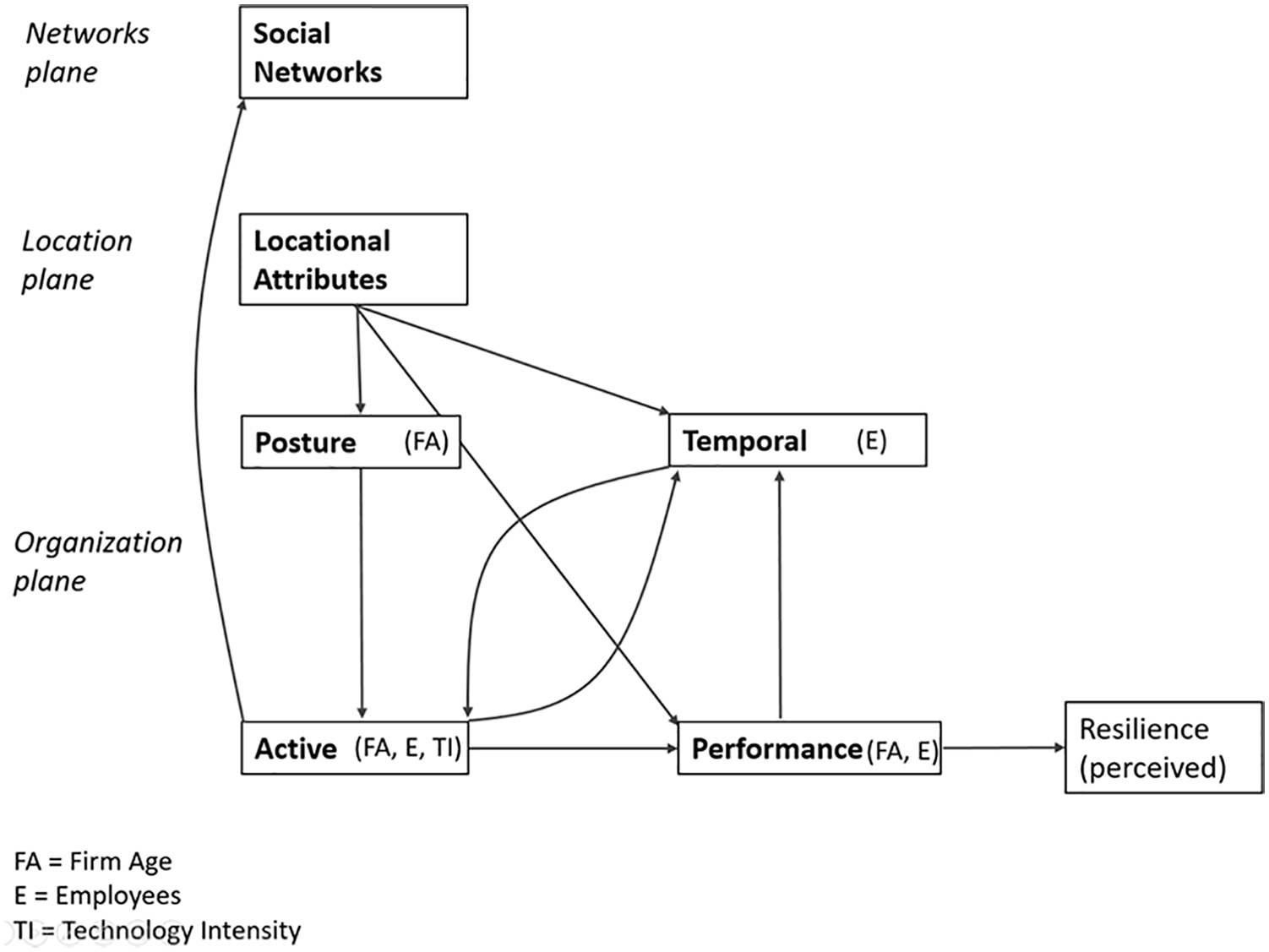
A place-based perspective on organizational resilience.
Limitations of the Study and Future Research
As we noted earlier, our focus and the measures used relate to perceived resilience. Although the hypotheses and measures were derived from antecedent literature, the nature of the data collection instrument necessarily makes the number of measures used for each variable narrow and the cross-sectional research design does not allow for the depth of insights that a longitudinal research design would provide. The latter would provide further insights into the dynamics and causal directions of the relationships identified in this study (especially, social networks and organizational resilience following a crisis). Driven by the findings presented here, such as study is now underway. Likewise, the sample and inferences that follow are limited to the United Kingdom alone given the possibility of large differences across SMEs between countries (Parnell, 2015).
Conclusion
As resilience is also a coproduced property of social, ecological, and governance systems in a locational context (Zaidi & Pelling, 2015), we contribute to the nascent place-based perspective in which resilience is integrated into urban policy and practice in the act of place-shaping (Coaffee, 2013) and in which the resilience of place arises from iterations of community learning to face, respond, and adapt to uncertainty (Mehmood, 2016). Place-specific factors have been associated with regional economic resilience (Fromhold-Eisebith, 2015) and clustering has been found to be influential in the types of relationships that firms have within their sectors, thereby influencing longer-term economic resilience (Elola et al., 2013). Given the direct impact of a crisis on the longer-term resilience and survival of a business, this study provides important insights into a precursor to longer-term, place-based resilience within what Wagenaar and Wilkinson (2015) characterize as an “urban policy discourse” (p. 1265). The increased complexity associated with urban space from a socioecological perspective (Wagenaar & Wilkinson, 2015) extends to businesses’ growing reliance on shared critical infrastructure such as roads, information and communications technology, and utilities, and thus their vulnerability to interruption arising from the damage or loss of such resources.
The increased recognition of SME resilience for local, regional, and national prosperity underscores the importance of the context into which this study makes a contribution. When referring to SMEs, the U.K. Government’s Civil Contingencies Secretariat Corporate Resilience Strategy emphasizes this succinctly—“their resilience matters” (Cabinet Office, 2013, n.p.). The analysis presented in this study reveals that insofar as perceived resilience is concerned, locational contiguity is more positive and influential than the sense of connectedness through wider networks and relationships which have a limited and negative association with perceived resilience. Of course, this cannot be interpreted as a complete rejection of the importance of social capital for small firms per se, but rather that there is a more muted influence upon in the ability to respond and recover from a crisis. This study does not suggest that others have overstated the importance of social capital in relation to the organizational performance of SMEs but rather that in the specific case of perceived resilience, further evidence and study is needed to develop our understanding of whether and how social networks (as an important precursor to social capital) support efforts to reduce the likelihood and impact of a crises. Importantly, the place-based perspective on organizational resilience for SMEs that is supported from the findings of this study develops contemporary thinking about urban space, social networks, and organizational resilience. For policy-makers—not least those with an interest in understanding the benefits of geographical proximity for SMEs—the study could add a further rationale for geographical clustering beyond direct economic benefits, namely the potential to enhance resilience against acute threats and to develop and enhance resilient places (Mehmood, 2016). In doing so, this study helps to bridge the gap between conceptual and practical understandings of resilience in both organizational and locational contexts (Albers & Deppisch, 2013). All studies have limitations and this one is no exception. Accordingly, more research is needed to validate the results to further understand locational contiguity and business continuity in an SME context. Nonetheless, these findings provide an important step in understanding the underlying dimensions of SME resilience and the factors that determine not only their ability to respond to a crisis, but ultimately their survival.
Footnotes
Declaration of Conflicting Interests
The author(s) declared no potential conflicts of interest with respect to the research, authorship, and/or publication of this article.
Funding
The author(s) received no financial support for the research, authorship, and/or publication of this article.
