




Abstract
The coronavirus virus (COVID-19) epidemic has swept the world, with the World Health Organization defining it as a pandemic on March 11. This in turn has affected the approaches and methods used in education throughout the world. According to United Nations report, by the time of mid-April 2020, 94% of learners in more than 200 countries around the world have been affected, and 1.58 billion students from pre-school to higher education are affected. In response to increased learning needs regarding infection prevention, the Ministry of Education has also provided cloud educational resources and private online learning resources, platforms, and tools to schools at all levels to encourage teachers and students to make effective use of digital resources. Although the government provides abundant teaching resources, the implementation of distance teaching in college physical education still faced with many problems, such as the shortage of course resources, the lack of information literacy of teachers, the difficulty in implementing conventional teaching plans online, the limited conditions for students to exercise at home, and the doubts about online physical education. Therefore, this study proposes a new teaching method, and studies, analyzes and discusses this method. The method of experimental design was adopted in this study to divide the students into two groups: blended learning group (synchronous and asynchronous) and single type learning group (synchronous). The results show that blended learning students perform better than single type learning students in all these aspects, which proves the practicability and effectiveness of the proposed method.
Keywords
Introduction
The coronavirus virus (COVID-19) epidemic has swept the world, with the World Health Organization defining it as a pandemic on March 11. This in turn has affected the approaches and methods used in education throughout the world. According to United Nations report, by the time of mid-April 2020, 94% of learners in more than 200 countries around the world have been affected, and 1.58 billion students from pre-school to higher education are affected. As the first reported pandemic region, China has borne the brunt of the pandemic, and the lives and health of its people have been seriously threatened (United Nations, 2020). According to National Bureau of Statistics of China (NBSC), its 3,031 million college students, the largest number of higher education students in the world, coming from 31 provinces, cities, and municipalities, must rely on various means of transportation and travel through different administrative regions to reach their colleges and universities (NBSC, 2020) with such large-scale migration activities, their risks of infection are considerable. Therefore, an educational policy was issued by China’s Ministry of Education (MOE) on February 12th, 2020, to ensure learning continues when classes are disrupted in response to the pandemic. Teaching can be conducted using synchronous and asynchronous distance-education methods. In addition to the online teaching systems of individual schools, teachers can also teach through live broadcast software (MOE, 2020). Furthermore, in response to increased learning needs regarding infection prevention cloud educational resources and private online learning resources, platforms, and tools to schools at all levels were provided by MOE to encourage teachers and students to make effective use of digital resources.
Distance learning provides learners with diversified learning scenarios and novel learning experiences. It has a variety of course information and online learning resources, which effectively promotes personalized learning and makes up for the time and space limitations of classroom learning. With the wide application of online learning, it becomes more and more important to evaluate the effect of it. According to different online learning environments, distance learning can be divided into three types: synchronous learning, asynchronous learning, and blended learning. Each of these three methods has its own advantages, and conditions like the subject’s characteristic, or even, the objects’ and their class schedule, their information competency, computer equipment, and network environment, should be considered while choosing the best way of teaching. Since the progress and development of information technology has removed the barriers to knowledge sharing, the use of distance learning has evolved into the form of distance learning of Massive Open Online Courses (MOOCs), which has also been widely applied in the university education system (Halverson et al., 2017; Liu et al., 2017; Vezne, 2020).
The MOOC platform provides broader resources for distance learning. Through effective resource integration, the advantages of distance synchronization and non-synchronous learning can be utilized to develop a mixed way of learning. The blended learning mode not only pays attention to the leading role of teachers in guiding, inspiring, and monitoring the teaching process, but also fully reflects the initiative, enthusiasm, and creativity of students as the subject of the learning process (Garrison & Kanuka, 2004; de Moura et al., 2021; Hsu, 2020; Julia et al., 2021). Blended learning brings out the most valuable educational goals, that is, to overcome the disadvantages of distance learning and improve the quality of teaching (Abramovich, 2016; Chango et al., 2021; Ruokonen & Ruismäki, 2016; Szeto, 2014).
As for learning methods, many scholars have defined it as face-to-face classroom teaching, virtual learning, and synchronous and asynchronous learning (Chaeruman et al., 2018). The main technology of online learning is often used in virtual and asynchronous learning, and the integration of online learning with face-to-face classroom teaching is commonly referred to as blended learning. According to Hrastinski (2019), The definition of blended learning is the one proposed by Graham (2006), that is, blended learning is “the combination of face-to-face instruction and computer-mediated instruction” and “the thoughtful experience integrating face-to-face and online learning” by Garrison and Kanuka (2004). From the above scholars’ definition of blended learning, the definition of blended learning is should be refined because it is too vague (Smith & Hill, 2019). For example, the past blended teaching defined face-to-face classroom experience as offline courses; nevertheless, in the face of the progress of information technology, face-to-face classroom experience should be more widely defined as the use of traditional offline face-to-face learning and real-time online face-to-face learning. Therefore, blended learning should cover all types of face-to-face learning experiences (traditional offline or real-time online) and integrate all other experiences that support learning (Müller & Mildenberger, 2021).
With the breakout of COVID-19, schools were forced to offer distance learning. Many studies have shown that using a hybrid approach can help students learn and improve the quality of instruction (Alsalhi et al., 2019; Baragash & Al-Samarraie, 2018; Bayyat, 2020; Farahani et al., 2020; Kingpum et al., 2015; Li et al., 2019; Vernadakis et al., 2012); however, these studies were conducted during non-pandemic periods and compared with offline learning through “offline + asynchronous distance-learning” or “offline + synchronous distance-learning.” Very few of them did the research on blended learning methods that are experimented only when online instruction is available. In addition, although MOOC has become the focus of higher education reform in China, and the government and schools have actively invested in and developed distance learning, Physical education (PE) has never been paid attention to by education reform (distance learning). The problems are described below.
(1) Physical education courses face a shortage of resources: For university education, the focus of school development is mainly on professional subject knowledge, and physical education courses are usually ignored. Due to the consideration of resource conditions or other reasons, the input of physical education courses in many schools is often neglected.
(2) PE teachers have a lack of information literacy: The goal of distance learning is to build an information-based platform, and the investment of network teaching resources. In addition to relying on teachers’ profession in basic knowledge, teachers are also required to have access to computers, the Internet and multimedia, and other related skills and capabilities. Such as multimedia, as a kind of auxiliary teaching tool, teachers need to have the ability of making multimedia courseware and teaching materials. In the past, PE teachers only needed to teach basic knowledge and skills outdoors, and few multimedia, computer and network technologies were used in the course. In consequence, few teachers take the initiative to learn without being forced to learn.
(3) Regular teaching plans are difficult to implement online, and students’ exercise conditions at home are limited: As college PE courses are mainly practiced offline, it generally requires specific venues and environments as the teaching basis, which may not be provided by distance learning. The main reason is that many courses of physical education need appropriate venues, and the movements of sports learning must first be explained and demonstrated by the teacher, and then repeated by the students to imitate the teacher’s movements, and finally through the teacher’s actual physical contact and correction of their movements then the students may gradually learn the movements the teacher taught. For distance learning, it is often considered impractical and difficult to achieve in PE course.
In sum of the problems mentioned above, when faced with the sudden breakout of COVID-19, schools had to use distance learning, and many colleges and teachers found it difficult to practice PE in distance learning. The main reason is that physical education has not been paid attention to by education reform, especially in the practice of distance learning. In the era of technology, internet, digital media, distance learning has became a trend in education. The development of the Internet allows us to break the limitation of space and time. When other subjects are enriching the curriculum content, communicating and sharing information in real time, physical education is trapped in traditional thinking teaching model. As a result, the purpose of this study is to put forward a new PE blended teaching method, and verify the practicality and usefulness of the proposed method by experiment. In terms of the experiment, this study defines blended learning as learning using online course + public account push notification, namely experimental group (synchronous and asynchronous), while learning using Online course only is defined as control group (synchronous). The experiment, analysis and comparison were carried out for the two groups.
It is expected that the new method proposed in this study can provide new viewpoints and thinking models for PE. During the pandemic period of COVID-19 or the multimedia era of digital network, PE can also enrich its course contents by using the media resources of the Internet like other subjects, and achieve the same teaching quality as the offline course.
Literature Studies
Literature Studies for the Distance Learning Education
In traditional education, teachers’ tasks include giving instruction to knowledge and skills and cultivating students’ characters. This way, classroom teaching is the main form to impart a class. Distance learning can break the limitations of time and space. Students can use computers or electronic devices (such as mobile phones and tablets) to acquire learning resources instantly and listen to teachers in distant classrooms (Salama et al., 2020). They can also participate in discussions and questions. The whole teaching process is basically the same as the regular classroom. Distance learning can be divided into three types, asynchronous distance learning, synchronous distance learning, and blended distance learning.
With the development of digital communication and network technology, distance learning has gradually developed from asynchronous learning in the past to synchronous learning in the last decade. Many studies have pointed out that distance synchronous learning can improve the lack of non-synchronous distance learning. Teachers can put efforts on curriculum design in a more flexible way, and provide bilateral interaction through real-time classroom discussion in order to attain better learning effectiveness (Altıner, 2015; Bower et al., 2015; Daly et al., 2019; Gong et al., 2018; Salama et al., 2020; Wolverton, 2018; Yang et al., 2019). For example, Wolverton (2018) believes that it is difficult to control students’ participation in asynchronous distance learning and it causes poor learning effectiveness. Therefore, he proposes the best method through distance synchronization to improve students’ participation and learning effectiveness. Gong et al. (2018) designed a set of intelligent and optimized remote multimedia physical education teaching optimization system. He thought that the system must be optimized in the implementation of distance course because of the particularity of PE course. These optimization include the function that teachers can use the system to inquire, search, and design PE courses. Yang et al. (2019) proposed that urban teachers should use communication technologies (including instant content presentation, audio/video interaction, resource sharing, and real-time feedback) to achieve synchronous teaching under the condition that there are not enough teachers in rural areas. The results showed that the use of communication technology can improve the learning effectiveness of rural students, and there is no difference in learning outcomes compared with urban students in the same learning environment. Salama et al. (2020) developed an online learning system for in-service training courses, which can provide teachers and students to upload any file (such as test answers). Anyone learning online can use annotations to discuss with other students and teachers. These features increased teachers’ willingness to design new courses, and students were interested in it without feeling bored. In a nutshell, the trend of distance learning has gradually shifted from asynchronous learning to synchronous learning. In sum, with the progress of technology, distance learning has evolved from asynchronous to synchronous learning. According to previous reference on the learning effectiveness of students, the acceptance of teachers, or the provision of a more optimized system platform, distance learning must provide more abundant learning resources in the course and strengthen the ability of instant communication between teachers and students in order to provide better teaching quality. This kind of approach is also the blended learning method proposed in this study.
With the popularization and application of real-time distance learning, online learning courses have evolved into the long-distance learning form of large-scale MOOC. Many universities began to build MOOC platforms to enrich the teaching resources of distance learning, and it has also been widely applied in the university education system (Halverson et al., 2017; Liu et al., 2017; Vezne, 2020). The MOOC platform provides broader resources for distance learning. Through effective resource integration, the advantages of distance synchronization and non-synchronous learning can be utilized to develop a mixed way of learning. The blended learning mode not only pays attention to the leading role of teachers in guiding, inspiring and monitoring the teaching process, but also fully reflects the initiative, enthusiasm and creativity of students as the subject of the learning process (Garrison & Kanuka, 2004). Blended learning brings out the most valuable educational goals, that is, to overcome the disadvantages of distance learning and improve the quality of teaching (Abramovich, 2016; Chango et al., 2021; Ruokonen & Ruismäki, 2016).
Literature Studies for the Blended Distance Learning Education
Blended learning entails a mixed use of synchronous and asynchronous distance learning. Blended learning uses synchronous teaching, synchronously records teaching content as video teaching materials, and then uploads the materials on asynchronous teaching platforms for students to review and discuss after class (Tsarenko, 2020). Through a school’s “curriculum on demand” platform, students can obtain required learning materials through the Internet and manage their learning progress according to their individual learning speed (Fresen, 2018; Tsarenko, 2020). Blended learning integrates the advantages and teaching processes of synchronous and asynchronous distance teaching so that learners and teachers can learn and teach in synchronous and asynchronous online situations (Bosch & Laubscher, 2019). Sharpe et al. (2006) The curriculum design of blended learning includes face-to-face communication and discussion between teachers and students in the classroom in a way that guides learning. Outside of the classroom, students can access more curriculum resources and complete homework through the Internet platform. Similarly, teachers can also provide more curriculum resources and check students’ homework through the platform. In addition, using the multimedia broadcast characteristics of the network, learners can learn from a variety of digital resources through a simple learning interface. Teachers can also design and upload text, audios, images, videos, and animation files related to the course on the Internet platform in advance so that learners can learn according to their own progress and pace (Bosch & Laubscher, 2019; Dziuban et al., 2018).
Studies have explored the use of blended learning in higher education to explore learning effectiveness. In research on PE courses, Vernadakis et al. (2012) conducted an experiment with 46 Turkish college students, dividing the students into two groups. The results indicated that the students who adopted blending learning had higher learning satisfaction and effectiveness than those who used the conventional offline learning model. Bayyat (2020) used a quasiexperimental design with 40 college students studying PE at the University of Jordan. The core course was ballet, but the students had not received ballet-related training before. The results revealed that the learning outcomes and PE performance with blended learning were superior to those of face-to-face learning. Kingpum et al. (2015) adopted an experimental control method to analyze the academic performance and thinking ability of 304 college students in a PE institute. The students who adopted blended learning had higher academic performance and better thinking ability compared with those engaged in conventional face-to-face learning. Baragash and Al-Samarraie (2018) conducted an experimental analysis of 196 college students and determined that the learning outcome and learning experience was better for students who used blended learning compared with those who adopted face-to-face or online learning alone. In a study with another curriculum, Gunes (2019) conducted grouping and experiments for students in English courses. The first group was taught by asynchronous distance learning, and the second group was taught by blended learning. The research mainly adopted semi-structured interviews. The results showed that the first group of students were dissatisfied with the teaching content, while the second group of students were satisfied with their courses. Farahani et al. (2020) conducted experiments in pharmacology courses with students in German medical schools, and the results confirmed that blended learning improved students’ pharmacology knowledge for patients with diabetes. Li et al. (2019) conducted an experiment on 574 nursing students and also demonstrated that compared with conventional learning, blended learning effectively improved the knowledge levels of the nursing students. Alsalhi et al. (2019) used a quasiexperimental design to analyze the performance of 112 Grade 9 science students and observed that the performance and attitude of students using blended learning were superior to those using conventional learning methods.
Although many studies have given positive affirmation to blended learning, there are also many studies pointing out negative views. The following problems are described below.
(1) From the perspective of students: Blended learning does not provide a sound curriculum design and environment may not have a positive impact on students’ learning effectiveness. For example, Ekwunife-Orakwue and Teng (2014) conducted a survey on 342 students majoring in Professional Development, Technology and Society, and Electrical Engineering. It mainly analyzes whether students’ learning satisfaction and academic performance will affect their learning effectiveness in the online synchronous learning and blended learning environments. The results show that blended learning improves student satisfaction, but not academic performance. Altıner (2015) conducted a questionnaire survey on the English courses of 83 freshmen in two national universities in Turkey. The results indicated that despite the advantages of using blended learning in English courses, most participants believed that English courses should only be conducted in a traditional classroom environment and that simultaneous learning would not help students learn English better.
(2) From the perspective of teachers: The challenge of blended learning mainly lies in the application of technology in teaching, including the presentation of diversified teaching content and overcoming the technology and environment of information system platform. Compared with traditional classroom (offline), distance learning needs more environmental support. Rich curriculum design is a key to a better learning effectiveness whether teachers apply synchronous, non-synchronous or blended learning. These courses must be supported by information technology, which leads to more financial expenditure and burden on universities or educational institutions (Oliveira et al., 2018; Rasheed et al., 2020).
Based on the above viewpoints, synchronous distance education does not require teachers and learners to be in the same classroom or location because learning content is sent mainly through the network’s video multimedia function to different locations. However, teachers and learners must participate at the same time. Conversely, in asynchronous distance teaching, students can choose the time, frequency, and location of learning; they can learn by reading learning materials and watching prerecorded videos. Although they cannot respond and discuss in real time as in synchronous teaching, discussions can take place by leaving messages. Due to the rise of MOOC, the use of digital information platform can provide more abundant teaching materials and teaching methods for distance learning, regardless of the synchronous and different learning modes. Integrated resources and proposal of blended learning make the theory of distance learning more complete. In summary, due to changing times, conventional learning methods can no longer satisfy the needs of modern education. Specifically, during the COVID-19 pandemic, when conventional learning cannot be adopted for teaching, blended learning can play an imperative role in teaching methods and learning outcomes.
Methods
This study collected research data by using the questionnaire survey method. Details on the development of the questionnaire, research participants, research design, framework and hypotheses, and data analysis are presented as follows.
Questionnaire Development
As discussed in subsection 2.2, numerous studies (Alsalhi et al., 2019; Baragash & Al-Samarraie, 2018; Bayyat, 2020; Farahani et al., 2020; Kingpum et al., 2015; Li et al., 2019; Vernadakis et al., 2012) have determined that blended learning aids in increasing learning effectiveness. Due to the changes in teaching modes enacted because of the COVID-19 pandemic, PE courses could not be taught using conventional face-to-face learning and could only be taken through online learning. The present study proposed a new blending learning method (i.e., live online teaching broadcasts + WeChat official account push notifications) and researched, analyzed, and explored the method for its effectiveness in improving teaching methods and learning effectiveness.
Questionnaires were used for data collection. The questionnaire was divided into three parts—demographic data, learning effectiveness scale, and physical activity status. The first part collected information on sex, educational attainment, and age. Details of the items in the various dimensions of the second part, the learning effectiveness scale, are as follows. Four items measured course content assessment and three items measured learning effectiveness using the scale developed by Alavi (1994). Self-learning attitude and behavioral intention were referenced using items developed by Wixom and Todd (2005). Physical activity status was measured mainly using 10 items from the Hagströmer et al. (2006). A 5-point Likert scale (1 = Strongly disagree, 5 = Strongly agree) was adopted for the questionnaire. The scale used in this study is an English one which was constructed by Alavi, Wixom and Todd along with International Physical Activity Questionnaire (IPAQ), nevertheless, the subjects of the measurement were Chinese students who are not native speakers. The results of validity and reliability of the questionnaire will be explained in 4.1 Results of Questionnaire reliability and validity.
Research Participants and Scope
The research participants were college students from six classes majoring in PE at Sanming University, Sanming City, Fujian Province. In this study, the subjects were divided into experimental group and control group, and the blended learning was defined as learning using Online course + public account push notification. That is, experimental group (synchronous and asynchronous), And the other subjects who only use online course is defined as the control group (synchronous). The experiment lasted from the middle of February to the end of May in the first semester of 2020. After the experiment, the above two groups were analyzed and compared.
Research Design
This study adopted an experimental design to conduct experimental teaching. To cooperate with regular class teaching, a total of 274 students in six classes taught by the researcher were selected into experimental (synchronous and asynchronous, n = 137) and control (synchronous, n = 137) groups using simple random sampling. Both groups had online live broadcast classes as their regular class. Only the experimental group had additional WeChat public account push notifications. After the weekly online classes were taught, the experimental group learned course content provided though WeChat public account push notifications, whereas the control group did not. The learning content provided through the notifications were recordings and schedules of practical course content. Specifically, the content was home videos of students exercising in a home environment, with various exercises suited to a home environment such as physical fitness, parent–children exercise, Tai Chi, ball exercise, resistance band exercise, and skipping rope. The exercise items were serialized according to the learning content, and a notification containing sports and health promotion theory and general knowledge (compulsory reading for the students) was sent every day during the experiment. The research hypotheses of the study are presented as H1 to H5 as follows, and the research framework is depicted in Figure 1.
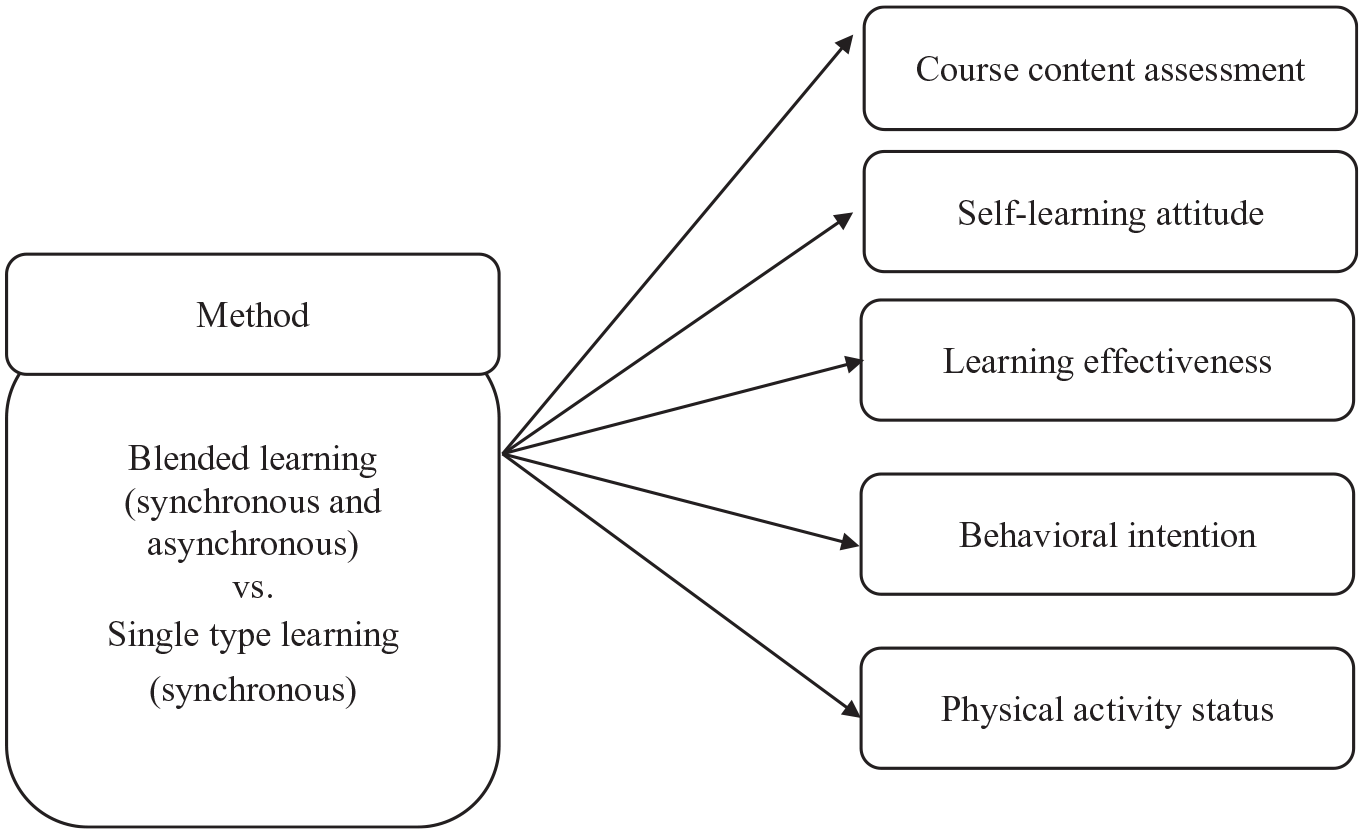
Research framework: experimental design.
In this study, blended learning is defined as synchronous and asynchronous, that is, learning using on-line real-time learning + WeChat public account push learning. Single type learning is defined as synchronous (control group), which uses real-time online learning only. Hypotheses:
H1: The “course content evaluation” of students with blended learning (synchronous and asynchronous) is significantly higher than that of students with single type learning (Alavi, 1994; Gunes, 2019).
H2: The “self-learning attitude” of students with blended learning is significantly better than that of students with single type learning (Alavi, 1994; Gunes, 2019).
H3: The “learning effectiveness” of students with blended learning is significantly better than that of students with single type learning (Alavi, 1994; Gunes, 2019).
H4: The “behavior intention” of students with blended learning is significantly higher than that of students with single type learning (Alavi, 1994; Gunes, 2019).
H5: The “current state of physical activity” of students with blended learning is significantly better than that of students with single type learning (This is the hypothesis of this study).
Data Analysis
The data obtained from the experiment were sorted and analyzed using SPSS Version 20. The methods of analysis included descriptive statistics, item analysis, reliability and validity analyses, independent sample t test, and path analysis. The results of each analysis are explained in Section 4.
Research Results
This section analyzes the data obtained from the experiment. It is divided into three parts, namely, results for descriptive statistics of sample, results for questionnaire reliability, and results for experimental design.
Results of Questionnaire Validity and Reliability
Step 1: Translate the scale
In order to ensure that the measurement can be carried out smoothly, firstly, the scale was translated and integrated into Chinese and then the reverse translation was conducted.
Step 2: Conduct the pretest to determine the validity of the scale
To ensure the validity of the scale, 10 experts were invited to pretest the validity of the scale. These experts are from the following fields. (1) Four experts selected from academia (university)—they are three full-time teachers in education and one full-time teacher in physical education with 5 to 10 years of experience in related education. (2) Four experts from the industry—two experts serve as professional physical trainers in the sports industry, one professional occupational therapist serve as a sports and rehabilitation professional in the medical system, and one professional teacher serve as a professional lecturer in a private education and training institution. (3) Two experts in charge of education and physical education—one expert each in charge of education and physical education in the municipality under the jurisdiction of the case study. After the experts were selected, the study invited 10 experts by email to fill in the “Expert opinion Form” on the translated questionnaire, and modified the questionnaire according to the experts’ suggestions, so as to obtain the consensus of the experts and achieve the content validity. The measurement period lasted for 2 weeks (2020.6.1–2020.6.14).
Step 3: Pretest to determine the validity of the scale
After the experts’ opinions were collected, the contents of the questions were modified according to the experts’ opinions. Then, pretest scale was made to test the reliability of the questionnaire. The measurement objects were 15 students randomly selected from two groups, and the measurement period was 1 week (2020.6.18–2020.6.24). The analysis results are described below.
We used the correlation value between each item and the total score and critical ratio (CR) for item analysis. Items had to have a correlation coefficient exceeding .30 with the total score and a significant t-value to be included. First, the pretest total scores of the samples were arranged from high and low, and the top 27% and bottom 27% were categorized as the high and low-score groups, respectively. Subsequently, the high and low-score groups underwent the independent sample t test to determine the significance of the difference in the mean score of each item between the two sample groups. If the CR of an item reached significance (p < .05), this meant that the item was capable of identifying the response levels of different respondents. As shown in Table 1, this study used the high- and low-score groups’ CR value (>3.5) of each item and the correlation coefficient with the total score as the basis for including them in the questionnaire. The results indicated that all items met the theoretical recommended criteria and they had discriminatory power.
Item Analysis Results of the Pretest Questionnaire.

p < .05.
Cronbach’s α was used to test the questionnaire’s reliability. The Cronbach’s α values were .885 for course content, .898 for self-learning attitude, .92 for learning effectiveness, .902 for behavioral intention, and .938 for physical activity status; the Cronbach’s α value for the overall questionnaire was .972. Therefore, all the questionnaire items had excellent discriminatory power and reliability (Table 2).
Reliability Test Results for the Questionnaire.

Results of Descriptive Statistics of the Sample
This study obtained the validity and reliability of the scale based on the analysis results in 4.1 and formed a formal scale. The measurement period of the questionnaire was 1 month (2020.7.1–2020.7.30).
A total of 274 college students (137 in each group) participated in this study, and the valid response rate of the questionnaire was 100%. As Table 3 indicates, 141 (51.5%) of the participants were boys, and 133 (48.5%) were girls. Overall, 48 (17.5%) students exercised less than once a week, 60 (21.9%) exercise once a week, 50 (18.2%) exercised twice a week, 45 (16.4%) exercised three times a week, 28 (10.2%) exercised four times a week, and 43 (15.7%) students exercised five or more times a week.
Descriptive Statistics.

Regarding average time spent on exercise per week, 48 (6.2%) did not exercise, 24 (8.8%) exercised for less than 10 minutes, 39 (14.2%) exercised for 10 to 20 minutes, 56 (20.4%) exercised for 21 to 30 minutes, 35 (12.8%) exercised for 31 to 40 minutes, 20 (7.3%) exercised for 41 to 50 minutes, and 83 (30.3%) exercised for 51 minutes or longer. Concerning their exercise experience, 36 (13.1%) found the exercise extremely easy, 43 (15.7%) found it very easy, 54 (19.7%) found it easy, 117 (42.7%) found it tiring, 19 (6.9%) found it very tiring, and 5 (1.8%) found the exercise extremely tiring. Thus, most students exercised less than twice per week for less than 50 minutes, indicating that the number of exercise sessions and their duration were low. Moreover, data on their experience following exercise indicate that a majority of students found the exercise tiring. However, whether the low number of exercise sessions and short duration influenced students’ total exercise time remained to be confirmed.
Result of the Two Groups Comparison
This study examined differences in the various dimensions of “online course” and “online course + public account push notification” using an experimental design analysis. According to 3.3 above, the experimental group (synchronous and asynchronous, n = 137) who were taught online every week and then studied the course content through Wechat public account push notification, while the control group (synchronous, n = 137) did not.
The results indicate that H1 to H5 were supported. Specifically, differences were observed between online course (control group) and online course + public account push notification (experimental group) students in all dimensions—course content, self-learning attitude, learning effectiveness, behavioral intention, and physical activity status, and the experimental group outperformed the control group at all levels, where the differences were significant (Table 4).
Results of the Two Groups Comparison Analysis.

Note. The control group had only an online course, whereas the experimental group had online course + public account push notification. *p < .05. The experimental group (synchronous and asynchronous) who were taught online every week and then studied the course content through WeChat public account push notification, while the control group did not.
According to the aforementioned results, blended learning is more effective than learning models that use only one method. The results of the analysis will be discussed later in Chapter 5.
Discussions
The results indicated that the students who used the new blended learning model had better performance in course content, self-learning attitude, learning effectiveness, behavioral intention, and physical activity status compared with those who used only the one type of learning method. From the results of the analysis, the following aspects will be discussed.
In this study, blended learning is defined as synchronous and asynchronous, that is, learning using on-line real-time learning + WeChat public account push learning. Single type learning is defined as synchronous (control group), which uses real-time online learning only.
(1) In terms of course content, blended learning is significantly different from single type of learning (t = −6.334, p < .05), and the average value of blended learning is 4.318, which is greater than that of single type learning (3.788). The results are the same as those of Alavi (1994) and Gunes (2019). This indicates that the design of curriculum by using blended learning courses is more diversified and rich than that by using single type learning courses, and students are satisfied with the curriculum. The reason for the poor satisfaction of single type learning students is that there is no special designed content or material in the course. That is, students use communication equipment for online learning, and teachers use slides with simple pictures and videos for teaching only. Therefore, students showed poor satisfaction.
(2) In terms of self-learning attitude, there is a significant difference between blended learning and single type learning (−5.961, p < .05), in which the average value of blended learning is 4.290, greater than that of single type learning (3.740). The results are the same as the research results of Ekwunife-Orakwue and Teng (2014) and Altıner (2015), the use of blended learning helps to improve the satisfaction of students’ self-learning attitude. In the implementation process of blended learning, in addition to the teacher’s explanation of theoretical knowledge in class, digital multimedia resources can be used as a supplementary material in the whole teaching process. In the sports skill practice demonstration (such as shooting action) before class, the WeChat public account was used to broadcast videos, the online bilateral communication and discussion mechanism was implemented in class, and the after-class discussion area was set up to strengthen students’ participation. On the whole, students expressed their approval and liking for the course content. On the contrary, students who only learned simple pictures or videos showed less interests in learning, and they were not active in classroom discussion. Therefore, students showed poor satisfaction.
(3) In terms of learning effectiveness, there was a significant difference in learning effectiveness between blended learning and single type learning (−5.994, p < .05), and the average value of 4.307 was greater than that of single type learning (3.752). These results are consistent with those of many studies (Alsalhi et al., 2019; Baragash & Al-Samarraie, 2018; Bayyat, 2020; Farahani et al., 2020; Kingpum et al., 2015; Li et al., 2019; Vernadakis et al., 2012), students who use blended learning are satisfied with their learning effectiveness. In the process of the implementation of blended teaching, the resources of network and multimedia are integrated. In order to overcome the difficulties of PE skill teachers to instruct and correct students’ movements in online courses, the hybrid method provides students to record videos of skills and movements displayed according to the instructions of teachers and upload them to WeChat platform. Teachers were able to check the students’ movements before class and give instructions during the class. These results made the students know more about the skills and movements they had learned, and they were satisfied with the learning effectiveness. For students who were taught in single type learning who simply learned by pictures or videos, they showed poor motivation in learning, and they are not active in classroom discussion. Therefore, students showed poor satisfaction.
(4) In terms of behavioral intention, blended learning was significantly different from single type learning (−6.68, p < .05), and the mean value of 4.285 was greater than that of single type learning (3.689). Many studies have proposed the view that positive attitude will lead to higher behavioral intention for the relationship between learning attitude and behavior (Altıner, 2015; Ekwunife-Orakwue & Teng, 2014). Just like the research results of self-learning attitude, students will show a good learning attitude in the implementation process of blended teaching with rich curriculum design and integrated use of resources. Thus, the result will also show a positive relationship with learning attitude for behavioral intention. If teachers do not actively improve the ability of curriculum design to engage the students in the class, students’ enthusiasm in learning PE will be affected seriously.
(5) In terms of physical activity status, there was a significant difference between blended learning and single type learning (−6.435, p < .05), in which the mean value of 4.233 was greater than that of single type learning (2.688). This is the part that the author is particularly interested in, so the IPAQ scale is specially used for investigation. Distance learning is likely to become the norm before the pandemic is brought under control in the near future. The objective of PE courses is to provide students with physical and mental health through physical activities. In the course design of blended learning, this experiment pays special attention to the demonstration of students’ skills and activities. Combined with the function of digital WeChat public account, students are allowed to practice with the videos to achieve the purpose of learning. Hence, the students of blended learning are satisfied with their current status of physical activities. In contrast, students who were taught by single type learning said that the limitation of space made the class boring and impractical (the result of open consultation). Therefore, they were not satisfied with their current situation of physical activities.
To sum up, blended learning is indeed better than single type learning considering from the research results of the experiment. During the outbreak of COVID-19, we found problems such as shortage of resources, lack of information literacy of teachers, difficulty in implementing routine teaching plans online, and students’ exercise conditions at home when implementing the distance learning for PE courses. The main reason for these problems is the particularity of physical education. PE teachers in universities should start to rethink and implement diversified online learning. Moreover, enriching the course content and paying attention to bilateral communication can also have a good teaching effect. When it comes to educational reform policies, university authorities, operators, and managers should begin to pay attention to the development and promotion of PE online resources (such as curriculum construction in MOOC platforms) if permitted. On the contrary, looking for other available resources (such as the method proposed in this study) is also a way to solve the problem when dealing with limited support.
Conclusions and Recommendations
In PE classes, students use physical exercises as primary learning means, and through reasonable PE and physical exercise they achieve the main goals of improving physical fitness, health, and sports literacy. The difference between PE and other courses is that the teaching of other courses is conducted primarily through thinking activities and the mastery of knowledge and related skills; by contrast, PE teaching allows students to master specific knowledge, and by repeatedly performing physical exercises and through the close integration of physical and thinking activities, students learn about sports and master sports knowledge, technology, and skills. The main purpose of PE is to develop beneficial exercise and living habits among students with exercises that promote physical and mental health. It is expected that the new method proposed in this study can provide new viewpoints and thinking models for PE. During the COVID-19 pandemic period or the multimedia era of digital network, PE can also make use of the media resources of the Internet to enrich its course content as other subjects, and at the same time achieve the same teaching quality as the Offline course. Based on the results of Experimental design analysis, it confirms that the performance of the proposed blended learning method of online stream + WeChat public account broadcast is better than that of students with only online learning. Meanwhile, the feasibility and practicability of the method are also proved. Suggestions for the future can be further considered from the following two points:
(1) The unexpected problems caused by the outbreak of COVID-19: The outbreak of COVID-19 forced schools to apply distance learning, so many colleges and teachers have found that there is a serious lack of online resources for PE. This study suggests that blended learning, namely online streaming and WeChat public account broadcast, can be used under this circumstance. During the class, the theory and knowledge of PE courses will be taught through online streaming, a bilateral communication will be build for a better instruction. Multimedia resources will be uploaded and learned through public accounts anytime but make arrangement for the students to strengthen skills and practice. The teaching design of WeChat public account after blended learning of physical education in college should pay special attention to the four aspects of preliminary analysis, teaching design, teaching implementation, and teaching evaluation. It enables students to participate in formal, informal, real-time and non-real-time, synchronous and asynchronous learning activities. However, the importance of traditional teaching methods can not be neglected. Teacher should ensure not only the openness, transparency, diversity and accessibility of the classroom, but also give consideration to individualized teaching and personalized feedback.
(2) PE is not taken seriously by education reform (distance learning): Faced with the sudden breakout of COVID-19, schools had to use distance learning, and many colleges and teachers found it difficult to practice PE in distance learning. The main reason is that physical education has not been paid attention to by education reform, especially in the practice of distance learning. In the era of technology, internet, digital media, distance learning has became a trend in education. The development of Internet allows us break the limitation of space and time. When other subjects are enriching the curriculum content, communicating and sharing information in real time, physical education is trapped in traditional thinking teaching model. Therefore, the purpose of this study is to propose, study, analyze, and discuss a new method for PE, namely, the mixed learning of online live broadcasting used with WeChat public account. It is expected that the new method proposed in this study can provide new viewpoints and thinking models for PE. During the pandemic period of COVID-19 or the multimedia era of digital network, PE can also enrich its course contents by using the media resources of the Internet like other subjects, and achieve the same teaching quality as the offline course.
(3) Suggestions for future research: The limitation of this study is the new blended learning method for PE during the COVID-19 pandemic period. (a) Selection of samples—This study mainly takes a university in southern China as a sample. It is suggested to conduct research in primary school, high school or university, or expand the survey area in the future to explore whether the proposed new blended method is effective. (b) Selection in experimental design— This study mainly uses the method of experimental design to compare the two modes of blended learning (online + online resources) and only online learning. Since the traditional physical education class still attaches great importance to offline teaching and practice, it is suggested that the offline experimental group can be added in the non-pandemic period in future research to verify the differences between the three groups.
Footnotes
Declaration of Conflicting Interests
The author(s) declared no potential conflicts of interest with respect to the research, authorship, and/or publication of this article.
Funding
The author(s) disclosed receipt of the following financial support for the research, authorship, and/or publication of this article: The authors gratefully acknowledge the financial supports by the Sanming University [grant number J2021035].
