




Abstract
The abrupt transition from the traditional model of medical education to online learning caused by the COVID-19 pandemic led to unprecedented changes in the education of future healthcare professionals. This study aimed to evaluate the opinions of Polish healthcare students on the changes introduced due to the COVID-19 pandemic and propose recommendations for improvement. Data were collected from June to July 2020 using an online questionnaire. The results demonstrate that students were generally satisfied with the online learning solutions implemented during the pandemic and appreciated their teachers’ efforts. In their opinion, some of the solutions should also be continued after the pandemic. Students noticed positive aspects of online learning: time efficiency, bigger student-friendliness and unlimited attention from teachers, the flexibility of the learning process, better learning conditions for students, and absences due to illness and other random situations. However, they also noticed its disadvantages: problems with the Internet connection and technical aspects, attitudes of teachers, limited interpersonal relations, limited learning of practical skills, health concerns, students’ engagement and distractions at home, and assessment. To conclude, our results indicate some necessary recommendations to improve the quality of further online learning in medical schools during the COVID-19 pandemic.
Introduction
The COVID-19 pandemic outbreak caused an unprecedented threat to global public health, forcing governmental authorities worldwide to introduce social distancing and limit social contact between their citizens to the minimum. The education sector was also affected, causing many educational institutions, including universities, to suspend their traditional face-to-face classes and continue the education process online.
Online learning, also known as distance learning or e-learning, has great potential, and its importance was already increasing before the pandemic (Abbasi et al., 2020). Similarly, many of its benefits were already described in the literature, including greater flexibility, comfort, and time savings (Abbasi et al., 2020; Przymuszała, Cerbin-Koczorowska, et al., 2020). Furthermore, during the pandemic restrictions, it remained the only option available, leaving many educational institutions with the choice of either e-learning or no learning at all. Still, many difficulties may come along the way, and the limitations of distance learning should also be acknowledged. The transition of the education process to the online environment is already a challenging process that requires careful planning and time for execution, and the sudden character of the change and the accompanying economic uncertainty did not make it easier (Rajab et al., 2020). Consequently, many institutions tended to choose simpler and low-cost solutions (Rajab et al., 2020). In this aspect, even before the pandemic, Cook (2014) recommended optimizing the use of e-learning to ensure its high quality with simultaneous low costs. Moreover, Nuere and de Miguel (2020) observed that the transition process went easier in institutions with prior experience in conducting online classes.
Another obstacle is that e-learning is not suitable for all educational activities, especially at medical schools (Bani Hani et al., 2021; Camargo et al., 2020). Its incorrect implementation in areas such as clinical reasoning, practical skills, or patient communication may result in breaking basic principles of constructive alignment, assuming consistency between learning activities and previously defined learning outcomes (Biggs, 2003). Keeping this limitation in mind, medical teachers worldwide faced a dilemma on how to invent new ways to convey these topics, adapting them to distance learning in the new COVID-19 reality. Finally, e-learning methods are more dependent on students’ self-discipline and motivation than traditional face-to-face classes. Here the obstacle is that the transition to the online learning environment was not chosen nor even could be anticipated by students, leaving them no time to prepare for it beforehand. Meanwhile, students’ acceptance seems crucial for the success of online education (Almaiah, Al-Khasawneh, & Althunibat, 2020). According to the adaptation of the Kirkpatrick’s evaluation model to an e-learning environment proposed by Hamtini (2008), the interaction phase is the first of three stages of e-learning evaluation. It describes “the ease of utility of the e-learning interface, its aesthetic qualities, user satisfaction and interaction as well as the ease at which the interface facilitated learnin,” (Hamtini, 2008). Getting to know students’ perspectives and opinions on the distance learning solutions implemented during the pandemic also gives the opportunity to recognize their advantages and disadvantages and introduce necessary changes, especially since it is not known how long the pandemic restrictions may last. What began as an “emergency education, a temporary shift of instructional delivery to an alternate delivery mode due to crisis circumstance,” (Ramos-Morcillo et al., 2020) may become the mainstream model of the education system for a longer period of time. Meanwhile, current pandemic-related distance learning solutions were mostly developed rather hastily, without careful planning and utilizing the potential of e-learning to the full extent (Ramos-Morcillo et al., 2020).
The studies conducted so far in the context of the COVID-19 pandemic show mixed results. For instance, Khalil et al. (2020) reported high overall students’ satisfaction with distance learning and their positive attitudes towards the use of e-learning as a new teaching modality. Rajab et al. (2020) showed that 62.5% of their participants preferred blending online and face-to-face methods and 67% believed that the pandemic positively impacted e-learning. However, they noticed some problems during the first sessions due to adjusting to new conditions. A similar percentage of students satisfied or neutral towards e-learning was observed by Bani Hani et al. (2021). On the other hand, most of the respondents of Abbasi et al. (2020) demonstrated a negative perception of e-learning and preferred face-to-face teaching. Similarly, around two-thirds of students surveyed by Compton et al. (2020) wished to return to the clinical environment, and more than half of respondents of Alsoufi et al. (2020) did not believe in the ability to use e-learning for clinical aspects.
Meanwhile, there are many factors influencing students’ satisfaction with their studies. Researchers indicate two groups of elements influencing learning satisfaction: personal and institutional. Among the first, we can indicate gender, age, preferred learning style, and grade point average, while institutional factors include the level of lecturers and the quality of facilities. Satisfaction may also be influenced by the quality and content of training, course flexibility, university prestige, availability of equipment, clarity of teacher expectations, or access to educational materials (Weerasinghe et al., 2017). In distance learning, the way the course is designed and the teacher’s supervision become important factors. The latter may be a key limitation for online learning, given the limited potential for direct influence of the teacher on the learner (Choe et al., 2019). Therefore, the intrinsic motivation of students to achieve learning outcomes seems to play an essential role in ensuring the quality of education. This factor influences the creativity or higher self-esteem of students (Shroff et al., 2007).
In Poland, the organization of face-to-face classes was first suspended by the Ordinance of the Ministry of Science and Higher Education of March 11, 2020 (Ministry of Science and Higher Education, 2020a) and on the same day by the Ordinance of the Ministry of Health (Ministry of Health, 2020a) for medical universities. The ordinances applied to all undergraduate and postgraduate types of higher education, and initially, the restriction was to last from March 12 to March 25, 2020. However, the Ministries continued to issue subsequent ordinances prolonging the suspension period (Ministry of Health, 2020b, 2020c, 2020d; Ministry of Science and Higher Education, 2020b, 2020c, 2020d). On May 21, 2020, and May 22, 2020, for medical schools (Ministry of Health, 2020e; Ministry of Science and Higher Education, 2020e), the restrictions were extended until September 30, 2020, however, leaving the Rector of the University with the possibility to reintroduce the face-to-face classes for those classes that cannot be realized with distance learning methods.
Taking all of the above into consideration, this study aimed to evaluate the opinions of medical students of our university on online classes conducted during the COVID-19 pandemic outbreak and collect data on potential areas for improvement.
The hypotheses in the study were as follows:
Medical and healthcare students perceive both advantages and disadvantages associated with online learning.
Students’ positive feelings on online learning are mostly related to classes focused on the knowledge domain (e.g., lectures and seminars).
Medical and healthcare students remain unsatisfied with practical classes conducted online.
Students indicate actions that should be undertaken to improve online learning during the pandemic.
Materials and Methods
Study Settings
Poznan University of Medical Sciences (PUMS) is a public medical university located in western Poland, with about 7,000 students learning in 20 different degree courses. During the suspension of the face-to-face classes, similarly to other Polish universities, PUMS also started conducting online classes for all its students. The synchronous forms of e-learning were conducted mostly with the help of the Microsoft Teams platform, while asynchronous e-learning using e-mails, WISUS system [internal informatics system of PUMS], AKSON module [module within WISUS used to send students didactic materials], sOLAT platform [PUMS LMS (Learning Management System) platform based on OpenOLAT software] and also Microsoft Teams platform. Exams were conducted on the sOLAT platform.
As a result of the governmental restrictions, both teachers and students had to adapt to the new reality. Although the distance learning methods were, at least to some extent, already present at PUMS, the leading role still belonged to the traditional face-to-face classes. As a result, most of the students had some contact with e-learning before pandemics, mostly in the form of asynchronous lectures. However, most of the academic staff had no prior experience in preparing and conducting distance learning classes. In order to promote the use of innovative techniques at PUMS, different faculty development initiatives were implemented, including workshops in the NESTOR [Nauczyciel – EkSpert – TutOR (Teacher - Expert - Tutor)] program (Projekt NESTOR) and the development of guidelines on asynchronous e-learning (Przymuszała, Cerbin-Koczorowska, et al., 2020) or writing multiple-choice questions (Przymuszała, Piotrowska, et al., 2020), for example.
Participants
In order to get a more comprehensive picture of the situation on the University and reduce the impact of selection mechanisms on data obtained, we decided to invite all students of PUMS to participate in the study and share their perspectives on online learning during the COVID-19 pandemic, regardless of their degree course and study year. Therefore, the sole inclusion criterion in the study was the active status of a student of PUMS. Consequently, the exclusion criterion was not being a student of the university.
Procedures
The invitations to participate in the study were sent at the beginning of June 2020 to all students of PUMS on their institutional e-mail addresses with the help of the Administrative Office. Additionally, the study was also promoted on social media and the webpage of the University. Data were collected to the end of July 2020, when no new completed surveys were received over two weeks. The decision to finish data collection was additionally supported by data analysis indicating their saturation—that is, no new issues were arising anymore from students’ answers in the survey.
Qualitative data obtained in the study were thematically analyzed by two independent researchers using the Atlas.ti software (ATLAS.ti 8 EDU), following the steps described by Braun and Clarke (2006). Their results were later compared and discussed until reaching an agreement. Phenomenology was used as a qualitative approach to obtain a thorough picture of respondents’ opinions and experiences with online learning during the pandemic outbreak (Cleland, 2017).
Tools
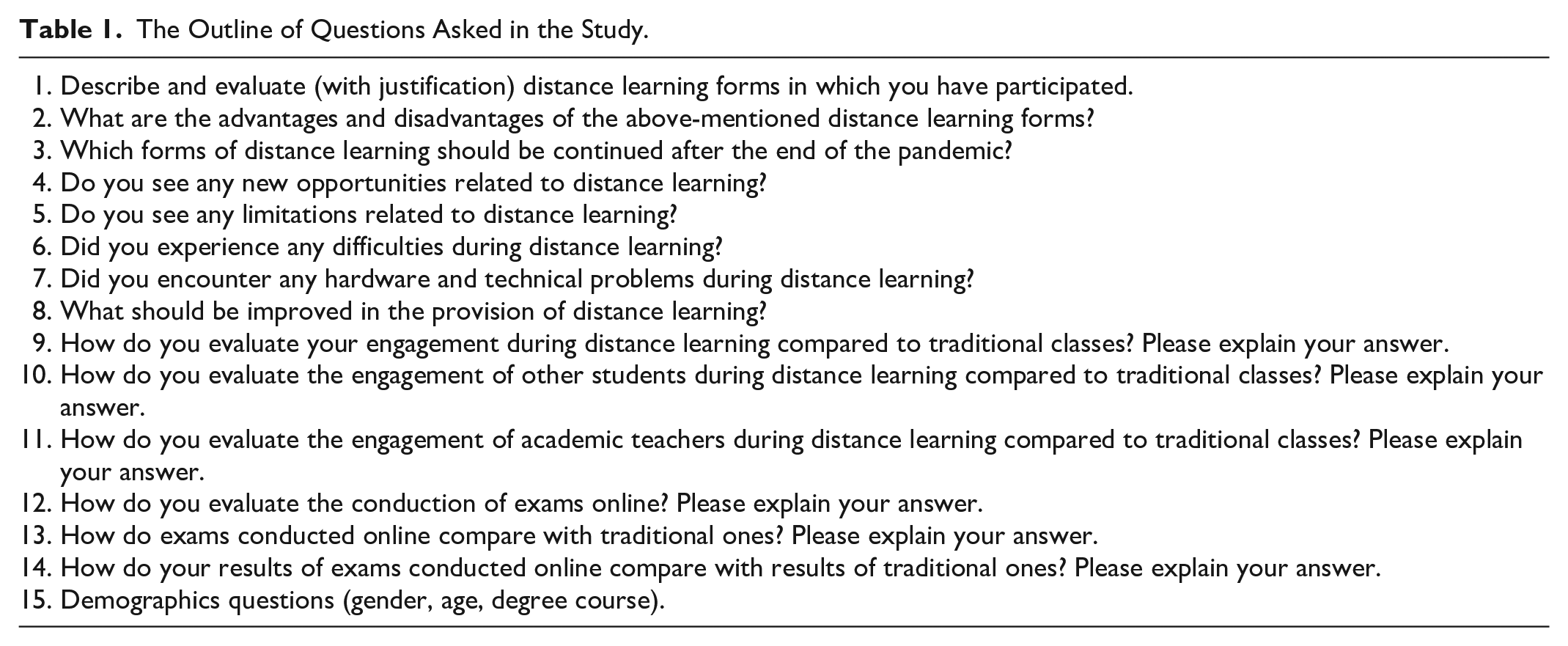
Due to the pandemic, the study was conducted using an online questionnaire with open questions on students’ perception of distance learning and assessment during the COVID-19 pandemic outbreak. Open questions were aimed to gain more insight into respondents’ opinions than would be possible with closed questions. Additionally, an introductory paragraph was added with the information on the study’s aims and its voluntary and anonymous character. The draft of the questionnaire was subsequently subjected to evaluation by two experts on the subject of e-learning and medical education. Their input and comments allowed to create the final version of questions asked in the study (Table 1). The questionnaire was pre-tested on a sample of students from the Students’ Scientific Club of Medical Education to confirm its clarity and understandability.
The Outline of Questions Asked in the Study.
Ethical Considerations
As the study only employed an anonymous online questionnaire, ethical approval was not required under the Polish legal system and the guidelines provided by the Institutional Review Board
Results
Data on students’ perceptions about their education during the COVID-19 pandemic were collected using an online questionnaire with open questions. It was displayed by 524 students and completed by 143 of them. Among the respondents, 114 were female and 29 were male. The mean age of respondents was 21.9 ± 2.4 years. They were representatives of different degree courses offered at PUMS as presented in Table 2. Additionally, 26 students provided answers to some of the open questions but resigned before completing the survey.
Degree Courses of Respondents of the Study.

Responses of participants were subjected to thematic analysis, which was conducted independently by two researchers. This procedure included familiarizing with data, initial coding, searching for themes, reviewing the themes, naming the themes, and creating a report.
The thematic analysis of students’ responses revealed themes presenting both positive aspects associated with online learning during the COVID-19 pandemic (Themes 1—5) and their negative aspects (Themes 6—12).
Students were mostly satisfied with the organization of distance learning in the initial months of the COVID-19 pandemic. However, it should be emphasized that their positive opinions mostly revolved around classes focused on the transfer of knowledge (e.g., lectures and seminars). In students’ opinion, these were also the forms that should be preserved after the pandemic. Analysis of students opinions and arguments on online learning during the COVID-19 pandemic revealed five themes pertaining to their advantages, namely time efficiency, bigger student-friendliness and unlimited attention from teachers, the flexibility of the learning process, better learning conditions for students, and absences due to illness and other random situations.
Theme 1: Time Efficiency
Classes conducted online, especially lectures and seminars, were seen as more convenient and time-efficient than traditional classes before the COVID-19 pandemic. Students seemed to appreciate the possibility to participate in them from their homes, as it allowed them to save much time, which was usually wasted on commuting to the university. Similarly, after the classes, students could immediately start other activities (like studying, household chores, or rest). They also noticed improved organization of their schedules, including no time wasted on moving between classrooms or departments and reduced inconvenience of any free periods between the classes.
“Live-streamed online lectures and seminars do not differ from those conducted in the class (and it’s even better to listen to them at home as you don’t have to spend time traveling to get to them)”
“it reduces the “dead time” associated with traveling to the university and the gaps between classes”
“I am very pleased with the way online classes were conducted. In my opinion, this should mobilize universities to introduce online classes, with an emphasis on lectures and seminars conducted in the form of presentations. Thanks to e-learning, we can save a lot of time”
Theme 2: Bigger Student-Friendliness and Unlimited Attention from Teachers
Students noticed that even though the face-to-face interaction was impossible due to social distancing, in some aspects, the cooperation and contact with their teachers improved during the pandemic. Teachers were more flexible and willing to change the time of the classes or share their lecture presentations, for instance. Also, the online contact after the classes was viewed as easier and more instant via the online learning platform than traditional e-mails. Students also recognized the work of their teachers to transfer their classes into the online environment. Although not everything was perfect, they appreciated their efforts and paid much attention to particular forms of classes they liked and the differences between them.
“I am generally satisfied. I understand that the lecturers are just learning this form of classes, and not everything is perfect, but the form of online classes suits me”
“I especially liked the lectures/seminars made available with a recording of the teacher explaining individual slides, this way you can repeat the information very well, paying the most attention to the issues raised by the teacher, and at the same time you can recreate the information that you did not manage to write down”
“I rate the “live” online classes higher than the recorded presentations because the lecturers spent time explaining the subject in detail, and if in doubt, you can ask questions immediately. [. . .]”
Students also noticed that their impression from online clinical classes was often better because teachers paid more attention to them and were less distracted by other duties than in the hospital ward.
“During classes, they focus only on students and not simultaneously on students, documentation, clinic, ward, and operating room as usual”
“First of all, the teachers are prepared, and all their attention is focused on the classes. They are usually at home, so they are not disturbed by patients, they do not have to go out to take care of other duties, and they are not distracted by anything”
Theme 3: Flexibility of the Learning Process
In the case of classes that involved recorded lectures or other forms of materials available for a longer time, students enjoyed the possibility to study at their own pace, including going back and repeating the material as many times as required. This allowed for a deeper and better understanding and consolidation of the topic. Students were also able to better adjust the learning process to their needs and daily schedule, allowing them to learn whenever and wherever they wanted. It allowed them to stay focused on the presented content and, when needed, take short breaks for a meal or other physiological needs.
“The possibility of going back and repeating [the material] gives significantly greater educational possibilities”
“I can pause the recording to have more accurate notes. Usually, we have a few days to acknowledge the material, so I don’t have to do everything at once. I can split it up, do it accurately and work efficiently for several days instead of doing everything at once”
“I believe that online lectures are a very good form of teaching because normally, lectures were organized in the afternoon or evening hours, and it was sometimes difficult to get to them after an intense day of classes. In this version, you would always be able to turn them on at home and listen to interesting content”
“I believe that it would be worth continuing to conduct lectures and seminars online because of the facilitated participation in classes, the possibility of re-playing them anytime, anywhere, and any number of times”
Theme 4: Better Learning Conditions for Students
Students paid much attention to the improvement in learning conditions associated with the transition to the online environment. They mentioned the comfort of their own homes, desks, sitting places, and access to snacks and beverages. It was also easier for them to take notes from their own computer screens as slides were more readable. In addition, the teacher was often more clearly hearable, and other students did not cause distractions.
“There is no need to sit in an uncomfortable room, and still, the content is prepared more or less in the same way”
“In lecture halls, slides were often not easily readable, and this is not a problem on the computer”
“I have time and greater motivation for it, [. . .] I have access to good coffee, and it does not make me lazy, but makes me feel good, and it is easier for me to participate in classes”
“Being at home, you can spend more time on recordings, and go through the previously learned material faster; in online seminars, it is easier to take notes because sitting at my desk at home, I have much more comfortable conditions and more space for a book, notebook, etc.”
Theme 5: Absences due to Illness and Other Random Situations
The online format of classes facilitated the participation of students faced with different random situations, which would have otherwise prevented them from attending the classes. Among them, respondents listed illnesses, malaise, pregnancy, hospitalizations, traffic jams, and accidents, or oversleeping.
“When someone does not feel well, they can still participate in classes. Before the distance classes, such a person had to give up coming to the class, which was making them lose a lot”
“The big advantage is that you can participate in them from virtually any place on earth, regardless of your situation or health condition, which prevents the need to make up for the absences. I think that it would be a very good idea to enable the use of this type of classes for sick students, students in hospitals, students in advanced pregnancy, or any impossibility to get to the classes in the department”
Students also noticed some disadvantages of online learning during the COVID-19 pandemic. Their analysis revealed seven themes, namely problems with the Internet connection and technical aspects, attitudes of teachers, limited interpersonal relations, limited learning of practical skills, health concerns, students’ engagement and distractions at home, and assessment.
Theme 6: Problems with the Internet Connection and Technical Aspects
The occasional occurrence of technical problems during their online classes was brought up by some respondents. Among them, they complained about the slow speed of the Internet connection or losing the signal during rush hours, causing screen freezing and sound issues. However, turning their cameras off usually helped to resolve these issues by reducing the bandwidth usage. Similarly, sometimes noises and echoing sounds were also heard during lectures or seminars when students left their microphones on. The problems with access to the fully operational computer equipment, including a camera, a microphone, and a sufficient Internet data package, were also reported by some respondents. These students felt surprised by the sudden transition to online learning and described limited possibilities to fix their computer equipment or purchase a new one due to limited financial resources or closed shops during the lockdown. Some students also expressed concern about the safety of transmitted data, especially their images from the camera.
“The situation surprised everyone and not everyone has free access to the Internet, computer equipment with a camera and microphone, not everything always works as it should, and the purchase of new equipment is not only difficult or impossible but also burdening the budget of students who have been deprived of the opportunity to earn extra money [due to the pandemic]”
“There were people with poor connection, there were technical problems, some had one computer and younger siblings, which made the access difficult”
Problems of the university staff with conducting the classes were also noted. Some students mentioned the lack of equipment, poor computer skills, and the reluctance to learn them among part of the older teachers. In their opinion, the University should offer more support to the teachers in this aspect.
“The lecturers were not able to organize the classes technically. Many of them were just sending materials and assignments”
“The staff should have access to training in technical aspects of conducting online classes”
Theme 7: Attitudes of Teachers
Students observed varying levels of their teachers’ engagement in conducting classes. While some of them well adapted to the new circumstances, others seemed to struggle, and their classes lacked creativity. Apart from technical problems and low computer skills described above, students also felt that some teachers seemed to cut corners, for example, only sending students presentations and giving them assignments. Although respondents appreciated their role in verifying their understanding of the topic and increasing their attention during classes, some teachers were reported to overuse them. On the other hand, students also noticed that teachers might have been overburdened with clinical duties due to the COVID-19 pandemic, which might have reduced their engagement.
“Most teachers adapted to this form by preparing materials, exercises, quizzes, recording seminars, they had to check the tasks and presentations sent by students, which was less frequent in the normal course of study. Some lecturers, however, were not so involved and were only sending learning materials”
“Completing and submitting assignments is okay to organize the knowledge, but not as the only form of classes.”
“E-learning classes largely depend on the preparation and charisma of the teacher. There are lectures and seminars that are very interesting and engaging, but there are also very average ones; there is no rule. On the plus side, there are various quizzes that engage students in the activities. The tasks are okay, as long as the lecturers do not treat them as an alternative to conducting classes, they do not overwhelm us with a huge amount of tasks and do not surprise us with deadlines”
Others acknowledged that the novelty of the situation interfered with the habits of the teachers in general, who had to get used to talking to the screen and had difficulty in verifying the actual attendance of students. As one student described it:
“they keep asking whether we are listening or “still alive,” and the microphones must be muted [to avoid echo sounds] so their perception of our interest may be wrong.”
Theme 8: Limited Interpersonal Relations
The lack of direct in-person contact with other people was also a difficult aspect of online learning during the COVID-19 pandemic. Students missed the company of their peers and teachers and firmly believed that the online conditions could not replicate the live experience. Equally important was the lack of contact with patients, which is of great importance in the education of future medical professionals.
“Lack of contact and interpersonal interactions. And the medical professions require them to a large extent”
“Impaired contact. It is often the case that the greatest value of seminars or classes lies in the individual way of the teacher, in their ability to explain and show something in their own way. Something like this is much more difficult to achieve online”
“No direct interaction with people— I believe that this is a really big minus, which significantly affects the well-being and work of people. I think we all agree that it is extremely important and that nothing can replace direct contact with people”
Theme 9: Limited Learning of Practical Skills
Contrary to lectures or seminars described above, most respondents did not think that classes focused on learning practical skills (e.g., medical simulation, clinical, and practical ones) can be successfully conducted online even despite the teachers’ best efforts. They regretted not having the opportunity to use theory in practice, examine the patients, assist in performing medical procedures or work in a lab. The lack of hands-on clinical and practical experience was viewed as a waste of time, a missed opportunity to experience a particular field of medicine, and not enough to prepare for their future professional roles. They expressed a strong need to return to the face-to-face form of practical classes.
“[Online] practical classes conducted with even the greatest commitment are not able to replace us with practical experience”
“Lectures give us access to theoretical knowledge, but without practical classes, my field of study loses its sense”
“Classes with patients and on clinical topics should always take place in the face-to-face form because one learns completely different then. However, lectures can take place in a distance from, because students do not do anything else except taking notes, and you can do it at home”
“The disadvantages are the activities that should be done live. Learning to draw blood via the Internet, despite the very good presentation of recordings and explanations, will not replace classroom classes”
However, aware of the extraordinary character of the pandemic situation, students seemed to appreciate different efforts of their teachers to at least partially replicate the clinical and practical experience. Although they were mostly viewed as imperfect and temporary solutions, some, like a video library of different medical procedures or surgeries, were seen wort preserving as additional learning materials even after the pandemic.
“Clinical, practical, and laboratory classes cannot be conducted online. Their value drops drastically. These aren’t even substitutes. These are completely different classes with different outcomes, if any. There is an exception—in the operating room, you cannot see anything anyway. If the problem of the number of groups in such classes cannot be solved, recordings of surgeries should be introduced, at least create a database of such recordings available to students at any time”
“Videos from surgeries and medical procedures are also a plus because when we couldn’t see something live, at least in this form, you could learn anything practical”
“Classes with a simulated patient allow you to improve the history-taking technique, which worked quite well via the computer. Surgery videos allow you to see and understand more than with the student group in the operating theatre. Cases can be discussed online undisturbed”
Theme 10: Health Concerns
Students also expressed concerns about the implications of the amount of time spent daily in front of the computer on their health. They complained about the appearance of symptoms such as headaches, back pains, wrist pains, or conjunctivitis. Additionally, the specificity of online classes and sedentary lifestyle negatively affected their form and well-being.
“The constant, monotonous schedule of classes is tiring. Electronics and a constantly sedentary lifestyle have a bad effect on my well-being and focus”
“Health problems started to appear from very long computer work (conjunctivitis, back pain, etc.)”
Theme 11: Students’ Engagement and Distractions at Home
Some students observed no difference or even an increase in their own and their colleagues’ motivation and engagement during online classes compared to traditional ones. These students pointed out their inner motivation, sense of responsibility for their future patients, as well as the aforementioned advantages of distance learning.
“I learn regardless of the form of the classes - the life of another person will depend on my knowledge”
“If someone is interested in the classes, they will pay attention regardless of whether they are online or not”
However, what is worrisome, other students gave an account of how their and others’ engagement and motivation decreased during online education. In their opinion, the online environment limited their willingness to learn and pay attention during the classes, especially when they were not interested in the topic of the class. In this context, they brought up the positive role of different tasks and assignments sent by teachers during the classes to increase their attention and verify the actual attendance.
“I know that during online classes, I can always check something in a book, on the Internet. This gives you peace of mind but unfortunately makes you lazy at the same time. In classroom classes, I can only rely on my own knowledge to answer the teacher’s questions, so I try to remember as much as possible while preparing for classes”
“During online lectures, hardly anyone controls whether the student is actually listening. That’s why it happened to leave the computer for a while to do something at home”
“There is a risk that during such online classes when the webcam is not turned on, etc., some people will do something else, instead of participating in the classes”
Some students also admitted that they were more easily distracted than in the classroom and also found it difficult to focus at home just sitting in front of the computer, especially during longer lectures or seminars.
“Despite the lack of other students around, there are many distracting factors, despite appearances, even more of them are at home, so it is very difficult to focus on the classes throughout their duration, especially when they are 3-hour classes”
“Online classes are not a beneficial form of teaching for me because it is harder to focus on, for example, a live lecture when at home. Especially when some of them last more than 2 hours. Homework and interactive quizzes are a good idea because it “forces” the student to work on their own, who as a result will surely gain some knowledge from the classes”
Moreover, students sometimes felt lack of understanding from their relatives, and also as one of them put it:
“the environment (e.g., families) thinks that online classes are not learning (after all, I sit at home) . . .”
Theme 12: Assessment
Although most students believed that their exam results before and during the pandemics were comparable, they still mostly preferred the traditional form of writing exams. Students also listed many limitations associated with the current situation, including technical problems, potential distractions, and precautions introduced by the authorities of PUMS to prevent cheating. These solutions mentioned by our respondents included, among others, limited time to answer questions, randomized order of questions and answers, lack of possibility to return to previous questions, or asking students to have their cameras turned on during the exams.
“The stressful part is the limited time to answer [. . .] and no possibility to return to previous questions [. . .]. It is understandable that these methods are designed to prevent cheating on the part of the examinees, but in my opinion, a similar effect could be achieved with only some of these methods, reducing unnecessary stress related to them”,
“[. . .] while writing exams at home some distractions often cannot be eliminated such as neighbor’s repairs or a postman’s visit [. . .]”
“The advantage of online exams is that you don’t have to get to the exam. However, a considerable disadvantage is a stress associated with the possibility of computer failure, losing Internet connection”
The advantages and disadvantages of distance learning indicated by students were summarized in Table 3.
Advantages and Disadvantages of Distance Learning.

Discussion
In this study, we examined the opinions of healthcare students on distance learning during the COVID-19 pandemic. Although students of our university had been previously exposed to some forms of e-learning, it was not the standard way of conducting classes, and the traditional face-to-face classes were still the majority.
Most respondents positively evaluated online learning and the efforts of their teachers in these unprecedented times. They also expressed interest in keeping some distance learning methods even after the end of the restrictions, recognizing their many benefits. In this context, students most commonly pointed out different forms of lectures and seminars conducted online. Similarly, in a study by Gupta et al. (2021), more than half of students wished to continue online classes along with the classroom ones after the pandemic. The comparison of themes resulting from our study with the existing literature also shows similarities in students’ perspectives. The themes describing the advantages of online learning in our study were as follows:
On the other hand, students also noticed disadvantages of the current situation, and the revealed themes were as follows:
The disadvantages associated with online learning during the current pandemic situation could have also affected the professional development of medical and healthcare students. The results collected on more than 30,000 students by Aristovnik et al. (2020) showed their career concerns and the anxiety and frustration experienced due to the current situation. Students learning online seem to be more likely to quit their studies, and their ability to study was mostly affected by social isolation (Bolatov et al., 2021). In a study by Harries et al. (2021), nearly three-quarters of students felt that the COVID-19 pandemic significantly disrupted their medical education. Although in the same study, around 70% of students responded that medical schools did everything they could to help them in adjusting, more than 60% of students answered that the pandemic still limited their ability to develop skills and competencies necessary to start residency, and for around 45% it interfered with their ability to apply to residency and influenced how their imagined spending their career. Interesting results on students’ burnout were provided by Zis et al. (2021). They observed that almost 20% of surveyed medical students were affected with burnout, with a higher prevalence for clinical years. Additionally, on analysis of burnout dimensions, an increase in cynicism levels was found across all years, which may signify that students start to lose interest and enthusiasm in their studies. Finally, another factor potentially affecting the current situation might be students’ involvement as volunteers during the COVID-19 pandemic. Some authors indicate potential risks for students’ physical and mental health. Others see it as a chance for learning and professional identity development, not to mention the value of their help for preoccupied healthcare workers (Aebischer et al., 2020). A study conducted in Switzerland found that anxiety, depression, and burnout among student volunteers were lower than among their colleagues not involved in the COVID-19 response (Aebischer et al., 2020). However, as the authors explained, their results may be caused by many other factors, including the potential lower likelihood of students with mental health problems to volunteer, good access to personal protective equipment in Switzerland, support from the employers, as well as coherence sense and contact with people. However, the situation and its influence on students could differ across healthcare and education systems, so further studies are needed to understand better the effect of students’ direct involvement at the pandemic frontlines on their mental health status, burnout, and future professional plans.
Consequently, despite the evidence for a generally good impression of students with distance learning during the COVID-19 pandemic as presented in this and other studies, some changes seem unavoidable. However, a lot will depend on the current epidemiological situation in a given country. In the case of medical education, it seems that clinical, practical, and medical simulation classes should return to the face-to-face format as soon as possible. They can, and even should be supported using distance learning methods for theoretical aspects (e.g., seminars and lectures). However, nothing can truly replace the practical hands-on experience and clinical context. This is visible in students’ opinions presented throughout this and other studies in the pandemic context.
Taking into consideration the results of the presented study, we propose the following recommendations regarding the use of distance learning methods in medical education during the COVID-19 pandemic outbreak:
Theoretical classes focused on the knowledge domain, for instance, lectures and seminars, should be conducted online. They may involve both asynchronous (e.g., pre-recorded lectures or seminaries) and synchronous (e.g., live online classes) forms of e-learning. However, to increase students’ attention and provide teachers with valuable feedback, they should be accompanied (but not replaced) with interactive forms, like quizzes or assignments (
Presentations used during lectures and seminars may be shared with students as additional materials facilitating their learning and preparation for exams. They should not replace the aforementioned e-learning forms as the only method of learning (
Clinical rotations, practical and medical simulation classes focused on the skills domain should be conducted in the traditional face-to-face form as soon as the epidemiological situation allows it. As long as it is not possible, they may be replaced with other temporary solutions (e.g., recording of surgeries or medical procedures, clinical case presentations, online medical simulation, or online scenarios with simulated patients). However, their limitations should be kept in mind, and the quality of medical training cannot be compromised. Compensatory practical classes after the pandemic should be considered. Students also do not perceive these methods as full substitutes of traditional education forms (
Both the teaching staff and administrative employees should be more attentive to the needs of students. Quick contact paths should be provided via e-mails, social media, and e-learning platforms to keep the information flow. Teachers should encourage students to contact them in case of doubts on the presented topic. They should also actively engage during the classes to limit social isolation and keep students motivated just as they would have done in the real classroom (
The negative influence of sitting in front of the computer for a long time should be considered when planning the classes. Universities should also offer psychological support and counseling services to students affected by the COVID-19 pandemic (
Anti-cheating mechanisms and precautions should be introduced during online exams. However, the solutions implemented should not be disruptive for students, especially given the existing burden associated with the pandemic, social isolation, and sudden changes in their education (
Faculty development and support initiatives should be implemented or, when already present, they should be re-adapted to the new reality, for instance, unprecedented changes in clinical and practical education. Teachers with poor computer skills should also be offered institutional support (
Limitations
We acknowledge the limitations of the study. First of all, it was a single-center study, and the sample of students who decided to take part in it cannot be considered as representative of the whole population of medical and healthcare students in Poland. However, given the stress and anxiety accompanying the pandemic period, the necessity to adapt to the new conditions, social restrictions, and a load of academic duties, we believe that the sample we were able to gather seems quite reasonable. Moreover, given that the data saturation was reached and the dynamically developing situation, we did not want to postpone the end of data collection. We are also aware of the possibility of selection bias to the study. Although invitations to participate in the study were sent to all PUMS students, it is possible that those with either very strong positive or negative experiences were more motivated to make their voices be heard and were more willing to answer questions.
Conclusion
Although the presented shift towards online learning can be regarded as successful given the exceptional circumstances, some changes seem required. The solutions introduced may become a mainstream method of education for a prolonged period of time both at our university and many other institutions around the world, at least in the case of lectures and seminars. However, as presented by the results of this and other studies in the context of medical education, the clinical and practical parts of the curriculum of future healthcare professionals cannot be easily translated into the online environment. Appropriate steps should be undertaken to restore the face-to-face format of these classes as soon as possible, depending on the current epidemiological situation in a given country. Overcrowding of the clinical hospitals can also be avoided by moving some part of clinical classes online, for instance, seminars or clinical case presentations. Our results show many advantages of online learning noticed by students. However, given the limitations mentioned by the respondents, appropriate measures should be taken. For teachers they should include, among others, designing and conducting the classes to make them engaging and interactive for learners, paying more attention to students needs during the classes, attempts to reduce negative effects of the social isolation on students’ well-being, offering students adequate support, and participating in faculty development initiatives on conducting online classes. Universities should take constant actions to improve and control the quality of online classes, offer or popularize faculty development initiatives in this regard, provide the staff and students with technical support and ascertain their access to hardware and fast Internet connection, pay more attentions to the needs of members of the academic community, and offer psychological support and counseling services to those affected by the COVID-19 pandemic. Finally, students should get more actively involved in the online classes and pay more attention to risks associated with their disadvantages, like lowered focus and distractions at home or limited learning of practical skills.
Footnotes
Acknowledgements
We would like to thank all the students who participated in the study.
Declaration of Conflicting Interests
The author(s) declared no potential conflicts of interest with respect to the research, authorship, and/or publication of this article.
Funding
The author(s) received no financial support for the research, authorship, and/or publication of this article.
Ethics statement
Due to the character of the study, the ethical approval was not required under Polish law and the guidelines of the Institutional Review Board provided on its webpage.
