




Abstract
This article uses the theoretical bases of Resident Empowerment through Tourism Scale, Framing Theory, and Self-Identification theory to explore the moderating effect of destination promotional videos on the relationship between residents’ empowerment and support for tourism. Initially, a large-scale survey with 1,634 respondents from Chinese Ningbo communities was performed to confirm that the destination promotion videos were widely viewed by the residents. After that, 492 questionnaires were administered to residents to test the moderating effect of media identification on the relationship between residents’ empowerment and support for tourism. The findings show that, overall, promotional media moderates the relationship between resident empowerment and support for tourism. Specifically, the use of destination promotion videos has been found to give residents a stronger sense of empowerment within society, increasing their high level of support for tourism. However, in this study’s case study of Ningbo, media were not found to moderate the relationship between perceived economic profit and support for tourism. The findings of this study could provide implications of how to use promotional video wisely to engage residents and build a “happy host.”
Introduction
Researchers have shown that media significantly influences peoples’ attitudes and perceptions (Dubois et al., 2020; McQuail, 1994; Mercille, 2005). The consumption of media information is one of a set of regular experiences, that together, construct our understanding of society (Jackson et al., 2001). According to Urry’s (1990) study of the tourist gaze, the impression, or image people have of a place is powerfully shaped by various media forms, such as film, television, literature, magazines, records, and videos. The importance of promotional media has received much attention in the tourism literature. Most tourism studies addressing promotional media have evaluated their effects on tourists’ understanding of destination image and branding (Gong & Tung, 2017; Guerrero-Rodríguez et al., 2020; Nunkoo & Ramkissoon, 2011; Shao et al., 2016). However, the organic and induced images contained in promotional message on destinations have a much wider audience than tourists alone (Nunkoo et al., 2020). The residents of destinations comprise another large audience for promotional message on destinations. Despite literature suggesting that exposure to promotional media may impact residents’ attitudes toward tourism (e.g., Nunkoo et al., 2020), very limited attention has been paid to the effects of promotional message on residents’ perception in the context of tourism development.
Destination marketing organizations (DMOs) commonly formulate promotional videos that showcase attributes of the destination, display branding slogans and images, and even create storylines to elicit place attachment in the audience. These videos allow brands to convey product messages in an entertaining format (Raney et al., 2003), engaging the audience (Gong & Tung, 2017). The main purpose of such promotional videos is to increase potential visitors’ awareness of the destinations depicted, and they have been identified as one of the main destination marketing approaches. Although in recent years, more and more DMOs have replaced traditional promotional videos with mini-films or combined them with films or television programs, destination promotional video is still critical for destination marketing because it can provide a series of cognitive, conative, and affective episodes, which is helpful for connecting destination brands and tourists, transforming experiences, and developing advocacy (McCabe & Foster, 2006).
If promotional message can attract potential tourists to a destination and increase their awareness of the destination, what influence does such message have on residents? It is argued here that overall, promotional message can affect viewers’ sense of connection with the destination described and shape their ideas, feelings, and motivations in relation to the destination (Guerrero-Rodríguez et al., 2020; McQuail, 1994). The purpose of this study is to investigate whether destination promotion video shapes residents’ perceptions of a destination. Banks (2001) argued that visuality played a central role: tourism-related visual practices construct cultural symbols and distinguish between cultures and people, structuring representation in the social discourse of tourism (Tzanelli, 2006). Of all such visual practices, videos provide the most persuasive and effective means of conveying important cultural concerns and representations, enhancing viewers’ image of a destination, and ultimately increasing their likelihood of visiting the destination (Butler, 1990; Chow, 1993; Gong & Tung, 2017; Pink, 2001; Rose, 2001).
This study focuses on the impact of destination promotional videos on residents rather than tourists. Different from the recreational, social, cognitive, self-realization, economic, and health factors that could impact travel decision directly (Karl et al., 2020; Roman et al., 2021), research has shown that promotional message affects people indirectly rather than directly (Klapper, 1960; Scheufele, 1999). Media contributes to additional knowledge about tourism destinations, which aids tourists to make decisions (Smallman & Moore, 2010). As Cohen (2001) reported, media have moderating effects on perception.
Particularly, the research tests the impact of promotional media using a resident empowerment model. The construct of empowerment has often been used in studies relating to public participation, community well-being, and quality of life to explain residents’ attitudes toward tourism (Andereck & Nyaupane, 2011; Joo et al., 2020; K. Kim et al., 2013). Scheyvens (1999) first proposed an empowerment framework for tourism, dividing empowerment into economic, psychological, social, and political aspects. Later, Boley and McGehee (2014) developed the Resident Empowerment through Tourism Scale (RETS) to empirically measure perceived psychological, social, and political empowerment in the context of tourism. Their model has been applied in various studies published in recent years. The findings of the RETS have indicated that empowerment and resident satisfaction are positively related to community life and support for tourism (Boley et al., 2017; Strzelecka et al., 2017). Studies using the RETS have thus shown that if residents feel empowered, their participation in tourism development is more likely to be effective, promoting sustainability (Choi & Murray, 2010; Cole, 2006).
Applying RETS, Framing Theory, and Self-identification Theory, this research evaluates the extent to which destination promotion videos, as a type of media content, strengthen or weaken the relationship between residents’ empowerment, and support for tourism. In doing so, the findings of this study are expected to contribute to contrite the current literature. This study develops a conceptual model to investigate the moderating role of media identification, which is the first attempt to explore the role of destination promotional videos on residents. The findings can add evidence to the value of destination promotional video in building a “happy host.” Practically, this study can make suggestions on how to use destination media wisely to build a “happy host” and gain residents’ support.
Literature Review
Resident Empowerment and Support for Tourism
Understanding residents’ views on and support for tourism development is of great importance for local governments, policymakers, and businesses involved in tourism. Therefore, resident attitudes have become a prominent topic in the tourism literature (Andereck & Nyaupane, 2011; Dyer et al., 2007; Gursoy et al., 2010; T. H. Lee, 2013; C. K. Lee et al., 2010; Nunkoo et al., 2020; Nunkoo & Gursoy, 2012). To gain insights into the factors that influence residents’ support for tourism, recent studies have adopted theoretical frameworks such as theory of reasoned action developed by Fishbein and Ajzen (1975; e.g., Dyer et al., 2007), social representation theory (e.g., Andriotis & Vaughan, 2003), social exchange theory (SET), and emotional solidarity framework (Erul et al., 2020; Woosnam, 2012). The leading theory in this context is SET, according to which support for tourism is an exchange based on the perceived rewards and costs of the relationship (Strzelecka et al., 2017). However, although widely used in the tourism literature, this theory has been criticized by researchers for its tendency to overemphasize the economic components of social exchange (Woosnam et al., 2009).
To overcome this limitation, Boley and McGehee (2014) developed their own framework for analysis of residents’ support for tourism, based on resident empowerment studies, and applied the framework to a few cases. The RETS measures residents’ perceived psychological, social, and political empowerment through tourism development. The original RETS did not include economic benefits, but in a few studies (Boley et al., 2015; Strzelecka et al., 2017), the scale was combined with SET to evaluate economic benefits. The RETS is derived from research on empowerment, a prominent topic of general social science studies. Perkins and Zimmerman (1995) explained that empowerment offered vital insights into the development of individuals, organizations, and communities. Cole (2006) argued that residents who did not feel empowered could not participate effectively. Sofield (2003, p. 258) went even further, stating that a lack of empowerment posed obstacles to tourism development at the community level.
The RETS model has been widely used in recent years to examine various cases. The results have generally shown that when residents feel more empowered, they hold more positive attitudes toward tourism and are more supportive of tourism (Eluwole et al., 2022; Joo et al., 2020; Strzelecka et al., 2017). The first dimension of resident empowerment, psychological empowerment, reflects tourism’s potential to increase residents’ pride and self-esteem: residents are empowered psychologically by the knowledge that visitors wish to travel to their community to experience its unique natural and cultural features (Boley et al., 2015; Scheyvens, 1999). Social empowerment refers to the sense of structural cohesion and integrity conferred at the community level by tourism activities (Scheyvens, 1999). These feelings may improve residents’ well-being and thus positively influence their perceptions of tourism. According to Boley et al. (2014), when residents have a voice in the tourism planning process or are empowered to share their concerns about tourism development, they feel that they have more agency in or control over local affairs. Political empowerment requires access to the process of decision making (Friedmann, 1992). It represents inclusion in democratic decision making (Miller, 1994). In the context of tourism development, residents’ political empowerment reflects their participation in tourism planning and management processes and their agency in decision making on tourism.
Scheyven (1999) indicated that the distribution of the economic benefits of tourism determined the sustainability of tourism activities, as local people would only continue to support tourism if it furthered their development (Sindiga, 1995; Woosnam et al., 2022) because it can generate a sense of emotional solidarity (Erul et al., 2022). Boley et al. (2014) argued that the inclusion of economic profit in the original RETS was actually derived from SET, which has been widely used in the tourism literature to assess residents’ perceptions (Erul et al., 2022; Y. Wang et al., 2020; Woosnam et al., 2022). However, the results are inconsistent based on different contexts. Although most of the studies show that economic benefits can shape resident support for tourism (e.g., Nunkoo & Ramkissoon, 2011; Rasoolimanesh et al., 2017), Y. Wang et al. (2020) found neither residents’ economic benefits nor perceived costs were significantly related to residents’ support for tourism. Woosnam et al. (2022) found perceived economic benefits had a positive impact on perceived positive impacts of tourism, but no significant effect on perceived negative impacts.
Studies have shown that residents who hold more positive perceptions of the impact of tourism are often more supportive of tourism development (Erul et al., 2022; T. H. Lee, 2013; Nunkoo & Gursoy, 2012). Boley et al. (2014) and Strzelecka et al. (2017) further argued that such positive perceptions of the impact of tourism may be influenced by resident empowerment, which comprises personal economic benefits, psychological empowerment, social empowerment, and political empowerment. Their studies revealed a direct relationship between resident empowerment and support for tourism. However, focusing on the context of gaming tourism during the COVID-19 period, X. Li et al. (2022) found the effects of empowerment are mixed. Y. Wang et al., (2020) argue that the explanation power of RSET on residents’ support of tourism is closely related to the situation of the local community and tourism development. Hence, further investigation regarding the relationship between RSET variables and support for tourism is required. Based on the above discussion, we formed the following hypotheses:
H1: Perceived personal economic benefits from tourism are positively related to overall support for tourism.
H2: Perceived psychological empowerment is positively related to overall support for tourism.
H3: Perceived social empowerment is positively related to overall support for tourism.
H4: Perceived political empowerment is positively related to overall support for tourism.
Promotional Media Effects on Resident
The majority of studies on the effects of promotional media have focused on tourists; few have discussed the effects of promotional media on the attitudes of residents. Most studies have specifically addressed either the impact of social media as a new marketing approach (Chu et al., 2020; Hays et al., 2013; Xiang & Gretzel, 2010), the impact of the mass media on destination image (Iwashita, 2003; Mercille, 2005; D. Wang et al., 2015), or the effects of media on tourist decision making (Butler, 1990; S. S. Kim et al., 2007; Schroeder & Pennington Gray, 2015). Representation theory has often been used in the tourism literature to explain the effects of media (Butler, 1990; Gartner, 1993; Mercille, 2005). This theory helps researchers to understand why certain promotional message shapes recipients’ image of a destination. However, all of these findings relate to the effects of promotional media on tourists or potential tourists, not residents.
This research is based on the assumption that promotional media can greatly influence residents. Residents constitute an important audience for tourism news, as changes in tourism, such as new tourism facilities with implications for safety or the local economy, may influence their living environment and quality of life. The effects of promotional media on people’s perceptions have received considerable attention in the general media literature for decades. The effects of promotional media are usually described as cognitive, affective, or behavioral (Ball-Rokeach & DeFleur, 1976; Bryant & Zillmann, 2009; Chaffee, 1977; Kowalczuk et al., 2021). Affective effects involve the formation of attitudes toward positive or negative evaluations of something (Perse & Lambe, 2016). Research on the mass media has described the power of these media to shape an audience’s ideas, feelings, and motivations (McQuail, 1994). In some studies, media have been shown to powerfully influence and even transfer ideas and feelings to an audience (Mercille, 2005). Vista (2015) found that a sufficiently sensational message would go viral regardless of its medium, spreading rapidly, and shaping people’s perceptions of reality. However, other researchers have argued that audiences are capable of making their own meanings and interpreting media messages in their own ways (Fiske, 1989; Mercille, 2005). The rise of the Internet and social media further empowered audiences to participate in the production and dissemination of media, substantially increasing their agency in relation to media (Castells, 2007). More recent studies of the effects of media have taken a social constructivist perspective, predicated on the coexistence of the above two ends of the research continuum (Nunkoo et al., 2020).
Many researchers have considered McQuail’s (1994) framing theory as the best approach to studying the powerful impact of mass media (Scheufele, 1999; Sherif, 1970). Framing Theory has been used frequently to investigate audiences’ reactions to media frames, attitudes, and behaviors, which are called “audience frames” (Schweinsberg et al., 2017). Framing theory has been applied in the tourism sector to understand public opinions and about tourism (Grazzini et al., 2018; Hansen, 2020; S. Li et al., 2021), which provides explanations of the role of media in framing public perceptions and opinions (McLennan et al., 2017; Schweinsberg et al., 2017). For example, Li et al. (2021) found media frame could impact people’s willingness to pay for pro-poor tourism products. According to framing theory, media frame images of reality in a predictable and patterned way, such that individual judgments and perceptions occur within certain frames of reference (Sherif, 1970). Scheufele and Tewksbury (2007) further argued that the effects of the mass media were limited by their interaction with recipients. Recipients’ ability to construct media messages indicates that the effects of media are not direct. Media cannot directly change people’s minds, but can reinforce people’s existing perceptions (Klapper, 1960). According to Perse and Lambe (2016), the effects of media are no more substantial than those of other aspects of life, such as one’s cognitive ability. The effects of media may be very subtle and very indirect. Media may play a moderating role in enhancing or weakening audiences’ perceptions.
In particular, this study focuses on the interpretation of media (destination promotional video) from the audiences’ perspective, by applying self-identification theory. Cohen’s (2001) self-identification theory has been widely used to evaluate the effects of media on recipients by evaluating the emotional linkages between viewers and characters in a media narrative (Rigby & Ryan, 2017). Identification is the emotional and cognitive process whereby a viewer takes the role of a character in a narrative (Moyer-Gusé, 2008). During this process, the viewer imagines “being that character” and “replaces his or her personal identity and role as audience member with the identity and role of the character” (Cohen, 2001, p. 251). Identification plays a significant role in shaping individuals’ perceptions and collective behavior (Fisher & Wakefield, 1988; Shamir, 1998). For example, Mael and Ashforth (1992) found that alumni who identify more strongly with their alma maters would donate more money and participate in alumni events more frequently. Stronger identification with a brand can lead to higher brand loyalty and purchase intention (Nam et al., 2011). In the tourism field, empirical evidence shows self-identification can enhance the experience and encourage favorable behavioral intentions (Kumar & Kaushik, 2017; Tussyadiah et al., 2011). Tourists’ self-identification with a destination can increase the attractiveness of the destination and increase their satisfaction (Alrawadieh et al., 2019).
Self-identification theory indicates that media content can trigger an increased sense of personal agency and understanding of one’s own needs and preferences, and even one’s strengths and weaknesses (Eluwole et al., 2022; Rigby & Ryan, 2016). Through media identification, people construct information on others and social reality; thus, this process shapes the development of social attitudes (Cohen, 2001). Self-identification theory contends that media transmit knowledge, values, cognitive skills, and behavior to viewers through viewers’ observation (Bandura, 2004). Greater self-identification tends to be linked with greater empowerment to make one’s own decisions in all aspects of life (Heroux et al., 2014). However, the theory also acknowledges that viewers are not blank slates before encountering media. Instead, they bring their pre-existing values, norms, and attitudes to the viewing process (Moyer-Gusé, 2008). Self-identification theory thus recognizes the potential impact of media, but argues that such an impact may be limited. Hence, we hypothesize that media identification (promotional video) can strengthen the relationship between residents’ empowerment and support for tourism, thus, playing a moderating role.
H5: The relationship between perceived economic profits and support for tourism strengthens with stronger media identification.
H6: The relationship between psychological empowerment and support for tourism strengthens with stronger media identification.
H7: The relationship between social empowerment and support for tourism strengthens with stronger media identification.
H8: The relationship between political empowerment and support for tourism strengthens with stronger media identification.
Methodology
Research Context
Based on the above hypotheses, a theoretical framework was developed as shown in Figure 1, indicating the relationship between resident empowerment and support for tourism and the moderating effects of media identification, that is, a destination promotion video.

Theoretical framework.
The research model and hypotheses were applied in a Chinese context, using the City of Ningbo as a case study to evaluate the moderating effects of media on resident empowerment and support for tourism. Ningbo is a coastal city in Zhejiang province, eastern China. Ningbo is well developed economically, with the world’s fourth-biggest port, and has a long history of being treated as the economic and cultural center of eastern China. Despite its rich tourism resources and landscape, Ningbo has not always been positioned as a tourist destination. As late as 2009, the Government of Ningbo recognized that the city lacked a concrete destination image and made a call nationwide for ideas for slogans promoting an image. The winning slogan was “书藏古今,港通天下” (describing the city’s rich culture from ancient times to the present day, and highlighting the importance of its port). This slogan has since been considered equivalent to the city’s image and is widely used across the city’s industries. Ningbo Tourism Bureau has produced a series of tourism promotion videos based on this slogan, showing Ningbo’s destination image.
Although the city’s slogan was determined in 2010, the promotional campaign only began in 2015, and significant investment in promotion was only made in late 2016. These efforts were guided by regulations and laws implemented by China’s state government in 2013 on the development of the leisure and tourism industry. “Citizens,” “Tourism and Leisure Strategy Outline” (2013–2020), “Tourism Law of People’s Republic of China,” and “Opinions on Developing Tourism Industry and Reforms” set a focus on national tourism development. In 2015, Ningbo’s city government formulated the regulation “Opinions on Accelerating Building Leisure Tourism,” which demonstrated the city’s determination to build an image of itself as a tourist destination. The city has since invested in promotional videos released via various media channels. For example, a video promoting Ningbo, entitled “Listen to Ningbo’s story” (https://haokan.baidu.com/v?vid=16844510224381654456&pd=bjh&fr=bjhauthor&type=video), was officially shown on China Central Television, Zhejiang Television, and Ningbo Television in 2016. The video can also be watched via online channels such as Youku and Tengxun (Chinese online video steaming sites) and on social media sites such as Ningbo Tourism Bureau’s Weibo site. By 2017, the 30-second video had received 86,000 hits on Tengxun, and the full 9-minute video had 51,000 hits on Tengxun and 19,000 hits on Youku. Later, Ningbo had released a series of promotion videos, such as “A bird’s eye view of New Ningbo” (2019, http://www.gotoningbo.com) and “Ningbo temperament” (2020, https://haokan.baidu.com/v?vid=11403350155176965581&pd=bjh&fr=bjhauthor&type=video). All these videos were widely viewed.
Ningbo is used as a case study in this research to demonstrate the impact of a promotional video disseminated through various media channels on residents and their support for tourism because Ningbo has made great efforts to tourism and the videos viewers are not limited to the tourists, but include residents. We noticed that some of the Weibo users who have forwarded the promotional video are current residents of Ningbo or were born there. Their captions acknowledge that they live or once lived in the city and are proud of its beauty.
Measures, Sampling, and Data Collection
Based on the proposed research model, the hypothesized moderating effects of media were tested through quantitative data analysis. The proposed research model comprised four exogenous variables (perceived personal economic benefit, perceived social empowerment, perceived psychological empowerment, and perceived political empowerment), one endogenous variable (support for tourism), and one moderator (media identification). The survey instrument used to assess the four exogenous variables was adopted from the RETS developed by Boley et al. (2014) and SET. To measure support for tourism, the five items developed by Boley et al. (2014) and Strzelecka et al. (2017) were used to assess the residents’ views on the advantages of tourism and whether tourism should be developed and promoted.
Framing theory provides fundamental insights into the effects of media on recipients. However, measurements of media effects have been vague. To measure media identification, we followed Cohen’s (2001) self-identification approach as the videos promoting Ningbo use a storytelling approach. His approach helped to determine whether the viewers had identified with/framed themselves in the video content through the characters in the video and/or the storyline. We developed the measurements for media identification in two steps. First, by referring to the content orientation the of Chinese destination promotional video (Hou et al., 2016) and analyzing the content of Ningbo’s destination video, we developed a list of 10 cognitive images for residents to identify, including “beautiful natural environment,” “high-quality city infrastructure,” “local dialect,” “historical and cultural attractions,” “local folklore,” “port and economic development,” “local cuisine,” “popular shopping malls in the city,” “activities in Ningbo, such as spa treatments and hiking,” and “local people of different ages.” Second, during January 2020, we accessed 1,634 residents in Ningbo to ask them whether they had viewed one of the destinations videos by visiting 12 communities distributed in the six districts in Ningbo (two for each district). For those who had viewed the videos, we requested them to finish a short survey containing two questions. For the first question, we asked the respondents to answer how many destination videos they had viewed. Then, we asked the respondents to identify the list of 10 cognitive images we selected from the videos. Among the 1,634 residents we got accessed, 1,327 said they had watched at least one video and can remember some key themes. This confirmed that the destination promotion videos were widely viewed by residents, reaching a rate of (81.21%). About 862 (65.00%) of the residents only watched one video, compared to that 368 (27.7%) watched two and 97 (7.3%) watched three. The cognitive images that were identified most frequently were “beautiful nature environment,” “high-quality city infrastructure,” “historical and cultural attractions,” “local cuisine,” and “local dialect.” So, we measured media identification from these perspectives. By adopting the measurements of self-identification in Harrigan et al. (2018), we developed six measurements for media identification (Table 2).
The follow-up survey was conducted online between March and June 2020 because of the impact of covid-19, with the online survey platform of “wenjuan.com,” which is a professional survey platform based in China. The questionnaire was initially designed in English and then translated into Chinese. We designed two screening questions to ensure only Ningbo residents who had watched at least one video participated in the survey: (1) Are you currently living in Ningbo or born in Ningbo? (2) Have you watched at least one of the Ningbo’s destination promotional videos thoroughly in the past 12 months? The survey was taken by 621 residents. Missing data were omitted, giving 492 useable questionnaires, or a 79.2% participation rate. All of the responses were given on a 7-point Likert scale ranging from “totally disagree” (1) to “totally agree” (7). Information on the participants’ demographic characteristics was collected at the end of the questionnaire for further analysis.
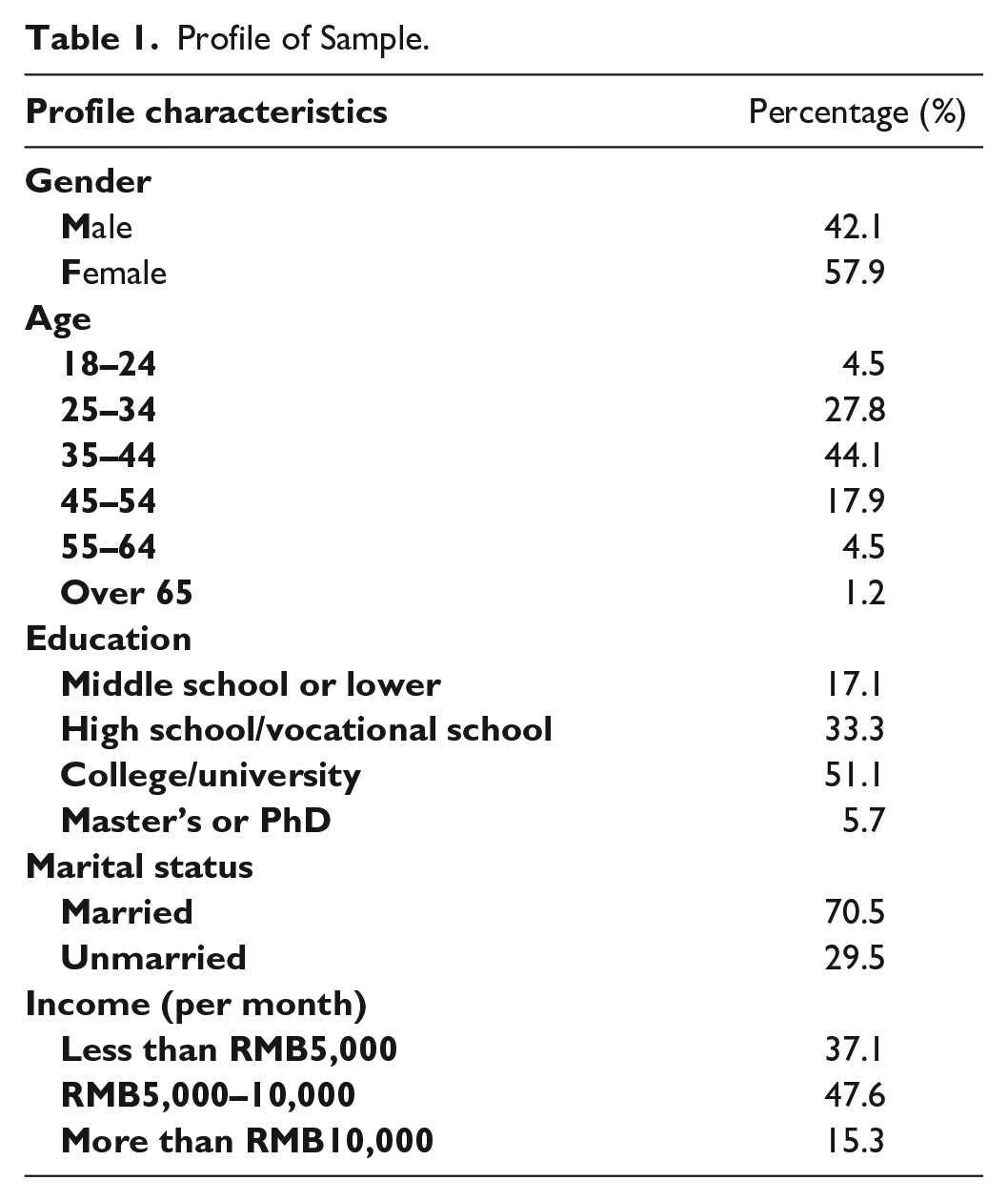
Table 1 shows the profile of the sample. Of the 492 respondents, 207 were female and 285 were male. The gender distribution was thus fairly even. Most (73.9%) of the participants were aged between 25 and 44. In terms of education, 56.8% of the participants had attained college education or above, and 33.3% had received only high school or vocational school education. Most (70.5%) of the participants were married; only 29.5% were unmarried. Regarding income, 37.1% of the respondents received less than RMB5,000 per month, 47.6% between RMB5,000 and RMB10,000 per month and the rest (15.3%) over RMB10,000 per month. The participants were also asked to indicate the industry in which they worked to aid identification of potential differences between residents in tourism-related and non-tourism-related sectors. The results indicated that 17.6% of the respondents did tourism-related work and 82.4% did not.
Profile of Sample.
Data Analysis
Before performing data analysis, all data were checked for issues of multicollinearity, normality, and common method bias before performing data analysis. First, we used VIF values to identify potential collinearity issues in the structural model. All of the VIF values were lower than 5, indicating an absence of collinearity (Hair et al., 2010). Second, the skewness and kurtosis tests suggested the data were normally distributed (Hair et al., 2010). Third, we performed Harman’s one-factor test for issues of common method bias. The results showed that no single factor accounted for over 40% of the variance, indicating no issues of common method bias (Podsakoff et al., 2003). After that, we used the SmartPLS software package (version 3.0) was used to carry out structural equation modeling (SEM) to analyze the data. SEM establishes both measurement and structural models to address complicated relationships, including moderation effects (Hair et al., 2010).
Results
Before the hypotheses were tested, the reliability and validity of the measurement model were evaluated. Cronbach’s alpha was used to test the internal consistency of each construct, reflecting the reliability of the measurement model. The Cronbach’s alpha values for all of the constructs ranged from .867 to .919 and were thus considered acceptable. The authors also tested the model’s composite reliability; this is recommended as an alternative measure for partial least squares path models, as Cronbach’s alpha indicates only internal consistency (Henseler et al., 2009). The composite reliability values ranged from .898 to .936, suggesting that the model had a high level of reliability.
Construct validity was measured by examining the convergent and discriminant validity. Convergent validity indicates the amount of variance shared by the items of a construct and the latent construct. According to Hair et al. (2010), all factor loadings should be statistically significant and have loadings higher than 0.5. As seen in Table 2, the factor loadings for the scales ranged from 0.730 to 0.929, exceeding the threshold of 0.5. The authors also obtained AVE values. Hair et al. (2010) suggested that the AVE should be above .5. In this study, the AVE values for all of the reflective constructs were greater than .5. This demonstrated the model’s convergent validity (Bagozzi & Yi, 1988).
Reliability and Validity of Scales.

Convergent validity was examined by investigating the outer loading of each scale item on its perspective construct and the AVE. The AVE values ranged from .580 to .791 (as shown in Table 2); all were above the threshold of 0.5. Discriminant validity was measured using Fornell and Larcker’s (1981) criteria, according to which a latent construct should share the greatest variance with its assigned indicators. As shown in Table 3, every construct met this requirement, indicating a satisfactory level of discriminant validity.
Discriminant Validity.

After the measurement model had been validated, the structural model was tested. The adjusted R2 coefficient was used to assess the fit of the structural model. R2 values of .19, .33, and .67 for endogenous latent constructs of a structural model represent a weak, a moderate, and a substantial fit, respectively (Chin, 1998). In this study, the R2 value for support for tourism was 0.712, indicating that the model explained 71.2% of the variance in residents’ support for tourism. The model’s ability to predict was tested using Gesser’s Q2 test, a commonly used method of assessing the predictive validity of exogenous latent variables. A Q2 value greater than zero suggests that the exogenous constructs have predictive variance for the endogenous constructs (Chin, 1998). The Q2 value for this study was 0.478, indicating that the model was able to predict residents’ support for tourism.
The hypotheses were tested based on two criteria: the statistical significance of the relationship at the .05 level and the nature of the relationship as hypothesized (+ or −). T values were calculated to test the path coefficients by bootstrapping. The non-parametric bootstrapping procedure was used to test 492 cases, 5,000 subsamples and individual sig changes (Hair et al., 2013). Table 4 shows the analytical results. Hypotheses 1, 2, 3, and 4 were all supported. Hypotheses 1, 2, and 3 were strongly supported, whereas hypothesis 4, which postulated a positive relationship between economic empowerment and support for tourism, was weakly supported. The hypothesis regarding the moderating role of media was partially supported, as media were not found to moderate the relationship between economic empowerment and support for tourism. Media had significant moderating effects on the relationships between social empowerment and support for tourism, psychological empowerment, and support for tourism and economic empowerment and support for tourism (Figure 2).
Results of Hypothesis Testing.
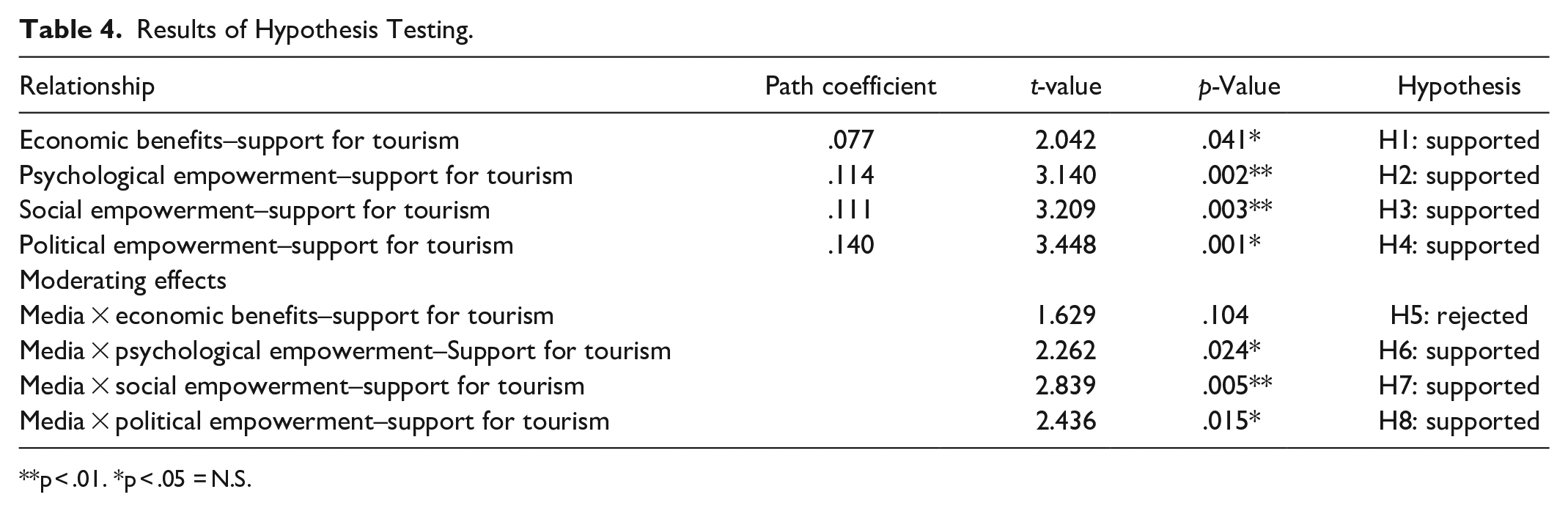
**p < .01. *p < .05 = N.S.

p-Values of hypothesis testing.
Discussion
As one of the most significant stakeholders, residents’ support for tourism is critical for the sustainable development of the tourism industry (Wassler et al., 2019). Although previous studies have investigated the effect of media on residents’ attitudes toward tourism, most of them focused on social media (Nunkoo et al., 2020). Compared to social media, destination promotional video works in different ways to build destination image because they usually adopt storytelling approach, which is especially effective in engaging audiences (Moin et al., 2020). The significance of destination promotional videos on tourism destination marketing has been discussed widely (Kowalczuk et al., 2021; Moin et al., 2020), but most of them take a marketing orientation, with little consideration given to residents. It is unclear whether the destination promotional video has a spillover effect on residents and the consequence of this effect on residents’ perceptions and behavior remains unstudied, leaving a major gap in the existing literature. Bear this gap in mind, this article uses the theoretical bases of RETS, Framing Theory, and Self-Identification Theory to explore the moderating effect of destination promotional videos on the relationship between residents’ empowerment and support for tourism.
The findings show that, overall, promotional media moderates the relationship between resident empowerment and support for tourism. Specifically, the use of destination promotion videos has been found to give residents a stronger sense of empowerment within society, increasing their high level of support for tourism. While destination promotional video enhances tourists’ perception of destination image, meanwhile, it strengthens the effect of empowerment on residents’ support for tourism. This indicates when watching destination promotional videos, residents are likely to turn their sense of empowerment into actual behavior to support tourism development. However, in this study’s case study of Ningbo, media were not found to moderate the relationship between perceived economic profit and support for tourism. In other words, residents’ feelings when they viewed the promotional video did not influence the relationship between their perceptions of the economic profit yielded by tourism and their support for tourism. The reasons for this finding are not yet clear. However, it may be relevant that the majority of Ningbo’s residents do not work in the tourism industry. Based on 2016 to 2017 statistics, the tourism industry contributes only 2.7% to Ningbo’s overall economy, and fewer than 15% of the residents of Ningbo work in the tourism industry (Ningbo Industry Statistics, 2017).
Conclusion
Theoretical Implications
Grounded in RETS, Framing Theory, and Self-identification Theory, this study develops a conceptual framework to understand the effects of destination promotional media on residents, which provides contributions to current literature. First, this study addressed a topic understudied in destination marketing, namely media identification. Using a self-identification approach, we developed measurements for media identification. This can add understanding to self-identification with media by evidencing and assessing the construct in the context of residents.
Second, it adopts an interdisciplinary approach, combining theories of RETS, Framing Theory, and Self-identification Theory. Although Framing Theory and Self-identification Theory indicate that media impacts residents indirectly, the role of media on the effects of empowerment remained unexplored in tourism. The findings of this study show that destination promotional videos were widely viewed by residents. Moreover, it had significant effects on strengthening the impact of residents’ empowerment, making residents show more support toward tourism development.
Practical Implications
Practically, this study could provide implications for destination managers and tourism entrepreneurs. It is essential to understand what drives residents’ support for tourism, as residents are significant place ambassadors and co-creators of place branding (Tse &Tung, 2022). This study indicates that a promotional video is not only an effective approach to building a destination image and brand, but also a powerful tool for enhancing residents’ support for tourism development through their perception of empowerment. Hence, it is vital for destination managers and tourism entrepreneurs to release destination promotional videos to strengthen the emotional feeling among its stakeholders.
Further, the destination managers can focus on essential aspects of the place when making destination promotional videos. This study indicates that certain elements in destination videos, such as “beautiful nature environment,” “high-quality city infrastructure,” “historical and cultural attractions,” “local cuisine,” and “local dialect,” were most identified by the residents. As a result, when making destination promotional videos, destination managers can highlight content from these perspectives to better engage the residents, making them more supportive of tourism development.
Study Limitations and Future Research Directions
This study has some limitations which can be considered for further research. First, using Ningbo as a case study, this study confirmed the value of destination promotional videos on residents. However, the measurements we developed for media identification were based on the context of Ningbo, which may be not universal appliable. Later studies can develop more general measurements for media identification by following our approach.
Second, although all the participants in this study reported they had watched at least one destination promotional video, this study did not investigate the impact of the number of videos watched by respondents on their sense of empowerment and support for tourism because most of the residents (65%) only watched one video. Further studies can consider the effects of the number of videos watched on residents by conducting a large-scale survey.
Third, this study focused on residents’ empowerment from the perspective of RETS, but one limitation of RETS is that it lacks consideration of the emotional factors. Hence, the discussion of emotional factors is outside the scope of this article. Further studies can focus on the effects of emotional factors in destination promotional videos on residents.
Footnotes
Declaration of Conflicting Interests
The author(s) declared no potential conflicts of interest with respect to the research, authorship, and/or publication of this article.
Funding
The author(s) disclosed receipt of the following financial support for the research, authorship, and/or publication of this article: This article was funded by Hainan University start-up fund No. Kyqd(sk)1924.
