




Abstract
Based on social capital theory and fairness theory, the study proposes a residents’ supportive attitudes influencing model, with social capital as the antecedent variable, and the perception of justice as mediator. An empirical research was conducted on residents of three well-known island tourist destinations in Zhejiang Province, China, a total of 620 questionnaires were distributed in the three regions. The results of data analysis show that the perception of distributive justice and procedural justice is positively influenced by social capital; it has a positive impact on distributive fairness and residents’ support. Distributive justice has a positive impact on the supportive attitudes of residents. In addition, the mediation effect of distributive justice and procedural justice between social capital and the supportive attitude of residents has been supported. The theoretical contribution and practical value of this research have also been discussed.
Keywords
Introduction
The community is the main field where social activities, social relationship networks, community value norms and social trust take place. It is also a key network that connects all aspects of the social activities. Community social capital is the embodiment of social capital in the community (Jones, 2005). The intensity of community social capital affects the ability of local residents to control or influence the growth of tourism (Park et al., 2012). Social capital is a tool and mean to enhance the capacity of tourism communities. Tourism development has changed the community’s economic, social, and cultural structures. Changes in the community’s social structure affect the community social capital stock, which in turn affects residents’ attitudes and behaviors in the support of tourism development. While economic analysis of social capital cannot be carried out by individuals, technical tools such as social capital measurement (De Silva et al., 2005; Park et al., 2012, 2015) provide technical support for quantitative research and the application of social capital in the tourism industry. Therefore, studying the residents’ perception of justice and residents’ tourism supportive attitudes from the perspective of social capital can provide theoretical understanding for the development of community tourism.
The relationship between fairness and organization is extremely close. Moorman (1991) studied the relationship between organizational fairness and organizational behavior based on the perspective of organizational fairness to construct a more comprehensive measurement model of procedural justice and interactional justice. The research on the effect of tourists’ perception of justice in tourism mostly focuses on the satisfaction of tourists’ perception of justice (Severt & Rompf, 2006; Xie et al., 2007), tourist loyalty (Su & Huang, 2010), repurchase intentions (Kim et al., 2009), tourists’ affections and emotions (Silva & Lopes, 2014), and the impact on the quality of customer relationship (Clark et al., 2009).
The development of tourism is closely linked to sustainable economic, social, and environmental development (Muresan et al., 2016). The impact of tourism growth can be perceived directly by residents. Residents’ attitudes of support or opposition are based on their perception of the impact of tourism (Peters et al., 2018), which will in turn influence the sustainable development of tourism (Almeida-García et al., 2016). The supporting attitude of residents toward tourism is therefore an important support for the sustainable development of tourism (Ayazlar & Ayazlar, 2016). However, several factors such as the natural, economic, social, and cultural climate, infrastructure (Muresan et al., 2016); the level of education of residents, place of birth, and length of residence (Látková & Vogt, 2012); location dependence, quality of life in tourism communities (Meimand et al., 2017); perception of tourism effects by locals, tourism destination growth phases (Yu et al., 2017) will affect the supporting attitude of residents toward tourism.
Through much in-depth research on the development of community tourism, the residents’ community of the tourism destination may also have an impact on their supportive behavior. The impact on the community’s perception of justice is increasingly concerned on the behavior and attitude of the residents (He et al., 2018; Xu, Sun, et al., 2015).
Although social support, social justice, and social capital are the three important components of the community (Dolan, 2008), few scholars have integrated the above relationships to conduct research on the attitudes of residents in tourism destinations toward tourism development. Especially in island tourist destinations, the relatively closed and independent community environment makes the discussion of the above relationship more academically valuable.
To this end, the aim of this research is to study the mechanism of influence of community social capital on the fair perception of residents and the attitude of tourism support by building the relationship model of “social capital-perception of equity-residents’ tourism support attitude” and thus expanding the theory of community tourism. At the same time, the above relationship model was tested as a research case with the communities of three island tourist attractions in Zhoushan, Zhejiang Province.
Theoretical Basis and Research Hypothesis
Theoretical Basis
Social capital theory
Social capital is a characteristic of social organizations, such as trust, norms, and networks. They can increase social efficiency by promoting cooperative actions, including mutually beneficial norms and citizen engagement networks (Putnam et al., 1994). The stock of social capital is often self-reinforcing and accumulable. Thus, norms, trust, and citizen engagement networks as the basic elements of social capital to solve the dilemma of collective action (Putnam et al., 1994). Norms are the result of human efforts to establish order and increase the predictability of social impact and bring benefits to individuals or groups (Ostrom, 2000). Trust is an indispensable component of social capital. It is like a lubricant and can make the operation of any group or organization more effective (Fukuyama, 2001). When members of society have a higher level of trust, they can usually solve problems concerning collective action at lower costs (Tye & Williams, 2009). Social networks can be classified as informal and formal connections between individuals or groups (Baum & Ziersch, 2003). Powerful network generate trust and strengthen collective action to share information, knowledge, and resources (Coleman, 1994). Social networks play an important role in actively participating in tourism activities in the form of social capital (Chan, 2017). Social networks and other social capital types involve interactions in enhancing sharing norms, trust, and understanding, which in turn promotes participation and collaboration to achieve common interests and sustainable development (Attama, 2012).
Fairness theory
The theory of organizational justice originated from the social exchange theory of Homans (1958). Later Adams (1963) proposed Equity theory. More recent, Rawls (2001) put forwards the concept of “the veil of ignorance” to illustrate two principles of distribution from the perspective of sociology and economics; one is the principle of maximum equality and freedom and the other is the principle of justice. The principles of Justice are divided into “Fair Equality of Opportunity” and “Difference Principle.” Deutsch (1975) further pointed out that the three principles of Equity, Equality, and Need should be followed in the distribution process.
The judgment of fairness influences the residents’ perception of justice in tourism, and further affects the residents’ behavior and attitudes. According to classic equity theory (Adam, 1965; Adams, 1963), referent cognitions theory (Folger, 1986), and fairness theories (Folger & Cropanzano, 2001), group engagement model (Tyler & Blader, 2003), fairness heuristic theory (Lind, 2001; Lind & Earley, 1992), the fairness judgment of residents in tourist destinations is formed by comparison and reference, group engagement and heuristic judgment under insufficient information resources.
Research Hypothesis and Research Model
The relationship between social capital and residents’ perception of justice
Social support, social justice, and social capital are three important components of the community. Those components influence and interact with each other to jointly promote community development (Dolan, 2008). Social capital can promote the establishment of equal social relations and promote the enthusiasm on the engagement of community residents (Putnam et al., 1994). Inequality in social capital can lead to inequality in power and obligations of different actions (Portes, 1998). In terms of gender in society, the development of social capital can effectively promote gender equality (Prasisca & Sutikno, 2015).
In relation to social distribution, social capital is an equalizer of residents’ income distribution. Its increase can significantly reduce the imbalance of income distribution and improve the satisfaction of community (Ram, 2013). Moreover, it also has an important function of promoting redistribution (García-Valiña et al., 2007). Residents with high-level and diverse social networks in the tourism community have a stronger sense of social fairness. Building bridging social capital helps strengthen residents’ confidences in society where is a fairness place. At the same time, citizen engagement also positively affects people’s impressions of social justice (Chen, 2016). Social capital promotes mutual integration and solidarity within the community, resulting in a common consciousness beyond individual consciousness, which can reduce its own sense of injustice (Putnam et al., 1994). However, when the trust within the group is too limited, the internal solidarity of the group weakens the ability to cooperate between members of the group and non-members of the group and often leads to negative externalities of the group (Fukuyama, 2001). A strong interest-bearing relationship usually prohibits others from earning income (Portes, 1998).
Based on the prior research, the following hypotheses are proposed:
Relationship between social capital and residents’ supportive attitude
Social capital is rooted in social relations, and social relations promote or restrict someone on accessing the use of social capital. Social capital is a resource acquired in a purposeful action and/or passively embedded in social structure (Lin, 2002). Social capital can promote residents’ willingness to build consensus of the community, and then carry out reciprocity and cooperation in order for obtaining benefits in tourism development (Putnam et al., 1994). Owing to social capital helps people gain advantages in terms of information, employment, income, and so on. Furthermore, personal well-being will be enhanced through obtaining these additional economic benefits (Powdthavee, 2008). However, there is significant interactional differences between capital and well-being within various regions (Rodríguez-Pose & von Berlepsch, 2014).
Integrity, network, formal, and informal rules or systems are the basic forms of social capital. Trust is the bridge of collective action as it is a mean to solve the problem of collective action (Ostrom, 2000). In the development of community tourism, the social connection between individuals and families can strengthen emotional interactions, thereby generating trust (Brunie, 2009). Emotional associations and group norms have significant positive effects on the willingness of tourists’ environmental maintenance and protective behavior (Jones, 2005). Interpersonal trust and reciprocal cooperation improve residents’ tourism supportive attitudes by helping residents realize the transition from “individual rationality” to “social man” (Park et al., 2015). Interpersonal trust can improve community residents’ positive evaluation of tourism development and improve community residents’ satisfaction (Dallago et al., 2009). Social capital has reinforced the overall cohesion of community residents and influenced residents’ supportive attitude and behavior of tourism development. Based on the prior research, the following assumptions are made:
The relationship between procedural justice and distributive justice
Procedural justice refers to people’s perception of justice through decision-making procedures and processes (Qureshi et al., 2017). Leventhal (1980) believe that procedural justice is used to determine the fairness of result methods, systems, and processes. Diamond et al. (1978) found that those who have a voice in court are always feeling to be treated much fairer than those who have no rights to speak and then turn in more satisfactory. Individual equity is not only affected by the results of fairness, but also by the relevant decision-making information and decision-making procedures in the distributive process (Leventhal et al., 1980). Intrinsic motivation is greatly and separately influenced by procedural justice and interactional justice. Organizations should begin to strengthen the fairness of the distribution process to enhance the sense of fairness of workers in distribution (Chiaburu & Lim, 2008; Zapata-Phelan et al., 2009). Since the distribution is primarily influenced by the process, the unequal treatment of individuals in the process of engaging in economic and social activities can trigger their negative emotions and then impact the satisfaction of the fairness of the outcomes (Shrivastava & Purang, 2016). Procedural justice has the most fundamental effect on the sense of distributive justice of employes (Zhou & Long, 2014) and has a substantial impact on the satisfaction of employes’ income and initial distributive justice satisfaction (Sun & Wu, 2019; Wang et al., 2014). Based on the research mentioned above, the following hypotheses are proposed:
Relationship between perception of justice and residents’ supportive attitudes
Resident’ perception of justice examines residents’ perceptions on tourism impact from the perspective of beneficial equity. Interactive, distributive, and procedural justice have direct and indirect effects on overall fairness and customer satisfaction (La & Choi, 2019; Severt & Rompf, 2006). Customers’ perceptions regarding distributive, procedural, and interactional justice affect the satisfaction of service organization and ultimately affect service quality and customer relationships (Clark et al., 2009). Procedural justice and distributive justice positively affect employes’ organizational citizenship behavior, and negatively affect employes’ willingness of turnover (Hemdi & Nasurdin, 2007; Raja et al., 2018). Distributive justice has a stronger effect on service restoration than procedural justice and interactional justice (Kim et al., 2009). In tourism development, when people are treated unfairly up to a certain degree, they will feel the sense of deprivation and become angry (Roseman, 2018; Shaw & Costanzo, 1982). Community engagement can promote the fairness among subjects with different powers, so that community residents can obtain compensation fairness. Based on the prior research, the following hypotheses are proposed:
The perception of justice has an intermediate effect between social capital toward residents’ supportive attitude
The support of residents in tourism development comes from the recognition of fairness, which is affected by many factors. For example, Ehrhardt et al. (2012) found that national identity affects distributive justice and interactional justice, and further affects organizational commitment so that distributive justice and interactional justice have an intermediate effect between national identity and organizational commitment. Lee et al. (2010) found that leader-member exchange affects organizational fairness, and further affects turnover intentions of employes. In other words, organizational fairness has an obvious intermediate effect on the relationship between leader-member exchange and turnover intentions of employes. Interactional justice, procedural justice and distributive justice have a direct effect on overall fairness and customer satisfaction. Overall fairness has an intermediate effect between interactional justice, procedural justice and distributive justice on customer satisfaction (Severt & Rompf, 2006). Social capital, as a key mechanism to promote the success of local tourism activities, can be regarded as an important mean at different stages (Pongponrat & Chantradoan, 2012). Both informal and formal social capital can affect a person’s perception of justice, and further affect residents’ recognition of social fairness (Chen, 2016). The government structure can generally be viewed as a formal system and can also be considered as a formal social capital. A formal or informal non-governmental network of ties may be considered to be an informal social capital. By solving the problem of collective action, both kinds of social capital will help optimize the social order (Bourdieu, 1985). Based on the previous research, the following hypotheses are proposed:
In summary, this study proposes the following research conceptual model (see Figure 1).
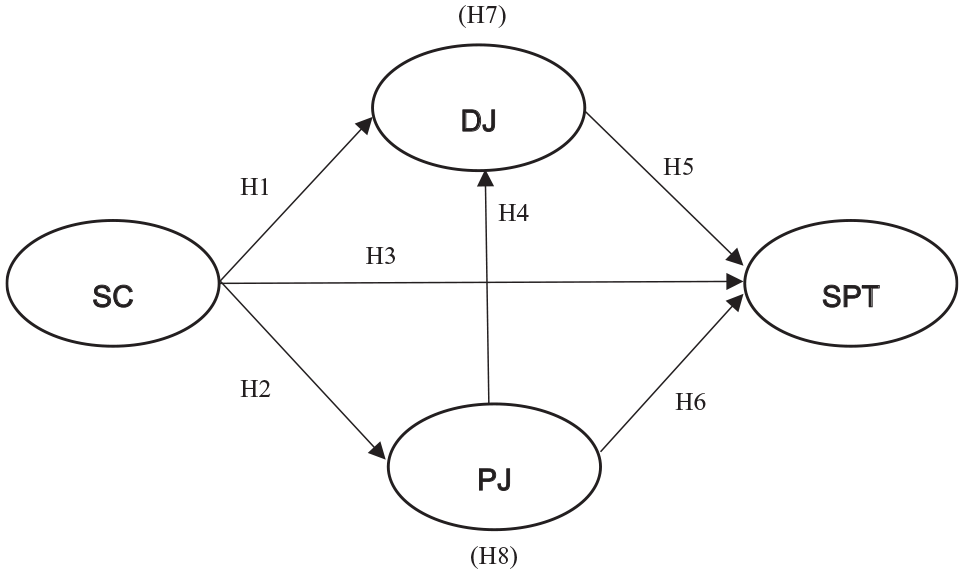
Theoretical model.
Methodology
Research Locations and Data Collection
The research sites are three islands, namely Putuo Mountain, Zhujiajian, and Taohua Island, under the jurisdiction of Putuo District, Zhoushan City. Zhoushan is an archipelago with rich tourism resources. “Golden three islands” consist of Putuo Mountain Scenic Area, Zhujiajian Cruise Terminal, and Taohua Island Scenic Area in the tourism development of Zhoushan Islands.
The survey of this study was conducted from June 15 to July 15 in the year of 2018 (Putuo Mountain), July 8 to 9 in the year of 2018 (Peach Blossom Island), and June 25 to 27 in the year of 2018 (Zhujiajian). The main reason for choosing three islands for research is that the islands mentioned above are relatively independent communities with three different models of development in the same administrative region. Therefore, each island is representative in the tourism development model. As such, selecting three islands for investigation can ensure that the relevant research results have some universality. To ensure that the interviewee meets the research needs, the interviewee’s identity during this study’s survey process must be pre-identified as an island permanent resident. The research process used two pre-screening questions: whether they were over 18; and whether they had lived on the island for at least 15 years. A convenient sampling method was adopted according to the actual case site situation.
A total of 620 questionnaires were distributed in the three regions. The overall response rate was 97.7%, of which 220 were in Zhujiajian, 212 were collected, the response rate was 96.3%, and 200 valid questionnaires. The effective rate was 94.3%; Putuo Mountain distributed 200 questionnaires and 199 questionnaires were collected, with a response rate of 99.5%, and 170 valid questionnaires, the effective rate was 85.4%; Taohua Island distributed 200 questionnaires and 195 questionnaires were collected, with a response rate of 97.5%, 179 valid questionnaires, with an he effective rate of 91.7%. A total of 57 invalid questionnaires were discarded so that 549 valid questionnaires were obtained, and the effective rate was 90.5%.
Measurement
According to the definition of social capital by Putnam et al. (1994), the measurement questions were designed with reference to the measurement scale of social capital by Park et al. (2012, 2015). It consists of three parts of measurement items. Community residents’ perception of justice is composed of distributive justice and procedural justice. Currently, there is no mature measurement scale for community residents’ perception of justice. Therefore, this study referred to the measurement scale of organizational fairness suggested by Liu et al. (2003) and combined the reality of the tourism community to make necessary adjustments to measurement items. After making necessary adjustments of the measurement items, the distributive justice and procedural justice are composed of four measurement items respectively. As to for residents’ support attitude to tourism, measurement scale referred to Gursoy et al. (2002) study and designed three measurement items. For the convenience of statistics, the Likert 5-level scale system is adopted instead of the Likert 7-level scale system. About 1 to 5 indicate strong disagreement, disagreement, general agreement, and strong agreement.
Data Analysis
This study mainly adopted structural equation models to conduct empirical tests on theoretical models and research hypotheses. First was to check the normal distribution of the data and the internal consistency of the scale. The data results show that the absolute value of the skewness coefficient of all scale items is between .031 and 1.087, which are <3, and the absolute value of the kurtosis is between 0 and 1.67, which are <10. This result is consistent with distribution test standard proposed by Kline (2005). The Cronbach’s a coefficient of the item is .875, which is >.7, and the CITC of each measurement item is >.4. This indicates that the overall reliability of the questionnaire is high. Finally, AMOS.20 was used to verify the reliability and validity of the measurement model through confirmatory factor analysis (CFA), and the overall fit of the structural model and the research hypothesis were tested.
Results
Sampling Statistics
Descriptive statistics mainly analyzed and described the type, characteristics, and proportion of the participants from their gender, age, education, income, location, and whether they took part in tourism and so on. The data shows that the respondents accounted for 52.64% of women and 47.36% of men in gender distribution; 25 to 44 and 45 to 64 years old accounted for 42.81% and 41.71% of the age distribution respectively; As to education, junior high school and below occupied 44.44% in a total of participants, junior colleges, and high schools accounted for 32.60%; In terms of income distribution, residents’ income was relatively high, with a group of 3,000 to 5,000 yuan/month accounted for 42.62%; In particular, most local residents participated in tourism industries were 72.50%; In the sample distribution, Zhujiajian accounted for 36.40%, Putuo Mountain accounted for 31%, and Taohua Island accounted for 32.60%.
Reliability and Validity Test
Confirmatory factor analysis (CFA) results show that the combined reliability of the social capital facet is (CR) 0.779. The average variance extraction (AVE) is 0.542, and the combined reliability of the procedural justice facet is (CR) 0.852. The average variance extraction (AVE) is 0.594. The combined reliability of the distributive justice facet is (CR) 0.854. The average variance extraction volume (AVE) is 0.594, and the combined confidence of the residents’ supportive attitude facet is (CR) 0.933. The average variance extraction (AVE) is 0.823. The combined reliability (CR) of all study facets is >0.6, and the average variance extraction (AVE) is >0.5, which indicates that the measurement model used in this study has good reliability (see Table 1). The standardized factor load of all facet measurement items is generally >0.6 (p < .01), showing good aggregation validity.
Confirmatory Factor Analysis Result.

Note. SC = social capital; PJ = procedural justice; DJ = distributive justice; SPT = supportive attitudes.
Regarding the test of discriminant validity, it is generally considered that if the square root of the AVE of the latent variable is greater than the concerned Pearson correlation coefficient, it can be regarded as having good discriminant validity. As shown in Table 2, the square root of the AVE of all latent variables in this study is greater than the correlation coefficient with other latent variables, which shows good discrimination validity. In addition, the correlation coefficients between the latent variables shown in Table 1 can be found that the correlation coefficients of all the constructs are all significant at .01 level.
Discriminant Validity of Latent Variables.

Note. n = 549. SC = social capital; PJ = procedural justice; DJ = distributive justice; SPT = supportive attitudes.
Means p < .01, The bold numbers are the square root of the AVE of latent variable.
Model Fitting and Hypothesis Testing
Based on the above measurement model and reliability test, AMOS20.0 software was used to conduct statistical tests on the overall model fit and the research hypothesis of the relationship between latent variables. Model fit index χ2/df = 2.45, <3; RMR = 0.003, <.05; RMSEA = 0.052, <.08; SRMR = 0.038, <.05, GFI = 0.956, AGFI = 0.935, IFI = 0.976, CFI = 0.976, NFI = 0.960, all >.90, which shows that the model fits well and has a parsimony goodness-of fit.
As shown in Figure 2, most of the research hypotheses proposed in this study are supported by data. Social capital has significant positive effects on distributive justice (β1 = .191**, p < .001) and procedural justice (β2 = .391**, p < .001), so hypothesis H1 and hypothesis H2 are supported. The influence of social capital on residents’ supportive attitudes (β3 = .048**, p < .01) is not significant, so Hypothesis 3 is not supported. Procedural justice has a significant effect on distributive justice (β4 = .531**, p < .01). Research hypothesis H4 is supported. Distributive justice has a significant impact on residents’ supportive attitudes (β5 = .280**, p < .01). Research hypothesis H5 is supported. Procedural justice has a significant effect on residents’ supportive attitudes (β6 = .163**, p < .01). Research hypothesis H6 is supported.
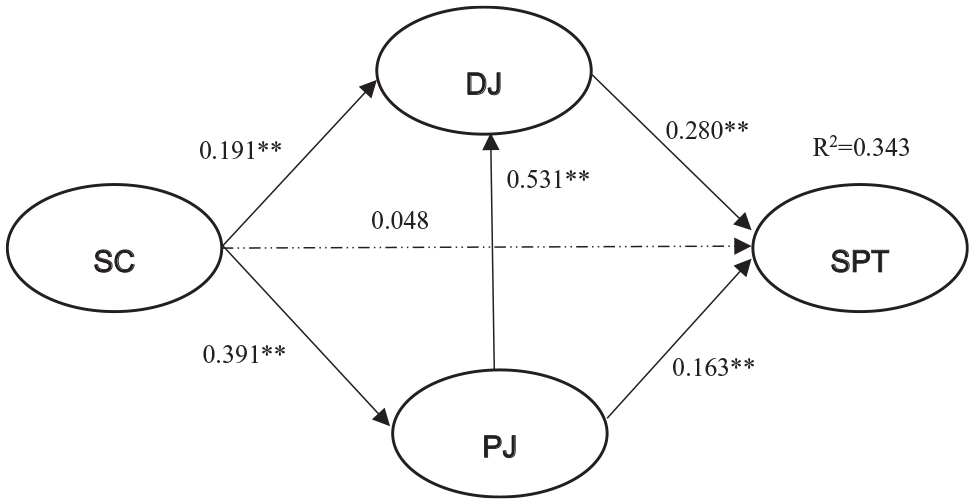
The results of SEM analysis.
This study applied the Bootstrap method to use the Process program to test multiple Mediation effects at a 95% confidence interval. The test methods and steps were mainly based on the procedures proposed by Hayes (2017) and Zhao et al. (2010). If the upper and lower limits of the confidence interval do not include 0 in the result of mediation test, it would indicate that the Intermediate effect is significant. From the test results in Table 3, it can be seen that the direct effect of social capital on residents’ supportive attitudes is not significant. Distributive justice and procedural justice have significant intermediate effect on the relationship between social capital and residents’ supportive attitudes. This indicates that distributive justice and procedural justice have completely mediation effects on the social capital to residents’ supportive attitudes. As a result, the research hypothesis H7 and H8 are supported. Please refer to Table 4 for detailed information.
Path Coefficient Estimation and Research Hypothesis Testing.

Note. N = 549. SC = social capital; PJ = procedural justice; DJ = distributive justice; SPT = supportive attitudes.
p < .01.
Bootstrap Mediation Effect Test Results.
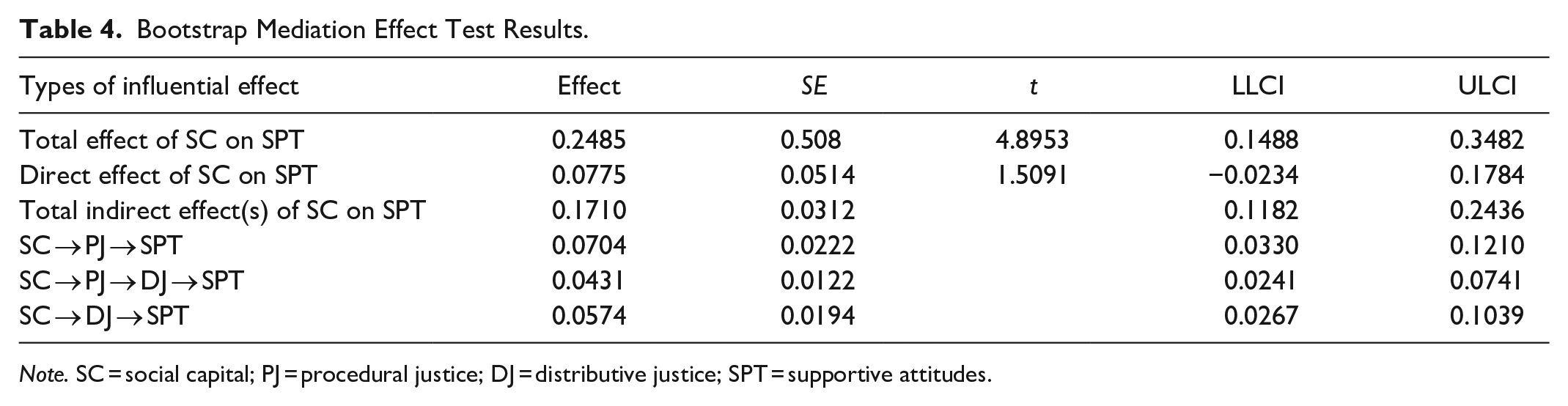
Note. SC = social capital; PJ = procedural justice; DJ = distributive justice; SPT = supportive attitudes.
In general, the R2 values of the explanatory variables are .01, .09, and .25, which represent the three levels of the model’s predictive power: weak, weaker, and strong. The regression judgment coefficient (R2) of the tourism supportive attitude of the dependent variable in the model is .343. It indicates that the independent variable of this study explains the variance of 34.3% of the residents’ supportive attitudes. This shows the good effectiveness of the model.
Conclusion and Implication
Discussions
Social capital has a significant effect on the perception of justice. Social capital has two forms, such as government social capital and civil society capital. Government social capital refers to the governance structure that affects the ability of individuals to cooperate mutually beneficially, including the execution of contracts, the rule of law, and the scope of civil liberties authorized by the government. Civil society’s capital includes common values, norms, informal networks of contact and corporate membership (Bourdieu, 1985). There are formal and informal forms of social capital. Formal social capital provides theoretical support for obtaining rights of community residents and striving for fairness to every community resident. Obviously, residents’ rights of engagement, vote, decision-making, and election are guaranteed by formal social capital. Informal social capital is a lubricant for tourism development and provides a public foundation for the protection of various tourism rights of community residents, such as various fishermen’s associations, homestay associations, economic cooperation. Those social organizations provide residents with an additional and efficient way to resolve community conflicts and improve the ability of community residents to participate in decision-making of community affairs. In this rural Chinese society, the capital of civil society is a significant supplement to government capital. The living areas of people are relatively small, especially in island communities with relatively closed geographic spaces, and each maintains an isolated social circle. Therefore, the social network of island communities in China has a more direct effect on the perception of equality by people. As a community governance tool, civil society capital should not only create a good community atmosphere for people to communicate with each other but also give citizens guidance, social, and emotional support, and facilitate the exchange of information resources., As a result, forming efficient contact, collaboration, and elastic structures (Costa & Galina, 2015) could minimize unjust situations. It will eventually boost the sense of identity, belonging, and security of citizens in the community.
The influence of social capital on residents’ supportive attitude is not significant. The study is different from the research results of Fan and Li (2016) and Park et al. (2015). Social capital has positive and negative impacts. Social capital has shaped the way that residents respond to tourism development. Only when the negative impact of social capital is observed and managed, the community could be benefit on building the sustainable development of rural tourism (Park et al., 2015). In sustaining community life, social capital plays an important role (Putnam et al., 1994), but the “acquaintance society” circle in China is defined by the degree, form, and stock scale of social capital. Further disparity and exclusion would be created by the “circle” of social ties. The gentrification, aging, and empty-nested phenomenon of island communities have torn apart the island’s original social structure and exacerbated the collapse of the community’s social capital. The crisis of community’s trust has become increasingly apparent. The social network structure has gradually disintegrated. Before establishing social norms, the lack of social capital in the development of community tourism affects the enthusiasm of residents’ supportive attitude. The tourism community belongs to residents as social community where residents work. Changes in social capital have contributed to the absence of the sense of belonging and identity of residents in the community. This would eventually limit the joint efforts of residents to support tourism.
The perception of justice has a significant effect on residents’ supportive attitudes. The results of this study are consistent with those studies of Xu, Wang, et al. (2015) and Liu and Li (2014). The pursuit of fairness guides the direction of movement and moral in social life (Montada, 2003). The engagement of community residents and the substance of tourism is a type of resource exchanges. When the resource exchange is balanced and is perceived by the host community, residents may feel to be treated fairly and their rights are objectively respected. Under this conditions of mutual benefit on returning treated fairly, residents of the community will be more motivated to support tourism development (Ap, 1992). On the contrary, if there is injustice in tourism, community residents will have a significant sense of social exclusion and lead to retaliation. Therefore, only achieving fairness can help and eliminate social problems in community development. Distributive justice and procedural justice are closely connected to the behavior and actions of residents (Zhang & Wang, 2010). Perceived procedural justice helps residents develop a shared sense of priorities, values, and reciprocity and expectations. This consensus helps to encourage the exchange and sharing of information and knowledge (Liu et al., 2012), and in social dilemmas to promote cooperative actions (De Cremer & Tyler, 2007). A fair distribution of benefits is the fundamental aim of residents involved in tourism. If the distribution outcome is achieved, trust will increase in community organizations, and the willingness of residents to support tourism will also increase.
Distributive justice and procedural justice have complete intermediate effect. Justice includes two dimensions: distributional Justice and procedural justice. This finding is consistent with the previous research findings on organizational fairness by Fryxell and Gordon (1989). The perception of justice had the complete intermediate effect. This indicates that social capital does not directly affect residents’ supportive attitudes, but indirectly affects residents’ supportive attitudes through the perception of justice. The procedural justice perceived by residents (SC → PJ → SPT, Effect = 0.0704) is greater than the perceived distributive justice from the point of view of intermediary effects (SC → DJ → SPT, Effect = 0.0574). The fairness of the distribution and procedures of tourism are the primary principles and urgent aspirations strongly sought by a great deal of people. The fairness of immediate and actual benefit distribution is particularly relevant for island residents with low social status and unstable incomes, while procedural justice is the precondition for equal distribution. Social capital, social equity, and residents’ supportive attitudes relate to each other in the framework of three-dimension (Dolan, 2008). In social operation, social capital maintains the stability of a community and the consistency of actions. It also improves the efficient behavior of individuals or institutions in the community. Social equity is the bridge that connects social capital and social support.
Theoretical Implication
The theoretical contribution of this paper is mainly expressed in several aspects: firstly, from the perspective of the theory of social capital, it examines the effect of social capital on the perception of justice by residents and the attitudes of support and the path of action by residents, and analyzes the mediating role of the perception of justice. Specifically, procedural justice and distributive justice perception absolutely mediate the effect of social capital on the attitudes of residents toward supporting tourism.
The second is to incorporate the theory of organizational justice into the research of the island tourism community of China, and to investigate the effect on the attitudes of residents toward tourism of the perception of justice in the island tourism community of China. The study found that various dimensions of justice have different impacts on the attitudes of residents toward tourism. The perception of procedural justice of residents has a greater impact on attitudes than distributive justice. It can be seen that procedural justice in the island-style destination communities in China is the prerequisite for achieving fair distribution.
Thirdly, from the point of view of social capital and the perception of justice of residents, research on the influence mechanism of tourism-supporting attitudes provides a new perspective for fostering community governance of the destination of island tourism and achieving healthy and sustainable development. That is, social capital and community justice are of great significance for ensuring the stable and sustainable development of island tourism societies.
Management Implication
This study has the following enlightenment to the development of Zhoushan Island Tourism Community:
To begin, it is critical to rebuild the social networks of island communities. For a variety of reasons, this study discovered that social capital has a negligible effect on residents’ attitudes toward tourism support. Among them, one of the most significant factors is the deterioration of social connections and interaction among island residents. As a result, management practice must prioritize the reconstruction of social network relationships. We can consider holding festivals that reflect the island’s traditional social culture as part of the process of reconstructing the local social network. Because traditional cultural activities serve as a bridge, they can strengthen social ties and interactions among island residents, thereby fostering closer family, friendship, and business relationships (Christiawan, 2018). Additionally, as social media platforms such as WeChat, QQ groups, Instagram, and Tik Tok gain popularity, they have created a new type of social communication space. The aforementioned are critical platforms for residents of the island community to communicate and interact, as well as express public opinion (Whiting & Williams, 2013). As a result, it is critical to value the emotional connection and organization functions of virtual social networks, as well as to actively use virtual social network platforms to cultivate social capital.
Second, island communities’ social norms must be strengthened. The findings of this study indicate that social capital has little effect on residents’ attitudes toward tourism support, which is partly due to a lack of community social norms. The primary manifestations are a lack of market norms, as exemplified by “pimps,” and a lack of behavioral norms, as exemplified by “investors.” From a community governance perspective, developing strict market supervision policies and enforcing strict penalties against “pimps” enables people to engage in tourism activities in accordance with the market value standards they agree upon. As a result, it may be an effective method of ensuring the tourism market’s healthy operation, preventing the absence of market behavior norms, and promoting the standardized development of the island tourism market.
Community regulations and civil agreements serve as the island communities’ “moral defense.” Complete community norms can help residents develop self-discipline and autonomy, as well as engage in social activities in accordance with traditional folk ethics, thereby protecting short-term investors from personal behavior anomie. Simultaneously, necessary restrictive measures should be implemented for foreign investors’ entry, and management should be conducted in accordance with social norms to prevent foreign investors from corroding, destroying, and disintegrating the island’s social community.
Thirdly, informal civil organizations at the local level should be established. This study discovered that civil organizations, as social capital, can foster a positive social climate and provide necessary emotional and industry support for tourism development. Tourism elites and opinion leaders in the community are rooted in the community and have direct contact with its residents. They frequently possess considerable authority and conviction and are capable of leading and promoting the development of community tourism values (Valente & Pumpuang, 2007). It is necessary to actively promote the positive exemplary role of community tourism elites, opinion leaders, and other groups, to enable them to participate in community tourism governance on behalf of the public, and to foster a non-governmental consensus for community tourism development. Numerous industry associations serve as a conduit for public opinion to government management departments and for the dissemination of official information to the general public. They perform the functions of self-regulation, restraint, and self-organization in the industry (Qiao et al., 2014). It is necessary to encourage communities to form industry associations in tourism-related fields, such as community tourism associations, bed and breakfast industry associations, and tour guide associations, in order to build industry consensus and form a collaborative force for development.
Fourth, establishing a transparent and participatory mechanism for public policy decision-making. The findings of this study indicate that residents’ perceptions of distributive and procedural justice significantly influence their attitudes toward tourism development. Additionally, allowing extensive participation of community residents in tourism planning and policy development is an effective way to improve residents’ perceptions of procedural justice (Mazerolle et al., 2012). The measures outlined above will also assist residents in comprehending tourism development decisions and in improving the consistency of decision support and decision-making implementation consciousness. When community residents’ opinions and information are communicated and released effectively, it can alleviate the situation of information obstruction and insufficient information, thereby increasing the transparency of decision-making. Allowing residents to speak out can improve their perception of interactional justice and contribute to residents’ sense of ownership and community responsibility (Mullenbach et al., 2019).
Fifth, establish a mechanism to assist marginalized groups in participating in tourism. This study discovered that tourism practitioners in their middle and senior years, as well as those with only a high school diploma or less, are a significant force in promoting the development of island tourism. As a result, it is critical that they maintain a favorable attitude toward the tourism industry. For elderly tourism practitioners, it may be worthwhile to consider establishing a series of assistance mechanisms via non-governmental organizations, such as elderly associations or seniors’ university, to assist middle-aged and elderly groups in updating their tourism expertise and enriching their leisure lives, thereby improving their cultural literacy, service skills, and overall quality of life (Wu et al., 2020). Local managers can tailor training on service knowledge, service skills, and service awareness for tourism practitioners with a low level of education and deliver it to target audiences in a variety of ways and formats, thereby assisting practitioners with a low level of education in continuing to improve their comprehensive literacy (Arango-Morales et al., 2019) and their ability to participate in tourism development.
The Limitation of Research
There are still some research limitations in this study. There are the issues of generalization and the concept of social capital. It is because the concept of social capital in tourism community is not unified and the social capital evaluation index system in tourism community still needs some improvement. At current stage, there is not any widely recognized, scientific and standardized measurement system being formed yet.
As to the perception of justice, there are limit worldwide studies on the perception of justice in community and lack of mature scales of the perception of community residents’ fairness in China. As a result, this study adopted the scale of organizational fairness to measure the perception of justice. Further verification and modification should be made to focus on the elements and dimensions of social capital in tourism community and the perception of justice.
Footnotes
Declaration of Conflicting Interests
The author(s) declared no potential conflicts of interest with respect to the research, authorship, and/or publication of this article.
Funding
The author(s) disclosed receipt of the following financial support for the research, authorship, and/or publication of this article: This research was supported from the Zhejiang Province Philosophy and Social Science Planning Project [Grant Number 20NDJC349YBM]
