



Abstract
Transportation systems are complex and multimodal, comprising diverse travel modes that often compete for limited roadway space. However, the diversity of these modes also generates varying levels of exposure and vulnerability, particularly among pedestrians, who represent the most at-risk group of road users. This study investigates the determinants of Pedestrian Safety (PS) within the Bangkok Metropolitan Region (BMR), focusing on behavioral, and environmental risk factors. Data was collected through a structured questionnaire distributed to 1,120 participants who had encountered potentially hazardous situations while walking. Ordinal logistic regression was used to examine the multifaceted influences shaping pedestrian risk behaviors across three user groups: (1) the general pedestrian population, (2) predominant pedestrian mode users, and (3) individuals with prior pedestrian accident experiences. The findings reveal that physical environmental characteristics and perceived behavioral control, particularly the availability and condition of pedestrian-supportive facilities have significant effects on risk-related behaviors. These results highlight the need for a comprehensive and context-sensitive approach to understanding pedestrian risk and for developing targeted interventions and strategic plans aimed at preventing pedestrian-related crashes in rapidly urbanizing environments.
Introduction
Managing road safety within urban transportation systems presents a complex and persistent challenge that many countries have been working to address over an extended period. This challenge is particularly pronounced in understanding the dynamic relationship between individual behavior and environmental factors. Active transport represents a key component of sustainable transportation, acknowledged for considerable impact on public health (Ding et al., 2024; Mizdrak et al., 2023). Active transportation relies on human energy and encompasses travel via walking and bicycling (Makahleh et al., 2025; Prince et al., 2021). Ideally, it is integrated into transit networks, including buses, trains and rapid mass transit systems. Walking, one of the most common and accessible forms of active transportation represents the simplest mode of mobility chosen by individuals to complete all or part of their journeys (Jin et al., 2022; Woodward & Wild, 2020). Pedestrians, as a category of Vulnerable Road Users (VRUs) face heightened risks and are exposed to multiple hazards due to the absence of external protective structures that can mitigate the impact of road crashes (Shah et al., 2021; Yannis et al., 2020). Consequently, individuals who travel on foot are disproportionately prone to injuries and fatalities resulting from traffic collisions (Li et al., 2021; World Health Organization, 2023a). Addressing pedestrian safety therefore constitutes a critical component of comprehensive road safety management. Despite ongoing efforts, pedestrian safety continues to pose a significant challenge within the broader domain of traffic safety. It is widely recognized that overall road safety outcomes arise from the complex interaction among human behavior, vehicle dynamics and the physical characteristics of the road environment (Iamtrakul et al., 2023; Parvez et al., 2025; Wang et al., 2023). Contemporary perspectives on traffic accidents have evolved substantially over the past century, shifting analytical focus beyond individual behavior to encompass environmental, and systemic determinants, particularly in post-accident analyses. Moreover, recent studies highlight that pedestrian behavior is shaped not only by street infrastructure, but also by broader social and material contexts (Haque et al., 2021; Tapiro et al., 2020).
The Theory of Planned Behavior (TPB) provides a comprehensive framework for understanding and predicting individual social behavior across diverse research domains (Ajzen & Schmidt, 2020; Paul et al., 2023). Building upon the Theory of Reasoned Action, TPB introduces perceived behavioral control as an additional determinant influencing both behavioral intentions and actual behavior. Control-related factors are thus recognized as significant predictors of behavior, although human actions remain inherently complex. These control factors can be associated with both internal psychological processes such as individual cognition and self-regulation and external environmental influences encountered during travel. Furthermore, the dynamic interaction between individuals and their surrounding environment encompasses both internal and external dimensions, reinforcing the notion that subjective norms are closely interrelated with personal characteristics and supportive environmental conditions. Within this context, Bangkok, as Thailand’s capital city, offers a wide range of travel alternatives. However, private automobiles remain the dominant mode of transport contributing to chronic challenges such as traffic congestion and air pollution. In response, the ongoing expansion of the urban rail mass transit system is fostering a more integrated public transport network that connects Bangkok with its peripheral areas. This transformation highlights the necessity for the city to enhance supportive infrastructure for active mobility, particularly pedestrian pathways and cycling networks to ensure seamless connectivity with rail transit and promote sustainable urban development around station areas.
Behavioral research examines the complex nature of human actions, encompassing not only individual decision-making, but also the ways in which behavior is influenced by environmental conditions. The physical and local context of each study plays a crucial role in shaping behavioral outcomes, often limiting the generalizability of findings across different settings. Context-specific characteristics may therefore constrain the effectiveness of solutions derived from other environments. Variations in traffic incidents, underlying causes and risk-related behaviors among populations in distinct geographic areas are frequently linked to differences in road infrastructure, the availability of safety-supportive facilities, social environments, and development policies. Despite extensive research, a gap remains in fully understanding the relationship between individual behavior and the surrounding environment. This research aims to address this gap by examining these complex interdependencies in greater depth to ensure that the findings more accurately reflect the behavioral patterns of vulnerable commuters. Moreover, encouraging walking as a mode of travel contributes to broader sustainability objectives, including improved public health and social equity (Aghaabbasi et al., 2018; Verity et al., 2025). Accordingly, this research investigates the factors influencing Pedestrian Safety (PS) within the Bangkok Metropolitan Region (BMR), Thailand.
Literature Review
Pedestrians and Improving Quality of Life-Related Transportation
In recent times, sustainable transportation has gathered significant attention as a subject of international scholarly investigation (Abbasnejad et al., 2025; Zhao et al., 2020). It stands as a key socioeconomic driver in the development of cities, facilitating connectivity for various purposes such as employment, education, healthcare and interpersonal interactions (World Bank, 2022). Sustainable transport plays a crucial role in addressing environmental concerns, becoming an integral part of the discourse. Concurrently, transportation, when improperly planned can give rise to a multitude of issues, including air pollution, road accidents, and traffic congestion (World Health Organization, 2023b). Therefore, sustainable transportation emerges as a vital solution, offering facilities, and frameworks to facilitate the movement of individuals and goods. Its overarching mission is to provide safety, affordability, accessibility, inclusiveness, efficiency, and resilience with the main goal of benefiting both current and future generations. Active transportation modes (e.g., walking, cycling, etc.) constitute essential elements of sustainable transport systems (Batool et al., 2024; Makahleh et al., 2025) offering effective means to reduce dependence on motorized travel. These modes represent a critical step toward advancing sustainable urban mobility while simultaneously promoting individual well-being through regular physical activity. Their benefits extend beyond personal health to include improvements in mental and physical fitness, environmental performance, and social interaction. Within this framework, pedestrians play a central role in creating and maintaining sustainable transport networks that support livable and resilient urban environments.
Risk Factors on Pedestrians
Globally, pedestrian safety remains a critical public health and transportation concern as more than half of all road traffic fatalities involve vulnerable road users, including pedestrians, cyclists, and motorcyclists (World Health Organization, 2023a). The concept of risk encompasses perceptions and concerns regarding the potential for harm, injury, liability, financial loss, or other adverse outcomes arising from internal or external vulnerabilities. In the context of pedestrian safety, such risks may stem from intrinsic factors, including individual behaviors and perceptions, as well as extrinsic conditions such as environmental and infrastructural characteristics, which collectively heighten the likelihood of adverse incidents. The factors influencing unsafe pedestrian situations are diverse, including aspects such as road user, vehicles, and physical environments (Tamakloe et al., 2023). PS planning should encompass a thorough understanding of pedestrian attributes, environment, including their preferences and habits. This involves recognizing factors such as the selection of walking locations and the types of design features that contribute to safer behavioral patterns.
A wide range of studies have identified key variables that explain pedestrian behavior and the dynamics of pedestrian interaction with vehicular traffic and road infrastructure (Alferova et al., 2017; Huang et al., 2018; Suzuki & Ito, 2017). The built environment and the quality of pedestrian facilities play a vital role in determining crash occurrences and injury outcomes. Numerous empirical investigations have demonstrated significant associations between built environment characteristics and pedestrian safety (Saha et al., 2021; Shin & Choo, 2023; Wang & Fan, 2025). Evidence consistently indicates that pedestrian risk increases when transport and urban planning give insufficient consideration to pedestrian-oriented infrastructure such as sidewalks and crosswalks (Tapiro et al., 2020; World Health Organization, 2018). Collectively, these studies highlight that PS is a multifactorial issue shaped by a complex set of interrelated determinants.
Pedestrian Risk Behavior and Phychology Dimensions
The Theory of Planned Behavior (TPB) is one of the principal psychosocial frameworks for explaining human action. It posits a causal sequence linking individual beliefs to behavioral intentions and ultimately to behavior through three key constructs of attitudes, subjective norms and perceived behavioral control (Ajzen & Schmidt, 2020). Numerous studies have applied this theory to examine risky travel behaviors, including both general travel practices and pedestrian-specific behaviors (Le et al., 2023; Matović et al., 2024; Somoray et al., 2024). Developed as an extension of the Theory of Reasoned Action, TPB incorporates perceived behavioral control as an additional determinant influencing both behavioral intentions and actual behavior. Perceived behavioral control (PBC) denotes an individual’s assessment of how easy or difficult it is to perform a given behavior (Ajzen, 1991). The inclusion of this construct highlights the significance of control-related determinants which are essential for predicting and interpreting human behavioral intentions and action.
Human behavior is inherently complex influenced by both internal and external control factors. These may include an individual’s cognitive processes and perceptions as well as the physical characteristics of the surrounding environment encountered during travel. Previous research has often examined psychosocial and environmental factors separately resulting in a limited understanding of their combined influence on behavioral outcomes. While some studies have explored the interactions between psychosocial and built environment variables within the behavioral domain, such integrative approaches remain relatively uncommon in research on risky behaviors. For instance, Carlson et al. (2012) demonstrated that walking facilities interact with self-efficacy in explaining leisure walking behavior, supporting the existence of synergistic relationships between built environment attributes and psychosocial determinants. Similarly, Wang et al. (2017) emphasized that interventions addressing both environmental and individual dimensions tend to yield more effective outcomes. Building on this perspective, the present research aims to examine the relationship between personal control factors and the physical environment that supports pedestrian travel within urban contexts, thereby highlighting their interconnected roles and significance for pedestrian safety management.
Methodology
Study Area
The study focuses on central locations in the six provinces of Thailand within the Bangkok Metropolitan Region (BMR) which encompasses the metropolis and five neighboring areas (Nakhon Pathom, Pathum Thani, Nonthaburi, Samut Prakan, and Samut Sakhon). This region is characterized by relatively high accident rates as illustrated in Figure 1.
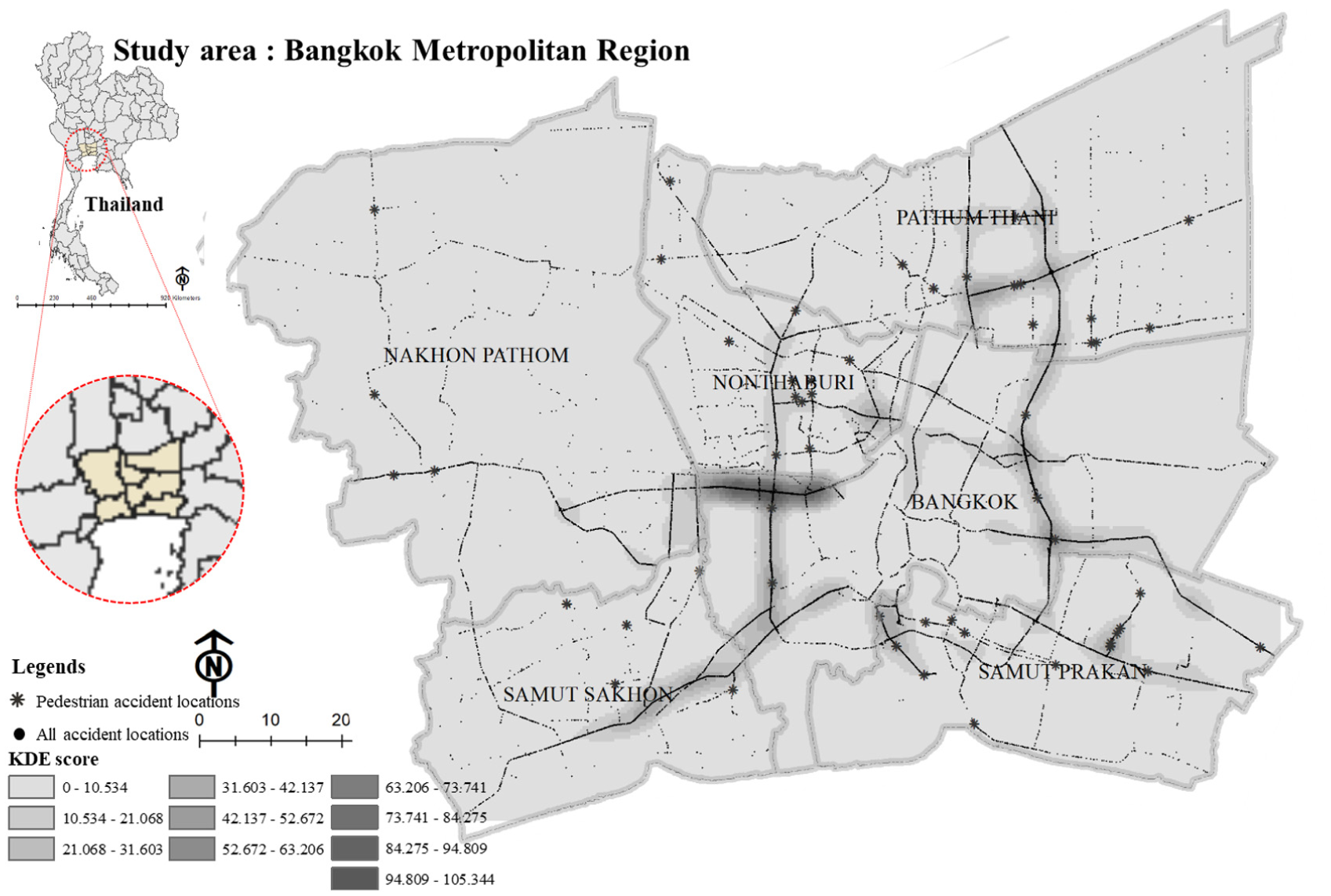
Geographic distribution of fatal traffic accidents in the Bangkok Metropolitan Region (BMR).
To analyze road safety incidents within the study area, the Kernel Density Estimator (KDE) was employed. KDE is a statistical tool used to estimate the probability density function of a data sample. It helps provide a comprehensive visualization of the issue by effectively mapping data and estimating probability distributions. As shown in Figure 1, areas shaded in darker tones represent high concentrations of accident sites, particularly those involving fatalities, predominantly located along major roads within urban areas. The study area demonstrates an urban cluster centered around Bangkok, the capital of Thailand which is a key hub for urban development. The region is notable for its density and diversity of activities and transportation systems. This area was selected for the study due to the noticeable significance of pedestrian safety concerns which are more severe compared to other provinces in Thailand.
Sample and Setting
To achieve the objectives of this study, a Risk Travel Behavior Questionnaire (RTBQ) was specifically developed as the primary data collection instrument. The development process began with an extensive review of relevant literature to identify key constructs and formulate preliminary items for the initial questionnaire draft. The RTBQ comprises several sections designed to assess variables such as perceived behavioral control, pedestrian facility usage, facility quality, pedestrian risk behavior, and respondents’ socioeconomic characteristics.
The questionnaire was subjected to an iterative refinement process through pilot testing with a sample of at least 20 participants. This phase served to verify the preparedness of surveyors, assess the clarity, and comprehensibility of questionnaire items and ensure the overall reliability and validity of the instrument. Feedback obtained during the pilot phase was systematically analyzed and incorporated to enhance the content validity and finalize the questionnaire for the main survey. Respondents were selected according to specific inclusion criteria by focusing on individuals with experience of walking as part of their daily activities. The sample was divided into two main groups: (1) those who primarily commute on foot and (2) those who have walking experience but predominantly rely on other modes of transportation. Pedestrians are defined as individuals who travel on foot rather than by vehicle who are recognized as particularly vulnerable to road crashes. Participant screening incorporated questions related to travel experiences by emphasizing the identification of individuals who had encountered or engaged in risky walking behaviors. Thus, the study population consisted of respondents with firsthand experience of risk situations while walking. After excluding incomplete or inconsistent responses, a total of 1,120 valid cases were retained for subsequent analysis.
Data Collection Tools and Procedures
The structure of the Risk Travel Behavior Questionnaire (RTBQ) is organized into five sections as summarized in Table 1. The first section focuses on psychological factors, specifically perceived behavioral control, assessed using a five-point Likert scale ranging from 1 (strongly disagree) to 5 (strongly agree). The second section examines pedestrian-related perceptions of facility quality with items categorized into three dimensions of comfort, convenience and safety which is measured on a five-point Likert scale ranging from 1 (never) to 5 (always). The third section explores pedestrian facility usage behavior, covering infrastructure types such as overpasses, underpasses, crosswalks, and sidewalks which is also rated on a five-point Likert scale (1 = never to 5 = always). The fourth section collects socioeconomic and demographic information which includes gender, age, marital status, educational attainment, and income level. Finally, the fifth section measures pedestrian risk behavior (PRB) by capturing the frequency of risky actions such as crossing a road without using designated pedestrian crossings using a five-point Likert scale (1 = never to 5 = always).
Variables.

The independent variables in this study include socioeconomic factors, perceived behavioral control, pedestrian facility usage, and pedestrian facility quality. The dependent variable is the level of pedestrian risk behavior (PRB). To assess the internal consistency of the measurement scales, a reliability analysis was conducted using Cronbach’s alpha which yielded a value of .70 by indicating acceptable reliability for subsequent analyses. Ethical approval for the Risk Travel Behavior Questionnaire (RTBQ) was obtained from the Institutional Review Board (IRB; Approval No. 064/2022) prior to participant recruitment. All participants were informed about the objectives and scope of the study which were asked to provide informed consent before data collection commenced. Participation was entirely voluntary and respondents were assured of their right to withdraw from the study at any stage without penalty.
The data collection phase was conducted over a two-month period from September to October 2022 by using a purposive convenience sampling approach involving 1,120 participants. Data was gathered through face-to-face interviews to ensure clarity and completeness of responses. The questionnaire distribution was spatially structured across grid cells measuring 500 × 500 m within the Bangkok Metropolitan Region (BMR). This spatial framework was designed not only to ensure balanced geographic coverage, but also to include areas corresponding to recorded accident hotspots as identified through Kernel Density Estimation (KDE) analysis. The number of questionnaires allocated to each grid cell was proportionally determined based on the density of road accidents within that area. Given the subjective nature of several study variables, extensive training sessions were conducted for surveyors prior to fieldwork. The training emphasized accurate administration of the questionnaire and consistent interpretation of response scales to capture responses that most accurately reflected participants’ behaviors, perceptions, and attitudes.
Data Analysis
Multiple factors influencing PRB must be considered to understand how to mitigate risks and make improvements beneficial for all. This study aims to analyze multidimensional factors that affect risk behavior among a specific group of pedestrian users as demonstrated in Figure 2. The main hypothesis of this research suggests that different groups of pedestrians possess distinct characteristics, resulting in variations in the factors that influence their engagement in risky behaviors. Accordingly, this study examines the associations between psychological factors and physical factors related to walking environments, specifically focusing on facility quality, and facility usage behavior. These variables serve as key predictors of pedestrian risk behavior with their integration providing a comprehensive understanding of both psychological and environmental dimensions of pedestrian safety.

Framework of study.
The analytical framework comprises three models. Model 1 examines the strength of relationships among perceived behavioral control (psychological factor), pedestrian facility quality, pedestrian facility usage, and socioeconomic characteristics in relation to risk behaviors associated with walking for the overall sample. Model 2 retains the same set of variables as Model 1 but restricts analysis to the main pedestrian group, representing individuals who primarily walk as their mode of travel. Model 3 also includes the same variables, focusing instead on the non-primary pedestrian group, composed of individuals who walk occasionally but predominantly use other modes of transport. All analyses were conducted with a statistical significance level of .05. This model framework enables not only the examination of interrelationships among key factors but also a comparative evaluation of the determinants influencing risky walking behaviors between regular pedestrians and general travelers, thereby elucidating group-specific variations in behavioral risk patterns. The analytical results highlight the significance and variation of influencing factors which provides insights into how these differences can inform targeted recommendations for distinct traveler groups within the city.
For the data analysis, a three-step procedure was employed. First, descriptive statistics were used to summarize and characterize both independent and dependent variables. Second, correlation analyses were conducted to examine the associations between pedestrian risk behavior and other relevant variables. Finally, ordinal logistic regression analysis was applied to model the relationship between the ordinal dependent variable (pedestrian risk behavior) and multiple independent variables (Harrell, 2015). This modeling approach was used to identify the key contributory factors influencing risky pedestrian behavior. A 95% confidence interval was adopted and results with p < .05 were considered statistically significant. All models were tested for key regression assumptions to ensure reliability and validity. The residuals were found to be approximately normally distributed (absolute skewness = −.085 to .194; kurtosis = −1.175 to −0.721), the residual variance was constant (homoscedasticity, heteroscedasticity test: p = .98) and no multicollinearity was detected (correlation coefficients r < .80; VIF < 5).
Results
Socioeconomic Characteristics
The sample consisted of 1,120 respondents whose socioeconomic characteristics were analyzed using descriptive statistics (as depicted in Table 2). Among the participants, 32.5% were individuals whose primary mode of travel was walking while 67.5% were general road users who occasionally walked but were not representative of regular pedestrians. Regarding socio-demographic characteristics, the sample comprised 531 males (47.4%), 458 females (40.9%), and 131 participants identifying as other genders (11.7%). In terms of religion, the majority identified as Buddhist (64.6%), followed by Christian (19.6%) and Muslim (15.4%) participants. The marital status distribution indicated that 42.9% of respondents were married while 37.4% were single. Participant ages ranged from 20 to 71 years (M = 36.57, SD = 9.53). With respect to educational attainment, 43.8% of respondents held a bachelor’s degree, followed by 32.6% with a college diploma. In terms of income, the largest group (43.9%) reported earning 10,001 to 20,000 THB per month, followed by 30.4% who earned more than 30,000 THB per month.
Socio-Demographic Characteristics.

Unsafe Pedestrians Among Specific Groups and Correlation
In assessing sidewalk selection based on quality conditions, sidewalks were categorized into three distinct types according to their physical characteristics: (1) no sidewalk, (2) separate sidewalk without a barrier, and (3) separate sidewalk with a barrier. Each type was evaluated across four quality sub-factors: (1) overall condition, (2) pedestrian crowding, (3) presence of obstacles along the pathway, and (4) general suitability for use. A five-point rating scale was employed, where a score of 1 represented the highest likelihood of sidewalk use and 5 indicated the lowest likelihood or greatest tendency to avoid using the sidewalk. As presented in Table 3, pedestrian behavioral risk was analyzed across three groups: the overall pedestrian group, the behavioral control group and the pedestrian-as-main-mode group. The results revealed that the average perception of risky behavior was generally moderate, clustering around the median value for the pedestrian group. Notably, individuals in the primary pedestrian group exhibited a lower propensity to engage in risky behaviors compared with general road users reflecting a greater awareness of safety risks associated with walking activities.
Risk Behavior Among Specific Groups.

Bivariate correlation analyses were conducted to examine the relationships among key variables. The detailed correlation coefficients are presented in Figure 3. Prior to model development, factor loadings were adjusted by excluding variables with correlation coefficients exceeding .80 to mitigate multicollinearity, retaining only those below this threshold for further analysis. For psychological factors, the frequency of pedestrian risk behavior exhibited a significant negative correlation with perceived behavioral control (r = −.140, p < .001). Regarding pedestrian facility quality factors, significant negative correlations were found between pedestrian risk behavior and comfort (r = −.486, p < .001) as well as convenience (r = −.584, p < .001). Similarly, for pedestrian facility usage behaviors, pedestrian risk behavior demonstrated significant negative correlations with overpass use (r = −.264, p < .001), underpass use (r = −0.412, p < .001) and crosswalk use (r = −.162, p < .001). In contrast, sidewalk use showed a significant positive correlation with pedestrian risk behavior (r = .352, p < .001). Overall, the correlation coefficients ranged from −.67 to .65, remaining below the threshold value of .80 which indicates an acceptable level of variable independence and confirms their suitability for reliable model estimation.
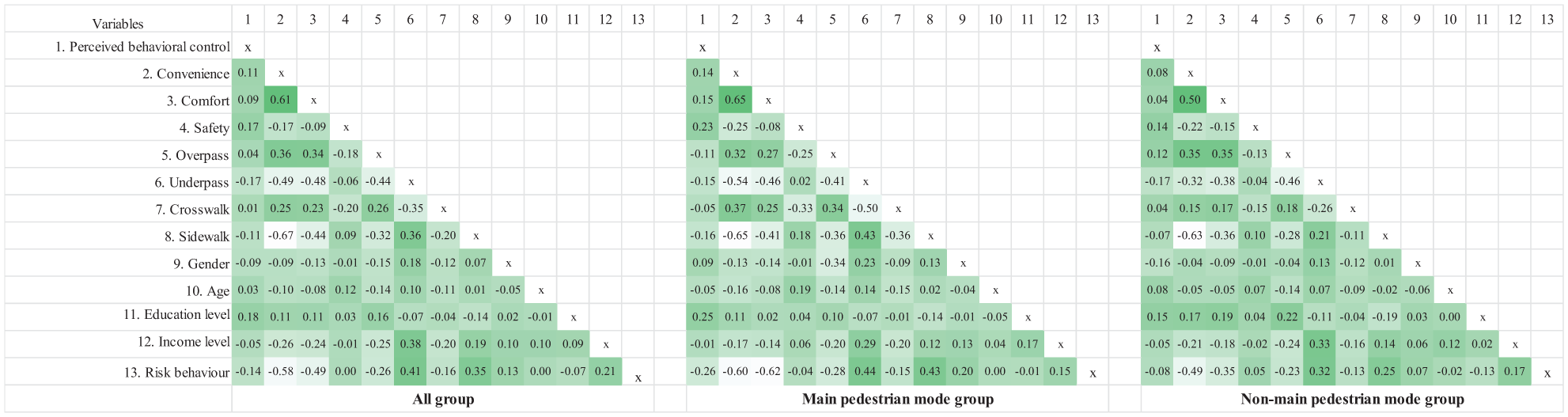
Correlating all input factors.
Understanding Pedestrians’ Risk Factors
Table 4 presents the results of the ordinal logistic regression models developed to examine the relationships between multiple factors and pedestrian risk behavior (PRB) across different road user groups. The model statistics indicate that all three models were statistically significant (**, p < .01) by confirming the overall goodness of fit and the significance of the independent variables. The pseudo R2 values for the models ranged from .511 to .616, suggesting a moderate level of explanatory power. The estimated coefficients of the ordered regression models are summarized in Table 4. The results show that the three threshold parameters in each model were significantly different from zero, contributing meaningfully to variations in response probabilities across the categorical levels of pedestrian risk behavior.
Analysis Results of Factors Affecting Pedestrian Risk Behavior (PRB).

, **Tests evaluated at a .05 and .01statistical significance level, respectively.
In Model 1, five factors exhibited significant negative associations with PRB: perceived behavioral control, convenience, comfort, sidewalk use and age. In Model 2, three variables, namely convenience, comfort and sidewalk use were significantly and negatively associated with PRB. Finally, Model 3 revealed a pattern similar to Model 2 with the addition of socioeconomic factors, all of which were also negatively significant.
Discussion
Many transportation planners and urban designers have emphasized the importance of promoting and supporting active modes of transportation for daily mobility. Such approaches offer substantial benefits in addressing current and future environmental challenges by enhancing social well-being, stimulating economic development and improving community health. Despite these advantages, pedestrians continue to encounter substantial challenges arising from unsafe walking environments which are largely a consequence of inadequate urban and transport planning. Understanding these issues is essential for identifying risk factors arising from the interaction between individuals and their surrounding environments. The findings of this study provide valuable insights into these dynamics and are discussed in details as follows:
The Interaction of Psychology as Perceived Behavior Control, Pedestrian Facility (Environmental) and Personal Characteristics on Pedestrians’ Risk Behavior
The research revealed a significant association between perceived behavioral control and the quality and usage of pedestrian facilities indicating distinct effects between individuals who primarily walk and those who predominantly travel by vehicle. Within the psychological framework, perceived behavioral control is a central determinant of behavioral intention. Consistent with previous studies, the present findings confirm its role as a key predictor of risky pedestrian behavior. Hou et al. (2021) identified perceived behavioral control as a significant factor influencing pedestrian actions while Matović et al. (2024) reported it as a strong predictor of pedestrians’ intentions to engage in risky behaviors such as crossing during a red-light phase. The latter study examined behavioral tendencies comparable to those observed here, particularly among individuals displaying defiant or risk-prone walking behaviors. Although this relationship has been well established, the present study contributes by highlighting group-specific differences and their implications for behavioral outcomes. Moreover, the analysis highlights the influence of pedestrian facility quality and usage on individuals’ perceptions of safety, comfort and functionality within the walking environment.
This research found that overpass usage and sidewalk conditions were significantly associated with pedestrian risk behavior. Adequate and well-maintained pedestrian facilities are fundamental to ensuring safety as their absence often leads individuals to adopt risky behaviors for convenience or perceived efficiency. The results further indicate that comfort and convenience strongly correlate with safer pedestrian practices, influencing the likelihood of using designated crossings or overpasses rather than walking along roadways. These findings align with previous studies emphasizing the role of comfort and convenience in shaping walkability (Blečić et al., 2020) and crossing decisions (Granié et al., 2016). Overall, the study emphasizes the key role of pedestrian-supportive infrastructure, particularly sidewalks, and overpasses in mitigating risky behaviors and fostering safer with more accessible walking environments. Regarding socioeconomic factors, age exhibited a significant association with pedestrian behavior. While prior studies have reported mixed findings, the present analysis identified age as the sole statistically significant factor. A negative relationship was observed, indicating that older participants were less likely to engage in risky behaviors than younger individuals. This contrasts with Osorio-García et al. (2023), who found road safety education and gender to have a greater influence than age. When considered alongside earlier research (e.g., Escobar et al., 2021), the results highlight that behavioral variations are shaped by context, individual characteristics and local conditions, emphasizing the situational nature of pedestrian risk patterns.
Differences in User Groups and the Relationship Between Factors Affecting Pedestrians’ Risk Behavior
The results of the correlation analyses comparing predominantly pedestrian travelers and vehicle users revealed notable differences across two key dimensions: perceived behavioral control and socioeconomic characteristics. Among participants who primarily traveled on foot, psychological factors associated with perceived behavioral control were significantly correlated with the frequency of engaging in risky behaviors whereas this relationship was not significant among vehicle users. This discrepancy may be attributed to the fact that the observed risky behaviors were specifically pedestrian-related, making them more relevant to individuals with direct walking experience. Perceived behavioral control reflects an individual’s prior experiences and anticipated obstacles in performing a given behavior. Consequently, pedestrians’ behavioral tendencies are shaped by their familiarity with walking environments whereas those who primarily travel by vehicle may possess limited experience or awareness of walking-related risks, thereby reducing their ability to accurately assess potential challenges. Additionally, socioeconomic factors, particularly age and income level were significantly associated with risky behaviors, but only among individuals who primarily traveled by vehicle. In conclusion, the analysis identified several factors influencing risk behavior across specific pedestrian user groups with distinct significant predictors emerging for each traveler category.
Recommendation and Contribution Related to Intervention of Pedestrian Safety Management
Overall, the findings highlight the importance of pedestrian facility usage, pedestrian facility quality, behavioral control and socioeconomic characteristics in shaping pedestrian risk behavior (PRB). Although previous studies have identified various factors influencing risky pedestrian behavior (Hafeez et al., 2022; Shaaban & Maher, 2019; Si et al., 2019), the present study specifically focused on examining the relationship between personal control factors by reflecting individual perceptions and physical control factors represented by facility quality and usage. A key contribution of this study lies in its comparative analysis between pedestrian and non-pedestrian groups, revealing how differences in both psychological and environmental factors affect behavioral frequency. The results emphasize that the interaction between perceived behavioral control and pedestrian facility-related usage and quality plays a crucial role in influencing risk-taking behavior. From a practical perspective, enhancing travel safety through behavioral change requires prioritizing the improvement and equitable allocation of pedestrian infrastructure, particularly facilities related to crossing safety and sidewalk design. While recent initiatives in Bangkok have aimed to upgrade pedestrian crossings, further improvements should focus on road designs surrounding crossings to reduce vehicle speed and mitigate sidewalk-related risks. Moreover, effective safety management should integrate infrastructure interventions with behavioral considerations, acknowledging the relationship between environmental conditions and individual perceptions of control in shaping pedestrian safety behavior.
In conclusion, the findings highlight the imperative of adopting a comprehensive multi-dimensional approach to urban planning for enhancing pedestrian safety. Policymakers and planners should prioritize compact urban development that supports mixed land use, higher-density blocks and improved street connectivity. Ensuring pedestrian safety also necessitates the provision of safe, accessible, and continuous pathways along with secure roadway crossings that effectively link key urban functions and activity nodes. Beyond physical infrastructure, fostering a cultural, and attitudinal shift toward road safety is equally vital. Advancing a safety-oriented mobility culture necessitates integrated interventions that align behavioral transformation with enhancements in the physical and environmental dimensions of urban design. Such a holistic framework is essential for creating safer, more inclusive and pedestrian-friendly cities. Furthermore, these findings highlight the critical importance of collaborative design and planning between urban and transport sectors, recognizing that cities and mobility systems operate as interdependent entities that reinforce one another. Urban and transport professionals should promote design strategies that advance safe and sustainable mobility, incorporating measures such as speed management, context-sensitive planning and user-appropriate infrastructure. Ultimately, realizing this vision requires proactive governmental leadership supported by robust legislative frameworks and regulatory mechanisms that embed safety as a central tenet of urban and transport policy. Aligning planning practices with safety-oriented principles will enable cities to create environments that actively promote safer, more sustainable, and human-centered mobility behaviors.
The Limitation and Further Study
The findings of this research should be interpreted with appropriate consideration of certain limitations. The determinants of pedestrian insecurity are inherently multifaceted arising from the interaction between individual psychological traits, environmental characteristics and broader contextual factors. Given the complexity of human behavior, pedestrian actions are shaped by both internal (psychological) and external (environmental) influences. This research primarily examined the effects of perceived personal control and physical environmental conditions which may constrain the generalizability of the results to other behavioral or contextual domains. A potential limitation concerns the issue of endogeneity between pedestrian risk behavior and infrastructure quality. Individuals exhibiting higher risk tendencies may self-select into environments characterized by inadequate pedestrian facilities or lower safety standards. This self-selection mechanism introduces simultaneity bias that may obscure causal inference. Future studies should address this issue by applying advanced econometric techniques such as instrumental variable estimation or two-stage modeling frameworks to more effectively disentangle causal pathways and enhance model robustness.
Pedestrian behavior encompasses multiple dimensions, including violations, errors, distractions and lapses, each potentially influenced by distinct psychological and contextual determinants. Previous research has often analyzed these behavioral categories in isolation (Alsharif et al., 2024; Karami et al., 2024). The present study primarily focused on control-related factors influencing violation behaviors within both individual and environmental contexts. Future investigations should broaden this analytical scope to include a wider range of behavioral typologies, situational variations and cross-level causal interdependencies, thereby promoting a more comprehensive understanding of the mechanisms underlying pedestrian risk behavior.
Advancing the understanding of pedestrian behavior necessitates a broader consideration of the planning and development context within sustainable cities, particularly those guided by principles of sustainable transportation. These contextual dimensions can directly or indirectly shape risky pedestrian behaviors through their influence on the built environment, mobility systems and patterns of social interaction. A deeper examination of these interrelationships and underlying mechanisms offers valuable insights into the behavioral foundations that inform evidence-based mobility planning. Such insights are crucial for formulating integrated strategies that harmonize human behavior with environmental design, thereby enhancing safety, accessibility and sustainability across diverse urban settings. Furthermore, risky pedestrian behavior may be embedded within social environments where community norms implicitly tolerate or perpetuate unsafe practices without visible consequences. Integrating an understanding of pedestrian risk with causal factors associated with other travel modes offers a more holistic framework for improving overall safety outcomes. Of particular concern are pedestrian-related accidents that occur even when individuals comply with traffic rules, emphasizing the complex interdependence of behavioral, infrastructural and institutional factors. Insights generated from such research are vital for developing evidence-based interventions and policy measures that effectively mitigate pedestrian risks and advance safer, more sustainable urban environments.
Conclusion
Pedestrian safety has emerged as an increasingly critical global concern, including in Thailand. A comprehensive understanding of the factors contributing to inadequate pedestrian safety is essential for developing effective evidence-based strategies and policy responses. Pedestrian safety is shaped by multiple determinants, particularly those arising from the interaction between individuals and their surrounding environments which collectively influence accident prevention. As a case study, this research examined risk factors affecting pedestrian safety (PS) within the Bangkok Metropolitan Region (BMR), Thailand. Final data collection from 1,120 participants was analyzed using ordinal logistic regression to identify the relationships among relevant variables. The findings revealed significant associations between pedestrian facility usage, attitudes, pedestrian facility quality, behavioral control, and socioeconomic characteristics in relation to pedestrian risk behavior (PRB). Notably, distinct sets of influencing factors were observed across different traveler groups, particularly between individuals who primarily walk and those who have travel by other modes.
The results further indicate that individuals with positive attitudes toward travel exhibited lower levels of risky behavior when supported by high-quality pedestrian facilities. Conversely, individuals with high perceived control over risk, namely those confident in their ability to manage it, tend to exhibit greater risk-taking tendencies. Importantly, the research highlights the influence of the social environment in shaping risky pedestrian behaviors, emphasizing that such behaviors often emerge through interactions within one’s immediate surroundings. Understanding the social and economic characteristics of pedestrians therefore represents a critical dimension to be incorporated into planning and policy frameworks aimed at enhancing pedestrian safety. This consideration is particularly crucial across different age groups of road users, as variations exist in their needs for and interactions with travel facilities, particularly among children and older adults. While the results align with established findings in road safety research, the research contributes by identifying distinct vulnerability patterns among user groups that are more prone to safety risks. Given that travel inherently involves varying degrees of risk, these findings highlight the importance of developing pedestrian safety strategies that account for demographic diversity, behavioral tendencies and contextual differences. Effective pedestrian safety planning must therefore incorporate a comprehensive understanding of pedestrian characteristics, their roles within urban environments and the specific interventions required to support safer mobility and guide future improvements.
Footnotes
Acknowledgements
The authors gratefully acknowledge the support provided by a grant from Thammasat University Research Fund, Contract No. TDS 06/2566, under project “The Quality of Life in Sustainable Urban Mobility, Suburban Areas, Thailand.” It is also partially supported by the Advanced Global Research Initiative under the “Office of the Permanent Secretary of the Ministry of Higher Education, Science, Research, and Innovation, Thailand.” The research was conducted by the Center of Excellence in Urban Mobility Research and Innovation (UMRI), Faculty of Architecture and Planning, Thammasat University, Pathum Thani, Thailand.

Funding
The authors disclosed receipt of the following financial support for the research, authorship, and/or publication of this article: This research received funding from Thammasat University Research Fund and the Advanced Global Research Initiative, provided by the “Office of the Permanent Secretary of the Ministry of Higher Education, Science, Research and Innovation, Thailand.”
Declaration of Conflicting Interests
The authors declared no potential conflicts of interest with respect to the research, authorship, and/or publication of this article.
Data Availability Statement
The datasets used and/or analyzed during the current study are available from the corresponding authors upon reasonable request.