




Abstract
Work-related stress and addictive behaviors have been described by several empirical studies as potential impairers for the health, welfare, and safety of workers. With this study, we aimed at describing the relationship between two work stress (Job Strain and Effort-Reward Imbalance) and tobacco consumption indicators among city bus drivers, and their association with traffic incidents registered by drivers along the last 2 years. For this cross-sectional study, the sample included 222 Colombian city bus drivers with a mean age of 41.4 years and driving experience of 18.63 years. A four-section questionnaire was used, and it was composed of individual (professional/demographic) information, Job Strain, Effort-Reward Imbalance, and self-rated health and lifestyle indicators, including the habit of consuming tobacco. Results showed that 21% of city bus drivers are smokers, and that four out of 10 drivers present job strain. Furthermore, significant associations relating smoking and job strain, and between smoking and traffic incidents were found. Finally, through a two-step cluster analysis, two patterns on work-related stress and tobacco consumption were identified for the drivers, finding significant differences in the traffic incident rates registered by each group/cluster of city bus drivers. The development of empirical-based interventions in psychosocial factors and potential sources of stress at work, and the enhancement of healthy lifestyles, including the prevention and treatment of addictive behaviors such as, smoking, are discussed as a way to strengthen the prevention of traffic incidents and the promotion of health among workers in the public transport.
Keywords
Introduction
Workplace stress is one of the most addressed factors in the empirical literature, as an impairer for job satisfaction, stability, and performance (Chao, Jou, Liao, & Kuo, 2015; Li et al., 2014; Useche, Cendales, Alonso, & Serge, 2017). Also, it is a constantly mentioned predictor of occupational injuries and accidents (Brown et al., 2011; Kim, Ahn, Kim, Yoon, & Roh, 2016), addictive behaviors (Ayyagari & Sindelar, 2010; Moore, Sikora, Grunberg, & Greenberg, 2007), and different negative outcomes for the health and welfare of the working population (Du, Lin, Lu, & Tai, 2011; Koda et al., 2000). For these and other reasons, stress at work has become a constant concern for different industries, researchers, and occupational health professionals, who understand stress-related factors at work as a constant threat for workers (Gómez, Cendales, Useche, & Bocarejo, 2018; Tsai & Liu, 2012).
Specifically in the field of transport, there is a non-despicable amount of research relating work-related stress to negative health outcomes and a substantial decreasing in the driving performance in the case of commercial vehicles operators (Kumar, Singh, & Kharwar, 2011; Rowden, Matthews, Watson, & Biggs, 2011; Useche, Cendales, & Gómez, 2017). Within this workforce, different factors, such as time pressure, working overtime, shift working, and job insecurity, have been often considered as prevalent stressors (Hege et al., 2015; Lemke, Hege, Perko, önmez, & Apostolopoulos, 2015).
Demand-Control (DC) and Effort-Reward Imbalance (ERI): Two Complementary Models for Studying Stress at Work
Two of the most relevant approaches to stress at work are, first, the DC model (Karasek, 1998) and, second, the ERI model (Siegrist, 2002). In brief, the first approach (DC model) states that a prolonged status of low control at work, when combined with high demands, elicits Job Strain (JS)—the work stress indicator of this model (de Lange et al., 2009; Karasek, 1998). Differently, the ERI model (Siegrist, 2002) is based on two different psychosocial risk factors related to working: the efforts made and the rewards perceived by workers, based on the assumption that, in situations in which efforts do not substantially result in three kinds of rewards (money or economical rewards, esteem, and status or stability at work), workers develop a major risk of suffering stress at work. Both approaches have related workplace stress to negative outcomes on mid-/long-term mental and physical health and, in the case of professional drivers, a greater rate of risky behaviors at the wheel (Cendales, Useche, & Gómez, 2014; Siegrist, 2012; Useche, Gómez, & Cendales, 2017).
Addictive Behaviors, Stress in the Workplace and Negative Outcomes
In the same way as different mental and physical health complaints (Alonso, Esteban, Sanmartín, & Useche, 2017; Berger, Rosner, Kark, Bennett, & for the Committee on Bioethical Issues of the Medical Society of the State of New York, 2000), and addictive behaviors such as alcohol consumption or smoking (Ragland, Greiner, Yen, & Fisher, 2000; Useche, Serge, Alonso, & Esteban, 2017), stress at work has been systematically associated to a lower performance of employees in their workplaces, specifically in the field of transportation (Anund, Ihlström, Fors, Kecklund, & Filtness, 2016; Robb, Sultana, Ameratunga, & Jackson, 2008; Santos & Lu, 2016). In fact, some studies have suggested that employees of this industry may constitute the occupational group experiencing the highest prevalence of workplace stress (Boada-Grau, Sanchez-Garcia, Prizmic-Kuzmica, & Vigil-Colet, 2012; Montoro, Useche, Alonso, & Cendales, 2018). Nevertheless, there is no absolute clearness about the causal direction of the relationship between stress-related factors at work and addictive habits, essentially those associated with the consumption of tobacco and other substances such as alcohol, non-prescribed medicines, and illegal drugs (Ragland et al., 2000; Sinha, 2008; Wand, 2008). But, based on the evidence, different psychosocial factors existing in the working environment, and essentially those related to stress, are often considered predictive elements for explaining the occurrence of health-risky behaviors such as smoking (Azagba & Sharaf, 2011; Lemieux & al’Absi, 2016). Despite of this, the empirically proven predictive weight of stress at work on concrete addictive behaviors is still relatively limited, considering factors such as the restricted number of applied research experiences, and the scarcely studied relationship between psychosocial work factors and addictions among professional drivers.
Furthermore, establishing a relation linking work stress with the consumption of substances may involve the potential mediating and/or moderating role of supplementary variables present in both the individual sphere and in the work environment, such as the coping resources in stress (Schneiderman, Ironson, & Siegel, 2005; Taylor & Stanton, 2007), personality factors (Angres, Bologeorges, & Chou, 2013; Franques, Auriacombe, & Tignol, 2000), subjective well-being (Laudet, 2011; Weinhold & Chaloupka, 2017), organizational culture and health policies in the workplaces (Gao, Zheng, Gao, Chapman, & Fu, 2011; Ham et al., 2011), and the perception of supportive factors in the work and/or social environment (Hagihara, Tarumi, & Nobutomo, 2003; Sapp, Kawachi, Sorensen, LaMontagne, & Subramanian, 2010).
Regarding safety risks, there is a proven and non-despicable potential risk related to addictive behaviors over driving safety (Seppala, Linnoila, & Mattila, 1979). Although particularly tobacco consumption and regular blood nicotine concentrations do not substantially alter perceptions nor the state of consciousness, they may impair driving performance in several ways: for instance, when performed while driving, smoking acts as a distractor and disturbs, having a busy hand, the correct operation of the vehicle (Mangiaracina & Palumbo, 2007). However, factors such as the anxiety produced by the desire to smoke can trigger impulsive behaviors and/or errors behind the wheel (Hitsman et al., 2010; Moylan, Jacka, Pasco, & Berk, 2013). For these reasons, it is believed that, although smoking itself is not as important as alcohol in exerting as a traffic crash predictor, it may substantially contribute to explain, in conjunction with other variables such as stress at work, a major risk of suffering a road incident (Brison, 1990; Mangiaracina & Palumbo, 2007).
Finally, and considering the significant influence of public transportation safety on the overall road safety, issues such as workplace stressors, health, and driving behavior of professional drivers can be listed as important lines of action in occupational and public health research, for the development of effective strategies aimed at reducing road and health-related risks among public transport drivers and, subsequently, at promoting healthy and positive lifestyles (Ding, Gebel, Phongsavan, Bauman, & Merom, 2014; Knipling, Hickman, & Bergofen, 2003).
Objective
The purpose of this study was to describe the relationship between two work-related stress indicators (from JS and ERI approaches) and tobacco consumption among city bus drivers, and its association with traffic incidents registered by drivers along the last 2 years.
Method
Sample (Participants)
The full sample involved n = 222 Colombian male city bus drivers between 20 and 79 years old, with an average of
Procedure, Design and Ethics
For this study, a convenience (non-probabilistic) sampling was employed, grounded on the availability and accessibility to the study population, and on their willingness to participate (or not) in the research. This method was selected bearing in mind that it is quick, inexpensive, and flexible for what concerns specific factors of the organizational context, such as the time availability of participants (Elfil & Negida, 2017; Tyrer & Heyman, 2016).
Regarding procedure, first, different city bus companies were invited to join the study. Once that an initial cooperation agreement with each transport company was made, their employees (professional drivers) were invited to voluntarily come over to fill out the questionnaire, through different institutional channels: posters, e-mails, and direct verbal requests of supervisors. The professional drivers who agreed to participate answered a self-report questionnaire, designed in a paper-based version and administered in Spanish language, in the facilities of their respective companies. Surveys were fully completed by 222 drivers, and the rate of response was approximately 96.6%, considering that 230 questionnaires were initially delivered.
As in other similar research experiences in public transport drivers (Useche, Cendales, Alonso, & Serge, 2017), the survey was carried out preserving the anonymity of participants and highlighting that the data would be used for research purposes only. We used a statement of informed consent, signed by both parties before the subjects started completing the questionnaire.
Description of the Questionnaire
The questionnaire was in Spanish, and it included four sections. In the first section, we gathered demographic variables (age, years of driving experience) and traffic incidents (traffic accidents suffered + traffic tickets or “fines,” received during the previous 2 years). The criterion of “during the last 2 years” corresponded to its frequent use in other research experiences dealing with job stress in professional drivers, and to the further possibility to establish comparisons with them.
The second section included the 27 items of the Job Content Questionnaire (JCQ; Karasek, 1998), adapted to Colombian workers (Gómez, 2011). The JCQ has been extensively used for evaluating psychosocial factors in the workplace and the effects they have on health. The response scale is composed of a 4-point Likert-type scale (1 = totally disagree and 4 = totally agree). The 27 items of the JCQ are grouped in six sub-scales: support from supervisors (four items, α = 0.87), support from coworkers (four items, α = 0.79), skill discretion (six items, α = 0.75), decision authority (three items, α = 0.69), psychological demands (six items, α = 0.66), and job insecurity (four items, α = 0.53). Decision latitude is computed as the sum of the scores on skill discretion and decision authority. Job Strain was computed as the ratio between decision latitude (demands/decision latitude) and psychological demands.
The third section was composed of the 23-item version of the Effort-Reward Inventory (Siegrist, 2002, 2012), and it was employed for the assessment of psychosocial risk factors in the workplace in relation to the dimensions included in the ERI model: extrinsic effort (six item, α = 0.73; α = 0.74), reward (11 item, α = 0.77; α = 0.79 original), and over-commitment (six item; α = 0.84). This version of the ERI questionnaire had already been validated in Colombia by Gómez (2010). Scores on rewards and extrinsic effort are calculated as the sum of items present in each sub-scale, and ERI is obtained through the equation: Imbalance = K(E/R), being K = (the number of items in rewards/the number of items in efforts).
Finally, the fourth part included questions about height and weight, and self-reported physical health, including a dichotomous indicator asking whether they had (or not) the habit of consuming tobacco (smoking).
Data Processing
We performed descriptive statistics (mean, standard deviation) and Pearson’s (bivariate) correlational analyses in order to obtain basic study factors and correlations between the variables of the study, after checking the basic parameters for their employment. Chi-Square tests were conducted to identify trends between categorical variables. With the aim of establishing specific patterns in tobacco consumption a two-step cluster analysis was realized. Finally, after testing normality and other basic parameters, the two-step cluster analysis and the one-way analysis of variance (ANOVA) were performed for comparing city bus drivers located in both obtained clusters (Smoker × High Stress vs. Non-Smoker × Less Stress) in terms of traffic incident rates. All statistical analyses were performed using SPSS (IBM Statistical Package for the Social Sciences), version 23.
Results
Bivariate Correlations and Descriptive Statistics
In Table 1, descriptive statistics of demographic and stress-related factors, and bivariate correlations among the variables of the study are summarized. First, a prevalence of smoking of 21% was found in this sample. Regarding Job Stress, 40.49% of city bus drivers participating in the study presented a JS-indicator score. Although it was found that this sample of city bus drivers had a mean score in JS (
Pearson Correlations Between Study Variables and Descriptive Statistics.
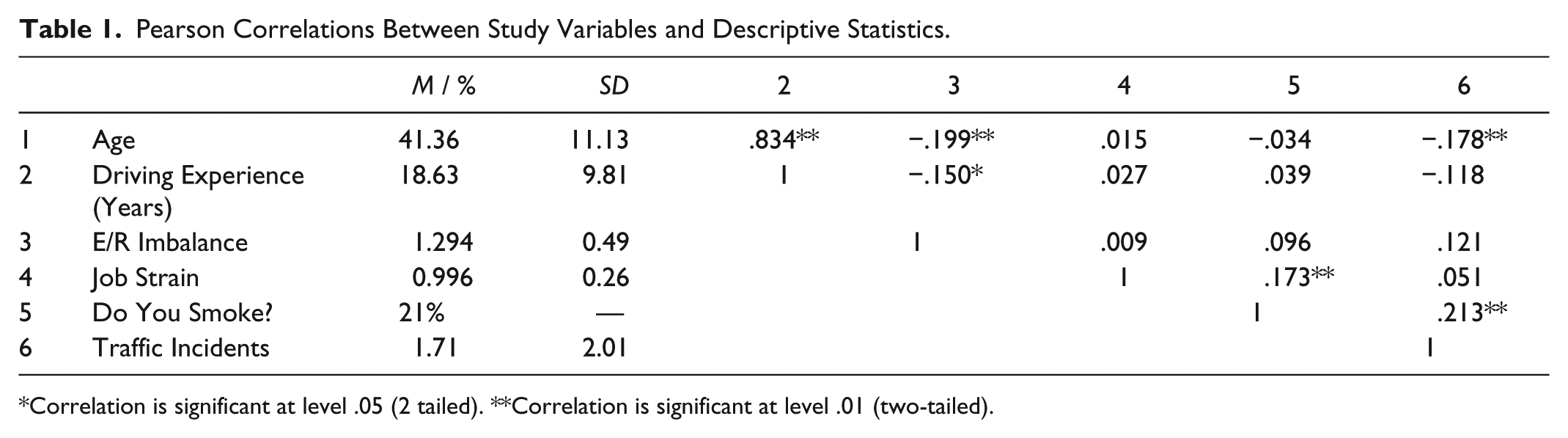
Correlation is significant at level .05 (2 tailed). **Correlation is significant at level .01 (two-tailed).
Regarding bivariate correlations (i.e., measures of association) between study variables, we found a set of relevant and significant associations between these factors: ERI was negatively related to age and driving experience. Regarding JS, we found that it was significantly and positively correlated to tobacco consumption. Tobacco consumption rates were also positively associated to the self-reported number of traffic incidents registered along the last 2 years, being the latter negatively associated to the age of city bus drivers.
Categorical Analysis
Through a Chi-square test, a statistical association between the fact of having a higher mean of JS and the habit of consuming tobacco was determined. In other words, there is a significant statistical trend between presenting higher rates of JS and being a smoker, X2(1,220) = 5.698; p = .013.
Cluster Analysis and Mean Comparisons
For the two-step cluster analysis, the optimal number of clusters for the combination of two continuous variables was initially determined (i.e., work-related stress indicators of the DC and ERI models), together with a categorical variable (i.e., tobacco consumption). Starting from 15 possible clusters, an optimal combination of the variables for two clusters was found (with a Silhouette measure of cohesion and separation of approximately 0.68), according to the values registered for the included factors:
Cluster 1: 46 city bus drivers with a higher score in JS (
Cluster 2: 176 city bus drivers with a lower score in JS (
The summary of the two-step cluster model is shown in Figure 1.

Descriptive information of the cluster model, importance of its predictors, and the cluster-quality measurement.
After observing that the number of records of each cluster and their parameters were representative, the obtained conglomerates were maintained for the final solution of two groups. It was not considered necessary to apply another method of non-hierarchical analysis, to obtain consistent, representative, and accurate results. In this regard, it was found that the habit of smoking may clearly differentiate professional drivers in terms of work-related stress rates, measured with both approaches (DC and ERI).
Regarding comparative analyses for the mean scores of the study variables, city bus drivers contained in Cluster 1 registered significantly higher scores in JS, F(1,220) = 6.81; p < .01, than drivers located in Cluster 2, and this difference did not apply to the scores found in ERI (ns difference). In other words, although the trend is consistent between both work-related stress approaches, the statistical difference of mean values is only significant for the case of JS coefficient.
Moreover, when comparing the mean scores of reported traffic incidents in the last 2 years between both clusters through one-way ANOVA, we found out that city bus drivers present significant differences in this regard, being the traffic incident rate significantly higher for city bus drivers with the profile (cluster) number 1, with higher scores on ERI and JS, and with the habit of tobacco consumption (

Mean scores in self-reported traffic incidents between clusters 1 and 2.
Discussion
Professional driving has been largely conceptualized as a highly risky profession, in terms of occupational, psychosocial, and health risks affecting the workers of this industry (Ding et al., 2014). Overall, the results of this research suggest that, in accordance with previous studies dealing with city bus drivers (Santos & Lu, 2016; Useche, Gómez, & Cendales, 2017), poor results in terms of working conditions, lifestyles, and stress-related factors are observable in this Colombian sample. Remaining within the primary objective of this article, that is, to describe the relationship of workplace stress measured under two complementary approaches (Karasek, 1998; Siegrist, 2002, 2012) and the tobacco consumption of city bus drivers, and its association to their traffic incidents registered in the last 2 years, some essential facts have to be discussed.
First, the high proportion of drivers presenting JS, that constitutes the work-related stress indicator of DC model. For the case of this sample, the percentage of workers diagnosable with JS was 40.49%; in other words, four out of 10 Colombian city bus drivers present this adverse condition. Furthermore, JS was significantly and positively associated with the habit of smoking (both using Pearson’s bivariate correlations, such as chi-square tests), in accordance to other empirical experiences on occupational health research relating the prevalence of JS with the prevalence of unhealthy lifestyles and addictive behaviors, such as tobacco consumption, in employees of different work industries (Heikkilä et al., 2013; Heikkilä et al., 2012).
Second, the obtained cluster model allowed us to establish two different patterns among city bus drivers when combining DC and ERI models’ work-related stress indicators (ERI and JS) with the habit of smoking (or not smoking) of participants. The first cluster, exclusively composed of city bus drivers who smoke, exceeds the mean values in JS (
Third, and finally, these significant differences proved that the mentioned patterns in work-related stress and tobacco consumption involve not only lifestyle and health-related factors, but also driving safety outcomes. It is clear that, in the case of public transportation, issues related to occupational safety imply other issues of public health (Gopalakrishnan, 2012), considering that the job of professional drivers takes place in open roads, in which they interact with other road users (Anund et al., 2016; Narciso & de Mello, 2017). Furthermore, both workplace stress and the habit of smoking have been related per separate to higher rates of risky behaviors on the road (Useche, Serge, Alonso, & Esteban, 2017) and traffic incidents among professional drivers (Mangiaracina & Palumbo, 2007; Rowden et al., 2011).
In this sense, and considering, first, some of the key results of this study—essentially those linking health habits and work stress to traffic crashes—and second, relevant empirically-based precedents in the literature (Ham et al., 2011; Useche, Gómez, Cendales, & Alonso, 2018), the development of interventions targeting psychosocial factors and potential stressors in the workplace are suggestible, as well as the enhancement of healthy lifestyles, actions that may strengthen the prevention of traffic injuries and promotion of health among public transport workers. Concretely for this case, the role of occupational safety interventions should go beyond the mere need to prevent and fight the workplace-related stress of drivers and their adverse lifestyle habits, keeping in mind, once more, that negative outcomes in traffic related to drivers working under stressful conditions may involve not only aspects of the worker’s health and well-being (Gómez et al., 2018; Tang, 2014), but also, more broadly, the public welfare and health (Gopalakrishnan, 2012).
Conclusion
This study confirmed a hypothesized high prevalence of workplace stress and tobacco consumption, and a relationship between them among Colombian city bus drivers. Moreover, the work-related stress/smoking profile has shown to be associated with their driving safety outcomes, considering the differential rates in traffic incidents reported by city drivers with different trends in work-related stress and tobacco consumption.
Limitations of the Study
Although the JCQ and ERI questionnaires—employed for measuring work stress in this study—have a proven good reliability and consistence coefficients, they remain vulnerable to the typical self-report bias, potentially affecting this kind of cross-sectional studies (Podsakoff, MacKenzie, Lee, & Podsakoff, 2003). Furthermore, factors related to data collection, such as the fact that participants completed the questionnaire within their work environment, may influence the sincerity and social desirability of items asking for stress and lifestyle-related issues. For these reasons, the employment of supplementary information for studying self-rated health indicators and adverse working conditions of workers is suggestible, since they could be undiagnosed or underestimated by them, reducing the probability of presenting common method biases in variable measuring (Pannucci & Wilkins, 2010; Razavi, 2001).
In addition, we should mention that the cross-sectional design allows the study of patterns and tendencies, but we cannot yet infer a directional causality in the association between workplace stress and addictive behaviors. Finally, we should remark the often-observed underrepresentation of women among the public transport workforce (European Parliament, 2006), fact that makes it difficult to realize gender-based comparisons for psychosocial risk factors and lifestyles of city bus drivers. In this sense, and regarding the further research in this field, these analyses may be very useful to determine potential differences in work-related stress, addictive behaviors, and traffic safety outcomes between male and female workers of transportation.
Footnotes
Acknowledgements
The authors wish to thank the transportation companies that supported the data collection of this study, both offering their installations for the conduction of surveys and inviting their workers to participate. The authors would also like to thank Runa Falzolgher for the professional edition of the final text.
Declaration of Conflicting Interests
The author(s) declared no potential conflicts of interest with respect to the research, authorship, and/or publication of this article.
Funding
The author(s) received no financial support for the research, authorship, and/or publication of this article.
