




Abstract
Extensive research has examined the relationship between driving anger and risky behavior; however, little is known about how drivers express and regulate anger while driving. The present study was designed to examine the verbal and acoustic correlates of driving anger, as well as whether emotion regulation strategies such as cognitive reappraisal are effective at reducing the outward expression of anger while driving. Forty-four participants were asked to drive in an emotionally neutral and an anger-provoking simulated driving scenarios, while their driving behavior as well as their speech was recorded. Participants were randomly assigned to two experimental conditions, with one group receiving instructions to reappraise the anger-provoking events and a control group receiving no instructions. Results show that in the anger-provoking scenario, participants exhibited more violations, horn-honking, and cursing. Few acoustic variations were detected and were compatible with the acoustic profile of cold anger rather than with the one of hot anger expression. Finally, reappraisal reduced the number of violations only. The implications of these findings are discussed.
Introduction
Compared with other negative emotions, anger promotes heuristic, rapid information processing based on superficial evaluations and reliance on stereotypical characteristics (Lerner, Goldberg, & Tetlock, 1998). Angry individuals are likely to spend less time evaluating situations, tend to be quicker to allocate blame to others, hold enhanced control beliefs, and tend to underestimate risks inherent in the situations (Lerner & Tiedens, 2006). As a consequence, anger can lead to poorer decision making and increased risk taking (Lerner & Keltner, 2001; Lerner & Tiedens, 2006). In the driving context, the anger-related tendencies to underestimate risk and to allocate responsibility to others pose a serious threat to road users’ safety, as they may lead to hazardous as well as aggressive driving behavior (Neighbors, Vietor, & Knee, 2002; Stephens, Trawley, Madigan, & Groeger, 2013). For this reason, a growing number of studies have examined the relationships between environment conditions (e.g., traffic congestion), driving anger, and its consequences for driving behavior (Hennessy & Wiesenthal, 1999; Underwood, Chapman, Wright, & Crundall, 1999).
So far, research has consistently shown that driving anger has detrimental consequences for driving behavior. Being angry while driving leads to poor driving performance (Groeger, 1997; Stephens & Groeger, 2009), less speed limits compliance (Mesken, Hagenzieker, Rothengatter, & de Waard, 2007), and more aggressive driving behavior, such as tailgating and horn-honking (Hennessy & Wiesenthal, 1999). Daily experience of anger has been associated with reports of near accidents and driving violations (Underwood et al., 1999). Drivers exposed to anger-provoking impediments in simulated driving scenarios have been shown to approach hazards with less caution, and to attempt more dangerous overtaking maneuvers (Stephens & Groeger, 2011; Stephens et al., 2013). Several studies have also found positive associations of trait driving anger with risky (e.g., more near accidents) as well as with aggressive driving behavior on the road (Dahlen, Martin, Ragan, & Kuhlman, 2005; Deffenbacher, Deffenbacher, Lynch, & Richards, 2003; Deffenbacher, Lynch, Oetting, & Swaim, 2002; Deffenbacher, Lynch, Oetting, & Yingling, 2001; Deffenbacher, Richards, Filetti, & Lynch, 2005; James & Nahl, 2000).
Although these studies provide a valuable contribution to our understanding of driving anger, there are still some open questions. First, most research has focused on the influence of driving anger on risky and aggressive driving behavior (e.g., violations, speed, reactions times) by employing self-reported evaluations as a measure of driving anger (i.e., subjective experience). By contrast, very little is known about driving anger considering other emotional response systems, such as expressive behavior. Do angered drivers typically yell insults at other drivers and honk in anger? Studies employing self-report assessments have indeed found that people are more likely to report displaying their anger aggressively when in a vehicle than in non-driving situations (Lawton & Nutter, 2002), and that verbal aggressive expression (e.g., yelling or cursing at another driver) is the most reported form of driving anger expression (Deffenbacher, Lynch, et al., 2002). However, less research has examined emotional behavioral data about how drivers tend to express anger.
A second related issue concerns emotion regulation. Because driving anger has been consistently shown to have detrimental effects on driving behavior, it is important to investigate which forms of emotion regulation may be more effective at reducing and minimizing drivers’ experience and expression of anger (Harris & Nass, 2011). So far, few studies have examined whether the instructed use of emotion regulation strategies such as cognitive reappraisal is effective at down-regulating drivers’ experience of anger, as well as their risky and aggressive driving behavior (e.g., Chan & Singhal, 2013; Wollstädter, Vollrath, & Pfister, 2013). However, this research has not yet considered the potential impact of emotion regulation on driving anger expression.
The present study addresses these limitations and adds to previous research in two ways. First, we examine individuals’ emotional responses to an anger-provoking (vs. neutral) driving simulated scenario, considering both anger experience and expression. Specifically, our goal is to examine the verbal and vocal nonverbal correlates of driving anger. Second, we examine the effects of emotion regulation, testing whether the instructed use of cognitive reappraisal reduces risky driving behavior, anger experience, and the outward display of anger (i.e., verbal and vocal expressions).
The Expression of Driving Anger: Hot or Cold Anger?
Anger is a negative emotion that arises when the individual perceives the control over a situation in which his or her goals are perceived to be blocked by an obstacle that becomes the target of blame (Berkowitz & Harmon-Jones, 2004; Lazarus, 1991; Roseman, 2001; Scherer, 2001; Smith & Ellsworth, 1985). Anger implies an active approach to the environment, as well as the tendency to act to remove the obstacle and defend the individual’s own self (e.g., Ekman & Friesen, 1975; Plutchik, 1980; Potegal & Stemmler, 2010). In driving contexts, anger has been found to arise as a consequence of events such as traffic obstructions, others’ illegal driving behavior, others’ slow driving, and to be associated with behaviors such as sounding the horn to indicate annoyance with other drivers, chasing other drivers, and tailgating (Underwood et al., 1999).
One important issue concerns how people display and express anger while driving. The expression of driving anger may in fact range from mumbling something to oneself to aggressive forms of expressions (e.g., screaming, trying to get off the car and have a fight with the other driver) that can impact on the driver’s—as well other road users’—safety and well-being. Deffenbacher, Lynch, et al. (2002) have identified four distinct expressive forms: verbal aggression (e.g., yelling, cursing, diving the other drivers by dirty looks), personal physical aggression (e.g., trying to get out of the car, giving the other driver the finger), use of the vehicle to express anger (e.g., flash one’s light), and constructive expression (e.g., paying more attention to the other driver, telling oneself to ignore the other driver, trying to find a positive solution). These findings, however, are based on self-reported measures only.
Looking at the expression of anger more in general, research has documented two possible ways of expression. The first form is hot anger (also called anger-out or rage), which is characterized by the outward display of anger by means of gestures, facial and verbal (e.g., cursing) expressions, hostile aggressive behavior (Kerr & Schneider, 2008; Spielberger et al., 1985; Spielberger, Krasner, & Solomon, 1988). Several studies have examined the acoustical correlates of hot anger, finding that it is marked by higher pitch and higher pitch variability, an increase in mean F0 (i.e., fundamental frequency) and mean intensity, an increase in articulation rate, and lower number of pauses (e.g., Johnstone & Scherer, 2000; Kappas, Hess, & Scherer, 1991; Pittam & Scherer, 1993; Scherer, Johnstone, & Klasmeyer, 2003; Simon-Thomas, Keltner, Sauter, Sinicropi-Yao, & Abramson, 2009).
Although hot anger corresponds to the prototypical full-blown anger emotion, milder and more subtle forms of anger expression exist and are generally known as cold anger (e.g., irritation). It has been argued that these less intense forms of emotional expressions are more frequently occurring in everyday life (Laukka, Neiberg, Forsell, Karlsson, & Elenius, 2011). Compared with hot anger, cold anger is thought to be less intense and characterized by lower levels of arousal (Bänziger & Scherer, 2005). Acoustically, cold anger is marked by lower pitch, increased intensity, faster attack times at voice onset, and standard rate of speech. Overall, cold anger comprises more subtle vocal signals than hot anger, so that it is often confused with other emotions such as contempt in decoding tasks (Banse & Scherer, 1996; Juslin & Laukka, 2001; Sauter, Eisner, Calder, & Scott, 2010).
Regulating Driving Anger: Cognitive Reappraisal
Emotion regulation has been defined as comprising all the conscious and unconscious strategies individuals use to reduce, maintain, or increase either positive or negative emotions (Gross, 2001). The process model of emotion regulation (Gross, 1998) provides a conceptual framework to organize the myriad forms of emotion regulation that people use and to explain how these forms differ in their affective, cognitive, and social consequences (Gross & Thompson, 2007). The model differentiates two major kinds of emotion regulation on the basis of how emotions unfold over time (Gross, 2001): Antecedent-focused strategies intervene before the complete activation of emotion response tendencies and response-focused strategies alter emotional responses once an emotion has been fully generated.
One form of emotion regulation that has been extensively studied is cognitive reappraisal. Cognitive reappraisal is an antecedent-focused strategy that involves changing the evaluation of an emotion-eliciting stimulus to diminish its impact. Because it occurs early in the emotion generative process, reappraisal is thought to be an adaptive and relatively effortless strategy (Gross & Thompson, 2007). Consistent with this theoretical prediction, experimental studies have found that instructed use of reappraisal influences many aspects of emotional responding, reducing both the experience and expression of negative emotion (Gross, 1998), as well as peripheral physiology (Jackson, Malmstadt, Larson, & Davidson, 2000). Recent research has also shown that compared with low reappraisers, high reappraisers tend to have a more adaptive profile of emotion experience and cardiovascular responding in an anger-inducing situation (Mauss, Cook, Cheng, & Gross, 2007). Notably, because reappraisal may affect stimulus encoding (Hayes et al., 2010), research has examined whether reappraisal has consequences for cognitive functions such as memory (Gross, 2002; Richards, 2004, for reviews), finding that the use of this strategy is unrelated to memory performance (i.e., reappraisal does not lead to adverse cognitive consequences).
Although the importance of regulating driving anger has been largely acknowledged (e.g., Chan & Singhal, 2013; Deffenbacher, 2009), thus far, little is known about whether emotion regulation strategies such as cognitive reappraisal are effective at regulating anger while driving. A recent work by Trógolo, Melchior, and Medrano (2014) has shown that self-reported difficulties in emotion regulation were related to anxious, angry, dissociative, and risky driving styles, whereas lesser difficulties in regulating emotions were associated with careful driving. This study, however, employed self-report measures only. A recent driving simulator experiment (Wollstädter et al., 2013) has examined the effects of in-car information designed to either distract the drivers’ attention from or to change the drivers’ appraisal of anger-provoking events. The results showed that, compared with distracting information, reappraising information significantly reduced subjective reports of anger experience, but had no decreasing effects on driving speed. Similarly, Harris and Nass (2011) found that participants hearing a conversational in-car interface that expressed reframing comments throughout a challenging driving course had better driving behavior and reported less negative emotion than participants driving without hearing any voice.
Other related evidence comes from studies examining the effects of cognitive behavior therapy on reducing driving anger (Gulian, Glendon, Matthews, Davies, & Debney, 1988; James & Nahl, 2000; Larson, 1996). For instance, Deffenbacher, Filetti, Lynch, Dahlen, and Oetting (2002) taught drivers relaxation and cognitive coping skills to reappraise driving situations, finding that cognitive change (i.e., taking a different perspective on sources of anger and frustration) reduces anger and risky driving behavior. Similar findings have been found in other studies (Deffenbacher, 2009; Deffenbacher, Filetti, et al., 2002; Deffenbacher, Huff, Lynch, Oetting, & Salvatore, 2000).
Overall, these studies suggest that cognitive reappraisal may be a promising strategy to down-regulate anger while driving, as this strategy influences many aspects of emotional responding without taxing the individual’s cognitive resources. However, more research is needed to assess whether this strategy is effective at reducing anger-related emotional responses such as expressive behavior in driving contexts.
The Present Study
In this study, we asked participants to drive through two simulated driving scenarios—including an emotionally neutral and an anger-provoking scenario—with the purpose of achieving two major goals. First, we aimed at provoking driving anger to examine its verbal and acoustic correlates. So far, research has mainly focused on the consequences of driving anger for driving behavior (e.g., horn-hocking, tailgating, exceeding speed limits, crossing the centerline), whereas the analysis of the verbal and vocal expressions through which driving anger is exhibited has received scant attention. By comparing spontaneous speech in the two driving sessions, we expected that participants would exhibit a significant higher number of bad words (cursing) while driving in the anger-eliciting scenario. Also, we hypothesized that participants’ spontaneous speech in the anger scenario would show the nonverbal vocal characteristics that are typical of hot anger expression. Previous research (employing self-report evaluations) has in fact found that verbal aggressive expression is the most reported form of driving anger expression (Deffenbacher, Lynch, et al., 2002).
Second, we investigated whether the instructed use of cognitive reappraisal is effective at regulating driving anger by reducing risky driving behavior, as well as verbal and vocal nonverbal expressive behavior. Participants were thus randomly assigned to two experimental conditions, with one group receiving instructions to reappraise the anger-provoking events and a control group receiving no instructions. To our knowledge, this is the first study examining the effects of cognitive reappraisal on the verbal and vocal expressive components of anger in the driving context. By comparing the two groups, we expected that participants instructed to use cognitive reappraisal would report less subjective experience of anger and exhibit a significant lower number of risky behaviors. Because there are no prior studies examining the potential effects of reappraisal on the vocal expression of emotions, we hypothesized that the regulated group would in general display fewer variations in the nonverbal vocal patterns (i.e., as a consequence of more control on emotional expression).
Method
Participants
The sample consisted of 44 participants (age ranging from 20 to 28 years, mean age = 23.32, SD = 1.91, 54.5% female). The selection criteria for participants were (a) a full category B (car) driving license held for at least 2 years and (b) an annual mileage ≥ 5,000 km. Participants were recruited via an announcement published on a students’ Facebook webpage, which invited to participate to a simulated driving experiment. All participants were Caucasian. Participants were volunteers and received no credit or compensation for their participation in the study.
Data from three participants were excluded from the analyses due to mistakes while following the experimenter’s instructions in the second driving session (i.e., these participants took the wrong road while driving the route).
Driving Scenarios
Participants were asked to drive in two driving scenarios from City Car Driving, that is, a car simulator game, which allows to simulate a realistic driving experience. Two different scenarios were selected. In the first scenario (neutral), participants drove a 10-km urban route. Drivers encountered fluid traffic condition, few cars, and few pedestrians on the road. In the second scenario (anger provoking), participants were asked to drive a 10-km urban route. This scenario, however, included congested traffic, lot of cars and pedestrians, as well as others’ illegal driving behavior that interrupted and hindered the driver’s journey. Each driving session lasted approximately 8 min.
The two driving scenarios were tested in a pilot study (N = 20) to test whether the second driving session actually elicited more anger-related emotional states than the neutral one. The participants’ subjective experience was measured through an ad hoc scale including 20 positive and negative emotional adjectives (e.g., nervous, amused, sad, anxious, satisfied, relaxed), assessed through a five-point Likert-type scale ranging from 1 (not at all) to 5 (very much). In addition, the Geneva Emotion Wheel was used (Bänziger, Tran, & Scherer, 2005; Scherer, 2005). This scale consists of 20 emotional families (e.g., interest/involvement, anger/irritation, happiness/joy) that are graphically arranged in a circular fashion as a set of circles with increasing circumference (comparable with a spike in a wheel). The respondent is asked to “choose the emotion family that seems to best correspond to the kind of feeling you experienced.”
Before starting the second driving session (anger provoking), participants read a short story, in which the protagonist had to participate in a very important job interview, but was late because of a public transportation strike. Participants were asked to try to think about how they would feel if they were the character of the story, to promote anger elicitation. They were then asked to drive the route of the second driving session and to reach the place where they would participate in the important job interview. They then received the following instructions: “Feel free to talk (or not) throughout the drive as you would spontaneously do in everyday life, when driving your car in situations similar to the one we have previously described, without any passenger on board.”
Finally, to simulate a more realistic driving experience, a set of steering wheel and pedals (Ferrari GT Experience Racing Wheel Thrustmaster) was used. Also, each experimental session was video recorded using two JVC R315BEU cameras. One camera focused on each participant’s face and upper torso, whereas a second camera was placed behind the participant to record stimulus presentation on the computer screen. The two camera images were then combined into a single split-screen image using a special effects generator.
Measures
Emotional experience
The Italian version of the Profile of Mood States Scale (POMS; McNair, Lorr, & Droppleman, 1971; Italian adaptation by Farnè, Sebellico, Gnugnoli, & Corallo, 1991) was used. The POMS consists of 65 adjectives/statements describing mood states. The respondents are asked to rate each item on a five-point scale ranging from 1 (not at all) to 5 (extremely). The questionnaire has a seven-factor structure (Anger-Hostility, Confusion-Bewilderment, Depression-Dejection, Fatigue-Inertia, Tension-Anxiety, Vigor-Activity, Friendliness). In this study, only Factor A (Anger-Hostility) was considered. The questionnaire was administered at the beginning and at the end of each driving session. Internal consistencies ranged from .78 to .81.
Driving behavior
The following dependent variables as recorded by the software City Car Driving were used as measures of the participants’ driving performance during the two driving sessions: number of accidents and collisions, number of traffic violations (e.g., overtaking when forbidden, exceeding speed limits), and number of horn-sounding.
Verbal and nonverbal vocal behavior
A headset with turning microphone together with Multi-Speech Analysis Workstation version 2.5.2 (Kay Pentax) was used to record and analyze verbal and vocal data. The Multi-Speech is a speech analysis program designed to capture, analyze, and play speech samples.
Four indices were computed as measures of the participants’ verbal expressive behavior during the two driving sessions: (a) total number of words, (b) number of bad words, (c) number of words describing the driving performance (e.g., “I’m waiting in line, as I cannot do anything else,” “I need to brake,”) divided by the total number, and (d) number of emotional words.
Concerning nonverbal vocal expression, frequency (pitch), amplitude (energy), and time parameters among the most commonly used in acoustic analysis (for a discussion, see Kappas et al., 1991) were extracted. Time parameters included (a) vocal string length (seconds), (b) speech length (without pauses; seconds), and (c) number and duration of pauses. Pitch parameters included (a) mean and standard deviation of pitch (Hz), (b) mean fundamental frequency (F0, Hz), and (c) minimum and maximum pitch (Hz). Amplitude parameters included (a) mean energy (db), (b) standard deviation of energy (db), and (c) minimum and maximum energy (db).
Procedure
Participants were tested individually in a quiet and comfortably lit room. Upon arrival, they read and completed a printed consent form. The experimenter verbally explained the experimental procedure telling participants that they would (a) perform a simulated driving task, (b) be videotaped while performing the driving task, and (c) answer a self-report questionnaire about their emotional experience.
As a first step, the participants were shown the City Car Driving software, the wheel, and the pedals, and were asked to drive for 2 min to get familiar with the instrumentation. Then, the first driving session began. At the end of the first driving task (neutral), participants completed the POMS. They were then asked to read the short story. After reading, the second driving task (anger provoking) began. Participants were randomly assigned to one of two conditions. In the experimental condition (regulated, N = 23), participants heard a reappraisal-inducing voice message. The message invited the participant to (a) focus on his or her subjective feeling of anger, (b) try to think that nobody was actually responsible for the traffic conditions, and (c) try to think that being angry does not improve one’s driving performance, but rather it may lead to provoke accidents. (“While trying to complete this task, you may sometimes feel angry. If this happens, focus on your feeling of anger trying to think that nobody is responsible for the traffic conditions. Also, try to keep in mind that feeling angry may affect your driving performance, as for instance, it may lead to provoke accidents.”) In the control condition (unregulated, N = 18), participants did not hear any message. IVONA text-to-speech software by Amazon (www.ivona.com) was used to record the voice message. This software is designed to create lifelike voices that can then be used in various platforms and apps.
At the end of the second driving session, participants were asked to complete the POMS. They were then debriefed regarding the purpose of the research and thanked for their participation in the study.
Experimental Design and Statistical Analyses
A 2 (emotion induction: neutral vs. anger-provoking) × 2 (emotion regulation: regulated vs. unregulated) mixed design was used, with emotion induction as within-subject variable and emotion regulation as between-subject variable. Mixed ANOVAs were run using SPSS 19.0 statistical software package.
Results
Preliminary Scenarios Validation
Paired t tests were used to analyze the differences between the two scenarios on the 20 emotional adjectives. The results (see Table 1) show that the anger-provoking scenario elicited significantly more anger-related emotional states than the neutral scenario, as well as less intense positive emotional states.
Preliminary Validation of the Neutral and Anger-Provoking Scenario: Means and Standard Deviations.

Bonferroni adjusted p < .0025.
Moreover, McNemar non-parametric tests were used to compare choice frequencies on the Geneva Emotion Wheel. The results showed that a significantly higher proportion of participants reported anger (χ2 = 13.07, p < .001) and annoyance (χ2 = 5.14, p < .05) while driving in the anger-provoking simulation, whereas a significantly higher number of participants reported fun (χ2 = 5.82, p < .05) after driving in the neutral scenario. Notably, no differences emerged in interest/involvement, χ2 = 2.13, p < .05
Anger Subjective Experience
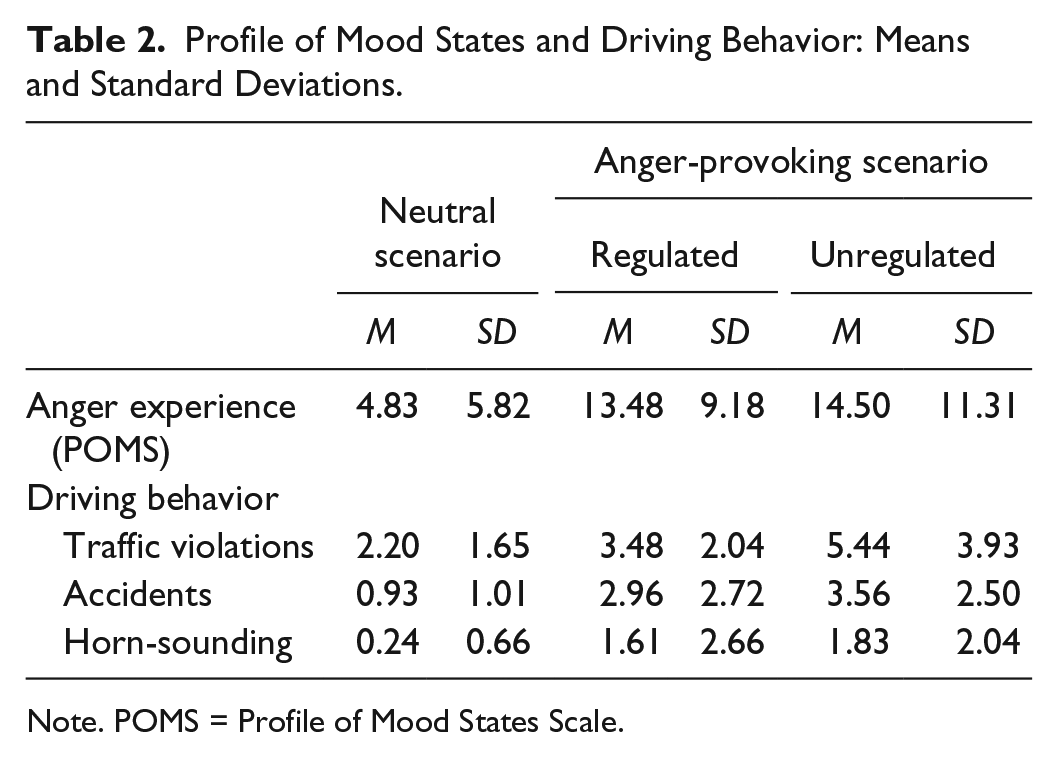
A mixed ANOVA revealed a significant main effect of emotional induction, F(1, 39) = 25.81, p < .001, η2 = .40, with participants reporting more anger in the anger-provoking scenario than in the neutral one. However, there were no significant differences between the (unregulated vs. regulated) groups.
Driving Behavior
Descriptive statistics are shown in Table 2. Mixed ANOVAs revealed a significant main effect of emotional induction on traffic violations, number of accidents, and horn-sounding, mean F(1, 39) = 24.45, p < .001, η2 = .38. On average, participants committed a higher number of traffic violations, provoked a higher number of accidents, and used more horn-sounding at other drivers in the anger-provoking driving session than in the neutral one.
Profile of Mood States and Driving Behavior: Means and Standard Deviations.
Note. POMS = Profile of Mood States Scale.
Concerning traffic violations, the analysis also revealed a significant interaction effect between emotional induction and emotion regulation, F(1, 39) = 5.45, p < .05, with participants in the regulated group committing a lower number of violations than participants in the unregulated group. However, no significant differences emerged between the (unregulated vs. regulated) groups concerning the other two indices (i.e., accidents and horn-sounding).
Verbal Expression
Concerning the use of bad words, the mixed ANOVA revealed a significant main effect of emotional induction, F(1, 39) = 8.30, p < .01, η2 = .18. On average, the number of bad words used in the neutral driving session was significantly lower than the number of bad words used in the anger-provoking scenario (see Table 3). There were no significant differences between the regulated versus unregulated groups.
Verbal Expression of Driving Anger: Means and Standard Deviations.

No significant effects emerged of either emotional induction or emotion regulation condition on the total number of words, the number of words describing one’s driving performance, and the use of emotional words.
Nonverbal Vocal Expression
Concerning pitch, we found a significant main effect of emotional induction on the minimum range, F(1, 35) = 4.91, p < .05, η2 = .12, with minimum pitch recorded during the anger-provoking driving session significantly higher than the one recorded during the neutral one (see Table 4). No other significant effects emerged of either emotional induction or emotion regulation condition on the other pitch parameters.
Nonverbal Vocal Expression of Driving Anger: Means and Standard Deviations.
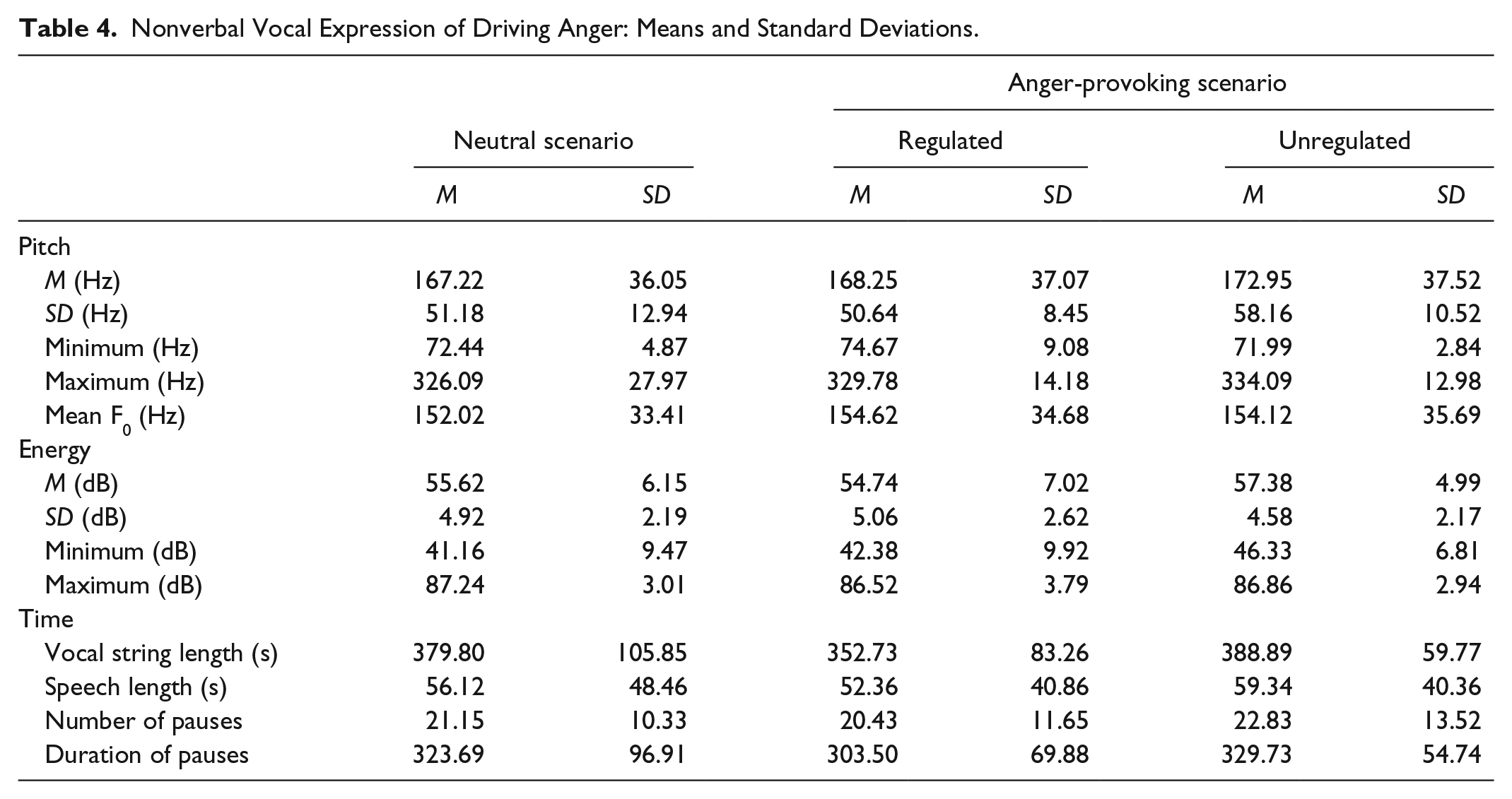
Concerning energy, the statistical analysis revealed a significant main effect of emotional induction on maximum energy, F(1, 35) = 4.56, p < .05, η2 = .12, with the maximum value of energy recorded during the anger-provoking driving session significantly higher than the one recorded during the neutral one. No other significant effects emerged of either emotional induction or emotion regulation condition on the other amplitude parameters.
Concerning time parameters, no significant effects emerged.
Discussion
Although extensive research has examined the relationship between driving anger and risky behavior, thus far, little is known about how drivers express and regulate anger while driving. The present study was designed to examine the verbal and acoustic correlates of driving anger, as well as whether emotion regulation strategies such as cognitive reappraisal are effective at reducing the outward expression of anger while driving in an anger-provoking driving scenario. Gaining knowledge about the expression and regulation of driving anger not only has implications for our theoretical understanding of anger-related phenomena but also can support the design of interventions for driving anger reduction (e.g., training programs for the empowerment of drivers’ emotion regulation abilities; implementation of driving assistance systems able to decode the driver’s emotional state on the basis of emotional expression cues).
Consistent with our hypotheses, the results show that participants reported significantly higher levels of anger while driving in the anger-provoking scenario than in the neutral one. Similar to previous studies (e.g., Stephens & Groeger, 2009), anger was generated by a frustrating simulated driving context that included events and situations considered as typical antecedents of road rage: Congested traffic, obstacles, as well as others’ illegal driving behavior hindered the drivers’ journey toward their destination. Anger emotional induction also had a significant effect on drivers’ verbal and vocal expressive behavior. Concerning speech, no differences emerged between the neutral and anger-provoking conditions concerning the total number of words (i.e., participants did not tend to talk more or less when driving under frustrating conditions), and most of the words were used to describe the driving performance in both scenarios. However, we found that drivers used a higher number of bad words when angered behind the wheel. Thus, consistent with prior studies (Deffenbacher, Lynch, et al., 2002), it seems that driving anger is typically expressed through a form of verbal aggression, that is, cursing, even though the number of bad words was on average low.
Concerning acoustic correlates, we found that driving anger leads to an increase of F0 minimum range and of maximum energy; however, we did not find any significant effect of anger induction on either mean F0, energy mean, or time-related indices. Overall, our results are thus compatible with the acoustic profile of cold anger rather than with the one of hot anger: Although prior research has found that individuals report to express driving anger by means of vocal behaviors prototypical of hot anger such as yelling (Deffenbacher, Lynch, et al., 2002), our data suggest that driving anger may correspond to a milder affective response such as irritation or cold anger. Alternatively, the need to attend and to quickly respond to a highly complex urban route (the anger-provoking scenario included congested traffic, as well as lot of cars and pedestrians) may have hindered the participants’ chance to fully express their anger. Notably, prior research on vocal expression of affect has shown that acoustic variations in spontaneous speech are generally smaller and subtler than variations found in posed emotional expressions (Laukka et al., 2011; Yanushevskaya, Tooher, Gobl, & Ní Chasaide, 2007).
Consistent with prior research (Deffenbacher et al., 2003) our findings show that anger has a significant influence on driving behavior: Participants exhibited a higher number of violations, accidents, and horns in the anger-provoking scenario than in the neutral one. These results suggest that milder affective response such as cold anger (and not only rage) may be related to aggressive driving behavior, characterized by violations, high rate of accidents, and horn use.
When comparing the regulated and unregulated groups, our hypotheses were not confirmed. First of all, we found that the participants instructed to use cognitive reappraisal did not report less anger than the participants in the unregulated group. Thus, unexpectedly, instructed reappraisal was not effective at down-regulating drivers’ subjective experience of anger. Similarly, cognitive reappraisal had no effect either on verbal or vocal measures of anger. Finally, few differences emerged concerning the indices of aggressive/risky driving behavior. Participants in the regulated group did not show a lower number of accidents and less horn-honking than participants in the unregulated group; however, reappraisal information was effective at reducing the number of violations. Compared with accidents, which may also result from errors and may thus reflect performance limits, violations are intentional (de Winter & Dodou, 2010) and have been associated with trait aggressiveness (King & Parker, 2008). Thus, reappraisal may be effective at reducing aggressive forms of driving behavior.
Overall, our results concerning the instructed use of cognitive reappraisal are not consistent with previous studies finding that reappraising information significantly reduces subjective reports of anger (Wollstädter et al., 2013) and leads to better driving behavior (Harris & Nass, 2011). One possible explanation is that reframing information in these studies was given throughout the challenging anger-eliciting drive, whereas in our study the reappraisal instructions were given at the beginning of the scenario only. Because the anger-provoking scenario required approximately an 8-min drive and included a sequence of anger-eliciting events, our reappraisal instructions might have been less effective. Alternatively, the type of reappraisal tactic we selected (which was focused on others’ responsibility) may be less appropriate than other tactics (e.g., distancing, finding positive aspects of the situation) to down-regulate driving anger (McRae, Ciesielski, & Gross, 2012). Future studies could test this hypothesis. Finally, emotion regulation may interact with trait anger, so that emotion regulation strategies such as reappraisal are effective at regulating anger of drivers prone to high levels of anger. Future studies employing measures of trait driving anger such as the Driving Anger Scale (DAS; Deffenbacher, Oetting, & Lynch, 1994) could address this issue.
The work presented here has some important limitations. First, our sample was limited to undergraduate students, that is, to young drivers with few years of driving experience. Second, we examined the effects of one regulation strategy only. Future research could compare the effects of different emotion regulation strategies on driving anger, as well as examine the relationship of vocal and verbal measures with other measures, such as psychophysiological signals and facial behavior. Third, the reappraisal message used in the emotion regulation condition before starting the anger-provoking drive asked participants to focus on their anger and think that nobody was to blame, possibly leading them to focus their attention on a feeling they may not necessarily feel.
Despite these limitations, this study provides important insights into the nature of anger experienced while driving and has some relevant implications. First, our results including the analysis of verbal and vocal expressions of anger suggest that anger behind the wheel may be often similar to cold anger (i.e., milder experience of emotional states such as irritation and annoyance) than to full-blown rage. Cold anger may be typical of frustrating driving contexts including congested traffic, as the one employed in this study. Although milder than rage, cold anger led nonetheless participants to more aggressive behavior, including higher rates of violations and accidents. These results offer a small window into potential mechanisms for cold anger and may be relevant to consider within driver training programs, which often underestimate the impact that emotions such as anger and frustration may have on driving performance.
A second practical implication of our findings may concern the design of in-vehicle communication systems to help the driver to control anger. Our (mostly) null findings about the use of instructed cognitive reappraisal at the beginning of the anger-provoking driving session seem to suggest that the regulation of driving anger may require regulating efforts throughout the drive. Frustrating driving contexts often consist of a sequence of multiple potentially anger-eliciting events that are likely to continuously tax the driver’s regulatory abilities. Also, driving is a task that further taxes the cognitive resources of the driver as it demands a high level of attentional resources for the driver to regulate his or her driving behavior (e.g., speed, steering control, lane position) and safely respond to pedestrians, roadway signs, traffic lights, and other sources of information (Chan & Singhal, 2013). Road safety may be thus improved by means of driving assistance devices able to decode the driver emotion from vocal and verbal cues to support emotion regulation by means of in-car messages throughout the drive.
Footnotes
Declaration of Conflicting Interests
The author(s) declared no potential conflicts of interest with respect to the research, authorship, and/or publication of this article.
Funding
The author(s) received no financial support for the research and/or authorship of this article.