



Abstract
The rapid growth of the electric scooter (e-Scooter) market and its increasing urban use necessitate research into rider behavioral patterns and their impact on traffic safety. This study aims to design and validate an e-scooter rider behavior questionnaire (eSRBQ) to address this need. The eSRBQ was validated based on established tools like the Driver Behavior Questionnaire (DBQ) and the Cyclist Behavior Questionnaire (CBQ). A sample of 445 participants completed the eSRBQ, which comprised three factors: violations, errors, and positive behaviors. Confirmatory factor analysis (CFA) validated the questionnaire’s structure. The eSRBQ demonstrated good fit indices (Chi-squared/df = 3.651, SRMR = 0.047, RMSEA = 0.077, CFI = 0.941, TLI = 0.932) and high internal consistency (Cronbach’s alpha > .7 for all factors). The study found significant differences in violations, errors, and positive behaviors based on collision history. Age and riding frequency also influenced behavior, with younger and less frequent riders displaying more violations. These findings highlight the necessity for targeted safety interventions and continuous monitoring of e-scooter rider behavior as their use expands. This study contributes to urban transportation safety by providing a validated tool for assessing e-scooter rider behavior and identifying critical factors for improving road safety.
Keywords
Introduction
The global e-scooter market has seen substantial growth, estimated at $37.07 billion in 2023 (Grand View Research, 2023). This rapid adoption has transformed urban mobility paradigms, offering an eco-friendly alternative for short-distance travel and potentially mitigating traffic congestion and carbon emissions (Abduljabbar et al., 2021; Sanders et al., 2020). E-scooters have gained popularity as a new means of urban transportation with the emergence of sharing services on a global scale (Li et al., 2022; Liu & Lai, 2020; Yang et al., 2021). However, the integration of e-scooters into existing transportation networks has precipitated public safety concerns and necessitated new regulatory frameworks (Choron & Sakran, 2019; Turienzo, Cabanelas, & Lampón, 2022), as e-scooter riders increasingly share public spaces with pedestrians, cyclists, and motorized vehicles.
The impact of e-scooters on urban transportation underscores the critical importance of comprehending e-scooter rider behaviors to inform the development of effective safety protocols, appropriate infrastructure design, and targeted educational initiatives (Janikian et al., 2024; Tuncer & Brown, 2020). Accordingly, the literature increasingly acknowledges the importance of comprehensive assessment of e-scooter riders. For instance, e-Scooter riders with personalities such as sensation-seeking and extraversion have been linked to greater willingness to use the e-scooters and may underlie a riskier pattern of use (Ionescu et al., 2020; Karami et al., 2025). Also, rider’s perception of risk can be miscalibrated, leading to inadvertent errors (Ventsislavova et al., 2025). Furthermore, emotional states like traffic anger, which is well-documented among other vulnerable road users (Marín Puchades et al., 2017), can significantly influence decision-making and interactions within complex traffic environments. Notwithstanding this imperative, a salient research gap persists in the development of specialized methodologies for collecting and assessing e-scooter rider behavior.
To conceptually anchor the behavioral framework of e-scooter riders, this study builds upon well-validated behavioral models in traffic psychology. At its core, the questionnaire builds on Reason’s distinction between errors and violations. “Errors” encompass involuntary risky actions, such as inattentiveness while riding or failing to recognize traffic signals and surroundings (Ledesma et al., 2010). Previous studies on road users (drivers, pedestrians, and cyclists) have identified errors as a crucial factor linked to crashes. “Violations” are widely understood as “deliberate deviations from those practices believed necessary to maintain the safe operation of a potentially hazardous system” (Reason et al., 1990). Finally, the “Positive Behaviors” category encompasses actions that illustrate e-scooter riders’ dedication to safety, such as adhering to traffic regulations and employing defensive driving techniques. These behaviors are designed to prevent collisions and violations, not just a mere absence of violations and errors. Recognizing the importance of safety-enhancing and prosocial conduct, this study further incorporates a positive behavior dimension, inspired by instruments such as the Positive Driver Behaviors Scale (Özkan & Lajunen, 2005). The addition of PDBS addresses proactive, prosocial safety actions of drivers. Overall, the focus on error-violation as well as the inclusion of positive behaviors, offer a valuable framework for conceptualizing e-scooter rider behaviors.
Traditionally, road user behaviors have been assessed via behavior questionnaires (BQs; Useche et al., 2022). Driver Behavior Questionnaire (DBQ; Reason et al., 1990) has been widely used to assess self-reported driving behaviors across various cultures and demographics (Martinussen et al., 2013; Zhang et al., 2013). Similarly, the Cycling Behavior Questionnaire (CBQ) has emerged as a valuable tool for evaluating cyclists’ road behaviors, including both risky and positive actions (Useche et al., 2018a, 2021b). While other variants of behavior questionnaires exist, such as the Pedestrian Behavior Questionnaire (PBQ) and Motorcycle Rider Behavior Questionnaire (MRBQ; Elliott et al., 2007; Esmaili et al., 2021), the CBQ is particularly relevant for e-scooter research due to the unique characteristics of e-scooters. Useche et al. (2022) state that e-scooters have many characteristics in common with bicycles, such as being a cheap, environmentally friendly and easy-to-use alternative to motorized vehicles. Moreover, e-scooters, powered by electricity with a maximum speed of 40 km/h (25 mph; Kim et al., 2018), occupy a distinct niche in urban mobility and serve as an effective mode of short-distance transportation (Uluk et al., 2022). They are faster than pedestrians but slower than motorized vehicles (Akter et al., 2021; Mwakalonge et al., 2019), a fact that makes PBQ and MRBQ less relevant.
By adapting these established instruments, researchers can deliver a comprehensive tool addressing the unique aspects of e-scooter use while building on proven methodologies for assessing road user behavior. The unique characteristics of e-scooters, such as their relatively recent integration into urban mobility and distinct physical properties alongside their status as a new category of vulnerable road users, necessitate modifications to existing questionnaires. Specifically, an e-scooter behavior questionnaire must address factors such as riding on pavements, alcohol consumption while riding, and interactions with pedestrians and other road users, all identified as key concerns in e-scooter safety research (Burt & Ahmed, 2023).
The primary aim of this study is to validate the e-Scooter Rider Behavior Questionnaire (eSRBQ), an instrument designed to assess the behaviors, attitudes, and risk perceptions of e-scooter users. By adapting elements from the well-established DBQ and CBQ while incorporating e-scooter-specific items, the eSRBQ seeks to provide a comprehensive and reliable tool for researchers, policymakers, and urban planners to understand both aberrant and positive behavior of e-scooter riders. The validation of the eSRBQ has the potential to significantly impact e-scooter-related studies by offering a standardized method for measuring rider behavior across different urban contexts and demographics. In addition, the researchers seek to identify differences in the subscales of the eSRBQ according to demographic variables such as the subjects’ gender, age, and riding frequency. The eSRBQ is expected to play a crucial role in promoting safer e-scooter riding practices by providing insights into rider behavior that can guide the development of effective inventory and safety initiatives. Ultimately, this study aims to validate a rider behavior survey specific to e-scooters, a recently emerging mode of transportation.
Methods
Participants and Study Design
This study was approved by the Institutional Review Board and conducted in accordance with the Declaration of Helsinki. A non-invasive, anonymous online survey approach was adopted to minimize potential risks and harms to participants without any involvement of physically and psychologically invasive procedures.
As the survey focused on collecting e-scooter rider behaviors, the potential benefits of this research are expected to significantly benefit society by informing the development of safety interventions, educational initiatives, and public policies for e-scooter riders. These societal benefits are considered to outweigh the minimal risks associated with completing an anonymous online survey.
Before any survey items, participants viewed an online information page and provided electronic informed consent by selecting an “I agree” checkbox; individuals who did not consent could not proceed and no data were collected. Participation was voluntary and could be discontinued at any time. No personally identifying information was collected in the survey, and optional contact details for incentive delivery were collected separately from responses.
A total of 531 individuals applied for the survey. The final sample comprised 445 participants (225 males and 220 females) who completed the online eSRBQ. Participants with incomplete surveys or insufficient experience (less than 1 week of e-scooter use) were excluded. The survey also collected socio-demographic data such as gender, age, riding frequency per week, riding time per day, and collision history within the past 6 months. Detailed participant characteristics are presented in Table 1.
Characteristics of Participants (N = 445).

The questionnaire was used for research purposes only and was distributed via the mailing lists of several universities with which the author had previously collaborated. We attempted to increase the reliability of the study by examining the history and frequency of e-scooter use and using only the survey results of people who frequently use e-scooters. After completing the survey, the subjects who completed it were given a gift certificate worth 5,000 won (approximately $3 USD). The survey procedure is shown in Figure 1.

Illustrative of overall procedure of this study.
Later, in analyses, the participants were divided into two groups (Useche et al., 2022) based on the 50th percentile of their socio-demographic factors (collision history, age, riding frequency, and riding time). Those with scores below or equal to the 50th percentile were placed in one group, while those with scores above the 50th percentile were placed in another.
Instruments
Expert Review Process
To ensure the validity of contextual relevance of the eSRBQ items, an expert review process was conducted by five researchers with background in Human Factors, Micromobility, and Transportations. The expert panel assessed each item’s applicability, cultural appropriateness, and coverage within the three theoretical domains of violations, errors, and positive behaviors, providing recommendations for refinement and translation in Korean.
First, a comprehensive review of the original DBQ and two CBQ sets was conducted (Reason et al., 1990; Useche et al., 2018, et al., 2022). Each expert independently reviewed each item from DBQ and CBQ sets for relevance, clarity, and contextual suitability for e-scooter use. The main criterion was whether replacing “bicycle” or “vehicle” with “e-scooter” preserved the intended meaning of the original items while maintaining relevance with the e-scooter’s context. Any items identified as ambiguous or considered inapplicable to e-scooter context were discussed.
The DBQ is the most widely used self-report questionnaire assessing the road use behavior of motorists, with particular focus on errors and violations (Hill et al., 2023; Jiao et al., 2024). However, the 50 items in the DBQ, especially those related to errors, are closely tied to vehicle design and interface features that are incompatible with e-scooters. This incompatibility stems from the fundamental difference between motorized vehicles and e-scooters, which serve as simple, easy-to-use alternatives to conventional motorized transport (Useche et al., 2022).
Similarly, the original CBQ questionnaires (Useche et al., 2018) proposed 42 items including items related to positive behaviors. The expert panel agreed that incorporating positive behavior was crucial for reinforcing road safety, rather than solely examining aberrant behaviors. However, a later cross-culturally CBQ studies conducted in 2022 across 19 countries proposed 29 items (Useche et al., 2022). After reviewing both versions, expert panel concluded that the 29 items in the latter study were better suited for the context of e-scooters. The majority of the 29 items in the CBQ demonstrated greater compatibility with e-scooter usage when the term ‘bicycle’ was replaced with ‘e-scooter’.
The inclusion of positive behavior items in the eSRBQ also serves to mitigate social desirability bias, a common limitation in self-reported behavioral assessments. This bias occurs when respondents provide answers they perceive as socially acceptable or favorable, rather than reflecting their true behaviors. Traditional behavior questionnaires like the DBQ focus primarily on aberrant behaviors (errors and violations), which may lead respondents to underreport risky actions due to fear of judgment or self-presentation concerns. By incorporating positive behavior items, the eSRBQ offers a more balanced behavioral spectrum that reduces psychological defensiveness and encourages more honest responses. Participants may recognize that the questionnaire acknowledges both responsible and risky behaviors, creating a more comprehensive assessment framework. Therefore, all 29 items from the CBQ were selected for validation within the Korean e-scooter context-of-use.
Final Instrument Development
Regarding the target users, Useche et al. (2022) developed two questionnaires: the External Rater Cycling Behavior Questionnaire (ECBQ) and the External Rater Scooter Questionnaire (ESBQ). They employed a method whereby non-users were asked to rate the behavior of scooter and cycle users. This approach was designed to eliminate any potential subjective bias by referring to these individuals as “external raters”. Nevertheless, certain behaviors are better assessed through subjective self-ratings by the individuals themselves rather than through observations by inexperienced non-users. Thus, the researchers retained questionnaires for actual e-scooter users.
This study targets both the shared e-scooter users and private e-scooter owners. Consequently, a concern has arisen that these two different groups would show different behaviors in not only driving but also in parking, handling, and maintenance (Oostendorp & Hardinghaus, 2023). Accordingly, the need to develop e-scooter-specific questionnaires was considered. However, the expert panel agreed that focusing on common behaviors regardless of e-scooters ownership was a valid starting point, as it was premature to apply a newly developed, unvalidated instrument alongside one adapted from the CBQ. Therefore, this study focused on the validation of CBQ, modified for e-Scooters, to scrutinize the overall behaviors of Korean e-scooter riders.
The eSRBQ consists of 29 items on a 7-point Likert scale, initially derived from CBQ, and organized into three factors. The three factors are Violation (8 items), Error (15 items), and Positive Behavior (6 items). To examine the initial version of the scale, a list of e-scooter rider behavior items potentially corresponding to the sub-questionnaire for each factor was created and then reorganized in consultation with experts in the field. In addition to the main times, the survey included demographic questions, such as a five-point scale to measure riding frequency (e.g., how often do you use an e-scooter per week?) was also designed.
Furthermore, considerable effort was devoted to translating the questionnaire into Korean, ensuring semantic and contextual fidelity to e-scooter use scenarios in Korea. This adaptation was intended to enhance the cultural and behavioral relevance of the instrument without compromising the psychometric properties of the original validated items.
Statistical Analysis
The statistical analysis comprised three distinct phases. First, the goodness of fit was assessed for the one-factor model, followed by a three-factor model, which was then refined to meet the established criteria. Consistent with prior literature, the model fit was assessed using a variety of indicators. In this study, the chi-square, CFI, SRMR, and RMSEA indices were employed. The criteria for the acceptable model fit were based on the general standards of existing studies, such as CFI > 0.9 and RMSEA < 0.08 (Bentler, 1990; Hu & Bentler, 1999; Steiger, 1990; Tucker & Lewis, 1973).
To refine the model, correlations between each item and its respective factor were assessed. Items exhibiting a low correlation (Pearson correlation coefficient below .7) with the total correlation were excluded, as they contributed minimally to the reliability and validity of the model. This approach aligns with the methods used by Freuli et al. (2020) and Useche et al. (2018), wherein analogous criteria were employed for item retention based on factor correlations. The acceptability of the model was evaluated based on the strength of the parameter estimates and the reliability of the scale. The internal consistency of the scale was evaluated using Cronbach’s alpha (CA) and validity of the model was confirmed using Composite Reliability (CR), and Average Variance Extracted (AVE).
Finally, an independent t-test was conducted to compare the differences in means of behavior variables (violations, errors, and positive behaviors) across demographic variables (collision history, age, riding frequency, and riding time). All statistical analyses were performed using IBM SPSS/AMOS version 27.0.
Results
Internal Structural Models for Riding Behavior on E-scooter
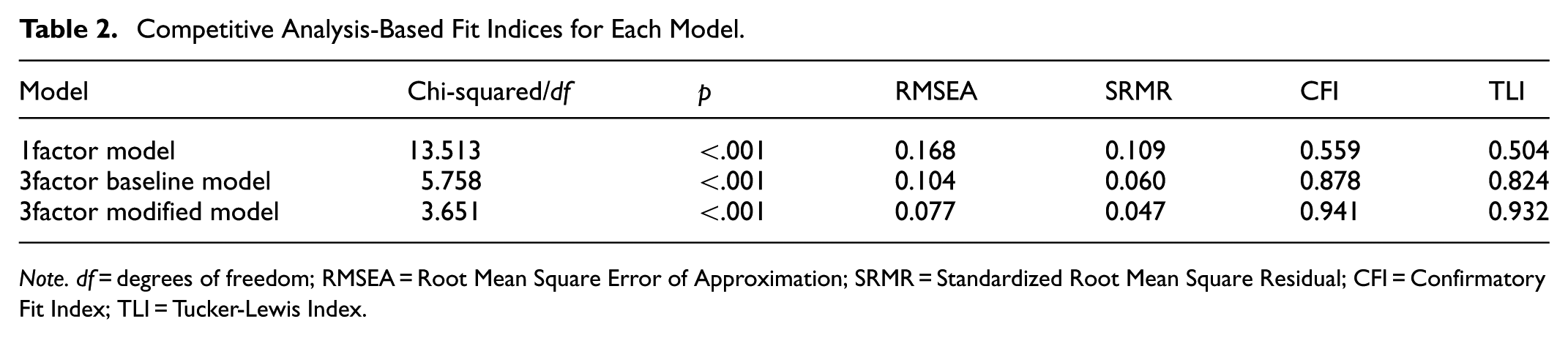
The objective of the study was to validate the eSRBQ structure through the implementation of a three-phase CFA (See Table 2). First, all items were integrated into a single factor model and tested using CFA. However, the results indicated that the model did not fit the data. Second, the three-factor model, comprising violation, error, and positive behavior factors was assessed. Despite the superior fit of the three-factor model to the one-factor model, the analysis results showed that the three-factor eSRBQ model, which has the same structure as the CBQ, also did not meet the appropriate goodness-of-fit criteria.
Competitive Analysis-Based Fit Indices for Each Model.
Note. df = degrees of freedom; RMSEA = Root Mean Square Error of Approximation; SRMR = Standardized Root Mean Square Residual; CFI = Confirmatory Fit Index; TLI = Tucker-Lewis Index.
As a result, an iterative model improvement procedure that included correlation coefficient evaluation and item removal was adopted. This process resulted in the elimination of 10 items, yielding a streamlined 3-factor model comprising 19 items that satisfied the goodness-of-fit criteria. The key fit indices for this model are reported in Table 2. The final model is organized as follows: Violation (6 items), Positive Behavior (6 items), and Error (7 items).
As shown in Figure 2, all factor loadings were large, positive, and statistically significant. Correlations between factors were statistically significant and substantial, as expected. Errors and violations were positively correlated (r = .708, p < .001). In contrast, the correlation between positive behavior and violations was negative and significant, as expected (r = −.718, p < .001). Table 3 presents the descriptive statistics, standardized factor loadings, and factor assignments for each item.

Confirmatory Factor Analysis (CFA) model of the three-factor structure: Violation, positive behavior, and error.
Descriptive Statistics of Each Metric and Factor.

Note. SD = standard deviation; Skew = skewness; Kurt = kurtosis; λ = standardized factor loading.
Reliability and Validity of the ESRBQ
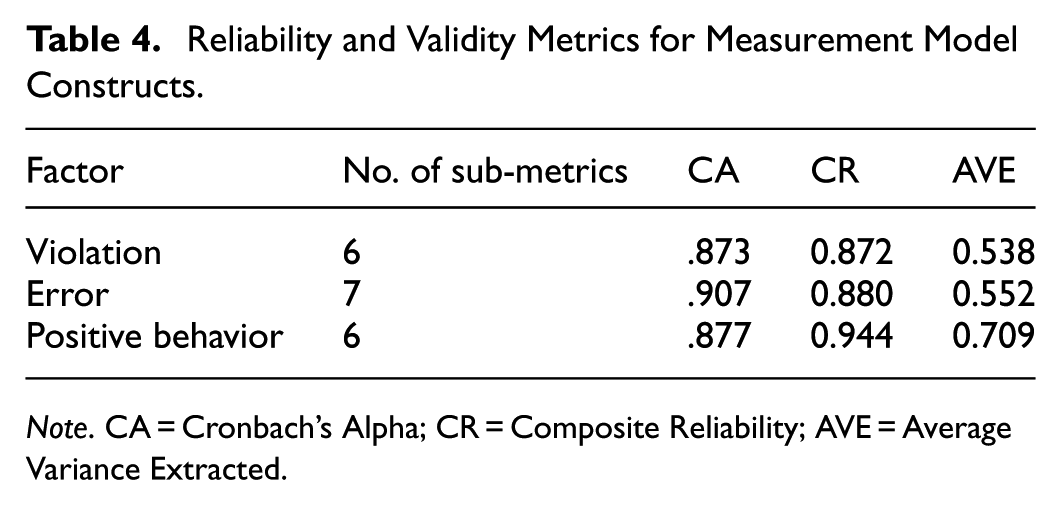
The reliability and validity of the measurement model were confirmed using CA, CR, and AVE (See Table 4). All constructs exhibited an acceptable internal consistency, with CA values exceeding the recommended threshold of 0.70 (Nunnally, 1978). CR values ranged from 0.872 to 0.944, further supporting the model’s reliability. AVE values for each construct were above 0.50, indicating that the items explained a sufficient proportion of variance and thus supported convergent validity (Hair, 2014). Taken together, these results indicate that the model is both reliable and valid for further analysis.
Reliability and Validity Metrics for Measurement Model Constructs.
Note. CA = Cronbach’s Alpha; CR = Composite Reliability; AVE = Average Variance Extracted.
Analyses of Demographic Variables
Differences in ESRBQ by Demographic Characteristics
The differences in behavior variables of e-scooters from eSRBQ regarding the demographic variables (collision history, age, riding frequency, and riding time) were analyzed. The t-test revealed significant differences in violation, error, and positive behavior between groups with and without collision history. The effect sizes, as measured by Cohen’s d, were −0.796 for violation, −0.779 for error, and 0.855 for positive behavior. The effect sizes for violation and error indicate medium to near-large effects, while the effect size for positive behavior indicates a large effect. For age groups, positive behavior showed a significant difference with an effect size of −0.207, indicating a small effect. Among groups categorized by riding frequency, error showed a significant difference with an effect size of 0.236, indicating a small effect. Finally, groups divided by riding time showed a significant difference in violation with an effect size of 0.356, also indicating a small effect. Detailed results are provided in Tables 5 to 8.
Results of t-Test for Collision History.

Results of t-Test for Age.

Results of t-Test for Riding Frequency.

Results of t-Test for Riding Time.

Discussion and Conclusion
This study successfully developed and validated the e-Scooter Rider Behavior Questionnaire to assess both aberrant and positive behaviors of e-scooter riders. The final three-factor structure of the eSRBQ demonstrated high internal consistency (CA > .8), aligning with the established frameworks of the DBQ and CBQ and confirming its reliability for the e-scooter context.
Validation on the e-Scooter Rider Behavior Questionnaires
The final 19-item model was derived by removing 10 items from the original CBQ (Useche et al., 2018), as shown in Table S1. Two items were removed from violations and eight from errors. This exclusion suggests these behaviors are less recognized as violations and errors by Korean e-scooter riders. Analysis of the removed items revealed unique physical and operational characteristics of e-scooters. This refinement suggests that certain behaviors are perceived differently by Korean e-scooter riders, likely reflecting fundamental physical and operational differences between e-scooters and bicycles.
In terms of violations, questionnaires related to carrying obstructive objects while riding (#4) and riding e-scooters in the opposite direction (#2) were removed. Although e-scooters share many aspects in common with bicycles, the removal of these two items highlights the distinct characteristics of e-scooters. For instance, due to their form factor, e-scooters are difficult to steer and carry with one hand. This makes carrying obstructive objects an infrequent and impractical behavior, validating its removal. Also, e-scooters offer more flexible route choices compared to bicycles and are often used on sidewalks and roads, making the concept of opposite direction ambiguous. It shows more flexible road choice characteristic of e-scooters.
In the Korean context, the concept of “wrong direction” riding among e-scooter users demands a nuanced understanding rooted in local infrastructural realities. Unlike countries featuring dedicated micromobility lanes, Korea currently lacks exclusive e-scooter pathways. Consequently, the traditional notion of riding against traffic is incongruent with the Korean urban landscape, where the absence of segregated lanes blurs the boundaries of proper directional use. Moreover, riding on sidewalks has become prevalent due to safety concerns and infrastructure limitations, avoiding motorized traffic, further complicating riders’ perceptions and behaviors regarding directional regulations (Anke et al., 2023). This situation underscores a critical gap in the current e-scooter infrastructure. The dedicated lanes not only enhance rider safety but also foster clearer, more consistent understanding and adherence to traffic direction. Establishing such infrastructure would be pivotal in cultivating awareness and compliance with safe riding practices, ultimately contributing to safer and more efficient urban mobility ecosystems in Korea.
Regarding errors, the removal of items #13, #21, and #22 can be attributed to rider’s lower engagement with the formal traffic environment. For instance, Korean e-scooter users often follow pedestrian crosswalk signals rather than vehicle traffic lights and may perceive road bumps as irrelevant, often choosing to ride on sidewalks to avoid them. These are misbehaviors caused by lack of awareness of regulations (Frank et al., 2024) by Korean e-scooter riders and limited knowledge of e-scooter legislation correlating with illegal behaviors and increased collision risks (Ventsislavova et al., 2024). Anke et al. (2023) also noted that e-scooter riders often choose sidewalks to avoid poor surface quality. Therefore, the removal of these items is reasonable and effectively reflects the behaviors of Korean e-scooter users.
A distinction was also found in collision-related error items. Questionnaire items #12, #15, #17, and #20 were removed whereas #9, #10, #11, #16, #18, and #19 were retained. The removed items primarily describe static or low-dynamic situations, such as unintentional collisions with parked vehicle (#20) or failures to notice pedestrian during turns or disembarkations (#12, #15, #17), which may exhibit lower relevance in the e-scooter context due to its high maneuverability, low-speed, and frequent use on sidewalks in Korean urban environments. In contrast, the retained items capture more dynamic interactions, including road crossings without looking (#9), distractions leading to near-collisions (#10), sudden braking (#11), misjudging departing vehicles (#16), overtaking (#8), and turn misjudgment (#19). This suggests the eSRBQ is more sensitive to errors requiring high cognitive load and immediate responses. This aligns with findings that riders focus their visual attention primarily ahead (39%–43%), potentially reducing their awareness of peripheral or slower-moving objects (Pashkevich et al., 2022).
Finally, a notable finding in the present study is that all six items associated with positive behaviors were retained through the confirmatory factor analysis (CFA) process. The robust retention of these items suggests several important implications. First, it demonstrates that positive behaviors among e-scooter riders are conceptually stable and empirically valid. Moreover, positive behaviors appear to be transferable across different micro-mobility modes, since their importance is equally recognized for drivers, cyclists, and e-scooter riders (Useche et al., 2018; Walker et al., 2011). This suggests that e-scooter riders, much like other road users, benefit from established safety habits and can be reached through educational campaigns that encourage these behaviors.
Demographic Analysis for eSRBQ
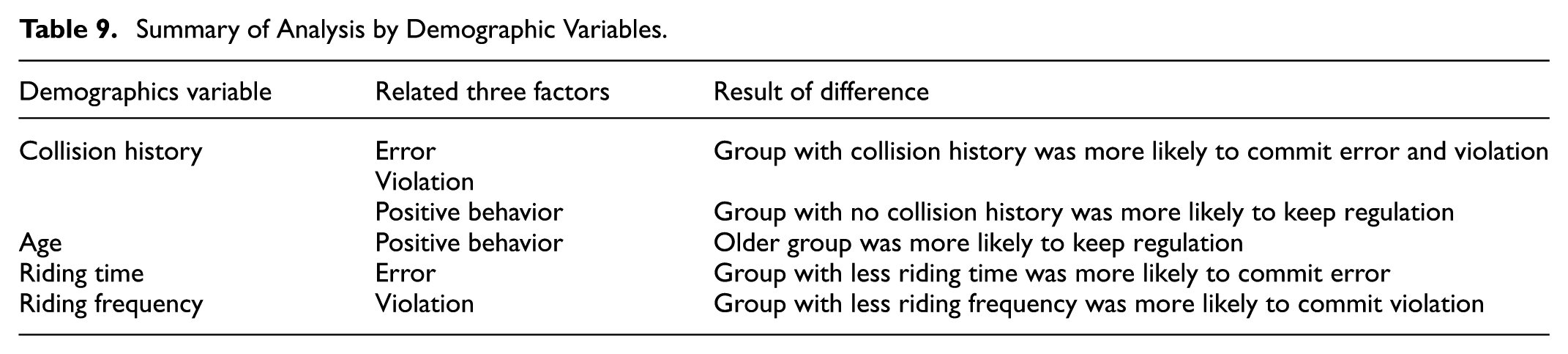
This study validates the eSRBQ as an effective tool for assessing e-scooter rider behavior. Analyses of demographic variables revealed significant differences in behavior based on collision history, age, and riding frequency. These findings, summarized in Table 9, provide valuable insights into how demographic characteristics influence e-scooter rider behavior.
Summary of Analysis by Demographic Variables.
Differences in Collision History
A key finding of this study is the significant difference in behavior based on prior collision history. Specifically, riders who had previously been in a collision reported significantly higher rates of both Errors and Violations. This result is consistent with extensive research on other road users, which has repeatedly demonstrated a link between past crashes and subsequent risky behaviors (Chang & Yeh, 2007; Hezaveh et al., 2018; Sexton et al., 2023). This relationship may be particularly pronounced for e-scooter riders, who often navigate ambiguous legal boundaries and may have lower awareness of traffic regulations (Brown et al., 2020; Useche et al., 2022). Understanding this cycle is crucial for developing targeted safety interventions for at-risk riders.
Conversely, this study found a strong link between a lack of collision history and higher engagement in Positive Behaviors. Riders who had not been in a collision reported performing safe and proactive behaviors more frequently. This finding highlights the importance of not only penalizing negative behaviors but also promoting positive ones, a concept increasingly supported in road safety literature (Ali et al., 2020; Arı & Yilmaz, 2024; Qu, Zhang, & Ge, 2022; Torbaghan et al., 2022; Useche et al., 2018). Therefore, fostering these protective behaviors is a crucial strategy for enhancing overall e-scooter safety.
From a theoretical perspective, the inclusion of positive behaviors expands traditional aberrant behavior models—such as the DBQ’s errors and violations—by emphasizing that safety is not only the absence of risky acts, but also the presence of proactive and protective conduct. Promotion of positive behaviors should thus be a central target for safety campaigns and educational interventions, as they can effectively supplement enforcement and regulatory measures. This study’s findings support prior literature advocating for strategies, such as social norm campaigns or in-app incentives—that reward and reinforce positive road behavior as a means of advancing safety and public health objectives in the context of the growing e-scooter population.
Age Related E-Scooter Riding Behavior
Contrary to extensive research on driving and motorcycling, which consistently shows younger individuals commit more errors and violations (Cordellieri et al., 2019; Satiennam et al., 2023), this study found no significant age-related differences for these two factors.
One potential explanation for this finding lies in the relatively young and homogenous age range of the participant sample (M = 28.32, SD = 5.01). This demographic profile aligns with recent studies indicating that e-scooter users are, on average, younger than the general population (Demir et al., 2023; Ventsislavova et al., 2024). This study’s results are also consistent with Freuli et al. (2020), who found no age-related variations in driving styles among Italian riders and suggested that a broader age range would be necessary to detect such effects. Therefore, the absence of a significant effect for Errors and Violations may be a feature of the current, predominantly young user base, rather than an indication that age is irrelevant to e-scooter safety.
However, a significant age difference did emerge for Positive Behaviors. Consistent with this study’s findings, older riders reported engaging in safe behaviors more frequently than their younger counterparts. This aligns with broader traffic safety literature, which suggests that maturity and experience often lead to more cautious and protective strategies on the road, whereas younger road users are more prone to risk-taking (Bucsuházy et al., 2020; Islam & Mannering, 2020; Lavallière et al., 2020). Older drivers adopt safer driving strategies, while young drivers are more likely to engage in risky driving (Islam & Mannering, 2020; Xing et al., 2020).
These findings suggest e-scooter riding may exhibit distinct characteristics that differentiate it from traditional driving modes in violations and errors. Further research with a wider age range and larger sample size may be necessary to fully understand the age-related patterns in e-scooter rider behavior.
Riding Frequency and Time: Impact on e-Scooter User Behavior
E-scooter riders using vehicles less than four times weekly violated traffic rules more often, though years of riding experience showed no significant difference in violations. Familiarity with transportation modes positively influences safe use (Walker et al., 2011; Wong et al., 2010). However, new mobility technology users may need time to adapt to operational characteristics and safety protocols (Yang et al., 2020). The studies indicate that less frequent riders may be less familiar with e-scooter operation and safety, potentially leading to more violations, aligning with studies on other transportation modes showing infrequent users engage in more risk-taking behaviors.
Given e-scooters’ recent introduction as a transportation mode (Marques & Coelho, 2022), riding frequency becomes more crucial in determining familiarity than years of experience. E-scooters are often used for shorter trips, unlike traditional vehicles (Uluk et al., 2022), making driving frequency potentially a more relevant indicator of familiarity and expertise than years of experience.
Implications for Safety Interventions
This e-scooter study identifies crucial areas for road safety interventions (Useche et al., 2022). The validation of the eSRBQ and the demographic analyses presented in this study offer actionable direction for the development of targeted safety interventions for e-scooter riders in Korean urban environments. While factors like collision history, age and experience matter, attitudes toward traffic safety, and knowledge of the relevant rules also influence behavior (Sexton et al., 2023; Suzuki et al., 2022). Despite e-scooters’ urban popularity, research on risks and behavioral patterns remains limited (Laverdet et al., 2023). E-scooter regulations lack practical safety provisions, with injury potential exceeding motor vehicles (Salas-Niño, 2022). This gap hinders effective safety measure development. The eSRBQ provides insights for tailored interventions through a three-factor framework.
Given the likelihood of errors and violations among riders with a collision history, targeted interventions for this group are essential (Rad et al., 2024). The programs should address overconfidence, risk awareness, and anger management (Chee et al., 2021; Hussain et al., 2023) to reduce violations and errors. Safety initiatives could include personalized training, graduated penalties, or mandatory safety courses to reduce recidivism.
In terms of age-related interventions, previous research has consistently demonstrated that younger drivers are involved in more violations and collisions than older riders (Bucsuházy et al., 2020; Islam & Mannering, 2020; Lavallière et al., 2020; Xing et al., 2020), necessitating targeted interventions for younger e-scooter riders. Given that errors and violations are more pronounced among younger and less frequent riders, safety campaigns should be customized for these groups. Educational initiatives might include mandatory onboarding modules for new users of e-scooter sharing platforms, emphasizing situational awareness, hazard recognition, and the importance of defensive riding. Simulation-based training—already shown to enhance risk perception in other vulnerable road user groups—should be considered for high-risk individuals, especially those with prior collisions.
The clear association between positive behaviors and reduced collision rates (Cohen’s d = 0.855, Table 5) makes a strong case for incentivizing safe practices. Increased awareness of traffic regulations can reduce illegal riding, while targeted education can modify rider choices (Qi, 2021; Ventsislavova et al., 2024). E-scooter rental services and government bodies could collaborate on reward-based programs: for instance, providing discounts or benefits to users who consistently demonstrate prudent speed management, adherence to designated lanes, or avoidance of riding in adverse conditions. Concurrently, regulatory measures such as tiered penalties for repeat violations and the integration of geo-fencing to restrict unsafe riding locations may further encourage compliance.
In conclusion, this study contributes to understand e-scooter rider behavior and its implications for road safety. It elucidates the relationship between collision history and aberrant driving, underscoring the impact of experience levels, and emphasizes the necessity for targeted interventions. These findings support the development of tailored policies, educational programs, and awareness campaigns to promote responsible riding and improve overall road safety.
Limitations of the Study and Future Research
This study has several limitations, notably its reliance on self-reported data, which may introduce social desirability bias. While self-reported questionnaires offer valuable insights into subjective experiences and behavioral perceptions, they are inherently susceptible to such bias, especially when addressing sensitive behaviors such as traffic violations or risky riding practices. To mitigate this, questionnaires were collected anonymously. Furthermore, the eSRBQ in this study was deliberately designed with a mixture of positive and negative behavior items to encourage more honest responses across the behavioral spectrum, potentially reducing social desirability bias. Although some studies report correlations between self-reported and actual driving behavior, future research should incorporate more structured approaches to enhance the eSRBQ’s robustness.
Accordingly, this study should be regarded as a preliminary step toward developing and validating an instrument to assess e-scooter rider behavior. Building on this foundation, more sophisticated methodologies—such as advanced structural equation modeling, or longitudinal analyses—are needed in future research to deepen insights and strengthen the findings. Subsequent studies could benefit from integrating established theoretical frameworks such as the Technology Acceptance Model (TAM), the Unified Theory of Acceptance and Use of Technology (UTAUT), or the Multidimensional Driving Style Inventory (MDSI). Leveraging these models could yield richer understanding of the determinants and consequences of e-scooter rider behavior, facilitating more comprehensive contributions to both theory and practical interventions in traffic safety and urban mobility.
Prioritize longitudinal studies, future study should evaluate the stability and predictive validity of the eSRBQ. Incorporating objective measures alongside self-reports would significantly strengthen these efforts and reduce subjective bias. For instance, GPS tracking log data could provide precise, real-time records of riding behaviors—such as speed, route adherence, and violation incidents—enabling direct comparison and validation against self-reported data from the eSRBQ. Additionally, integrating wearable sensors (e.g., accelerometers in helmets or smartwatches) or in-vehicle monitoring systems could track risky riding incidents with greater accuracy, capturing metrics like sudden accelerations or near-misses. However, longitudinal designs using these objective measures require careful planning to address challenges such as participant retention, data privacy, and ethical considerations related to continuous monitoring.
Further validation is also needed to identify cultural similarities and differences across diverse ethnicities and countries. Recent studies have explored driving behaviors in Europe and North America (Glodasis et al., 2021; Sexton et al., 2023; Ventura et al., 2023). Existing DBQ/CBQ research suggests cultural differences may affect scale structure and parameter estimates. While this study focuses on Korean e-scooter riders, future research should investigate eSRBQ’s cross-cultural invariance. In addition, the study’s demographic composition skews toward younger age groups, with underrepresentation of users over 40. This aligns with recent research indicating e-scooter users are mostly younger (Demir et al., 2023; Ventsislavova et al., 2024). However, this trend may change as e-scooters become more mainstream, potentially leading to more pronounced age-related differences in the future.
Finally, the analysis revealed socio-demographic differences in eSRBQ factors through separate t-tests. While these results offer intriguing insights, caution is needed due to potential Type I error inflation. Future studies should address the imbalance in demographic categories by increasing sample sizes within each category and expanding the overall sample range, particularly in terms of age diversity. This approach would enhance the robustness and generalizability of findings.
Supplemental Material
sj-docx-1-sgo-10.1177_21582440251391538 – Supplemental material for Assessment and Validation of Rider Behavior Questionnaire for Electric Scooter: Insights into Traffic Safety in Korea
Supplemental material, sj-docx-1-sgo-10.1177_21582440251391538 for Assessment and Validation of Rider Behavior Questionnaire for Electric Scooter: Insights into Traffic Safety in Korea by Joong Hee Lee, Jinhong Wie, Donggun Park and Wonjoon Kim in SAGE Open
Footnotes

Ethical Consideration
This study was approved by the Institutional Review Board of Pukyong National University (IRB No. 1041386-202309-HR-96-02) and conducted in accordance with the Declaration of Helsinki. The research employed a non-invasive, anonymous online survey with no physically or psychologically invasive procedures, and participation was entirely voluntary.
Consent to Participate
Written electronic informed consent was obtained prior to participation via an on-screen information page and an “I agree” checkbox; individuals who did not consent could not proceed and no data were collected. No personally identifying information was collected in the survey, and any optional contact details for incentive delivery were collected separately from responses.
Funding
The authors disclosed receipt of the following financial support for the research, authorship, and/or publication of this article: This research was supported by the National Research Foundation of Korea (NRF) grant, which is funded by the Korean government (MSIT: Ministry of Science and ICT; No. RS-2023-00239877).
Declaration of Conflicting Interests
The authors declared no potential conflicts of interest with respect to the research, authorship, and/or publication of this article.
Data Availability Statement
Data sharing not applicable to this article as no datasets were generated or analyzed during the current study.
Supplemental Material
Supplemental material for this article is available online.
References
Supplementary Material
Please find the following supplemental material available below.
For Open Access articles published under a Creative Commons License, all supplemental material carries the same license as the article it is associated with.
For non-Open Access articles published, all supplemental material carries a non-exclusive license, and permission requests for re-use of supplemental material or any part of supplemental material shall be sent directly to the copyright owner as specified in the copyright notice associated with the article.
