




Abstract
Introducing the cloud platform operator (CPO) to manage all kinds of manufacturing services on the cloud service platform, the game strategy selection of the multiple participants in the cloud manufacturing alliance is one of current research hotspots of the cloud manufacturing mode. Based on the game theory, this article elaborates the multi-participants business collaboration process and proposes the game strategy selection framework of the multiple participants in the cloud manufacturing alliance. From the perspectives of the manufacturing resource demander (MRD), the manufacturing resource provider (MRP), and the CPO, the game types are analyzed, the benefit functions are established, the existences of game equilibria are proved, and their corresponding constraint conditions are obtained. Integrating the dominant game strategies of the multiple participants, the dominant combination strategies of the above three game equilibria are proposed and the intersection conditions of Nash equilibrium from the mixed perspective are obtained. A set of experimental data from the practical case is given to prove that the solution space of Nash equilibrium from the mixed perspective is not empty. This research provides the theoretical basis for the landing application of the cloud manufacturing mode and the technical support for the development of the cloud manufacturing service platform. It has the important academic value and the broad application prospects.
Introduction
At present, more and more enterprises adopt the agile manufacturing, the grid manufacturing, and the other networked manufacturing modes to realize the resource sharing and the business collaboration (Camarinha-Matos et al., 2009; Figay et al., 2012). However, due to the lack of the unified management and operation of the centralized manufacturing resources, the traditional networked manufacturing modes cannot realize the decentralized service of the centralized resources (H. Yang, 2010). Furthermore, these manufacturing modes cannot guarantee the individual interests and enthusiasms of the manufacturing resources providers and demanders in terms of the benefit distribution and the win-win cooperation (Xu, 2012). These bottlenecks result in the limited business collaboration ability, which seriously restricts the further promotion and application of the conventional networked manufacturing modes (Wu et al., 2015).
With the new development of cloud computing, internet of things (IoT), and advanced manufacturing, some scholars first proposed a new service-oriented networked collaborative manufacturing mode, called “cloud manufacturing” (B. Li et al., 2010; Sadiku et al., 2014; Villegas et al., 2012; L. Zhang et al., 2019). Under the cloud manufacturing mode, the cloud platform operator (CPO) known as a third party implements the unified management and operation of all kinds of manufacturing resources supplied by the manufacturing resource providers (MRP) and all kinds of manufacturing requirements submitted by the manufacturing resource demanders (MRD) (He & Xu, 2015; Liu et al., 2019). Standing for a new trend in the development of manufacturing industry, the cloud manufacturing mode makes a step forward in terms of on-demand access, decentralized service, optimal allocation and business collaboration of the manufacturing resources, and quickly attracts the attention of industry, academia, and government departments (Ren et al., 2017; Tao et al., 2011).
Taking the benefit maximization as the starting point and the ultimate goal, the MRD, the MRP, and the CPO collaborate together to form the cloud manufacturing alliance. Based on the cloud service platform, the manufacturing resources and the manufacturing requirements are matched deeply (Valilai & Houshmand, 2013). Comparing with the traditional networked manufacturing modes, one of the main characteristics of the cloud manufacturing mode lie in the multi-participants business collaboration of the cloud manufacturing alliance including the MRD, the MRP, and the CPO (Bi et al., 2016; Meng et al., 2011).
The related researches of the cloud manufacturing mode mainly focus on the key technologies of the cloud service platform, such as the manufacturing resources sharing, clustering, matching, and evaluation (Argoneto & Renna, 2016; Ren et al., 2015; Thekinen & Panchal, 2017). These technologies are usually applied to the service sense in the early formation stage of the cloud manufacturing alliance. However, little research has been done on the game strategy selection of the multi-participants business collaboration and the cooperative interest distribution under the cloud manufacturing mode (Chong et al., 2014; M. Li et al., 2016; Miao & Li, 2017).
In fact, the benefit distribution of cloud manufacturing alliance has some remarkable characteristics (Bi et al., 2016). Besides the MRD and the MRP, the CPO becomes the third-party beneficiary obtaining the service fees paid by the participating enterprises of the cloud manufacturing alliance. After it becomes the third-party beneficiary in the cloud manufacturing alliance, the platform operator will inevitably pursue the benefit maximization (Gao et al., 2018). The situation that all participants trust mutually can be formed and the cloud manufacturing alliance can be established successfully and operated efficiently on condition that the benefit consistency and the game equilibrium of all participants are reached.
The multi-participants business collaboration is the prerequisite foundation for the value existence of the cloud manufacturing alliance and the benefit equilibrium distribution is the important guarantee for the continuous and efficient operation of the cloud manufacturing alliance (Chen et al., 2019). Aiming at the characteristics of the cloud manufacturing mode, the main contribution of this article is to propose the strategies combination and the constrain conditions of the multi-participants business collaboration in the cloud manufacturing alliance. Furthermore, it also proves that the solution space of Nash equilibrium from the mixed perspective is not empty and that the cloud manufacturing alliance can be successfully established and operated efficiently. This research provides the theoretical basis for the landing application of the cloud manufacturing mode and the technical support for the development of the cloud manufacturing service platform. It has the important academic value and the broad application prospects.
Related Works
The cloud manufacturing is an emerging network manufacturing paradigm (Charro & Schaefer, 2018). It collects a lot of redundant manufacturing resources, and provides the manufacturing services on demand with the help of the cloud service platform (Zhang et al., 2014). The main researches on the cloud manufacturing mode include the supply and demand matching of the manufacturing resources and the manufacturing service evaluation (Wu et al., 2014). By analyzing the interest conflict between the MRD and the CPO, Su et al. (2015) solved the Nash equilibrium solution based on the non-cooperative game theory, and obtained the optimal matching result of the manufacturing resources. Considering the preferences of the resources demanders and the differences of the resource providers, Thekinen and Panchal (2017) achieved the optimal allocation of the resource demanders and the resource providers on the basis of the matching theory. Tang et al. (2017) integrated the user feedback information and the cloud service quality evaluation mechanism to effectively evaluate the credibility of the cloud manufacturing services.
On the cloud service platform, the resource providers share the redundant manufacturing resources and the resource demanders seek the satisfied manufacturing resources (X. V. Wang & Xu, 2013). The reason they choose to cooperate is that the cloud manufacturing alliance meets the requirements of the maximized interest and the reasonable distribution. Considering the various factors such as the enterprises importance, the bargaining, and the risk-taking ability, Diao et al. (2011) proposed a multi-weighted Shapley value method to resolve the problem of the alliance profit allocation. Panda et al. (2015) adopted the contract negotiation method to solve the channel conflict and the excess benefit distribution of manufacturers. According to the supplier’s capacity share and the resource sharing degree, Mohebbi and Li (2015) calculated the sharing capability index to realize the rational benefit distribution in the supply network. By means of many cooperative game methods, Lozano et al. (2013) solved the cost-saving allocation equilibrium solution.
Introducing the CPO as the third party, the game strategy selection of the multiple participants in the cloud manufacturing alliance is an important and urgent problem. Furthermore, the game strategy selection will be influenced by the mutual trust of multiple participants (Bi, 2015). At present, the research on the mutual trust of multiple participants mainly focuses on the establishment of revenue or payment functions under the feasible multi-participants strategy, the possibility analysis of equilibrium solution existence, and the optimal combination solution of multi-participants game strategies. Gan and Duan (2012) adopted the moving weighted average method to predict the mutual trust of the resource demanders and the resource providers. Yin et al. (2013) proposed a trust measurement based on the Quality of Service (QoS) and the fuzzy theory by considering the timeliness of history data to improve the accuracy of trust measurement results. Manapat et al. (2013) proposed an evolutionary framework to explain the seeming irrational and the altruistic behavior. According to the actual situation of the asymmetric information between two players in the game, Huang et al. (2011) analyzed the profit and loss values of each player under the different feasible strategies combination, solved and proved the existence of dominant strategy. Bi et al. (2016) proposed a trust game model based on the incomplete information game theory to analyze the trust formation mechanism. To achieve the online data-driven optimization decision, Y. Zhang et al. (2017) presented a dynamic optimization model for the flexible job shop scheduling based on game theory to provide a new real-time scheduling strategy and method. L. Wang et al. (2018) considered the cloud service rescheduling problem as a combinatorial optimization problem with the multi-participants and constructed a game model according to the various strategies of the service suppliers that do or do not participate in the rescheduling. Based on game theory, J. Xiao et al. (2019) proposed a multi-task scheduling model from the customer perspective and derived the optimal result for the cloud manufacturing platform from the Nash equilibrium point.
In summary, little research has been done on the game strategy selection of the multi-participants business collaboration and the cooperative interest distribution under the cloud manufacturing mode (Chong et al., 2014; Miao & Li, 2017). In this article, the dominant combination strategies integrating the dominant strategies of the multi-participants are proposed to achieve the equilibrium solution of the multi-participants game. The multiple participants including the MRD, the MRP, and the CPO can trust mutually, and the cloud manufacturing alliance can be established successfully and operated efficiently on condition that the Nash equilibrium comes into existence.
Research Framework
Based on the cloud service platform, the cloud manufacturing alliance is a temporary organization, which integrates the social manufacturing resources to realize the multi-participants business collaboration and complete the large-scale manufacturing project under the cloud manufacturing paradigm (Joe, 2016; X. Yang et al., 2014).
In the cloud manufacturing alliance, the business collaboration and the benefit distribution of the multiple participants are both restrictive and interrelated mutually (Y. Wang et al., 2017). The effective business collaboration can create the benefits that can be distributed by the multiple participants. In return, the reasonable benefit distribution of the multiple participants can improve the business collaboration of the cloud manufacturing alliance. In fact, the benefit maximization is the starting point and the ultimate goal of the multi-participants business collaboration, which depends on the game strategy selections of the multiple participants including the MRD, the MRP, and the CPO in the cloud manufacturing alliance.
Figure 1 shows the game strategy selection framework of the multi-participants business collaboration. From the perspectives of three game participants in the cloud manufacturing alliance, the game types are ascertained, the interest functions under the different game strategies are established, the existences of game equilibria are proved, and their corresponding constraint conditions are obtained. Integrating the dominant strategies of three game participants, the dominant combination strategies of the three equilibria are analyzed comprehensively, and the intersection conditions of Nash equilibrium are obtained from the mixed perspective. Here, the hypothesis is proposed as follows.

Game strategy selection framework of multiple participants under cloud manufacturing mode.
Research Method
Game Theory
Game theory is a mathematical approach to decision-making that analyzes the competitive situations to determine the optimal actions of the decision-makers (J. Xiao et al., 2019). A game problem includes several basic elements, such as the decision-makers, the actions, and the payoff functions. Generally, the game theory can be divided into the cooperative game theory and the non-cooperative game theory, and the main difference lies in whether a binding cooperative contract can be reached when the decision-makers face the competitive situations. Furthermore, the game theory can also be divided into the dynamic game and the static game, and their difference lies in whether all participants make decisions simultaneously in the sense of information. In addition, the game theory can also be divided into the complete information game and the incomplete information game based on the information mastery of other participants. Based on the game theory, this article proposes the dominant combination strategies integrating the dominant strategies of the multi-participants in the cloud manufacturing alliance and achieves the multi-participants game equilibrium from the mixed perspective.
Short-Term Game From the Perspective of MRD
With the uncertain and dynamic manufacturing requirements, the MRD pays attention to the short-term benefits under the cloud manufacturing mode. The process that the MRD selects the collaborator from several similar MRPs is a single game. The CPO plays an indirect supervision role and is not considered as a game participant in this single game. With the independent decision-making ability, both the MRD and the MRP choose the game strategies that are conducive to maximizing their own interests. Furthermore, the MRD and the MRP all know the probability that the resource provider chooses to participate in the cloud manufacturing alliance, but they don’t know their private benefit functions. Therefore, the short-term game from the perspective of MRD is a dynamic game with the incomplete information.
In order to analyze the perfect Bayesian Nash equilibrium, the interest information asymmetry problem of both game sides should be solved firstly (Bi et al., 2016; Yuan, 2018). Harsanyi introduced a virtual participant “Nature,” who decides whether the manufacturing resource provider participates in the game or not. From the perspective of MRD, the strategy selection process and the individual benefit functions of the game participants are shown in Figure 2.

Strategy selection process of game participants from the perspective of MRD.
Firstly, the Nature selects the type for the resource provider from the type set
After receiving the type
Although it does not know the specific benefit function corresponding to the strategy chosen by the resource provider, the resource demander can use the Bayesian formula to obtain a posterior probability according to the resource provider’s action, and then choose an action
The related notations and their descriptions are as follows.
In the dynamic game with the incomplete information between the resource provider and the demander, there may be some Nash equilibria existing in four pure strategies including
In the pooling strategy

The expected benefits of the MRD choosing the acceptance strategy
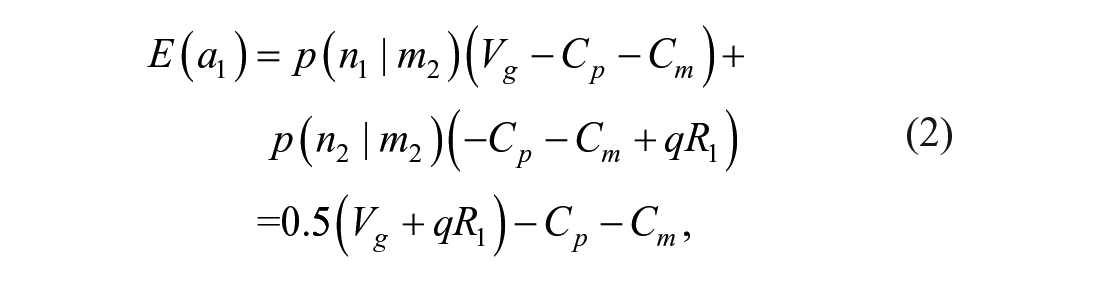

If
In order to determine whether the resource provider is always willing to choose the low-quota commitment strategies
If the response of the resource demander toward the strategy


In such a situation, it is clear for the MRP that the benefit of the strategy
If the response of the resource demander toward the strategy

According to the initial condition

In such a situation, it is obvious for the MRP that the benefit of the strategy
In conclusion, the MRP will choose the low-quota commitment strategies

Furthermore, it can be proved that there is no perfect Bayesian Nash equilibrium existing in the rest three pure strategies including the pooling strategy
Long-Term Game From the Perspective of MRP
In the cloud manufacturing mode, the resource provider possesses the fixed manufacturing resources and pursues the long-term cooperation and benefits (P. Xiao & Hu, 2014). The duplicate game process of the resource provider with the multiple resource demanders with the homogeneous requirements can be regarded as the infinite repeated game between one resource provider and one resource demander (Bi et al., 2016). At the same time, the supervision strategy
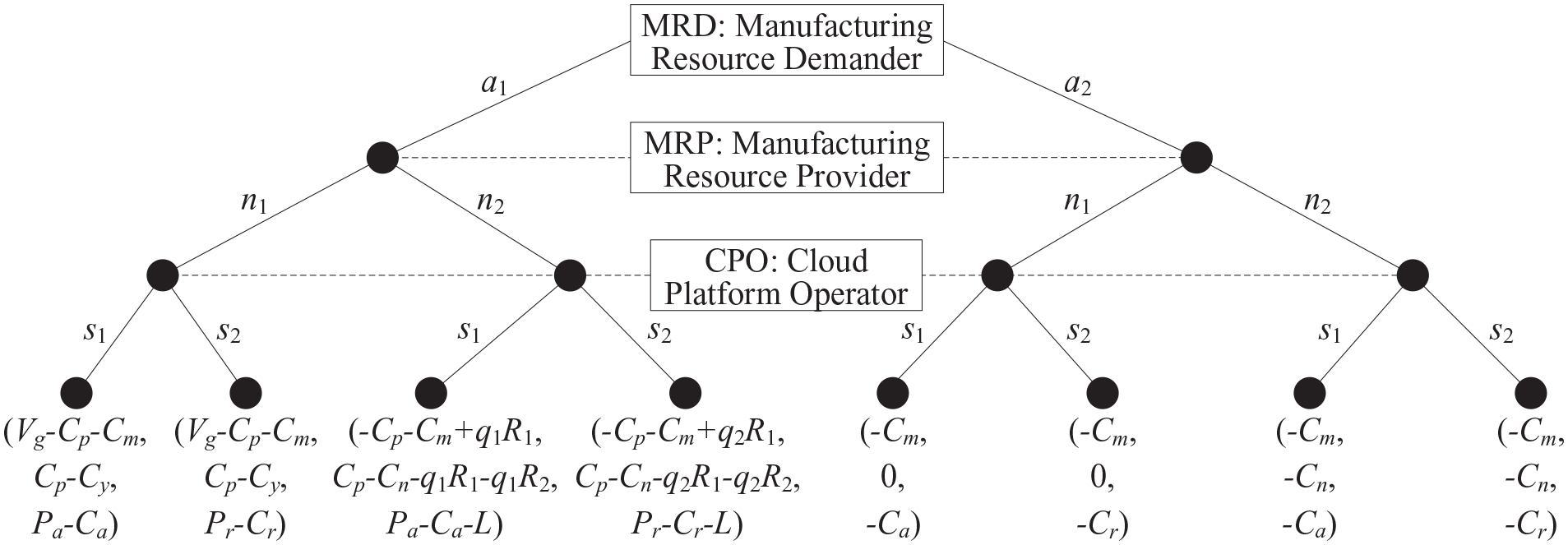
Strategy selection process of multiple participants in cloud manufacturing mode.
The new notations and their descriptions are as follows.
In the initial stage of the strategy selection, the game participants will choose the strategies with the cooperative attributes until one of participants takes actions with the non-cooperative attributes (Yu et al., 2013). Thereafter, the other game participants will always choose the strategies with the non-cooperative attributes (Yan et al., 2008). By means of the discount factor
The strategy of MRD in the infinite repeated game is to accept or not to accept the resource provider to participate in the cloud manufacturing alliance, that is,
Under the active supervision of CPO, the single expected benefits of the resource demander choosing the acceptance strategy


If
The strategy of MRP in the infinite repeated game is to participate or not participate in the cloud manufacturing alliance, that is,
Under the acceptance strategy of the resource demander and the active supervision of the CPO, the long-term expected benefits of the resource provider choosing the participation strategy


If
The strategy of CPO in the infinite repeated game is to supervise actively or supervise negatively, that is,
Under the acceptance strategy of the resource demander, the long-term expected benefits of the CPO choosing the active supervision strategy
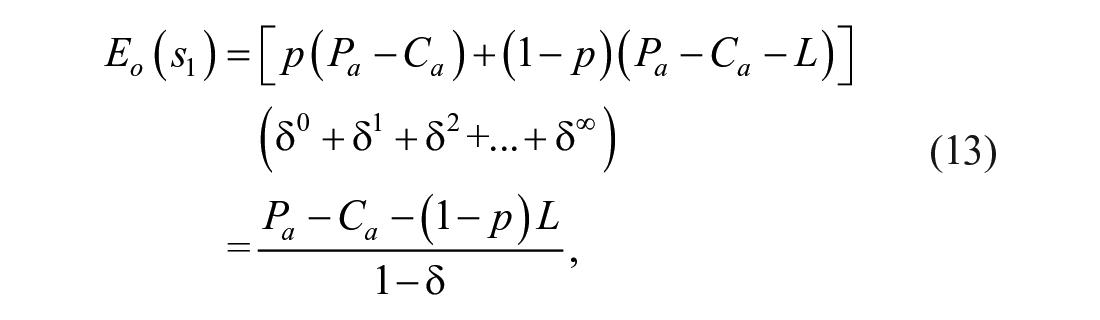

If
In summary, if the constraint conditions
Changing strategy of MRD from
to
Under the dominant strategies

Therefore, there is no Nash equilibrium solution under the combination strategies
Changing strategy of MRP from
to
Under the dominant strategies
If the MRP chooses the participation strategy in the later stage, the expected benefit of the MRP is as follows.

If the MRP continues to choose the non-participation strategy in the later stage, the expected benefit of the MRP is as follows.
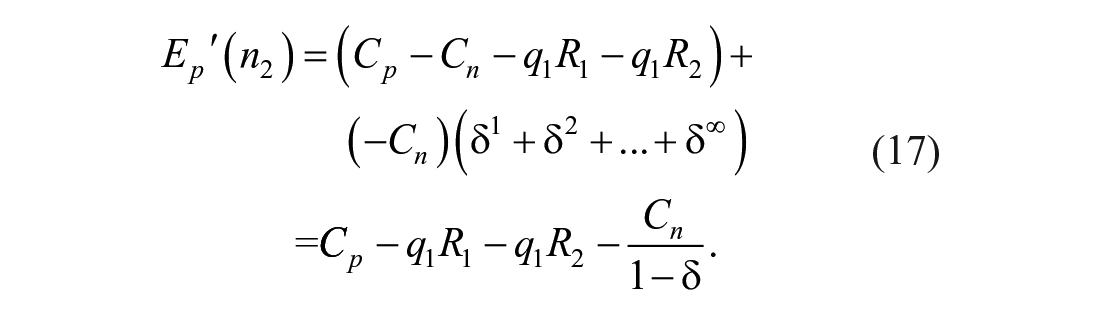
According to the constraint condition



Therefore, there is no Nash equilibrium solution under the combination strategies
Changing strategy of CPO from
to
Under the dominant strategies
If the CPO chooses the active supervision strategy in the later stage, the expected benefit of the CPO is as follows.

If the CPO continues to choose the negative supervision strategy in the later stage, the expected benefit of the CPO is as follows.

According to the initial condition

Therefore, there is no Nash equilibrium solution under the combination strategies
In conclusion, any of the game participants including the MRD, the MRP, and the CPO changing the strategy unilaterally will result in the benefit reduction. It is proved that dominant strategies

Single Game From the Perspective of CPO
In the cloud manufacturing mode, the CPO exists between the resource provider and the resource demander in the form of a third party. The profitability of the CPO is based on the formation and operation of the cloud manufacturing alliance. Because of the network externalities of the cloud service platform, the CPO focuses on long-term interests. Considering the interest information asymmetry and the cooperation homogeneity between the resource demander and the provider, the game from the perspective of CPO can be simplified into a single game of the incomplete information among one resource demander, one resource provider, and one CPO.
In Figure 3, the notation
Under the active supervision of the CPO, the expected benefits of the MRP choosing the participation strategy


If
Under the participation strategy of the MRP, the expected benefits of the CPO choosing the active supervision strategy


If
Summarily, under the probability
Under the participation strategy of the MRP and the active supervision of the CPO, the expected benefit of the MRD with the probability

Under the non-participation strategy of the MRP and the negative supervision of the CPO, the expected benefit of the MRD with the probability

According to the initial condition


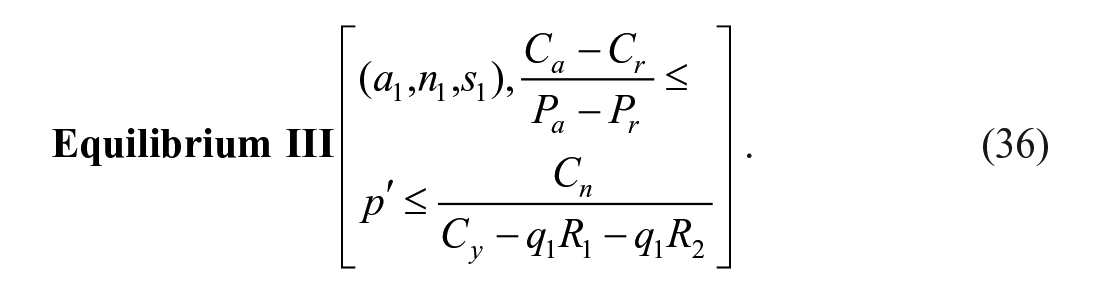
In conclusion, it is for the MRD with a probability choosing the acceptance strategy that the benefit under the cooperative strategies of the CPO and the MRP is higher than the benefit under the non-cooperative strategies of the CPO and the MRP. The Hypothesis 3 (H3) is supported, and the perfect Bayesian Nash equilibrium exists as follows.
Game From the Mixed Perspective
The win-win of multi-participants business collaboration in the cloud manufacturing alliance mainly depends on the game strategy selections of the MRD, the MRP, and the CPO (Ye et al., 2017). Furthermore, the game strategy selections of the multiple participants are based on the consistency of their benefit maximization from their own perspectives. The comprehensive interest consideration of the MRD, the MRP, and the CPO can promote the mutual trust and eliminate their motivations to depart from the cloud manufacturing alliance.
Synthesizing the strategy selections and the constraint conditions of the Equilibrium I, the Equilibrium II, and the Equilibrium III, the dominant combination strategies and the intersection conditions of the perfect Bayesian Nash equilibria are obtained. From the mixed perspective of the MRD, the MRP, and the CPO, the perfect Bayesian Nash Equilibrium exists in theory as follows.

The Nash equilibrium from the mixed perspective needs to satisfy the game equilibria from perspectives of the MRD, the MRP, and the CPO. Therefore, the Nash equilibrium from the mixed perspective is easy to achieve the benefit consistency of three game participants. Once the conditions that the Nash equilibrium from the mixed perspective come into existence, the MRD, the MRP, and the CPO can trust mutually, cooperate friendly, and achieve the win-win situation.
Case Analysis and Discussion
In a large-scale cloud manufacturing project including seven sub-tasks, the core enterprise called the manufacturing resource demander (MRD) can only complete some of sub-tasks, such as the design and manufacturing of gear shaper. It must seek five member enterprises called the manufacturing resources providers (MRPs) with the low service price on the cloud service platform operated by the cloud platform operator (CPO) to form a cloud manufacturing alliance. The MRPs will complete the remaining five sub-tasks, that is, the design and manufacturing of pinion cutter, the rough and finish machining of gear blank, and the gear quality inspection (Gao et al., 2018). Here, a set of experimental data from the cooperation agreement of three game participants is collected, as shown in Table 1. These experimental data satisfies the intersection conditions of the Nash equilibrium from the mixed perspective. The purpose of their application in the large-scale cloud manufacturing project is to prove that the Hypothesis 0 (H0) is true and the solution space of the Nash Equilibrium IV from the mixed perspective is not empty.
A Set of Experimental Data from the Practical Case (Unit: ¥10,000).

The short-term game from the perspective of MRD is a dynamic game with the incomplete information. The CPO only plays an indirect supervision role in this single game. The parameters in the constraint condition of the Equilibrium I are substituted with the experimental data and the Equilibrium I can be instantiated as follows.

The Equilibrium I’ shows whether the Nature selects the type of participation or non-participation for the resource provider, the MRP will choose the low-quota commitment strategies and the MRD will choose the acceptance strategies.
The long-term game from the perspective of MRP can be simplified as an infinite repeated game among one resource demander, one resource provider, and one CPO. Substituting the parameters in the constraint conditions of the Equilibrium II with the experimental data, the inequality

The Equilibrium II’ indicates all of game participants including the MRD, the MRP, and the CPO will choose the dominant strategies with the cooperative attributes if the constraint conditions are satisfied. Any of the game participants change the dominant strategy unilaterally will result in the benefit reduction.
The game from the perspective of CPO can be simplified into a single game of the incomplete information among one resource demander, one resource provider, and one CPO. Substituting the parameters in the constraint conditions of the Equilibrium III with the experimental data, the Equilibrium III can be instantiated as follows.
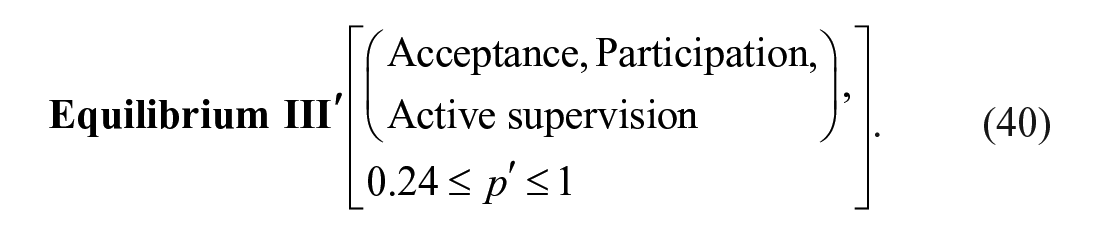
The Equilibrium III’ shows both the MRP and the CPO will choose the dominant strategies with the cooperative attributes if the MRD chooses the acceptance strategy with a probability 0.24≤
The strategy selections and the constraint conditions of the Equilibrium I’, the Equilibrium II’, and the Equilibrium III’ are synthesized and the parameters in the constraint conditions of the Equilibrium IV are substituted with the experimental data, the Equilibrium IV from the mixed perspective can be instantiated as follows.
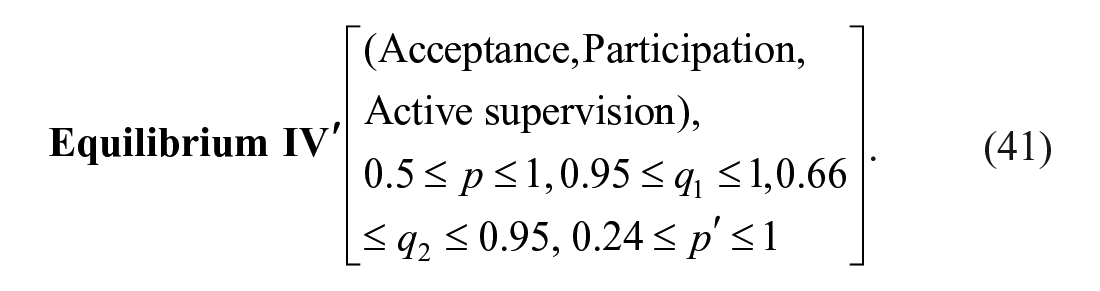
The experimental data and their application in the large-scale cloud manufacturing project shows that the Hypothesis 0 (H0) is supported. The perfect Bayesian Nash Equilibrium IV from the mixed perspective of the MRD, the MRP, and the CPO exists and the solution space of the Nash equilibrium is not empty. If the constraint conditions, especially the sensitive parameters of the Equilibrium IV’, are satisfied, all of the game participants will choose the dominant strategies with the cooperative attributes. The CPO will choose the active supervision strategy to create a fair competition network environment, the MRP will choose the participation strategy to revitalize the redundant resource and achieve the self-value, and the MRD will choose the acceptance strategy to form the cloud manufacturing alliance for completing the large-scale cloud manufacturing project. In fact, the benefit maximization is the starting point and the ultimate goal of the multi-participants business collaboration. Once the benefit consistency of three game participants is reached, the MRD, the MRP, and the CPO can trust mutually, cooperate friendly, achieve the win-win situation, and promote the long-term development of the cloud manufacturing mode.
Conclusion and Future Work
Under the cloud manufacturing mode, the main participants of the business collaboration include the manufacturing resource demander (MRD), the manufacturing resource provider (MRP), and the cloud platform operator (CPO). In this article, the game types of three game participants in the cloud manufacturing alliance are elaborated, and the game strategy combination and constraint conditions are analyzed and proved.
The strategy selection purpose and order of three game participants in the cloud manufacturing alliance are different, which leads to that their interest preferences and dominant strategies are also different. From the perspectives of three participants in the cloud manufacturing alliance, the game types are ascertained and the benefit functions of three participants in the different game strategies are established. By the careful analysis and the sufficient proof, the Nash Equilibrium I from the perspective of MRD, the Nash Equilibrium II from the perspective of MRP, and the Nash Equilibrium III from the perspective of CPO are obtained. The Nash equilibria from the perspectives of three game participants are all based on the maximization of their own interests. Integrating the dominant strategies of three game participants, the intersection conditions of three Nash equilibria are analyzed comprehensively, and the Nash Equilibrium IV and its constraint conditions are obtained from the mixed perspective. A set of experimental data from the practical case is given to prove that the Nash Equilibrium IV comes into existence and the solution space of the Nash equilibrium is not empty from the mixed perspective of the MRD, the MRP, and the CPO.
Aiming at the characteristics of the cloud manufacturing mode, the contribution of this article mainly focuses on the game strategy selection of the multi-participants business collaboration under the cloud manufacturing mode, which provides the theoretical basis for the successful formation of the cloud manufacturing alliance and the technical support for the development of the cloud manufacturing service platform. It has the important academic value and the broad application prospects.
The business collaboration and the win-win cooperation of the cloud manufacturing alliance depend on whether the benefits of the multi-participants in the cloud manufacturing alliance are higher than those of the multi-participants participating in other projects or working alone. Therefore, the benefit allocation method of the multiple participants in the cloud manufacturing alliance based on the cooperative game is the direction in future research.
Footnotes
Acknowledgements
The authors are grateful to the editors and the anonymous referees for their constructive comments and valuable suggestions.
Declaration of Conflicting Interests
The author(s) declared no potential conflicts of interest with respect to the research, authorship, and/or publication of this article.
Funding
The author(s) disclosed receipt of the following financial support for the research, authorship, and/or publication of this article: The research was supported by the National Natural Science Foundation of China (Grant 51575443); the Key Scientific Research Program of Shaanxi Provincial Education Department, China (Grant 20JY047); and the industrial internet platform test bed construction project of MIIT, China (Grant TC19083W8).
