




Abstract
English Medium Instruction (EMI) has experienced rapid expansion in recent decades. Previous research has explored the perceived advantages and challenges of EMI courses among students in some contexts. However, the specific English language experiences of Chinese students in EMI courses, especially those enrolled in Business English programs, remain underexplored. Despite the provision of English for Academic Purposes (EAP) courses to help address students’ linguistic hurdles in EMI programs, many EMI students continue to face language-related difficulties. This qualitative study, conducted at a university in eastern China, sought to uncover (a) Business English undergraduates’ perceptions of English language advantages and challenges in EMI courses and (b) their preferred English language support mechanisms for addressing EMI-related language challenges. Qualitative data, derived from online open-ended questionnaires and semi-structured interviews, underwent thematic analysis. Findings indicated that students commonly perceived improvements in their English reading, communicative abilities, and lexical knowledge through the EMI courses. However, four main English language challenges linked to their EMI courses were identified: comprehending instructors’ English speech, timely completion of English reading tasks, expressing ideas in English during class, and understanding academic writing conventions and expressions. Students expressed a need for additional language support at both the teacher and program levels, with a particular emphasis on Business-specific language support. Informed by the study’s findings, five actionable and evidence-based suggestions for policymakers, program directors, and EMI instructors were provided to improve students’ linguistic experiences and strengthen the overall quality of EMI programs. Limitations and recommendations for future research are also discussed.
Keywords
Introduction
In recent years, with the influences of globalization and internationalization, English has been increasingly used to teach content knowledge across various regions, including Europe, Asia, the Middle East, Africa, and South America (Macaro et al., 2018; Phuong & Nguyen, 2019), and this trend is especially noticeable in higher education (HE) institutes (Doiz et al., 2013). English Medium Instruction (EMI) has been widely used to label this phenomenon in the HE context. Macaro et al. (2018, p. 37) define EMI as “the use of the English language to teach academic subjects (other than English itself) in countries or jurisdictions where the first language of the majority of the population is not English.” Currently, the number of Higher Education (HE) institutes offering undergraduate and postgraduate EMI programs is continuously increasing (Rose et al., 2020). Although EMI courses primarily focus on teaching content knowledge (Hu and Li, 2017), they are also believed to enhance students’ English language proficiency. Recent empirical studies have identified many advantages of EMI courses, such as increased learning motivation, enlarged English vocabulary size (Wei & Macaro, 2024), and enhanced English listening and speaking skills (Chung & Lo, 2023; Dang & Nguyen, 2024).
In China, the government has formulated many educational policies to support the development of EMI courses. In 2001, to improve the reputation and international standing of Chinese HE, the Ministry of Education (MOE, 2001) published an official document, stating that the proportion of specialized courses taught by EMI would reach about 5% to 10% within 3 years. In subsequent years, more HE policies at the national level were released by the MOE to facilitate the adoption of EMI courses in China (Ministry of Education, 2005, 2007). Additionally, since 2001, the MOE has begun to provide financial support to encourage Chinese universities to develop EMI courses and programs (Hu & Li, 2017). With administrative and financial support from the central and local governments, the number of HE institutions offering EMI courses has grown rapidly in China (X. Gao & Yang, 2023). To date, China has established one of the largest HE systems globally and offers a substantial number of EMI courses and programs (Rose et al., 2020).
Despite the widespread implementation of EMI programs, recent research has underscored the complexity and variability of EMI policy and implementation across different contexts. To systematically analyze this complexity, a three-level EMI framework (Aizawa & McKinley, 2020), which encompasses macro (national/policy), meso (institutional/program), and micro (teacher/student) levels, has been widely utilized in EMI research. This framework offers a theoretical lens to examine how EMI policies are adapted and implemented by educational institutions, programs, individual teachers, and students. In the current study, this framework is utilized to guide researchers to explore the discrepancies between EMI national policies at the macro level, program support mechanisms at the meso level, and the lived experiences of EMI Business English students at the micro level. In light of this multi-layered approach, the study can not only illuminate the linguistic benefits and challenges encountered by students but also offer actionable recommendations for EMI teachers, program directors, and policymakers to refine existing EMI policies and support structures to align with real-life classroom practices.
Exploring students’ perceived language benefits and challenges of EMI can help EMI program directors and teachers understand the difficulties students encounter. This is essential for informing the provision of targeted language support mechanisms in tandem with EMI programs (Macaro et al., 2018; McKinley & Rose, 2022), and thereby improving the quality of future EMI programs (Curle et al., 2020). Although students’ perceptions of the benefits and challenges of EMI courses have been investigated in some contexts (e.g., Bolton et al., 2023; Phuong & Nguyen, 2019; Wei & Macaro, 2024), the design and implementation of these EMI courses within discipline areas is constantly evolving. Moreover, Business English students present a unique and increasingly important position within EMI programs in China, because they are required not only to master general academic English but also to comprehend and articulate complex business concepts, theories, and academic discourse within an EMI environment. This means they have to meet the dual demands of acquiring advanced business knowledge and specialized English language proficiency, which places salient challenges on their linguistic and cognitive resources. Further, this urgency is underscored by the growing adoption of EMI in Business-related programs (Alhassan et al., 2021).
However, despite these pressures, there is a scarcity of studies focusing specifically on the linguistic experiences of Business English students within Chinese EMI programs. As Alhassan et al. (2021) emphasize, there is a growing need for empirical research to investigate the specific linguistic experiences of Business English students in EMI settings, in order to inform the development of business-specific language support. Therefore, the current qualitative case study was conducted at a university in China to systematically investigate Business English students’ perceptions of the language-related benefits and challenges of EMI courses, and to identify forms of additional English language support, including ESAP strategies, needed to supplement existing EAP provision. Specifically, the study addressed the following research questions:
By focusing on Business English students, a group whose academic and professional trajectories are closely tied to their ability to master discipline-specific English, the study extends the limited context-specific understanding of students’ linguistic experiences in EMI programs. Building on the study’s findings, the study offers comprehensive and evidence-based recommendations for policymakers, program directors, and EMI teachers to enhance both student experiences and the further development of EMI programs.
Literature Review
Language Benefits and Challenges of EMI
Investigating the language advantages and challenges of EMI is crucial for guiding curricular improvement and enhancing the quality of EMI programs (Curle et al., 2020). Previous research reveals that EMI is often perceived as a catalyst for language development, especially in contexts where English proficiency is highly valued (Li & Pei, 2024). For example, improvements in lexical knowledge and overall English competence have been consistently observed in many settings, such as China (Wei & Macaro, 2024), Turkish (Kirkgöz & Karaka, 2022), and Korean (Kim, 2011). Studies in Japan (Chu & Takahashi, 2024) and Vietnam (Dang & Nguyen, 2024) extended these findings, reporting that EMI increases opportunities for students to use spoken English and boosts their confidence in English speaking. In addition to English speaking and vocabulary, recent studies across various contexts further highlighted that EMI also positively impacts students’ listening (Chung & Lo, 2023), reading (Hutabarat, 2024; Su & Kong, 2023), and writing skills (Dang & Nguyen, 2024; del Mar Sánchez-Pérez, 2023), which suggested a multilayered language-related benefit of EMI. Collectively, this body of research showed that, despite the differences in educational settings, students generally associate EMI courses with enhanced comprehensive language capability, particularly in vocabulary, listening, reading, and speaking skills.
Despite the language benefits of EMI courses, EMI is not without its critics. Recent literature reveals salient language challenges related to EMI courses, which may undermine students’ success and satisfaction with EMI. A recurring issue across these studies is that increased exposure to English does not always contribute to increased comprehension or academic ease, particularly when students face insufficient language support (Si, 2023). Athirah (2024) and Kohnke and Jarvis (2023) found that, even with supplementary EAP courses, EMI students frequently struggled to keep pace with the linguistic demands of their classes. This challenge is echoed in Cho’s (2012) mixed-methods study, in which Korean undergraduates reported understanding less than 70% of the content in EMI classes. Similarly, research in Indonesia (Bolton et al., 2023), China (Li & Pei, 2024), Oman (Ali, 2021), and United Arab Emirates (Jones et al., 2022) demonstrated that many students suffered from the stress and difficulty in reading course materials, and this can be primarily attributed to inadequate vocabulary and lack of expertise in the discipline.
Moreover, oral production and academic writing further exacerbate students’ challenges in EMI, particularly for those with lower proficiency levels or limited EMI experience. Li and Pei (2024), Phuong and Nguyen (2019), and J. Pun and Jin (2021) found that students with lower English proficiency or limited experience in EMI courses struggled with speaking and academic writing tasks, and difficulties in expressing ideas during class discussions and composing academic essays were commonly reported. Besides, Pritasari et al. (2019) and Moorhouse and Wan (2023) found that, even when students meet the English entry requirements of an EMI program, they may still experience considerable difficulty in composing written assignments and engaging in class interactions, which suggested that passing a standardized language test does not necessarily mean students are fully prepared for the language challenges of learning in an EMI environment.
Overall, although EMI offers pathways for linguistic development, the persistent barriers in comprehension, speaking, and writing indicate the need for more robust and tailored language support, particularly for students at earlier stages of EMI exposure or with limited language proficiency at the outset.
Language Support for Success in EMI Courses
Given the multidimensional language demands and challenges of EMI, offering effective English language support has become crucial for facilitating students to succeed in EMI courses (X. A. Gao & Zheng, 2023). Recent research emphasized the importance of multi-level support strategies, involving students, teachers, and institutions. At the student level, research indicates that learners often employ a combination of cognitive and social strategies to overcome linguistic obstacles in EMI courses (e.g., Luu & Hoang, 2022; Moorhouse & Wan, 2023; J. K. Pun et al., 2024). Moorhouse and Wan (2023) and Yu et al. (2021) identified the adaptive techniques students use, such as seeking main ideas, inferring meaning from context, translating difficult passages, or engaging peer communities for support. Yu et al. (2021) further typifies these strategies as L1-mediated, L2-mediated, tool-mediated, or community-mediated strategies, which illustrate the flexibility and agency students display in navigating EMI programs.
Teacher-level support is also highlighted by recent research. Studies conducted by J. K. H. Pun and Thomas (2020), J. K. Pun et al. (2024), and Bukhari (2022) suggest that EMI teachers tends to apply a wide range of instructional strategies to attempt to bridge the insufficient language proficiency for students, and the commonly used strategies comprise the strategic use of students’ first language, use of simple vocabulary, slow speech, and frequent repetition of keywords. Richards and Pun (2022) systematically classified teacher support into three types, including pre-teaching, while-teaching, and post-teaching assistance, which provides insights into the effective supporting mechanics that should be integrated throughout the EMI instructional process. Nevertheless, despite extensive investigations into student- and teacher-level supports for EMI, institutional or program-level support has received much less attention. Ekoç (2020) pointed out that the provision of EAP courses at the program level can improve students’ linguistic competencies and, therefore, help them have more effective participation in the subsequent EMI courses. This is corroborated by recent empirical findings examining the effectiveness of EAP on students’ writing proficiency (H. Lee & Lee, 2023) and academic study in EMI programs (Zou & Jiang, 2021).
Taken together, previous studies have underscored a growing consensus that multi-faceted language support, which integrates student agency, teacher scaffolding, and program support, is essential for unlocking the full potential of EMI programs. However, these studies have predominantly focused on the support for EMI courses from teachers’ perspectives, whereas students’ voices about their desired support remain underrepresented. Given their central role in EMI courses, capturing and responding to students’ voices is critical for developing contextually relevant and tailored support strategies (Moorhouse & Wan, 2023). Hence, it is essential to investigate and incorporate students’ suggestions in designing responsive language support for EMI programs.
Methods
Research Design: A Two-Stage Case Study
A qualitative case study excels at exploring subjective perspectives, individual challenges, and context-specific phenomena since it can capture the complexity, richness, and diversity of participants’ experiences (Creswell, 2013; Merriam & Tisdell, 2016). Further, it helps unveil important information that might be overlooked in large-scale quantitative studies that may restrict responses to predetermined categories and risk oversimplifying nuanced attitudes and experiences (Yin, 2009). Given that the implementation of EMI is highly context-dependent and shaped by local institutional, disciplinary, and student factors (Galloway & Ruegg, 2020; Macaro et al., 2018), a qualitative case study approach was appropriate for the current study. Therefore, a qualitative case study was employed to investigate the lived and context-specific experiences and perceptions of EMI among Business English students at a Chinese university.
To further strengthen the comprehensiveness and trustworthiness of the findings, a two-stage case study was adopted, which incorporates both online open-ended questionnaires and follow-up semi-structured interviews. This two-stage sequential design allowed for initial broad data collection from a diverse participant sample, and subsequent interviews enabled deeper investigation of emergent themes and clarification of ambiguous or complex responses (Cohen et al., 2018).
Research Context and Participants
This study was purposively conducted at a foreign language university located in eastern China. The university is renowned regionally for its early and extensive adoption of EMI within its business-related courses, which distinguishes it from many peer institutions that continue to rely primarily on Chinese-medium instruction. This made the university an appropriate site for an in-depth case study focused on Business English students’ EMI experiences and perspectives (Galloway & Ruegg, 2020).
The university offers a well-established Bachelor of Arts (BA) program in Business English, which integrates both business-related content and advanced English language training. In the Chinese context, Business English programs refer to programs where the knowledge and communicative strategies for business are instructed through Business knowledge courses, and the English linguistic knowledge for communication is instructed through English language courses (Zhang, 2007). The main focus of Business English programs in China is the instruction of business-related knowledge instead of English language knowledge (Zhang, 2007). At the reported university, the primary teaching objective of its Bachelor of Arts (BA) in Business English program is to cultivate students who mastered adequate business-related knowledge, such as economics, management, and business law, with good English language ability so that they are qualified to participate in future international business competition and cooperation. To achieve this goal, the program offers a series of business knowledge courses and English language courses to students each semester, and the medium of instruction for these business knowledge courses is English.
Purposive sampling was used to invite students in two third-year Business English classes at the university to participate in this study (Class 1: n = 32; Class 2: n = 30). The third-year students in this program were chosen since they have obtained more learning experiences in business-related EMI courses in the past 2 years of learning in the EMI program (see details in Table 1), which means they were likely to offer more holistic and in-depth insights to this matter than the first- and second-year students. The fourth-year students were not considered in this study, since they were in the final year of the program and were busy completing their theses for graduation. All students enrolled in the two third-year Business English classes were invited to complete the open-ended questionnaire on a voluntary basis. 38 out of 62 completed the questionnaire online. After excluding incomplete responses, 32 questionnaires were included in the final analysis. Among them, 6 were identified as males and 27 as females. The age of participants ranged from 20 to 22. Most of them have learned English for 13 years, while some of them have learned English for a longer time.
Demographic Information of the Interviewees.

Note. The full English mark for CEE is 150. CEE = College Entrance Examination. N/A means no overseas learning experiences.
For the follow-up semi-structured interviews, participants were selected using maximum variation sampling, a type of purposive sampling, to capture a rich diversity of perspectives based on different demographics and educational backgrounds (Suri, 2011). Therefore, among the 32 questionnaire respondents, eight volunteered for the interviews, and six interviewees were purposively chosen to present students with diverse backgrounds and demographic characteristics, including gender, age, years of English learning, overseas study experience, and English scores from the CEE (see Table 1).
Data Collection
Qualitative data were collected using open-ended questionnaires and semi-structured interviews, which realized methodological triangulation and increased the methodological rigor and trustworthiness of findings (Merriam & Tisdell, 2016; Shenton, 2004). The open-ended questionnaire provided participants with the opportunity to articulate their actual experiences and perceptions. It is helpful for reaching a larger sample and gathering a wide range of perspectives on language-related issues within EMI (Cohen et al., 2018). Therefore, open-ended questionnaires were utilized. The open-ended questionnaire (see Appendix A) included demographic information and 12 open-ended questions regarding the language benefits and challenges of EMI courses, as well as the additional language support. This questionnaire was constructed after a comprehensive literature review (Moorhouse & Wan, 2023; Phuong & Nguyen, 2019; Soruç & Griffiths, 2018). The initial items were piloted with two professors in language education, and their suggestions were adopted to refine the questionnaire to enhance the content and face validity (Kallio et al., 2016). Then, the questionnaire was piloted with four Business English students from another class in the same program. They were required to complete the questionnaire and provide feedback regarding the item clarity, relevance, and readability. Further revisions were made based on their feedback, which enhanced its clarity, relevance, and comprehensibility.
Semi-structured interviews allowed researchers to obtain in-depth and context-specific data, which was suitable for an in-depth exploration of participants’ experiences and perspectives concerning EMI (Cohen et al., 2018). Furthermore, the flexibility of semi-structured interviews facilitated responsive questioning, enabling the researchers to adapt the previously designed questions based on participants’ real-time responses. Therefore, semi-structured interviews were subsequently conducted as a complementary data source for open-ended questionnaires to help researchers understand students’ experiences and perceptions of EMI further. The interview guide (see Appendix B) comprised five sections: (1) opening; (2) language benefits of EMI courses; (3) language challenges of EMI courses; (4) language support for EMI courses; (5) closure. The questions in the interview guide were informed by the recent relevant literature (Moorhouse & Wan, 2023) and students’ previous responses in the open-ended questionnaire. To strengthen trustworthiness, the initial interview guide underwent expert review by two professors in language education, and their feedback was incorporated into the finalized interview guide to improve its relevance, coverage, and face validity (Kallio et al., 2016).
Prior to the main study, pilot interviews were conducted with two students from the same program. This piloting process allowed the researchers to further examine the clarity and suitability of the questions for eliciting meaningful responses, and then further refinements were made based on the students’ feedback. During the interviews, the researchers flexibly adapted the questions on the interview guide according to participants’ real-time responses. This was helpful for investigating emergent insights and reducing researcher-imposed constraints, and therefore, the trustworthiness and rigor of the study were reinforced further (Cohen et al., 2018). The language used for the interviews depended on participants’ preference, and all participants opted to use their first language, Chinese, which improved their comfort and authenticity in responses. After the interviews, the recordings were transcribed verbatim into Chinese. Then, the transcripts were sent back to participants for them to check whether the transcripts precisely captured their intended meanings. This member checking process strengthened the accuracy and credibility of the findings further (Shenton, 2004). Subsequently, the verified Chinese transcripts were translated into English for data analysis.
Data Analysis
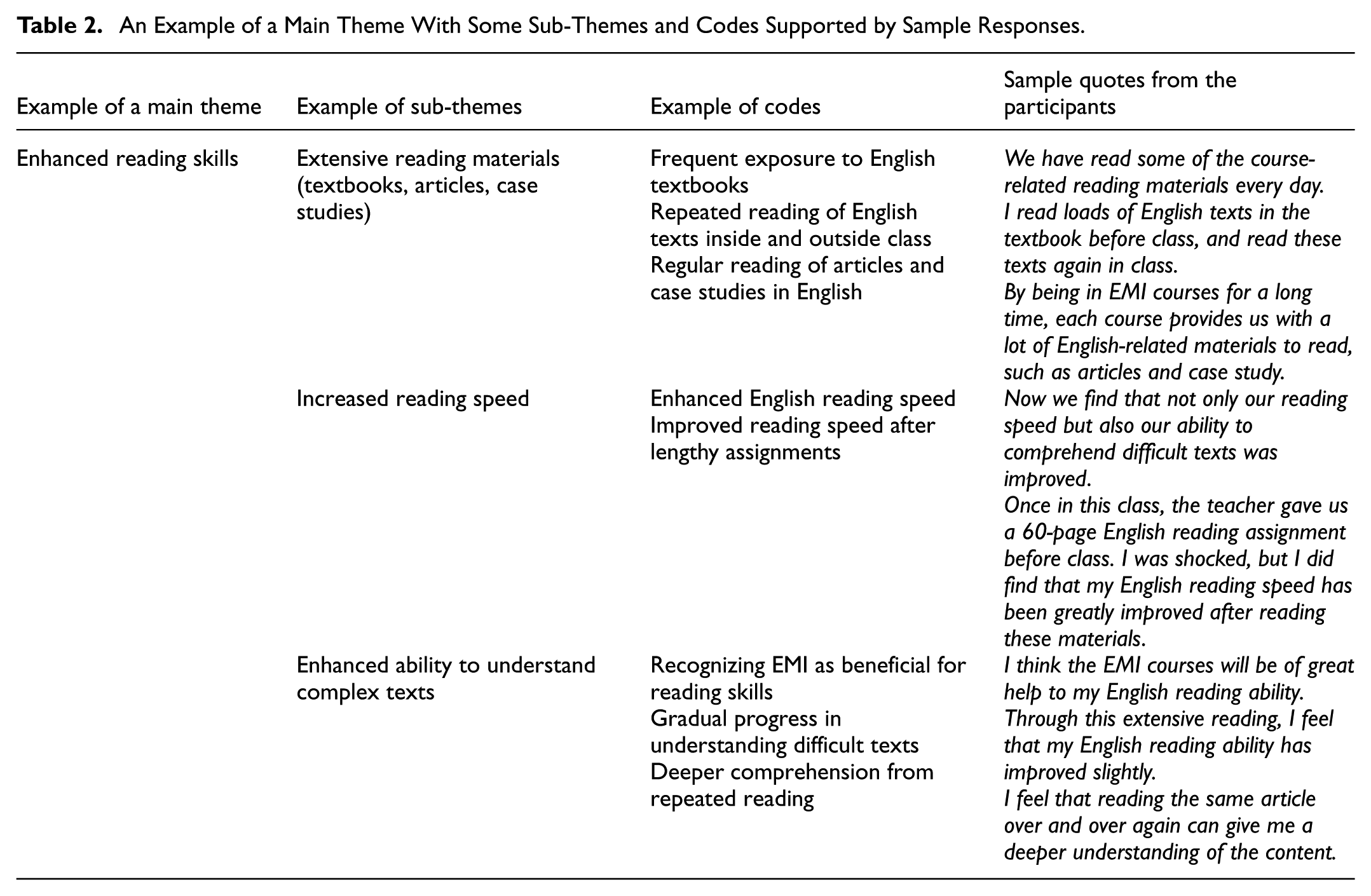
The current study employed Braun and Clarke’s (2006) six-stage thematic analysis to analyze the qualitative data from open-ended questionnaires and semi-structured interviews. This approach was chosen for its flexibility and robustness in capturing individuals’ experiences and perceptions (Braun & Clarke, 2006). The detailed process of each stage is outlined below. Two researchers repeatedly and independently read through all questionnaire responses and interview transcripts, which can immerse themselves in the data and improve their understanding of the data. Then, both researchers inductively constructed initial codes from 10 questionnaire responses and two interview transcripts in an independent way. Chenze Wu coded the data manually, and Michael Budzenski used ATLAS.Ti. to code the data. After the initial coding, the researchers met to thoroughly discuss their initial codes and collaboratively resolve discrepancies in interpretations. Through consensus building, a codebook was constructed, which enhanced the reliability and provided clear guidance for subsequent analysis. Afterwards, based on the codebook, another set of 10 questionnaire responses and two interview transcripts were coded independently. Inter-coder reliability was then calculated and yielded a percent agreement of 88.89%, which reflects a satisfactory consistency among the two researchers. A follow-up meeting was held to further discuss and address the discrepancies, and the codebook was refined accordingly to ensure analytic convergence. Then, the remaining datasets were coded independently, and regular meetings were arranged to refine the codes and themes. Themes and sub-themes were carefully reviewed and named to ensure they accurately reflected the data and addressed the research objectives. To strengthen the transparency of the study, an example of a main theme with some sub-themes and codes supported by sample responses from the participants was presented in Table 2. The final overarching themes and sub-themes were presented in Tables 3 to 5.
An Example of a Main Theme With Some Sub-Themes and Codes Supported by Sample Responses.
Perceived English Language Benefits of EMI Courses.

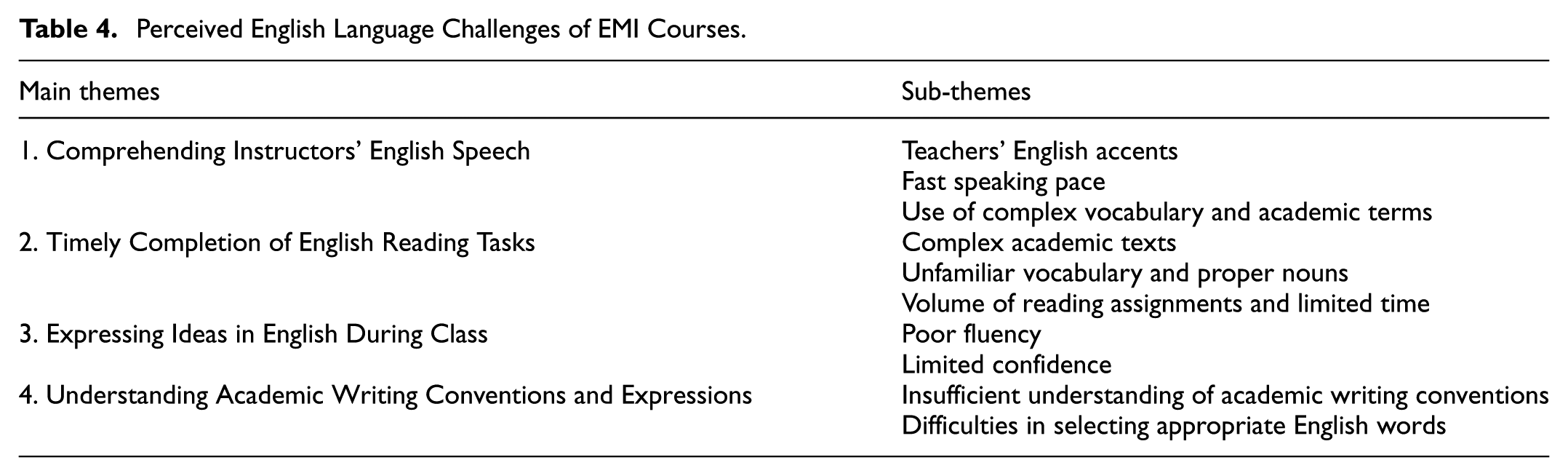
Perceived English Language Challenges of EMI Courses.
Additional Language Support for EMI Courses.

Findings
Perceived English Language Benefits and Challenges of EMI Courses
Thematic analysis of student responses to the open-ended questionnaires and semi-structured interviews identified several salient themes regarding the English language benefits and challenges of EMI courses (see Tables 3 and 4). The findings reveal that, while EMI provides opportunities for language development, particularly in listening, reading, speaking, and vocabulary acquisition, students concurrently encounter persistent linguistic hurdles that can impede their learning.
A majority of students reported notable improvement in their English listening skills, and they attributed this to the immersive English environment and sustained exposure to varied accents, speech patterns, and authentic lexical usage in EMI courses. This immersive exposure not only enhanced their ability to decode complex sentences and unfamiliar pronunciations but also promoted their adaptability to different speaking styles. Furthermore, students emphasized enhancements in English reading capabilities, which they linked to the extensive volume and range of reading materials provided by EMI courses. The breadth of assigned reading materials, including textbooks, articles, and case studies, was perceived to help them accelerate their reading speed. Crystal underscores this point during the interview,
It was difficult for me to understand complex sentences, such as sentences with subordinate clauses. But now, I can overcome these sentences during listening. (Crystal, interview)
Improvement in speaking skills emerged as another language benefit of EMI courses. Students highlighted that EMI courses provided opportunities to develop their English-speaking fluency and cultivate the ability to articulate opinions clearly and confidently through class discussions, presentations, and group activities. Moreover, vocabulary growth was also evident, with many students noting an increase in both general and business-specific English vocabulary and terminology. The exposure to new words in context and the repeated use of terminology in class discussions and assignments were recognized as crucial to their vocabulary growth. Clive elaborated on this point during the interview.
We have taken many related EMI courses, such as Introduction to Management, Introduction to Business, Business Ethics, etc. In class, I not only have many opportunities to listen to the English vocabulary related to the business field but also can use these words in discussions, which consolidates my memory and understanding of these words. (Clive, interview)
However, most students also faced challenges in comprehending the instructors’ English speech during EMI courses. They reported many factors, such as teachers’ accents, fast speaking pace, and the use of complex vocabulary and academic terms, which made it difficult for students to follow lectures at times. Nancy, during the interview, described her challenges when she first engaged with EMI courses. She noted that the diverse accents of some teachers made comprehension difficult, and many instructors spoke at a rapid pace during their lectures, which added to the complexity of understanding. For numerous students, the demand for timely completion of English reading assignments is another salient difficulty. The complexity of academic texts, the prevalence of unfamiliar vocabulary, especially technical terms and proper nouns, and the sheer volume of assigned readings often challenged students’ reading proficiency and time management skills. For example, Clive mentioned that it took him “a very long time to digest” reading materials related to stocks and shares since they contain “a lot of terminology and abstract concepts.”
The theme of limited English-speaking fluency and confidence recurred throughout both questionnaires and interviews. Approximately half of the students reported struggling to express ideas with precision and fluency in English. Some students indicated that they were not confident enough and opted to disengage from class discussions due to concerns about inaccurate pronunciation, fear of misunderstanding, or negative judgment of their peers. Additionally, challenges in academic writing were also frequently stated. Although EMI courses provided opportunities to write essays, papers, and assignments in English, the majority of students encountered difficulties in academic writing, such as insufficient understanding of academic writing conventions and difficulties in selecting appropriate English words. For example, during the interview, Arthur said, “I cannot find appropriate words and phrases to accurately express my meanings in English. This led to the inaccuracy of my writing.” The lack of targeted training in English academic writing, particularly at the early stages of their university study, was identified by some students. For instance, in the interview, Crystal suggested that,
We did not have any specialized courses to teach us how to write academic papers until now. So, it was difficult for me to figure out things related to academic writing, such as how to write an abstract, how to write an introduction, and how to write a literature review. (Crystal, interview)
Collectively, the findings of this study underscore the dual impacts of EMI. Although students acknowledge the fruitful benefits of EMI on multiple aspects of their language proficiency, they simultaneously encounter persistent linguistic obstacles that might impede their academic progress in EMI courses. These findings highlight the need for supplementary language support mechanisms to help students address linguistic challenges and improve learning experiences in EMI courses.
Additional Language Support for EMI Courses
Thematic analysis also revealed several forms of additional English language support that EMI teachers or EMI programs could offer to help Business English students overcome the language challenges faced during EMI courses (see Table 5). These expected supports are synthesized into two main themes: teacher-level and program-level language support.
Students advocated for EMI teachers to offer various language support to proactively address their linguistic challenges and accommodate their diverse learning needs. The provision of pre-class materials, e.g., vocabulary lists, targeted readings, and PowerPoints, was widely valued as a means of scaffolding understanding and facilitating pre-lesson preparation. This approach was regarded as instrumental in helping them engage more effectively with complex content and unfamiliar terminology, as noted by Clive in the interview. Further, the importance of teacher-student interaction is also highlighted. Many students emphasized that approachable instructors who encourage questions and offer individualized explanations play a crucial role in mitigating barriers to comprehension. Olivia’s remarks further suggest that responsiveness to student feedback, such as re-explaining difficult sections or clarifying disciplinary concepts, can substantially enhance their understanding of the lessons and learning outcomes.
The strategic incorporation of Chinese as a support language was also mentioned, with most students suggesting that selective use of their mother tongue can facilitate comprehension, especially when teaching abstract or technical business concepts. Moreover, most students suggested that language support should be tailored to individual student needs based on their English proficiency levels and specific challenges. They proposed that teachers and the university should assess students’ language abilities and provide targeted support accordingly. In the interview, Warrick explained,
If teachers know our different backgrounds and previous learning foundations in advance, they can better teach us in accordance with our competence. That is to say, different tasks are required based on our background, knowledge foundation, and learning ability. This may also improve the teaching outcome of our courses. (Warrick, interview)
Beyond teacher-level strategies, students further expressed the need for additional support in developing their writing and speaking skills at the program level. The provision of Business-specific English writing seminars (ESAP) was regarded as essential. They suggested that, in the workshops, teachers teach them “some academic writing strategies, the common structure of an essay, critical thinking skills, and citations and referencing in writing.” In addition to the demand for general English academic writing training, the provision of Business discipline-specific writing training, including “how to use English to write business case studies, emails for business communication, and pervasive business proposals,” was consistently expected by most of the students. In addition, the arrangement of English-speaking activities, such as English corners or conversational practice groups, was also recommended. Participants described these settings as low-anxiety arenas for authentic communication, which enabled regular practice and confidence building in oral expression.
Taken together, students recommended that EMI programs and teachers offer a multi-faceted language support to optimize the linguistic benefits of EMI and address the challenges encountered. Future EMI program development should prioritize both responsive and in-class support and broader and discipline-specific initiatives, ensuring that all students are equipped with the language skills essential for succeeding within the high-demanding EMI context.
Discussion
The current study deepened our understanding of Business English students’ experiences and perceptions of EMI by exploring their perceived linguistic challenges, benefits, and support needs. Findings indicated that students perceived EMI courses as effective in promoting their English language development, especially in listening, reading, speaking, and vocabulary skills. This outcome supported and extended findings from previous EMI research across various disciplines and educational contexts (Chu & Takahashi, 2024; Dang & Nguyen, 2024; del Mar Sánchez-Pérez, 2023; Kirkgöz & Karaka, 2022). Many participants attributed improvements in their listening and reading skills to sustained and varied language exposure in EMI settings, where they encountered a diversity of accents, speech patterns, and substantial reading demands. Moreover, frequent participation in class discussions, presentations, and group work in EMI courses was reported to foster their increased fluency, precision, and self-confidence in spoken English, which corroborates the findings of Chu and Takahashi (2024). A recurrent benefit reported by participants was vocabulary expansion, which encompassed growth in both general English and business-specific terminology. As highlighted by some scholars (Huang, 2024; Qiu & Yuan, 2025), EMI environments rich in authentic and discipline-specific content provide meaningful contexts for students to encounter, practice, and internalize specialized vocabulary. As a result, they support both comprehensive lexical development and mastery of the language required for future professional business communication.
While the benefits of EMI were evident, this study also identified several linguistic challenges that may impede Business English students’ engagement and performance in EMI contexts. Participants reported difficulties ranging from comprehending instructors’ speech and complicated academic texts to struggles with oral participation and understanding academic writing conventions. These findings suggested that EMI courses may not be universally accessible, even to students who have possessed relatively strong language backgrounds and have met the EMI program’s minimum language requirements (Moorhouse & Wan, 2023). That is to say, these reported language obstacles implied that current language proficiency thresholds for program admission may not guarantee student readiness for learning EMI courses, especially for students in business-related disciplines (Alhassan et al., 2021). Therefore, it is recommended to reconsider the English language threshold for admission into EMI Business English programs. A more comprehensive discussion regarding this recommendation is provided below under Recommendation 1: Reconsider the English language threshold for admission into EMI Business English programs (at the macro-level). Furthermore, the anxieties and lack of confidence expressed by students regarding spoken English suggested that some language difficulties may be intertwined with emotional matters, such as fear of peer judgment and concerns about self-efficacy (Thompson et al., 2022). Accordingly, it is recommended that EMI instructors incorporate regular and low-stakes speaking activities, such as pair work and small-group discussions, to help reduce students’ speaking anxiety and enhance their self-efficacy in EMI courses.
The analysis of students’ desired language support emphasized the need to move beyond generic language assistance and advocate for more structured and responsive support strategies at both the teacher and program levels. Students valued pre-class learning materials, selective L1 use, and individualized feedback, all of which suggested a preference for a student-centered approach in EMI contexts, and this is also highlighted by recent studies (Wang et al., 2025; Yuan et al., 2024). The call for discipline-specific writing seminars and more opportunities for speaking practice among participants reflects an emerging consensus that ESAP modules are essential for bridging the gap between general English proficiency and specialized academic communication needs. In addition, the emphasis on teacher-student interaction and individualized support highlights the crucial importance of cultivating strong interpersonal relationships within the EMI setting, which not only enables timely assistance with students’ language difficulties but also promotes a sense of belonging and resilience in EMI courses (Gu et al., 2024; Lai, 2023; Wang et al., 2025).
Overall, the current study demonstrated that effective EMI language support should be supportive, flexible, and discipline-specific. Building on the findings of this study and the three-level EMI analytical framework of Aizawa and McKinley (2020), five evidence-based recommendations were proposed at the macro (national/policy), meso (institutional/program), and micro (teacher/student) levels to guide potential enhancement of EMI. They can complement the existing language support mechanism for EMI so as to assist students in addressing language difficulties and achieving better learning experiences in EMI settings.
The findings revealed that, although participants acknowledged a range of linguistic benefits from EMI, including improved vocabulary, listening, reading, and speaking proficiency, these positive perspectives coexisted with persistent language challenges, such as difficulties in academic writing, oral expression, and understanding complex texts. This dual reality aligned with the findings of prior research in EMI contexts, which highlighted both the advantages and the hurdles of studying in EMI programs (Athirah, 2024; Chu & Takahashi, 2024; Dang & Nguyen, 2024; Li & Pei, 2024). Moorhouse and Wan (2023) found that, even though all participants had reached the minimum language requirement of the EMI program, overall band score of 6.5 in the IELTS test, many of them still reported difficulties in academic writing, expressing thoughts in English, and understanding teachers’ lecturing. Likewise, in the current study, participants had passed the National College Entrance Examination, including an English testing component, before being admitted to the program, whereas they still encountered various linguistic difficulties. This suggested that the current English language threshold for admission into EMI might not meet the program’s actual demand for language proficiency.
Therefore, at the macro level, it is imperative for policy-makers to re-consider the English language threshold for admission into the EMI Business English programs. Establishing a program/discipline-specific English language entry requirement is helpful to mitigate the risk of admitting students whose linguistic preparedness may be insufficient for successful participation and knowledge mastery in the EMI program (Aizawa et al., 2023), ensuring that students begin their studies with sufficient language proficiency for academic and professional growth in the program. However, the appropriate threshold for entering EMI Business English programs is still controversial, and it should be determined based on empirical evidence about the language demands of specific EMI programs, which needs to be investigated further (Aizawa et al., 2023; Kamaşak et al., 2021).
The findings of this study highlighted many language-related challenges experienced by Business English students in EMI courses and their pressing need for discipline-specific language support, especially Business-specific academic writing training, to help them tackle the challenging business studies. The findings are consistent with recent studies (Ekoç, 2020), which indicated that while EAP courses within EMI institutions/programs have been shown to enhance students’ academic English language competencies and mitigate some language barriers, the existing EAP support alone remains insufficient for effectively addressing the specialized language demands of many EMI students, and they continued to experience language-related challenges (Kohnke & Jarvis, 2023). Thus, at the meso-level, it is recommended for program directors to arrange ESAP courses within the EMI Business English program to complement the current EAP support. ESAP can provide learners with Business-specific language support to help them meet the specific learning and communicative demands of business studies (Galloway et al., 2024), such as case analysis, business correspondence, professional negotiation, report writing, and persuasive presentation. This recommendation has been highlighted by many scholars, who noted that ESAP modules can effectively enhance students’ discipline-specific language proficiency and self-efficacy in EMI courses (Galloway et al., 2024; Kamaşak et al., 2021).
Participants suggested that they can benefit when instructors employ a variety of teaching strategies to facilitate their comprehension in EMI contexts. They specifically recommended many strategies, including the use of L1 explanations and the provision of pre-lesson materials, which highlighted how such practices ease cognitive load and enable more effective preparation for challenging content. Responding to these insights, at the micro level, it is recommended that teachers strategically incorporate a broader palette of supportive approaches, such as visual aids, concept mapping, guided summaries, and the integration of real-world business examples that can contextualize abstract concepts (Bukhari, 2022; J. K. Pun et al., 2024). Additionally, allowing flexible translanguaging during teaching complex concepts and theories can bridge the linguistic gaps without undermining the immersion intent of EMI (J. K. H. Pun & Thomas, 2020). The value of formative assessment tools, such as comprehension checks, reflective prompts, and low-stakes quizzes, should also be emphasized, which can help EMI teachers regularly monitor student understanding and promptly address their language confusions.
Some participants expressed concerns about the negative peer judgment since this led them to withdraw from speaking opportunities in EMI classes, which is consistent with the findings of J. K. Pun et al. (2024) and Li and Pei (2024). This psychological barrier, often rooted in their perceived language proficiency, underscores a critical need for pedagogical strategies to foster a more supportive and inclusive learning environment (J. Lee, 2023). As a response, at the micro level, it is recommended that EMI instructors employ more collaborative and peer-supported learning activities, including small-group discussions, peer feedback practices, and cooperative project-based activities. These collaborative tasks, wherein students learn from and support each other, could make the EMI classroom an encouraging and mutually supportive environment, and ultimately mitigate students’ fear of making mistakes and enhance their willingness to participate orally in EMI courses (Galloway et al., 2017; Macaro et al., 2018). This is supported by recent empirical studies (Millis, 2023), which revealed that collaborative and peer-supported learning activities can effectively reduce students’ learning anxiety in the EMI context and subsequently improve their class engagement. Moreover, collaborative learning activities empower students to take an active role in their learning journey, and meanwhile enable teachers to circulate, observe, and provide instant explanations and support for those in need (Millis, 2023). This can help students improve their emotional experiences and the teaching effectiveness of EMI programs.
The findings revealed that participants perceived teacher-student interaction and individualized support as crucial for their learning experiences in EMI programs. They hoped that EMI instructors should be more approachable, communicative, and actively offer individualized support based on their language proficiency and specific needs. Fostering a classroom culture of open communication encourages students to seek assistance and articulate their difficulties, thereby reducing the concerns caused by their linguistic struggles in EMI contexts (Millis, 2023). Moreover, previous research underscored the importance of positive teacher-student interaction and individualized support in diverse EMI classrooms, since they can enable instructors to identify students’ needs in both academic content understanding and English language competence and then offer personalized support to address their actual demands in a timely manner (McKinley, 2025). Therefore, at the micro level, it is recommended that teachers establish ongoing channels of interaction with students and promptly offer differentiated support that aligns with students’ varying language proficiency and academic needs. This recommendation can be realized by arranging regular formative assessments, after-class feedback surveys, or one-on-one tutorials.
Conclusion
This study revealed that Business English students perceived notable improvements in their listening, reading, speaking, and vocabulary skills. However, they also faced diverse linguistic and academic hurdles, including difficulty understanding varied teacher accents, managing the demands of complex and voluminous reading, expressing ideas fluently, and mastering academic writing conventions. Accordingly, a range of language support strategies was identified at both the teacher and program levels, such as fostering interactive teacher-student communication, the appropriate use of translanguaging, and offering ESAP support, which are vital to alleviating their language challenges and optimizing EMI learning experiences.
Practical Implications
This current study provides valuable practical implications at policy, program, and classroom levels. These implications, drawn from the reported case of a Chinese university, illustrate how EMI programs in non-English-dominant countries/regions can address distinctive language and learning challenges, ultimately enhancing students’ linguistic experiences within EMI environments. Moreover, the insights from this case study provide references for multi-level language support, which can offer potential pathways for the global regulation and ongoing enhancement of EMI programs for education institutions worldwide and therefore improve the quality of EMI programs both within the reported university and in broader international contexts. To be specific, at the policy (macro) level, it is recommended to reconsider the threshold of Business English programs to ensure that students are admitted with sufficient language skills to succeed in the program (Aizawa et al., 2023). At the institution/program (meso) level, Macaro’s (2018) classification of EMI program-level language support offers useful models that institutions/programs can draw upon to better support their students’ English language development. Specifically, institutions/programs should consider implementing the “preparatory year model,” in which students undertake targeted pre-sessional EAP courses before entering EMI programs, or the “concurrent support model,” where EAP courses run alongside content courses to address ongoing language needs. Embedding discipline-specific ESAP support within these models is also recommended, as it could address the unique linguistic needs of Business English students and support their success with business communication, writing, and negotiation tasks. At the classroom (micro) level, various instructional strategies, such as distributing pre-class materials in advance, incorporating the use of L1 when necessary, and offering differentiated instruction, should be flexibly used to mitigate students’ linguistic and affective barriers in EMI courses (J. Pun & Jin, 2021).
Limitations and Suggestions for Future Studies
The study was limited in some aspects, and thus, further research directions were discussed. First, although students’ perceptions of EMI courses were explored in this study, it did not consider the viewpoints of other stakeholders, such as teachers, program directors, and policymakers, whose involvement is critical for a more comprehensive understanding of the EMI practices. Future studies are advised to investigate their perspectives to obtain a more holistic understanding of this matter. Second, while the qualitative case study design was well-suited to examine students’ context-specific experiences, it may limit the generalizability of findings. Future studies could adopt a mixed-methods design that integrates large-scale quantitative surveys with qualitative interviews or classroom observations to reveal richer insights. Additionally, it is suggested that future studies extend participants to multiple institutions and regions, which enables comparative analyses to identify patterns and differences that a case study cannot reach.
Footnotes
Appendix A
Appendix B

Ethical Considerations
This study obtained ethical approval from the Research Ethics Committee of The University of Edinburgh. All methods performed in the study were carried out in accordance with the 1964 Helsinki Declaration and its later amendments or comparable ethical standards.
Consent to Participate
Informed consent was obtained from all individual participants involved in the study.
Author Contributions
Conceptualization: C. Wu & M. Budzenski; Methodology: C. Wu; Data curation: C. Wu; Investigation: C. Wu, M. Budzenski, & A. W. Li; Original draft: C. Wu; Review & Revising: C. Wu, M. Budzenski, & A. W. Li; Project administration: M. Budzenski. All authors have read and agreed to the published version of the manuscript.
Funding
The authors received no financial support for the research, authorship, and/or publication of this article.
Declaration of Conflicting Interests
The authors declared no potential conflicts of interest with respect to the research, authorship, and/or publication of this article.
Data Availability Statement
We confirm that the data supporting the findings are available within this article. Raw data supporting this study’s findings are available from the corresponding author, upon reasonable request.*