




Abstract
With the general growth of human capital, it is urgent to reduce and eliminate the distortion of labor factor allocation, which may cause the loss of productivity. This study focuses on whether internet use has a moderating effect on labor wage distortion and its mechanism. Based on the national China Family Panel Studies survey in 2016, the study uses a stochastic frontier approach. The results show that the degree of average wage distortion in the labor market ranged from 45.02% to 55.24%, while internet use alleviated wage distortion by 3.76% on the whole. This reduction was maintained after treatments for endogeneity and tests for robustness. Internet use effectively reduced wage distortion through educational matching, employment security, and job expectation.
Introduction
Workers continuously pursue fair rewards for their hard work. Generally speaking, each worker hopes that their salary can keep pace with marginal production. As we know, economic growth should be accompanied by a simultaneous increase in residents’ income to achieve a simultaneous improvement in labor remuneration accompanied by an increase in the marginal productivity of labor. However, the reality is often unsatisfactory, as the phenomenon of wage distortion caused by underestimating labor remuneration is common. External policies, shocks, and internal market defects hinder the efficient allocation of labor factors; this leads to uneven income distribution, strained labor relations, and even hinders social development, harmony, and stability. The question of how to improve the fairness and efficiency of distribution and allow most workers to share the fruits of economic development remains to be answered.
To explore the factors that affect real wage deviation, it is first necessary to correct and alleviate the downward distortion of wages. In conventional studies, many scholars have confirmed that both macro and micro factors impact the distortion of regional, industrial, and individual wages. The macro factors include foreign investment (An & Zhang, 2019), labor market segmentation (Démurger et al., 2009; Meng & Yang, 2016), business and legal systems (Wei & Dong, 2014; Yang & Zhang, 2015a, 2015b), and environmental pollution and trade policy (Gu & Pu, 2019; Xie et al., 2019). The micro factors include bargaining between employers and employees (Kumbhakar & Parmeter, 2009); information asymmetry (Liu & Tian, 2017); and individual characteristics of workers, including marriage, insurance, gender, number of children, and family characteristics (Pang & Chen, 2014; Pu et al., 2018).
However, few current studies examine the relationship between internet use and wage distortion. With the rapid development of China’s internet technology and the related infrastructure, its audience is also increasing. Information technology such as the internet has dramatically improved workers’ ability to search for information, boosted the efficiency of individual work, and brought about rapid accumulation of human capital. This has attracted many scholars to focus on research in this new field and establish a relationship between labor supply behavior and workers’ personal income. In research on the relationship between the internet and wages, many scholars have confirmed that internet use can significantly improve workers’ wages (Li & Xiao, 2014; Majumdar, 2014; Zhuang et al., 2016). The wage level is the absolute value of the actual currency (or equivalent) that it obtains. Moreover, we also care whether the actual output receives a relatively “fair” material return, that is, whether internet use has relieved wage distortion. This study examines two issues related to internet use: (1) Will internet use slow the distortion of workers’ wages? (2) If so, what is the mechanism between internet use and workers’ wage distortion? Data from the China Family Panel Studies (CFPS) 2016 are used to explore the impact of internet use on wage distortion and its effective mechanism.
This research’s main contributions are as follows. First, this study explores new ways to alleviate workers’ wage distortion from the perspective of internet use and provides a new explanation for many factors that affect workers’ wage distortion. Second, the study examines the mechanism through which internet use affects wage distortion and investigates its effects, which include educational matching, job security, and job expectation. Third, we confirm the reliability of the study’s main findings by employing designs that deal with potential endogeneity and performing robustness tests.
The remainder of the paper is organized as follows. The second section summarizes the relevant literature and proposes the study hypotheses. The third section defines and describes the primary variables, including the measurement methods and wage distortion results. The fourth section presents the baseline empirical regression results and the results considering heterogeneity. The fifth section describes controls for endogeneity and tests for robustness, while the sixth section examines the influence mechanism. The final section presents the discussion and conclusion.
Literature Review and Hypotheses
Under the neoclassical economic theory framework, in equilibrium, workers’ wage levels should be equal to their marginal output. As one of the production elements, labor will be optimally allocated in a perfectly competitive labor market with no market friction. Under the assumption of constant returns to scale, a firm will pay its labor force at the same level based on the principle of maximizing profit (assuming marginal output equals marginal compensation). In the long run, if we regard marginal output as workers’ potential wage, then actual and potential wages should be the same. However, this is not the case in reality. The inefficiency factors that lead to inefficient market allocations (such as discrimination, information asymmetry, and transaction costs) cause actual wages to deviate from relative marginal output; that is, wage distortions emerge. Measuring wage distortions has gradually attracted the attention of researchers worldwide. These researchers have reached consistent conclusions: The primary trend is downward distortion of the wage level to below marginal output. Günter (2005) used German employment data from 2000 and calculated the wage distortion in the labor market as about 16%, while Polachek and Xiang (2006) used labor market data of 11 OECD countries and found that the degree of distortion was about 30% to 35%. The results of Chinese researchers suggest that urban labor wage distortion was about 45% to 60% (Pang & Chen, 2014) and 25% to 35% (Zhu, 2016). Thus, the degree of distortion varies depending on the characteristics of the micro sample. Nevertheless, the problem of labor wage distortion appears to be widespread and severe, and the reasonable interests of workers have been significantly eroded.
In this study, we focus on whether internet use leads to more closely realizing “fair” wages after controlling for labor productivity heterogeneity. Although there has been no prior research on this specific issue, in research similar to this study’s subject, many scholars have confirmed internet use affects wages. Past studies have generally agreed with the view that the internet’s intervention will greatly expand the channels for acquiring personal information and improve the efficiency of information processing (Suvankulov et al., 2012). Obtaining high-quality, timely and accurate information will reduce friction and costs in the job matching process and reduce the information asymmetry between labor and capital (Hadass, 2004; Kuhn & Mansour, 2014). This will lead to higher-quality job matching (Kuhn, 2014; Mang, 2012) and ultimately help release individual productivity so that labor market results will be close to potential wages and the degree of wage distortion can be alleviated.
Considering the heterogeneity of groups, does the effect of internet use differ? Many scholars have found different internet use premium effects based on gender and household registration. For example, some scholars have found that women’s internet wage premium was 90.6% that of men’s (Cheng & Zhang, 2019), and the income effect for rural residents was greater than that for urban residents (Zhao & Zhou, 2019). Studies have shown that due to the division phenomenon caused by discrimination in the labor market, men and women have differences in fields of employment and employment methods. The division phenomenon is also the main source of the gender wage gap (Reddy et al., 2021). Compared with women, men have a higher participation rate in the paid labor market, and most of them are engaged in non-agricultural employment (Reddy & Kumar, 2011). The efficiency of internet use among fields of work is not completely consistent; for example, internet skills and applications have limited impact on unpaid housework and low-paid agricultural labor, and women are the main performers of this type of work. Moreover, there is a gender preference for internet use; more men than women use the internet. This potential difference in employment distribution between genders could benefit the process through which internet use affects men’s wage promotions or quality of job matching to alleviate the distortion of relative wages. In addition, some studies consider this problem from different ways of using internet resources; that is, men are more inclined to learn and accumulate human capital, while women tend to use the internet socially or for entertainment (Mao et al., 2018). This difference leads to men’s higher efficiency in using the internet to alleviate wage distortion. This analysis may also be applicable to the discussion of differences in household registration. It is obvious that urban labor has more advantages in using the internet than rural labor. Ross and Mirowsky’s (2006) resource intensification theory could be used to illustrate our point. That is, the abundant resources of dominant groups have a complementary superposition effect of bringing more robust profitability. Moreover, if the degree of wage distortion was used as a group perspective, different groups’ ability to use the internet to improve wage distortion may also be different. Wang (2019) has confirmed that as workers’ wage levels increased, the wage premium effect of the internet gradually decreased. Resource substitution theory could explain this: the disadvantaged group could not supplement a specific resource with other resources, so the group’s efficiency in utilizing specific resources would also be higher, which would bring about higher marginal utility and a more substantial wage distortion relief effect.
As mentioned above, the abundance of information sources can help increase the reserve wages set by workers when matching jobs in the job market and minimize the waste of human capital caused by mismatching as much as possible. This suggests a potential mechanism through which the internet affects wage distortion. Obviously, internet use will effectively supplement the availability of information in laborers’ employment search processes, thereby improving the quality and efficiency of matching. The improvement in the quality of job matching may be the most direct source of potential wage realization, which is specifically reflected in appropriate matching of education or skills. Previous studies have confirmed that over-education (or over-qualification) causes wage losses for workers (McGuinness et al., 2018; Yan & Wang, 2018). In other words, in the case of over-education, an individual’s real productivity is significantly higher than indicated by the wages they receive, which leads to the relative expansion of wage distortion. Therefore, internet use may reduce the degree of wage distortion by reducing or avoiding educational mismatch. Further, some scholars believe that improvement in employment stability also significantly increases workers’ wage levels (Amuedo-Dorantes & Serrano-Padial, 2007; Brown, 1989; Luo, 2008). The main reason for this is that frequent external job mobility or conversion (such as job hopping) results in less income than internal mobility (Le Grand & Tåhlin, 2002). It prevents workers from fully displaying their abilities (including not enough time to demonstrate their abilities to employers) and reduces their ability to match to posts that can reasonably release their productivity. Consequently, the quality of job matching (McGuinness & Wooden, 2009) is reduced, keeping labor remuneration below the potential wage ceiling based on ability. Using the internet will help workers find stable job opportunities and improve their understanding of labor-related laws to ensure long-term security in their own employment. Finally, internet use has effectively reduced the cost of workers’ on-the-job searches, keeping them searching for jobs at all times and improving their ability to collect, filter, and screen labor market information. Studies have shown that workers’ on-the-job job search behaviors give them insight into the external labor market’s wage structure. This increases their “job expectation” (partly from competition among employers, a role that is even more important than wage negotiation) and improves their bargaining power over employers (Cahuc et al., 2006). Furthermore, the increase in bargaining power leads current employers to pay remuneration consistent with employees’ marginal productivity (Postel-Vinay & Robin, 2004; Yamaguchi, 2010), which ultimately helps reduce the deviation of workers’ real wages from their potential maximum wage. All of these channels may help alleviate wage distortion and become intermediary mechanisms for the impact of internet use on wage distortion.
To summarize, this simple model produces the following predictions:
Hypothesis 1: All else being equal, internet use will reduce the degree of wage distortion.
Hypothesis 2: All else being equal, internet use is more beneficial for men, urban residents, and people with lower degrees of wage distortion.
Hypothesis 3: Internet use alleviates workers’ wage distortion through education matching, employment security, and job expectation effects.
Variables and Statistical Analysis
This data for this study were obtained from the 2016 CFPS, which covered 25 provinces and 162 districts and counties in China. The CFPS is a comprehensive national social survey project. Based on this study’s requirements and variable selection, employed individuals of working age are selected and then screened to remove outliers and those with invalid or missing values. The final sample includes 5,520 valid observations from 28 different provinces.
Distortion of Labor Wages
Wage distortion measurement model
Following Pu (2018), we use stochastic frontier analysis (SFA) to measure the degree of labor market wage distortion. We assume that

If

Equation (2) requires the following assumptions:
We need to make further assumptions about the distribution of

The premise of using an SFA model is the existence of inefficient perturbation terms. This assumption could be judged by the unilateral generalized likelihood ratio test hypothesis:
Measurement results of wage distortion
Consistent with existing literature, the Mincer wage determination equation factors are chosen for inclusion in the model as the basis for measuring the degree of wage distortion. The factors include explained and explanatory variables. The explained variable is the logarithm of the average monthly wage, including actual salary, bonuses, in-kind subsidies, and cash benefits. The explanatory variables include education level, working years, the square of working years, gender, and health status.
Specifically, education level is converted to the number of years of education (logarithmic form) according to the highest education level. Working years are regarded as the work experience in human capital accumulation, and the unit is years (logarithmic form), and its square term is used to reflect the nonlinear relationship. Gender is a 0 to 1 variable, where male is equal to 1. Health status is assigned a value of 1 to 5, and the value increases to reflect an improvement in health status. Table 1 reflects the results of estimating inefficiency
Estimation Results of the Wage Distortion Degree Measurement Model.

Note. In model (1), values in square brackets represent the t statistic, and in other models, values in square brackets represent the z statistic.
p < 0.01.
Under the three stochastic frontier models, the LR(Z) value does not reject the null hypothesis, proving the existence of the inefficiency term. Each potential wage impact variable is consistent with the direction predicted by traditional human capital and wage determination theory (except health status, which is not repeated in this study).
According to each model’s inefficiency value, Table 2 reports the results of calculating wage distortion using equation (3). Based on the data available in the CFPS data, those who responded that they use a mobile terminal or computer (desktop) to access the internet are classified as internet users to distinguish them from those who do not use the internet.
Results of Measuring Wage Distortion.

According to Table 2, the internet has at least an inhibiting effect on wage distortion under any model assumption. The effect refers to a decrease in the mean absolute value. There would be no individual whose real wage is higher than the front surface because of the non-negative assumption of unilateral perturbation of the compound perturbation term in the SFA model. In other words, the upward twist condition (

Kernel density map of wage distortion degree.
Variable Descriptions
In addition to the definition of the core variables, internet use and the degree of wage distortion, control variables in the regression include individual characteristics, family characteristics, industries and departments, and the regional economy. We also add e-mail use as a replacement for the internet use variable based on the survey question “Do you send and receive e-mail?” These two questions are strongly correlated, which allows e-mail use to be adopted in an auxiliary regression. Departments are divided into public and non-public sectors, using a 0 to 1 variable based on Yin and Gan (2009).
The specific selection criteria and statistical descriptions are shown in Table 3. Individual characteristics include gender, marital status, communist party status, labor union status, and position type. These all have different degrees of influence on wage distortion. For example, discrimination such as that based on gender and registered residence will deepen wage distortion. Some factors can support work matching, such as spousal support, political status, gains from management positions, and union protection, which reduce the degree of wage distortion. Per capita household expenditures and social capital reflect the abundance of personal resources. Improvement in a couple’s capital stock is conducive for helping workers carry out time-sufficient and efficient job search activities to match low-wage distorted jobs. Finally, the external environment, differences in the degree of market economy development, and resource matching efficiency in different industries, departments, and regions have different effects on workers’ wage distortion. These are all control variables that cannot be ignored.
Descriptive Statistics.

Discussion: Wage Distortions Caused by Internet Use
The goal of the study is to test whether workers’ internet use impacts their wage distortion. In addition to the human capital variables used in the SFA method to calculate the degree of wage distortion, individual, family, and external environmental variables are included in the baseline model. The baseline model is as follows.

The explained variable,
The primary regression method for the baseline model is OLS; however, SFA is also used to test the impact of internet use and other control variables on wage distortion. Because the degree of wage distortion varies from 0 to 1, and the degree of wage distortion in the sample has a trend of aggregating to 1 (refer to Figure 1), there are many completely distorted observations. Therefore, a Tobit model, which may be more efficient, is also used for testing.
In Table 4, the OLS and Tobit models show that internet use reduces wage distortion. When we replace internet use with e-mail use, there is no significant coefficient difference, indicating that the original result has a certain robustness. The inefficiency item
Regression Results of the Baseline Model.

Note. In model (4), the values in square brackets represent the z statistic, and in other models, the values in square brackets represent the t statistic. The dependent variable in model (4) is the logarithm of monthly wages; in the other models, the dependent variable is the degree of wage distortion.
p < 0.05. ***p < 0.01.
In terms of control variables, being married, party member status, labor union membership, administrative background, and good family economic conditions all restrain wage distortions, consistent with expectations. Improvement in and promotion of personal and family resources can increase workers’ bargaining power to achieve a consistent match between potential and actual wages. However, compared with rural household registration, urban household registration aggravated wage distortion. The reason may be that as demographic dividends disappeared, the actual wages of the floating population with low human capital stock and those of the urban population with high human capital stock tend to be the same and are influenced by gradually increasing labor costs and the “labor shortage” situation in the secondary labor market. In the regression results, the bargaining power of rural residents is improved.
Heterogenous Analysis
The baseline regression results show that internet use reduces wage distortion. To further explore the differences in the impact of internet use on labor wage distortions among groups, three perspectives are explored: gender, household registration, and quantile according to the degree of wage distortion. The regression results are shown in Table 5. Compared to women and rural residents, men and urban residents have stronger ability to use the internet to alleviate wage distortion, consistent with empirical cognition. The possible reason is the difference in how the former and the latter use the internet. Women and rural residents use the internet to enjoy life and for entertainment and social activities, while men and urban residents are more likely to use it to improve personal production efficiency and achieve high-quality job matching. Undoubtedly, how men and urban residents use the internet is more beneficial for reducing wage distortion.
The Impact of Internet Using on Labor’s Wage Distortion in Various Genders and Household Registers.

Note. All values in square brackets represent t statistics. All models control for the same variables as the models in Table 4 (excluding gender and registered residence).
p < 0.05. ***p < 0.01.
The regression results are shown in Table 6. In the quantile regression, the estimated coefficient of internet use first decreases and then increases with the wage distortion quantile (−.026 → −.047 → −.054 → −.023). There is a U-shaped relationship between the estimated coefficient of internet use and the degree of wage distortion, which is illustrated in Figure 2. A possible explanation for this result is that the internet has low impact on workers with the lowest level of wage distortion. Social capital and political resources may play an essential role in achieving wage levels consistent with potential productivity. These results confirm the viewpoint of resource complementarity theory. Furthermore, the labor force with a high degree of wage distortion may have weak accumulation of human capital and limited channels for internet use, making it difficult for this group to alleviate wage distortion. The explanation for this phenomenon is similar to that for gender and household registration; we can also refer to the views of resource complementarity theory. Therefore, we can predict that the internet plays a more effective role when wage distortion is moderate, while its role is ordinary when distortion is too low or too high. Hypothesis 2 is supported.
The Impact of Internet Using on Labor’s Wage Distortion in Various Quantiles.

Note. All values in square brackets represent t statistics. All models control for the same variables as the models in Table 4 (excluding gender and registered residence).
p < 0.05. ***p < 0.01.
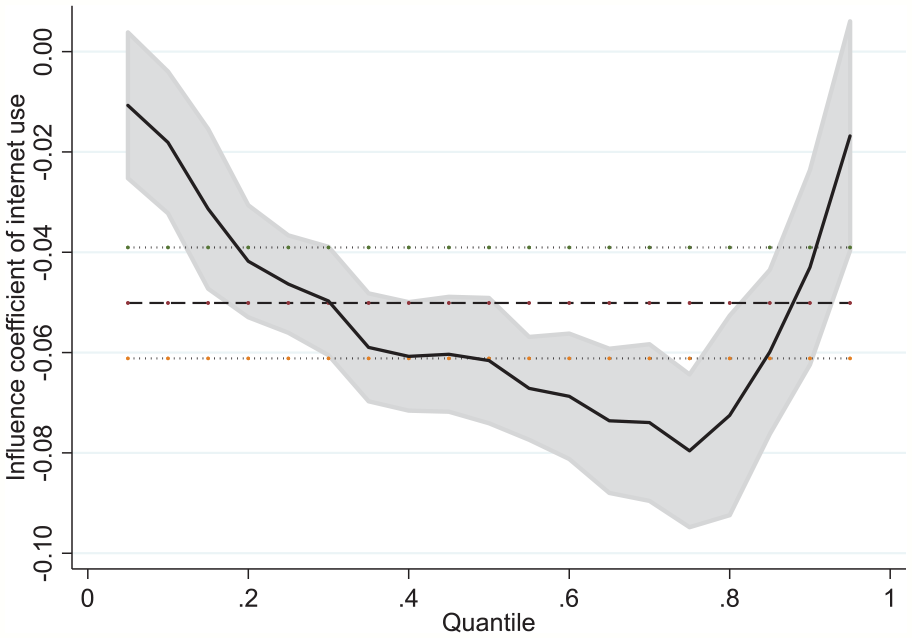
Change chart of regression coefficient of internet use by quantile.
Endogeneity and Robustness Checks
Endogeneity
There is a potential endogeneity problem caused by the two-way causality between internet use and the degree of wage distortion; in other words, groups with high human capital stock often have strong bargaining power in the job market, and at the same time, are fond of internet use. Consistent with existing literature, the instrumental variable (IV) and propensity score matching (PSM) methods are applied to solve this endogeneity problem. We select political concerns and the average internet user in the community as instrumental variables for internet use based on the survey question “the number of days spent learning about political news through TV stations in the past week.” The higher this value is, the higher the degree of personal political concern. As a tool variable for internet use, an increase in political concern effectively promotes workers’ access to the internet to expand the quantity and quality of political information they receive. Referring to Leng and Cao (2018), we also take the internet use rate at the community or village level.
Television and the internet are both channels used to spread information. They often complement each other and spread information to the public. These increased channels make it challenging to distort personal wages through other effective channels. Internet use at the district and county level reflects the local infrastructure, especially the construction and coverage of infrastructure network facilities that are conducive to laborers’ use of the internet, which produces a “peer group effect.” This exogenous variable does not affect the degree of personal wage distortion through other channels. Therefore, these two variables are suitable as instrumental variables. Table 7 reports the regression results using the instrumental variable method.
Regression Results of the Instrumental Variable Method.

Note. We control for the same variables in all models as those in Table 4.
p < 0.01.
The p-value of the DWH test (to ensure whether the core explanatory variable is endogenous) in model (2) is 0.0, which rejects the exogeneity hypothesis at the 1% level, proving that internet use is endogenous. The p-value in the over-identification test is .14, which indicates that the exogeneity hypothesis of the instrumental variables cannot be rejected, verifying the exogenous instrumental variables. In addition, the Wald test with a “nominal significance level” of 5% is performed on the significance of the endogenous variables. The minimum eigenvalue statistic is 246.3, much larger than the critical value of 19.93 at the 10% level. Thus, we can reject the original hypothesis of “weak instrumental variables,” and consider that there are no weak instrumental variables. Internet use can still be seen to negatively impact the degree of wage distortion. To examine the robustness of our results, model (3) uses the limited-information maximum likelihood method (LIML), which is less sensitive to weak instrumental variables. Model (5) uses general method of moments (GMM) estimation and iterative GMM estimation, which are more effective for heteroscedasticity conditions. The estimated coefficients are not much different from those of the 2SLS regression.
To further avoid endogeneity problems caused by sample selection bias, we use PSM and adopt a counterfactual analysis framework to match treatment and control groups with similar propensity values. The characteristic variables used for matching are consistent with those in baseline regression model (2), and the average treatment effect (ATT) is obtained. The results are as follows. Table 8 shows that under the two matching strategies, internet use has adverse effects on wage distortion, and internet use brings about a 5% reduction in wage distortion. In conclusion, the results of this study are relatively robust.
A Propensity Score Analysis of the Influence of Internet Use on the Degree of Wage Distortion.

Note. K-nearest-neighbor matching adopts one-to-four matching. When bootstrap calculates standard error, the number of self-service samples B = 400.
p < 0.01.
Robustness
To examine the reliability of our main results, we consider replacing the core explanatory variables and using weekly internet time (hours) instead of internet use to select observations for the study.
We also add possible missing variables to test whether there are biased estimates of the core variable parameters. Generally speaking, as the constituent elements of individual human capital, an excellent external image and proficient mandarin can significantly help effectively match employment and employers’ bargaining power to alleviate wage distortion. The degree of marketization in the region where workers are located will undoubtedly affect the wage distortion of individuals and even the whole region.
Competition in the commodity market will be accompanied by competition in the labor market, improving its ability to allocate resources and achieve a more efficient equilibrium. The direct embodiment is convergence of potential and actual income. Therefore, four variables are selected to be added to the baseline regression: clothing tidiness, mandarin proficiency, marketization degree, and internet use × marketization degree. Compared with a self-evaluation of appearance, tidiness of clothing is used to reflect the interviewee’s external image, which is less biased than the respondents’ subjective evaluation. The degree of marketization refers to China’s marketization index (Fan Gang index) in 2015.
The results are shown in Table 9. The coefficients of the core explanatory variable, internet use, are significantly negative in each model, and there is no significant difference with the baseline regression (within ±2% marginal impact difference). Excluding “clothing tidiness,” the directions of the other three variables are consistent with the expected impact. The interaction item is significantly positive. A possible reason is that the alleviating effect of internet use on wage distortion is weakened as marketization continuously improves. With the continuous deepening of the market economy’s development, the internet’ s information advantage in obtaining employment will continue to weaken. These results support the reliability of the main conclusions.
Robustness Test (Replacing Core Explanatory Variables and Adding Possible Missing Variables).

Note. All values in square brackets represent t statistics. All models control for the same variables as the models in Table 4.
p < 0.01.
Mechanism Analysis
As mentioned in the previous analysis, internet intervention helps distort workers’ wages through education matching, employment security, and job expectation. Therefore, in the following, each effect variable is used as an intermediate variable to construct a basic model to verify the existence and direction of the three mechanisms. We refer to the method used by Wen (2014).
Education Matching Effect
Consistent with the literature, over-education is regarded as an educational mismatch and insufficient education and coincidence are considered educational matching. The classification standard comes from the self-evaluation question “The level of education required for the job.” According to a comparison between the answers and their actual educational background, those whose positions are higher than or equal to their actual academic qualifications are regarded as educational background matching. Those whose positions are lower than their actual educational background are regarded as educational background mismatches. We use a 0 to 1 variable to represent matches and mismatches, respectively. After screening, 3,267 observations were retained, and the numbers of matching and non-matching academic qualifications were 2,129 and 1,138, respectively. Table 10 shows the estimation results.
Mediating Effect Model Estimation of Educational Matching.

Note. In models (1) and (4), the values in square brackets represent t statistics, and in models (2) and (3) the values in square brackets represent z statistics. All models control for the same variables as the models in Table 4. A bootstrap test is the interval range of the indirect effect estimated under the bootstrap method within a 95% confidence interval
p < 0.05. ***p < 0.01.
The results in column (2) of Table 10 confirm that internet use has a positive impact on education matching. After adding the education matching variable to column (4), the estimated coefficient of internet use does not change much, while education matching significantly alleviates the degree of wage distortion. The confidence interval of the indirect effect (joint coefficient) under the bootstrap test does not contain 0, indicating that the mediating effect of education matching is significant and partial. Internet use significantly improves job search ability and efficiency, reduces the cost of job matching, and guides workers to achieve a higher degree of work-education matching. At least internet use helps workers obtain jobs that match their work ability and avoid the deviation in actual wages from potential productivity caused by the “low income” of high education, which indirectly contributes to reducing wage distortion.
Employment Security Effect
Signing labor contracts is used as a proxy variable to measure employment security and is used to indicate a stable job by creating a 0 to 1 variable to include in the regression. After screening, 5,088 observations are retained, of which 2,191 involve stable employment and 2,897 represent unstable employment.
The results in column (2) of Table 11 confirm that internet use has a positive effect on employment security. After adding the employment security variable in column (4), both internet use and educational qualification matching significantly alleviate the degree of wage distortion. The confidence interval of the indirect effect (joint coefficient) under the bootstrap test does not contain 0, indicating that employment security’s mediating effect is significant and partial. These results are also consistent with the above hypothesis. Internet use may enrich employment information sources and deepen understanding of laws and regulations related to labor protection, thus promoting workers to obtain jobs with contract protection. Moreover, employers who sign labor contracts are constrained by the relevant systems to take appropriate measures to protect the rights and interests of workers, especially in terms of salary. Therefore, contracts indirectly help reduce wage distortion.
Mediating Effect Model Estimation of Employment Stability.
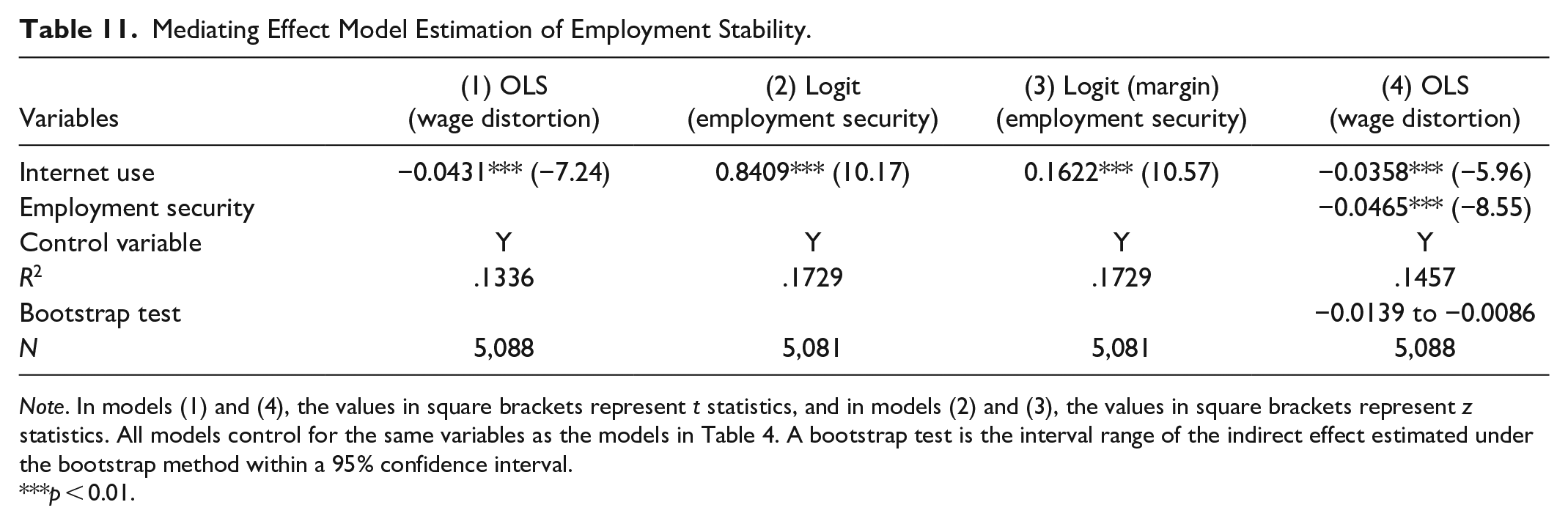
Note. In models (1) and (4), the values in square brackets represent t statistics, and in models (2) and (3), the values in square brackets represent z statistics. All models control for the same variables as the models in Table 4. A bootstrap test is the interval range of the indirect effect estimated under the bootstrap method within a 95% confidence interval.
p < 0.01.
Job Expectation Effect
This study indirectly reflects the job expectation cost level by identifying workers’ subjective evaluation of the external labor market. The more optimistic respondents are about the employment situation in the external labor market, the higher their job expectation. This variable comes from the subjective scoring of the question “How serious do you think the employment problem is in your country?” which increases from 0 to 10 in severity level. Table 12 shows the regression results.
Estimation of the Mediating Effect of Job Expectation.

Note. All values in square brackets represent t statistics. All models control for the same variables as the models in Table 4. A bootstrap test is the interval range of the indirect effect estimated under the bootstrap method within a 95% confidence interval.
p < 0.01.
The results in column (2) of Table 12 confirm that internet use improves the evaluation of employment status. Internet users are more inclined to maintain a more optimistic attitude about the external labor market. After adding two variables to column (3), internet use and an optimistic attitude toward employment evaluation significantly alleviate the degree of wage distortion. The confidence interval of the indirect effect (joint coefficient) under the bootstrap test does not contain 0, indicating that job expectation’s mediating effect is significant and partial. The application of internet technology can help in-service workers grasp external labor market information quickly and at low cost to dynamically adjust their salary expectations and provide an information basis for on-the-job job search, thereby enhancing their job transition confidence and ability. The final result is that the bargaining power of workers and employers changes, and workers can improve their individual wage level through external mobility (job transfer), internal mobility (such as job transfer, promotion), or internal negotiation (wage bargaining), which promotes appropriate employment matching, and finally reduces wage distortion. These results support hypothesis 3.
Discussion and Conclusion
In the process of supply-side reform, although the main goal is improving labor productivity, we should also pay attention to the synchronous increase in labor factor income to avoid a series of social problems caused by inconsistency in input and output factors and inequality in factor income distribution. Among the many factors that can alleviate the distortion of labor factor income (wages), the national survey data of CFPS 2016 are used in this study to focus on the impact and transmission mechanism of internet use. The results show that the average wage distortion in the labor market in our sample is about 45.02% to 55.24%; internet use has generally alleviated 3.76% of the wage distortion, and the results remain valid after treatments for endogeneity and tests for robustness. Considering heterogeneity, internet use has a more substantial wage distortion alleviation effect for men and urban registration groups. From the perspective of wage quintiles, its impact presents a U-shape; it affects groups whose wage distortions are distributed in lower and higher positions. Finally, we find that internet use can effectively reduce wage distortion through education matching, employment security, and job expectation effects.
We use relative data as support and draw a rough conclusion. Compared to workers who are not exposed to the internet, internet use can reduce the degree of workers’ wage distortion to a certain extent based on human capital measurement. Generally speaking, workers’ actual wages approach the upper limit of their potential wages (potential productivity release). Therefore, it is important for an individual to improve job efficiency, search ability, and then enhance bargaining power through the internet. From the public sector perspective, it is necessary to improve the internet penetration rate. We should also note that the distribution or efficiency difference of new skills such as the internet may cause income inequality because of the significant difference in the internet’ s effect on different groups of people.
In terms of specific measures, we can continue to promote rural informatization and promote information infrastructure construction to improve digital literacy and the digital human capital stock of workers in backward areas to promote the convergence of urban and rural ability to use the internet to obtain, distinguish, and use information. From the perspective of gender differences, we suggest providing robust conditions for women’s internet access. Women’s internet use skills can be improved through various methods of training and education; their wage bargaining ability based on internet use can be promoted and improved, and gradually converged with that of men to prevent the “digital gap” between urban and rural areas and gender and prevent the resulting income distribution inequality. In addition, we should understand the transmission mechanism through which the internet reverses wage distortion and give full play to the internet’s role in job matching and in-service search. Finally, we should have accurate insight into the transmission mechanism of internet use in reversing wage distortion and give full play to the internet as an information medium in job matching and on-the-job searches. Matching efficiency can be improved through the full exchange and display of two-way information in job hunting, which will reduce information asymmetry. A fair and orderly competition pattern in the labor market will be created, free flow and reasonable allocation of the labor force will be promoted, and the rights and interests of both labor and capital should be guaranteed as far as possible. To reverse wage distortion, individuals need to improve their ability to use the internet skillfully, that is, their ability to collect and process internet information. At the same time, relevant departments need to further standardize and develop internet job hunting platforms, including but not limited to direct online recruitment by employers and construction of third-party platforms. On this basis, we should take relevant labor laws as the criterion to ensure the authenticity and reliability of both parties’ information and reduce both sides’ matching costs, promote appropriate matching of labor factors, and reduce the degree of invalid or inefficient employment matching represented by wage distortion. In short, the internet’s importance in effectively alleviating the distortion of workers’ wages promotes improvement in labor remuneration and labor productivity so most workers can share in the dividends brought about by economic development.
Footnotes

Declaration of Conflicting Interests
The author(s) declared the following potential conflicts of interest with respect to the research, authorship, and/or publication of this article: The authors declare that the research was conducted in the absence of any commercial or financial relationships that could be construed as a potential conflict of interest.
Funding
The author(s) disclosed receipt of the following financial support for the research, authorship, and/or publication of this article: This study was funded by “the Fundamental Research Funds for the Central Universities,” Zhongnan University of Economics and Law (Grant Number: 202011205), “the Fundamental Research Funds for the Central Universities,” and Zhongnan University of Economics and Law (Grant Number: 202011212).
Ethical Approval
No animal studies are presented in this manuscript.
Informed Consent
Written informed consent for participation was not required for this study in accordance with the national legislation and the institutional requirements.