



Abstract
This study intends to examine the influence of trade openness on economic growth in the Kingdom of Saudi Arabia including government consumption and labor force as control variables. Using time-series yearly data from 1985 to 2019, the study applies the Auto-Regressive Distributed Lag (ARDL) cointegration regression and the Toda-Yamamoto (T-Y) Granger causality check to achieve the objective of the study. The ARDL model estimation discloses the positive contribution of trade openness and labor force to economic growth in the short and long run as well; government consumption causes economic growth positively in the short-run, while in the long its impact is insignificant run. The T-Y Granger causality test outcomes have demonstrated several bidirectional and unidirectional causalities. There are three feedback relations; “trade openness-economic growth,” “economic growth-government consumption,” and “government consumption-labor forces.” Three are an equal number of unidirectional causalities; “labor forces to economic growth,” “labor forces to trade openness,” and “trade openness to government consumption.” The outcomes have implications for the policymaker to boost the Kingdom’s trade openness to benefit further from trade, rationalize its government’s size to promote private sector growth to raise the latter’s effective contribution to GDP, and accelerate income growth.
Introduction
The trade openness of a country reveals its relative reliance on foreign trade that is defined by the fraction of its total value of global trade to gross domestic product (GDP). It is seen as a “trade-led growth (TLG)” strategy, which claims that trade is a locomotive for growth. It focuses on trade-led growth, which improves the growth accomplishment of a country in the long-run by facilitating access to foreign markets for goods and services, realizing efficiency in the allocation of resources, and refining total factor productivity by technology dissemination and transmission of skills and knowledge across countries (Barro & Martin, 1997; Batiz & Romer, 1991). Therefore, economists and policymakers envision that a country employing a trade openness strategy can have an enhanced growth presentation than one with a smaller amount of trade openness. Based on this view, many developing countries have followed a trade openness policy to benefit from external trade.
Trade openness essentially calls for the gradual elimination of trade barriers to ease trade across countries. Therefore, multinational organizations such as the IMF, and World Bank; and bilateral donors often advise developing countries to participate in the global economy and take advantage of trade through implementing trade liberalization rules and policies. These policies are inspired by the enriched growth scenarios of economies open to trade, specifically, by the East Asian economies’ incredible growth performances during 1965 to 1990. These countries, among other policies, embraced the trade-led growth path (World Bank, 1993). Besides, the disappointing performance of the import substitution policy of industrialization by many nations also has prompted developing countries to adopt trade openness comprising the declining trade barriers.
On the other hand, opening to trade is not a panacea; there is another strand of literature, which claims and has documented that increasing trade openness is harmful to a country’s economic growth (EG), because trade openness may charge inflation and drop the exchange rates (Cooke, 2010; Jafari Samimi et al., 2012). For example, the developing economies making low-grade, and primary goods, are often forced to devalue their monies to augment exports. Consequently, trade openness may distress the EG of developing countries, which produce and export low-quality products. Therefore, countries, which specialize in and trade primary products are vulnerable to terms of trade blows. However, the common confidence among economists exists that trade openness favors developing countries to achieve EG. Hence, this study intends to investigate the degree of trade dependence and its contribution to the EG of the Saudi Arabian economy.
The EG performance of an economy is estimated by the increase in its real GDP. Theoretically, based on the national income identity, an increase in government expenditure stimulates EG. Government spending on human capital formation and infrastructure development leads to EG, while expenditure on unproductive sectors such as military affairs may limit EG performance. Moreover, a high government expenditure may restrict a country’s overall EG, if it is financed by increased taxes and borrowing from financial institutions that may crowd out private investments.
The budgetary affairs are the key elements of the Kingdom’s macroeconomic policy. Hence, public spending occupies crucial importance in financing investment and consumption activities of the government to meet the increasing demand for public social services. The various categories of public expenditure in the Kingdom of Saudi Arabia (KSA) include general public service, health, education, social security and welfare services, housing and community amenities, defense, economic services, and other purposes. Evidence shows that public expenditures increased from 32.01 billion US dollars in 1985 to 193.63 billion US dollars in 2018 in the Kingdom to meet the increasing demand for public services owing to the growing population and an enhanced standard of living (General Authority for Statistics [GAS], 2019). It follows from the national income identity that an increase in government consumption is likely to influence the growth of the national income of a country. [The identity is NI = C + I + G + NX; where, NI = National income, C = Consumption expenditure, I = Investment expenditure, G = Government expenditure, NX = net export.] Therefore, this study intends to examine its impact on EG.
The labor force is critically important for an economy because labor is a principal and indispensable factor of production. An economy can produce nothing without labor. Saudi Arabia has a short supply of labor, to administer its economic activities, the Kingdom still relies on expatriate labor forces. The private sector predominantly depends on foreign laborers, while the government sector essentially hires Saudi nationals as part of the Suadization move articulated in the Vision 2030 of the Kingdom to absorb its growing population (GAS, 2019). Thus, the role of the labor force in the economic activities in Saudi Arabia is enormous. Moreover, neoclassical growth asserts significant importance on the labor force. Therefore, the current study is motivated to examine the trade-led growth hypothesis considering government consumption and labor force as control variables.
A Summary of the Variables
An outline of the variables under investigation in this study is presented in Table 1 to provide an overall outline.
An Outline of the Variables Under Investigation.

Source. The World Bank (2020).
Note. (a) Trade openness and government consumption are calculated as a percentage of GDP. (b) The labor force is expressed in million. (c) GDP is documented in billion US dollars at 2010 market prices.
A summary of the variables included in the study is offered in Table 1 for selected years only. During the study period 1985 to 2019, the trade ratio has ranged between 50.20% and 73.94% of GDP with an average of 61.91%, which reveals the Kingdom’s enormous reliance on external trade. Saudi Arabia is a top crude oil producer and exporter, it possesses the second-largest oil reserve in the world, and thus, its economy is oil-dependent. The Kingdom’s geographical position makes it smooth to access foreign markets across the world, do trade, and benefit therefrom (Department of Knowledge Management [DKM], 2020).
Government consumption has been quite handsome ranging from 17.70% to 34.67% of GDP with an average of 25.84% to meet the increasing demand for government services. The various kinds of government expenditure such as general public service, education, health, defense, social security, and economic services. Both labor force and GDP have shown uninterrupted continuous growth over the period.
Under the circumstances, examining the influence of “trade openness on the EG” of the Kingdom seems to be a useful exercise. Hence, this study attempts to test the stability of the relationship between trade openness and EG including labor force and government consumption as explanatory variables. The rest parts of the study are organized as follows. Section 2 considers the review of the empirical literature, Section 3 explains the methodology, Section 4 analyses the results, and lastly, Section 5 concludes the study.
Empirical Literature
Many studies have surveyed the link between “trade openness and EG.” After the publication of the influential works by Grossman and Helpman (1990) and Romer (1990), an increasing body of literature appeared that examined the role of foreign trade in promoting EG. In a study, Grossman and Helpman (1990) employed a two-country model and explored the link between trade and EG. The study revealed that the profit-maximizing approaches of the entrepreneurs led to endogenous technological improvement. Romer (1990) considered the affiliation between EG and technology and reported growth as an outcome of technological improvement, which resulted from foreign investments by profit-seeking firms. Grossman and Helpman (1991) examined the knowledge spillover effects on the EG of trading countries and reported that these effects were contingent on the size of external trade. It follows that trade created an externality, which co-occurred with an externality of indigenous innovation.
Dollar and Kraay (2004) examined the influence of globalization on poverty and income inequality. The study revealed that globalization led to increased trade, and reduced tariffs. This helped the developing economies to draw near to the rich countries and enabled them to boost their EG rates and reduce poverty levels. Thus, globalization facilitated quicker growth and reduction in poverty levels in developing countries. Sarkar (2008) employed panel data on 51 least developed economies for the period 1961 to 2002 and examined the association between “trade openness and EG.” The study reported that trade openness influenced EG in the case of 11 relatively rich, trade-oriented countries. In the cases of individual countries, the majority revealed no affirmative relationship, while the middle-income countries exhibited long-term affirmative relations. In a study, Chang et al. (2009) used cross-country panel data and examined the impact of trade openness on EG and concluded that in the existence of structural reforms, trade openness enriched EG significantly. Vlastou (2010) employed panel data on 34 African countries from 1960 to 2003, and observed the association between “trade openness and EG.” The study showed a negative impact of trade openness on EG and further reported oneway causality from trade openness to EG.
Kim (2011) explored the contribution of trade to EG and standard of living based on varying levels of economic development and reported that trade openness exerted positive influences on the EG of developed countries, however it produced negative impacts on real income in the case of less developed countries. Kim et al. (2012) employed a simultaneous equation model and investigated the relationships among trade openness, EG, and financial development. The study disclosed a positive impact of “trade openness on EG” in the case of non-agricultural, high-income countries with low inflation, while its impact was negative on the latter in the case of countries with different attributes. Tekin (2012) considered a panel of 27 African least developed economies from 1970 to 2010, studied the causal relationship among income growth, trade openness, and official development assistance, and found no noteworthy causal associations among the variables.
Islam and Mirza (2013) used annual time series data on Bangladesh, India, and Pakistan from 1973 to 2008, and utilized the “Johansen cointegration” and “Granger causality” tests. The study investigated the underlying relationship among EG, exports, and foreign direct investment (FDI), and reported no proof in favor of the export-led growth proposition for any country. The growth-led export notion was confirmed for Bangladesh but, no causal association was found between GDP and exports in the case of India and Pakistan. L. C. Huang and Chang (2014) considered a panel data of 46 economies. They used data for the 1983 to 2007 period, examined the nexus between “trade openness and EG” and concluded that trade openness boosted EG when countries’ stock markets achieved a threshold level of development. Sakyi et al. (2015) employed a non-stationary heterogeneous panel cointegration model and examined the impact of “trade openness on income growth” for a panel of 115 developing economies over the period 1970 to 2009. The study reported a bi-directional relationship between “trade openness and EG” both in the long and short runs. Brueckner and Lederman (2015) used the instrumental variable method and investigated the linkage between “trade openness and EG” in 41 Sub-Saharan African countries. They found that trade openness positively influenced EG in the short run as well in the long run, while income growth negatively impacted trade openness.
Hye et al. (2016) used the ARDL cointegration technique and investigated the association between “trade openness and income growth” employing Chines data over the period 1975 to 2009. They reported a positive influence of “trade openness on EG” in the long run and short-run as well. Keho (2017) employed the ARDL bounds test for the period 1965 to 2014, investigated the relationship between “trade openness and EG” in Cote d’Ivoire, and exhibited that trade openness enhanced EG in long run, and also in the short run. Marilyne et al. (2018) followed an endogenous growth model, employed panel data on 169 countries over the period 1988 to 2014, used the Generalized Method of Moments estimator, and reexamined the “trade openness and EG” nexus. They documented that EG was sharp in the case of countries those exported high-quality and new products. They further reported a nonlinear relationship between export and quality of exports, indicating that trade openness impacted EG unfavorably in countries that produced low-quality outputs. Emrah et al. (2019) used time series yearly data from 1950 to 2014 and examined the Granger causality between “trade openness and EG” in Turkey and reported a feedback association between trade and EG
Islam (2020) utilized time-series annual data from 1986 to 2018, employed the ARDL bound test, and explored the association among income growth, readymade garments (RMG) export incomes, and FDI inflow in Bangladesh. The study concluded that RMG export incomes influenced EG positively in both periods, the short and long runs. Islam (2021b) utilized time-series annual data from 1990 to 2019 period, used the ARDL approach, investigated the TLG hypothesis for Saudi Arabia, and discovered that trade openness showed a positive impact on EG in the Kingdom both in the long and short run. Islam (2021a) investigated the validity of the TLG hypothesis for South Asia with the labor force and “gross fixed capital formation” as explanatory variables employing panel data and the pooled mean group estimation. The study reported an encouraging impact of trade on EG and supported the TLG notion for South Asia.
The relationship between government expenditure and income growth is researched by a handful of studies and their findings are inconclusive. Ghali (1997) considered an endogenous growth model, used time-series yearly data from 1960 to 1996, employed the VAR model, and examined the link between “EG and government expenditure” in Saudi Arabia. The study found no evidence that government expenditure could enhance per capita income growth in the Kingdom and suggested the fiscal authority to limit fiscal deficit and downsize the size of the government.
Alexiou (2009) used annual panel data over the 1995 to 2005 period and investigated the relationship between EG and government consumption in seven transition economies of South-Eastern Europe The study found government consumption, development aid, private investment, and trade openness significantly contributed to income growth, while the influence of the population on EG was insignificant. Alshahrani and Alsadiq (2014) explored the impact of government expenditure on EG in Saudi Arabia utilizing time-series 12-monthly data for the period 1969 to 2010. They employed the Vector Error Correction Model technique and reported that public investments stimulated growth in the long run, and trade openness boosted EG in the short run.
Dudzevičiūtė et al. (2018) explored the linkage between public expenditure and income growth in eight European Union countries for the period 1995 to 2015. They applied descriptive statistical analysis and Granger causality testing and found a significant affiliation between “public spending and EG.” Alrasheedy and Alrazyeg (2019) considered the connection between government consumption and income growth in Saudi Arabia by utilizing annual time-series data from 1970 to 2017. They applied the ARDL technique and found that government expenditure significantly affected income growth. Sheilla and Nicholas (2019) surveyed the prevailing literature on the underlying relationship between government size and income growth and found four possible outcomes regarding the direction of causality between them. The prominent outcome validated a unidirectional causality from income growth to the size of the government.
The relation between the labor force and income growth is investigated by many studies that are quite debatable. The neoclassical growth models assume that low population growth in developed countries limits the scope of EG owing to lack of labor forces and creates social problems, while high population growth in developing countries checks the potential EG owing to the unemployment of increasing labor forces. These theories have used exogenous growth models, where EG is driven by two variables, for example, saving and labor force, which is exogenously introduced. Saving leads to an upsurge in the stock of capital, while the labor force delineates the availability of workforces, the quick growth of the labor force leads to a lesser amount of capital per worker decelerating EG, thus providing a negative relationship between the growth of the labor force and per capita income (Solow, 1956).
According to the “neoclassical growth model,” a rise in the labor force along with comparatively static growth in the capital stock leads to declining returns causing a drop in EG. Even a more sophisticated model comprising labor quality and the labor force structure gives similar findings. Mankiw et al. (1990), for example, added human capital formation to Solow’s model to account for the labor force quality and discovered that higher growth of population caused lower steady-state growth, and a larger saving rate led to a larger EG rate. Shackleton (2013) opined that the use of the neoclassical growth model accounted for the effects of only labor and capital on EG, a large residual remained undiscovered, which was attributable to technical progress. Thus, endogenous growth theories were placed to offer a superior explanation incorporating research and development in the model, and lifting the assumption of diminishing return to capital owing to labor force increase (Todaro & Smith, 2012).
However, the empirical findings of endogenous growth models across countries are not uniform, rather the influence of the “labor force on EG” is contradictory. Simon (1990), Tumwebaze and Ijjo (2015), Sethy and Sahoo (2015), and Bucci (2015) found that population growth ensured positive impacts on per capita income, while Banerjee (2012), T. Huang and Xie (2013), and Yao et al. (2013), and found current growth of labor force exhibited an adverse influence on EG. Hence, this study considers assessing the impact of the labor force along with other relevant variables on income growth in the Kingdom.
The above-discussed literature examined the associations among trade openness, government expenditure, the labor force/population, and EG having different timeframes, and diverse datasets in many countries. However, the outcomes are inconclusive; many of them have presented a positive relationship between “trade openness and EG,” while others have documented negative relationships. Similarly, several studies have reported a positive influence of government consumption on EG, while others have uncovered a negative impact. Another set of studies has revealed a positive linkage between “population and EG,” while others have conveyed a negative relationship. Moreover, they are discrete studies on “trade openness and EG,” “government consumption & EG,” and “population and EG”; there is no single study, which considers “trade openness, government consumption, labor force, and EG linkage” together. In the Saudi Arabian context, Ghali (1997) investigated the impact of government expenditure, particularly, government consumption and investment on EG, Alshahrani and Alsadiq (2014) examined the impact of different kinds of government expenditures including openness on GDP growth, while Alrasheedy and Alrazyeg (2019) explored the role of government spending on EG employing the Wagner’s law and Keynesian approach. This study differs from the earlier studies, it examines the trade-led growth hypothesis considering government consumption and labor force as control variables. Thus, this study augments all previous studies by incorporating more explanatory variables and updated data. Moreover, studies relating to the Saudi Arabian economy concerning said variables are very few. Therefore, this study intends to scrutinize the linkage between “trade openness and EG” incorporating government consumption, and labor force as explanatory variables.
Methodology of the Study
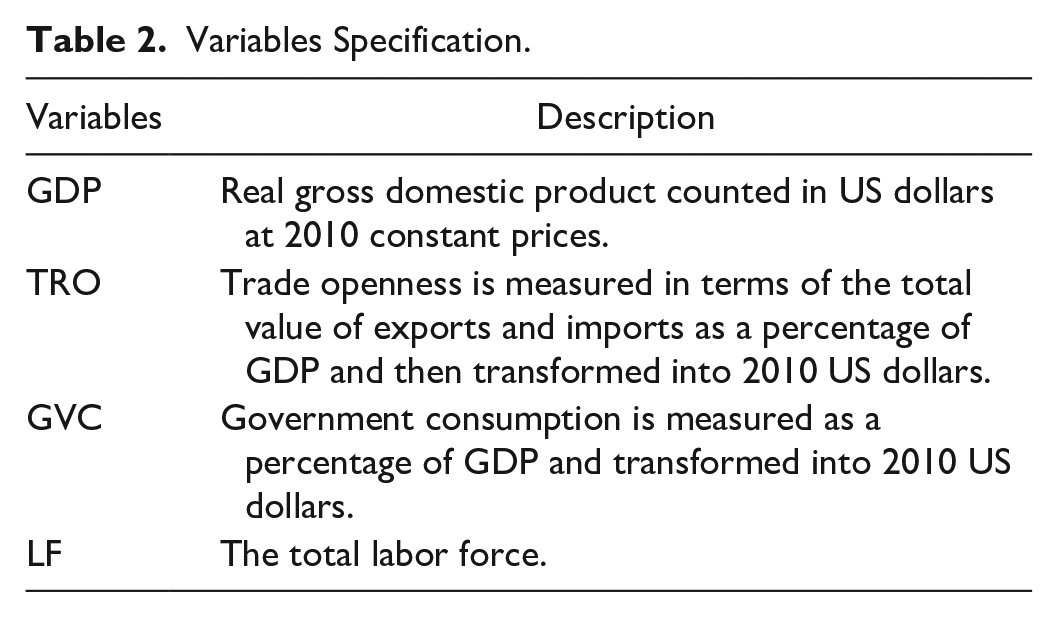
The study employs time-series annual data from 1985 to 2019 circulated by the World Bank (2020). A model is specified with GDP as a function of trade openness, government consumption, and the labor force. The model is delineated in equation (1), while the variables included in the model are defined in Table 2.

Variables Specification.
Unit root tests are conducted to justify the stationarity of the variables. The Dickey-Fuller GLS (ERS) test, “Augmented Dickey-Fuller” (ADF) test and “Phillips-Perron” (PP) test are employed to ascertain whether the variables have any unit root. The Kwiatkowski-Phillips-Schmidi-Shin (KPSS) test is used to employ the causality analysis. After determining the stationarity of the variables, this study employs the ARDL model, which is devised by Pesaran and Shin (1995). The ARDL model is suitable to estimate both the short and long-run associations among variables. The key advantage of this model is, that it permits both the identical or different integrating order(s) of the variables. Besides, the model is equally applicable to a small sample study. The usual long-run form of an ARDL model is delineated in the following equation.

Where, p, q, r, and s are the optimal lag length of respective variables considering the Akaike info criterion (AIC). The existence of a long-term relationship among the variables is validated by employing the bounds test statistics. Usually, in bounds testing, the estimated test statistics are compared with Pesaran et al.’s (2001) critical values. However, in the case of a small sample, as is our case, instead, Narayan’s (2005) critical values are employed to determine any long-term association among the variables. The short-run ARDL model based on the error correction form is formulated in equation (3).
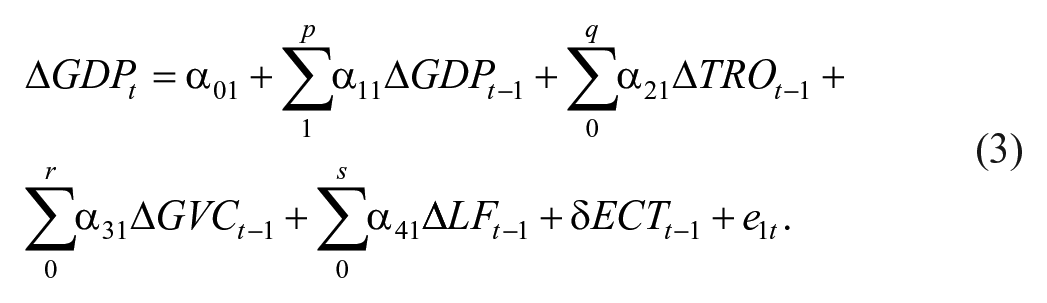
The error correction term (ECT) determines the rapidity of error correction to long-run stability from any short-run shock and assimilates the short-run constants with long-run ones without losing any long-run evidence. ECT is derived from the residuals of equation (2) by one-period lag. The coefficient of ECT must be negative, <1, and statistically significant to validate the long-run relationship, while the short-run coefficient is established by significant values of the regressors.
Lastly, the Toda-Yamamoto (T-Y) (1995) causality check is employed to determine any causal relationship among trade openness, GDP, government consumption, and the labor force. The T-Y Granger causality test is outlined in equations (4) to (7) based on the Vector Autoregressive (VAR) model.


The T-Y causality test applies to any order of integration among variables, either I(0) or, I(1) or I(2). In the above equations, dmax is the utmost possible order of integration amid the variables that is determined employing appropriate criteria, while p, q, r, and s are the ideal lag length of the corresponding variables; u1t, u2t, u3t, u4t stand for the error terms with zero mean, constant variance, and without autocorrelation.
Results
Unit Test Results
The unit root test outcomes are exhibited in Table 3. The ADF, ERS, and PP unit-root test results divulge that all variables have unit roots at levels but they are stationary when they are first differenced based on 1% significance level. The KPSS unit root test result is particularly reported to ensure the level of integration for the T-Y Granger causality test.
Results of the Unit Root Test.

and * show significance at 1% and 10% levels, respectively.
Long-Run ARDL Model Estimation Results
The long-run ARDL model is automatically selected as ARDL (1, 1, 0, 0) following maximum dependent lags: 2 and dynamic regressors: 2 based on the AIC criterion. The model is predicted by employing equation (2) to determine the long-run association among the variables. The estimated result of the long-run model is reported in Table 4.
ARDL (1, 1, 0, 0) Long-Run Model Estimation, Dependent Variable: GDP.

Shows significance at 1% level.
The value of the coefficient of TRO(−1) is .2704, which is affirmative and significant at 5% level. It indicates that trade openness impacts EG favorably. An increase in trade volume by 1 US dollar is likely to enhance the KSA’s GDP by 27.04 cents. Thus, the higher the volume of trade, the larger will be the value of GDP causing positive EG. The joint effect of the two lag values of TRO on EG is positive, which is evidenced by the Wald test statistic exhibited in Table 5. It demonstrates the rejection of the null hypothesis C(2) = C(3) = 0 at 1% level of significance, indicating that the two lag values of TRO positively influence the Kingdom’s EG. The outcomes acknowledge the earlier findings of Kim (2011), L. C. Huang and Chang (2014), Brueckner and Lederman (2015), Alshahrani and Alsadiq (2014), Hye et al. (2016), Keho (2017), Emrah et al. (2019), Islam (2021b), and Islam (2021a). This finding provides implications for policymakers to boost the Kingdom’s trade openness to accelerate its EG.
Wald Test Statistics.

shows significance at 1% level.
The coefficient of GVC is positive, and highly significant, which indicates that government consumption directly causes EG. One-dollar increase in government consumption directly adds to GDP by 34.67 cents. This reflects the Kingdom’s enormous size of public spending, which constituted 25.84% of its GDP on average during the study period. The finding is in line with Alexiou (2009), Alshahrani and Alsadiq (2014), Dudzevičiūtė et al. (2018), and Alrasheedy and Alrazyeg (2019), who reported a positive contribution of public expenses to EG. However, this finding contradicts the previous results of Ghali (1997), who found no evidence that government expenditure could enhance per capita income growth in the Kingdom. The outcome has managerial implications for the government to continue to support EG. However, it may rationalize its huge budgetary affairs and expense, as across the world, historically, small government size is considered to be an efficient one, while the case of the Kingdom is unusual. Moreover, the enormous role of the government may restrict the growth of the private sector which is generally considered to take a lead performance in the EG of a country.
The coefficient of the labor force is affirmative and significant, which expresses that the labor force directly influences the EG of the Kingdom, because labor is a principal factor of production, and the country being labor deficient, specifically relies on foreign workers and has a shortage of skilled labor force. This evidence is in line with Romer (1990), Simon (1990), Sethy and Sahoo (2015), Tumwebaze and Ijjo (2015), and Bucci (2015) who reported that population growth had positive impacts on income growth, refutes the findings of Banerjee (2012), T. Huang and Xie (2013), and Yao et al., (2013), who conveyed a negative influence of population on EG and contradicts Alexiou (2009), who reported an insignificant influence of population on EG.
The bounds test statistic is reported in Table 6 to validate the prevailing long-run association among the variables. The F statistic in the bounds test outcome indicates that the test statistic [11.318] is significant at the 1% level, and thus, confirms a long-run relationship among the variables.
F-Bounds Test Outcome.
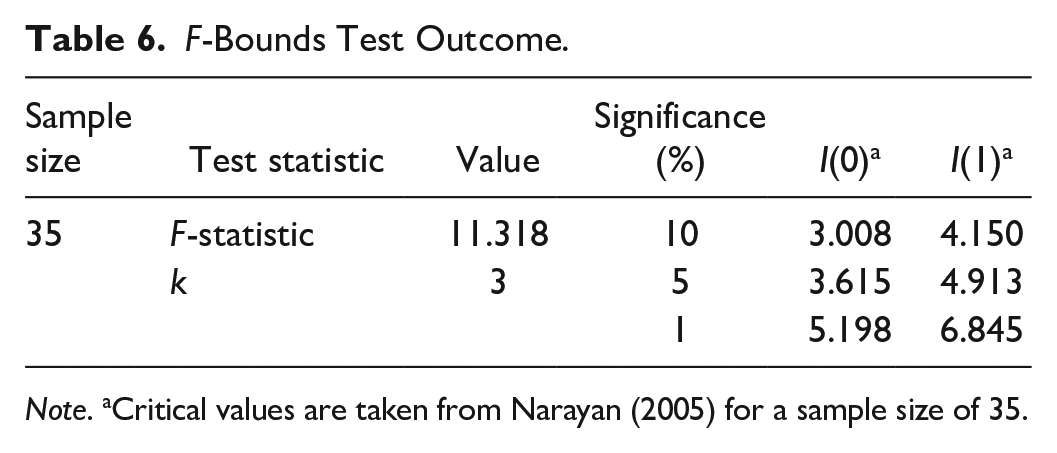
Note. aCritical values are taken from Narayan (2005) for a sample size of 35.
Diagnostic tests results
An estimated ARDL long-run model necessitates that its residuals must be normally distributed, and should be serially uncorrelated. Moreover, the residuals must be homoscedastic, and stable. To authenticate these phenomena, required diagnostic tests are employed and their results are portrayed in Table 7 (Figures 1 and 2).
Results of Diagnostic Tests.
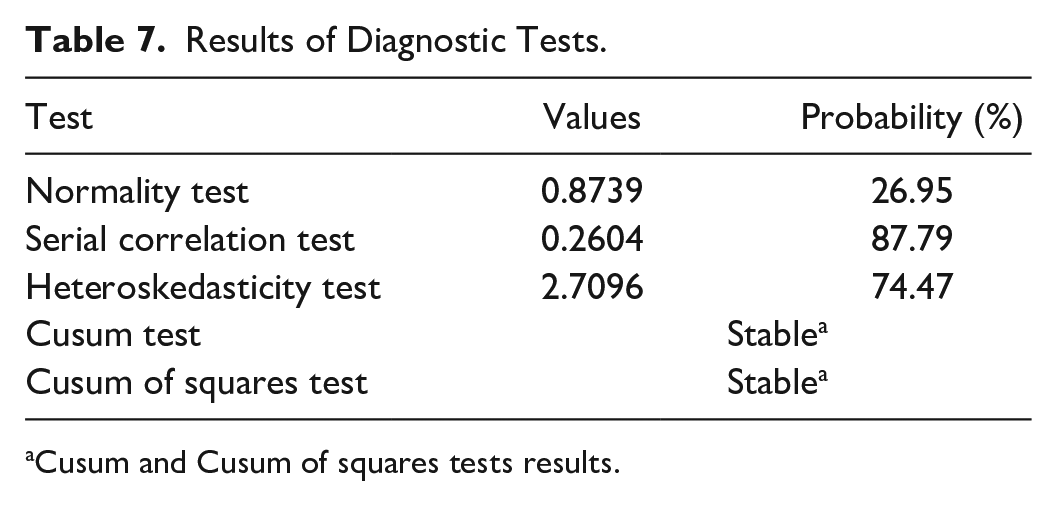
Cusum and Cusum of squares tests results.

CUSUM test result.

CUSUM of squares test result.
The foregoing analyses, their test statistics, and the results of related diagnostics tests demonstrate that the estimated long-run ARDL model holds all ideal characteristics. Therefore, a long-run relationship among the variables is justified, and it is established that they are cointegrated.
Short-run error correction form
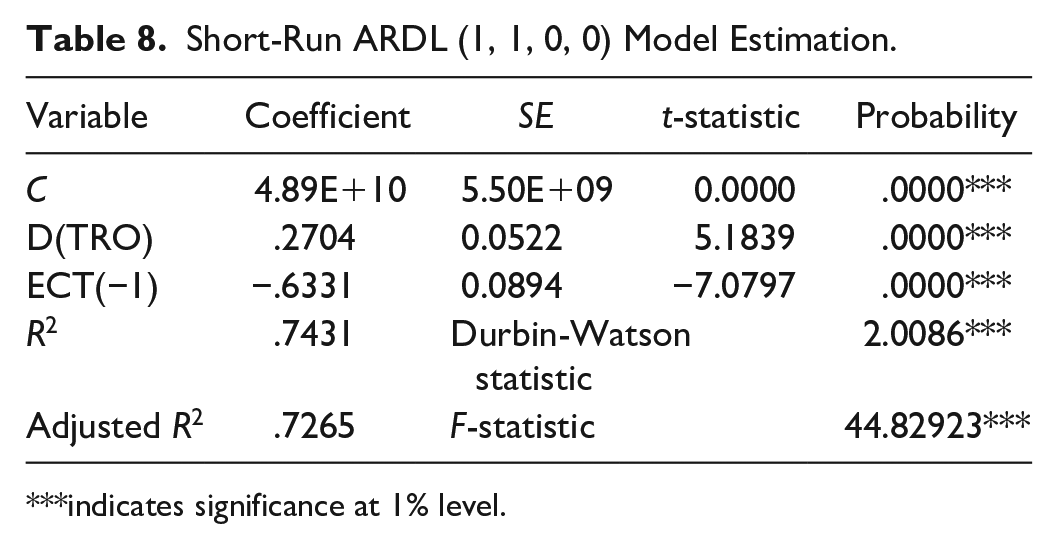
The short-run error-correction ARDL (1, 1, 0, 0) model based on equation (3) is estimated and described in Table 8.
Short-Run ARDL (1, 1, 0, 0) Model Estimation.
indicates significance at 1% level.
Trade openness positively influences EG in the short run in a similar manner as it changes the latter in the long run. Neither government consumption, nor labor force affects EG in the short-run. They contribute to EG in the long run only.
The coefficient of ECT is statistically significant at 1% level, its value is <1, and the sign is negative, which authenticates the cointegration among the variables of interest. The divergences among the short-run coefficients with those of the long-run converge to the long-run coefficients at the speed of 66.31% annually.
Results of the T-D Causality Test
The higher order of integration dmax is determined by employing the “VAR lag order selection” criterion. The order dmax is selected (=5) following the “FPE, AIC, and HQ” criteria and documented in Table 9. The KPSS unit root test result is particularly used to determine the optimal lag length of each variable for the T-D causality test. The optimal lag length (K = 1) is defined by the KPSS unit root test result in Table 3.
“Lag Order Selection” Process.
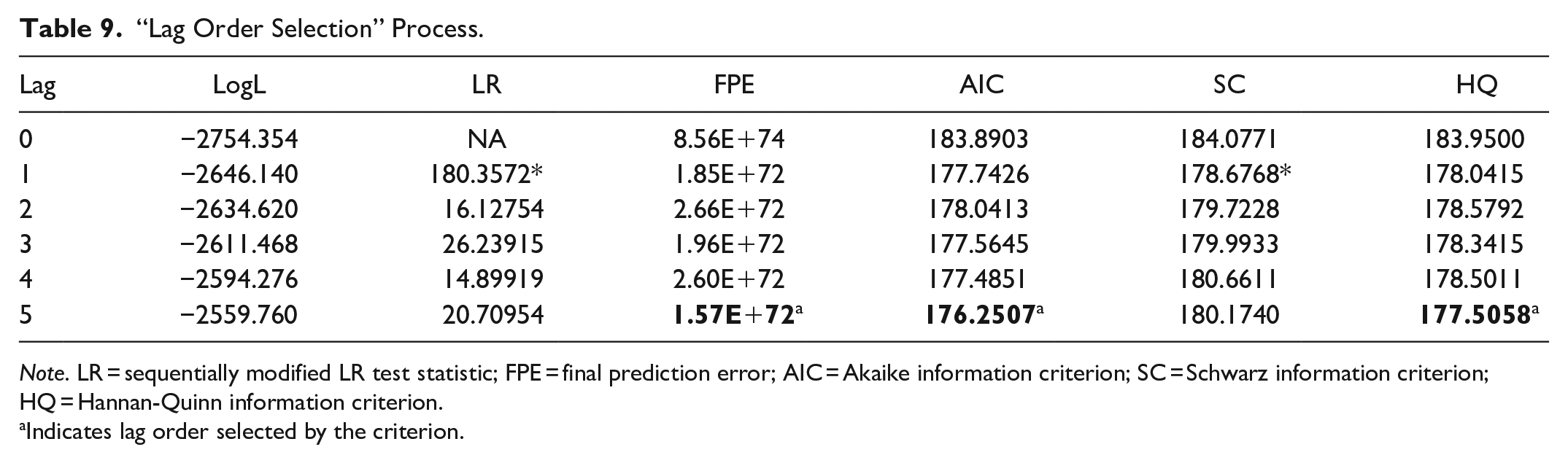
Note. LR = sequentially modified LR test statistic; FPE = final prediction error; AIC = Akaike information criterion; SC = Schwarz information criterion; HQ = Hannan-Quinn information criterion.
Indicates lag order selected by the criterion.
The direction of causation among the above variables following the T-Y causality test is reported in Table 10. It is evidenced that there exist three bidirectional, and three unidirectional causalities among the variables. The results authenticate the findings of the ARDL model estimation, and thus, validate the robustness.
Results of the T-Y Causality Test.

**, and *** denote significance at 10%, 5%, and 1% levels, respectively.
The first bidirectional causality between TRO⇄GDP shows that trade openness impacts EG and the other way round. Trade facilitates growth, and a growing economy facilitates further trade. The second bidirectional causality (GDP⇄GVC) shows that an increase in GDP causes government expenditure to rise, and vice-versa. When EG takes place, the government needs to spend more to maintain the rising demand for public social services and a higher standard of living. The rising government expenditure directly causes EG through the aggregate demand channel. The third bidirectional causality (GVC⇄LF) denotes that government consumption causes an increase in the labor force and vice-versa. As government consumption increases, it absorbs more labor forces in the economy to meet larger economic activities; it is already evidenced that the government has been very much focused to absorb a growing share of the Saudi Arabian labor forces in the public sector. Similarly, when the government accommodates a growing percentage of increasing labor forces, it escalates government consumption.
The first one-way causality from LF to GDP depicts that the labor force impacts EG. In Saudi Arabia, labor is scarce having deficiency, and thus, the economy depends on expatriate laborers. Therefore, the role of labor is critical to its EG. The second unidirectional causality from LF to TRO shows that a rise in the labor force leads to trade openness. As trade openness accounts for 61.91% of the Kingdom’s GDP, an upsurge in the labor force consistently causes trade openness affirmatively. The third unidirectional causality exists from TRO to GVC. It denotes that trade openness causes government consumption positively. As trade promotes EG, an increased GDP leads to an increased government expenditure to meet increased involvement in the trade.
Conclusion
The study has investigated the influence of trade openness, government consumption, and labor force on the Kingdom of Saudi Arabia’s EG.
The ARDL estimation has witnessed evidence that trade openness exerts a significant affirmative impact on the growth presentation of the Kingdom both in the short and long run. The more the country is persuaded to foreign trade, its EG situation is likely to be better off. Government consumption directly improves the EG show of the Kingdom; as public spending constitutes a significant portion of its GDP. However, based on the enormous size of the public expenditure, and the relatively smaller role of the private sector, the Kingdom may rationalize its government consumption, which may ease the working and growth of the private sector. The labor force strongly influences the EG of the country, as it is a labor-deficient economy.
The T-Y causality test has revealed three bidirectional and another three unidirectional causalities. The three bidirectional causalities are trade openness (TRO⇄GDP) causes EG and vice versa; EG causes (GDP⇄GVC) government expenditure favorably and vice versa; the government consumption causes (GVC⇄LF) labor forces positively, and vice versa. Three unidirectional causalities are, the labor force causes (LF→GDP) EG positively, the labor force causes (LF→TRO) the trade openness positively, and trade openness causes (TRO→GVC) government consumption positively.
The findings have policy implications for the policymakers of the Kingdom to enhance openness to trade to benefit from it and augment its EG. They further may rationalize the government’s consumption to promote private sector growth to raise the latter’s effective contribution to EG.
Footnotes
Declaration of Conflicting Interests
The author(s) declared no potential conflicts of interest with respect to the research, authorship, and/or publication of this article.
Funding
The author(s) disclosed receipt of the following financial support for the research, authorship, and/or publication of this article: The authors would like to thank the University of Ha’il for its financial support. This research has been funded by Scientific Research Deanship at the University of Hail, Saudi Arabia through a project numbered RG-21 145.
