




Abstract
ICT use has significantly increased over the years across the world, including Saudi Arabia. This study links ICT with economic growth (EG) in Saudi Arabia, controlling human capital (HC) and COVID-19. We employ time-series annual data from 1990 to 2021, a nonlinear Autoregressive Distributed Lag (NARDL) approach, and a cointegrating regression analysis to look at the asymmetric effects of ICT diffusion on EG. The NARDL assessment establishes a cointegrating relationship among variables; the effect of ICT negative shocks on EG is favorable and relatively larger. In contrast, the positive shocks of ICT generate a negative and somewhat less impact on EG with an overall positive impact. The findings imply that the ICT, during its expansion stage, cannot contribute positively to EG, perhaps because of a lack of required skilled human capital to administer and utilize the ICT instruments. The positive and insignificant coefficient of HC supports this conclusion. Despite Saudi Arabia’s generous efforts, physical and human capital have no significant impact on EG. COVID-19 has hindered the usual economic activities in the Kingdom and impaired EG. The cointegrating regressions authenticate the robustness of the NARDL findings. The outcomes suggest policymakers should appraise the existing ICT infrastructure and initiate raising the capability of HC through practical training and education to benefit from ICT diffusion and positively impact EG.
Introduction
“Information and communication technology (ICT)” is a broad term that refers to a collection of technological tools and resources utilized to create, transmit, accumulate, share, and interchange information. Computers, the Internet, live and recorded communications, and telephony are examples of technological equipment and resources (UNESCO Institute for Statistics, 2009). ICT includes any device that can electronically store, access, control, send, or obtain data in digital format. It enhances the transparency of financial transactions, automates numerous business processes, and boosts business communications. Over the past three decades, ICT has made significant advancements, and empirical evidence suggests that using ICT to drive economic growth (EG) is beneficial for countries (Islam and Rahaman, 2023). Saudi Arabia has the largest ICT market in the Middle East and North Africa, with a value of over $32.1 billion. It is also well-located to progress into a hub for technology services and the cloud, with access to global connectivity through the Red Sea and the Gulf and the potential for reaching the European, Asian, and African markets (CCG, 2022).
Four variables are widely used as a proxy for ICT in economic literature; they are “fixed broadband subscription (FBS),”“individuals using Internet (IUI),”“mobile cellular subscriptions (MCS),”“fixed telephone subscriptions (FTS)” [all % of the population]. Besides, the “medium & high-tech exports (MHE)” as a percentage of total manufactured exports is also used as a proxy in some literature. We combine them into a single index using the “principal component analysis (PCA)” and label it ICT-index. The proxy data on ICT components retrieved from the World Bank (2022) are exhibited in Figure 1. It reveals that over time, particularly after the year 2000, the diffusion of ICT in the Kingdom has increased, except for FTS.

Components of ICT.
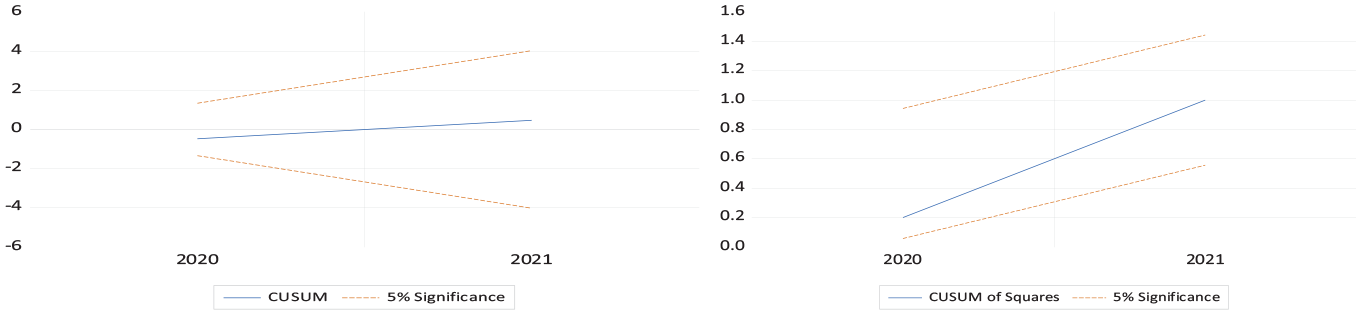
CUSUM & CUSUM of Sq. plots.
ICT diffusion enables accessible, fast, and effective communication, facilitates innovative and efficient production techniques, and minimizes waste; all of these give momentum to EG. As a result, many countries increasingly depend on ICT diffusion to increase productivity and growth among different economic sectors (Zhang & Danish, 2019). Therefore, we examine the impact of ICT deployment on EG in the Kingdom using an enhanced neoclassical growth model with ICT and HC as explanatory variables.
To measure the level of EG across the diverse size of economies, we consider GDP per person instead of considering GDP. We measure EG in terms of an increase in countries’ per-person GDP over the study period. We consider a conventional two-factor growth model where the employment of labor and capital determines per-person output. Capital is an essential factor of production and occupies a central position in growth economics. On many occasions, production is hampered due to a lack of it; therefore, the accumulation of it governs the size and scale of production a country may generate. Recent studies have highlighted the positive contribution of physical capital (Islam et al., 2022a) to EG in Saudi Arabia. In contrast, others (Islam & Alhamad, 2023 ; Islam, 2021 ) have revealed no influence of capital on the latter.
Likewise, we cannot produce anything without using a labor force (LF); labor is the primary and most crucial factor in production. A shortage of job opportunities for surplus labor in some economies restricts production, while a lack of labor force limits production in numerous economies. Saudi Arabia has a labor shortage and frequently employs foreign workers to compensate for the shortfall. Several recent studies have documented the affirmative impact of LF on EG. Islam et al. (2022a, 2022b) and Islam(2021) are a few available research studies investigating the labor force’s contribution to EG in Saudi Arabia and documenting affirmative outcomes. This study also revisits the influence of LF on the Saudi Arabian economy.
A stock of skilled human capital (HC) is a precondition to tap the benefits of ICT diffusion in any economy, including Saudi Arabia. The population’s talent, knowledge, and skills are the essential aspects of human capital, which largely determine a country’s capability to utilize ICT devices and benefit from them. Usually, human capital is positively correlated with the EG of a country if it is properly generated and utilized (Jiang & Wang, 2023). Several studies showed the positive contribution of HC to EG. For instance, Islam (2020a, 2020b) documented how HC augmented EG in South Asia, while Islam (2020c) revealed its positive effect on EG in Bangladesh. While Almutairi (2023) accounted for a negative and significant impact of HC in Saudi Arabia, Islam and Alhamad (2023) highlighted a positive but insignificant effect of HC on EG in the Kingdom. Thus, the impact of HC on EG is mixed and inconclusive and deserves further research. Therefore, we intend to examine its effect on the EG of Saudi Arabia. We devise an HC-index comprising two human development indicators, e.g., life expectancy (LE) and mean year of schooling (MYS).
Moreover, we want to explore the impact of COVID-19 on economic performance in the Kingdom and, as a result, include it in the augmented growth function as a dummy variable. In section 2, we have shown that studies on Saudi Arabia regarding the nexus between ICT, HC, and COVID-19 are missing. Therefore, we aim to link ICT diffusion with EG in Saudi Arabia, controlling HC and COVID-19 using a nonlinear ARDL bounds approach. This study is distinctive because we consider the case of Saudi Arabia with a legitimate sample size for the first time, and we include COVID-19 as an explanatory variable to assess its impact on EG in Saudi Arabia.
Literature Review
Studies on how ICT affects EG have gained the interest of researchers in recent years, and a significant volume of research is available in the literature. We review the pertinent contemporary pieces here and add our contribution. Shahiduzzaman and Alam (2014) investigated the causal relationship between ICT and EG in Australia using a production function approach. They used the level of ICT investment as a measure of ICT, employed an ARDL approach and causality analysis, and proved a positive role of ICT capital on EG. Kumar et al. (2016) explored the impact of five ICT indicators on the EG of China during 1980–2013, using an augmented neoclassical framework and the ARDL bounds test, and noted that all five indicators of ICT had positive effects on EG.
Latif et al. (2018) investigated the relationship between ICT and EG along with other variables in BRICS economies for the period 2000–2014 using several estimation techniques and concluded that ICT positively contributed to EG. Niebel (2018) investigated the effect of ICT capital on EG and whether ICT investments yielded different returns in developing, emerging, and developed nations. It employed a sample of 59 economies, data from 1995 to 2010, panel regression techniques, and confirmed a positive correlation between EG and ICT capital. It also discovered no appreciable variations in ICT output elasticity among three groups of nations, raising doubts about the “leapfrogging” argument.
Bahrini and Qaffas (2019) examined the impact of ICT on EG of selected “Middle East and North Africa (MENA)” and “Sub-Saharan African (SSA)” countries using a GMM approach covering data from 2007 to 2016 and exhibited that adoption of ICT instruments, particularly mobile phone, Internet and broadband were the main drivers of EG. Ferna et al. (2020) studied the effect of ICT on EG in OECD European Union nations using the “Partial Least Squares” technique. They used the “Digital Economy and Society Index” database and highlighted that advancement in the deployment and use of ICT fueled EG.
Kallal et al. (2021) investigated the link between ICT diffusion and EG in Tunisia. They devised an index of Tunisia’s sectoral ICT diffusion, used the panel ADRL method, employed data from 1997 to 2015, and concluded that ICT adoption boosts Tunisia’s economy over the long term, though it reported a short-term negative effect. Using a linear regression approach, Remeikiene et al. (2021) looked at how ICT development affected economic growth in 11 EU transition economies from 2000 to 2019 and concluded a positive association between ICT development and EG in the nations under assessment.
Cheng et al. (2021) used panel data encompassing 72 countries from 2000 to 2015 and GMM estimation to investigate the correlation between financial development, ICT diffusion, and EG. ICT diffusion improved EG in high-income countries, but the impact in middle- and low-income countries is unclear. Only an increase in mobile phones could increase EG in middle- and low-income economies; an increase in the Internet or secure Internet servers was ineffective. Grahyaia et al. (2021) examined the role of ICT diffusion on EG and financial development in Saudi Arabia using the bootstrap ARDL approach and employing annual data from 1990 to 2019. The study reported ICT’s positive impact on EG; however, its outcome remains unreliable as it used only 29 years of data. No time-series analysis is acceptable with less than 30 data points.
Kurniawati (2022) examined the relationship between ICT and EG in 25 Asian economies utilizing data from 2000 to 2018 and used three discrete proxy indicators of ICT, for example, “fixed telephone, mobile phone, and internet users per 100 persons.” The study applied the CCEMG and “fully modified ordinary least squares (FMOLS)” techniques and concluded that ICT positively impacted Asian high- and middle-income nations. A summary of the literature reviewed is exhibited in Table 1.
Summary of the Literature Reviewed.

The studies cited above mainly considered different ICT proxies/indicators, namely fixed telephone, mobile phone, internet users, broadband connections, ICT goods exports, ICT capital, and secure Internet servers, to assess their individual effects on EG. For example, Shahiduzzaman and Alam (2014) and Niebel (2018) used ICT capital, Latif et al. (2018) utilized an ICT composite index comprising five proxies, while Remeikiene et al. (2021) and Kurniawati (2022) used three proxies, Bahrini and Qaffas (2019), Grahyaia et al. (2021) and Cheng et al. (2021) used four different proxies, and Kumar et al. (2016) used five proxies, all of them used those proxies separately and investigated their distinct impact of EG.
Almost all studies used an augmented production function approach; we also have followed the same course and added human capital, COVID-19 [dummy] and ICT as explanatory variables. From the literature review, it also appears that studies regarding the ICT-growth nexus in Saudi Arabia are missing. Although Grahyaia et al. (2021) made an effort, there is a valid reason to doubt their findings, as they used an insufficient sample size. As a result, we aim to investigate the effect of ICT on Saudi Arabia’s EG using a NARDL bounds approach using recent data of 32 years. All the cited pieces of literature considered a linear relationship between ICT and EG. We consider the nonlinear association between ICT and EG using the nonlinear ARDL (NARDL) technique. Moreover, we consider the ICT-index and HC-index based on the PCA as novel exercises. Thus, the novelty of our effort is that ♀ we investigate the nonlinear association between ICT and EG; we employ the PCA, formulate ICT and HC indexes, and utilize them as explanatory variables, ♂ we consider the case of Saudi Arabia with proper sample size, we incorporate the impact of the COVID-19 pandemic on EG and consider Saudi Arabia as an example.
Data and Methods
The study uses secondary, openly published data. Data on GDP per person, gross capital formation, labor force, and ICT have been obtained from the World Bank (2022) website. ICT data are collected on five proxy indicators [FBS, IUI, MCS, FTS, and MHE], as mentioned in the introduction section, and then they are combined into a single index based on the PCA. Data on human capital is collected from UNDP (2023) for life expectancy (LE) and mean year of schooling (MYS), then these two indicators are converted into one HC-index based on the PCA. Data are taken on an annual interval that covers a period from 1990 to 2021. Data on COVID-19 appears as a dummy variable.
We employ a conventional two-factor growth model and specify in Equation 1, where GDPC is gross domestic product per person, L stands for the labor force, and K is for capital.

We augment Equation 1 with ICT and HC to assess the impact of ICT and HC on EG and report in Equation 2. Also, we replace k with GCF (gross capital formation).

Then, we further extend Equation 2, incorporating a dummy variable labeled COV, to see the impact of COVID-19 on the economic growth of Saudi Arabia and generate Equation 3. We use [0, 1], 0 for the years 1990 to 2018, when there was no outbreak of COVID-19, and 1 for the years 2019 to 2021, when the COVID-19 pandemic widely affected the population of the Kingdom. We specify the variables and demonstrate their description in Table 2.
Variable Descriptions.

Source. UNDP (2023), World Bank (2022).

We employ stationary tests to check the time-series attributes of the variables, which are essential to perform any econometric analysis. After confirming that the data, particularly GDPC, is stationary at I(1), the BDS test, created by Broock et al. (1996), is used to look at the nonlinear characteristics of the ICT variable. Once we ensure the variables have no unit roots, and ICT follows nonlinear features, we utilize the “nonlinear autoregressive distributed lag (NARDL)” approach (Shin et al., 2013) to estimate ICT’s long- and short-term asymmetric impacts on EG. The NARDL approach performs well in unequal integrating orders of the variables. However, it requires that the dependent variable (GDPC) is I(1).
As we want to look at the asymmetric effects of ICT on EG, we use the partial sum procedure depicted in Equations 4 and 5 to separate the positive and negative values of ICT.


The NARDL model determines the asymmetric connection, which cannot be assessed by traditional econometric modeling, such as the ARDL method. This model is capable of investigating any dynamic deviation-induced changes in the regressors. It is a more sophisticated version of the standard ARDL model and applies to small and large sample sizes (Nkoro & Uko, 2016). As a result, our sample size of 32 is appropriate for analysis using the NARDL method. Equation 6 gives the long-run NARDL model’s formula.

According to the AIC, each number from l to r represents the ideal lag length for the corresponding variable. (AIC). We employ the bounds test of the ARDL model to confirm the long-run affiliation between the pertinent variables. We relate the bound F-statistic score to Narayan’s (2005) critical value as opposed to Pesaran et al.’s (2001) critical values due to the small size of the sample—only 32 data points. A long-run connection is determined if the estimated F-statistic exceeds Narayan’s (2005) critical values. Level forms are then used to present the long-term relationship between variables. The short-term behavior of the NARDL procedure is illustrated in Equation 7 using an error correction framework.

ECT refers to the “error correction term.”Equation 7 is a differenced version of Equation 6 that includes the ECT. The ECT stands for the one-period lag of residuals of Equation 6 and enables rapid adjustment of any short-term deviations from the long-run stable interaction.
All short-term statistics are incorporated into ECT along with long-term properties. If δ <0 and significant, a long-run connection is established, and a significant coefficient score of each regressor recognizes its short-run association. We conduct a set of diagnostic checks to verify the long-run assessment outcomes of the NARDL approach.
Finally, we employ the cointegrating regression techniques, particularly the FMOLS by Phillips and Hansen (1990), “dynamic ordinary least squares (DOLS)” by Stock and Watson (1988), and “canonical cointegrating regression (CRR)” by Park (1992), to have a robustness check of the NARDL outcome. Cointegrating regression accounts for serial correlation and endogeneity problems in regressors.
Result and Discussion
Stationary Assessment Outcome
We have assessed the stationary properties of the variables using usual tests, and their results are shown in Table 3. The results show that the dependent variable (GDPC) is stationary at the first difference, which suffices for using the NARDL estimation method. All explanatory variables are also stationary, either at level or at the first difference. Thus, total variables integrate at I(0) and I(1) orders suitable to employ the NARDL model. Then, the BDS test result is demonstrated in Table 3, which validates the nonlinear characteristics of the intended variable, ICT.
Stationary Check and BDS Test Outcomes.

p < .01. **p < .05.
NARDL Long-Run Assessment Outcome
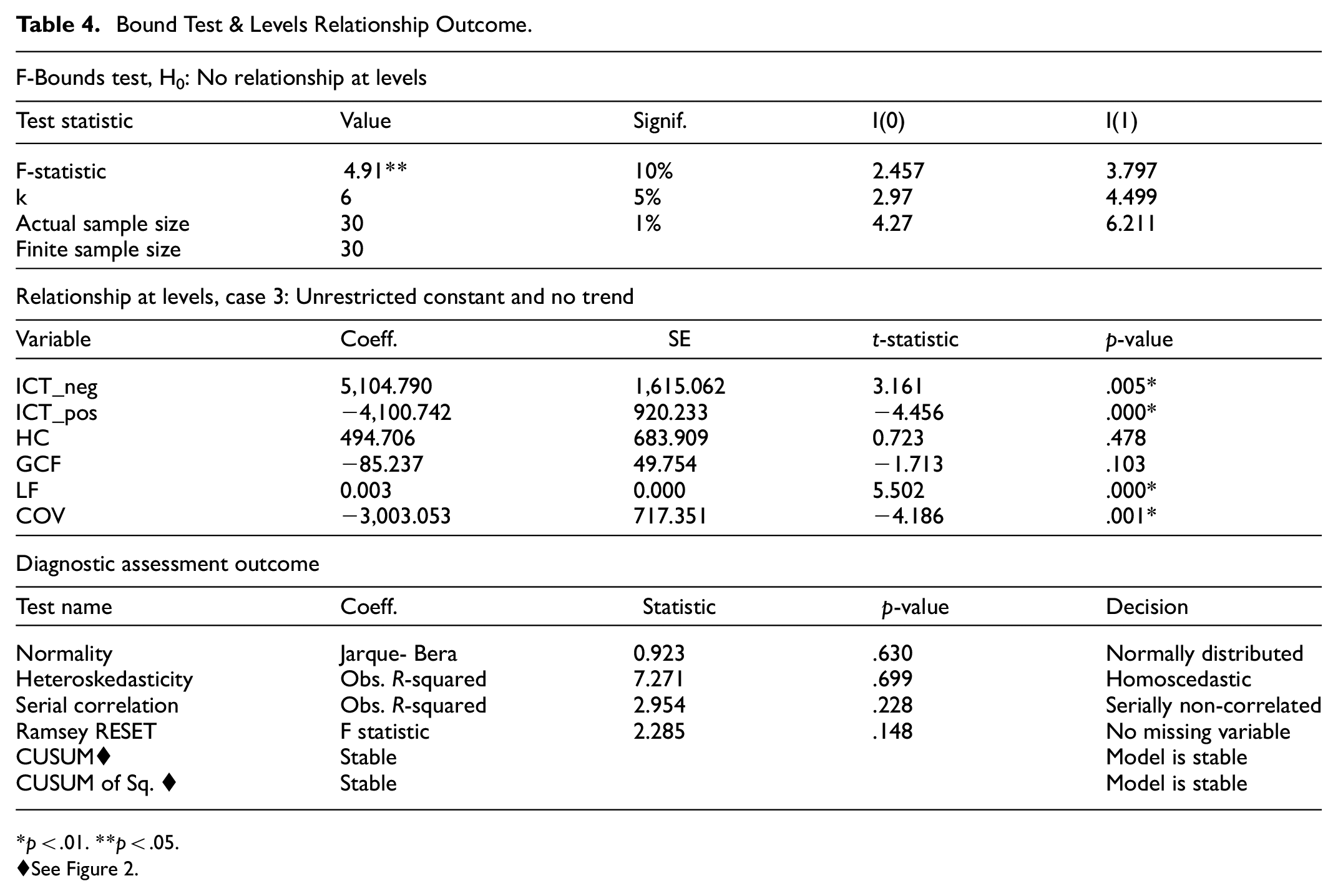
The bound test format of the NARDL approach is employed following an automatic “Akaike info criterion (AIC)” criterion with a maximum of 2 lags for the dependent and 1 for all explanatory variables. Based on the above criteria, the order of the selected model appears to be ARDL (1, 1, 1, 0, 0, 1, 0). The model is assessed based on the bounds test strategy, and the long-run levels relationships among the variables are reported in Table 4.
Bound Test & Levels Relationship Outcome.
p < .01. **p < .05.
◆See Figure 2.
The bounds test F-statistic value for a finite small sample of 30 [4.91] is larger than the critical value at the 5% level, rejecting the plausible null hypothesis that there are no level relationships among the variables. As a result, the variables are cointegrated and have a stable long-run relationship.
An assessment of the parameters of a long-run stable relationship among the variables reveals that ICT_neg generates a positive constant at a 1% significance level, indicating its positive contribution to the EG of the country. It means that the use of ICT in the Kingdom might be at a very high level, and a negative shock to it is causing a positive impact on economic expansion. While ICT_pos yields a negative constant at the same significance level, causing a downward revision in the income per person. It indicates that the growth of ICT cannot bring about any positive contribution to EG, perhaps because the required skilled human capital to administer and utilize the ICT instruments is lacking in the Kingdom. This is evident from the positive and insignificant coefficient of HC. The impacts of ICT_neg and ICT_pos are opposite, and there is an apparent asymmetry between them. Moreover, the magnitude of the positive constant (5,104.79) is much greater than the magnitude of the negative constant (−4,100.742). Eventually, ICT’s overall impact on EG will likely be positive. Nonetheless, the Kingdom may tap the fuller benefit of ICT expansion if properly managed and utilized. An important implication arises from the finding that policymakers must apprise the existing ICT infrastructures and use them rationally to tap optimum benefits.
As mentioned, HC produces a positive coefficient, which is insignificant to bring about any contributory effect on EG. Even though the Kingdom has been generous in allocating much-needed finance to the education and health sectors, their impacts on EG are yet to be realized. A conceivable explanation of HC’s insignificant contribution to EG may be owing to inadequate practical skills among the populace. The outcome is directly in line with Islam and Alhamad (2023), which highlighted a positive but insignificant impact on human capital (tertiary enrollment ratio) on EG in Saudi Arabia. However, our findings contradict Almutairi (2023), who reported that the gross tertiary education enrollment ratio and scholarships have a negative and significant influence on EG, and mean years of schooling have an adverse but insignificant effect on EG in the Kingdom. The outcome also differs from Islam (2020a, 2020b, and 2020c), who reported a positive contribution of HC to EG in South Asia and Bangladesh. Hence, the policymakers of the Kingdom must find a way to enhance the quality of HC through practical training and education.
GCF yields a statistically insignificant coefficient, exercising no influence on EG. The outcome is consistent with Islam and Alhamad (2023) and Islam (2021), who reported the non-contribution of physical capital to EG in Saudi Arabia. However, it differs from Islam et al. (2022a), who found a positive contribution of capital formation on EG. The constant generated by LF is positive and significant, indicating its usual affirmative contribution to EG. The result aligns with previous studies by Islam et al. (2022a, 2022b) and Islam (2021), who found the labor force’s positive contribution to EG. Historically, the Kingdom has been constrained by a skilled labor force, and as a result, it largely depends on emigrant workforces to ensure smooth economic events (Islam, 2021).
The negative and highly significant coefficient of COV indicates that COVID-19 hampered the usual economic activities in the Kingdom severely, which harmed income per person. For instance, in 2018, the preceding year before the outbreak of the pandemic, the GDP per person was 19,329 US$, which decreased to 18,956 US$ in 2019, further reduced to 18,086 US$ in 2020, and in 2021 it increased to 18,696 US$ but has yet to reach the pre-pandemic level (World Bank, 2022). Thanks to the practical and generous measures taken by the Kingdom, the economy has bounced back to its familiar economic environment since 2022. Hopefully, it will reach and even surpass the pre-pandemic level soon.
A set of necessary diagnostic assessments are also accomplished, and their results are reported in Table 3. The outcomes of diagnostic assessments reveal the long-run model to be normally distributed, homoscedastic, serially uncorrelated and stable, and missing no determining variable. Thus, the estimated long-run NARDL model is suitable.
Shor-Run Outcome
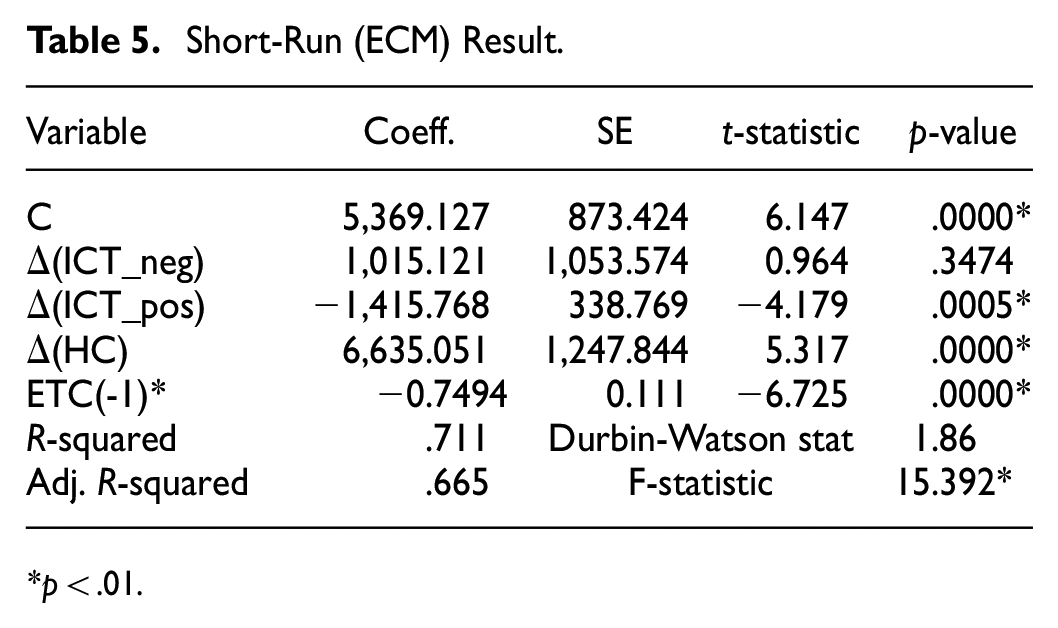
The short-run outcome of the NARDL assessment is produced in Table 5. ICT adverse shocks generate no significant influence on EG in the short run as opposed to the long run. ICT positive waves negatively impact EG, similar in the long run.
Short-Run (ECM) Result.
p < .01.
The impact of HC on EG remains positive in the short-run, contrasting with its long-run influence on the latter. The size of ETC is negative and less than one, which confirms the cointegration among variables and ensures a speed of 74.94% per year for the long-run stable connection.
Robustness Assessment Outcome
In addition to the NARDL bounds assessment, a robustness check is carried out employing three variants of the cointegrating regression approach. Their outcomes are exhibited in Table 6, and the NARDL outcomes provide a space for easy comparison.
Robustness Check by Cointegrating Regression Outcomes.

p < .01.
The outcomes of cointegrating regressions are closely similar to those of the NARDL. ICI has an asymmetric and positive contribution to EG based on the FDOLS, DOLS, and CCR approaches. The impact of the labor force is positive and significant based on all three cointegrating regression techniques. At the same time, the contributions of HC and GCF to EG remain insignificant, and COVID-19 affected EG negatively. Thus, the cointegrating regressions confirm the robustness of the NARDL outcomes.
Conclusion and Policy Recommendation
The preceding sections have examined the asymmetric relationship between ICT diffusions and EG in Saudi Arabia in an augmented two-factor growth model, enhanced by ICT utilization, HC, and COVID-19. We have defined ICT as a composite index of five proxy indicators, FBS, IUI, MCS, FTS, and MHE, and linked with GDP growth per person. Away from linear analysis, a nonlinear asymmetric analysis is explored using the NADRL technique, which is further complemented by the cointegrating regressions.
The NARDL bounds test reveals an association among variables over the long term. Both the positive and negative waves of ICT affect EG; negative waves affect positively, and positive waves negatively, with an overall affirmative effect. Thus, ICT has been a source of EG in the Kingdom, and yet it has room to harmonize between various types of ICT diffusions to tap the maximum out of it. The labor force has its usual positive contribution to EG, while HC and GCF fail to realize their desired role in EG. COVID-19 brought about a disorder in the country’s economic affairs and reduced economic output, weakening EG. The NARDL outcomes are compared with the outputs of three cointegrating regressions, which generate similar results and acknowledge the robustness of the NARDL findings.
The study’s findings imply that in order to maximize benefits, policymakers should be aware of current ICT deployments and make judicious use of them. To maximize the benefits and have a beneficial effect on EG, they must figure out how to improve the quality of HC through efficient training and education.
Limitations and Future Track
This research is confined to Saudi Arabia only. A similar study may be executed for other countries. Any future effort may consider even a panel investigation on the GCC nations or other groups of countries.
Footnotes
Acknowledgements
Not applicable.
Declaration of Conflicting Interests
The author(s) declared no potential conflicts of interest with respect to the research, authorship, and/or publication of this article.
Funding
The author(s) disclosed receipt of the following financial support for the research, authorship, and/or publication of this article: The authors thank the University of Ha’il for its financial support. This research has been funded by the Scientific Research Deanship at the University of Hail, Saudi Arabia, through a project numbered RG-23 017.
Ethics Approval and Consent to Participate
Not applicable.
Consent to Publish
Not applicable.
