




Abstract
The new world of work has seen many employees adapting to the dynamics of working from home. With the change in location, the factors that promote employee thriving while working have altered as well. Drawing on the literature on thriving and broaden-and-build theory, this research examines how family-work affect helps employee thriving through increased exploration, with conditional effect of ambidextrous leader. Based on two studies (n = 483), results confirm the proposed model. In Study 1, the mediating effect of exploration in the relationship between family-work affect and thriving is supported on a sample of university students. Study 2 corroborates the mediating effect and supports the moderating role of ambidextrous leadership among employees. Specifically, the positive effects of family affective experiences on an individual’s exploration were greater under high levels of ambidextrous leadership behaviors. The practical recommendations offered are intended to increase thriving while working from home.
Introduction
Remote work is an established working arrangement, however its implementation was questioned due to decreased collaboration and decreased work pace (Simons, 2017). When working remotely, either from home or another offsite location, employees can experience professional or social isolation due to less in-person (in)formal communication at work (Brunelle & Fortin, 2021; Choudhury, 2020). The importance of social relationships in remote work received further attention in 2020 due to the global COVID-19 pandemic. Past research suggests that trusting relationships and social connectivity create a nurturing environment which enables people to thrive (Carmeli & Spreitzer, 2009) in the classical workplace setting. Thriving at work is defined as a “psychological state in which individuals experience both a sense of vitality and a sense of learning at work” (Spreitzer et al., 2005, p. 538), and is experienced subjectively, affected by social surroundings at home and work, thereby contributing to psychologically healthy workplaces (Spreitzer & Hwang, 2019).
According to Spreitzer et al. (2005) in order for individuals to thrive in an office, they need to behave agentic, and receive both support and resources produced in the doing of work. Yet, when working exclusively from home the conditions for thriving might differ considerably. Grounded in the “broaden-and-build” theory (Fredrickson, 2004), maintaining positive affective states at home may help build novel and creative actions, ideas, and social bonds, which in turn build resources such as knowledge and health (Fredrickson, 2004). More specifically, family-work affect could have an impact on employee performance and explorative behaviors during remote work (Yamaguchi et al., 2020). Aside from family, leaders can also play an important role in mitigating the negative effects of unexpected changes in the work environment (Kraft, 2018). That said, the factors that increase employee thriving while working from home (i.e., working remotely) have thus far not been sufficiently explored.
In this paper, we propose and test a conceptual model, where family-work affect will increase thriving at work through the mediating role of exploration at work (Spreitzer et al., 2005). Moreover, we hypothesize a moderating role of ambidextrous leadership, which reflects a leader’s ability to motivate employee explorative and exploitative behaviors and flexibly switch between both (Rosing et al., 2011). We situate these hypothesized relationships in a remote (i.e., home) work setting, testing them on two samples: students, who are attending classes and studying exclusively remotely and employees working exclusively remotely. Following previous studies (Schaufeli et al., 2002), we assert, that the substitution of studies at the university for work (in terms of thriving at work) is not problematic, as students perform daily activities in their studies at the university, which is fundamental for their role. Moreover, the rationale behind our choice of samples was examination of contextual embeddedness of thriving across two major populations, which were most effected by working from home due to COVID-19 restrictions (Cao et al., 2020). The hypotheses are grounded in the socially embedded model of thriving at work (Spreitzer et al., 2005) and the broaden-and-build theory (Fredrickson, 2004).
This research intends to make the following contributions to the existing literature: firstly, we are responding to calls by Russo et al. (2018) to explore the effect of family-work enrichment on thriving, whereby we focus on positive affective experiences at home, which help employees to be more engaged during remote work (Yamaguchi et al., 2020). Here, rather than work affecting family roles, we are interested in how family factors influence positive work outcomes, as the family becomes an employee’s key stakeholder in the remote work domain. Secondly, in the work-family enrichment literature, we address the call in McNall et al. (2010) for more work to examine the individual effects of the specific dimensions of family-to-work enrichment on different outcomes (McNall et al., 2010). More specifically, our research investigates the role of family-work affect, the most prominent dimension of family-work enrichment (Jaga & Bagraim, 2011). This complements existing literature family-to-work constructs, as family-work affect are significantly less studied than work-to-family constructs. Thirdly, Spreitzer and Hwang (2019) called for research to focus on the role of leaders in promoting thriving. In this study, we provide a more nuanced understanding of how leaders can stimulate employee exploration by introducing ambidextrous leadership as a moderator in the thriving literature. Ambidextrous leadership behavior has thus far been linked exclusively to employee innovative behaviors (Gerlach et al., 2020), however here we situate it in a different context. Finally, to the best of our knowledge, this is the first research focusing on thriving at work in a remote work/study setting (i.e., at home), which is predicted to become more common even after the end of pandemic (Ozimek, 2020). This is important, because factors facilitating thriving at home may be different from factors affecting thriving at work.
Theoretical Background
Thriving as conceptualized by Spreitzer et al. (2005), stems from agentic work behaviors, such as task focus, exploration, and heedful relating. Existing research, which has focused exclusively on thriving with employees in physical offices, has found that perceived organizational support, various leadership practices (Kleine et al., 2019), relationships at work (Carmeli & Spreitzer, 2009), other work resources, and positive relationships contribute to thriving. The concept of thriving in turn increases well-being (Yousaf et al., 2019), job satisfaction, and positive attitudes toward self-development (Kleine et al., 2019), to name a few. When employees work remotely, and specifically from home, the factors contributing to thriving may change. Specifically, the novel work surroundings, both in terms of physical and psychological atmosphere, becomes paramount for employees. In this paper, we focus on the psychological atmosphere, namely positive affective experiences and leader support, as positive emotions and social support were recognized as most important factors in mitigating negative effects of the pandemic (Yamaguchi et al., 2020).
Firstly, broaden-and-build theory explains that positive affect moves individuals forward and helps them to get onto the higher ground of optimal well-being, helping them to be more creative, knowledgeable, resilient, socially integrated, and healthier (Fredrickson, 2004). The positive (and negative) state-based specific affective reactions evidently move across domains, proving reciprocal impacts between domains (Eby et al., 2009). This positive affective states further trigger state-based global affective reactions, which are considered as consequences of work-family (or family-work) experiences, like job satisfaction, family satisfaction, and well-being (Eby et al., 2009). In the light of remote work and positive affective resources, we consider family-work affect as the driver of a remote worker’s exploration and thriving.
Secondly, based on Spreitzer et al. (2005) model of thriving, one of basic contextual features that enable people to thrive through agentic work behaviors is adequate supervision. When shifting to remote work, leaders have to navigate employees through the process in order to effectively adapt to the new working environment (Kraft, 2018). This calls for ambidexterity in managing the process of defining work strategies for remote work. Ambidextrous leadership, a more recent concept, is conceptualized by opening leader behaviors, which foster employee exploration, and closing leader behaviors, which foster employee exploitation (Rosing et al., 2011). However, it is also able to switch flexibly between both these leader behaviors, as required by the given situation (Rosing et al., 2011), especially in challenging contexts (Kraft, 2018). In the next two sections we will provide further theoretical rationale on moderating and mediating roles, as presented in Figure 1.
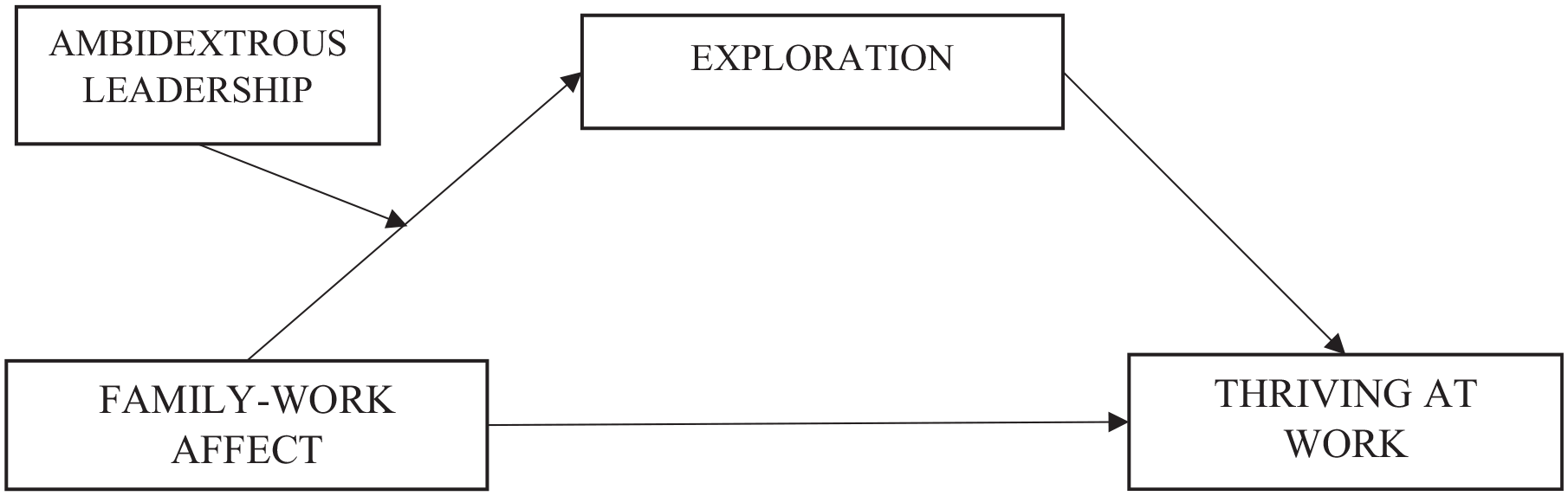
Proposed conceptual model.
The Mediating Effect of Exploration Between Family-Work Affect and Thriving
When working at home, a person’s family role and work role are physically intertwined, allowing for the possibility of enriching each other in the form of positive affect. Eby et al. (2009) note the importance of positive affective states, having reciprocal and cross over effects on work and family. The positivity that arises due to the caring and loving emotions received from one’s family helps individuals feel more enthusiastic, alert, and energetic, and in turn they can more efficiently transfer these positive resources from the family to work domain (Greenhaus & Powell, 2006). Family-work affect occurs when involvement in one’s family results in positive emotional states that help the individual to be a better worker (Kacmar et al., 2014). These positive emotions help employees to simply perform better, giving them better perceptions of their work, co-workers, leaders, and even organizations. However, in a remote work setting the resources from work might be mitigated by the spatial separation that occurs, especially due to blurred boundaries between work and family domains. Thus, the increase in importance of a positive relationship between family and work in a remote setting becomes inevitable, and this is why the impact of an employee’s family in a remote setting should be addressed.
We propose that exploration, which involves experimentation, risk-taking, discovery, and innovative behaviors (Spreitzer et al., 2005), will mediate the relationship between family-work affect and thriving during remote work. A recent meta-analysis found that individuals explore more in enabling contexts and conditions, where they have sufficient personal and social resources (Goh et al., 2021; Liu et al., 2021). According to the broaden-and-build theory, the spiral of positive affective resources (i.e., family-work affect) will have an important influence on exploration (Fredrickson, 2004), and previous research reported that positive affect and openness to experience were the strongest predictors of employee exploration (Zacher et al., 2016). When employees engage in exploration, they explore new ways of working, by encountering novel ideas, information, and new strategies to achieve their work goals (Spreitzer et al., 2005). Exploration is also beneficial for organizations, as the amount of knowledge available increases, which in turn positively influences the attitude toward knowledge-sharing (Baburaj & Kumar, 2021). In the context of remote work this may not only include exploring new tasks and solutions, but also new ways of working in terms of technology and managing the work environment in the home setting.
We argue that positive affective states will propel remote workers to engage in more exploratory behaviors, as proposed by the broaden-and-built theory (Fredrickson, 2004). The daily experience of positive emotions from the family will help build positive interpersonal relationships, motivating employees to experiment and try new things. The positive feelings received from one’s family during remote work are even more important during the COVID-19 pandemic (Yamaguchi et al., 2020). Therefore, as remote workers receive positive affect from their family members, they would broaden their thoughts and actions at work, becoming more interested in adopting an explorative mindset in their work role, along with increasing their willingness to try novel solutions to work challenges (Fredrickson, 2004). In turn, a wider breadth of alternative solutions will enable them to learn on the job, and meaningful relationships due to the positive affect experienced at home will make them more energetic, thereby enabling thriving, as stated in the following hypothesis:
H1: Exploration mediates the family-work affect—thriving at work relationship.
The Conditional Effect of Ambidextrous Leadership
Next, we hypothesize that ambidextrous leadership, as contextual enabler of thriving (Spreitzer et al., 2005), will moderate the relationship between family-work affect and exploration. Leaders play an important role in employee thriving, and research suggests that leaders should provide enough support and autonomy to employees in order to enable their thriving (Liu et al., 2021). Recent research on leadership during the COVID-19 pandemic shows that employees working from home need flexibility on the one hand, and supervisor support on the other (Lee, 2021). Employees expressed that it is important to have some level of freedom while they work remotely, but also need established routines and support from their leader, as long as it does not become micromanagement (Lee, 2021). Moreover, research about the workplace in the future notes that successful leaders need to understand how to be ambidextrous during and after COVID-19 pandemic—knowing when to be tight or loose in their behavior toward their employees (Kniffin et al., 2021). Therefore, due to importance of flexibility in leadership behaviors during uncertain circumstances, we present ambidextrous leadership as a contextual driver of employee thriving, through its moderating effect on the relationship between family-work affect and exploration.
Ambidextrous leadership encapsulates opening and closing behaviors performed by leaders, which in turn foster exploration and exploitation in employees (Rosing et al., 2011). Rosing et al. (2011) interpret opening leader behaviors as allowing employees to accomplish tasks in different ways, encouraging experimentation, motivating risk-taking, raising the possibilities of independent thinking and acting, creating room for a person’s own ideas, allowing errors to be made, and encouraging learning from them. In contrast, closing leader behaviors help in establishing routines, controlling goal attainment, taking corrective actions, controlling adherence to rules, paying attention to uniform task accomplishment, sanctioning errors, and sticking to plans. Ambidextrous leaders exhibit a temporal flexibility, which is the ability to switch between both behaviors as the situation requires (Rosing et al., 2011). Ambidextrous leadership has previously been linked to innovation performance (Gerlach et al., 2020), creativity (Tung, 2016), and job crafting (Luu et al., 2019). Most recently it was also explored as an antecedent of thriving (Usman et al., 2022), although here we conceptualize its moderating role. We assume that ambidextrous leaders, recognized as an example of the basic contextual feature of agentic work behaviors, would further help build the resources, needed to experience exploration during the pandemic (Spreitzer et al., 2005).
Ambidextrous leadership is recognized as an antecedent of employee exploration in its theoretical conceptualization (Rosing et al., 2011), and based on Spreitzer et al.’s (2005) socially embedded model of thriving, leadership practices serve as a contextual feature that fuels employee agentic work behaviors, which in turn are reflected in thriving. Therefore, in the scope of our study we assert that the opening and closing behaviors of ambidextrous leaders will strengthen the positive relationship between family-work affect and thriving through exploration. The two opposite behaviors in ambidexterity help encouraging different ways of thinking and applying new practices in the changing workplace, which in a way is similar to the highly unpredictable and complex innovation processes (Rosing et al., 2011). Leaders that will engage in ambidextrous leadership behaviors will be more involved in the process, which will help employees to feel that they have the ability to cope and make sense of the new situation, encouraging them to explore (Kashdan et al., 2004). If leaders are not ambidextrous, they can either exhibit opening or closing behavior, being unable to flexibly switch between the two. Most importantly, ambidextrous leadership has been recognized as an approach that is well-suited to deal with more complex challenges in the organization, and is considered as leadership practice that promotes employee well-being (Kraft, 2018). Thus, if some leaders would engage only in closing behaviors, controlling and directing employees when working from home, it would result in extensive exploitation of employees rather than giving space to employee creativity (White, 2010). Oppositely, if leaders would give employees the complete freedom of performing work related tasks, not monitoring their goal attainment, giving no structure, it could result in overwhelmed and confused employees. Therefore, it is important for leaders to know when to use particular behavior in particular situations, in order to balance employee performance at work.
We hence suggest that the positive relational resources produced by family-work affect and a contextual feature in terms of support from ambidextrous leader will help employees to feel more explorative. This is in line with the broaden-and-build theoretical underpinning of this work: employees who are able to nurture positive emotions in relation to others are more open to possibilities, being more susceptible to leader behaviors, which in turn provides the opportunity for employees to explore their work tasks more extensively (Fredrickson, 2004; Spreitzer et al., 2005). Ambidextrous leaders will further help organizations to remain adaptive by integration of external and internal knowledge, cultivating employee learning (Luu et al., 2019), which makes people feel more energetic (Spreitzer et al., 2005). Therefore, based on the broaden-and-build theory of positive emotions with interlaced basic tenets of socially embedded model of thriving, we hypothesize:
H2: Ambidextrous leadership behavior moderates the indirect effect of family-work affect on thriving at work via exploration, such that the indirect effect will be stronger (weaker) at higher (lower) levels of ambidextrous leadership behavior.
Overview of Studies
Study 1 examined a mediation model (H1), which was tested on the sample of university students involved exclusively in online learning, using cross-sectional methodological design with self-reported data. In accordance with previous research (Schaufeli et al., 2002), studying is considered as main work task for students.
In Study 2, our sample consisted of employees who were working from home during the pandemic. In addition to replicating the mediating effects, we further extend the mediation model by exploring of the notion of workplace support during remote work (H2) in form of ambidextrous leadership. This leadership construct is included only in the second sample, as it refers to behaviors that are exhibited by the immediate supervisor at work, which is not the case at the university. Therefore, we could not measure ambidextrous leadership in sample 1, as university students do not have immediate supervisor.
Data collection for both studies was carried out at the end of 2020 and beginning of 2021, when lockdown measures were in place in Europe (BBC News, 2020). Data for Study 1 were collected by the authors, while data for Study 2 were gathered through an online provider. Detailed sampling frames are presented in method section of each study.
Study 1
Method
The participants of this study are university students from a triple accredited business school in a European country, who were recruited through an online course and were at the time studying exclusively remotely, but did not have any experience with online studies before the COVID-19 pandemic. The students were invited to participate in a study on remote study experience by their course leaders, and received a link for the survey through course webpage. Participation was completely voluntary and students did not receive any credits for participation. No personal data was required, and thus the anonymity of responses was assured. Informed consent was obtained from all participants. The final sample comprised a total of 169 responses, with an average age of 20 years (SD = 1.45), with 65% being female and 35% male.
Measures
Validated and established scales were used for measurement of the core variables. If not stated otherwise, a 5-point Likert scale was used, ranging from 1—strongly disagree to 5—strongly agree. The respondents were asked to think about their current situation at the school and focus on their experiences with online learning.
Thriving at Work
Thriving was measured using a thriving at work scale (Porath et al., 2012) adapted for the study context. The original measurement scale asks employees to reflect on their regular experience with work. To capture the regular student experience, whose “work” (i.e., main occupation) is represented by their studies (Schaufeli et al., 2002), they had to reflect on their regular experience with online studying. Therefore, we also replaced “work” with “school” to represent the context appropriate for each population. One sample item used in the survey is: “At the school while experiencing online education, I find myself learning often”. As suggested by Porath et al. (2012), we have used aggregated scores from both dimensions to represent thriving. The Cronbach’s alpha is .92.
Family-Work Affect
This construct was measured using items assessing the family-work affect, a subscale of the family-work enrichment scale (Kacmar et al., 2014), which was adapted for students. The original scale asks participants how involvement in their family helps them to be a better worker. Similar to the above, participants in this study were asked to think about their school and family nexus, where we replaced work with a school-related aspect. A sample item is: “My engagement and active participation in my family puts me in a good mood and this helps me be a better student.”. The Cronbach’s alpha is .96.
Exploration
Exploration was measured by the curiosity and exploration inventory (Kashdan et al., 2004). This measurement of exploration was used by previous studies, which addressed exploration as an agentic work behavior in context of Spreitzer et al. (2005) model of thriving at work (Porath et al., 2012; Sia & Duari, 2018). A sample item is: “I would describe myself as someone who actively seeks as much information as I can in a new situation”. The Cronbach’s alpha is .72.
Control Variables
We used student age, gender, experience with work (in months), and GPA (Ozcan et al., 2021) as control variables.
Results
In Table 1, we present descriptive statistics and correlations between the study and control variables.
Descriptive Statistics and Correlations (Study 1).

p < .05. **p < .01. ***p < .001
H1 proposed the indirect relationship in the mediated model. We have tested the indirect effect with SPSS PROCESS model 7, using 95% bootstrap confidence intervals (95% CI, 5,000 resamples). The results in Table 2 show, that family-work affect was positively related to exploration (β = .20; p < .000), and exploration was positively related to thriving (β = .60; p < .000), when controlling for family-work affect. The direct effect of family-work affect on thriving is 0.15 (95% CI [0.04, 0.25]) which provides evidence that the mediation model is significant (Hayes, 2017). Controlling for exploration, those who experience greater family-work affect will experience higher levels of thriving. The indirect effect of the mediation is 0.12, with (95% CI [0.06, 0.18]), meaning that as one experiences higher family-work affect, it will result in higher levels of thriving through exploration, where those who experienced more affect, will feel more explorative and consequently thrive more. As such, the results support H1.
Results of the Mediation Analysis (Study 1).
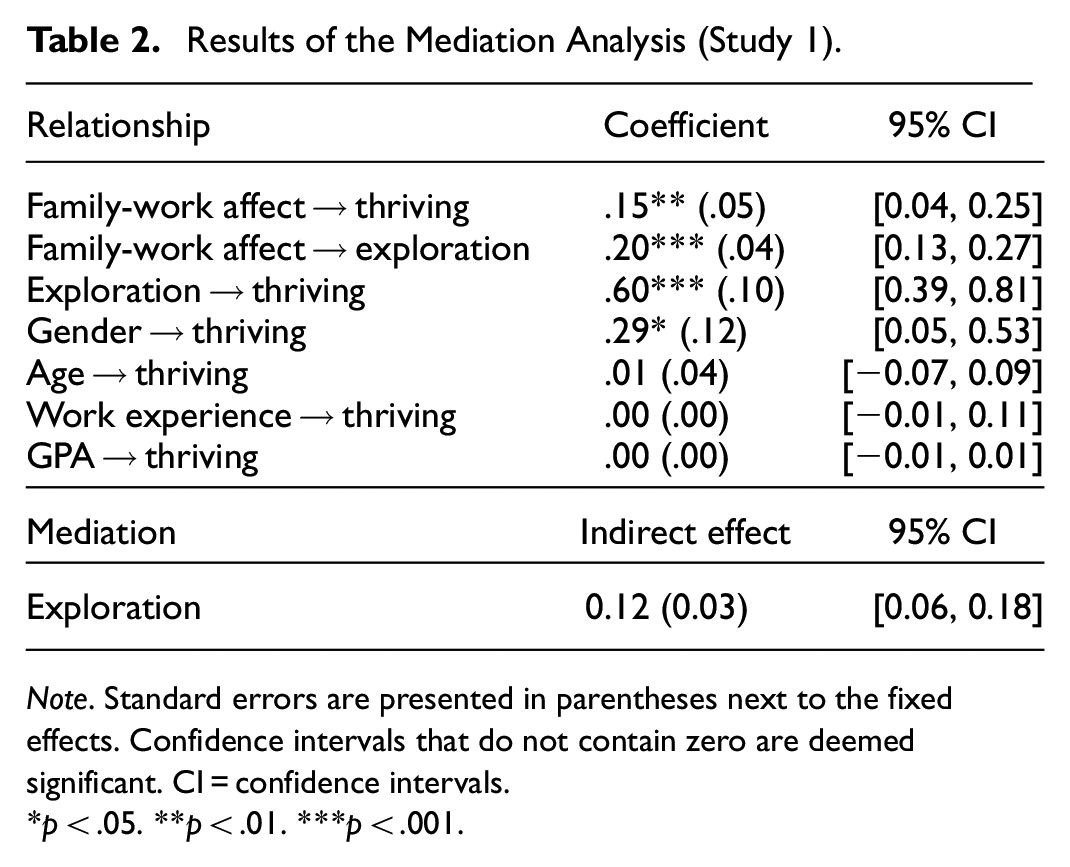
Note. Standard errors are presented in parentheses next to the fixed effects. Confidence intervals that do not contain zero are deemed significant. CI = confidence intervals.
p < .05. **p < .01. ***p < .001.
Study 2
In Study 2 we conducted research on sample of employees, who have been working from home during the pandemic full time, and have never worked remotely before the pandemic. Moreover, they all lived with their romantic partner, which was prerequisite to assess the family-work affect.
Method
The participants of this study were recruited online, through Prolific Academic, where participants are recruited for scientific purposes. Prolific Academic is recognized as superior to alternative platforms, due to the high quality of the participants it enables (in terms of honesty, diversity, and being less exposed to common research tasks; Peer et al., 2017). Our sample comprises remote workers from a European country, who have shifted to working exclusively from home since the first wave of the COVID-19 pandemic. Prior to actual data collection, we performed initial screening of participants to assure a representative sample of the target population. Through screening, the included participants were: (1) working from home every day, but rarely worked from home before COVID-19 (less than 1 day a week) and (2) living with a spouse/partner. Informed consent was obtained from all participants. Anonymity was assured and participants could withdraw from the survey at any point. The final sample comprised a total of 314 responses, with an average age of 36 years (SD = 0.48), with 63% being female and 37% male.
Measures
The same scales were used to measure the main constructs as in Study 1, whereby the items reflected the home working context of employees. The Cronbach’s alphas in Study 2 are .91 for thriving at work, .95 for family-work affect, and .72 for exploration.
Ambidextrous Leadership
Ambidextrous leadership behavior was assessed with scale of opening and closing behaviors (Zacher & Rosing, 2015). Participants were instructed to assess how often their direct supervisor has behaved in certain ways over the past few months. Sample item is: “My supervisor allows different ways of accomplishing a task”. The items were answered on 5-point Likert scale ranging from 1—never to 5—frequently, if not always. The Cronbach’s alpha is .83.
Control Variables
We used employee age, gender, education, and tenure as control variables, as suggested by previous research in relation to thriving (Carmeli & Spreitzer, 2009). We further added participant’s family conditions as controls (age of youngest child in household and caregiving responsibilities for elderly family members), due to the nature of the context of the research in remote work setting due to the pandemic.
Results
In Table 3, we present descriptive statistics and correlations between the study and control variables for Study 2.
Descriptive Statistics and Correlations (Study 2).

p < .05. **p < .01. ***p < .001.
Both hypotheses were tested in Study 2, using the two stage process of Preacher and Hayes (2004), through SPSS PROCESS (model 4 and 7). The first stage tests the indirect relationships of mediation model (H1). The next stage was testing the moderated mediation model (H2), involving inference testing of the moderator. Same confidence intervals were used as in Study 1.
The results of H1 in Table 4 show that the indirect paths between family-work affect and exploration (β = .11; p < .01); exploration and thriving (β = .40; p < .000) are statistically significant. Moreover, the indirect effect of mediation is significant with indirect effect of 0.04 (95% CI [0.01, 0.09]). We again confirm the H1 with the Study 2 results.
Results of the Mediation Analysis (Study 2).

Note. Standard errors are presented in parentheses next to the fixed effects. Confidence intervals that do not contain zero are deemed significant. CI = confidence intervals.
p < .05. **p < .01. ***p < .001.
The results of the second stage of the analysis are presented in Table 5, and these show that while keeping family-work affect and the covariate variables constant those employees relatively high in exploration report higher levels of thriving relative to those with lower exploration (β = .40, p < .000). Results for H2 indicate that ambidextrous leadership in fact moderates the relationship between family-work affect and exploration (β = .14, p < .05). The plotted interaction of moderating relationship is presented in Figure 2.
Results of the Moderated Mediation Analysis (Study 2).

Note. Standard errors are presented in parentheses next to the fixed effects. Confidence intervals that do not contain zero are deemed significant. CI = confidence intervals; X = independent variable; W = moderator.
p < .05. **p < .01. ***p < 0.001.
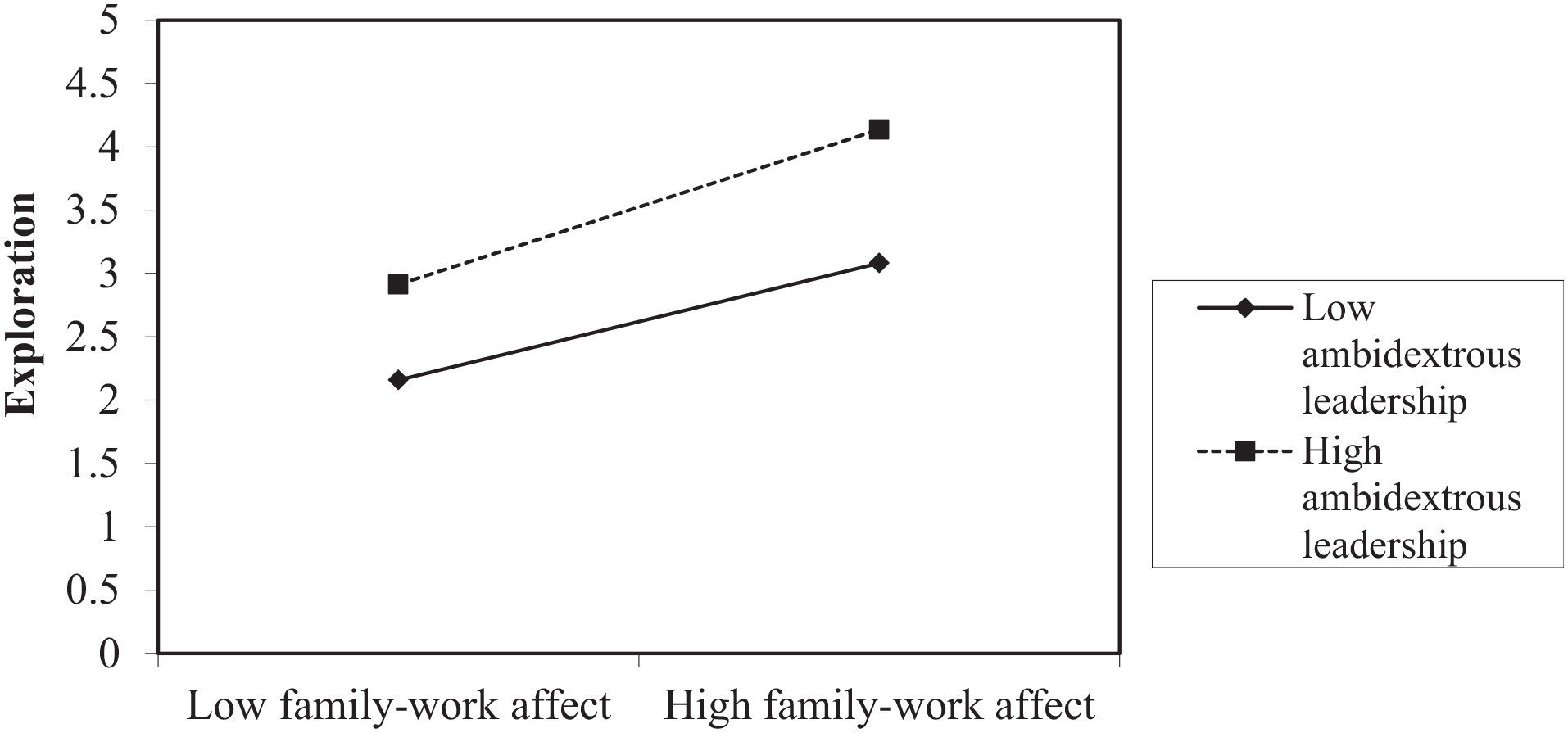
Moderating effect of ambidextrous leadership on the relationship between family-work affect and exploration.
The results further suggest that the mediating role of exploration in the relationship between family-work affect and thriving was conditional on employees experiencing average (95% CI [0.01, 0.08]) to high (95% CI [0.03, 0.13]) levels of ambidextrous leadership. For those employees with experience of low levels of ambidextrous leadership, there was no statistically significant relationship between family-work affect and thriving through exploration. To sum up, employees who experience higher levels of ambidextrous leadership behaviors from their leaders the indirect effect increases, as the index of moderated mediation is positive and significant (index = 0.06; 95% CI [0.01, 0.11]). H2 is therefore supported.
Discussion
This research investigated the antecedents of thriving in the context of working from home. Testing a mediation and a moderated-mediation model in two studies, we show that family-work affect increases thriving. Family-work affect also motivates student and employee exploration, as positive affect helps them to get new ideas at work or during online studies, while more exploration enables them to thrive. Moreover, ambidextrous leaders who are highly present in the remote work setting enable employee exploration, promote higher levels of thriving due to this conditional indirect effect of the first-stage moderator. With this research, we provide several important contributions, examining which factors contribute to thriving in a remote work setting.
First, we established family-work affect as a novel predictor of thriving. Previously, research connecting the relationship between thriving and the work-family interface focused on work-family conflict and thriving, with a spillover effect from helping one’s neighbors (Zhang et al., 2020), and a mediating effect of work-family enrichment on family supportive supervisors and their effect on thriving (Russo et al., 2018). However, the current research takes one step further, by proving the positive impact of family-work affect in remote work context. With this knowledge we contribute to the work-family enrichment theory, as positive family-work affect is a part of the family-work enrichment dimension. When family-work affect is experienced during remote work, it helps employees to be better worker increasing their ability to thrive at work. With this, we responded to the call of Russo et al. (2018) to research the relationship between family-work enrichment and thriving, and that of Greenhaus and Powell (2006) to address specific experiences using the work-family enrichment theoretical model. Moreover, a recent systematic review on thriving highlighted that agentic work behaviors stem from personal and social resources (such as the family-work affect), although this has not been extensively tested thus far (Goh et al., 2021). Therefore, by examining the mediating role of exploration in the family-work affect–thriving relationship, we also complement literature on thriving at work.
Second, we complement the literature on family-work enrichment by measuring only the affective dimension of the family-work enrichment construct, because McNall et al. (2010) called for more research measuring separate dimensions, rather than the overall family-work enrichment construct in order to understand the relationships between the dimensions of enrichment and the various outcome variables. Moreover, Jaga and Bagraim (2011) reported that affect was the strongest dimension of family-work enrichment, helping employees increase their quality of work role. Our research thus adds to the importance of family-work affect in organizational research.
Third, our research offers additions to the ambidextrous leadership literature in two ways. On the one hand, we establish ambidextrous leadership as a moderator in the relationship between family-work affect and exploration, in which context it has never been studied before. Thus our research expands the current domain of ambidextrous leadership outcomes focused on innovative behaviors (Gerlach et al., 2020) to the family-work interface and agentic work behaviors. Our research proves that employees who have leaders who are highly engaged in ambidextrous behavior, explore more when experiencing family-work affect during remote work. On the other hand, we extend these relationships to the outcome of thriving. Some very recent research addressed the mediating role of thriving in the ambidextrous leadership—innovative behavior relationship (Usman et al., 2022), but we examined conditional effects of ambidextrous leadership. This is in line with call for future research on how leadership practices might promote thriving (Spreitzer & Hwang, 2019). Our results further confirm the important role of the leader during remote work, as the higher the level of ambidextrous leadership, the stronger the indirect effect of family-work affect on thriving, via exploration. Kraft (2018) emphasizes the relevance of ambidextrous leadership when organizations are facing complex challenges, and it plays an important role in uncertain circumstances, such as those that arose during the global pandemic, where we faced many complex challenges. Therefore, ambidextrous leaders during the pandemic have been able to balance contradicting behaviors, bringing out the best of their employees (Kraft, 2018). As such, we augment the literature on thriving with the novel construct of ambidextrous leadership.
Lastly, we extend the knowledge on thriving by situating it in a non-classical, remote work setting (i.e., home). The pandemic forced organizations to adopt remote work in order to ensure the well-being of their employees, creating additional challenges (Choudhury, 2020). We take this research further by including in our sample remote students who had experienced only online schooling at the university and remote workers who have rarely worked from home before but had to do so due to COVID-19. This provided us with novel information about the factors facilitating thriving in this context. By confirming the hypotheses, we have provided the evidence on the importance of enriching family domains in a remote work setting, with the combination of ambidextrous leadership practices, which are needed for employees to feel vital and learn in the remote work context.
Practical Implications
Our research offers various practical recommendations for HR professionals, leaders, and remote workers. When it comes to an organization’s attempts to increase thriving, it is important for HR professionals to acknowledge the role of family during remote work in order for individuals to thrive, as it is unfeasible to completely disconnect family and work demands due to the integration of both worlds (Pauleen et al., 2015). A more general approach for HR professionals to address all employees regarding positive family emotions in a remote work setting could be sharing some established tips and tricks on how to manage work-life balance during remote work, focusing on the importance of family and/or life, or giving remote workers regular opportunities to engage in positive family roles, but with their work tasks having first been completed. HR professionals could also prepare a campaign that showcases positive family experiences through stories or videos of employees, and how good family relationships can help employees become better, more thriving remote workers.
With their families helping remote workers to become better employees through increased positive affect, they (employees) would feel more energy to engage in exploration. Organizations can also encourage exploration by giving employees the option to decide upon their daily routine during remote work, as exploration consists of experimentation, risk-taking, discovery, and innovative behaviors (Spreitzer et al., 2005). By giving employees the opportunity to balance their family and work obligations in work from home, it will make them more comfortable with exploration at work (Sia & Duari, 2018). The balance should be encouraged not only by the organization but also by managers (Mukanzi & Senaji, 2017). Moreover, those employees who exhibit more exploration are more likely to actively seek information in order to create additional resources, which would consequently lead to more thriving (Spreitzer et al., 2005). HR practitioners can help in increasing exploration in the workplace by having monthly online discussions on best practices regarding company-specific challenges, learning from successful employees in the company. Monthly discussions in remote work could present best practices of time and spatial management in remote work settings, giving remote workers the opportunity to address issues and discuss solutions, as well as for them to actively participate in dealing with such problems, building their skills, and thriving (Spreitzer et al., 2005).
The findings reveal that ambidextrous leaders strengthen employee exploration. Greater flexibility between opening and closing leader behaviors can help employees to explore or exploit innovations at work (Rosing et al., 2011), and it is in the leader’s domain to know what subordinates need the most in this regard. Ambidextrous leaders could identify when employees need more of a routine, and in this case they should exhibit closing behaviors. On the other hand, by giving employees the space for creativity when needed, the leader would exhibit opening behavior. Hence, we suggest that supervisors take time and organize meetings with each employee via phone or other means of communication, such as Zoom or Teams, in order to get their input on work experience during work from home. Supervisors and remote workers could thus together identify the areas where the latter need more monitoring and control with regard to goal attainment, help with routines, and sticking to plans, and where they need space to be creative, experiment, and think and act independently. With this input, leaders could identify where employees need more opening behaviors (e.g., creativity and experimentation), and at which times more closing behaviors (e.g., monitoring and control). With the combination of closed and open behaviors from their supervisors, remote workers will want to explore even more than before, because they will have the feeling that they can be creative, but will still have some support in terms of structure in the relatively unstructured environment when working from home.
Limitations and Future Research
While the present research has its merits, the limitations need to be acknowledged. First, we collected data for one of the studies through the online service Prolific Academic, where participants are paid for their collaboration, and thus may give biased answers in order to receive the reward. However, the online service enabled us to apply multiple screeners in order to target specific participants, an important advantage which helped achieve more nuanced results (Smith et al., 2015). A second limitation is that the scales used were self-reported, which could produce common method bias. In order to mitigate the bias, we incorporated steps suggested by Podsakoff et al. (2012): (1) reducing evaluation apprehension by indicating that the survey is completely anonymous and there are no right/wrong answers and (2) using a marker variable approach, where in both studies no difference in significance between the zero-order correlations and those partialled out by the marker variable were indicated, showing low common method variance risk in the dataset. A third limitation lies in the cross-sectional study design. While this research design does not allow us to establish causality, it is appropriate for conducting studies in novel contexts (such as COVID-19 pandemic). Spector (2019) argues that cross-sectional design is valuable in processes that have already occurred, and the subject of the research is established in the current process. We conducted the studies in end of 2020 and beginning of 2021, when the COVID-19 pandemic had been present for almost a year, and the effects of remote work had already occurred and developed. In this research we focused on family-work affect and did not investigate other dimensions of family-work enrichment. Thus, we propose that in the future the other two dimensions of family-work enrichment are studied in relation to thriving. Overall, both studies were done in context of remote work, so we propose that the model could be tested also in other contexts, such as hybrid work or pre-pandemic work environment, depending on the development of work environments in the future.
Conclusion
In this research, we investigated how family-work affect and exploration at work together with ambidextrous leadership promotes a thriving experience for employees even when working from home. In confirming the moderated mediation model, we hope that this research will help organizations and leaders to understand the role and value of positive affect not only at the office, but also during remote work. With this understanding, both employees and organizations should acknowledge the importance of a positive family environment in the new world of work, and how it can help individuals thrive, and consequently help the business to also perform better.
Footnotes
Declaration of Conflicting Interests
The author(s) declared no potential conflicts of interest with respect to the research, authorship, and/or publication of this article.
Funding
The author(s) disclosed receipt of the following financial support for the research, authorship, and/or publication of this article: Authors acknowledge partial financial support received from the European Union’s Horizon 2020 research and innovation program under Marie Sklodowska-Curie grant agreement No. 734824 for working on theoretical background.
Ethical approval Statement
The authors declare that the research design and data collection for this article were in accordance with the ethical standards of the institutional ethics committee and with the 1964 Helsinki declaration and its later amendments. The questionnaire and methodology for this study were approved by the institution’s Research ethics committee. Informed consent was obtained from all participants.
Informed Consent
Informed consent was obtained from all participants included in the study.
Availability of Data and Material
The datasets generated for this study are available on request to the corresponding author.
