




Abstract
Apart from the traditional Kurdish gender regime, which originates from the Kurdish tribal structure and which to some extent restricts the visibility of women in society, the status of Kurdish women is considered to be relatively high in comparison with that of their neighbors, since Kurdish women enjoy relative tolerance in society. This includes the possibility of reaching high professional positions, their presence in public spaces, and entertaining guests in the absence of their husbands. Certain socio-economic and political transformations took place in recent decades, which improved Kurdish women’s social standing, turning it into a symbol representing fundamental change in the gender role model in the Middle East. Although there are some studies on the status of Kurdish women in different individual Kurdish regions throughout the Middle East, not many reviews have compared the four parts of Kurdistan simultaneously, and there are hardly any specific analyses dealing with Kurdish women’s interactions in public spaces. This review aims to investigate the status of women in Kurdish society in different Kurdish regions according to a comparative approach. Although the path of Kurdish female emancipation was initiated first in the region of Rojhalat in 1946 and the Kurdish region of Iraq was granted some opportunities toward national liberation in 1991, the Bakur in Turkey can be considered a successful movement, establishing a sustained approach to the liberation of Kurdish women from patriarchal structures. During the Rojava Revolution in northern Syria, this movement proved itself able to build an indigenous alternative to Western-type egalitarian societies.
Introduction
A whole history remains to be written about spaces - which would at the same time be the history of powers (Foucault, 1980, p. 149). Discipline proceeds from an organization of individuals in space. Once established, this grid permits the sure distribution of the individuals who are to be disciplined and supervised (Rabinow, 1984, p. 17).
The roots of this idea regarding space was ascribed to Henry Lefebvre, who in The Production of Space argues that spatial patterns are not absolute, but are influenced by the social and economic systems of the institutions and individuals who exercise political power (Lefebvre, 1991). This implies that social systems effectively gendered spaces in favor of men and against women, even by conveying the names of men onto public spaces and various institutions. The extent of such male domination is such that, as Lender claims, patriarchal concepts became a dominant form of societal order in the history of humankind. Thus, “it gradually institutionalized the right of men to control and appropriate the sexual and productive services of women” (Lerner, 1993, p. 3). In this social system, “[m]en were associated with public, productive spheres, including paid work outside the home, while women were associated with private” spheres, such as care-giving and consuming roles, and furthermore with “reproductive spheres that confined them within the home” (Preston & Ustundag, 2005, p. 213). For feminist scholars, this system of dualism reinforced housework and childcare responsibilities, which limit women’s ease of spatial travel, and “traditional gender norms for safety and modesty that hinder women’s freedom in public spaces” (Banerjee & Loukaitou-Sideris, 2011, p. 151). As a result, a strong mental association between women and private spaces and men and public spaces still influences how we understand spaces and their users. That is why patriarchy can be recognized as “the prime obstacle to women’s advancement and development” (Sultana, 2010, p. 1). To cope with this challenge, access to the public realm/spaces was vital to the empowerment of women, where they could create spaces for resistance in which people with shared values could meet to “explore their identity and develop their literary voices,” and then create a collective power to challenge cultural norms and public policies (Reus & Usandizaga, 2008, p. 26). This conveys the general points of identity empowerment theory, which emphasizes “that all women can make some constructive changes to enhance and improve their situations, however restricted those situations,” in particular by consciously linking the private and public aspects of their lives (Hall, 2013, p. 2).
The traditional Kurdish gender regime was rooted in the patriarchal tradition of the Kurdish tribal structure. Furthermore, there was a “colossal direct impact” of “the surrounding cultures and religions . . . on gender relations in Kurdistan.” This can be described as “cultural Islam,” which to some extent restricted the visibility of women in society. Nevertheless, the status of Kurdish women was considered reasonable in comparison with their neighbors, as they enjoyed relative tolerance due to their socio-cultural background (Hassan, 2013, p. 86). Throughout Kurdish history there have been instances of “women reaching high positions and becoming the political, in some cases even military, leaders of their communities. It is hard to find comparable cases among the Kurds’ most important neighbors, the Turks, Arabs and Persians” (Bruinessen, 2001, p. 95). In addition, the women of this society were also in the past recognized more liberally than was the case in other societies in surrounding nations (Alizadeh, 2021). This related, for example, to women’s presence in public realms outside of kin groups and to entertaining guests in the absence of their husbands. In recent decades, socio-economic and political transformations have improved Kurdish women’s social standing, which became a slogan of “moral superiority” over other cultures in the Middle East region, particularly with the onset of the Rojava revolution in Northern Syria in 2014 (Bruinessen, 2001, p. 95).
Some research has been done concerning the status of Kurdish women in different separate parts of Kurdish regions in the Middle East. Yet, only a few reviews follow a comparative approach to cover all four parts of Kurdistan as “the story of Kurdish women is not monolithic” and largely depends on the socio-political contexts of the regions where they reside: Turkey, Syria, Iraq, and Iran (Bengio, 2016, p. 31). More importantly, in the literature, there is hardly any specific analysis dealing with Kurdish women’s interactions in public spaces. This review aims to investigate the status of women in Kurdish society according to a comparative approach in different parts of the Kurdish regions. Due to the shortage of specific literature and field studies concerning Kurdish women’s interactions in public spaces, this part of the research will be elaborated more in relation to the Kurdish women in Turkey and Iran by cross-referencing to similar works concerning women and public spaces in these two countries. As our methodology is historical in nature, we rely on a critical review of literature enriched by official reports of various international organizations. Apart from this, we also came across a comparative analysis of available recent secondary data, which enables us to draw conclusions on various accounts concerning the status of women in Kurdish societies. We exclusively limit ourselves to qualitative methods of interpretation and evaluation of the material.
Historical Foundations
There are many cases throughout the Kurdish history where Kurdish women reached high positions in society. They for instance became political, and in some cases even religious and military leaders. In other cases, they became writers, a phenomenon which is not seen or recorded in other cultures in the Middle East. In this regard, the most renowned are the three women who came to power after the death of their husbands and ruled in the same manner as males did in order to pave the way for their sons to gain power (Mojab, 2005). Another female ruler is the Khanzade Sultan, who ruled over the two regions of Harrir and Soran to the east and northeast of Erbil (Iraqi Kurdistan) in the mid-17th century in the time of Sultan Murad IV (1623–1640). She headed her army, which included 40,000 to 50,000 men, and raided into Iran several times (Grabolle-Çeliker, 2018).
The Kara Fatima Khanum from Marash in the Kurdish region of contemporary Southeastern Turkey is another Kurdish lady who replaced her husband as chieftain of a large tribe in Eastern Anatolia, spanning the 1850s. She also joined the forces of Ottomans in the Crimean War against the Russians with 300 of the tribe’s strongest men (Basch-Harod, 2014). During military campaigns, the Kurdish Zand Dynasty (1750–1794) employed women alongside men in its campaigns against Afghan forces, to such an extent that the Afghan officers mocked the Zand army, “accusing them of hiding behind their women’s skirts” (Izady, 1992, p. 194).
From a religious perspective, it is possible to mention a spiritual leader of the Kurdish Jewry, Asenath/Osnat Barzani, who had lived in in Iraqi Kurdistan in the 17th century (1590–1670) and became the head of a yeshiva after the death of her husband. She was appointed as the head of the Yeshiva in Mosul and thus became the first women leader of the entire community of the Jews of Kurdistan.
In terms of authorship, it is possible to mention the name of a famous poet and historiographer known as Mastura Ardalan (1805–1848) who was born in the Kurdish city of Sanandaj/Senna. She was recognized as the only female historiographer in the mid-19th century in all of the Near and Middle-Eastern regions (Alizadeh, 2007).
At the turn of the 19th century, there are even more examples of female Kurdish leaders in different parts of Kurdistan. Among them, Adela Khanum of Halabja who gained the headship of the Jaf tribe in southern Kurdistan upon Usman Pasha’s death in 1909 is the prominent figure in Kurdistan. She gained the title of Khan Bahadur (Prince of the heroes) from the British government due to her strong political character (Galletti, 2001). This followed the prominent role she had as an administrative assistant to Usman Pasha, which enabled her to rule the region properly until after 1924.
In another case, Mayan Khatun (1874/1873–1957/1958) became a leader of the Yezidi Emirate of Sheikhan (Iraqi Kurdistan) after the death of her elder husband, regardless of highly damaging rumors about her involvement in his death (Bruinessen, 2001). She gained this status in Yezidi society where “the clearly defined roles of the sexes” limit the range of women’s status and she powerfully shaped Yezidi politics for two generations in recent times (Allison, 2001, p. 163). As Bruinessen (2001) made clear, such succession by a female was “explicitly referred to in the records of customary law (Qanunname) compiled by the Ottomans.” It became a common rule accepted by the Kurds in the region of Sharbazher in Iraqi Kurdistan (Bruinessen, 2001, p. 98).
Apart from these female examples of leadership, there are some other cases without such a clear background, who are not visible in the Kurdish history due to the dearth of records and the strongly oral character of Kurdish tradition. In this regard, one can find the name of Fatma Khan-e Galwakhi, known as Fata Rash, whose name became popular in social media platforms such as Telegram, Instagram, and Facebook. She was a lady from the village of Zakha, 30 km from the city of Divandare in the Iranian Kurdistan province, who headed a group of men and fought against the Russian invasion of the eastern part of Kurdistan in 1916.
In another example, a lady named Rabia Khan was the head of bakers in Sulaimani, who “detested Shaikh Mahmud and was intensely loyal to the administration regarding her firm control over her fellow tradesmen” (Edmonds, 1957, p. 86). Then there was Fatima Khan, who was in charge of the administrational affairs of eight villages in the period of Sheikh Mahmud. As Edmonds explains, she was always in touch with the government herself to transact the villages’ affairs and, thus, “regularly chosen by the villagers to vote on their behalf at the parliamentary elections regardless of the law that only males were entitled to take part either as primary or secondary electors. There is no doubt that great potential ability lies latent in the make-up of the average Kurdish women” (Edmonds, 1957, p. 14). More importantly, there are numerous cases in which women is more well-known than men in family life so that the people usually refer to such families in terms of the character and name of those women. This tradition is so important that their children are usually referred to as children of their mothers rather than their fathers.
In line with the above leadership roles of women, one may refer to the evidence of European travelers who visited the Kurdish regions from the 17th century onwards. European “travelers and scholars have found Kurdish women notably different from other Muslim or Oriental women sisters” as they were enjoying more freedom (Mojab, 2005, p. 359). This includes freedom of socialization with men out of kinship, to the extent that they entertained guests in absence of their husbands, attended public spaces without veil, and could wear colorful dresses and dance hand in hand with men, in some cases also singing in front of other people (Galletti, 2001). The Italian traveler Pietro Della Valle, who visited Kurdistan in January and February 1617, for example explained the hospitality of unveiled Kurdish women, approaching and serving men, both natives and foreigners, in the absence of their husbands. As he mentioned:
A lady called Chanun Sultan lived here; she owned the site and other lands nearby. . .. One could not describe the warm way in which we were received . . . while her husband was away serving the king. . .. The meals were simple, but to us more appreciated than the feast of Sardanapalus. . .. because of the kindness and courtesy, with which they were offered (Galletti, 2001, p. 210).
In the account of Claudius James Rich (1836), who visited the city of Sulaimani in May 1820, “the women [were] going about with the men, and performing their domestic labors without any veil” (p. 85). For Millingen (2008), Kurdish women freely interact with other men, and they are strong as the men in familiarity with and partaking in different affairs. In the words of Bayazidi, a Kurdish writer in the mid-19th century, “Kurdish women are free in socializing with men, and they did not veil, and together with men participated in production work as well as singing, dancing” fighting, and other entertainment (Mojab, 2005, pp. 358, 359).
Although from the aforesaid evidence so far it is impossible to claim an equal status of Kurdish women with men, it shows the potential of Kurdish society toward exerting the rights of women. This has long been a favorite point of departure owing to many political troubles, particularly the priority enjoyed by the nationalist movement, and other unfavorable circumstances, which caused many delays in the development of the Kurdish regions. In addition, in socio-anthropological terms, although there are some common lines, trends, and ideological commonalities, there are various differences in the social-political structures of the region which prevent us from gaining any narrow view of women’s status in the whole Kurdistan region. A plethora of upheavals and transformations took place in the Kurdish societies in the last century—such as the rise of modern nation/state relations, the urban/rural divide, and the influence of tribal structures. These have all had a dramatic impact on Kurdish society in general and particularly on the status of women within it. Consequently, women gained a certain freedom of movement in some parts of Kurdistan but not in the whole region of Kurdistan. For these reasons, it generally is not possible to say that there is one social structure and one status model for Kurdish women. Thus, contextualization is necessary to highlight each part of Kurdistan’s various socio-political developments, social strata, etc., regarding our intended research on women’s status and the extent of their presence in the public realm.
The Present Situation
For the present situation, one must rethink the changes that had taken place since the start of modernization in Middle-Eastern countries, particularly the formation of nation states after the collapse of the Ottoman Empire. Within the newly established authoritarian regimes, the Kurdish regions were divided between the four countries of Iran, Turkey, Iraq, and Syria. Thus, one entity turned into fragmented identities, subsumed as “othered minorities” (Alinia, 2013, p. 75). Apart from the geophysical setting of the Kurdistan region providing a nature-based barrier for a unified Kurdish region, it used to be an embattled border region between two rival empires (Persian and Ottoman). Consequently, varying geopolitical conditions resulted in the course of history. This division also imposed greater variation on the socio-political structure and destiny of the Kurdish regions, which in turn led to differences in the pace of the development of the status and sociological situation of women in the region. More notably, the establishment of these modern nation states did not dismantle the traditional tribal and kinship structures but they rather attracted their leaders as partners and allies of the new ruling systems to maintain their political power within their system of royalty (Alinia, 2013). Considering these conditions, the status of Kurdish women in the present situation is reviewed, based on the current literature for different parts of the Kurdistan region in the following sections.
Turkey (Bakur)
The first signal of “Kurdish women’s activism had emerged in the late 19th century among the urban Kurdish elite that advocated for women’s rights as part of broader demands for Kurdish emancipation within the Ottoman Empire” (Begikhani et al., 2018, p. 26). For instance, in the first call for Kurdish statehood by the Kurdish Mullah and poet Haji Qadiri Koyi (1818–1897), who migrated to Istanbul, there is also an emphasis on female education to promote their role in society. Following this, the voice of Kurdish women gradually became audible and a topic of interest to readers in the Society for the Advancement of Kurdish Women and in journals such as Jîn (life) and Women’s World by Kurdish urban elites. In that period, most of the Kurdish population lived in isolated, mountainous, and poor rural areas in the south-eastern part of Turkey. For this reason, in the early decades of the Turkish Republic, “the vast majority of Kurdish women did not have access to this set of legal measures that transformed women’s lives in urban areas” (Ferreira & Santiago, 2018, p. 482).
Those early women’s organizations were closed down by Kemalist Turkish nationalists “for the sake of national unity and consolidation” in the newly established modern Turkey (Aktürk, 2016, p. 47). Apart from the exile of many Kurdish nationalists to Syria, Lebanon, and Egypt, the establishment of the Turkish Republic in 1923 created a problematic issue for Kurdish nationalism in general and Kurdish female emancipation in particular. This was due both to patriarchal structures in society and to the particular political movement in Turkey, characterized by “assimilationist policies” (Erel & Acik, 2020, p. 480). Considering such oppression, the “Kurdishness” of the Kurdish question was consistently ignored by the Turkish state until the end of the 1980s. This gave rise to the establishment of the Kurdistan Working Party in 1978. Following this, many Kurdish women were encouraged to participate in the socio-political and even military spheres of society, particularly regarding the groundbreaking views of Abdullah Öcalan concerning the liberation of women from “their traditional repressed role in male-dominated society.” For him,
The extent to which society can be thoroughly transformed is determined by the extent of the transformation attained by women. For a democratic nation, woman’s freedom is of great importance too, as liberated woman constitutes liberated society. Liberated society in turn constitutes a democratic nation (Bengio, 2016, p. 34).
For this reason, he recognized the 21st century as the era of women’s liberation to establish their pivotal leadership roles in society. As he stresses, this can be achieved by their active roles in all spheres of society, and more importantly, by creating separate and autonomous branches of their own to prevent dominant and traditional men from destroying women’s rights after reaching any achievements (Öcalan, 2013). Such anarchist ideas encouraged women first to educate and then to play an important role in the establishment of the Kurdistan Working Party, so that one of its founders was a woman called Sakine Cansiz, who was recognized as a legend among the members (Bengio, 2016). Another important figure of female influence in the Kurdish resistance movement in Turkey is Leyla Zana, who came from a humble background but later was able to engage in politics. Due to her hard work as a politician pursuing Kurdish and women’s rights, she was elected “as a member of Turkey’s parliament whose reputation in Europe for representing the rights of Kurds in Turkey gives rise to annual rumors that she is on the short list for the Nobel Prize for Peace” (Kuniholm, 1996, p. 358). Such pioneering steps grounded a more active role for women to such an extent that reaching the 1990s, women had gained 30% of this party’s fighting forces.
The politicization of women continued even in the new Kurdish party (the Peace and Democracy Party/BDP) regarding the wave of new ideas emerging from the recent shift of the wider legal and political Kurdish movement from Kurdish nationalism to democratic confederalism. Within such radical democracy, “radical participatory democracy promotes with principles based on multi-culturalism, anti-statism, social ecology, and feminism in the existing state boundaries of the region” (Al-Ali & Tas, 2018, p. 457). This development paved the way for women’s self-confidence and, consequently, for significant ideological, political, and social transformations. For the first time, three Kurdish women were thus elected as local mayors in 1999. This number reached 14 women mayors in 2004 and, more importantly, it also witnessed the start of co-chairing system in Bakur. The co-chair system increased the visibility and power of Kurdish women in society to such an extent that Mary Davis, a British academic and trade unionist, was fascinated by many women in leading positions in the BDP (Davis, 2012). Such visibility and empowering progress can be highlighted in the 2007 elections when Kurdish women gained 8 out of 26 Kurdish parliamentary seats. As Gültan Kişanak says, the results of this election marked “a radical revolution for Kurdish and Turkish women rights and position in Turkey. First, the idea of women not being able to succeed was destroyed. Second, the well-known male stereotype of society not being able to accept women was challenged as well. Third, the general tradition of electing only well-known, famous women, or wives of famous men was challenged. Women were elected with their own identity, from a mix of economic, social, ethnic and religious backgrounds” (Kişanak, 2016). Following this, women became more confident as they achieved at least a 40% gender quota at all councils and assemblies and shared leadership positions (co-chairs) with men (Pope, 2013). Considering these achievements, a woman (Gültan Kişanak) for the first time became the co-mayor of Diyarbakır, the largest Kurdish city in southeastern Turkey, in 2014. The process of empowerment in public life can be gathered from the following words of Gültan Kişanak:
We have [gradually] gained confidence and trust in ourselves. We did not simply follow established policies but also took part in creating new policies. We came onto the streets with new innovative slogans. We challenged not just the state’s perspective but also the established rules of society. The male-dominated political establishment usually does not make women’s issues their main argument. However, day-by-day, women’s participation and active demanding of their rights while coming out onto streets has been increasing. When women come onto the streets for a demonstration, some of them bring along their children. Others leave their husband at home, to look after the children. The changes were not easy and the rights were not just given by men: Kurdish women have fought at all levels and achieved these changes despite barriers within patriarchal society and despite the resistance of some of our male comrades (Kişanak, 2016).
As it is clear from the words of Gültan Kişanak, such socio-political progress in the political life of Kurdish women alongside the trends of urbanization and “its concomitants— nuclear family, schooling, the opening up of public spaces to women, [social medias and close contact with western culture and its life style], and [thus] links with world society”—broadened their presence in the public realm, particularly their interactions in public spaces of the cities (Moghadam, 2010, p. 27). Such emancipation opportunities to attend and interact in public spaces generally arose for the second generation of women in Turkey in modern times (Ünlü Yücesoy, 2006). They display a more liberal mindset and an increasing desire to participate in public life. Furthermore, they have been able to access and participate in public spaces independently due to their higher education and engagement in professional careers, which facilitated own social networks and more spatial movement within the city for them. This means that the second generation was empowered first by means of higher education and then by approaching the outside world of public spaces. For them, this empowerment facilitated more social roles and spatial experiences of the city, enabling them to take risks and overcome the barriers set by their families or society. However, such opportunities are to some extent restricted for Kurdish women due to the discrimination imposed by the government in general, and it has also become a typical kind of social behavior in public life specifically in Turkey (Nilsson, 2018a). Such discrimination limited many Kurdish women and their families in getting access to better education, the labor market and, thus, in their presence and mobility in public spaces in general.
Rojava (Syria)
Apart from all obstacles Kurdish women in Turkey faced amid their emancipation efforts, the way was paved to some extent for a model of the “Rojava Revolution” in northern Syria as a result of the aforementioned background. In addition, Kobane’s historic resistance against ISIS, where armed Kurdish women had a major role in defeating this jihadist group, became another stronghold for their political struggle to initiate a women’s revolution (Dirik, 2018). This model followed the groundbreaking approach of democratic confederalism to build an alternative to egalitarian society. It also contained the compulsory co-chair system with rotated positions which has emerged since 2012, “where a man and woman head committees and courts together” and councils and assemblies on all levels including a 40% gender quota (Grabolle-Çeliker, 2018, p. 248). Women’s autonomous organizations were among the first to be set up in Rojava, even before the revolution in 2012. As Adla Bakir says (she is the head of the KongraStar branch in Kobane that advocates women’s rights across Rojava), “Before 2011, women were only at home and in the kitchen, and after the uprising, people were coming out in mass to gather in squares, school yards and out in the streets.” They started to participate in councils and different arenas of public places to participate in society (Benas, 2019). This means that public spaces became a place for spontaneous eruption in line with the view of David Harvey that people have rights reaching beyond simple normal affairs, but the right to occupy communal spaces for the advancement of the urban environment and personal development (Harvey, 2012).
This model was recognized in line with Murray Bookchin’s theory of Ecological Society (1982) as “a radical departure from the hierarchical global growth regime [to a] democratic confederalism or libertarian municipalism, [which] entails elements such as community-based, cooperative production and trade as social ecology, radical gender equality, and local forms of direct democratic political rule” with coexistence of ethnic and religious diversities (Cemgil & Hoffmann, 2016, p. 53). In other words, it was recognized as a movement toward “democratic, ecological and gender-liberated society where people can live together without instrumentalism, patriarchy, or racism—an ethical and political society with a base-democratic, self-managing institutional structure” that would stand against the assaults of authoritarian uniformity under the label of nation-state in the region in specific (TATORT-Kurdistan, 2013, p. 20). These points, which embrace the value of pluralism, were included in the Charter of Social Contract formed by cantons in Rojava:
We the people of the democratic self-determination areas; Kurds, Arabs, Assyrians (Assyrian Chaldeans, Arameans), Turkmen, Armenians and Chechens, by our free will, announce this to ensure justice, freedom, democracy, and the rights of women and children in accordance with the principles of ecological balance, freedom of religions and beliefs and equality without discrimination on the basis of race, religion, creed, doctrine or gender, to achieve the political and moral fabric of a democratic society in order to function with mutual understanding and coexistence with diversity and respect for the principle of self-determination and self-defense of the peoples (Kolokotronis, 2014).
This model challenges both the modern forms of patriarchy and of nation-state. To some extent it resonates the prevalent discourse of inter-culturalism, where ordinary people with diversity backgrounds from the same community work in a democratic way to regulate their affairs collectively in the established communes, bottom up. Apart from the general aspects of this model, which tries to cover all aspects of human life, it can be recognized to a great extent as a revolution of women. Such priority of women’s issues in Rojava stemmed mainly from the radical feminism movement in Bakur that crossed the borders and has formed similar revolutions in Rojava and beyond to this day. This happened through engaging women “in liberatory politics in the polis” to experience the practices of empowering, particularly engaging in their individual capacity toward development to liberate themselves from “the trap of their domestic roles (the oikos),” and in breaking female internalizations of patriarchy (Biehl, 1991, p. 154). For this reason, based on the principles of women’s liberation ideology in this model, “women must make their own decisions and make a mental break with the structures that dominate” (Cartier, 2019, p. 85). To institutionalize and secure the role of women in society, from neighborhood to canton level, parallel institutions of women were established in this model to curb the forces of the patriarchal structure. For their empowerment, women should independently “look for solutions to their own problems” and rely on themselves (Cemgil & Hoffmann, 2016, p. 54). In the reconstruction of Kobani, “many women’s organizations spring up with immense vitality” to embrace the radical trend of women’s liberation (Cartier, 2019, p. 74). As a result of this trend, “it was perhaps unsurprising that in 2014, Kurdish women’s visibility in the public [spaces] had been commodified into something suitably feminine”(Shahvisi, 2018, p. 4).
All in all, the Rojava revolution was recognized as “a radical democratic polity beyond kinship associations, which makes women’s liberation conditional to its principles and identity, [and] has a liberating effect on people’s everyday lives” (Dirik, 2018, p. 174). More importantly, it became a flagship movement in disturbing “the foundational boundaries of the modern nation-state alongside the hegemonic constructions of masculinity and femininity, and the militarised character of politics, which are constitutive of the modern imaginary of political community” (Ferreira & Santiago, 2018, p. 479). That is why their resistance for liberation alongside male partners in Rojava “is at the same time voiced and defended as a struggle for equality” and the guarantor of democracy (Küçük & Özselçuk, 2016, p. 186). This model impressed David Harvey’s vision. For him, this system was an alternative to the crisis of capitalist modernity, thus, worth of support and development (Harvey, 2015).
Iraqi Kurdistan (KRG)
As stated, this region become a part of the Iraqi state after 1923 when Iraq gained independence from Britain. Traditionally, the majority of people in this region lived in villages and survived through farming and animal husbandry, where tribal structures and patriarchal relations along with honor-based violence was common and had prevailed. Moreover, due to the enduring challenges of the Kurdish region in Iraq, faced in the efforts toward gaining an independent state since the collapse of the Ottoman Empire, the construction of a national identity was prioritized over the rights of women until 1991. Advocating gender issues started when a kind of national liberation front formed regarding the declaration of the No-Fly Zones by the UN in 1991 and followed by the establishment of the Kurdistan Region (KRI). The safe zone “enabled the formation of new political organizations, the return of previously-exiled women, the establishment of international NGOs, the creation of new spaces and opportunities for Kurdish women to educate and gradually gain economic independence through employment and, thus, to promote a women rights’ agenda” (Al-Ali & Pratt, 2011, p. 343). Among these opportunities, education and employment became basic means for women to pursue their activities in the different realms of public spaces because these two enabled them “to come out of the house” to experience the world of the public domain (Joly & Bakawan, 2016, p. 959). Although this brought some opportunities for women to be more active in the public sphere in relation to their rights, political leaders again ignored the active role of women in politics in favor of tribal leaders to strengthen their powers and did not even support their initiatives. Despite this attitude of Kurdish leaders, Kurdish women continued the struggle for their rights, particularly in 1993, when women first mobilized and demanded an amendment to the “the Iraqi Penal Code and Personal Status Law.” In 1994, they also organized a unified action via a protest march to parliament from the cities of Sulaimani and Erbil against the civil war taking place between the two major parties (Joly & Bakawan, 2016, p. 967). This, along with different NGOs and women’s associations, helped women to achieve more civil and political rights than any deep reform in family life conditions, as they still were under the pressure of patriarchy and Islamic cultural influence. The convincing evidence is the increase in the rate of the prosecution of honor crimes since the inception of the safe haven (Al-Ali & Pratt, 2011). This happened despite the abrogation of parts of the Iraqi Penal Code and Personal Status Law concerning the so-called honor behavior in society, which was mainly initiated by the Kurdish women’s campaigns through the Mutual Center established in 1998. That is why Mojab (2004) recognizes the period of the safe haven, from 1991 to 2003, as the period in which “the alliances between nationalism, religion, and tribal-feudal male power” have been forged by political leaders in favor of their power in the region (p. 130).
As the region was becoming more stabilized, gaining its fully autonomous status in 2005, new improved living conditions relative to the broader Iraqi context positively affected the status of Kurdish women and they gained more public visibility. This new condition can mainly be accounted to the voices and efforts of different Kurdish women’s organizations of the diaspora, “international involvement of diplomacy, politics, trade, and NGOs, as well as the KRG’s desire to gain international credibility and further independence” (Grabolle-Çeliker, 2018, p. 245). Considering such opportunities, different organizations and initiatives were formed in support of women’s issues and rights, albeit mainly under the sponsorship of one of the main political parties (Al-Ali & Pratt, 2010). Furthermore, a Stance Group (Grupi Helwest) was formed to unify the organizations concerned with women’s legal and civil rights in 2005. More importantly, based on data provided by the Kurdistan parliament, the KRG gender quota increased from 25% to 30%, as 34 MPs are women in the current cabinet of 111 parliamentarians (Al-Tamimi, 2018). This is particularly important if one compares the data with previous records, which show that only 6 out of 105 parliamentarians were women in 1992. Notably, the IS threat against women’s life in the Sinjar region in August 2014 encouraged more “Kurdish women to join the frontline war effort, challenging their victim role in warfare and broadening their identity from being mere caregivers to protectors” (Nilsson, 2018b, p. 16). This also brought forward some changes in the conservative Kurdish society concerning women’s roles and identities, so that it became easier for women to join the Peshmerga today than it had been before.
Despite these achievements, as Sherri Kraham Talabany reported in MERI Forum 2019, women in the KRG are still facing some features of inequality including domestic violence, a low share in the labor market (14%), and notably only 3 female representatives in the 23-member Cabinet of federal government. Likewise, in the current KRG cabinet of 21 ministers, only 1 is a woman (MERI, 2019). In addition, although they have made progress in publicizing their issues and engagement in politics, women’s voices for equal rights are usually underestimated by political parties regarding their struggle for national political agendas, for example, concerning Kirkuk and federalism. Notably, this underestimation is enhanced by the power and tradition of tribalism, both of which still influence Kurdish culture and gender norms. Convincing evidence of this can be found in the following words of Nazdar S, a militant peshmerga:
“Our problem is culture and traditions. Some women listen to clerics more than they listen to university professors. We need to start in schools and educate our children about equality and human rights” (Al-Ali & Pratt, 2011, pp. 346, 347).
In addition, the gender quota system was set in the context of the continuation of the struggle for nationalism and women’s role in the KRG remained more symbolic, instead of being recognized as a true feminist identity. More importantly, the aforementioned organizations were not completely independent, as they were mainly managed by powerful women from the leading parties. Moreover, some of them relied on financial support from those parties. As Mojab (2007) declares, these women’s organizations and NGOs in Kurdistan “have very little or no knowledge of the real situation of Kurdish women. They do not have much contact with people at the grassroots level nor are they in possession of statistics about women. They mainly . . ., rely on information generated by mainstream intellectuals, other elites or the political parties with whom they are associated” (Mojab, 2007).
The above review thus shows that, despite good progress in political participation, Kurdish women in the KRG require more efforts to create an independent and unified women’s movement aimed at changing cultural mindsets to achieve equal rights to those enjoyed by men. This is especially important considering the situation of the region since the rise of Islamic extremism, and the related rise in militancy, which led to the deterioration of economic and social conditions in the region. These alarming signals are detrimental to women’s rights as they once more place restrictions on women’s socioeconomic life, particularly on their mobility in public realms, considering the ongoing conflicts and insecurities.
Iran (Rojhalat)
In Iran, emancipatory impulses for women’s rights mainly started on the eve of the Constitutional Revolution (1906–1909), when women began to come out onto the streets. This period witnessed the expansion of schools for girls in Tehran and in different provincial capitals, as well as several new organizations dealing with women’s issues. Following this period, the modernization reform was launched by Riza Shah’s agenda in the 1930s, which mainly targeted the emancipation of civil law from the sharia. These policies opened emancipation possibilities for women to mobilize for their civil rights. These initial developments were followed by more reforms by his son Mohammad Reza Shah (1941–1979) under the title of the White Revolution in 1963. Although such reforms were recognized as vehicles for women’s awakening in this period, they rather stood in line with state feminism based on “Persian nationalism,” which dismissed “the non-Persian as retrograde,” similar to sentiments of the Turkish neighbors, than with the consequences of women’s own movements (Amin, 1999). In the period of Reza Khan (1925–1941), “all independent women’s organizations, women’s magazines, and women’s newspapers that existed in Iran were dismantled by Shah’s decision” (Vogel, 2018, p. 5). That is why such reforms were recognized as a new kind of modern patriarchal ambition to “achieve national progress through the legal construction of women as social participants, educated mothers and subservient wives,” to achieve a rapid modernization of Iran, not to emancipate women (Yeganeh, 1993, p. 5). Considering this forced program, only the upper and some middle classes accepted the policy of forced unveiling to attend public spaces, but the majority of women whose religious background were strong had to refrain from entering the public realm to avoid the immorality of unveiling.
Considering such state-initiated reforms, which were in line with the power of patriarchy, the right to vote were given to women with delay in 1963. Due to these failures and other socio-political issues mainly concerning the lack of inclusivity of the reform, as well as its conflicts with the religious background of the people, women actively participated in the 1979 revolution along with men. They wished to achieve their socio-political aims, in which gender equality and the removal of all existing obstacles to their participation in political and social spheres were paramount. Although the Islamic revolution of 1979 saw the traditional codes of gender segregation and patriarchal roles prevailing and becoming a political symbol against previous reforms, the women themselves gradually tried to re-acquire their rights through their visibility even with the veil in different spheres of public life.
Despite being a minority, geographically removed from the center of these modern programs, the status of Kurdish women to a degree remains similar to that of other Iranian women in the modern era. Some points of exception can be observed in the time of the Republic of Mahabad in January 1946 and the Islamic revolution of 1979. With the rise of this republic, the Women’s Party (Hizbi Jenan) was constituted and immediately started its activities by establishing the right to vote for women, encouraging women to step out of their homes and participate in public affairs including education, national movement, etc. This movement is epitomized by Lady Wilma Sayadiyan, who gave a speech on “the advancement and guidance of women” during the first days of this republic:
We should not always expect our husbands [to give us] money, clothes and gold. Dear ladies, do not make your children miserable by [keeping them] within the four walls at home; send them to school so that they won’t be like illiterate men and women and so that they can defend their national rights and especially so that Kurdish women will be able to be at the same footing with the civilized women abroad (Mojab, 2001, pp. 80, 81).
These sayings were in line with the Universal Declaration of Human Rights (Article 26), which states that “everyone has the right to education” because, as the Committee on Economic, Social, and Cultural Rights makes clear, “education has a vital role in empowering women, safeguarding children from exploitative and hazardous labor and sexual exploitation, promoting human rights and democracy, protecting the environment, and controlling population growth” (Monteiro, 2014, p. 302). As the republic lasted for less than 1 year, such pioneering programs came to an end and the status of Kurdish women was trapped between internal and external forces of patriarchy: on one side the traditional Kurdish society and on the other side the state feminism launched by the Pahlavi regime (1925–1979), and then Islamic codes of gender segregation which regulated women’s access to public spaces after the Islamic revolution of 1979.
During the Pahlavi Monarchy, urban women became a symbol of modernization through initiating forced unveiling, the policy of education, and their public visibilities in different realms of social life. Such policies were more in line with the urban bourgeoisie, as around 25% of the population of Kurdistan province lived in urban areas in 1979. This means that policies which brought forward primary rights and opportunities mainly applied to a very limited part of the female Kurdish population. Thus, it took decades before such reforms reached rural areas away from Tehran and the provincial cities where the programs of the modern Persian nation were first initiated. In addition, the entering of women into different occupations including “professional, technical and related fields occurred in urban areas while rural areas demonstrated movement into production and craft industries” (Touba, 1972, p. 35).
Within the region itself, there were some big differences among urban dwellers and between cities and rural areas in gaining access to opportunities provided by secular programs, including education and employment in public affairs. In this regard, two factors, namely that of the social and economic backgrounds of the families, were also influential. Both in cities and in rural areas it usually was difficult for traditional and more conservative families to allow their girls to become educated and thus become a part of the new public realm. Although Kurdish women in rural areas were freer to attend the public realm than women in urban areas, their education started with some delays due to the urban-led nature of the programs and to the fact that rural communities were more conservative regarding the education of their girls. In 1928, there was only one school for girls in the whole province of Kurdistan, located in Sanandaj (Moradineya & Motalebi, 2019). More importantly, there was no secondary school for girls in the two provinces of Kurdistan and Kermanshah at the time, because the few families who did allow the education of their daughters usually only allowed them the attendance of primary school, after which they were expected to prepare themselves for marriage. However, Reza Khan gradually realized that such reforms, particularly regarding public education in Kurdistan, is an important step toward creating a unified modern government in Iran as an answer to different nationalistic Kurdish movements in the region. For him, “the nation’s progress and prosperity depended on the education of its women.” It also enabled them to challenge the institutional and social power of religious authorities (Kashani-Sabet, 2005, p. 34). For this reason, he attempted to devote more initiatives and funds to establishing new modern schools in the region from 1933 onwards.
The second period of the Pahlavi dynasty is highlighted by its White Revolution, launched in 1963 by Mohammad Reza Shah, which advanced social and legal reforms. This to some extent furthered the emancipation and enfranchisement of women in public realms. Apart from its emphasis on secular education that enhanced women’s presence in public realms, the development of secular courts “whose sole purpose was to handle divorce and child custody cases in a civil court,” was to the advantage of women, as it enfranchised them and gave them the right of presence in a court of divorce alongside their male counterparts (Rafique & Butt, 2020, p. 433). The economic growth of the 1960s also brought some opportunities toward female engagement in the public realm of employment in so-called feminine activities, particularly in the large cities where the service sector was enlarged. However, the patriarchal nature of society in general still was in force as the power continued to be aligned with male-dominated social structures, to such an extent that “the Family Protection Law continued to construct women as male property” (Yeganeh, 1993, p. 8). Consequently, involvement in many socio-economic affairs required the prior permission of husbands. Although all public spaces were legally free for women to attend, the major problem occurred in relation to the cultural background of the traditional society, which opposed such modern norms. Thus, public spaces were mostly gendered in line with men’s desires and wishes. This means that “the Pahlavi only scratched the surface of the problem and did not aim to remove patriarchal relations” (Yeganeh, 1993, p. 6). These failures, along with clerical and traditionalist views opposing women’s emancipation for being dangerous to the popular morality of Iranian society, mobilized massive participation of women in the Iranian Revolution of 1979 (Halper, 2005).
In a nationwide referendum in April 1979, the people voted for a new political system known as the Islamic republic, within which articles 19 and 20 declared the principle of gender and ethnic equality based upon Islamic precepts. After the Islamic revolution, wearing Hijab first became mandatory in government and public offices in 1980, after which it became compulsory for all women attending public spaces in 1983, as a physical sign in rejection of Pahlavi’s values. It means that the newly established constitution devalued westernized, secular, and unveiled woman in favor of “a set of patriarchal relations which strengthened male control over women in the family while granting women the right to be active participants in society” (Yeganeh, 1993, p. 9). These rules reconsider the boundaries of masculinity and femininity to contextualize gender segregation and to necessitate the symbol of the veil as the precondition of women’s presence in public spaces, combined with state surveillance. Thus, “women once more experienced the impact of their appearance in the configuration of political change” (Amir-Ebrahimi, 2006, p. 456). However, regardless of the political climate, which was largely in line with the mainstream of the Islamic Revolution and did not tolerate any oppositional ideas or parties, gender segregation has not always been an obstacle for Iranian women. This is because “spatial gender segregation provided more opportunities for many women, especially in the religious and working classes,” such as women-only spaces (green parks, coffee shops, or taxis) to work, study, and consume”(Sattari, 2018, p. 50). Such a policy of gender segregation in today’s Iran is legitimized through “a discourse that permeates both the state and society and that justifies gender segregation as a response to [women’s needs and rights] and not as a requirement for an Islamic order” (Shahrokni, 2014, p. 112). This evidence reveals that Iranian women gradually enlarged their presence in public spaces and learned to apply innovative ways to execute their rights. They have thus been empowered to overturn patriarchal domination over their lives by conquering different realms of public spaces. Such processes of conquering public spaces are in line with Bayat’s (2013) argument that “women’s public presence would in addition challenge male superiority in personal status laws, entitling women to demand equal rights in divorce, inheritance, blood money, and child custody” (p. 112).
The early period of the Islamic revolution brought about some emancipation opportunities for Kurdish women regarding the patriarchal structure of Kurdistan, particularly when different parties emerged in the wake of the revolution, which had exposed women to political upheavals. At the time, many young Kurdish women joined those political parties, mainly to escape from the power of patriarchy and enjoy some freedom with fellow women. “Families who would not allow their female members to travel alone or associate with a stranger, [this opportunity allowed] them to join social and political groups which involved dealing with men as well as travelling” (Fallah, 2020, p. 75). By stabilizing the Islamic revolution, those political parties opposed to the nature of Islamic revolution were considered illegal and thus, as the enemies of revolution. As a result, Kurdish women for the first time engaged in armed struggle along with fellow men, launched by their party in the 1980s and onwards. Apart from the above point concerning some young Kurdish women who engaged in opposition parties and relating struggles, the status of Kurdish women generally was relatively similar to that of other Iranian women. Kurdish women therefore both had to bear restrictions determined by their culturally inherited patriarchal structure and the new Islamic ethical codes based on gender segregation. As the restrictions on the presence of women in public spaces increased, particularly during the war from 1980 to 1988, the closed domestic spaces became an arena for different social and cultural activities, for example, for watching movies and staging family shows in Kurdistan. Although, in the words of Amir-Ebrahimi (2006), “almost no woman could wear obvious colors” in public spaces at that period (p. 456), this did not work for Kurdish women because wearing the black chador is not a common custom in Kurdistan and women usually attend public spaces with traditional dress or white chador (Alizadeh, 2012).
The first decade of revolution which coincided with the war against Iraq “resulted in a severe decline in women’s participation and employment figures,” as it declined from 14.8% in 1976 to 10.3% by 1990, because women’s place within the private domain as good mothers and housewives was advocated more strongly than before (Alaedini & Razavi, 2005, p. 57). Even in comparison with other countries in the MENA region, this shows a declining trend until 2001 (see Table 1). More importantly, although women’s education levels have continuously increased in the past seven decades, labor force participation of women changed with slight fluctuation and reached 17.54% in 2019 (Majbouri, 2019). In comparison with the average rate in the world which is 47.70%, this shows that Iran has one of the lowest levels of female participation in the work force. Despite participation in the labor force in general, women still suffer from restrictions against reaching managerial and high decision-making positions in public and private sectors. In addition, due to different international sanctions imposed on Iran’s trade and financial activities and particularly due to erratic economic policies and management styles as well as the crises associated with COVID-19, Iran’s economy has shrunk, and this affected women’s employment opportunities. Apart from the economic crises, this can also be related to the social norms and laws which are still in force, such as segmentation of the labor market based on gender, or the power of men over women’s decisions to join the labor force as well as in other social affairs (Majbouri, 2019). For the Kurdish regions in Iran including the four provinces of Elam, Kermanshah, Kurdistan, and West Azerbaijan, the female participation rate in the labor force shows that, except for the province of West Azerbaijan with 16.4%, the other three provinces rates are below the average rate of the country, which was calculated at 15.9%.
Women’s Employment Rate (%) in Selected MENA Countries, 1970 to 2019.
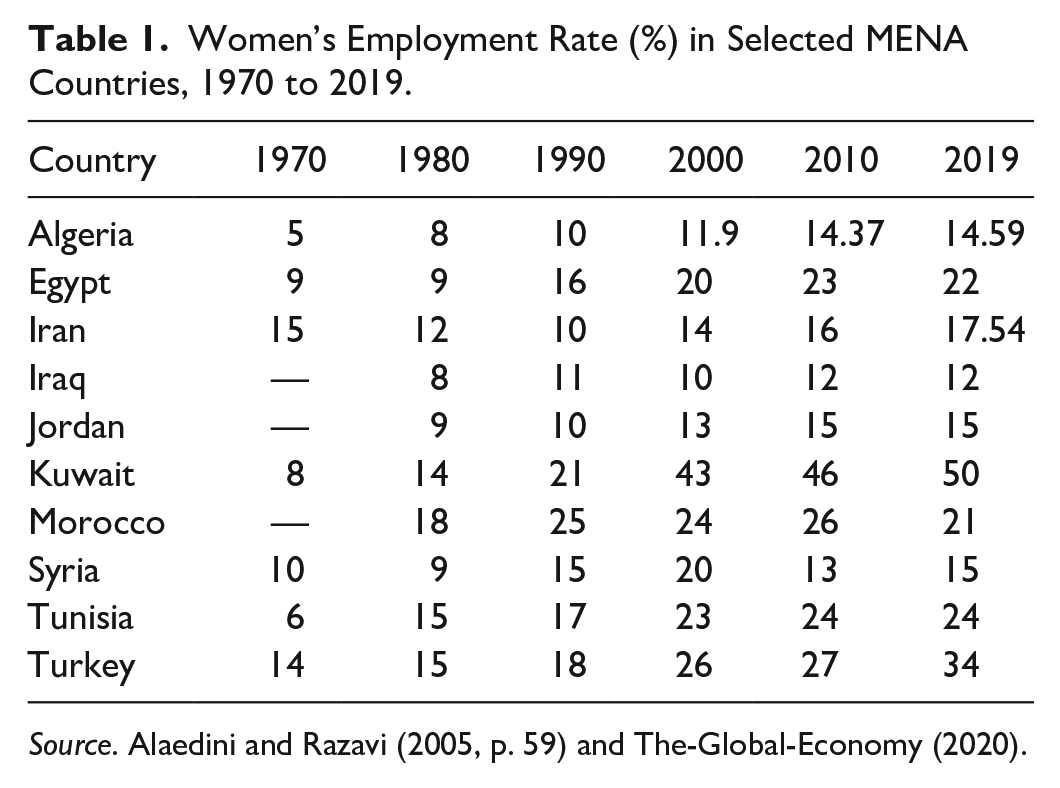
Source. Alaedini and Razavi (2005, p. 59) and The-Global-Economy (2020).
Women’s total parliamentary share from the first to the 11th national councils only amounts to 3.5%. With some fluctuations, this share started at 1.24% in the first national council election in 1980 and reached its zenith at 5.8% and 5.5% in the more recent councils of the 10th and 11th national councils in 2016 and 2020. This means that it remains an overwhelmingly male-dominated institution. Notably, more than 50% of this low percentage was recorded for the city of Tehran. This means that the share of other regions further away from the center is <50%. Moreover, no Kurdish women has entered the National Parliament during these 11 terms, except one lady in the 11th term, from the Kurdish region of Mariwan. Soraya Aziz Panah, sixth parliamentary candidate and a Kurdish women’s activist, believe that women’s rights have been neglected during different parliamentary terms. She argues that strong gender stereotypes, which sometimes even contradict our customary teachings, indicate a surrender to patriarchal policies to such an extent that, in order to be accepted in the face of this attitude, we are willing to cede interests and demands to the rights of women in society (Gourji, 2016). Considering such low participation of women in National Parliament, some female activists started a campaign to increase participation in politics through gender quotas and demanding a change in the male-dominated face of Parliament in 2016. Their campaign aimed to increase public awareness to help “defeat misogynist candidates.” The campaign however fell short of its objective due to the strong role of the Council of Guardians which used its “approbatory supervision” prerogative to disqualify the candidates for their own reasons.
For local councils, the status of women is not much better than in the National Council. According to data from the local council of Sanandaj, female participation has averaged at 10.6% during the five terms of the council since 1998. More importantly, this share has reached zero in 2014. For the city of Kermanshah, the share of women in the city council members shows the lowest rate, so that during the five terms, they have only averaged at 6.5% of the total. Moreover, no women were present in the third, fourth, and fifth terms of the city council. Based on the results of the last city council elections (fifth term) in 2016, the share of women in the four Kurdish provinces of Elam, Kermanshah, Kurdistan, and West Azerbaijan was 4%, 5%, 6%, and 7%, respectively. These rates are to some extent equal to the average share of women in city councils’ seats in Iran which was recorded at about 6%. Such a small share stands in contrast to that which women civil rights activists in Iran had targeted, the 30% share. For Azar Taherabadi, a Kermanshah civil rights activist,
In the Kurdish regions, this belief that women should continue to be kept in the private sphere is still strong due to the persistence of tribal behavior and structure in our society. In the belief of our people, women should have a smaller share of public affairs, because they are the honors of a tribe and this honor should be definitely protected. Unfortunately, our women are also in line with this idea. For this reason, we have to start from ourselves to develop self-confidence to overcome such believes and barriers as it also turns our thoughts to action (Gourji, 2016).
To summarize, apart from the challenges concerning women’s presence in the political realm, the presence of women today in different arenas of public space including streets, bazaars and shopping centers, leisure spaces such as parks and gardens, national and religious celebrations and ceremonies, cinemas and theaters, restaurants and coffee shops, and particularly shops, has become significant. Modern and traditional markets, especially shopping malls and bazaars, have become places to fill women’s leisure time, so that the presence of women as buyers, especially in the shopping malls, is higher than that of men. Thus, this type of space is increasingly becoming dedicated to women (Pourahmad & Salarvandiyan, 2012). In general, in recent decades, cultural and social developments inspired first from the improvement in the level of university education and then from the wave of globalization and the technological revolution, objectified in the leap of virtual mass media manifested in lifestyle and consumption patterns, have made the presence of women in urban spaces more visible than before (Shakiba et al., 2021). In addition, some recent research findings reveal that social media has become an alternative popular public sphere “to partake in a communication discourse, raise awareness, practice democracy, mobilize masses, and protest against social injustice” (Mohammadi, 2020, p. 651). As Scott (1990) declares, such virtual spaces enable women to move from “the individual resisting subject—an abstract fiction—to the socialization of resistance practices and discourses” (p. 118). As a result of such social changes, women have to some extent succeeded in accumulating more social and cultural capital on their own, and are now able to compete with men in some fields. However, there is still a long way toward reaching gender balance in all affairs of society compared to other Kurdish regions and developed countries.
Concluding Remarks
In this review, it became clear that the Kurdish history, notwithstanding its male-dominated and patriarchal structure, showed the rise of certain strong and charismatic women compared to its neighboring cultures. For the present, the fact is that the status of Kurdish women is not monolithic, as each of the Kurdish regions experienced a different socio-political atmosphere since the establishment of modern nation-states. More importantly, there are also huge differences between those living in rural and urban areas and even between the more conservative/traditional and modern-oriented parts of society regarding the role and status of women.
Despite the fact that the Kurdish region of Rojhalat, based on the Mahabad republic institution, is recognized as the pioneering political movement of Kurdish women’s emancipation in 1946, the Kurdish region of Bakur in Turkey, based on the groundbreaking views of Abdullah Öcalan, can be considered as a successful movement in establishing a sustained approach to the liberation of Kurdish women from patriarchal structures at the beginning of the 1990s.The realization of such a sustained approach manifested itself in the Rojava Revolution, where democratic confederalism was mainly established in line with women’s equal rights to build an alternative to an egalitarian society and, more importantly, with the coexistence of ethnic and religious diversities. Such radical social changes to some extent have been realized successfully in male-female relationships and in breaking with some key male privileges contextualized by the long tradition of patriarchy. Nevertheless, such emancipation is not widespread in society as a whole and it requires more time for proliferation.
Although the political situation of the Kurdish region of Iraq is completely different from the Kurdish regions of Turkey and Syria, as it granted some opportunities for national liberation, the strong character of national movement construction and lack of any “overarching ideology” to some extent delayed the realization of the rights of women and its relevant movements until 1991 (Bengio, 2016, p. 40). With some fluctuations in their struggles for emancipation, which was affected by the nature of patriarchy rooted in the tradition of tribalism, women gradually became empowered to conquer different arenas of public space. As a result of their ongoing campaigns, they have gained a degree of progress in public life and their involvement in politics has increased significantly. However, there is still a long way and efforts toward implementing the principles of equal rights with men, due to the unstable condition of the KRG and the power of tribalism, which is also institutionalized in the political parties (Alizadeh et al., 2021). For this reason, “the public standing of women in the KRG’s politics is less pronounced than in the Kurdish regions of Turkey and Syria” (Bengio, 2016, p. 39).
Although the path of Kurdish women’s emancipation was initiated first in the Kurdish region of Rojhalat, it was not sustained there, due to the short life of the Republic of Mahabad and strong centralized policies of both national states in Iran. Apart from this, there is also a long historical affiliation between Kurds and the land of Iran. This affected the issue of Kurdish female rights to a degree, so that the destiny of Kurdish women remained more in line with the movements of other Iranian women rather than as an independent identity within the Kurdish question in general. That is why Kurdish women in Iran drop behind their sisters in the other parts of Kurdistan.
Footnotes
Declaration of Conflicting Interests
The author(s) declared no potential conflicts of interest with respect to the research, authorship, and/or publication of this article.
Funding
The author(s) disclosed receipt of the following financial support for the research, authorship, and/or publication of this article: This article is a part of a research project that has received funding from the European Union’s Horizon 2020 Research and Innovation Programme under the Marie Sklodowska-Curie grant agreement No. 836194.
