



Abstract
Critical thinking (CT) and harmonious academic passion (HAP) are two crucial personal traits that influence students’ learning performance and future achievement. However, the relationship between CT and HAP, as well as the mediating roles of resilience and self-esteem, remain unclear. To address this gap, a three-wave longitudinal survey was conducted over 5 months, with valid data from 350 Chinese college students who completed online self-report questionnaires. Mediation analyses revealed that CT, resilience, self-esteem, and HAP were all positively correlated. CT directly predicted HAP, and indirectly influenced it through resilience and self-esteem, both as independent mediators and as a sequential chain. These results indicate that resilience and self-esteem serve as important psychological pathways through which CT fosters HAP. The findings contribute to the literature by clarifying how CT influences HAP over time and offer practical implications for designing educational interventions to enhance students’ motivation and well-being.
Background
In today’s rapidly changing educational environment, critical thinking (CT) has emerged as a core ability for students’ academic success (Anggraeni et al., 2023; El Soufi & See, 2019). Critical thinking refers to a mode of thinking in which individuals improve the quality of their reasoning by actively managing its underlying structures and applying intellectual standards (The Foundation for Critical Thinking, 2024). However, the influence of CT on academic motivation and passion remains underexplored. Harmonious academic passion (HAP), defined as a positive attitude toward learning, encourages individuals to sustain long-term commitment and enthusiasm in their academic endeavors. According to the dualistic model of passion (Curran et al., 2015; Vallerand et al., 2003), HAP allows individuals to harmoniously integrate academic engagement with other life domains, thereby promoting well-being and academic achievement.
Therefore, this study seeks to examine how CT influences HAP through the chain mediating roles of resilience and self-esteem using a longitudinal design. Resilience, an individual’s capacity to handle stress and adversity (Osório et al., 2017; Rutter, 2012), may serve as a psychological mechanism linking CT to HAP. Furthermore, self-esteem, a critical component of self-evaluation (Magee & Upenieks, 2019; Yang et al., 2016), impacts learning enthusiasm and persistence. This study is significant because it not only elucidates the link between CT and HAP, but also examines the chain-mediated pathway through resilience and self-esteem. It offers theoretical insights for personalized educational support, aiding students in overcoming academic challenges and achieving both academic and personal growth.
The Relationship Between CT and HAP
As a high-order cognitive ability, CT plays a crucial role in both academic and everyday decision-making (Alsaleh, 2020; El Soufi & See, 2019). CT enables students to approach learning challenges more rationally, critically and openly, thus enhancing the depth and quality of their learning. Simultaneously, the dualistic model of passion proposed by Vallerand et al. (2003) suggests that HAP arises when individuals autonomously internalize activities into their identity, leading to intrinsic satisfaction and more positive learning experiences (Curran et al., 2015; Pollack et al., 2020).
The impact of CT on HAP can be understood from several perspectives. First, CT facilitates a deeper understanding and analysis of complex learning material (Ahern et al., 2019; Alsaleh, 2020), which enhances learners’ sense of autonomy. According to the dualistic model, autonomy promotes harmonious rather than obsessive passion, as students integrate learning into their identity in a flexible and self-determined manner (Vallerand et al., 2003). With greater autonomy, students are more likely to experience joy and fulfillment in their studies (Mammadov & Schroeder, 2023; Mohammadi Zenouzagh et al., 2023), thereby strengthening their HAP (Ahn, 2020). Additionally, CT helps students remain composed and rational in the face of academic setbacks and challenges, encouraging students to solve problems constructively (Maksum et al., 2021; Stanovich, 2016). This adaptive process reduces anxiety and stress in the learning environment, which further supports the development of HAP and discourages maladaptive, obsessive forms of passion. Research has also shown that CT development is positively associated with academic motivation and achievement (Berestova et al., 2022; Orakci, 2023). Accordingly, this study investigates the mediating roles of resilience and self-esteem in the relationship between CT and HAP.
The Multiple Mediation of Resilience and Self-Esteem
Resilience, as a critical psychological resource in the face of challenges, is typically defined as an individual’s ability to actively cope with and recover from stress, frustration, or adversity (Stainton et al., 2019). Research indicates that resilience not only aids individuals in managing academic pressure (Cooke et al., 2019; Kegelaers et al., 2021) but also enhances self-efficacy and positive emotions when encountering challenges (Bender & Ingram, 2018; Sagone et al., 2020), thus boosting academic motivation and enthusiasm. Resilience mediates the relationship between CT and HAP. It helps students maintain sustained focus and effort when dealing with complex academic problems (Aburn et al., 2016; Vanhove et al., 2016). CT encourages in-depth problem analysis, while resilience ensures persistence despite difficulties. This positive coping approach reduces anxiety and emotional exhaustion during the learning process and enhances students’ sense of achievement, further promoting and maintaining HAP. In line with Vallerand’s dualistic model of passion, resilience allows students to engage in their studies through adaptive, flexible strategies that foster the autonomous internalization of learning activities, supporting the development of HAP rather than maladaptive obsessive passion (Vallerand et al., 2003).
Self-esteem, defined as an individual’s evaluation of his or her own value, also plays a significant role. Individuals with high self-esteem often exhibit confidence in their academic abilities and face challenges with a more positive attitude (Joshanloo, 2022; Vaughan-Johnston et al., 2023). Research shows that self-esteem can increase academic motivation by improving self-efficacy and fostering positive emotions (Ruvalcaba-Romero et al., 2017; Tran et al., 2022). Under the influence of CT, the role of self-esteem becomes even more crucial, as CT aids in comprehending and addressing complex problems, while self-esteem helps buffer against self-doubt when facing challenges. In addition, research indicates a close correlation between self-esteem and HAP (e.g., Lafrenière et al., 2011; Mageau et al., 2011; Stenseng & Dalskau, 2010). Students with high self-esteem tend to experience intrinsic satisfaction in learning (Wong et al., 2016), aligning with HAP’s core characteristic: sustained learning engagement and fulfillment through autonomy and self-worth (Schellenberg et al., 2019; Vallerand et al., 2003). From the perspective of the dualistic model, higher self-esteem facilitates autonomous internalization by reinforcing self-worth and intrinsic satisfaction, which are essential to sustaining HAP and preventing the emergence of obsessive passion. Therefore, self-esteem mediates the relationship between CT and HAP by enhancing individuals’ sense of self-efficacy and positive emotions, thereby fostering and sustaining HAP.
Resilience, as a form of psychological flexibility, is an important factor affecting self-esteem (Caqueo-Urízar et al., 2022; Fernández-Castillo et al., 2022). It helps individuals manage stress and challenges, improving self-esteem by fostering a sense of efficacy and control. Resilience influences self-worth through its impact on how individuals perceive and cope with adversity (Vella & Pai, 2019). Additionally, resilience is considered a protective factor for self-esteem, buffering its decline and promoting mental health in the face of negative situations (Akhtar & Bilour, 2020; Chung et al., 2020).
While existing research has explored the individual effects of CT and HAP on student outcomes, the causal relationship between CT and HAP remains underexplored. More importantly, the mediating roles of resilience and self-esteem in this process have not been adequately examined. Although studies have suggested that both resilience and self-esteem are crucial for academic success, little attention has been given to how these factors interact with CT to affect HAP over time. Furthermore, while cross-sectional studies have provided some insights, the longitudinal relationship between CT and HAP, particularly through the chain mediation of resilience and self-esteem, has not been fully addressed. This study seeks to fill these gaps by using a three-wave longitudinal design to investigate the relationship between CT and HAP and the roles of resilience and self-esteem as mediators. This approach provides new insights into how CT, resilience, and self-esteem jointly promote HAP. It contributes to both theoretical understanding and practical interventions in educational psychology.
Overall, resilience and self-esteem as chain mediators of the impact of CT on HAP have important theoretical significance and application value. Enhancing students’ CT, resilience, and self-esteem can effectively boost learning motivation and HAP, contributing to academic success and supporting a positive mental state under academic pressures. To address the existing research gaps, this study employs a longitudinal design to examine the relationships among CT, resilience, self-esteem, and HAP. Specifically, it seeks to answer the following research questions: (1) Does CT directly predict HAP? (2) Does CT indirectly influence HAP through resilience and self-esteem independently? (3) Does CT indirectly influence HAP through the chain mediation of resilience and self-esteem? By investigating these questions, this study aims to provide theoretical insights and practical implications for developing effective intervention strategies in educational practice.
The Present Study
Based on these research questions, the present study employed a three-wave longitudinal design to further investigate the relationship between CT and HAP and to examine the mediating roles of resilience and self-esteem. Specifically, five hypotheses were proposed to test whether CT directly predicts HAP, whether resilience and self-esteem independently mediate this relationship, and whether they function sequentially as chain mediators.
Models 1 and 2 were considered as competitive models because existing literature does not provide a conclusive sequence regarding the mediating roles of resilience and self-esteem. Some theoretical perspectives suggest that resilience, as a psychological resource, enhances self-worth and thereby fosters self-esteem (Akhtar & Bilour, 2020), which in turn influences passion development. Alternatively, other studies indicate that higher self-esteem may strengthen individuals’ capacity to cope with challenges, thereby promoting resilience (Arslan, 2016; Mouatsou & Koutra, 2023). Given these competing but theoretically plausible perspectives, both sequential pathways were hypothesized and tested to clarify the dynamic interplay between resilience and self-esteem in the effect of CT on HAP. See Figure 1 for the hypothesized Competitive Model 1. Diagram for competitive Model 2 is not shown, as it is identical to Model 1 except that the order of resilience and self-esteem is reversed.

Hypothesized chain mediation model in which CT predicts HAP through resilience and self-esteem (Competitive Model 1).
Research Design
Participants and Procedure
A total of 450 Chinese college students were initially recruited from a university at Time 1 in Guangzhou City, Guangdong Province, one of the most economically developed regions in South China. Participants were selected using a convenience sampling approach, without sampling weights, stratification, or clustering techniques. By Time 2, 372 students (82.67% retention) completed the assessment, and by Time 3, 350 students (94.09% retention from Time 2) completed the final assessment. The testing intervals were set at 2-month intervals. The first wave established baseline measures of CT, resilience, self-esteem, and HAP, while the second and third waves captured subsequent changes in these variables, providing insights into their dynamic interrelationships over time. The 2-month intervals were chosen to allow sufficient time for changes in resilience and self-esteem to affect HAP, while minimizing potential seasonal or extraneous effects that could confound the longitudinal analysis.
Participants who dropped out after Times 1 or 2 were excluded from further analyses. Independent t tests showed no significant differences in Time 1 scores between participants who remained and those who dropped out at Times 2 or 3 (ps > .05). The final longitudinal sample consisted of 323 females (92.29%) and 27 males (7.71%). Among them, 155 participants (44.29%) were from urban areas, and 195 (55.71%) were from rural areas. The mean age was 20.05 years (standard deviation = 1.21 years).
All procedures were approved by the university’s institutional review board prior to data collection. Participants received an online information sheet assuring confidentiality and anonymity of their responses, and they provided electronic informed consent before participation. Upon completing the online questionnaires (https://www.wjx.cn/), each participant received a 5 RMB (yuan) electronic voucher.
Measures
CT was assessed at Time 1 using the Chinese version of the California Critical Thinking Disposition Inventory (CCTDI-CV; Yu & Yu, 2020), which contains 28 items rated on a 6-point Likert scale (1 = very strongly disagree, 6 = very strongly agree). Total CT scores were calculated by summing the item responses, with higher scores indicating greater CT ability. The CCTDI-CV has demonstrated good reliability and validity (Yu & Yu, 2020). In this study, Cronbach’s alpha values for CT were .844, .843 and .852 across the three waves, indicating good internal consistency.
HAP was measured at Time 3 using the Academic Passion Scale (Marsh et al., 2013), adapted and validated for the Chinese academic context by Zhao et al. (2015). This scale includes two subscales: HAP and obsessive academic passion (OAP), each with 6 items. Participants rated their items on a seven-point Likert scale (1 = strongly disagree, 7 = strongly agree). Total HAP scores were calculated by summing the relevant items, with higher scores indicating greater HAP. The Chinese version of the scale has demonstrated strong reliability and validity (Zhao et al., 2015). In this study, Cronbach’s alpha values for HAP were .867, .873 and .882 across the three time points, indicating good internal consistency.
Resilience was assessed at Time 2 using the Chinese version of Brief Resilience Scale (Chen et al., 2020), which consists of 6 items rated on a five-point Likert scale (1 = strongly disagree, 5 = strongly agree). Total resilience scores were calculated by summing the item responses, with higher score indicating greater resilience. The scale has demonstrated good reliability and validity (Chen et al., 2020). In this study, Cronbach’s alpha values were .800, .793 and .806 across the three time points, indicating good internal consistency.
Self-esteem was assessed at Time 2 using the Chinese version of Rosenberg Self-Esteem Scale (Tian, 2006), which includes 10 items, rated on a four-point Likert scale (1 = strongly disagree, 4 = strongly agree). Total self-esteem scores were calculated by summing the item responses, with higher scores indicating higher self-esteem. The scale has demonstrated good reliability and validity (Tian, 2006). In this study, Cronbach’s alpha values for self-esteem were .897, .908 and .910 across the three time points, indicating good internal consistency.
Notably, the scales used in this study retained their original response formats (e.g., six-point, seven-point scales) in order to preserve their established reliability and validity.
Statistical Analysis
First, descriptive statistics and correlations among the variables were computed. Then group difference tests for HAP (T3) across demographic variables were conducted using SPSS 25.0. The data were analyzed using the PROCESS macro, and no issues related to normality, outliers, multicollinearity, or missing data were identified. Subsequently, the two aforementioned competing multiple mediation models were tested to examine the longitudinal relationship between CT (T1) and HAP (T3), with resilience (T2) and self-esteem (T2) as mediators. Specifically, the effect of CT on HAP was examined through two pathways: the chain mediation of resilience and self-esteem (Model 1) and the chain mediation of self-esteem and resilience (Model 2). Age, gender, and place of residence (PR) were included as covariates. The multiple mediation analysis was conducted using the PROCESS macro (model 6; Hayes, 2022). All variables were standardized before the multiple mediation analysis. The upper and lower limits of 95% confidence intervals for indirect effects and their standard errors (boot SE) were calculated with 5000 resamples. An indirect effect was considered significant if the 95% confidence intervals did not include zero.
Results
Preliminary Analyses
Table 1 presents the descriptive statistics and correlations among the variables. The correlation coefficients ranged from .323 (between resilience and HAP) to .487 (between CT and HAP). CT (T1), resilience (T2), self-esteem (T2), and HAP (T3) were all significantly and positively correlated. Table 2 reports the differences in HAP (T3) scores across demographic factors, including gender, age, and PR. Results from independent-samples t tests and one-way ANOVA indicated no significant differences in HAP (T3) scores across these covariates (i.e., age, gender, and PR).
Descriptive Statistics and Pearson Correlations Among CT, Resilience, Self-Esteem, and HAP Across Three Time Points (N = 350).
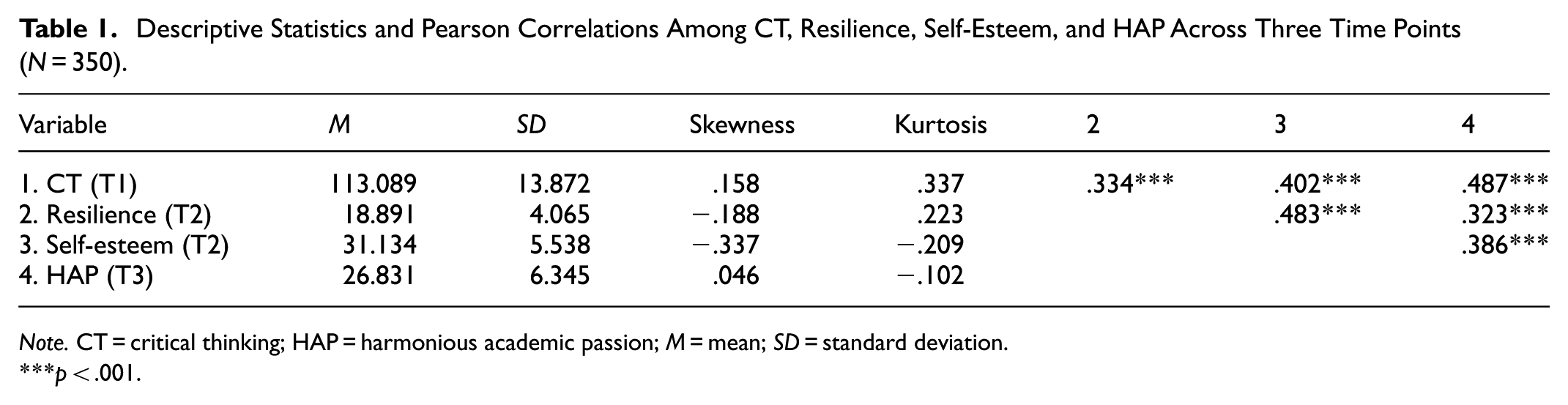
Note. CT = critical thinking; HAP = harmonious academic passion; M = mean; SD = standard deviation.
p < .001.
Group Differences in (HAP, T3) by Demographic Variables (Gender, Age, and PR).

Note. HAP = harmonious academic passion; M = mean; SD = standard deviation; PR = place of residence.
Multiple Mediating Analyses
Table 3 illustrates the longitudinal relationships between CT (T1) and HAP (T3), mediated by resilience (T2) and self-esteem (T2; model 1). After controlling for gender, age, and PR, CT (T1) positively predicted resilience (T2; β = .334, p < .001, 95% CI [.234, .434]), self-esteem (T2; β = .276, p < .001, 95% CI [.182, .370]), and HAP (T3; β = .375, p < .001, 95% CI [.267, .475]). Furthermore, resilience (T2) positively predicted both self-esteem (T2; β = .391, p < .001, 95% CI [.297, .485]) and HAP (T3; β = .110, p < .05, 95% CI [.006, .213]). Self-esteem (T2) also positively predicted HAP (T3; β = .186, p < .01, 95% CI [.079, .293]). Figure 2 depicts the standardized path coefficients for model 1.
Mediation Analysis Testing the Effects of CT (T1) on HAP (T3) Through Resilience (T2) and Self-Esteem (T2; Model 1).

Note. CT = critical thinking; HAP = harmonious academic passion; SE = standard error; LLCI = lower limit of confidence interval; ULCI = upper limit of confidence interval; PR = place of residence.
p < .05. **p < .01. ***p < .001.

Multiple mediation model results for CT (T1) predicting HAP (T3) through resilience (T2) and self-esteem (T2), controlling for demographic covariates (age, gender, and PR; Competitive Model 1).
Table 4 reports the significance of the indirect effects of CT (T1) on HAP (T3) through the multiple mediators of resilience (T2) and self-esteem (T2; model 1), controlling for age, gender, and PR. The total indirect effect of CT (T1) on HAP (T3) was significant (β = .112, boot SE = .027, 95% CI [.061, .167]). Specifically, the indirect effects through resilience (T2; β = .037, boot SE = .018, 95% CI [.002, .074]) and self-esteem (T2; β = .051, boot SE = .019, 95% CI [.019, .092]) were both significant, indicating that resilience (T2) and self-esteem (T2) independently mediated the effect of CT (T1) on HAP (T3). Additionally, the chain multiple mediation effect of resilience (T2) and self-esteem (T2) was significant (β = .024, boot SE = .009, 95% CI [.009, .044]), suggesting that CT affected HAP via both mediators (Model 1).
Indirect Effects of CT (T1) on HAP (T3) Through Resilience (T2) and Self-Esteem (T2), Controlling for Age, Gender, and PR (Model 1).
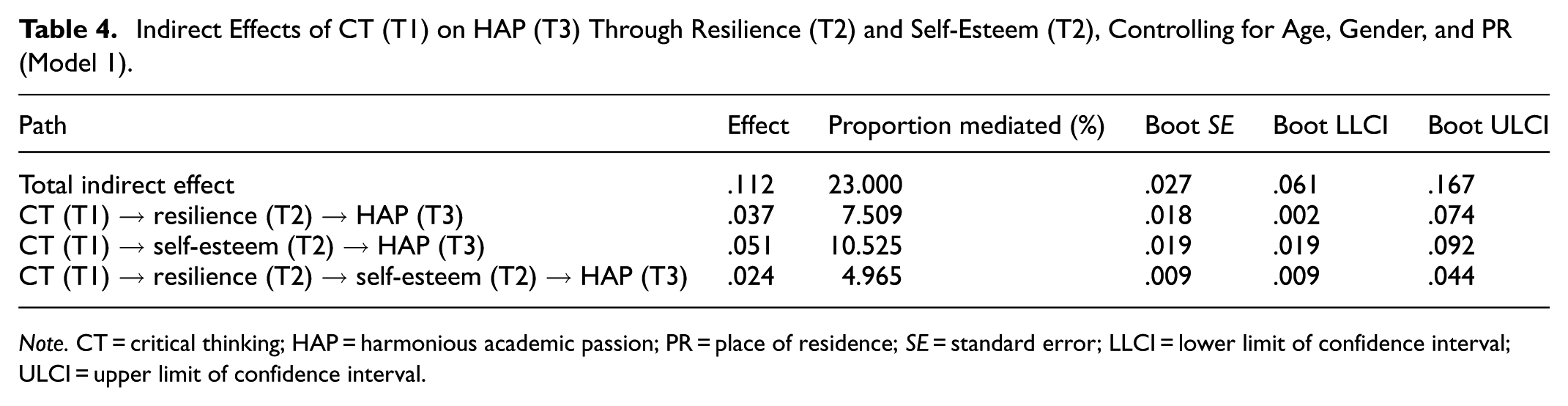
Note. CT = critical thinking; HAP = harmonious academic passion; PR = place of residence; SE = standard error; LLCI = lower limit of confidence interval; ULCI = upper limit of confidence interval.
In model 2, Table 5 illustrates the longitudinal relationship between CT (T1) and HAP (T3), with self-esteem (T2) and resilience (T2) serving as mediators. After controlling for gender, age, and PR, CT (T1) positively predicted self-esteem (T2; β = .406, p < .001, 95% CI [.310, .503]), resilience (T2; β = .164, p < .01, 95% CI [.064, .264]), and HAP (T3; β = .375, p < .001, 95% CI [.267, .475]). Additionally, self-esteem (T2) positively predicted both resilience (T2; β = .417, p < .001, 95% CI [.317, .518]) and HAP (T3; β = .186, p < .01, 95% CI [.079, .293]). Resilience (T2) also positively predicted HAP (T3; β = .110, p < .05, 95% CI [.006, .213]). Figure 3 depicts the standardized path coefficients for model 2.
Mediation Analysis Testing the Effects of CT (T1) on HAP (T3) Through Self-Esteem (T2) and Resilience (T2; Model 2).

Note. CT = critical thinking; HAP = harmonious academic passion; SE = Standard Error; LLCI = lower limit of confidence interval; ULCI = upper limit of confidence interval; PR = place of residence.
p < .05. **p < .01. ***p < .001.

Multiple mediation model results for CT (T1) predicting HAP (T3) through self-esteem (T2) and resilience (T2), controlling for demographic covariates (age, gender, and PR; Competitive Model 2).
Table 6 reports the significance of the indirect effects of CT (T1) on HAP (T3), mediated by self-esteem (T2) and resilience (T2; model 2) while controlling for age, gender, and PR. The total indirect effect of CT (T1) on HAP (T3) was significant (β = .112, boot SE = .027, 95% CI [.060, .167]). Specifically, the indirect effect of self-esteem (T2; β = .076, boot SE = .025, 95% CI [.030, .128]) was significant, whereas the indirect effects of resilience (T2; β = .018, boot SE = .011, 95% CI [.000, .044]) was not significant, indicating that self-esteem (T2) mediated the effect of CT (T1) on HAP (T3). In contrast to model 1, the chain mediation effect of self-esteem (T2) and resilience (T2) was not significant (β = .019, boot SE = .010, 95% CI [.000, .039]), suggesting limited support for the hypothesis that CT affected HAP through the multiple mediations of self-esteem and resilience (Model 2).
Indirect Effects of CT (T1) on HAP (T3) Through Self-Esteem (T2) and Resilience (T2), Controlling for Age, Gender, and PR (Model 2).

Note. CT = critical thinking; HAP = harmonious academic passion; PR = place of residence; SE = standard error; LLCI = lower limit of confidence interval; ULCI = upper limit of confidence interval. Some values are .000 due to rounding to 3 decimal places.
Summary and Discussion
In this study, two hypothesized models were proposed and tested to examine the longitudinal relationship between CT and HAP, with resilience and self-esteem as potential chain mediators. The findings revealed that CT, resilience, self-esteem, and HAP were all positively correlated. More importantly, CT not only directly predicted HAP (Hypothesis 1), but also indirectly influenced it through resilience and self-esteem. Both variables served as independent mediators (Hypotheses 2 and 3) and, when considered together, formed a sequential pathway linking CT to HAP (Hypothesis 4). These results provide strong support for the hypothesized mechanisms and underscore the critical roles of resilience and self-esteem in explaining how CT fosters HAP. Building on these findings, the following sections discuss their theoretical implications, practical significance, and directions for future research.
CT was found to have a significant positive effect on HAP, supporting hypothesis 1. As an advanced cognitive skill, CT enhances individuals’ ability to deeply analyze and solve problems during the learning process (Anggraeni et al., 2023; El Soufi & See, 2019), which in turn strengthens their engagement and HAP. Students with stronger CT skills are generally more capable of addressing academic challenges, sustaining intrinsic motivation for learning, and fostering HAP. This finding is consistent with previous studies (Kwan & Wong, 2015; Namaziandost et al., 2023), which highlight the close relationship between CT and positive learning behaviors, such as motivation and academic success. HAP is driven by intrinsic interest, with individuals experiencing autonomy and satisfaction during learning (Curran et al., 2015; Vallerand et al., 2003). By enabling students to remain composed and think independently when facing complex academic tasks, CT enhances their sense of control and identity over learning, therefore reinforcing HAP.
Second, self-esteem, as a core component of self-worth, plays a pivotal role in learning motivation and emotional well-being. This study supports Hypotheses 2 and 3, demonstrating that resilience and self-esteem independently mediated the effect of CT on HAP. Individuals with high self-esteem tend to hold a more favorable view of their academic abilities and the value of learning (Orth & Robins, 2022; Reitz, 2022), leading to greater motivation and passion for study (Popoola & Fagbola, 2021; Topçu & Leana-Taşcılar, 2018). These findings indicates that self-esteem not only directly correlates with HAP but also bridges the relationship between CT and HAP. When individuals possess stronger CT skills, they improve their learning experiences through active coping with challenges (resilience) and positive self-cognition (self-esteem).
Moreover, this study also found that resilience and self-esteem jointly formed a chain mediation between CT and HAP (Hypothesis 4). Specifically, CT enhanced resilience, which in turn boosted self-esteem, ultimately exerting an indirect effect on HAP. Resilience, as a psychological resource, enables students to maintain a positive learning attitude despite pressures and challenges (Quintiliani et al., 2022; Wang et al., 2024). Highly resilient individuals tend to recover quickly from failures or setbacks, seeing them as opportunities for growth and learning. Research indicates that resilience is positively related to both academic passion (Paquette et al., 2023; Rahimi et al., 2023; Vallerand & Paquette, 2024) and self-esteem (Caqueo-Urízar et al., 2022; Fernández-Castillo et al., 2022). By overcoming academic challenges, individuals enhance their self-efficacy and self-esteem, which in turn strengthens their engagement and HAP.
The findings showed that CT influenced HAP through resilience and self-esteem (Hypothesis 4), whereas the reverse pathway—self-esteem influencing resilience and subsequently HAP (Hypothesis 5)—was not significant. This suggests that resilience, as a critical psychological resource for managing difficulties and adversity, enables individuals to maintain a positive mindset when faced with academic challenges (Cooke et al., 2019; Kegelaers et al., 2021), thereby enhancing their sense of self-worth and self-esteem (Bender & Ingram, 2018; Sagone et al., 2020). Resilient individuals are more likely to recover from setbacks and develop stronger self-efficacy (Akhtar & Bilour, 2020; Chung et al., 2020), which in turn enhances self-esteem and ultimately promotes HAP. Conversely, the indirect effect proposed in Hypothesis 5 was not significant, possibly because self-esteem in this context is primarily shaped by external recognition or achievements and lacks the intrinsic growth fostered by resilience. Thus, cultivating resilience is essential in the process by which CT fosters HAP, as it strengthens both self-esteem and HAP.
These findings hold particular explanatory value within the Chinese cultural context. First, Chinese society places high value on education, with academic performance regarded not only as a key determinant of personal development but also an important marker of family honor and social status (Liang & Matthews, 2023). For centuries, Chinese culture has emphasized the belief that “only academic achievement leads to success” (Li, 2017), contributing to substantial academic pressure among college students. Within this context, cultivating CT provides students with a more flexible and open mindset, enabling them to analyze and make rational decisions under heavy workloads and complex challenges, thereby mitigating the negative impact of external pressure. Second, Chinese culture emphasizes collectivism (Ding et al., 2024), where social evaluation and recognition play crucial roles in shaping self-esteem. Unlike in Western cultures, Chinese students’ self-esteem is often closely tied to social comparison, academic performance, and external feedback (Wang et al., 2021; Yang et al., 2019). In this setting, resilience serves as an important psychological resource for buffering external pressure and maintaining a positive self-perception. Students with high resilience are able to interpret academic setbacks or social comparisons more positively, reducing negative emotions and thereby improving self-esteem (Caqueo-Urízar et al., 2022; Fernández-Castillo et al., 2022). Finally, HAP in China reflects not only intrinsic interest and independent engagement in learning but also the need to balance social expectations with personal development. Thus, when students develop resilience, guided by CT, and internalize external expectations into their identity with the support of positive self-esteem, they are more likely to sustain healthy academic enthusiasm in highly competitive environments. This interpretation not only highlights the cultural specificity of this findings but also offers valuable insights for cross-cultural research.
In summary, the present findings suggest several practical implications for higher education. Teachers can promote students’ HAP by integrating CT exercises into coursework, such as case analyses and classroom debates. University counselors may offer resilience training programs that emphasize stress management, adaptive coping, and positive reframing, thereby supporting students’ persistence in learning. Curriculum designers are encouraged to implement activities that strengthen self-esteem, such as reflective assignments and structured peer feedback, to enhance students’ sense of competence and self-worth.
Despite these contributions, several limitations warrant consideration. First, the data were collected across three waves, which allowed for longitudinal mediation testing. However, because resilience and self-esteem were measured at the same time point (T2), disentangling their causal relationship remains difficult. Although two competing models were compared to address this issue, stronger causal inferences require more fine-grained research designs. Future studies should adopt longitudinal approaches with at least four time points, such as cross-lagged panel models or latent growth models, to better capture the dynamic interplay among CT, resilience, self-esteem, and HAP. In addition, intervention or experimental designs would provide more rigorous evidence for establishing and testing the causal mechanisms underlying these relationships. Second, the sample composition may limit the generalizability of the findings. More than 92% of participants were female, creating a serious gender imbalance that may have biased the observed relationships. Replicating the study with more gender-balanced or stratified samples is essential to determine whether the findings hold across different groups. Third, all data were collected through an online survey platform (wjx.cn). While this approach facilitated efficient data collection, it may have introduced self-selection bias, as students with greater interest in the topic or higher digital literacy may have been more likely to participate. This potential bias limits the external validity of the findings. Future research should adopt more diverse sampling strategies, including offline recruitment and multi-site data collection, to reduce potential sampling bias. Finally, the present study focused exclusively on Chinese college students. To enhance cross-cultural validity and broader applicability, future research should test the longitudinal mediation model in different educational and cultural contexts, as well as across age groups and developmental stages.
Footnotes

Ethical Considerations
Review and approval for the study procedures were obtained from the university institutional review board prior to study onset. Before answering the scale, participants received an information sheet online that assured them that the data obtained would be handled confidentially and anonymously, and they were asked to give electronic informed consent.
Funding
The authors disclosed receipt of the following financial support for the research, authorship, and/or publication of this article: This study was supported by the project 2024WTSCX155 funded by Special Innovation Projects for Regular Institutions of Higher Education in Guangdong Province.
Declaration of Conflicting Interests
The authors declared no potential conflicts of interest with respect to the research, authorship, and/or publication of this article.
Data Availability Statement
Data are available upon request.