




Abstract
Higher education institutions are eager to attract more qualified students in a competitive environment. In this direction, they strive to increase the commitment of the students to the university by improving the quality of the offered service. Thus, students continue their higher education with great satisfaction and talk positively about their universities and recommend it to the next generations. This research aimed to identify the effect undergraduate students’ perceived quality of service had on their commitment. A mixed methods research methodology with an explanatory sequential design was used. The research sample composed of 1,782 students, and the quantitative data were collected through scales developed by the researchers. The qualitative data were collected through a semi-structured interview and critical incidents technique forms. The findings have pointed out that the quality of service in higher education positively affects student commitment; as the perception of service quality improves, student commitment increases. Students’ commitment to the university is mainly affected by the quality of education, the image of the university/faculty, and the quality of facilities. While research related to service quality and student commitment exists in the literature, this research has pointed out the underlying reasons for students’ commitment and perceptions of university services with direct quotations. Students’ views should be taken into consideration by the management to improve quality in the university. This research is limited to public university undergraduate students’; future researchers can conduct studies with private university students and state their findings.
Introduction
Universities are institutions where students can acquire a wealth of knowledge, socialize with their peers, and gain valuable experiences that will affect their future. Importantly, students are stakeholders in the educational process (Yorke, 1999) that constitute an input of the educational process while also representing one of the important output indicators for evaluating the quality of education (Ozdemir, 2002). One of these outputs is student satisfaction, based on the experience students have during their time at university. Satisfaction also affects student commitment, and students who are satisfied with the quality of service offered by their university are more willing to attend and participate in school activities. According to Zineldin et al. (2011), among the most basic indicators of educational quality is the reflection of student experiences gained from student feedback. The quality of higher education institutions or educational services can be determined based on students’ educational level, the socio-cultural activities they participate in, and their satisfaction with the care provided to them by their institution (Yilmaz et al., 2007).
Quality of Service and Student Satisfaction in Higher Education
The concepts of satisfaction and service quality within the realm of higher education can be relatively difficult to define. Ramsden (1991) reports that student satisfaction is considered a good indicator of the quality of service and education in higher education institutions and a final criterion of the educational process. Richardson (2005) describes student satisfaction as a complex concept due to the difficulty in evaluating the programs of higher education institutions. Lawson et al. (2012) suggest that it would be appropriate to include the criterion of student satisfaction as part of the success story of universities because these institutions operate in what can be considered a service environment.
Quality is also a multidimensional and transversal concept in higher education (Vesce et al., 2021). Nevertheless, there is still no universally agreed-upon definition of service quality or a model for measuring the quality of service. While some consider service quality as a measure of how well the level of provided service meets customer expectations, others claim it depends on expectations versus perceptions (Arrieta & Avolio, 2020). Understanding quality can be subjective since it fundamentally depends on the perceptions of service receivers (Bertolin, 2015); however, the feedback of different stakeholders’ expectations and experiences in determining the quality of service is enlightening (especially those who receive services). When stakeholder feedback is applied to research in higher education, it requires caution (Zhu & Sharp, 2021). Thus, in addition to students’ perceptions and experiences, evidence-based approaches such as records, official documents, or observation should be used to measure the quality of services.
The approach of determining student satisfaction must be viewed as a cycle of data collection, reporting, and implementation that enables management to make improvements with direct student support (Harvey, 2006). The main purpose of student satisfaction is to maximize student experiences and satisfaction, minimize dissatisfaction with the university, and increase the institution’s performance, which are the only factors influencing the achievement of improvements. Therefore, improvement activities at universities are closely related to student satisfaction (Douglas et al., 2007). Universities wish to be the preference of potential students and be at the top of university ranking lists (Sahin, 2009). For universities focusing on student marketing; attention should be paid to the results of student satisfaction surveys, mitigating negative experiences related to the university, and along with considering student admissions over the long term, student attitude and financial stability are also important (Douglas et al., 2007). Leonnard (2018) states that similar to student satisfaction, ensuring high quality of service is a fundamental strategy to maintain and increase the number of students attending the university. In this regard, service quality in higher education is an important effort to implement improvement plans, attract new students, retain the best students, recruit exceptional staff, and improve the organization’s finance (Leonnard & Susanti, 2019). For higher education institutions to function effectively and efficiently in a competitive environment, they need to analyze the quality of the services provided and make an effort to define a strategy that focuses on the satisfaction of their stakeholders (Pedro et al., 2020). Academic and non-academic aspects of service quality can affect student satisfaction, exhibited by methods currently available for recognition (certification and accreditation) and the measurement of quality rates (Stefani, 2003; cited by Vesce et al., 2021). In other words, issues such as service quality and student satisfaction in higher education are subject to internal and external evaluations at regular intervals due to international agreements and accreditation.
Recently, due to the Sorbonne and Bologna Declarations, there have been ongoing efforts to create a Higher Education Area within Europe and establish inter-country standards for higher education. With the Bologna process, there have been studies conducted regarding the European Credit Transfer System (ECTS), Diploma Supplement (DS), curriculum renewal, mobility (student and academic exchange), and recognition as well as lifelong learning, joint degrees, the three-stage degree system (undergraduate, graduate, and doctorate), and quality assurance (Cetinsaya, 2014). For example, quality assurance in higher education has been transformed into accreditation because it is believed to achieve greater transparency in many European countries (Sungu & Bayrakci, 2010). Accreditation serves as development, improvement, and self-evaluation for an organization. In this context, to gain accreditation, higher education institutions are expected to meet certain standards regarding their educational processes, their students, and the institutional organization. These standards are introduced by the New England Association of Higher Education Institutes (2016), such as mission and purposes, planning and evaluation, organization and governance, academic programing, student standards, teaching-learning and scholarship, institutional resources, educational effectiveness, transparency, integrity, and public disclosure. Therefore, student satisfaction regarding the quality of services offered at universities is among the most important indicators for determining how well student-related standards have been met.
There have been structures and scales specifically created for higher education institutions to measure their quality of service. Ho and Wearn (1996) developed the total quality management model in higher education. The structure they utilized included leadership, commitment, total customer satisfaction, total involvement, teaching and learning, ownership of problems, reward and recognition, error prevention, and teamwork. Another structure developed for measuring higher education is the HEdPERF created by Abdullah (2005), which consists of academic and non-academic aspects, reputation, access, program issues, and understanding. Additionally, Sultan and Wong’s (2010) Performance-Based Higher Education Service Quality Model (PHed) consists of dependability, effectiveness, capability, efficiency, competencies, assurance, unusual situation management, and semester syllabus. On the other hand, the Higher Education Quality of Service model (HiEdQUAL) developed by Annamdevula and Bellamkonda (2012) consists of teacher and course content, administrative services, academic facilities, campus infrastructure, and support services.
Stakeholders who perceive a high level of quality of service also have increased commitment and loyalty to their organization. Students’ commitment will particularly increase if they are highly satisfied with the services they have received from their higher education institution. Commitment to an institution is a concept influenced by personal characteristics, facilities offered by organizations, and employee attitudes, beliefs, and behaviors. This concept, which influences job persistence, motivation, and interests of employees working within an organization, can also influence student attitudes and behaviors toward educational training and other services offered through their school. Hackman and Dysinger (1970) determined that commitment is an important factor in the lack of retention of university students. On the other hand, services offered by the school can ultimately affect the level of student commitment. For example, there is a positive relationship between student commitment and time spent at school (Bayardo et al., 2014). In short, the quality of services offered by the school can be considered an indication for determining students’ commitment to the school.
Student Commitment in Higher Education
Commitment is a comprehensive concept that reveals the attitudes and behaviors one has toward aspects of their lives such as a job, group membership, personal relationship, and so forth. The theory of commitment also emerges in organizational psychology, where research is widely conducted with employees (Rodríguez-Izquierdo, 2020). Accordingly, it can be said that the idea of commitment primarily appears to be dealt with on the level of employees in organizational structures. However, the discovery of commitment in educational organizations has directed studies toward students, based on being influenced, having a sense of belonging, satisfaction, and quality perception (Strauss & Volkwein, 2004). In this context, students’ commitment is described as a dedication to the university, enabling them to integrate themselves into teaching and learning the culture, academic life, and campus services (Abduh et al., 2018). More studies are being conducted on the commitment of university students to improve educational processes by understanding the negative and positive emotions, attitudes, or behaviors that affect their level of commitment (Rodríguez-Izquierdo, 2020). Additionally, university students are mature enough to express their views on commitment indicators such as satisfaction and the quality of service.
The concept of student commitment was adapted based on an understanding of the concept of organizational commitment. For example, organizational commitment is defined as employees’ commitment to the organization’s process of achieving its goals. However, this includes employees’ engagement, loyalty, and identifying themselves as part of the organization. Organizational commitment is an emotional reaction that can be measured by employees’ attitudes, behaviors, and beliefs. Meyer and Allen (1991) describe this emotional reaction in three dimensions, including affection (affective commitment), need (continuance commitment), and obligation (normative commitment). Therefore, the concepts of student engagement, involvement, and commitment contain dimensions that subsume dimensions of the other. However, this present study adopts the concept of “student commitment” as the focus of the investigation. In this case, students’ commitment to the institution can be defined as their positive attachment based on feelings of belonging, honor, and identification. It contributes to students’ willingness to keep their relationship with the university (Cownie, 2019).
There are studies available in national and international literature that focus on the commitment of university students. The study conducted by Gunuc (2013), which included 1,219 teacher candidates in Eskisehir, Turkey, determined that students’ commitment to the university was affected by their relationships with the teaching staff and the benefits the students’ derived from their classes. On the other hand, Ergun (2014), in a semi-experimental study with 107 university students in Ankara, Turkey, utilized a structural equation model to test the relationship between sociability perceptions, personality traits, and student commitment. According to the structural equation model, there is a significant and positive relationship between student commitment with sociability and personality traits. Results showed that the perception of sociability demonstrated the strongest effect on student commitment.
Internationally, Daniels et al. (2020) have identified the variables affecting students’ commitment to the university, consisting of students’ well-being, peer communication, social and academic environment, and program-personal choice fit. It could be stated that students whose personal, social, and academic expectations are met have higher commitment levels to the university. Furthermore, students’ commitment to the university is a predictor and has outcomes. Davidson and Ewert (2020) have described these predictors as setting goals, self-determination, academic discipline, and self-confidence. In contrast, the outcomes include social activity, connection, communication, academic success, and psychological well-being. Additionally, Clements et al. (2016), in their research with health sciences students in the United Kingdom, determined that commitment was the internal driving force for becoming a nurse. Simultaneously, students’ lack, or low level of commitment causes them to drop out of specific programs. However, Cownie (2020) has stated that students who have higher commitment talk positively about the university and academics.
Quality of Service, Student Satisfaction, and Student Commitment in Higher Education
Service quality and student’s satisfaction have affected student’s level of commitment to the university. Research has shown that satisfaction of services at universities is important to explain student’s commitment. Students’ satisfaction level explains 70% of the variance of their commitment to the university (Womack et al., 2018). Although much of the research regarding satisfaction has been conducted in business, such as examining customer complaints and complaint handling strategies, higher education institutions have begun to adopt business models to improve student satisfaction and persistence. The results of these studies can be used as an important tool to understand students’ experiences better and resolve student complaints and dissatisfaction. Importantly, student satisfaction regarding the services offered by universities in education, accommodation, and social activities can be considered a valuable tool for a university’s self-evaluation. Through self-evaluation, universities can gain critical information that can later be utilized to improve and develop the services provided to students (New England Association of Higher Education Institutes, 2016). In other words, self-evaluation focuses on quality improvement in higher education institutions. With quality studies, conscious steps must be taken to ensure continuous improvement in students’ learning experiences (Williams, 2016). Additionally, perspective derived from universities self-evaluation processes can provide opportunities to set new goals and, as a result, use the newly garnered information to take more concrete steps toward developing planned strategies for improvement and development. Studies have shown that universities that consider students’ survey responses for quality improvement result in higher student satisfaction levels (Williams, 2016; Womack et al., 2018)
Given all the above, the quality of services offered to students, such as academic, socio-cultural, and accommodation, greatly affect student satisfaction. Students satisfied with the quality of services can be expected to maintain a high level of positive commitment, resulting in academically, socially, and psychologically developed healthy individuals who later serve their society. While research exists related to service quality and student commitment in the literature, this research has pointed out the underlying reasons for students’ perceptions on services at university and commitment with direct quotations and incidents from students. In this context, it is believed that exploring student perceptions on the quality of services and their commitment toward the university will lead to the education and development of more qualified members. Also, universities can better utilize the self-evaluation process to provide more appropriate and advantageous services for students that will attract new students and help maintain the retention rate of the already enrolled students.
The objective of this study was to determine how undergraduate students at different faculties of a public university perceived the university’s quality of services and how their perception affected student commitment. As part of this overall objective, answers to the following questions were sought:
Does the quality of service perceived by higher education students have a direct effect on student commitment?
How do students view the services they receive from the university and faculty and their commitment to the university?
What were the positive and negative experiences of students regarding the services they received from their university and faculty, and did it affect their commitment to the university and faculty?
Method
Research Design
In this study, a mixed-methods research design was utilized that incorporated an explanatory sequential design where quantitative and qualitative methods were utilized. Creswell and Plano Clark (2014) define mixed method research as one where “a researcher makes deductions by using qualitative and quantitative approaches and methods in a single study.” The general research framework for this study is provided in Figure 1 below.

General research framework.
As seen in Figure 1 above, in the quantitative dimension of the study, data was collected through scales regarding the quality of service perceived by students and student commitment. For this study, the authors have defined the student commitment variable as students’ identification with the university depending on their positive feelings and experiences. This data was analyzed, and the subsequent model was tested to answer the research questions. In the qualitative dimension of this study, interviews were conducted with students to determine the current quality of services and student commitment based on the results found through the quantitative findings. The Critical Incidents Technique (CIT) was implemented. Through CIT, students’ positive and negative experiences regarding the quality of services and their commitment were learned from students’ personal stories (Creswell, 2015). The present study supported and explained the quantitative results with the data obtained using the CIT and the interview technique.
Population and Sample
The target population of this study consisted of 39,547 undergraduate students who studied at 15 faculties within a public university during the 2016 to 2017 academic years. The study was conducted utilizing a sample size that was assumed to represent the student population because of the difficulty of reaching all students that comprised the target population. The feasibility of reaching all the students was not economically affordable in terms of time and resources. The sample numbers were derived considering that a total of 2,000 students would represent 39,547 students. A sample of 381 people could represent 50,000 people at an accuracy level of 95% and a tolerance level of 5% (Anderson, 1990; as cited in Balci, 2013, 108). Accordingly, about 40,000 people can be represented by a sample of 2,000 people with a 5% error margin. In this study, a stratified sampling method was utilized. Sub-groups of the population were identified and represented in the sample according to their ratio within the population. Accordingly, 15 faculties that have active students were each considered a stratum. In total, the researchers were able to gather data from 1,782 participants for the quantitative dimension of the study.
About 63.1% (1,124) of the students participating in the quantitative dimension were females and 35.2% (610) were males. About 27% (48) of the study participants did not indicate their gender. According to the faculty variable, the distribution of students was parallel to the amount of data obtained from the faculties with a large student population. By class level, most of the students were second (27.8%), third (31.4%), and fourth (26%) year students. Only 5.7% of the participants were first, and 4.4% were fifth-year students, while 4.7% did not indicate their class level. In the qualitative dimension, 50 students from different faculties participated in the CIT implementation. In face-to-face interviews, 31 students were reached from 15 faculties, including 2 students from each faculty and 3 from 1 faculty. The student participants for the study were assigned participant codes, for example, “S1, S2. . .”
Data Collection Instruments
Data on students’ perceptions of the quality of services provided by the university and student commitment was collected through quantitative and qualitative measuring tools. Quantitative data was obtained through scales (Data collection instruments as a supplemental material are available online), consisting of a 5-point Likert type scale developed by the researchers. The Scale of Quality of Service in Higher Education consisted of 3 dimensions and 29 items with a Cronbach’s α of .904. The reliability for sub-dimensions is .892, .850, and 0.779. They explain 45.04% of the total variance. Confirmatory factor analysis (CFA) model fit indices (χ2/df = 10.6, RMSEA = 0.07, SRMR = 0.04, CFI = 0.91, and TLI = 0.90) have indicated that the scale has a good-fit. The scale of Student Commitment to Higher Education consisted of 1 dimension and 14 items. It explains 54.88% of the total variance. Item-total correlations (.83–.66 > .30) and Cronbach’s alpha reliability coefficient (.930) are calculated to test the reliability of the scale. CFA model fit indices (χ2/df = 8.28, RMSEA = 0.46, SRMR = 0.03, CFI = 0.94, and TLI = 0.93) have indicated that the scale has a good-fit. The qualitative data was collected using a semi-structured interview form and the CIT form prepared by the researchers.
Data Collection and Analysis
The quantitative data of this study were collected during the 2017 to 2018 spring semester, while the qualitative data were collected during the 2018 to 2019 spring semester. To determine the appropriate tests to be applied for data analysis, a multivariate normality distribution was tested. After the normality test, CFA and the Structural Equation Modeling (SEM) were utilized. The Statistical Package Program for Social Sciences (SPSS) and AMOS were employed.
First, it was checked whether the data showed a normal distribution. The assumption of normality was met. Skewness and kurtosis values were between −1.0 and +1.0. (Skewness: −.101 and kurtosis: −.210, for Service Quality; skewness: −.309 and kurtosis: −.107, for Commitment). It is seen that there were linear relationships between variables, so the linearity assumption was met. A moderate and positive correlation was found between the variables (r = .475, p < .001). Moreover, it was observed that there were no multi-collinearity problems. (VIF = 1.00 < 10 and Tolerance = 1.00 > .20, CI = 10.936 < 30). The CFA was utilized for each measurement tool separately, and acceptable or good fit indices were reached for model fit. Since the Scale of Quality of Service in Higher Education has sub-dimensions, a second-order CFA was also utilized. Then, the measurement model and the structural model were presented.
The qualitative part of the study was analyzed through the deductive method. The deductive analysis is the analysis of data through the available frames (Patton, 2014). The findings derived with the descriptive approach from the data analysis were directly quoted and enriched by placing the participant codes in italics. The researcher’s comments regarding the research findings were also supported in the context of the relevant literature.
Results
Effect of Quality of Service on Student Commitment in Higher Education
The quality of service perceived in higher education on student commitment was tested with the SEM model. The measurement models were first tested. Necessary analyses were made before testing the model. The different fit statistics were identified to evaluate different aspects of the model’s fit to the data (Cokluk et al., 2014; Heck & Thomas, 2015; Tabachnick & Fidel, 2014). The relevant values are presented in Table 1 below.
Fit Indices of Measurement Models and Accepted Values.

As seen in Table 1 above, the modified versions of the structural model of quality of service in higher education and the structural model of student commitment in higher education were a good fit except for p and χ2/df indices. The reason for these high index values can be the large sample size (n = 1,678). When these values were taken together, the models of quality of service and student commitment exhibited acceptable goodness of fit.
After testing the measurement models, the structure between the quality of service and student commitment was tested. The relevant structure and its standardized values are presented in Figure 2 below.

Quality of service and student commitment.
Figure 2 above shows that the model established between quality of service and student commitment was statistically significant. Also, an analysis was performed regarding possible changes to improve upon the model-data fitness. The fit indices for the model are presented in Table 2 below.
Fit Indices and Accepted Values.

When Table 2 and Figure 2 above are considered together, although the model was created with improvements because it did not fit perfectly, this model, concerning the fit indices, was statistically significant and had an acceptable value. Although the CFI and TLI were not a good fit in the model’s unmodified version, these indices demonstrated an acceptable fit in the modified version. These values were enough to determine that the model was a good fit. The RMSEA value was found to be 0.04, which can be interpreted as the model parameters providing a good fit to the population co-variances. In Table 3 below, standardized factor loads of the model, t-values of these effects, and the structural equations are provided:
Values and Structural Equations of the Model.

As shown in Table 3 and Figure 2 above, there was a statistically significant positive relationship between the quality of services and student commitment (β = .59, p < .05). In other words, a student who has a high perception of the quality of services offered in higher education will tend to have an increasing commitment. Depending on this relationship, the quality of service in higher education explains approximately 36% of the variance observed in student commitment (R2 = .359). The relationship between the dependent variables is provided in Figure 3 below.
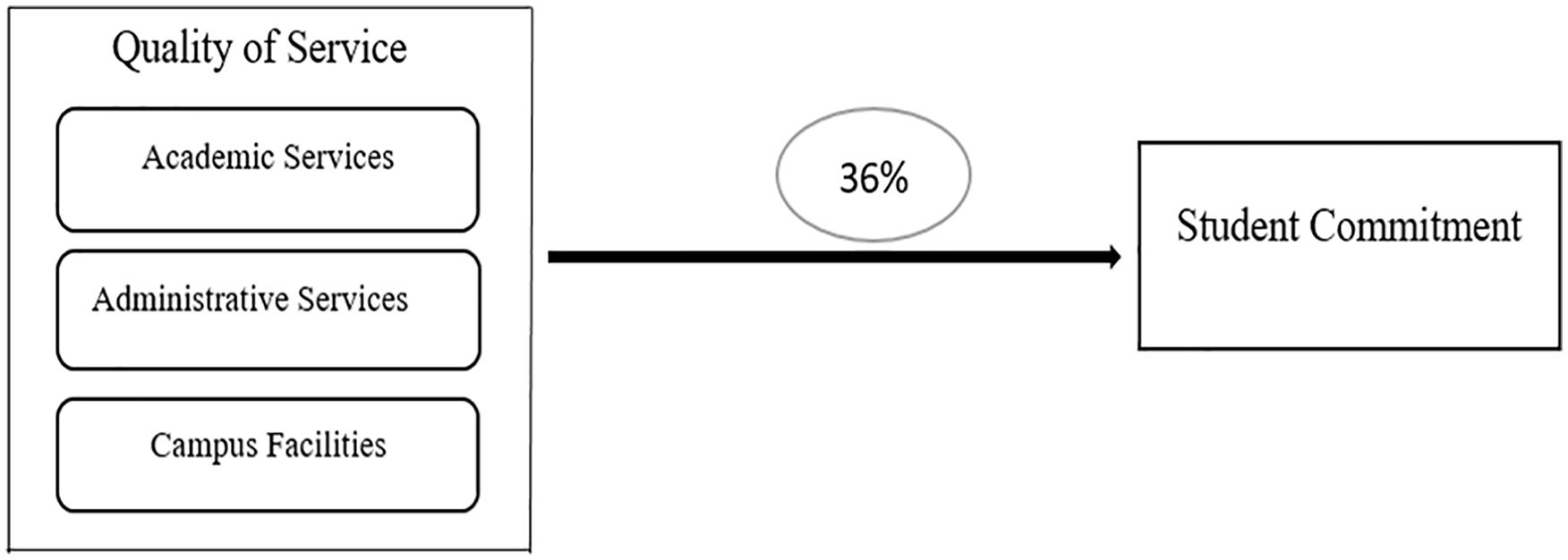
The model of the relation between quality of service and student commitment in higher education.
As shown in Figure 3 above, approximately 36% of student commitment in higher education is explained by the quality of services offered. In other words, a student who has a high perception of the quality of services offered in higher education will tend to have an increasing commitment.
Student Views on Quality of Service and Student Commitment in Higher Education
It was revealed through the quantitative findings of this study that the quality of service in higher education positively affected student commitment. Based on this finding, students’ positive and negative experiences of the academic services offered at their university, the campus facilities, and factors affecting commitment were explored. In the qualitative stage of this study, the effect of the quality of services on student commitment was determined through concrete examples from the students’ insights and experiences. Accordingly, information regarding the themes and categories derived from the qualitative data is provided in Figure 4 below.

Modeling of qualitative findings on quality of service and student commitment in higher education.
Figure 4 above shows the themes and categories derived from participating students’ insights and positive and negative experiences. Information was derived regarding the quality of service in higher education, academic services, administrative services, and campus facilities. As a result, students’ positive and negative experiences regarding the quality of services and student commitment were categorized.
Qualitative Findings on Quality of Service
Students were first asked about the quality of service in higher education. In this regard, student views relating to themes of academic services were grouped under the categories “classes and presentation method, exams and assessment processes, and academic staff.” For example, in the classes and delivery method category, students were particularly critical of the current practices within their program of study as it related to “the balance of theory-practice, teacher-centered presentation, the currency of class content, skill acquisitions, student numbers, electives, and foreign language acquisition.” Regarding the balance of theory-practice, a student stated, “Yes, theoretically a good university and a quality faculty. But I don’t think much is taught in practice (S16).” While another student stated, “Classes are taught focusing on theory. We are very good in theory, but in practice, we have a big problem (S23).”
Furthermore, students stated that there was a little contribution toward classes where no interaction was provided. Participants also criticized that some classes were completely presented by students, which was a part of the teacher-centered teaching approach. Regarding teacher-centered teaching, one student stated, “classes at the faculty are delivered monotonously, I shy away from asking questions. They react ‘like you have come this far and still do not know these’ (S6).” Another student stated, “The topics are divided into groups starting from the first week. Each week, one comes to present the topic. I don’t learn anything. That class is zero for me (S8).” Additionally, students expressed dissatisfaction with classes and presentation methods where the content was not up to date and did not teach the skills required for their field. The students also expressed dissatisfaction with crowded classes and deficiencies with the university’s foreign language education.
In line with the academic service’s theme, student views for the exams and assessment processes category were grouped under the subcategories of “exam contents, evaluation criteria, and mid-term exams week.” Regarding the exams administered as part of faculty education under the “exam contents” subcategory, students’ main criticism was that the exams were based on rote learning. In this respect, a student stated, “you learn thousands of things. And the teacher asks you a very specific question. I mean they do not cover the entire subject. If you know it, you know it, if you don’t know it, you are doomed. That’s just luck. Or he asks a question of general culture, which is not related to the class. . . Exam processes are still based on rote learning (S8).” Another student emphasized the rote learning method in exam contents by saying, “I think student’s rote learning, rather than skills, is tested in the exam process (S16).” In the “assessment process” subcategory, student views varied according to their program of study. Participants from the faculties where a verbal assessment was applied were uncomfortable because verbal assessment grading was not objective. Similarly, some participants stated that the grading of written exams was also not objective. Based on the results of CIT, students had positive experiences with the quality of academic staff and teaching, while they had negative experiences with cleanliness, dining hall food, library services, and the student information system.
On the other hand, students stated that the academic staff was generally highly skilled and knowledgeable but could not convey their knowledge. An example from a student’s perspective was as follows: “I think all of them are subject-matter experts in their field. But some have the difficulty of. . . I mean they have difficulty teaching it. They achieve a lot in their field, and some cannot teach it to us. . . I mean they become academics and can’t make a teacher (S8).” How the academic staff should approach students was another matter expressed by students. Accordingly, students stated that they were satisfied with the attitudes of some academics, while a few academics were seen to have difficulty in this matter. Importantly, the quality of academic staff at the university also supports the positive experiences of students.
Student views regarding administrative services were grouped under the categories of “management processes, administrative staff, technical services, cafeteria, and socio-cultural and sports activities.” Regarding student demands in management processes and the improvement of the electronic infrastructure based on student feedback appeared to be an area of services that needs attention. Students complained about the communication processes and professional deficiencies of the university administrative staff. For example, “Student affairs is problematic, harsh, doesn’t look at us (S5).” In the category of technical services, some students found the cleanliness of their faculty to be poor, and security was adequate to a degree, but sometimes entering campus was a problem. Students were uncomfortable with the state of the university cafeterias (they reported them as being in a poor state, that the food service was inadequate, and that the meal prices are too expensive). Students who followed university activities expressed that the university was very good at providing opportunities for socio-cultural and sports activities. In contrast, another group of students stated that such activities were not enough. Students also stated that the lack of spring festivities was an important shortfall.
Students’ comments regarding campus facilities were grouped into the subcategories: “student-oriented campus, detached campus, buildings and infrastructure, and learning environments.” In the student-oriented campus subcategory, the students stated that the spaces provided to them within the university campus where they could socialize and spend out-of-school time (e.g., the canteen or cafeteria) were inadequate. In this regard, one student stated that “there could be more social spaces, spaces where we can enjoy the time more comfortably. There could be common areas for all students (S6).” Another student stated that “there are very few social spaces at the university. I mean we have a parking lot in front of the school. That should be an area that belongs to the students. I mean it should not be school-cars, but school-students. . . (S12),” and thereby emphasized the student’s perception that the campus was not student-oriented.
Additionally, regarding the detached campus, students expressed their preference for having one single campus for higher education and felt uncomfortable being on a campus detached from the main campus. One student stated that “we have electives this year, and I have to go to Golbasi (a detached campus outside the city limits) to take them, which is hard (S31).” Another student stated, “I mean it sometimes feels bad to be in such an isolated faculty (S26).” Furthermore, the student interviews revealed that students found their faculty buildings, classrooms, and infrastructure inadequate. Additionally, students reported that common learning environments were also insufficient/inadequate. It was revealed through this finding that the students had negative experiences regarding insufficient/inadequate building, library, and equipment on campus. For example, students criticized the lack of a large central library on each campus. Another important expectation of participants was that more study rooms should be created for them at the faculty and campus. To this end, students recommended that there should be a central library on each campus and that libraries on campus should always be open.
Qualitative Findings on Student Commitment
Regarding commitment in higher education, students were asked: “why they chose this university, whether they see themselves as a member of the university, whether they believe they are educated to become well-equipped, and whether they learn something new in their classes.” Accordingly, factors that affected student commitment to the university were identified. As shown in Figure 4 above, student views were grouped into the categories: “quality of education, university/faculty image, quality of facilities offered, city/location, and physical condition.” Among these categories, student views were mostly grouped into the “quality of education” category. In this regard, a student stated, “the Faculty of Veterinary Sciences of the University of X has the best veterinary education. The statistics and scores also prove this. That’s why we chose here, to get the best education in our field (S28).” While other students stated, “I chose the University of X because of its success. Its education is of high quality. When I talk to students in other faculties, I can see the difference (S12),” thus emphasizing the quality of education. The positive experiences of students also support the finding that the quality of education is critical to student choice.
According to the students, the university/faculty image and the quality of education positively affected university-student commitment. In this regard, a student stated, “good thing is that I have come here. . . Well-established. The reputation of the university; when you say the faculty of dentistry at the University of X, they say ‘wow’ (S3).” Another student stated, “When I look at it, it is one of the well-known universities; the University of X is the first one that comes to mind (S7).”
Participants stated that their commitment to the university was positively affected by the quality of education and the university/faculty. It was positively and negatively affected by the quality of the facilities offered. A student who thought positively about the quality of the facilities offered the following statement, “The school has community opportunities. It has vacation opportunities. We have communities in which we can improve ourselves (S28).” Another student stated, “There are student houses; the dormitories are in the centre. It offers housing for students. Other universities do not offer this or don’t have any in the centre (S22).” In comparison, a student who thought negatively about the quality of the facilities offered by their university stated that “There is a lack of social activities; they mostly lead students to study more. . . There are not enough clubs. . . when I receive the diploma; I will only feel satisfied with the education (S6).” Another student stated, “We have only one festival in the semester, which is not enough. There are a few cafes on campus; not enough, there should be more activities (S30).”
Furthermore, students’ commitment was affected by the facilities offered at the university and the city and location where the university was located. The choice of university was also affected by the city where the students’ families lived and how appropriate families found the city for studying. Also, student commitment to the university was affected positively by experiences related to the ease of transportation, the financial support provided to students, friendships, and the appreciation of effort. In contrast, it was affected negatively by the lack of internship and practical education. The results of CIT show that students had positive experiences with friendships. They emphasized, “Thanks to the time we spend with our friends, our commitment to the university increases”(S1–S9). On the other hand, the negative experiences, such as the inadequate infrastructure of the university and socio-cultural activities, decreased students’ commitment to the university.
Discussion and Conclusion
This study determined the direct effect of students’ perceived service quality on their commitment. According to the findings, there was a statistically significant positive relationship between the quality of service and student commitment in higher education. Additionally, student commitment improved as student perceptions of the quality of service improved. Particularly, students who were satisfied with the academic services offered by their university were able to tolerate a lack of services in other areas. Other factors affecting student commitment to the university were identified as the quality of education, the image of the university/faculty, the quality of facilities offered, city/location, physical condition, and transportation to the campus.
The findings related to the first objective of this study indicate that students’ perceived quality of services significantly influences students’ commitment. This finding is in line with the result of the research conducted by Kim (2019) with 229 senior students attending university, which points out that service quality affects student’s perception of satisfaction and image positively, and their level of satisfaction has an influence on commitment. This influence can contribute to improving the long-term competitiveness of higher education and attracting more students. Similarly, Mulyano et al.’s (2020) study, conducted with 312 students at a university in Indonesia, shows that students’ satisfaction affects their perception of reputation and commitment to the university. Davis (2014) reports that universities affect student commitment through the services they offer. According to the author, enabling students to use university services through announcements, advertisements, and student-friendly fees reduces school dropout rates. The research study by Leonnard (2018) also found that ensuring high service quality is a basic strategy that service providers can meet to increase the number of students. Better service quality and student satisfaction can enhance commitment to the university.
In student satisfaction, the quality of education, the quality of the available resources, and the effective use of technology mattered to students (Wilkins & Balakrishnan, 2013). Similarly, studies conducted by Weerasinghe and Fernando (2018) in Sri Lanka, Duong (2015) in Vietnam, Guo et al. (2014) in China, Yusoff et al. (2015) in Malaysia, and Wilkins and Balakrishnan (2013) in the United Arab Emirates have established that the quality of the academic staff and the academic processes have an effect on student satisfaction and that the quality of academic staff and the quality of education improves student satisfaction. Accordingly, the fact that the student perception of academic services offered at the university was relatively higher than that of other types of services indicated that they were satisfied with their education. In the context of academic services, students were particularly satisfied with the subject knowledge of the faculty members. This result was also in line with the qualitative findings of this research. The interviewed students also stated that the academic staff was well-equipped and that the university provided a quality education.
Similarly, Kyrgyz higher education students’ perception of quality is defined by the achievements of the academic staff (Momunalieva et al., 2020). Peruvian University students also focused on the service quality of academics and curriculum planning (Arrieta & Avolio, 2020). In the quality-of-service study conducted in Oman, it was also determined that university students focused on the quality of academic staff and the quality of teaching (Al-Amri et al., 2020). Additionally, in a study conducted by Cinkir et al. (2019) with 500 undergraduate students at their faculty of education, they found that the academic field services played a major role in student satisfaction. Alzafari and Ursin (2019) have supported the idea that “higher education institutions should apply the principles of student-centred learning in their programs” due to their study. Moreover, Douglas et al. (2006) point out that student who think they receive a good education can tolerate the lack of physical facilities at the university. According to this result, which was also true for this research, the commitment of students who were satisfied with academic services was positively affected and that they tolerated and compensated for the negative experiences with administrative and campus services.
Under academic services, some students were not satisfied with how the classes prepared them for professional life The qualitative findings of this study yielded similar results. In the interviews related to the second objective of this study, students indicated that the instruction was generally theory-based, delivered through a teacher-centered classical presentation method, and that they were not taught the skills necessary for their age and profession. In addition, the content lacked information about current developments and permanent learning was not achieved in class because there were not enough opportunities for practical exercises. This finding was in line with the results from the qualitative research conducted by Cevher (2015), where 60 associate-degree students in Turkey reported that classes at the university fall far below the expectations of the business world and fail to prepare them for professional life, do not go beyond theoretical education, and that the internship/practice is inadequate. Accordingly, faculty members must focus on applications/activities that enable students to participate in the class actively. Furthermore, the learning outputs and course content determined by the Higher Education Council must be arranged with a focus on professional competencies across all faculties. Measures must also be taken to reduce course loads, administrative duties, and responsibilities of the faculty members.
The students of the faculties with a large number of students were not satisfied especially with the crowded classrooms. The number of students, especially in the practical classes, had a negative impact on the materials assigned per person and on the commitment of the teaching staff to each student, thus reducing the quality of service. This finding was in line with the research conducted by Giannakis and Bullivant (2016) in the United Kingdom, where it was determined that the increase in the number of students caused the quality of service offered in higher education to be compromised. In other words, crowded classes reduced the overall quality of the services offered. In Turkey, the number of students per faculty member is quite high, at 43 students per faculty member (Higher Education Council, 2019). In this context, it was recommended that the number of students per faculty member could be reduced through placement procedures for students in higher education and enriching academic staff according to regulations created concerning supply and demand equilibrium.
Students did not appear to be adequately informed about their university’s social, cultural, and athletic activities and student support services. Student support services such as psychological counseling, the “disabled university” and the counseling service need to be made known to students via a website, text messages, announcements, posters, and/or leaflets. In addition, faculty examination calendars must not overlap with the University’s socio-cultural and athletic activities so that students can participate in these services. Students must also be able to cheque with the Division of Student Affairs or the Division of Health, Culture and Sport and search online for the information they need about the services they require.
Students’ commitment to the university is an important sign of their positive affective reaction to their university/faculty. In this regard, based on the second objective of this study, the interviews highlighted that students believe that a relevant university is a well-established institution that has an image and culture of faculty that is strong in their field and that the quality of education offered at the university is important. The above finding is consistent with the study by Pedro and Andraz (2021), who have stated that the image variable is important to ensure a high student commitment level. In this regard, students with a high level of commitment strongly recommend the university to others. Positive feelings, which demonstrate commitment, are also seen as a key indicator of students’ intention to complete their study (Davis, 2014). Furthermore, in their study conducted at a university in Pakistan, Sarwar and Ashrafi (2014) found a positive relationship between student commitment and academic success. In other words, it is possible to say that as academic success improves, the consideration of dropping out of school decreases and student commitment improves.
Finally, in this current research, a positive relationship was determined between the quality of service offered to students in higher education and their commitment to the university. This finding was elaborated in relation to students’ positive/negative experiences with the university. Although students are satisfied with the educational process, academics, and friendship, they have negative experiences with the infrastructure and administrative services of the university. In this regard, to improve student commitment to the university, changes should be introduced based on student recommendations regarding academic-administrative services and campus facilities. Additionally, researchers can compare graduate students, students at different universities, between educational levels, and/or between universities. In conclusion, universities’ educational levels or good practices can be utilized as examples of how and what to improve upon regarding unfavorable practices. On the other hand, researchers can test the effect of variables such as trust, school climate, social adaptation, and student engagement on student commitment by establishing differing structural equation models and utilizing these models for investigating the effect of student commitment on academic success, student absenteeism, and school dropout/retention rates. Providing proper university education, personal and social support, and quality campus facilities and technology will improve student satisfaction and commitment, therefore creating an environment where the best and brightest students can acquire the necessary knowledge and skills to become the leaders of tomorrow.
Theoretical and Practical Implications of the Study
The research presented in this article requires certain theoretical and practical implications. The main theoretical implication of the research lies in the understanding of the positive impact of perceived service quality on students’ commitment to the university. This finding adds to the literature on student commitment to the university by explaining the significant positive relationship between perceived service quality and student commitment to the university. However, the literature points to some studies that show the relationship between satisfaction and commitment. Therefore, this study can be a starting point for future studies that explain the mediating or moderating effect of satisfaction on student commitment. In addition, the authors have made an important contribution to student commitment through this study by developing a scale for student commitment in higher education. This is because in the commitment literature, this concept is usually treated in relation to employees. Those explaining student commitment are also conducted using the instruments developed in the context of organizations and workers. The practical significance of the research lies in the empirical evidence of the positive impact of perceived service quality on student commitment with the university. In this case, universities should improve the quality of management staff, campus facilities, and academic service. According to the quantitative and qualitative results, especially academic service is an important sign of commitment. This research confirms that the quality of education has a great impact on students’ commitment to the university. This finding can be used to reduce student absenteeism and dropout rates. In addition, student-friendly services provide the foundation for increased student engagement. The researchers suggest that higher education institutions develop a model of service quality based on the study of a sample of university students, describing how service quality is perceived by students. In addition, strong engagement is considered a very important dimension of perceived service quality. Administrators of higher education institutions need to place value on service quality and student commitment. These concepts are interrelated and the importance of the image of higher education institutions should be recognized.
Limitations of the Study
This study demonstrated the direct impact of service quality on student engagement. Although it was conducted with almost 2,000 participants, this study is limited to the students of one public university in Turkey, which cannot be applied to all students of all universities. Therefore, it is suggested that researchers conduct a study with students from a private university and make comparisons between public and private universities in different countries. Another limitation is that this study was only conducted with two dependent variables based on their relationship. Therefore, future studies can be conducted with more variables such as satisfaction and their mediating role.
Supplemental Material
sj-docx-1-sgo-10.1177_21582440221096134 – Supplemental material for The Effect of Undergraduate Students’ Perceived Service Quality on Student Commitment
Supplemental material, sj-docx-1-sgo-10.1177_21582440221096134 for The Effect of Undergraduate Students’ Perceived Service Quality on Student Commitment by Sakir Cinkir, Sevgi Yildiz and Gul Kurum in SAGE Open
Footnotes
Acknowledgements
We would like to thank all study participants for their time. We acknowledge the financial support provided by Ankara University, Scientific Research Project Unit (BAP). BAP Has only provided the funding, all other processes from research design to submission, were done by the researchers.
Declaration of Conflicting Interests
The author(s) declared no potential conflicts of interest with respect to the research, authorship, and/or publication of this article.
Funding
The author(s) disclosed receipt of the following financial support for the research, authorship, and/or publication of this article: The author(s) received financial support for the research from Ankara University, Scientific Research Project Unit (BAP).
Ethical Approval
This study was conducted under ethical principles: Ankara University Ethical Committee Approval Number: 01.03.2018/04/11.

Supplemental Material
Supplemental material for this article is available online.
References
Supplementary Material
Please find the following supplemental material available below.
For Open Access articles published under a Creative Commons License, all supplemental material carries the same license as the article it is associated with.
For non-Open Access articles published, all supplemental material carries a non-exclusive license, and permission requests for re-use of supplemental material or any part of supplemental material shall be sent directly to the copyright owner as specified in the copyright notice associated with the article.
