




Abstract
While the topic of attracting and maintaining inbound international students has received much scholarly attention in higher education, attracting female international students has rarely been discussed. This study addresses the issue of attracting degree-seeking female international students. Based on the notion of situational factors and total quality management (TQM), we assumed both institutional design and students’ satisfaction are core concepts for attracting and retaining female international students that will make a difference in higher education. A total of 215 survey responses were analyzed, and a covariance-based structural equation modeling (CB-SEM) approach was developed. The results confirm female international students’ perception of 14 observed variables in the three first-order components and suggest that they can create a second-order construct of push factors, institutional situations, and satisfaction (latent variables). This study demonstrates that higher-order modeling leads to theoretical parsimony and reduces model complexity in the proposed CB-SEM. The findings suggest that the casual relationship works well and both institutional leadership and international strategy can play crucial roles in the process of transforming female international students’ learning satisfaction.
Plain language summary
Purpose: Based on the notion of total quality management (TQM), we considered satisfaction as a core concept for attracting and retaining degree-seeking female international students in higher education. This study intends to confirm a proposed structural relationship can be used to interpret the specific group’s satisfaction.
Introduction
Increasing students’ global mobility has shaped a new map in the world. Within the global framework, the topic of attracting and maintaining inbound international students has been garnered much scholarly attention, and it remains a hot topic in higher education. For example, previous studies address this topic focusing on fostering mutual understanding and cooperation in increasing uncertainty and unrest of 21st century (Bhandari & Blumenthal, 2011); Studying abroad can improve employability in an increasingly globalized labor (Di Pietro, 2019; Fielden, 2007; Teichler & Janson, 2007; Van Mol, 2017). Mobile students may offer an important income and have a substantial impact on the economic and innovation systems of the inbound country (OECD, 2021). Therefore, many countries view international academic mobility as a critical strategy, not only for sharing knowledge and building intellectual capital, but also promoting competitiveness in global settings. From a government’s perspective, international student mobility has received increasing attention from policy makers in recent years, and numerous countries have moved their higher education into the high participation stage in the global competitive framework (Marginson, 2016a, 2016b). From an individual perspective, studying abroad has become an essential differentiating experience for young generation participated in higher education.
According to a report by OECD (the Organization for Economic Co-Operation and Development), international students favor STEM fields (i.e., science, technology, engineering and mathematics) one-third of them enrolled in these fields in 2019 (OECD, 2021). In Asia, students are more internationally mobile at the short-cycle undergraduate and master’s level, while European students tend to be more mobile at the bachelor’s and doctoral level (OECD, 2021). This study would like to know: Is this phenomenon similar to the specific female international student group?
Over the past 20 years, college opportunities have drastically increased for women in the United States, including female international students. For example, in the 1979 to 1980 academic year, women represented just 28% of international students studying in the United States; In 2016, it increased to more than 40% (Contreras-Aguirre & Elsa Gonzalez, 2017; Sitarz, 2022). Australia is becoming increasingly female international students. From 2016 to 2020, there was an 18% increase in the number of male international students enrolled at Australian education providers. However, the number of female international students increased by 22% during the same period. China—which is Australia’s largest source of international students—sends more women than men, with more than 54% of Chinese international students in Australia being female (MacFarlane, 2022). Within a part of growing trend, Taiwan is increased female international students. When the world moved into a post-pandemic era, is it still favored for women to join universities abroad?
Perceived that international students’ participation in higher education may be varied, female international students more specifically have received comparatively little scholarly attention. Taking Taiwan’s higher education as an example, this study focuses on female international students’ satisfaction issue on campuses. The findings can bridge the gap in the literature on international students that lacks a related discussion on female student issues. Moreover, the findings can reinforce the current international strategies in higher education institutions. Using data from Taiwan’s Ministry of Education, it was found that the diversity of gender among international students has changed fundamentally in the system. In 2020, there were 52,714 inbound students for degree purposes, with females comprising 27,948 and males at only 24,766 (Ministry of Education, 2021). Female inbound students are expected to grow into a critical mass in the future (Chang and Chou, 2022). Regarding gender diversity, the pattern has changed, and attracting and maintaining female international students is getting more important, thus more attention must be paid to their study journey. Moreover, Taiwan has confronted declining enrollment in the last decade. Between 1974 and 2016, births decreased by 40%, from 328,461 to 196,973, according to data from the Ministry of Interior (Ministry of Interior, 2018). Given this decline, many private higher education institutions are now confronted by a serious shortage of student applicants. Ministry of Education (2021) has warned the declining birth rate will result in serious challenges to undergraduate enrollment in the next few years. Thus, effective attracting and maintaining international students has become a decisive strategy for higher education sustainable development.
Based on the notion of total quality management (TQM), we assumed satisfaction as a core concept for attracting and retaining degree-seeking female international students that will make a difference in higher education. This study intends to confirm a proposed structural relationship can be used to interpret the specific group’s satisfaction. With these purposes in mind, this study answers the following research questions:
a. What situational factors impact female international students’ study journey in Taiwan?
b. Are female international students satisfied with their current enrolled programs?
c. What kind of structural relationships can be used to interpret female international students’ satisfaction?
The rest parts of the paper are organized as follows: First, we present a literature review, including soft power, attracting international students, participation of female international students, and an analysis of the situational factors that impact female international students’ satisfaction. Second, the methodology section is presented, including instruments, samples, a framework for verification, hypotheses, and statistical analyses. Third, the results are presented, including the results of the covariance-based structural equation modeling (CB-SEM) and the bootstrap method to interpret the robustness of the structural relationships. Finally, we draw a conclusion and provide some suggestions for further studies.
Literature Review
This study begins with the soft power theory (Nye, 2004a, 2004b) associated to attracting and maintaining international students in higher education (Li, 2018; Lomer, 2017). A proposed conceptual framework justified by situational factors (including push factors, institutional leadership, and international strategy) and satisfaction (learning satisfaction, environment satisfaction, and willing to recommend) in terms of the outcome dimension.
Soft Power and Attracting International Students
Student mobility has referred to inbound and outbound two different types. Inbound mobility means the students move to a host country for study. Outbound mobility indicates the students who leave their country to another country for study purposes (Teichler, 2015; Teichler et al., 2012). The point is, the question needs to be answered, how to create a meaningful student mobility in higher education. Nye’s theory of soft power may provide a specific lens to examine the global mobility movement (Nye, 2004a, 2004b). In the global influence rationale, it is not surprising that attracting international students is a type of soft power conversion. For example, in UK and US, higher education has growing significance worldwide, with economic, technological, political, and social forces driving the increasingly global economies.
The soft power of higher education not only rests on a country’s culture, values and policies, but also depends on “the structure of the international education system, comprised of international education norms, rules, and institutions” (Li, 2018; Lomer, 2017). Lomer (2017) argues that international students constitute a global political resource or soft power for the UK. For instance, “the promote Britain around the world campaign” where alumni are seen as “unofficial ambassadors” and “long-term advocates” in the destination countries (BIS, 2009; British Council, 2003; Mellors-Bourne et al., 2013). The US provides another example, which includes “providing sufficient educational resources, institutional funding for international activities, international courses, and curricula.” All these initiatives play a significant role in shaping the soft power conversion of US higher education (Li, 2018). Moreover, Trilokekar (2010) argues that the political rationale of Canada has been dominated by “commercial logic,” while the case in the UK appears to be somewhat different, in that “the commercial and political rationales have coexisted since 1999” (Lomer, 2017).
Soft power theory has been converted into related policies for outbound and inbound international education in various countries. We argue that soft power implementation for attracting international talents might also impact the mobility of female international students. Within the soft power context, it may provide an alternative narrative on the mobility phenomenon of female international students.
Participation of Female International Students in Higher Education
Previous studies have addressed international student participation in the global context, with most giving positive evaluations (Chung et al., 2018; Madge et al., 2015; Shahjahan & Morgan, 2016), while Souto-Otero, et al. (2013) argue the barriers to international student mobility. Even though the international student participation varies by country, the number has grown significantly over the last few decades. Based on the OECD report, 67% of all international students comes from developing countries, it has become the largest flow of international students in the OECD area. The United States is the top OECD destination country for international students; of the 4.1 million internationally mobile students in OECD countries, 977,000 are enrolled in the United States (OECD, 2021). In addition, over 30% of mobile students in OECD countries come from China and India (OECD, 2021).
Even though the number of female international students has shown increasing in the United States and Australia (Contreras-Aguirre & Elsa Gonzalez, 2017; MacFarlane, 2022; Sitarz, 2022), traditionally females are under-represented in study abroad. For example, engineering, manufacturing, and construction are less popular among internationally mobile female students (OECD, 2021). In the OECD, women are more likely to study abroad in the arts and humanities (the share of women is 62%) and health and welfare (63%) (OECD, 2021). The distribution of female international students provides a rough picture to review the phenomenon of participation in higher education.
Situational Factors
Previous studies indicate that the factors impacting female international students may include push and pull factors, institutional leadership, international strategies, and campus life, among others. Related studies on situational factors with satisfaction are addressed as follows.
Push Factors
Mazzarol and Soutar (2001) indicate when deciding to study internationally, most students go through the following stages: clarifying the intention to study internationally, choosing the country in which to study, selection of a type of institution, and choice of the city. Push factors include the non-availability of enough livelihood opportunities, poverty, rapid population growth that surpasses available resources, “primitive” or “poor” living conditions, desertification, famines/droughts, fear of political persecution, poor healthcare, loss of wealth, and natural disasters (Lee, 1966; Ravenstein, 1985, 1989). On a micro-level, push factors refer to most of the decision-making involving parents and other relatives. In a meso-level, push factors may refer to the economic impact of international students on individual institutions. For example, university agendas are increasingly aligning with corporate interests in neoliberal transformation (Magnusson, 2000; Scott, 2000; R. Sidhu, 2002; R. K. Sidhu, 2006). Economic factors can be considered as a common aspect of internationalization. The macro economic rationale is widely viewed as serving the interests of host institutions and countries who benefit from recruiting high fee-paying international students (De Wit, 2020). To investigate international students’ mobility reasons, we view the push factors as negative situations that they might confront in their countries. The push factors might include employment opportunities, living conditions, family related reasons, and political reasons.
Institutional Leadership
Selznick’s (1984) original ideas about institutional leadership and the role they play in the institutionalization processes. Institutional leadership concerns establishing and protecting institutional values and characters. Washington et al. (2008) argue that institutional leaders “typically use a backward-leaning vision, meaning that the vision is to remind the organization of the core values” (p. 722), suggesting that agency, influence, and power are important factors. Here, leadership is important to understanding how institutional values contributes to internationalized development in higher education institutions. In general, institutional leaders are characterized as administrators, and their concern is with the technical core of the organization and its function. Therefore, institutional leaders need to develop external supporting mechanisms that lead to increasing resources for their organizations. Organizations focusing on values-based work are better for improving their practices and quality of services (Askeland et al., 2020; Selznick, 2008). In this sense, the leadership in higher education for internationalization may include equal treatment of international students, caring students, better advices for students, and the decision-making mechanism.
International Strategy
Drawing on relevant literature to analyze the experience of undertaking both initiatives, van Staden et al. (2022) show that universities can benefit from regarding these strategies as interconnected and complementary approaches that boost knowledge processes and learning progress. Specifically, enhancing friendly international campuses can attract more international students. For example, a clear international strategy on campus, encouraging recruitment of international students, encouraging international students to engage in learning, funding opportunities for international students, and funding international students to participate in international academic activities (Chang and Chou, 2021; De Wit, 2004; Salimi, 2011).
Measurement of Satisfaction
Studies have confirmed “life satisfaction” is a significant indicator to assess how well international students have adjusted to their studying situation (Salimi, 2011; Yalçın, 2011). Following this concept, this study focuses on learning satisfaction and environmental satisfaction. Moreover, Fečiková (2004) argues the concept of total quality management (TQM) is associated with the customer satisfaction. To maintain customer satisfaction, TQM can provide benefits in the form of higher quality products, and customers feel more cared for because their needs are met by the company (Brata & Soediantono, 2022). Previous studies indicate that customer satisfaction is the crucial quality assurance component of TQM; for example, TQM practices are significantly and positively linked to customer satisfaction and service quality (García-Alcaraz et al., 2021; Ooi et al., 2011). TQM practices have been applied to various settings and extended to internationalization in higher education. We assume that the recommended study program can be extended to investigate female international students’ implicit satisfaction. In this sense, the satisfaction evaluation for female international students may include learning satisfaction, environment satisfaction, and recommendation.
Method
In Method section, first, we design the questionnaires to collect data from female international students participating in degree-seeking programs. Second, we present how the characteristics of the target samples, the reliability, and the factorial construct will be analyzed. Third, we propose a research framework to test what might work in the CB-SEM framework. Finally, we address the criteria to verify the hypotheses and provide evidence for further interpretation.
Instrument
In this study, we considered the tests consisted of latent and observed variables two parts. The latent variables included push factors, institutional situations, and satisfaction. There were 14 observed indicators, falling under the three latent variables: push factors with four indicators, institutional situations with seven indicators, and satisfaction with three indicators. For example, in push factors, PS1 refers to “it is difficult to find employment opportunities in my country”; PS2 refers to “poor living conditions in my country”; PS3 refers to “family reasons”; PS4 refers to “I have political reasons to study abroad.” Institutional situations include institutional leadership and international strategies two domains. For example, IL1 refers to “I experienced that my university has strong leadership for student affairs”; IL2 refers to “My university’s policy is indifferent to the treatment of international students”; IL3 refers to “I experienced that my university has a collegial decision-making mechanism”; IS1 refers to “I experienced a clear international strategy on campus”; IS2 refers to “My university provides various learning opportunities or funding for international students”; IS3 refers to “My university encourages recruitment of international students,” and IS4 refers to “My university encourages international students to attend conferences abroad and provides funding support.” In satisfaction latent variable, Learning (LS) refers to “I am satisfied with my learning progress and related arrangement in my department”; Environment (ES) refers to “I am satisfied with my campus environment and the learning environment”; Recommend (RS) refers to “I am satisfied with the academic program and will recommend the program to others.” All indicators in the questionnaire were designed using a 5-point Likert scale, ranging from 1 (strongly disagree) to 5 (strongly agree).
Samples
In Taiwan, the majority of international students come from Asia (72%), followed by the Americas (15%), Europe (9%), Africa (2%), and Oceania (2%) (Department of Educational Statistics, MOE, 2021). Based on the statistics in 2020, female international students for degree-seeking are 15,978 (49.87%) in Taiwan (Department of Statistics, MOE, 2023). We considered that the fitted samples were collected using the following formula (Dillman, 2000):

This study set the confidence level of 95% (Zα/2 = 1.96), and the sampling error was controlled within ±0.05 (d). The suggested sample (n) was 375 participants of the target population (N = 15,978). This study was conducted using an online questionnaire platform to collect data from March to July 2020. In consideration of research ethics, all participants were invited and voluntarily participated. Since female international students were the research target, most of the samples were distributed in 20 top public universities and 10 top private universities in Taiwan. After excluding incomplete questionnaires and non-degree seekers, 215 valid questionnaires were collected. The valid samples indicated that most female international students are enrolled in the health and medical sciences (40%), engineering related programs (30%), agricultural & forestry (9.8), life sciences (8.8%), physics & math (4.7%), computer science (9%), and personal, transport & security services (2.3%). The samples reveal that the female international students came from Asia (74.0%), followed by Oceania (12.1%), Europe (3.7%), the Africa (1.9%), Americas (1.4%), and unidentified (7.0%). The nationalities of female international students are Vietnam (20.9%), Indonesia (17.7%), Hong Kong (9.3%), Malaysia (5.1%), Japan (3.7%), China (2.8%), Korea (1.9%), the United States (1.9%), and the others (38.6%). Female international students in undergraduate programs were 30%, in master’s programs 40.5%, and in doctoral programs 26.5%.
A Framework for Verification
The two most prevalent SEM-based analytical methods are CB-SEM (covariance-based SEM) and PLS-SEM (partial least squares SEM) (Hair et al., 2014), each technique has advantages and limitations. In this study, we employed CB-SEM with Analysis of Moment Structures (AMOS) to illustrate the relationships between push factors, institutional situations, and satisfaction. Based on AMOS, we considered CB-SEM because the relationships among numerous latent constructs can be examined such that errors are reduced in the model (Astrachan et al., 2014; Hair et al., 2014). Figure 1 presents the latent variables, organized by push factors, institutional situations, and satisfaction. We assume that push factors may not impact female international students’ satisfaction directly but institutional situations make a difference. With this proposed structure, the findings can provide help information to explore a specific international student group.
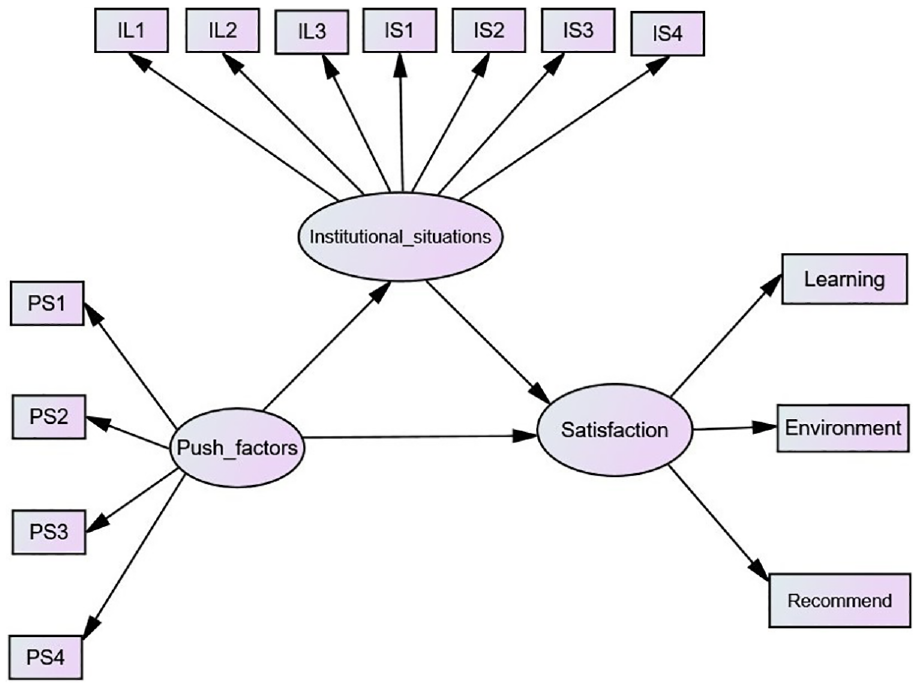
Framework of the research.
Hypotheses for Testing
Based on the research framework, we proposed the following hypotheses to test:
H1: There is a direct causal relationship between push factors and satisfaction.
H2: There is a direct causal relationship between push factors and institutional situations.
H3: There is a direct causal relationship between institutional situations and satisfaction.
H4: Push factors will, through institutional situations, impact satisfaction.
The hypotheses tests will follow the statistical inference process, that is, we justify the null hypothesis first. When the null hypothesis is rejected, we will accept the alternative hypothesis (H1–H4).
Statistical Analysis
Group differences were detected by analysis of variance (ANOVA) and post hoc tests. Comparing group differences can detect the quality of which ongoing programs need to be improved. IBM SPSS software and AMOS were used to analyze the data and verify the proposed model. First, the reliability of the instrument was verified. To fit CB-SEM, Blanthorne et al. (2006) suggested that a Cronbach’s α > .6 can be used as an index to confirm the internal consistent of a measure. This is the basic requirement of reliability to verify our instrument. Second, we test the validity of the instrument. Factor analysis was use to estimate the constructs of the survey instrument. In general, the acceptable total variance of the instrument is over 50%. In the factor analysis process, this study sets the criteria for selecting the candidate indicators, and factor loadings of less than 0.50 were omitted (Bentler, 1990; Walker & Fraser, 2005). Third, the mean and standardized deviation of satisfaction was checked by bootstrapping with 2000 samples to identify their bias-correction acceleration percentile (BCa) 95% confidence interval (CI). Fourth, we assessed the structural relationships among the selected latent variables. CB-SEM, with a maximum likelihood procedure to minimize the differences between observed indicators and estimated covariance matrices, was used to estimate the model fit (Hair et al., 2014). The model fit in CB-SEM was assessed using common goodness-of-fit indices, including Chi-square minimum (CMIN), ratio of Chi-square to degrees of freedom (χ2/df < 5.0), number of distinct parameters (NPAR), goodness-of-fit index (GFI > 0.90), adjusted goodness-of-fit index (AGFI > 0.90). In parsimonious test, the parsimonious goodness-of-fit index (PGFI > 0.50) was considered. Testing the error of the model, the root-mean-square residual (RMR < 0.08) should be fulfilled (Bagozzi, 1981; Hair et al., 2010; R. B. Kline, 2015; Schumacker & Lomax, 2004; Wardrop & Loehlin, 1987). Finally, we tested the mediation effect and calculated the effect’s 95% CI with BCa (Efron, 1987; Efron & Tibshirani, 1993; Shrout & Bolger, 2002). Suppose a mediation effect existed, the value of indirect effect will be significantly larger than that of the direct effect. While, it is not clear enough for estimating the mediation effect. Considered the design of causal relationships, we will estimate the mediation effect using bootstrap method in this study. The bootstrap samples as 2000 will be used to estimate the robustness of the mediation effect. In this process, Z = point estimate/standardized error (SE) was estimated, the level of significant difference was set at α = .05. We considered Z > 1.96, implying a mediation effect between the latent variables (Jung et al., 2019; Shao & Tu, 1995).
Results
Reliability and Construct of the Measurement
The reliability analysis revealed the Cronbach’s α of the whole scale to be .821, with .659 for the push factors scale, .857 for institutional situations, and .604 for satisfaction. Internal consistency was confirmed with a Cronbach’s α > .6. The Kaiser-Meyer-Olkin measure of sampling adequacy indicates a value of 0.861, implying the samples are fitted. Bartlett’s sphericity test is significant (χ2 = 958.513, p = .000). In factor analysis, the extraction method was principal component, the rotation method was varimax with Kaiser normalization. All selected factor loadings are larger than 0.5. The results revel 55.530% of total variances can be explained, with push factors explaining 12.349%, institutional situations 34.617%, and satisfaction 8.564%. The observed variable constructs are displayed in Table 1.
Constructs of Observed Variables.

Moreover, the measurement construct demonstrated that the removal of any one item does not change the essential nature of the underlying construct. Table 2 shows the item-total statistics, indicating the deletion information for a specific indicator in the measurement scale.
Item-total Statistics in the Measurement Scale.

Mean of Satisfaction
The results reveal that the mean of learning satisfaction (LS) is 3.71, environment satisfaction (ES) is 3.77, and recommend (RS) is 3.80. Following the bootstrap results with 2000 resamples, we found the BCa 95% CIs are 3.64 to 3.81, 3.67 to 3.88, and 3.67 to 3.92, respectively. It indicates the female international students’ satisfaction is moderately and tended to satisfy.
Comparing Satisfaction With Group Differences
ANOVA and post hoc tests demonstrate that female international students in undergraduate programs are less satisfied compared to students who pursued graduate degrees (F(2, 212) = 9.024, p = .000) in terms of undergraduate—master = −0.456 (p = .001) and undergraduate—doctor = −0.518 (p = .001). The satisfaction at the graduate level reveals that there is no significant difference between master’s and doctoral programs (Master − doctor = −0.062, p = 1.00). The findings reveal that the undergraduate program might need to be improved.
Testing Model Fit With CB-SEM
P. Kline (1999) suggests that the value of skewness and kurtosis is larger than ±3, it belongs to absolute skewness. We found all skewness and kurtosis of the observed indicators are less than ±3, implying the values of the indicators are normal distribution. The results suggest that the data can be transformed and estimated as parameters in CB-SEM. The details of the skewness and kurtosis are listed in Table 3.
Descriptive Statistics of Push Factors, Institutional Mediation, and Satisfaction.

The results of the SEM with a generalized least squares method (GLS), indicated that the CMIN was 105.445, and the degree of freedom was 71. In this study, we found the value of χ2/df was 1.465 (χ2 = 105.445; df = 72), implying a good fit (1.465 < 3.00). The results revealed that the values of the suggested model-fit indices are all at the acceptance levels (i.e., GFI = 0.930 > 0.90, AGFI = 0.897 < 0.90, PGFI = 0.637 > 0.50, and RMR = 0.068 < 0.08). The model suggests that the significant standardized coefficients are push factors → institutional situations (0.425, p = .003) and institutional situations → satisfaction (0.649, p = .001). While the estimated standardized coefficient of push factors → satisfaction is 0.145, it was not significant (p = .213). Table 4 provides the estimated standardized coefficients in the paths and their p-values. The results indicate that three hypotheses are accepted, implying that the causal relationships existed in the model. The results of the hypotheses tests are as follows:
H1: There is a direct causal relationship between push factors and satisfaction. (
H2: There is a direct causal relationship between push factors and institutional situations. (
H3: There is a direct causal relationship between institutional situations and satisfaction. (
H4: Push factors will, through institutional situations, impact satisfaction. (
The Estimated Standardized Coefficients and their Significances.
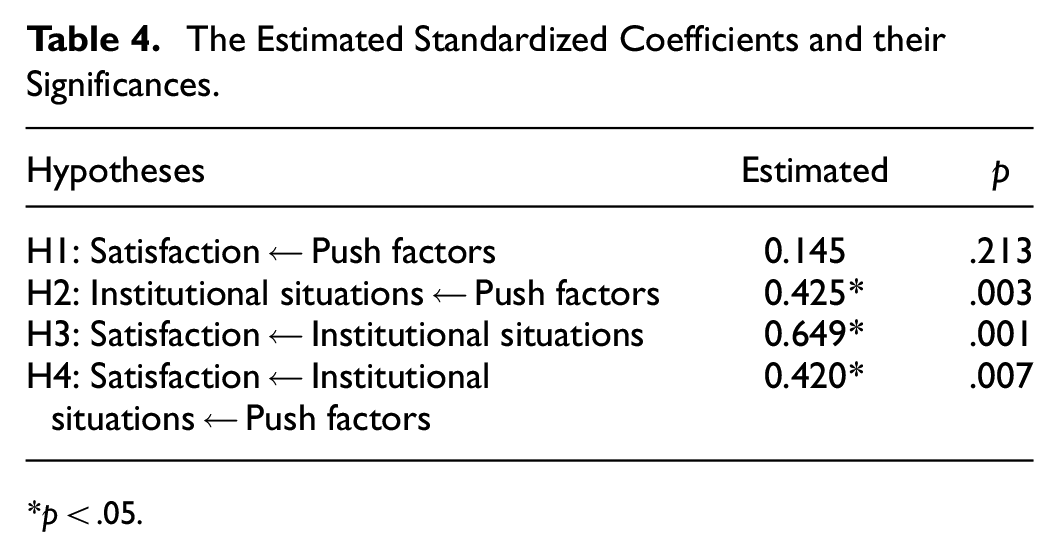
p < .05.
Based on the results, this study suggests that an institutional situations exerted strong mediation effect in the model.
The details of the causal structural relationships in CB-SEM are displayed in Figure 2.

SEM results.
Testing the Mediation Effect
We found that the coefficient β1 (push factors → institutional situations) is significant (β1 = .425, p = .03), and β2 (institutional situations → satisfaction) is also significant (β2 = .649, p = .001), while β3 (push factors → satisfaction) is not significant (β3 = .145, p = .213). Since the model demonstrates β1 × β2 > β3, the institutional situations might exert a strong mediation effect in this model. The results show that the effect of mediation (β1 × β2) was 0.275, and it was significant at the 0.05 level (p = .002) with a 2,000 resampling bootstrap method in AMOS. The details of the indirect, direct, and total effects, p-values, and BCa 95% CI are listed in Table 5. The findings suggest that the mediation effect of the institutional situations works well in this model. When considering the total effect, the model shows the total effect (0.420) = indirect effect (0.275) + direct effect (0.145, push factors → satisfaction).
Summarizing the Estimated Standardized Coefficients of Indirect, Direct, and Total Effect with BCa.

p < .05.
Validation of the Measure Constructs
Two types of measure constructs, reflective and formative, needed to be discussed in this study. Formative measures will cause the latent construct, whereas reflective measures are caused by the latent construct. The validation of the reflective construct provides evidence for the causal relationships among push factors, institutional situations, and satisfaction. Regarding formative measures, high correlations with the indicators may not exist in formative constructs. Generally, high correlations among formative indicators may indicate that the scale items are essentially measuring the same concept and result in a multi-collinearity problem. In this study, the mean of inter-indicator correlations was 0.266 (minimum −0.044, maximum 0.595) based on the SPSS calculation. There is no multi-collinearity in this measurement. The correlation analysis among the latent variables, Cronbach’s α, composition reliability (CR), and average variance extracted (AVE) are listed in Table 6. The CR is better than Cronbach’s α for push factors, institutional situations, and satisfaction measures. The AVE results indicate push factors as 0.477, institutional situations as 0.496, and satisfaction as 0.481, which are very close to the criteria of 0.50. Based on Fornell and Larcker’s (1981) suggestion, we checked if the correlation of latent variables is less than the root square of AVE. The result reveals that the correlation among the three latent variables is less than the square roots of AVE (see Table 6); thus, the validation of the constructs has been confirmed.
Validation of the Constructs.

Note. The values of 0.691, 0.704, 0.694 are square roots of AVE.
Discussion
The study was conducted with the following steps. First, we developed a self-designed questionnaire to collect data and verified the measurement construct. Second, to determine the causal relationships among push factors, institutional situations, and satisfaction, we proposed a CB-SEM model with hypotheses for testing. Finally, bootstrapping was used to estimate the mediation effect in the model. The results fit the SEM criteria proposed in previous studies (Bagozzi, 1981; Hair et al., 2010; R. B. Kline, 2015; Schumacker & Lomax, 2004; Wardrop & Loehlin, 1987). Considering the limited samples from female international students, this study used a bootstrap method, extending the 215 samples to 2,000 resamples. It is an alternative strategy for extending moderate samples. Amos can extend the samples up to 10,000 (Efron, 1987; Efron & Tibshirani, 1993; Jung et al., 2019).
In this study, we view the push factors as negative situations that female international students might confront in their countries (Lee, 1966; Ravenstein, 1985, 1989). This study found that push factors are relative low based on their factor loadings in SEM, except PS2 “poor living conditions in my country.” Therefore, scholarships are traditional pull factors that can help to attract international students. This study found that IS2 refers to “My university provides various learning opportunities or funding for international students” and IS4 refers to “My university encourages international students to attend conferences abroad and provides funding support” could be influential factors that impact on attracting female international students. The result confirms the mediation effect, with the institutional situations exerting a strong mediation effect in this model. Whether female international students confronted push factors or not, this study confirmed that institutional leadership and international strategies can provide significant and meaningful transformation within the proposed framework. The findings suggest that institutional leaders can enhance their leadership and international strategies based om the reflected requirements for attracting and retaining international students. The design of this study can be used to investigate female international students’ study journey in similar higher education settings, not limited to a specific group.
Previous studies show that soft power might exert policy influence on higher education (Li, 2018; Lomer, 2017; Mellors-Bourne et al., 2013). Trilokekar (2010) argues the political rationale has been dominated by commercial logic in Canadian higher education, while in the British experience, representations of international students as social subjects have disciplinary implications, which need to be considered in pedagogical contexts (Lomer, 2017). Moreover, mobile students could be an important source of income and have a disproportionate impact inbound countries’ economic and innovation systems (OECD, 2021). In this case, we found one of the major reasons for attracting and maintaining international students is the declining of enrollment. We assume that economic and political purposes might be less important in the target country. For international students, most higher education institutions are considered in an educational rather than economic or political framework.
Regarding the investigation of satisfaction, this study suggests that female international students could be represented differently. Based on the means of satisfaction, the learning and environment satisfaction were between 3.71 and 3.7, and recommend the program to newcomers is 3.8 (See Table 3), only moderately and tended to satisfy. Similar to the majority of international students, which are self-funded and may not become major political or economic actors, female international students that may be dampened by loneliness or disappointment, for example, disappointing experiences in the destination country. It is possible that they do not significantly change their views during their studies. Moreover, recommendation could be an important indicator to evaluate student satisfaction based on the application of TQM (Brata & Soediantono, 2022; Fečiková, 2004). Previous studies indicate that customer satisfaction is a crucial component of quality assurance in TQM. For example, TQM practices are significantly and positively linked to customer satisfaction and service quality (García-Alcaraz et al., 2021; Ooi et al., 2011). This study found that when international students are willing to recommend the program to newcomers, it may reflect their satisfaction with the program. In this particular case study, the findings may suggest that the recommend is tended to low in the model. It is an alert to current higher education provisions.
Practical and Theoretical Implications
Female international students come from a variety of cultural backgrounds, and their motivations for studying vary. An adequate quantitative research design can help establish reasonable dimensions for specific research purposes. CB-SEM was successfully applied to analyze the data and verify the hypotheses regarding interactions among female international students with push factors, institutional situations, and satisfaction. This study demonstrates a holistic approach to consider the selected factors in the causal model. For higher institutions, the female international students reflect that IL2 “My university’s policy is indifferent to the treatment of international students” is tended to low. The proposed indicators can detect what is going on the internationalization implementation on campus. The model also displays that female international student might suffer poor living conditions in their original countries.
Moreover, this study extends the traditional notion of satisfaction to evaluate the program’s quality. It is possible to increase recommendations as one of the key components in the satisfaction measurement scale. However, higher education settings are diverse, it could not fit internationalization entirely. This study indicates when the researchers focus on the learning process of international students, the research design can be extended to a wide range of related variables, not limited to institutional situations and satisfaction.
Conclusion
Given that internationalization has become an important movement, policy-oriented studies in higher education are urgently needed. As an exploratory study using an innovative approach, this study provides an example for conducting similar analyses in higher education, not only in terms of the theoretical framework, but also regarding international students’ campus life. This study employed the CB-SEM approach to address the participation issues among female international students. Specifically, we modeled three first-order components of female international students’ perception (observed variables) and confirmed that they could make up a second-order construct of push factors, institutional situations, and satisfaction (latent variables). This study demonstrates that a higher-order modeling approach leads to more theoretical parsimony and reduces model complexity. Based on the research design and verification process, this study demonstrates that the designed instrument and CB-SEM are useful in addressing the topic of female international students. In the conceptual research framework, we found it is feasible to interpret the status of female international students in a specific country.
Limitations and Future Research Directions
While there is limited literature on soft power with empirical studies for internationalization in higher education, there are even less focusing on a specific international student group. Thus, an in-depth qualitative study may be needed as a supplementary tool for further studies. Even though this study cannot directly extend to the topic of soft power, the findings provide useful information for institutional leaders.
Future research could focus on the consequences of international students’ studies in the model. The model can also deeply differentiate satisfaction and student learning effects or skill levels. In the global labor market, it would be interesting to know to what extent skills contribute to chances of employment, quality of work performance, and earning higher income. The related learning performance might be a crucial factor impacting international students’ desirable careers. Further studies may follow these steps for an in-depth exploration of this topic.
Footnotes
Declaration of Conflicting Interests
The author(s) declared no potential conflicts of interest with respect to the research, authorship, and/or publication of this article.
Funding
The author(s) received no financial support for the research, authorship, and/or publication of this article.

Data Availability Statement
Data sharing not applicable to this article as no datasets were generated or analyzed during the current study.