



Abstract
The potential international university education market value is expressed in billions of dollars. Countries are trying to increase their competitiveness to attract international students and get a decent market share. Countries that can accurately analyze the factors affecting the country and school preferences of international students will be more advantageous in developing appropriate competitive strategies. The primary purpose of this study is to try to understand and explain the effects of the quality of university education service and socio-cultural adaptation difficulties factors on the satisfaction levels of international students. The research was carried out at Karabuk University, with the highest number of international students in Turkey. The data obtained through an online questionnaire using the convenience sampling method from 413 international students were analyzed with the “Structural Equation Model.” According to the analysis results, assurance and empathy from service quality dimensions, and cultural differences and religious belief variables from socio-cultural adaptation difficulties positively affect general student satisfaction. The research sample mostly consists of Syrian students who migrated to Turkey due to the war and bright students from low-income African, Asian and Middle Eastern countries. Turkish universities form attraction centers for international students flowing toward western countries. In this respect, the results of the research offer original contributions to the higher education literature.
Keywords
Introduction
The number of university-level international students increases worldwide (Nada & Araújo, 2019). The total number of international students in the world has reached 5.6 million (UNESCO, 2018). While the USA is first with 1,000,075 students in international student admission, England is second with 551,445 students, followed by Canada with 503,270 students (IIE, 2020). These three English-speaking countries are followed by China, Australia, France, Russia, Germany, Japan, and Spain. China, India, Germany, South Korea, Nigeria, France, and Saudi Arabia are among the countries that send the most international students (UNESCO, 2019). The minimum annual cost of a student studying at international universities has been calculated as approximately $20,000. By this calculation, the potential global international university education market is worth over $100 billion (Ruby, 2009). Every country is trying to increase its competitive power to get a share of this market. About 20% of international students prefer the United States (USA), and this industry brought $44.7 billion to the US economy in 2018 alone (IIE, 2019).
Private or public universities are active for international students to choose their schools. Governments actively support educational institutions in these activities. The distinctive capabilities that provide competitive advantages in this sector are; the prestige of universities, international programs differentiated according to needs, perceived quality, educational adequacy, country image, social and cultural ties between countries, geographical distance, and cost of living are counted (Sultan & Yin Wong, 2012). Despite the Covid 19 pandemic, international students seeking ways to continue higher education at international higher education institutions. International students attach special importance to the education quality of the university they study at. In addition, students’ social interactions affect their overall satisfaction levels (Finn & Darmody, 2017).
Apart from this, the university-level children of families who left their own country due to irregular migrations due to various reasons have almost the same conditions as international students who come voluntarily. Countries generally resist irregular migration and refugee entry, limit their immigration activities according to their initiatives, and support the admission of international students with economic considerations. On the other hand, international students can choose to stay in the countries they study if they see the appropriate conditions.
International university education has a transformative quality. It enables people and knowledge to become cosmopolitan. The internationalization feature of education can also lead to oppressive social and geopolitical hierarchies if not strictly designed (Morley et al., 2020).
Higher education has an important role in sustainable development. Universities are in a key position to contribute to a sound future by educating their students, who are the architects of the future, as democratic, egalitarian, well-equipped and ecologically minded individuals (Weiss & Barth, 2019).
The international higher education curriculum aims to equip students with qualifications for a decent job. Collaboration should be made with all stakeholders in determining the qualifications and abilities of the graduates. Higher education graduates should be equipped with independent and critical thinking, problem solving and effective communication skills (Oliver & Jorre de St Jorre, 2018).
Universities aim to provide their students with the necessary qualifications to graduate and join the work-force. It is necessary to specify qualifications and curriculum with maximum multilateral contributions from all stakeholders and to be constantly updated. Thus businesses, workplaces and universities should jointly develop educational projects. The success of knowledge management depends on the creation, storage, sharing, use, transformation, and evaluation of knowledge by both internal and external stakeholders (Stanca et al., 2021).
School preference motivations of students, as customers of the international higher education sector are constantly researched. With neuroscientific methods, it is possible to examine the Dynamics of students’ buying reactions such as choosing and giving up at the decision stage (Mirica, 2019). International students’ school preferences can be understood through neuroscientific marketing methods (Drugău-Constantin, 2019).
As of the 2019–2020 academic year, the total number of international students studying in Turkey is 185,001. Students from Syria (37,236), Azerbaijan (21,069), and Turkmenistan (18,016) take the first three places in the total number. Syrian students make up one-fifth of the total number of students. In addition to the demand for Turkish universities from neighboring countries (Iraq: 9,752, Iran: 8,776, Bulgaria: 3,688, Greece: 2,874), more than 30,000 students from more than 50 African countries preferred Turkish universities (YOK, 2021).
Karabük University, where this research was conducted, is the third university in Turkey in terms of capacity, with 8,084 registered international students from 90 different countries in the 2019–2020 period. Approximately 25% of international students studying at Karabuk University are Syrian nationals (YOK, 2021). Syrian students are the children of families fleeing the war, and it is almost impossible for them to pursue higher education in other countries. The remaining approximately 6,000 students chose to study at Karabuk University with their means and initiatives. Students who are Turkish citizens receive free education at state universities in Turkey. Teaching in private universities is paid for Turkish citizens and foreign nationals. International students can study at state universities by paying a fee. In recent years, both public and private universities have increased their international student quotas. The students of the top 10 countries that most preferred Karabuk University in the 2019–2020 academic year are shown in Table 1.
Countries/Numbers of International Students Preferring Karabuk University in the 2019/2020 Academic Year (YOK, 2021).

This research aims to determine the factors affecting the general satisfaction level of international students studying at Karabuk University, which ranks third in Turkey, regarding the number of international students. The first of the factors whose effect on the general satisfaction level is examined is the students’ opinions about the quality of the education service they receive, and the second is the socio-cultural adaptation difficulties they experience in Turkish culture.
This study, unlike the literature, takes these two dimensions together. In addition, it is one of the few studies in the literature that includes the variable of religious belief in the dimension of socio-cultural interaction difficulties.
The students satisfied with the quality of the service and the cultural interaction environment will continue to Karabuk university, be more successful and happier, and recommend Karabuk University to others by spreading word of mouth. For this reason, it is considered that this research will contribute to the administrators of Turkish universities in making decisions and determining strategies regarding the processes regarding international students. In our study, the career planning of international students was also investigated, and it was questioned whether the mentioned factors affect their career intentions.
Concepts and Theoretical Background
Acculturation is one of the most important theories in the literature at measuring the satisfaction level of international students. Berry’s (1997) acculturation model is used to form the theoretical basis of this research. According to Berry (2001), a distinction should be made between an individual’s conservatism attitude and his willingness to communicate with host culture. Acculturation focuses on the effects of interaction between different cultures. The adaptation variable emerges as a result of the acculturation process experienced. Individual adaptation refers to the psychological experiences of the minority members of the society during the cultural adaptation (Berry, 2006). Individual adaptation process may be categorized as as psychological adaptation and sociocultural adaptation (Berry et al., 2011; Ward & Rana-Deuba, 1999). Socio-cultural adaptation includes the members of cultural minorities adopting certain features of the mainstream culture and continuing their lives in accordance with their new life (Berry et al., 2011). The sociocultural adaptation difficulties experienced by the students cause them to have psychological and motivational problems. These problems also make students to adapt to their environment more difficult (Pan et al., 2010). Adaptation difficulties increase students’ feelings of anxiety. When students have difficulty interacting with their new social environment, their academic success decreases and they become more unhappy. Students’ sociocultural adaptation difficulties also reduce the factors that motivate them (Ward & Kennedy, 1993). Students with low motivation will have low academic and life satisfaction levels.
Service Quality
Quality is defined as conformity to purpose, use, need, and standards (Juran, 1988). Service quality emerges as the difference between what the customer expects and finds regarding the service they receive. Service quality is evaluated by determining the difference between the quality expected and perceived by the customer regarding the purchased service (Parasuraman et al., 1985). Service quality in education refers to the quality of unique learning experiences that universities create for their students in order to gain competitive advantage (Latif et al., 2019). Although university students’ perception as customers does not seem ethical, the size of the international student market and the intense competition have led educational institutions to investigate how students choose their school. The concept of “neighboring countries” is known as an influential factor in attracting international students.
International students examine the educational institution, city, and country in depth while making their university choices. The core of the requested service is the education offered. However, the elements that make the educational institution stand out and differentiate it from its competitors are generally auxiliary elements. The perception of service quality in higher education may vary depending on the conditions. The perception of service quality may differ from year to year, from class to class, from educator to educator, or from student to student in the same school. In addition to the primary service, issues such as security, health (as in the Covid-19 epidemic), cultural activities, quality of life, university environment, and visa requirements can affect perceptions about service quality (Cubillo et al., 2006). Service quality is a related with but a different concept than customer satisfaction. Service quality refers to the difference between the customer’s performance expectation and perception of the service purchased (Ozdemir et al., 2020).
Academics are among the essential elements that contribute to the quality of service in university education. To be productive, they must be loyal to their organizations and be satisfied with their professional conditions. However, especially in developing countries, academics suffer from their salaries, lack of resources for research, overcrowded classrooms and inadequate educational materials. Since these problems affect the quality of education service, students in these countries tend toward international higher education institutions (Ssesanga & Garrett, 2005).
Service is intangible and heterogeneous. Its supply and consumption are simultaneous (Parasuraman et al., 1991). For these reasons, service quality is measured according to the quality level perceived by the customer. Service quality and customer satisfaction are related but separate components (Parasuraman et al., 1988). As a customer in the higher education sector, it is strategically essential to learn the student’s views on service quality. Students satisfied with the quality of service contribute to the effective promotion of their schools through positive word of mouth and gain new customers (Arambewela et al., 2006). Service quality is the result of an evaluation process and indicator of the extent to which a service provided meets the expectations of the customer (La Rotta et al., 2020).
Developing a sound market-oriented service strategy needs to specify factors which increase the international students’ satisfaction levels with their new environment and education system. According to research conducted in this area, one of the factors that most affect student satisfaction is service quality. As the perception of quality increases, students are willing to pay higher student fees. The effect of the university’s image on the satisfaction level is not as high as the effect of the service quality. It has been determined that student groups belonging to different cultures are generally less satisfied with their university experiences than others (Clemes et al., 2008).
Perceived service quality is a holistic evaluation of a service. Studies on service quality measurement are mainly done by Parasuraman et al. (1988) using the SERVQUAL instrument. This scale (determinants of service quality) has grouped the determinants of service quality under five factors and is used to measure service quality in many different sectors. With this method, the level of service quality is determined by mathematically interpreting the positive or negative difference between customers’ expectations about the service and the actual situation they encounter (Sureshchandar et al., 2002). Various researchers have also used the SERVQUAL scale to measure service quality in the field of higher education (Arambewela & Hall, 2006).
The 22-item Servqual scale was used to measure perceived service quality (Parasuraman et al., 1988). In this study, perceived service quality was measured simultaneously by obtaining a single service quality score as expectation and performance items were combined, following “Shemwell et al.” s method (Shemwell et al., 1998).
Socio-Cultural Adaptation Difficulties
International students aim to receive a quality education abroad. However, these students interact with the university students they study with during their education, becoming a part of the host society. The social relations they experience in the community, the emotions, the difficulties they encounter, the perspective and attitudes of the society toward them can also affect the quality of life of these students. The service quality and international acceptance of education are essential. The students may experience adaptation difficulties to their new environment. These difficulties may also affect the quality of their educational experiences, school preferences, and career planning after their education.
If international higher education is not used as a purely economic and political tool, it may be a mechanism and process that will produce scientists who care for the benefit of all humanity. International students can develop cosmopolitan personhood through this process. Global citizenship education adopts policies covering all humanity. Covid 19 pandemic conditions necessitated openness and sharing in the scientific field and revealed the need for universal personalities (Green, 2020). Increased levels of globalization and international education powered discussions about what the main purpose of education should be at the national and international levels. Some scientists argue that the ultimate goal of education should be developing critical thinking abilities. The rationale for this idea is stated as the achievement of any goal requires critical thinking skills. In addition, some others think that moral excellence should be the ultimate goal and that includes critical thinking. These discussions actually include critical approaches about the quality of current international education (Roth, 2019). A curriculum that critically addresses differences in international education is considered as a cosmopolitan legacy. Education needs to be able to teach students to negotiate what they are doing and why. Today, ethnic, religious and cultural understanding and practices lead to deep conflicts between groups. Education should be able to give students a dream of global peace based on international personality and mutual trust. In this framework, it is necessary to create a participatory curriculum based on negotiations in a way to highlight the concept of democracy in international education (Englund, 2019).
Researches are continuously carried out to determine the language and academic problems of students studying abroad. According to these studies, human relations, economic issues, accommodation, lodging, clothing, food, society’s perspective on international students and traditions are among the critical factors that students are affected by during their education (Kıroğlu et al., 2010). People who are in a different environment than their own cultural environment in foreign countries generally experience cultural interaction problems. Sociocultural adaptation level may vary according to individual characteristics and attitudes/behaviors of different cultural groups. This is also true for international students (Güzel & Glazer, 2019). A student studying at the undergraduate level stays in a foreign country for at least 4 years and interacts with a different culture for him. The socio-cultural difficulties international students face are problems or concerns that arise from fundamental foreign language deficiency, academic development, cultural differences, social interaction, finance of education, tradition, religion, and security (Pan et al., 2010). International students have academic adjustment difficulties in their schools. This is due to the difference in the basic education they received in their own country and the cultural environment in which they grew up. The cultural interaction that students are exposed to in their new environment can cause stress in students and negatively affect their educational experiences. Language deficiency negatively affects academic achievement and social interaction, thus makes adaptation more difficult (Bastien et al., 2018). Students may experience a cultural shock in the new educational environment come, and even hostile attitudes toward international students may develop in that society due to misperceptions (Nada & Araújo, 2019).
Even in developed countries, the issue of immigration and international students can be negatively combined and used as a tool for politics. The case of foreigners in the country can turn into a political rent-making area for some far-right parties with populist policies (Betz, 1993; Rooduijn, 2015). The children of the families who had to go to other countries due to regional crises and migrations, who go to university, experience the problems experienced by international students more severely. Since 2011, the university-level children of many families who migrated from Syria due to the war in Turkey continue their education as international students at Turkish universities.
This study used the “Cultural Problems Scale” developed by Pan et al. (2010) for foreign university students. This scale tries to determine to what extent international students studying at Karabuk University and predominantly coming from Asian and African countries face socio-cultural difficulties and how this situation affects their satisfaction with being at this university and in this country.
Othering and xenophobia based on race or religion are understandings that make social and cultural harmony impossible. Recently, Islamophobia has been added to the historical anti-Semitic or Black hostility (Taras, 2012). This study also investigated whether the students experienced any difficulties at school or in the community due to their religious beliefs or practices. Among the push-pull factors that affect international students’ school preference are the visa applications of the destination country, policies against immigrants, discrimination and security concerns that may arise from the political or religious environment (Ramia, 2021). Religion and religious organizations are vital to most people. Foreigners act more religiously in their new environment than in their own country, and religious beliefs and practices make their lives more balanced (Hirschman, 2004). Religious beliefs are one of the mechanisms that make it easier for minority groups to experience their socio-cultural characteristics (Saroglou & Mathijsen, 2007). Religious discrimination practices cause international students to cut off relations with other students, and students become more unhappy and stressed because of their environment (Philip et al., 2019).
Customer Satisfaction
Oliver (1980) states, satisfaction stems from perceptions of the expectation and standards at the beginning of the process and the deviation from the initial standard. Customer satisfaction is an evaluation made after using the product or service, the main component of the marketing activity, and an indicator of the overall business effectiveness (Islam et al., 2021). Positive perceptions about the performance of a product or service satisfy the customer. The increase in customer satisfaction increases customer loyalty, decreases price sensitivity, and affects the determination of the next shopping behavior. A satisfied customer contributes effectively to promoting the company’s products or services with positive comments (Lim et al., 2020). According to Sureshchandar et al. (2002), total customer satisfaction results from customers’ experiences with product/service providers in more than one area. Therefore, customer satisfaction is multidimensional (Sureshchandar et al., 2002). Customer satisfaction is a concept closely related to service quality. What they have in common is that both are concepts based on the “disconfirmation” theory. Their difference is that the service quality evaluation is made by the customer during the service, and the satisfaction evaluation is made as a general evaluation at the end of the consumption process. With this feature, satisfaction is the result of service quality perceptions (Oliver, 2000; Teeroovengadum, 2022). As a customer of international education institutions, the level of satisfaction of international students emerges as a result of the multidimensional experiences these students have at all levels during their education process. Educational institutions are applying different marketing strategies to attract more students in a competitive international market. The cost of education, recognition, and prestige of the diploma in the international arena, social and physical facilities, the public and institutional perception about international students, ease of transportation, and communication are some of the key elements highlighted in line with the strategies followed. The main goal is to increase the overall satisfaction level with the institution. Every student satisfied with their education environment will be a natural advertiser of that university and will attract more customers (Arambewela & Hall, 2006).
School satisfaction is a cognitive assessment of one’s overall satisfaction with one’s school. Students’ experiences due to their school choices affect their overall school satisfaction and even their enjoyment of life (Varela et al., 2018). This result is particularly striking for international students. If these students do not like the environment they find after making their choices, they may have to bear considerable costs in terms of immediate replacement.
The factors that can affect the satisfaction of international students can be very diverse and multidimensional. Various scales have been developed to measure the overall satisfaction level of the student. Ngamkamollert and Ruangkanjanases (2015) used a five-item scale to measure student satisfaction. In this scale, overall satisfaction was measured as a function of the following dimensions: cost-effectiveness, intention to maintain relations with the school after graduation, and school recommendations to others.
In this study, the overall job satisfaction scale, applied to university students by Judge et al. (1998) and developed by Brayfield and Rothe (1951), was adapted and used. Students’ general satisfaction levels with the environment were questioned on this scale’s environmental, emotional, and career-related dimensions.
Research Model
This section defined variables related to the research model, and hypotheses determined based on the literature were put forward. The research model tested within the scope of the study is given in Figure 1.

The research model.
Within the framework of the model, the effect of 10 factors on the overall satisfaction of international students is investigated. Five of these factors are related to service quality, and the other five have socio-cultural difficulties that international students face during their education. In this research, the factors affecting international students’ satisfaction with the education service they receive in higher education are investigated. Within the framework of the study, these elements are classified under two main groups. The first is the perception of the quality of the education service. The second is the difficulties arising from the socio-cultural environment in which the students interact during their education.
Service Quality Dimensions
Parasurman et al. (1988, 1991, 1994) state that service quality has five dimensions. These are reliability, tangibles, responsiveness, assurance, and empathy. If the customer does not find what he expects in service quality, he will not be satisfied with the service quality, which may lead to customer loss (Haming et al., 2019).
Reliability means the ability to provide the offered service accurately and consistently as promised (Arambewela & Hall, 2006; Pekkaya et al., 2019). In terms of the business and customer relationship, reliability is the business performing the service as promised. Students, who are customers of the education service, expect to encounter a service that meets their expectations regarding registration procedures, fees, accommodation costs, quality of education and educators, and communication efficiency. On the other hand, the student wants to see the service for the price he has paid. Accordingly, the following hypothesis has been developed:
Physical facilities refer to the condition of the facilities, materials, personnel, and communication materials where the service is provided (Arambewela & Hall, 2006). The beauty of the campus in universities, the library, computer rooms, sports facilities, and the location of the campus in the city can be evaluated within this framework. Especially the campus location is one of the critical factors that make life easier to reach the city center. For this reason, the physical facilities of the university and the easy accessibility of the services will have effects on satisfaction. Accordingly, the following hypothesis has been developed:
Responsiveness refers to corporate and personal willingness to assist customers, timely service delivery, and quick response to customer requests (Arambewela & Hall, 2006; Haming et al., 2019). Especially for international students, effective counseling services and problem-solving, open and accessible communication channels enable them to have a positive personal experience (DeShields et al., 2005). Accordingly, the following hypothesis has been developed:
The assurance dimension is related to the fact that the person providing the service is knowledgeable and respectful and that they give confidence to the customer by having the ability to do their job well. It is not easy to meet expectations on trust and empathy in the education sector, especially in the health field (Arambewela & Hall, 2006; Zun et al., 2018). The international student invests in his education in another country at a great cost and expects a significant return from this investment. This return is closely related to the image and acceptability of the educational institution in the international arena (Ruby, 2009). In this context, the trust dimension of service quality is related to the fact that the student is in the right place for education in terms of career goals. Based on this information, the following hypothesis was developed:
Empathy is about the personal attention and care that service providers show to customers (Arambewela & Hall, 2006). It has been determined that it is challenging to meet customer expectations regarding empathy, especially in the banking sector (Kumar et al., 2018). Empathy is not easy in places with large customer groups. Supporting international students in solving their problems, organizing social activities for them, and providing an environment where they are not disturbed because they are foreigners will affect their perception of the service quality. From this information and evaluations, the following hypothesis was put forward:
Socio-Cultural Adaptation Difficulties Dimensions
In this study, following the relevant literature, the dimensions of socio-cultural adaptation difficulties were determined as language deficiency, academic difficulties, cultural differences, social interaction difficulties (Pan et al., 2010), and the perception of religious freedom. Cultural interaction is the change and interaction experienced by people exposed to a culture different from one’s own social culture. Depending on the duration of their education, international students interact with a different social culture for a considerable period and try to adapt to the difficulties created by this situation.
The inadequacies of international students in the language they study can be interpreted as their inadequacy in learning. Language inadequacy can make participation in classroom activities risky for the student. Language deficiency is one of the main factors that creates pressure on acculturation of international students. This factor creates personal and environmental barriers for them. Language deficiency negatively affects academic achievement and daily functioning (Gong et al., 2021). Academicians may prefer to make academic evaluations of international students only by considering their foreign language skills. These difficulties lead to feelings of not being accepted and ignored in international students and, as a result, general dissatisfaction (Ryan & Viete, 2009). From this information, the following hypothesis was developed:
University education service is actually a service-product bundle. In terms of service quality, the physical facilities of the university and its explicit and implicit are evaluated all together. Although the physical facilities of the school are important, its academic activities are given more importance. In addition, human relations affect students’ general evaluations about their schools (Douglas et al., 2006). Emotional and situational factors experienced by international students affect their academic performance and education experience in general. Stress arising from academic or socio-cultural experiences in education at all levels negatively affects students’ academic motivation and school/life satisfaction (Lardier et al., 2020). Adaptation problems can be perceived as inadequacy in students’ mental skills, which puts pressure on students. Academic failure caused by adaptation problems leads international students to feel more worthless (Luzio-lockett, 1998). Accordingly, the following hypothesis has been developed:
Globalism and cultural diversity enrich human relations and the learning experience (Abrar-ul-Hassan, 2021). However, to ensure the active participation of international students in lessons, a learning environment that is inclusive of different cultures and takes into account differences should be prepared (Liu et al., 2010). International students face significant difficulties, especially in terms of language, culture, and social relations. These students must create a new social support system and develop new relationships to share effectively with their social and academic circles. Developing these relationships is not as easy as it is said (Taylor & Ali, 2017). International students are deprived of social support networks, have difficulty developing new relationships with local students, and face different challenges due to cultural diversity. These difficulties affect students’ emotional and academic experiences (Pan et al., 2010). Accordingly, the following hypothesis has been developed:
High quality education, urges student to continue education at the university he was enrolled in. Studies show that perceived service quality affects the communication behavior of consumers (Athiyaman, 1997). The fact that the person does not know enough the country’s language they go to causes language insufficiency. This person has difficulties in social communication due to his language deficiency. When language deficiency is accompanied by a problem of cultural adaptation, the difficulty of social communication increases. Language deficiency also causes the person to comprehend the environment. International students do not only experience language deficiencies during their social interaction efforts. Apart from language deficiency, policies, social ideologies, stereotyping, prejudice and personal value judgments can also complicate students’ social interactions (Lou & Noels, 2020). This situation causes a lack of self-confidence and a feeling of exclusion. This feeling experienced by international students leads to feelings of not being accepted and ignored and a general dissatisfaction (Ryan & Viete, 2009). Based on this information, the following hypothesis was developed:
Religion has a vital role in the development of people’s psychological, mental, and social functionality. Studies reveal that satisfied religious feelings and practices positively affect students’ academic performance (Philip et al., 2019) and improve behavioral control and positive mood by reducing feelings of anxiety and depression in students (Sultan et al., 2020). Based on these views, the following hypothesis has been developed regarding the relationship between the socio-cultural adaptation difficulties that international students may encounter and the general satisfaction levels of students:
Methodology
The research model includes ten factors. All items were determined and adapted from the relevant literature to increase the content validity. Measurements were made using at least three items in all structures. Responses were asked to the statements in the scale in a 5-point Likert format. Accordingly, “1 = Strongly Disagree” means “5 = Strongly Agree.” The following scales were adapted to collect data on the variables of the study.
The “Servqual Scale” developed by Parasuraman et al. (1988) was used to measure students’ perceptions of the current service quality, and the “Acculturative Hassles Scale” developed by Pan et al. (2010) was used to determine socio-cultural difficulties. To test the structural validity of the scale, we performed a confirmatory factor analysis (CFA). The CFA results showed a good fit of the five-factor structure (χ2/df = 2.14, CFI = .97, TLI = .95, RMSEA = .05, SRMR = .02). Specifically, the effect of international students’ ability to freely practice their religious beliefs on their overall satisfaction levels was also investigated. A scale consisting of five items was used to determine the perception of religious beliefs. These scale items were determined by scanning the relevant literature (Hirschman, 2004; Philip et al., 2019; Saroglou & Mathijsen, 2007; Sultan et al., 2020). The results of the CFA showed a good fit to the data (χ2/df = 1.98, CFI = .97, TLI = .97, RMSEA = .04, SRMR = .03). The “General Job Satisfaction Scale” developed by Brayfield and Rothe (1951) and applied to international students by Judge et al. (1998) was adapted and used in this study. The CFA results indicated a good fit (χ2/df = 1.4, CFI = .99, TLI = .99, RMSEA = .03, SRMR = .01). According to the results the our measurement model had convergent and discriminant validity and construct reliability. All items’ factor loadings were over recommended level of .60. Since, all loadings were significant (p < .001), reliability for each construct exceeded the recommended level of .70 and the square root of the average variance extracted (AVE) by each construct fulfilled the recommended benchmark of .50 (Hair et al., 2010), convergent and discriminant validity was supported.
In the translation of the expressions in the scale, the most preferred translation technique, the “translation-back translation method,” was used to ensure consistency and accuracy. The statements in the scale were first translated into Turkish by an expert in the field and then translated back into English by another expert to ensure consistency. Finally, no significant differences were found when comparing the original English questionnaire and the translated English questionnaire by a native speaker. Later, these questionnaires were translated into Arabic and French using the same technique. In the meeting held with students from 14 different countries studying at Karabuk University, the instrument’s face validity was examined. Then, a pre-test was conducted with 40 international students to validate and fine-tune our instrument. These participants were asked to make suggestions about the problems they experienced regarding the intelligibility and language of the questionnaire. Following the feedback received about the relevance and clarity of the questionnaire items, a few words were replaced with more commonly used words. The pilot tests’ results showed that the scales’ reliability and validity were at acceptable levels. Since March 2020, as the Covid-19 epidemic in Karabük has threatened public health, education has started to be done remotely at the university.
For this reason, survey studies that were initially planned to be conducted face-to-face became risky. The convenience, cost efficiency, and time advantages of web-based surveys on developments have been exploited. The participants can answer web-based surveys whenever and wherever they want, and the high level of technology use of the participants provided convenience in our research. A significant portion of university students did not return to their country during the pandemic. Survey participation was encouraged with a prize announcement.
The online survey link created via the Google form was sent to 14 foreign student representatives and asked to share them in the groups they represent. The study questionnaire consists of 52 questions, 8 of which are demographic and 44 of which are to explain variables. The distribution of 44 Likert-type statements about the variables according to the sub-dimensions is as follows: (1) a total of (21) statements in 5 sub-dimensions (reliability, tangibles, responsiveness, assurance, empathy) for determining service quality, (2) 5 for detecting socio-cultural problems. In the sub-dimension (language deficiency, academic work, cultural difference, social interaction, religious belief), a total of (19) expressions, and (3) a total of (4) expressions for determining general student satisfaction.
The universe of the study consists of 8,084 international students registered at Karabuk University in the 2019–2020 academic year. However, since it is impossible to reach the whole population due to time and cost constraints, data were collected by the easy sampling method. For this purpose, communication was established with student representatives from (14) different countries. Data were collected from 413 international students who agreed to participate in the research from students registered in WhatsApp groups created by student representatives with the participation of students from their own countries. As a general rule, it is stated that the sample size should be at least five times the number of observed variables (Tabachnick & Fidell, 2001). According to this rule, the sample size of the study is considered sufficient. Structural Equation Modeling (SEM) was used to examine the relationships between the variables in the research model.
As of 2021, there are approximately 4 million international migrants in Turkey. Turkey ranks first among countries hosting migrants. Children of immigrant families who have reached the age of university education continue their higher education in Turkey. Moreover, the demand for Turkish universities from African, Asian and Middle Eastern countries has increased considerably in recent years. In 2020, a total of 224,000 foreign students are registered at Turkish universities. Approximately 50,000 of these students are Syrian nationals. There are 9,800 foreign students in total at Karabuk University in 2021. About 25% of this number is Syrian and the other 25% is from African countries. The remaining students are mainly from Asian and Middle Eastern countries. Approximately 95% of foreign students are Muslim. Karabuk University ranks second in Turkey in terms of the number of foreign students enrolled. For this reason, Karabuk University was considered appropriate for this research.
The results of this research may be generalized for countries which may host similar groups of international students. The number of immigrant students who had to flee from their countries for many reasons like wars, political and economic problems is quite high. In coming years, European countries will be more and more under the pressure of immigration originating from African, Asian, and Middle Eastern countries. For this reason, interpreting and understanding the behavior of young people who migrate is important for decision and policy making processes. This research is one of the few studies conducted on the mentioned group. In this research, service quality and socio-cultural adaptation problems that affect higher education satisfaction were examined through the selected sample. Probably international students belong to similar countries will choose to enroll at higher education institutions in EU border countries such as Spain, France, Italy, Greece, Bulgaria, Romania and Poland and will exhibit similar attitudes and behaviors in their schools. For this reason, the results of this research can be generalized at least for the above mentioned European countries. However, it is necessary to conduct new researches on this subject from different perspectives.
The demographic characteristics of the participants who answered the questionnaire are given in Table 2.
Demographic Characteristics of the Participants.
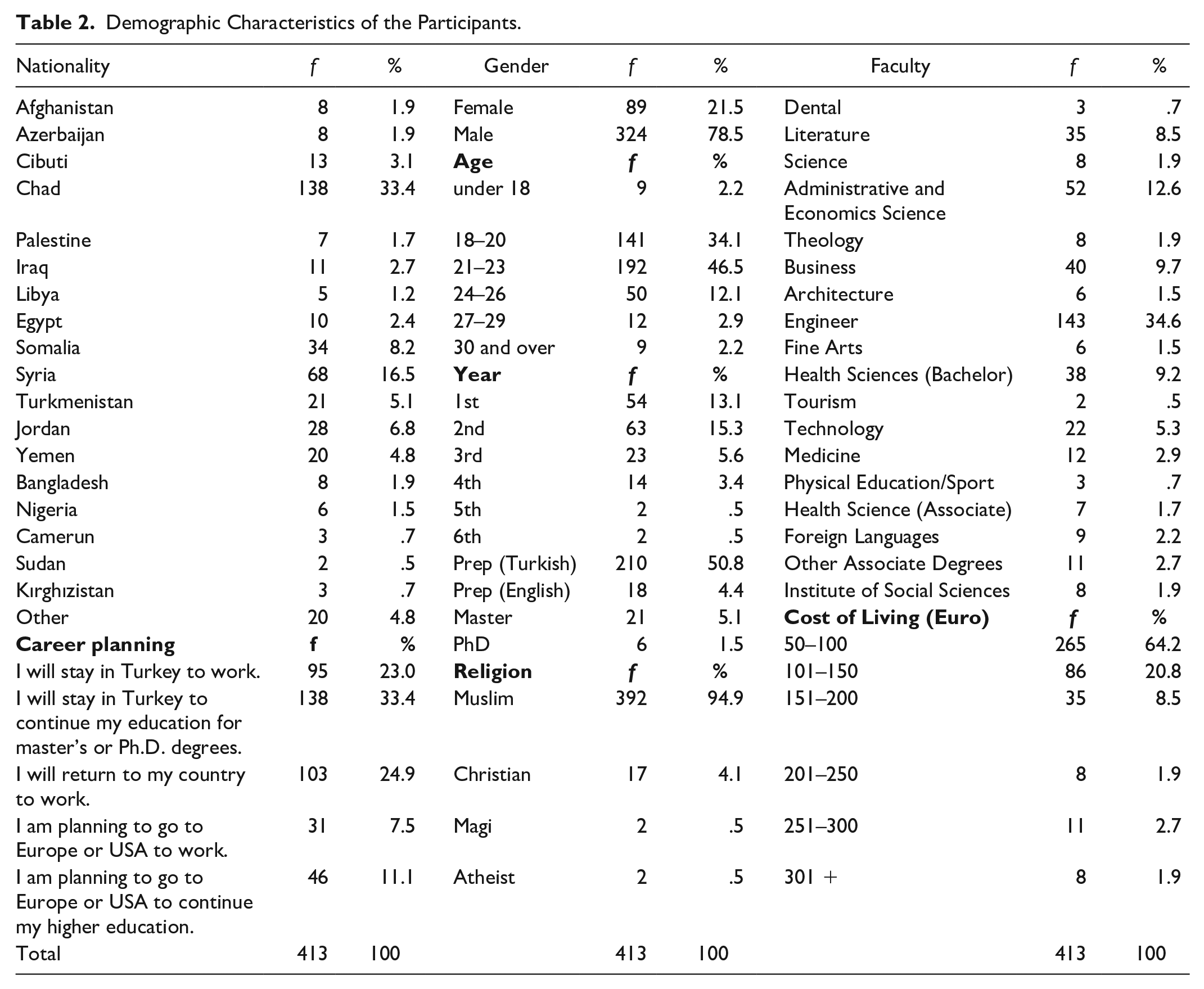
It is seen that the majority of the participants are from the Republic of Chad (33.4%), which is a North African country, and Syria (16.5%), which is located in the Middle East and is the southern border of Turkey. Turkey currently has more than 3.5 million Syrian refugees. The children of these families who go to university are accepted as international students (Turkish Directorate General of Migration Management, 2021). Turkey also cooperates with countries in the African continent in the field of education. As a result of the protocols signed with the education ministries of these countries, many students prefer universities in Turkey. Many students from Asia and Africa want to complete their undergraduate and graduate studies (33.4%) in health and social sciences, especially engineering (34.6%).
Analysis of Data
A two-stage process was followed to test the research model (Gerbing & Anderson, 1988). First of all, Confirmatory Factor Analysis (CFA) was performed for the measurement model, and it was statistically examined whether the scale was compatible with the previously known dimensions. In the second stage, the relationships between the structures were tested. CFA results are presented in Tables 3 and 4. After determining the good fit values of the CFA model, reliability and validity analyzes of each construct were performed. Cronbach’s Alpha, Subtracted Mean-Variance (AVE), and Composite Reliability (CR) values for each construct were calculated separately. Alpha values were above the critical value of .70 and acceptable (Hair et al., 2010). AVE values are above the critical value of .50 and CR values above .70 (Bagozzi & Yi, 1988).
Standardized Item Loadings, AVE, CR, and Alpha Values.

Confirmatory Factor Analysis Fit Indices.

CFA results provide information about the validity of the multi-item scale, factor weights of the variables, relations between factors, and the degree of fit of the CFA model. Through CFA, the explanatory degree of each factor expression and the correlations between the factors were examined. One item (REL5) with a low explanatory degree was removed, and the findings presented in Table 3 were obtained after necessary modifications.
The fit indices of the model are given in Table 4 below. The findings show that the model fits the data satisfactorily. Accordingly, it can be said that the items in Table 3 well represent the structures in the model. The values in the table show that the fit indices of the model overlap with the fit index values that are widely recommended in the literature (Doll et al., 1994; Mishra & Datta, 2011).
Finally, discriminant validity was examined by comparing the correlations between constructs and AVE values (Ozkara et al., 2016). As shown in Table 5 for each factor, the square root of AVE is significantly greater than its correlation coefficients with other factors, showing good discriminant validity (Gefen et al., 2000).
The Square Root of AVE (Shown as Bold at Diagonal) and Factor Correlation Coefficients.

Table 6 lists the recommended and actual values of fit indices of the normalized fit index (NFI), the comparative fit index (CFI), and the root mean square error of approximation (RMSEA).
The Recommended and Actual Values of Fit Indices.

Bentler and Bonett (1980). **Hu and Bentler (1999) ***Fornell and Larcker (1981) ****Brown and Cudeck (1993).
For all indices, the actual values are better than the recommended values. Therefore, the model has good fitness. Since satisfactory values were reached as a result of CFA, the structural model in which the inter-structure relations, in other words, the research hypotheses were examined, was tested. Table 7 lists path coefficients and their significance.
Hypothesis Results.

Note. R2: Overall Student Satisfaction = .519.
p < .05. ***p < .001.
According to the analysis, the service quality dimensions of competence (β = .40) and empathy (β = .17) have a positive and significant (p < .05) effect on general student satisfaction. In addition, cultural differences (β = .11) and religious practices (β = .27), which are the dimensions of socio-cultural difficulties, affect general student satisfaction positively and significantly.
The effects of reliability, physical elements, and sensitivity, which are among the variables related to service quality, on general student satisfaction were not found statistically significant. Likewise, it was observed that foreign language insufficiency, academic achievement, and social interaction difficulties, which are among the dimensions of socio-cultural adaptation difficulties, did not significantly affect general student satisfaction. In addition, when the R2 value is examined, it is seen that perceived service quality and socio-cultural difficulties explain the majority (51.9%) of the general student satisfaction variable.
Discussion
Theoretical Implications
This study revealed that the service quality variables which affect student satisfaction are assurance and empathy. It is understood that students will be pleased to receive education from a prestigious university that is internationally accepted, admired in their own country, in a field suitable for their career plans. This result is partially compatible with the results obtained by Arambewela and Hall (2006) and entirely with the research results of Ngamkamollert and Ruangkanjanases (2015), which determines the image and prestige of the university as an internal factor affecting student satisfaction. In the study conducted by Arambewela and Hall (2006), physical elements emerged as the most critical elements in service quality. The researchers’ findings that determine that positive student experience through faculty and educator performance increases school satisfaction are also in line with the results of this research (DeShields et al., 2005).
As a result of the study, another service quality variable that affects student satisfaction is empathy. It is imperative to create a smooth and friendly environment where students from different countries can interact. In addition, social activities should be given importance to support these students. At this point, advisor support to students is essential. Organizing social actions for international students in a favorable environment affect overall school satisfaction. This result is in line with the research results indicating that empathy increases the satisfaction level of students as a motivating factor following Herzberg’s Two-Factor Theory (DeShields et al., 2005). Empathy is understanding the situation of international students personally or institutionally and making meaningful and effective efforts to solve their problems or motivate them. Institutional support increases student satisfaction and significantly reduces the intention to drop out (Gopalan et al., 2019).
It has been concluded that the cultural difference and religious belief variables belonging to the socio-cultural adjustment problems dimension positively affect general student satisfaction. The traditional hospitality of the Turks has a significant role in reaching this result. Because in Turkish culture, hospitality is almost a religious and national duty. The warm and friendly nature of the Turkish people toward international students makes them feel comfortable and facilitates their daily life and work. These results are in line with Arambewela and Hall’s (2009) study, which determined that social factors and counseling activities affect student satisfaction. The satisfaction of educational elements alone is not sufficient in terms of motivation. Students may find it challenging to adapt to an entirely new culture for themselves. However, students from similar cultures can help each other to facilitate the adaptation process.
On the other hand, studies determine that cultural adaptation does not affect academic satisfaction (Gopalan et al., 2019). According to the Cultural Interaction Model (Berry, 1997), international students, who are a kind of temporary immigrants, develop a unique adaptation behavior in the face of the cultural difference they encounter. The emotional experience of this behavior to the student also affects the level of satisfaction with the education process (Sarmiento et al., 2019).
According to the research results, students attach great importance to living their religious beliefs and practices freely. Religious matters also affect their overall satisfaction level. This result is also consistent with the findings obtained in the studies mentioned below. Namely, religion improves people’s psychological, mental and social functionality and positively affects their academic performance when satisfied (Philip et al., 2019). It also enhances a positive mood by reducing their feelings of anxiety and depression (Sultan et al., 2020). Religious discrimination practices make it challenging to develop intercultural harmony and relationships and make people unhappy and stressed (Philip et al., 2019). If students can freely practice their religious beliefs and find a comfortable environment to practice their religion, they will have a positive attitude toward school. If the international student has the same religion as the faith of the country he studied, he can adapt to the environment more easily. In a study conducted among university students in Pakistan, it was found that religious practices improved healthy lifestyles for international students. Religious students are more capable of coping with stress and anxiety and have higher levels of satisfaction with the environment they live in (Sultan et al., 2020). In a study conducted in a higher education institution in the USA, it was determined that students who perceive religious discrimination against themselves do not engage in social interaction and experience stress during the acculturation process. In addition, students who can freely practice their religion can cope with the stress they experience due to other socio-cultural adaptation difficulties by the help of their religious beliefs (Philip et al., 2019).
Other hypotheses (H1, H2, H3, H6, H7, and H9) were rejected apart from those evaluated above. The result of the research, which revealed that reliability, tangibles, and responsiveness, which are among the service quality dimensions, do not affect student satisfaction, is not compatible with the findings of some studies (Halai, 2013). In the reliability dimension, there are also statements to evaluate “training and accommodation fees.” It is considered that although the education costs in Turkey are at a reasonable level, the fact that most of the students have a meager income may lead to this result. According to some studies, physical facilities of universities can be given different degrees of importance in different cultures (Arambewela & Hall, 2006), learning facilities and institutional sensitivity affect student satisfaction (Gibson, 2010). A research at an US university revealed international students showed more depression symptoms than others. Academic difficulties played an important role beside other reasons like cultural shock, language inadequacy and social interaction problems (Acharya et al., 2018). However, there are also studies in which a very weak relationship was found between the quality of education and student satisfaction (Mavondo et al., 2004). The results revealed that socio-cultural difficulties such as language insufficiency, academic difficulties, and social communication difficulties do not significantly affect student satisfaction are not compatible with some research findings in the literature (Yates & Wahid, 2013). The reason for this is that students from the Syrian and Turkic republics, which make up a large part of the sample, speak Turkish well. Thus these students do not have a problem such as a language deficiency.
In Europe and USA, many international students cannot speak fluently despite passing the language tests. They feel disadvantaged due to language inadequacy, and they have difficulty in social interaction with the students of the country they live in (Yu & Wright, 2016). This situation causes them to have negative experiences in the education process and become lonely (Brown, 2008). In addition, difficulties arising from language inadequacy and lack of social communication lead to feelings of not being accepted and ignored and general dissatisfaction among international students (Ryan & Viete, 2009). In their study among international students in the USA, Woods et al. (2020) determined that international students had difficulties in social interaction with local students especially in the first year. They also had difficulties in teamwork and sociocultural adaptation (Woods et al., 2020).
The student profile as children of Syrian refugee families in Turkey due to the war and the Covid 19 pandemic are determinative in the emergence of the study results. As of March 2020, distance education has been started in universities. Most of the international students did not leave Karabuk, and after a while, they continued their face-to-face language learning education under supervised health precautions. Students outside the preparatory classes have started distance education. Therefore, the existence of physical facilities of the university, apart from the internet infrastructure, has become largely meaningless for students during the pandemic process.
Managerial Implications
Universities have to develop appropriate policies to ensure that as many quality international students choose their schools following their quota capacities. According to the research results, international education is preferred, especially in engineering, economy, and health. Universities that adopt strategically recruiting international students should evaluate the most preferred areas correctly.
More than half of international students do not intend to return to their countries immediately after undergraduate education. Some of this group aim to continue their graduate studies while the rest strive to stay abroad to work. In terms of the education sector, it is a significant advantage to keep international students in the country for longer. Therefore, it can be recommended to guide international students in their postgraduate education planning. According to the study results, 20% of the participants plan to go to European countries or the USA. The motivation of these students can also be examined.
The international prestige of universities and the validity of their diplomas are one of the main reasons why students prefer these schools. Prestige and image are among the main factors that affect students’ satisfaction with higher education. The prestige of universities is ensured, especially by academic efficiency. Universities need to improve their prestige with international projects and promote their institutions widely using all their means. Universities can identify their strengths and build their image on these abilities.
For international students coming from far away places, the cost of going back to their country is also relatively high. Therefore, students with low-income levels stay away from the support of their families and communities in host countries. Consequently, they need to be socially supported. Empathy is the ability of university administrations to understand the situation of students by trying to see them through their eyes. Solving possible problems with counseling services, providing a friendly environment for students from different cultures, and supporting social activities that consider diversity makes it possible for students to have a more positive educational experience. It can be recommended that universities treat and support diversity to increase quality and wealth in their campuses and cities.
Finally, religious and cultural differences can be perceived as wealth or problem areas according to their perspectives. Intolerance toward people of different religions can, unfortunately, be experienced all over the world. International students being stigmatized, reprimanded, or harassed because of the clothes reflecting their beliefs or national cultures can make their lives unbearable during their education. According to this research, cultural differences and religious belief factors affect students’ satisfaction levels. Every nation has its own national culture and understanding of life. Encountering a different culture abroad has advantages as well as difficulties. Worrying about discrimination inside or outside the school for various reasons, academic difficulties, and efforts to adapt to cultural differences can make students more tired. Universities should clearly state that they support tolerance toward people of different religions and cultures in their official policies, lead the society in this regard, and constantly emphasize universal human values.
Limitations
This study was carried out in Karabuk University, which is in the top three for international students in Turkey. Participants were selected by convenience sampling method, one of the non-probabilistic sampling methods due to time and access constraints. In addition, approximately 17% of the students participating in the research are Syrian nationals. These students are the children of families who came to Turkey as refugees due to the war. If there were no war in their country, they probably would not have gone abroad to study. This situation is likely to affect the research results.
For this reason, caution is recommended concerning the generalizability of the results of this study. Most international students have not returned to their home country, despite the transition to distance learning during the Covid-19 pandemic. In this process, students from some countries whose financial situation is weak were given free scholarships, and all international students were allowed to benefit from public hospitals free of charge. When the whole world is going through extraordinary conditions, the priorities of international students in Karabuk have also changed. It is thought that this priority differentiation may affect the research results. Since this study was carried out in a state university, similar studies should be conducted on private universities, and the results should be compared.
Future Research Perspectives
The study examined the factors of service quality and socio-cultural adaptation difficulties that affect general student satisfaction. New studies can be carried out by including factors such as the economic and political situation and the country’s relations in which education is desired to be included in the model used in the research. In particular, the purchasing power of students and the cost of living in that country can affect the student’s decision to continue their education. Conducting similar studies in different countries with qualitative data collection methods can add in-depth dimensions to the subject.
Conclusion
According to the research results, assurance and empathy variables from service quality dimensions and cultural difference and religious belief variables belonging to socio-cultural adjustment difficulties have a positive and significant effect on overall student satisfaction. According to R2 value, the variance of the “general student satisfaction” variable explained by the dimensions of service quality and cultural adaptation difficulties is 51.9%. The reliability, tangibles, and responsiveness variables of the service quality dimension and the language deficiency, academic work, and social interaction variables of the social-cultural adaptation difficulties dimension did not significantly affect overall student satisfaction.
Among the service quality dimension variables, the variable “assurance” has the most impact on general student satisfaction. Students attach importance to the national and international prestige of their university. Another variable that has a significant effect is empathy. According to this result, students want a smooth and friendly environment where they can interact. In this context, he expects the university to organize social activities to support students. In addition, counselors have essential duties in solving problems of international students, especially at the beginning of their education period.
Among the socio-cultural adjustment difficulties, the variable of religious belief emerged as the variable that had the most effect on overall student satisfaction. According to this result, students want to freely fulfill their religious beliefs in the countries where they are educated. The fact that religious beliefs and worships can be lived freely means that students can reveal their religious identities without being found strange. Approximately 95% of the students participating in the research are Muslim students. Although a Muslim identity is not found strange in Turkey, it is remarkable that students are sensitive about this issue.
It is seen that the cultural difference variable is also effective on the level of student satisfaction. Students may have difficulties while trying to adapt to the cultural values of the country they are studying. They should be more flexible and respectful of cultural differences, and the level of tolerance in society should be high to interact more effectively. International students may be worried about discrimination practices against them in their countries for education for many different reasons. Students will experience fewer adjustment difficulties and positive educational and life experiences in an environment where such anxieties and fears are not experienced. As a result, the level of satisfaction increases when the student encounters a smooth and friendly environment in which they can interact with each other in the country they study.
According to the research results, most international students plan to stay in Turkey to continue their postgraduate education. It is considered that some of them can settle in Turkey if they can legally find employment and residence opportunities during this period. This situation is similar to the problem experienced in leading countries in the international student market, such as the USA.
Footnotes
Declaration of Conflicting Interests
The author(s) declared no potential conflicts of interest with respect to the research, authorship, and/or publication of this article.
Funding
The author(s) received no financial support for the research, authorship, and/or publication of this article.
Research Ethics
The permission for this research was obtained from “Karabuk University Social Science Ethics Board” with official Consent Form dated 11/03/2020 and # 78977401-050.02.04-E.12325
