




Abstract
Industry 5.0 is regarded as the next industrial evolution which is still on its infancy stage and under investigation phenomena. How shared economy can perform a superlative role in augmenting the corporate sustainable performance is another interesting gap that needs to be unveiled. This study investigates the linkage between shared economy practices and corporate triple bottom line (TBL) in three core streams—environmental performance (ENVP), social performance (SP), and economic performance (EP)—using empirical data. An additional factor of industry 5.0 (i5.0) technologies was treated as a moderator between shared economy and TBL. The findings assured the positive nexus of shared economy (i.e., contract manufacturing services, professional services, data entry & clerical services, creative and multimedia services, sales and marketing services, software development services, and writing or translation services) on TBL (i.e., ENVP, SP, and EP). The positive moderating influence of i5.0 technologies was further affirmed between the relationships of shared economy and TBL. The findings yield multidimensional insights for operational management to adopt shared economy and i5.0 practices to improve corporate TBL in today’s competitive era. In addition, this study accentuates the notion of shared economy by providing positive evidence from developing nations. The study also highlights insightful implications for managers along with future avenues for the researchers to conduct additional multi-directional studies worldwide.
Keywords
Introduction
Nowadays, organizations are prioritizing to hire a part-time workforce owing to several benefits, including cost-reduction and work burden sharing of existing employees (Chadwick & Flinchbaugh, 2016; Martin & Sinclair, 2007; Möhring et al., 2021). Organizations rely on a part-time workforce because it supports to get skilled and experienced workforce within lower budgetary circumstances (Eitzen et al., 2004; Mayfield & Mayfield, 2006). Such a workforce provides several benefits for businesses both for SMEs and multinational enterprises to hire a competent person for particular task based on a specific time or contract. According to experts, part-time workforce improves business performance and by transforming business toward more agile (Burke & Cowling, 2020; Eitzen et al., 2004). There are two schools of thought on part-time workforce where one argues the significance, while the other indicate certain disadvantages (Burke & Cowling, 2020; Varghese & Bini, 2019). For instance, some scholars advocated that such capability brings agility in business process; whereas, a few claimed that part-time workforce might be less dedicated than a full-time workforce (Wojčák & Baráth, 2017). In general, several researchers explained the immense significance of the part-time workforce, sharing economy, and shared economy not only within developed countries but also from emerging nations by revealing the nexus toward distinct contexts and themes worldwide.
Shared economy is an emerging phenomenon that stands under the umbrella of contracted workforce where labor market or workforce is to be hired based on short-term contract other than permanent based (Vallas & Schor, 2020; Wood & Lehdonvirta, 2021). There are several freelancing services which stand within the domain of shared economy and successfully operations such as online freelancing websites (Kässi & Lehdonvirta, 2018; Schroeder et al., 2021). Such online freelancing websites provide the platform for the organizations to hire part-time workforce for certain services (Kässi & Lehdonvirta, 2018). For instance, such services may include contract manufacturing services, professional services, data entry service, clerical services, creative services, multimedia services, sales or marketing services, software development services, and remainder translation services (Dokko et al., 2015; Kässi & Lehdonvirta, 2018; Lehdonvirta, 2018). How employing shared economy may enhance the organizational performance or sustainability in terms of three streams such as environmental sustainability, social sustainability, and economic sustainability is a key objective of this study. Triple bottom line (TBL) is defined under three core sustainability indicators such as environmental sustainability, social sustainability, and economic sustainability (Bansal, 2005; Slaper & Hall, 2011). TBL model is being used to examine the performance of organizations particularly sustainable performance of the organizations. The experts suggested that firms must focus on TBL to achieve profit and to obtain competitive advantages (Elkington, 1998; Hammer & Pivo, 2017; Slaper & Hall, 2011).
In the past, several experts have worked on shared economy and TBL by taking these terms as independent variables without considering the influence of shared economy on TBL, especially within emerging nations adopting i5.0 technologies as moderator. For instance, shared economy has been discussed by the experts in different contexts and themes across the world other than business performance (Healy et al., 2017; Kässi & Lehdonvirta, 2018; Lehdonvirta, 2018; Schroeder et al., 2021; Vallas & Schor, 2020; Wood & Lehdonvirta, 2021). Similarly, TBL has widely been discussed by the researchers in distinct aspects across the globe other than shared economy perspective (e.g., Hammer & Pivo, 2017; Norman & MacDonald, 2004; Rashidi et al., 2020; Slaper & Hall, 2011). A recent study considered TBL with respect to sustainable selection of the supplier (Rashidi et al., 2020). Industry 5.0 is another emerging phenomenon therefore researchers are trying to gage insights of i5.0 within certain domains (Carayannis & Morawska-Jancelewicz, 2022; Javaid et al., 2020; Maddikunta et al., 2022). The concept of i5.0 is defined as the smart factory by utilizing certain related capabilities to improve the organizational efficiency in comparison to i4.0 enable technologies such as IoT, big data, cyber-security, simulation, additive manufacturing, and cloud computing (Chauhan et al., 2021; Culot et al., 2020; Xing et al., 2021; Yadav et al., 2020). A few recent studies specifically explored the importance of i5.0 technologies but other than consideration as a moderator globally (Gürdür Broo et al., 2022; Carayannis & Morawska-Jancelewicz, 2022; Javaid et al., 2020; Maddikunta et al., 2022; Show et al., 2021).
The motivation to perform the research on such themes is as follows. The concept of sharing economy and shared economy is emerging therefore still there is a lack of research understanding the insights with respect to distinct aspects to support the notion of shared economy and part-time workforce (Lobel, 2017; Schroeder et al., 2021). This study attempts to reveal the influence of shared economy on TBL that was ignored in the literature. Likewise, moderating influence of i5.0 provides another interesting contribution to uncover more insights regarding shared economy and TBL. Most works were done within developed nations whereas this study provides additional evidence from developing nations such as China. This study attempts to reveal the impact of shared economy on TBL using i5.0 as a moderator for sake of comparison and additions in the existing literature. China is the top populated country of the world (Waheed & Zhang, 2022).
First, the aim is to identify the relationships between shared economy and economic factor of TBL. Second, the aim is to explore the nexus between shared economy and environmental factor of TBL. Third, the objective is to explore the connection between shared economy and social factor of TBL. Finally, the moderating influence of i5.0 technologies between shared economy and TBL was observed (i.e., ENVP, SP, and EP). The study is outlined as follows. The theoretical support along with hypothesized relationships is reported after introduction section. Methodologies of the study are highlighted immediately after literature section. The findings and discussion section is located subsequently to methods part. Likewise, implications both managerial and theoretical are shown accordingly. Final section is consisting of the conclusion, shortcomings, and future directions for academic researchers and practitioners.
Theoretical Support and Hypotheses Formation
Equity theory determines the fair distribution of the resources in terms of costs and benefits for the employees or each person who is working within the organization (Adams, 1965; Guerrero et al., 2014). This theory is also acknowledged as a justice theory which encourages the organizations to adopt fair policies for all the workers in order to achieve highest positive outcomes (Adams, 1965). It is advocated by the experts that a part-time workforce may affect the equity comparisons between full-time workforce and a part-time workforce of the organizations (Chadwick & Flinchbaugh, 2016). This theory claimed that workers’ motivation and level of satisfaction may decrease if workers perceive any level of difference at any stage (Adams, 1965). Therefore, it is immensely important for the firms to target serious and productive part-time workers to achieve faster response since sometimes such workers further hire part-time workers to compile a specific project (Feldman & Doerpinghaus, 1992) which might be more time-consuming process. In the past, several researchers have finalized the studies drawing on equity theory (Chadwick & Flinchbaugh, 2016). Equity theory further encourages the researchers to evaluate insights on how employees (e.g., full-time or part-time) might be more productive to produce quality output by maintaining a level of justice for both part-time and full-time workers (Chadwick & Flinchbaugh, 2016; Kwon & Jang, 2012; Lawler, 1968). Because compensating the workers is a key motivation of such theory whether they are part-time or full-time workforce. Shared economy is another essential indicator of part-time workforce and how it affects organizational performance is core objective of this study considering i5.0 as moderating factor in such domain. However, Resource-based theory (RBV) encourages organizations to focus on such resources that are more valuable in order to earn long-run success utilizing existing resources (Barney, 1996). RBV is a managerial model which supports to attain competitive advantages within existing resources of the organizations (Barney, 1991). This theory helps the firms to form such strategies that support to gain competitive edge over competitors.
The work on shared economy is accelerating because of its immense importance for organizations(Chadwick & Flinchbaugh, 2016). Shared economy is an approach in which organizations intent to hire part-time employees for a specific task or in order to support the full-time employees’ workload (Vallas & Schor, 2020; Wood & Lehdonvirta, 2021). There are diverse platforms that are being considered as the part of shared economy, including online mechanisms to acquire part-time services. For instance, researchers highlighted most important and frequently used online platforms for acquiring part-time services, including upwork, freelancer, guru, mturk, and PeoplePerHour website designed for such purposes(Chadwick & Flinchbaugh, 2016; Kässi & Lehdonvirta, 2018; Wood et al., 2019). Using shared economy methods, organizations may accelerate various operations acquiring distinct part-time services, including contract manufacturing services, professional services, clerical services, data entry services, creative services, software-related services, translations services, writing services, and other related part-time services(Kässi & Lehdonvirta, 2018; Schroeder et al., 2021; Wood et al., 2019). Likewise, the TBL is being employed as a dependent factor that defined the organizational framework having three core parts, that is, economic, social, and environmental performance. All these performances collectively understand insights in terms of organizational sustainable performance which eventually support to achieve organizational goals by creating value for organizations (Bansal, 2005; Elkington, 1998; Slaper & Hall, 2011). TBL framework has been known as the best tool to evaluate the firms’ performance and further support to achieve a competitive edge (Elkington, 1998; Hammer & Pivo, 2017; Slaper & Hall, 2011). Industry 5.0 is another interesting and emerging phenomenon being defined as the extent to which a firm attempts to create a smart factor by incorporating distinct smart capabilities to enhance efficiency and performance (Maddikunta et al., 2022). Smart capabilities may include big-data, Internet of Things, simulations, cloud computing, cyber-security, and additive manufacturing (Chauhan et al., 2021; Culot et al., 2020; Xing et al., 2021; Yadav et al., 2020). Implementing i5.0 technologies may improve the manufacturing operations of the organizations. Hence, experts such as academicians and practitioners claimed that shared economy, TBL, and i5.0 technologies are evolving concepts and more research is needed on such themes across the world.
Therefore, it is worth mentioning to explore the nexus of shared economy toward organizations TBL within three perspectives, that is, economic, social, and environmental perspectives. How i5.0 influences the connection between shared economy and TBL is another interesting and unique motive of this study to uncover from China. The following Figure 1 shows the proposed hypothesized relationship where explanation and formation of each hypothesis are subsequently reported.
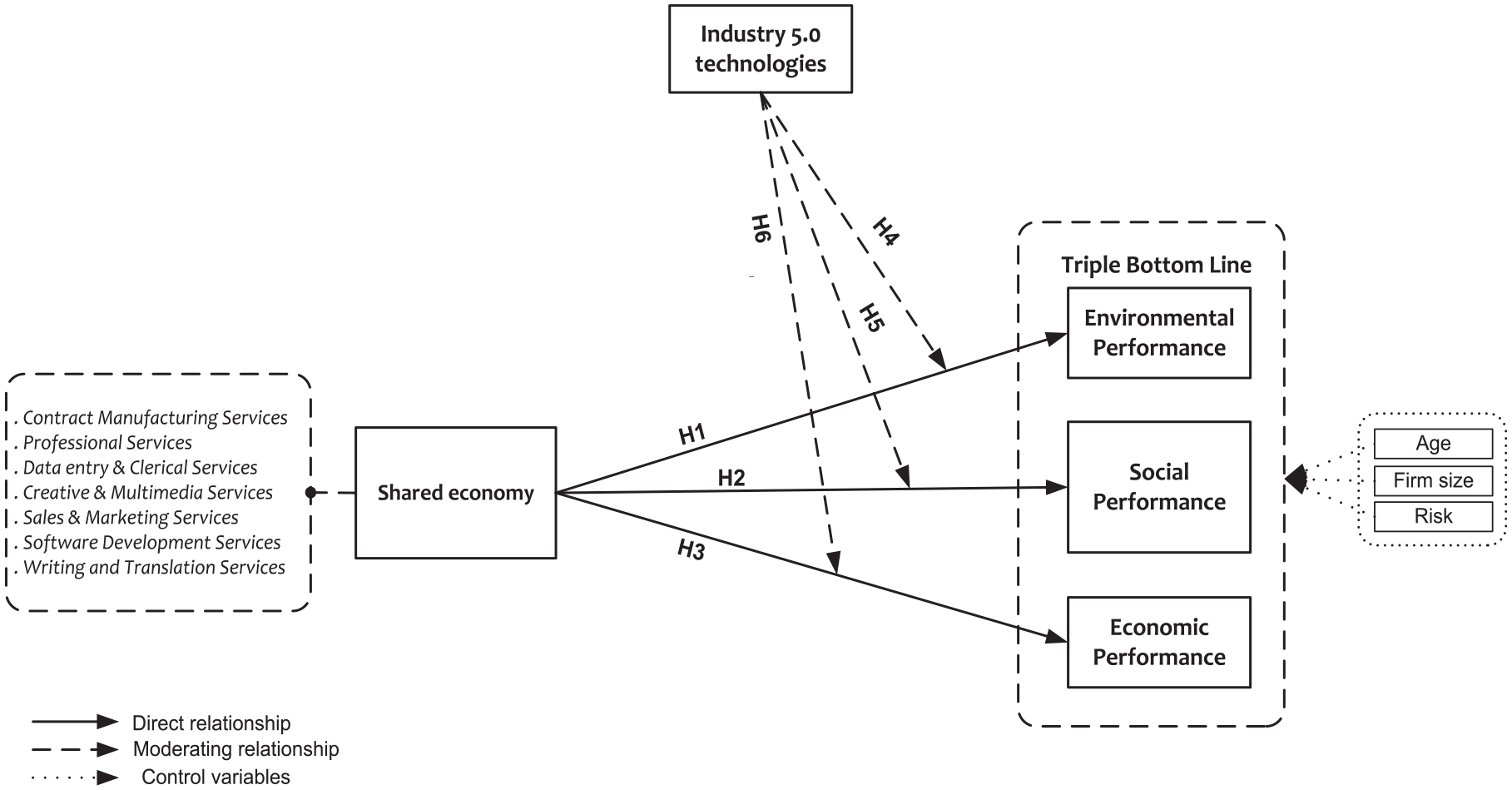
Research framework.
Shared economy is attaining the intense concern of the experts because of its essentiality for the businesses success. It allows organizations to hire part-time or temporary workers to accomplish a particular task. It might be the contract workers from firms, workers on call, or workers that might be engaged using online platforms as earlier discussed. TBL is an important framework also known as the best tool to evaluate the firms’ performance that support to achieve competitive edge and profit (Elkington, 1998; Hammer & Pivo, 2017; Slaper & Hall, 2011). In past, a few works have been conducted to evaluate the influence of shared economy on organizational performance. A study explained the relationships of shared economy with respect to organizational performance particularly financial performance of the organization (Chadwick & Flinchbaugh, 2016). Gig economy is like shared economy which contributes a vital role to enhance organizational performance (Chadwick & Flinchbaugh, 2016). Furthermore, such economy was considered several past studies where experts showed positive influence in distinct contexts and themes other than TBL (Gleim et al., 2019; Horney, 2016). A study explained that shared economy is a factor to enhance agility for organizational operations such as HR operations (Horney, 2016). Some experts conducted a comparison between good shared economy and bad shared economy (Wood et al., 2019). Shared economy is a capability to hire part-time workforce on-call or using online tools at low cost (Chadwick & Flinchbaugh, 2016; Martin & Sinclair, 2007; Möhring et al., 2021). According to another expert, part-time workforce may enhance the organizational performance (Cappelli, 2001). A total of six hypotheses are assumed to gage the insights about shared economy, TBL, and i5.0 from China. Eventually, focusing on shared economy (part-time workforce) increases organizational efficiency by reducing environmental cost, economic cost, and social costs. For example, if the firms will hire more part-time workforce, then performance will also be increased which eventually represents U-shaped relationships between part-time workforce and organizational performance, that is, ENVP, SP, and EP. The hypothesized relationships are summarized in Figure 1 and explained as follows.
Shared economy and environmental sustainability performance (ENVP)
ENVP is concerned to an environment where firms try to sustain ecology balance by considering need of a person and by focusing on green practices to maintain the organizational environment (Goodland, 1995). As earlier explained that Shared economy offers part-time workforce to the organizations by providing different services such as contract manufacturing services, professional services, clerical services, data entry services, creative services, software-related services, translations services, writing services, and other related part-time services(Kässi & Lehdonvirta, 2018; Schroeder et al., 2021; Wood et al., 2019). It is reported by the experts that hiring part-time workforce may enhance organizational performance because it provides several advantages such as cost reduction capability (Chadwick & Flinchbaugh, 2016; Martin & Sinclair, 2007; Möhring et al., 2021). An environmental standpoint, hiring a part-time workforce may support the organizations in certain ways. For example, organizations are not necessarily required offices for such places which eventually reduce distinct expenditure costs such as reduce electricity and carbon emissions caused by office equipment, and other related costs. How it may enhance environmental sustainability of the organizations is another sphere to answer in the literature that got far less intention in the past. However, a few studies examined the significance of shared-economy or part-time workforce in distinct perspectives worldwide but other than ENVP factor (Chadwick & Flinchbaugh, 2016; Horney, 2016; Lehdonvirta, 2018; Wood et al., 2019). This study is specifically designed to explore the impact of shared economy on TBL framework collectively and independently in order to understand insights. Equity theory also encourages evaluating the outcomes of workforce in distinct manner. Based on précised explanation regarding shared economy, we currently proposed following hypothesis to examine its relationships toward ENVP as factor of TBL.
H1: Shared economy positively correlated to ENVP
Shared Economy and Social Sustainability Performance (SP)
Social sustainability is defined the extent to which organizations provide humans’ basic rights, healthy community systems, and security systems without any level of discrimination (Dempsey et al., 2011). Understanding the social aspect is immensely important for firms’ success though organizations often failed to achieve SS because they are unaware of the importance of social aspects (Beekaroo et al., 2019). SP is an important indicator of firms’ sustainable performance since experts claimed that firms often failed to achieve such performance because they did not pay attention on social aspect (Beekaroo et al., 2019). How shared economy may enhance organizational SP is an important contribution of this study. In a social standpoint, hiring part-time workforce may support the organizations in social perspectives. Based on equity theory, part-time work may improve organizational performance because of having certain benefits such as diversified options of the workers within limited resources (Chadwick & Flinchbaugh, 2016). Since shared economy is emerging phenomena therefore work on shared economy with respect to social sustainability has not been discussed by the experts, especially from developing nations.
However, studies ensure the positive affect of shared economy on distinct capabilities of businesses (Horney, 2016) therefore considering its influence in term of SP may yield an additional evidence from China. A study of an expert revealed the relationships of shared economy with respect to social sustainability (Loganathan, 2021). Besides, most studies considered shared economy other than social sustainability such as evaluated the impact of shared economy on social security (Corujo, 2017). Hence based on shared economy in term SP, the following hypotheses are proposed to affirm the relationships from two nations in order to yield additional empirical evidence.
H2: Shared economy positively correlated to SP
Shared Economy and Economic Sustainability Performance (EP)
Economic sustainability is defined as the extent to which a firms’ long-run growth is being observed by considering distinct factors such natural resources, wealth distribution, ecosystem, and certain welfare practices (Choi & Ng, 2011). In developing nations such as China, organizations are continuously trying to seek economic sustainability as they have realized its significance for organizational success (Tseng et al., 2018). Likewise, the other TBL factors, there is lack of relationships between shared economy and economic sustainability in the literature that got no attention by the experts. However, shared economy might play an essential role in achieving economic sustainability (Allon et al., 2018). A few studies considered the shared economy and examined the nexus in different contexts and themes across the world (Corujo, 2017; Lehdonvirta, 2018; Lobel, 2017; Wood et al., 2019). A study affirmed the connections between shared economy and economic drivers (Allon et al., 2018). Another study examined the connections between part-time workforce and financial performance (Chadwick & Flinchbaugh, 2016).
In economic standpoint, hiring part-time workforce may support the organizations which help to reduce cost because organizations are not required to hire full-time workforce that facilitate reducing unlike costs such as land, capital, transportation, and equipment related costs. Although there is a lack of literature in terms of shared economy and EP though experts further advocated that effect of shared economy might be evaluated in a distinct perspective in future (Lobel, 2017). Based on the above précised importance of shared economy in distinct aspects and operations, we currently attempted to uncover the influence between shared economy and EP to contribute in the literature with additional evidence by proposing following relationships.
H3: Shared economy positively correlated to EP
Industry 5.0 as Moderator
Industry 5.0 is known and upcoming industrial evolution, core objective is to leverage the humans’ creativity with collaboration of accurate, affective, and intelligent machines to obtain resource-efficient solutions as compared to industry 4.0 (Maddikunta et al., 2022). The objective to adopt industry 5.0 is also to offer user preferred systems and solution where firms may achieve utmost level of profitability by making its operations more productive and affective. The research on industry 5.0 is new and only a few known studies have worked on industry 5.0 to understand the insights and to ensure its significance since most work have been done on industry 4.0 (e.g., Bodrow, 2017; Lin et al., 2019; Nagy et al., 2018; Oláh et al., 2020; Pfohl et al., 2015; Sumer, 2018). In the past, researchers showed the positive relationships of i4.0 technologies on organizations’ operations which might be possible by incorporating certain developmental capabilities such as robotics and additive production systems(Kumar, 2018; Niaki et al., 2019). Integration of i4.0 technologies supports to enhance social process and also help to achieve sustainable manufacturing (Stock & Seliger, 2016). However, the work on industry 5.0 is extremely new where a few studied examined the role of i5.0 in different contexts and dimensions (Carayannis & Morawska-Jancelewicz, 2022; Gao et al., 2021; Gürdür Broo et al., 2022; Javaid et al., 2020; Maddikunta et al., 2022; Show et al., 2021). Therefore, it is worth mentioning to consider industry 5.0 between the proposed relationships of shared-economy and organizational performance. Therefore, this study attempts to uncover the intervening effect of industry 5.0 by proposing following hypotheses
H4: i5.0 moderates the relations between shared economy and ENVP
H5: i5.0 moderates the relations between shared economy and SP
H6: i5.0 moderates the relations between shared economy and EP
Methods and Procedures
Sampling and Collection of Data
The study’s data were acquired China using a convenience sampling approach in order to provide more deep and comprehensive findings to promote the notion of shared economy, TBL, and Industry 5.0 for business success. The questionnaires were specified Chinese respondents working within SMEs of distinct sectors. We focused on SMEs to promote shared economy and TBL due to various reasons such as follows. SMEs has great importance for the economic growth of a nation which is defined in different ways based on certain criteria for each country such as sales volume, personnel count, and assets’ worth (Alkhoraif et al., 2019; Haroon & Shariff, 2016; Rowley, 2008; Waheed & Zhang, 2022). We followed the definition of Alkhoraif et al. (2019) who explained SMEs as a business entity with a workforce of 999 people and annual revenue of three billion RMB for the Chinese market. The aim to focus on SMEs is because of less concentration by the experts and practitioners over the past decades, especially in terms of shared economy, TBL, and Industry 5.0 aspects. The literature is witnessed on the substance of SMEs for the organization and has been known as the imperative facilitators for a nation’s economies (Haroon & Shariff, 2016). SMEs contribute to the nation’s GDP and support to condense the rate of unemployment (Alkhoraif et al., 2019; van de Vrande et al., 2009). Thus, it is vital to note the effect of shared economy, TBL, and i5.0 technologies by considering SMEs.
Moreover, by scrutinizing and removing incompletely filled or dubious questionnaires (e.g., double-ticketed or missing information), a total of 520 questionnaires in order to avoid any invalidity of the response that is an important factor is survey studies (Edwards, 2019). Nonetheless, during the data gathering phase, we obtained the help of Chinese colleagues along with students for data collection using unlike tools and personal visits. For the Chinese population, key online instruments such as Wechat was primarily utilized since Wechat is the most commonly used app in China (Ashfaq et al., 2021). Besides, the questionnaires’ structure and pattern are as follows. It divided into two portions whereby the first part comprised of core questions regarding shared economy, TBL, and i5.0 technologies, while another part was loaded to obtain respondents’ information. A five-point Likert scale from strongly disagree to strongly agree was employed derived from past studies (Ashfaq et al., 2021; Waheed & Zhang, 2022). Nonetheless, in the second portion, we used nominal and ordinal scales to collect the personal information (demographic profiles) of the respondents (see Table 1).
Participants’ Profiles.

Note. n = 520.
Widow, divorced, or others.
Professional course or diplomas.
Pilot Study of the Scales
We carried out pilot plan to affirm the constructs’ reliability before moving forward with the main investigation, where 50 participants were requested to respond the questionnaire in China. The reliability was tested using one of the most often used methods, that is, Cronbach’s alpha being recommended by the researchers and might be accepted at .70 level of advised criteria (Hair et al., 2019). A few items were eliminated in further data gathering procedures because of the lower outcomes less than advised criteria by the expert <0.5 for loadings of the items (Hair et al., 2019). The current output values after these methods are as follows. The value of shared economy stands at 0.80, TBL at 0.78 and outcome values for i5.0 technologies at 0.82, respectively.
Measurements of the Variables
Presently three variables are employed such as shared economy as an independent variable, TBL as a dependent variable, and i5.0 technologies as a moderator between shared economy and TBL. All the variables are adapted from the past studies to affirm the nexus from China. To that end, first, shared economy was measured using seven practices that an organization may acquire such as contract manufacturing services, professional services, data entry & clerical services, creative & multimedia services, sales & marketing services, software development services, and writing and translation services adopted from previous studies (Kässi & Lehdonvirta, 2018; Plambeck & Taylor, 2005). Second, TBL is measured with three core sustainability streams such as environmental performance (ENVP), social performance (SP), and economic performance (EP). ENVP is measured by five-items scales, SP is measured by four-items, and EP is measured by 6-items adapted from Bansal (2005). Third, the scales for i5.0 technologies were adapted from previous i5.0 enable technologies (Maddikunta et al., 2022). We self-customized the statements using those adapted factor to affirm the moderation connection. A few control variables, for example, age, risk, and firm-size were additional utilized inspiring from the past studies that considered similar control variables (Abbas & Sağsan, 2019; Bansal, 2005; Ben-Jebara & Modi, 2021; Waheed & Zhang, 2022).
Data Analysis Methods
To analyze the data, we employed AMOS (version 27.0) and SPSS (version 21.0). The items for shared economy that is IV, triple bottom line (TBL) that is DV, and i5.0 technologies that is MV were coded in the SPSS data sheet. Furthermore, the descriptions of the participants’ profiles such as age, education, experience, gender, and marital status were generated using descriptive statistical approaches.
We used Pearson’s correlation approach to look over the correlation among constructs. The parameters for interpreting such correlation technique ranges from −1 to +1 where higher positive outcome values indicating a better positive connection and lower positive outcome values indicating a lower connection (Hair et al., 2019; Taylor, 1990). Discrminant validity and HTMT validity approaches were utilized to affirm the level of differentiation among shared economy, TBL, and i5.0 technologies (Fornell & Larcker, 1981; Hair et al., 2019; Henseler et al., 2015). According to the experts, the values of AVEs square must be higher than the interrelationships of the subsequent variables (Fornell & Larcker, 1981), while values should be lower than 0.9 in HTMT output (Henseler et al., 2015) to affirm the validity. Another tool was employed to determine the validity (convergent) using loadings of the items and AVE, while reliability using composite reliability approach. The output of each loading should be higher than 0.5, AVE higher than 0.5, and reliability should be higher than 0.7 to assure the suitability of the results (Fornell & Larcker, 1981; Hair et al., 2019). Likewise, a common method bias tool was applied to understand the insights about variables biasness using CLF techniques as advised by Podsakoff et al. (2003). According to Podsakoff et al. (2003), the output values should be lower than 0.2 by conducting a comparison with and without CLF. Finally, upon satisfying the main paths, SEM was used to confirm the proposed hypotheses inspiring from past studies that used a similar technique to explore the nexus among used variables (Aksoy & Bayram Arlı, 2020; Cao & Zhang, 2011; Waheed & Zhang, 2022; Waheed et al., 2020; Zafar et al., 2021). Model fit indices, such as NFI and SRMR were calculated and checked to ensure the model fitness of SEM. Besides, the following equations are formed in order to develop and explore the relationships between shared economy and TBL with moderation of i5.0 technologies from China.
First, the nexus of shared economy on each dimension of TBL were autonomously explored to assure the proposed connection using the following equations (1)–(3).


Where environmental performance (ENVP), social performance (SP), and economic performance (EP) are taken as dependent constructs whereas shared-economy is an independent construct. β shows unidentified parameter and for a specific construct need to be predictable whereas ζ indicate the error term.
Second, the moderating influence of i5.0 technologies was independently examined between the shared-economy and TBL dimensions, that is, ENVP, SP, and EP. To this end, the moderating influence of each construct of TBL was determined using following equations (4)–(6).



Where i5.0 was adopted as a moderating construct between TBL (dependent construct) and shared economy (independent construct). β shows unidentified parameter and for a specific construct need to be predictable whereas ζ indicates the error term.
Results and Findings
Table 2 indicates the output values for correlation analysis being employed to attain interrelationships among latent variables, that is, shared-economy, TBL, and i5.0 technologies using advised criteria by the experts (e.g., Hair et al., 2019; Taylor, 1990). The greater values represent the higher linkages whereas lower affirm the lower connections between particular variables as shown below.
Pearson’s Correlation.

SharedE = shared economy; TBL = triple bottom line; i5.0 = Industry 5.0 technologies; ENVP = environmental sustainability; SS = social sustainability; EP = economic sustainability.
Triple Bottom Line is combined effect of Economic, Environmental and Social Sustainability
Correlation is significant at the .01 level (two-tailed).
Discriminate Validity
Fornell and Larcker (1981) method for such validity was applied to estimate the values by comparing the interrelationships of latent factors with values of √AVEs. Following Tables 3 and 4 shows that discriminant validity exists as per evaluation methods of the experts (Fornell & Larcker, 1981; Hair et al., 2019).
Discriminant Validity.

Bold values indicated the √AVEs.
Heterotrait–Monotrait.

HTMT (Heterotrait–Monotrait)
Table 5 affirms the validity using another important technique of validation suggested by Henseler et al. (2015). This technique is highly employed by current researchers (e.g., Ashfaq et al., 2021; Henseler et al., 2015; Waheed & Zhang, 2022); therefore, we considered a unique tool on present instant where experts advocated the values should lower than 0.9 to achieve desired level of validation (Henseler et al., 2015). HTMT results show the values as per advised level.
Reliability, Validity Means, and SD Values.
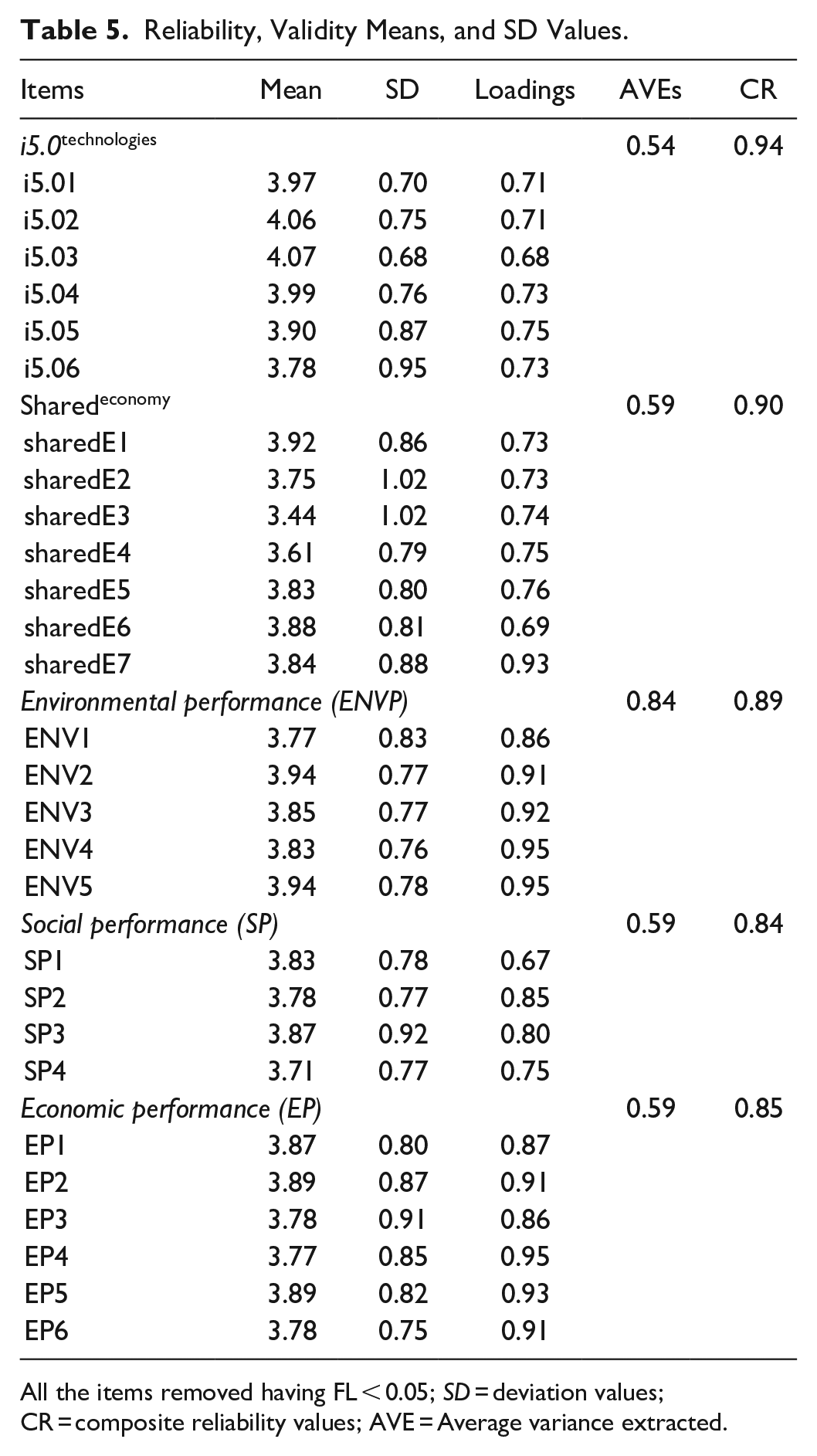
All the items removed having FL < 0.05; SD = deviation values; CR = composite reliability values; AVE = Average variance extracted.
CMB (Common Method Biased)
CMB is a method to affirm the biasness among employed variables of the study using distinct tools and techniques. It is advised by the researchers that CMB could be attained and evaluated by utilizing CLF (common latent factor) (Podsakoff et al., 2003). We presently applied the technique of Podsakoff et al. (2003) to affirm CMB. Podsakoff et al. (2003) advocated that the outcome values should <0.02 that might be obtained by conducting a comparison of loadings values once with CLF and subsequently without CLF. Our value is lower than the advised cut-off consequently we are assured about no CMB in dataset. We used this technique for CMB evaluations since several researchers have been utilized a similar approach in their studies over the past years (e.g., Ashfaq et al., 2021; Waheed & Zhang, 2022).
Reliability and Validity
The reliability (composite) and validity (convergent) determined using suggested methods and criteria (e.g., Fornell & Larcker, 1981; Hair et al., 2019). According to those experts, reliability should be evaluated through composite reliability and its outcome values should be greater than the advised cut-off (0.7). Similarly, validity should be evaluated through AVEs and loadings (items factor loadings) whereas the values should be greater than the advised cut-off (0.5) for both indices. Besides, the comprehensive results for both methods are shown in following Table 5 along with means and SD values which seem suitable as per highlighted cut-off.
SEM Model Fit Indices and Paths Relationships
It is recommended by scholars to understand the model fit indices before further applying path relationships among latent variables of the study. With such consideration and using AMOS tool, the following model fit indices were calculated as evaluated using advised cut-off points (e.g., Fornell & Larcker, 1981; Hair et al., 2019; Hu & Bentler, 1998; Scott, 1995). Table 6 shows the cut-off values and current model fitness values.
Model Fitness Indices for SEM.

The results show the moderating influence of i5.0 technologies between shared economy and TBL. In addition, the multidimensional moderation analysis uncovered the influence between each dimension of shared economy (ENVP, SP, and EP) and TBL as shown in Figure 1. Second, the effect of i5.0between shared economy and TBL was observed. Besides, the following Table 7 shows the overall summary of the proposed paths obtained using SEM.
Summary of Relationships.

.001; **.01; *.05; NS = not significant
Key Findings and Discussion
The study yields insights with respect to shared economy, TBL, and i5.0 technologies by employing the empirical design within China. This study promotes the notion of shared economy on how the incorporation of shared economy may benefit the organizations in order to enhance TBL is one of the key motives of this work. Organizations can establish a better environment by emphasizing on shared economy and i5.0 technologies practices that eventually lead to attain organizational performance. Besides, this study proposed 14 hypotheses to explore the multidimensional analysis as summarized in Figure 2.

Structural model.
First, hypotheses were proposed to affirm the deep analysis about each dimension of TBL and shared economy as follows. It was assumed in H1 that shared economy has a positive connection with ENVP dimension of TBL. The hypotheses are supported because of the positive outcomes such as Sharedeconomy→ENVP at (β = .312***; SE = 0.016; Sig = 0.000). Likewise, it was assumed in H2 that shared economy has a positive connection with SP dimension of TBL. The hypotheses are supported because of the positive outcomes such as Sharedeconomy→SP at (β = .268***; SE = 0.024; Sig = 0.000). It was assumed in H3 that shared economy has positive connection with EP dimension of TBL. The hypotheses are supported because of the positive outcomes such as Sharedeconomy→EP at (β = .159***; SE = 0.038; Sig = 0.000), respectively. Likewise, it is found that i5.0 technologies positive moderate the relationships between shared economy and organizational sustainable performance such as between Sharedeconomy and ENVP at (β = .265***; SE = 0.035; Sig = 0.003), Sharedeconomy and EP at (β = .154*; SE = 0.033; Sig = 0.008), as well as Sharedeconomy and SP at (β = .176*; SE = 0.035; Sig = 0.029), respectively. Hence, H4–H6 are accepted because of positive nexus as moderators among direct relationships (see Figure 2).
Implications
Industry 5.0 is known and upcoming industrial evolution, core objective is to leverage the humans’ creativity with collaboration of accurate, affective, and intelligent machines to obtain resource-efficient solutions as compared to industry 4.0. The objective to adopt industry 5.0 is also to offer user preferred systems and solution where firms may achieve utmost level of profitability by making its operations more productive and affective. The research on industry 5.0 is new and only a few known studies has worked on industry 5.0 to understand the insights and to ensure its significance since most work have been done on industry 4.0. However, sharing economy has massive importance for businesses which enables the individuals to utilize the existing resources in a more productive and dynamic manner. This trend is gaining absolute concentration in all business operations that eventually improve operational efficiency. Part-time workforce is another key example of sharing economy in which organizations attempt to hire additional part-time labor along with permanent workers to meet firms’ objectives. However, this concept also creates opportunities for people to work well and earn more money. Furthermore, the workplace is a dynamic entity that suffers frequent change because of uncertain challenges. In order to achieve competitiveness, organizations continuously attempt to seek and develop unique business strategies such as operational strategies to win over the market (Anand & Gray, 2017). Nowadays, organizations are emphasizing on a part-time workforce to optimize business operations and to compete in today’s modern era. These concepts are evolving consequently firms are immensely relying on part-time workforce because of unlike benefits such as ease of getting skilled personnel within low cost. Likewise, shared economy and i5.0 technologies are on the front-line to attain business sustainability such as TBL (i.e., environmental, social, and economic sustainability). The successful implications of shared economy and i5.0 technologies in developing nations may support to achieve organizational sustainable performance. This study adds in the relevant literature with empirical evidence by yielding insights about shared economy, i5.0, and TBL on how the incorporation of such practices may improve organizational operations. This study also contributes to literatures’ world with comprehensive analysis of shared economy toward TBL dimensions autonomously with the moderation of i5.0 which provides interesting findings.
From a managerial standpoint, the study attempts to enrich the knowledge of the managerial personnel to accept shared economy and i5.0 practices to obtain business sustainability within three key streams, that is, ENVP, SP, and EP. Although findings affirmed the positive nexus between shared economy and TBL along with the positive connection of i5.0 as a moderator; however, the results indicate some different trends in Chinese market that managers should take into considerations. For instance, the overall influence of shared economy is found in China which further encourages the managers to focus more on shared economy practices to better sustain the business performances. The managers are advised to focus on i5.0 since current findings suggest that a higher level of i5.0 is associated with an increased level of organizational shared economy practices such as environmental, Integration of i5.0 technologies may support the business by providing the integrations of different capabilities such as cloud computing, artificial intelligence in business operations, edge computing, additive manufacturing, cyber security, blockchain, simulation, and big data technologies.
The manager must understand the insights that social and economic capability is likely to be higher when organizations have a higher focus on industry i5.0 technologies to integrate into business operations. The related management is encouraged to focus shared economy and i5.0 because of the positive outcomes. For example, managers can achieve work efficiency by hiring part-time skilled workforce having more freedom to choose a skilled person. Managers are advised to focus shared practices because it allows to hire the persons not on a regular base but for a specific task or project. Shared economy is cost reduction tool for organizations where firms may recruit employees without providing particular medical support and reduces rest of the cost, including incentives, bonuses, and training. Managers are encouraged to focus shared economy because it provides the mechanism to collaborate with multiple workforces having multiple options, support to bring innovation and change in business, and help to achieve a level of sustainability in terms of all three perspectives of TBL as presently studied. However, managers should acknowledge that current interest in shared economy has spurred the implications of technologies such as i5.0. Since the importance of technology in all business operations would not be neglected owing to diverse benefits (Gao et al., 2021; Waheed & Jianhua, 2018). Therefore, managers are encouraged to incorporate advanced means of technologies to survive and compete in the current modern and competitive era. Finally, as literature witnessed sustainability in business operations is a vital capability of the organizations where managers need to adopt those practices that may support to achieve the utmost level of sustainability to compete in today’s fierce competitive time. Incorporating i5.0may enhance labor level of productivity by enriching their skills and provide a complete solution to the organizations by staying connected using advanced means of technologies. In such a business scenario, shared economy and i5.0 might be fruitful and most productive practices in order to boost business performance by optimizing operations.
Conclusion
The notion of shared practices into the contemporary workplace has lucratively shaped the opportunities for the organizations. We primarily concluded that shared economy and i5.0 practices are the prime predictors of the organizational sustainable performance for emerging nations, China. Organizational should include such practices to optimize the TBL. It is accomplished that organizations may acquire part-time services (e.g., contract manufacturing services, professional services, data entry & clerical services, creative & multimedia services, sales & marketing services, software development services, writing and translation services) that ultimately support optimizing organizational environmental performance, social performance, and economic performance. This study advances that i5.0 framework supports the organizations by playing a useful part between shared economy practices and TBL. Firms may adopt these practices owing to several benefits such as the widespread options to hire more skilled workforces within a low-cost. In such a scenario, organizational need not employ standard or full-time personnel since the current results summed the positive nexus between shared economy and TBL from China. However, the results’ trend indicates the higher positive connections within Chinese market which highlighted the higher use of such practices in China. Finally, the study summarized with insights about shared economy and i5.0 practices that might be interesting and inimitable methods to transform the organizations toward part-time workforce in the present competitive era, especially within emerging nations where firms are sometimes not able to hire permanent workforce because of low budgetary resources.
Shortcomings and Future Avenues
Although this study stands with several interesting and productive ramifications for the management though we believe there are certain confines that might be acknowledged by scholars, practitioners, and policymakers in the future within developing economies and across the globe. First, this study conducted empirical analysis by taking only a few regions of China. Future studies may catch more emerging nations to identify the perceptive information about shared economy, i5.0, and TBL to validate the present findings on broader scale. Second, the sample size is restricted to 520for the Chinese market therefore limits the prevalent generalization of the existing findings. The researchers with future work attention may elevate the sample size to comprehend insightful and multidimensional information about the genuineness of these variables within Chinese or other than such nations worldwide. This study adapted the certain discussed i5.0 enable technologies and form the self-statements to affirm the relationships on present instant; however, there is lack of developed scales of i5.0 which could be the future intentions of the experts to work on valid constructs for more longitudinal studies. The study lacks the exploring mediation influence of any construct consequently future scholars are advised to perform additional profound studies to investigate the mediation-moderation affect together utilizing unlike variables to appraise the strength of these relationships. Finally, our study is mainly concerned within SMEs thus researchers are encouraged to consider large-sized firms in developing and developed nations to guarantee the essentiality of shared economy and i5.0 technologies with respect to TBL employing longitudinal and empirical design.
Footnotes
Declaration of Conflicting Interests
The author(s) declared no potential conflicts of interest with respect to the research, authorship, and/or publication of this article.
Funding
The author(s) received no financial support for the research, authorship, and/or publication of this article.
