




Abstract
This systematic literature review is designed to evaluate the current state of knowledge in rural homestays and tourism academic literature. With reference to the Preferred Reporting Items for Systematic Reviews and Meta-Analyses (PRISMA) flowchart, we reviewed 94 studies published in the selected journals from January 1, 2010, to December 31, 2020. Our review explores how sustainable rural homestays have been previously researched in terms of the context, topic, sample, method, geographical location, and theoretical framework. The review provides insights on sustainability and rural homestay tourism from the perspective of co-occurrence beside highlighting the valuable content addressed by authors and suggesting future research directions. In a sustainable rural tourism context, only 51% of the reviewed studies had considered homestay as the core and independent area of inquiry. This review notes an increasing number of researchers from developing countries are working on community-based rural homestays, especially in the Asia-Pacific region. Unfortunately, important topics—like homestay branding, homestay and entrepreneurship, homestays and information and communication technology (ICT) competency, homestay operator’s training and development about sustainability—are rarely addressed in the existing literature.
Keywords
Introduction
In September 2015, the General Assembly of the United Nations approved a set of goals “to end poverty, protect the planet, and ensure prosperity for all as part of a new sustainable development agenda,” with each goal having detailed objectives to be completed by 2030 (UN, 2015). The 17 Sustainable Development Goals (SDGs) and their 169 specific objectives focused on “areas of critical importance for humanity and the planet” (UN, 2015). By these SDGs, the United Nations highlighted the importance of sustainability for every country and business.
Sustainability is considered a new strategic imperative and a long-term goal for firms, nations, and society as a whole (Finke et al., 2016; Tura et al., 2019). Like other industries, tourism needs to be understood and managed with a wider context of sustainability (Higgins-desbiolles, 2018). Sustainability offers an enduring outlook that stresses commitment to moral beliefs and ethics, integrating the environmental and social uncertainties with economic objectives. Through balanced and complete tactics, the stakeholder’s roles are identified, and resources are used prudently for both present and future generations (Font & Mccabe, 2017).
Tourism firms are seen to focus merely on the economic aspect which is contradictory to the concept of the triple bottom line (TBL), which calls for an equal emphasis on all the three key areas: economic, environmental, and social (Wise, 2016). Particularly for the least developed countries, tourism may symbolize “growth without prosperity,” where the government talks about the environment but actually priority is usually given to economic development over environmental security (Ruhanen & Shakeela, 2013).
Governments are currently paying much attention to rural tourism to diversify tourism industry and play an active role in managing economic activities to increase local communities’ incomes (Chin et al., 2014; Nooripoor et al., 2020). Homestay is an attractive sustainable rural tourism product (Acharya & Halpenny, 2013; Walter et al., 2018). Unfortunately, there is no universal definition for a homestay; it is typically defined as a type of accommodation in which visitors stay in the homes of residents (Agyeiwaah, 2019; Agyeiwaah & Mensah, 2017). A homestay is a stay by a tourist, traveler, or student at a house, which is hosted by a local family in a local vicinity (Rizal et al., 2018). Homestay provides tourists with a sense of feeling at home, interaction with the host family, firsthand relationship with locals, the experience of the local culture and low-cost accommodation (Kuhzady et al., 2020; Kulshreshtha & Kulshrestha, 2019).
The homestay business is a component of the broader tourism and hospitality industry, and has the distinct features of intangibility, variability, and inseparability (Sun & Ghiselli, 2010). Homestay business encourages the rural community to get involved in the tourism industry (Samsudin & Maliki, 2015). Homestays are an intense visitor-host interaction zone (Walter et al., 2018) with threefold sustainable community-based tourism goals of environmental, cultural, and local employment protection (Reimer & Walter, 2013). A homestay program is typically carried out by individuals who own houses located in the rural areas (Bachok et al., 2018), where tourists pursuit their vacation in the cultural and traditional way of local (often rural) community living (Hanim et al., 2014). Variants of the rural homestay concept include cultural homestay, farm stay, heritage homestay, agricultural homestay, leisure homestay, cottage homestay, and so on (Hamzah, 1997). Hereafter, all variants are referred to as the rural homestays in this review.
Several systematic literature reviews (SLRs) on the sharing economy and peer-to-peer accommodation in tourism have been conducted (Prayag & Ozanne, 2018; Guttentag, 2019; Kuhzady et al., 2020). Nevertheless, an SLR on homestay and sustainability in rural setting is still lacking. In response to the growing sustainability awareness and emerging role of the homestay as a sustainable rural tourism product, this SLR sets out to explore the homestay literature from the sustainability perspective.
To contribute to this knowledge gap, capture key insights from the past studies, and identify directions for the future (Kuhzady et al., 2020), this review is well timed. Moreover, this review highlights homestay’s role in sustainable rural tourism and community development to gain long-term social, cultural, economic, and environmental benefits. This review also addresses the increasing importance of homestays as a sustainable rural tourism product.
Therefore, the objectives of this article are as follows: (a) to summarize sustainability studies in homestays from January 1, 2010, to December 31, 2020; (b) to capture the research status for sustainability and homestay tourism based on the keyword co-occurrence; (c) to do content analysis of selected studies; and (d) to present future research direction.
Systematic Literature Review
An SLR, unlike traditional narrative reviews, emphasizes a systematic process for searching the literature, abstraction, and synthesis, which is reported and justified. For enlisting the included and excluded studies at different phases of review, a reporting flowchart is recommended. The reporting, traceability, and processing quality also improves by this flowchart (Yang et al., 2017). The systematic reviews can include knowledge generated through both qualitative and quantitative approaches (Pickering & Byrne, 2014). A systematic quantitative method is considered as an appropriate tool, as the review purpose is charting the homestays and sustainability research from multi- and interdisciplinary hospitality and tourism literature.
The SLR has been used in tourism studies to explore numerous themes such as tourism within a particular country such as China (Bao et al., 2018). Similarly, SLR has been used for event and volunteer tourism (Getz & Page, 2016), tourism demand (Goh & Law, 2011), tourist behavior (Bhati & Pearce, 2016; Pomfret & Bramwell, 2014), tourism attraction (Leask, 2016), and tourism risk (Yang et al., 2017). Likewise, SLR has been used in virtual reality and augmented reality (Yung & Khoo-lattimore, 2017), the use of mixed methods (Khoo-lattimore et al., 2017) sustainability communication in tourism (Tölkes, 2018), and integrated sustainability indicators for tourism (Kristjánsdóttir et al., 2017). Many researchers highlighted the importance of SLR in tourism and hospitality, but SLR in sustainability and rural community-based homestays are somehow not addressed by researchers. Therefore, our review will conduct SLR addressing homestays and sustainability.
Practical, objective, and reliable discussions and findings are provided by SLR. SLR presents a significant opportunity for scholars and practitioners to apply existing knowledge for future policymaking and research (Pahlevan-Sharif et al., 2019). This methodology is predominantly effective in plotting outfield scope (Pickering & Byrne, 2014). In the current study, five SLR steps are undertaken, which were adapted from Pickering and Byrne (2014).
In Step 1, review aims are determined, and research questions are formulated; in Step 2, review protocol is formulated by identifying search terms and databases besides drafting the literature selection criteria. Then, in Step 3, the identified databases are searched for relevant literature and then screened against selection criteria. In Step 4, all relevant information is extracted and summarized in tabular form; in Step 5, content analysis is carried out. All steps are shown in Figure 1.
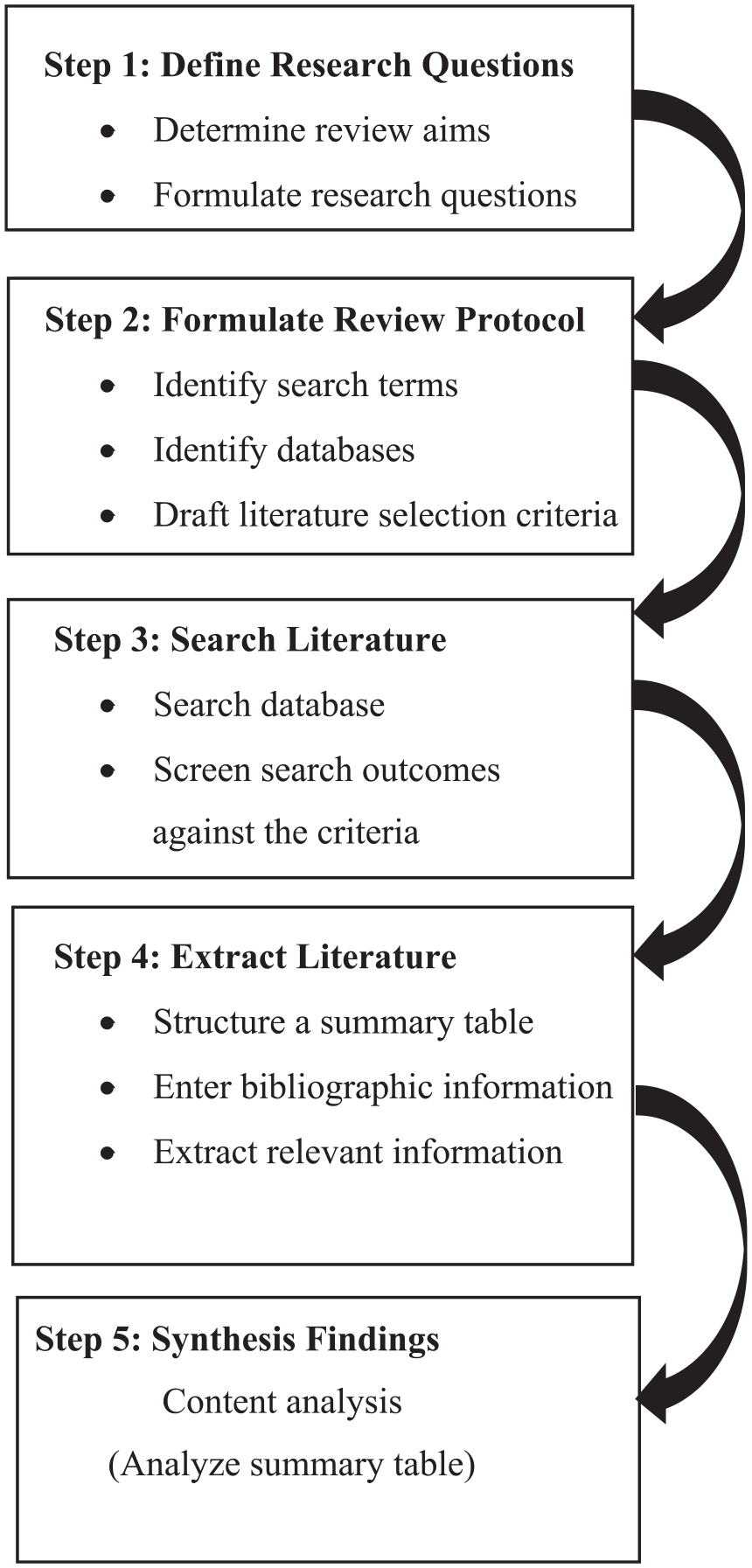
SLR process.
Method
In a nutshell, this SLR explores how sustainable homestays have been previously researched in terms of the research topic, context, sample, method, geographical location, and theoretical framework. The SLR started by setting the review aims as detailed in the previous section. This literature review addressed the following research questions:
What are the suggestions for future research directions?
Literature Review Protocol
Considering the review aims, a review protocol to direct a literature search was developed. The review protocol contained databases, search terms, and literature selection criteria. The following word schemes were used to capture studies that explored homestay from a sustainability perspective: Sustainable AND “homestays” OR “home-stays,” Sustainable AND “homestays” OR “home-stays” AND CSR, Sustainable AND “homestays” OR “home-stays” AND Economic sustainability, Sustainable AND “homestays” OR “home-stays” AND Environmental Sustainability.
To attain multidisciplinary breadth, the relevant literature was searched in tourism and hospitality’s most significant e-databases. While earlier systematic reviews mostly considered two to three databases (Yang et al., 2017), our review would consider six major databases namely SAGE (Social Science and Humanities → Marketing and Hospitality), EMERALD, ELSEVIER (Science Direct), WILEY Online Library (Business and Management), SCOPUS (Business, Management, and Accounting), and Taylor & Francis Online (Subject: Tourism, Hospitality & Events → Tourism). These six databases were commonly used in previous review studies (Figueroa-Domecq et al., 2015).
The search terms were examined in the study title, keywords, abstract, or text, and published in English language academic journals within the time frame 2010 to 2020. English is the predominant language of international academic publishing (Kristjánsdóttir et al., 2017), so in our review, this is the main reason for choosing peer-reviewed academic journals published in the English language and covering 11-year time frame.
Literature Screening
The Preferred Reporting Items for Systematic Reviews and Meta-Analyses (PRISMA) methodology is used for the literature screening that formed the basis of our review (PRISMA, 2019b). The PRISMA checklist (PRISMA, 2019a) sets out the steps that should be followed to carry out a review that is replicable by other researchers and generate trustworthy data. The PRISMA methodology has been adapted for use in tourism research in several publications (Garcês et al., 2018; Stone & Duffy, 2015; Wijesinghe et al., 2017; Yang et al., 2017). Kim et al. (2018) contended that a systematic review in tourism against the PRISMA checklist would contribute to having a clearer understanding of the execution, quality, and rigor of systematic reviews. The reason behind the choice of PRISMA (Liberati et al., 2009) over other existing protocols lies on the recognition of its comprehensiveness, its use in several disciplines worldwide, and its potential to increase consistency across reviews (Pahlevan-Sharif et al., 2019).
As of December 31, 2020, the literature searched against the six databases yields 943 studies. In the first stage of the screening process, editorials, conference proceedings, book chapters, and reviews were excluded; then duplicate (overlapping) studies were removed. The remaining 423 studies were matched to the literature selection criteria. As homestays in the context of tourism were the only consideration, publications from medical/nursing-related journals, online booking, and homestays in urban settings were deemed irrelevant and discarded. A total of 200 papers were screened out in this second stage, leaving 223 studies.
In the final eligibility stage, the remaining 223 studies were carefully reviewed one by one against selection criteria. If the abstracts did not contain sufficient information, the full papers were analyzed against selection criteria. Only those studies matching the exact selection criteria were considered. During this stage, 129 studies were excluded as they were unable to meet one or more selection criteria. After these comprehensive stages, 94 studies were considered eligible and selected for the final synthesis and analysis. The screening process is shown in Figure 2.

A PRISMA flowchart for literature screening process.
Results
The results section widely explains the evolution of literature and content analysis. In the evolution of literature, journal and year of publications from 2010 to 2020 are discussed. Through content analysis, authors, journals, and research designs (subjects of studies, research methods, and geographical locations) are discussed alongside the common sustainable tourism practices.
General Overview: Evolution of the Literature
Descriptive statistics of studies reviewed were computed and presented in Figures 3 and 4. Figure 3 presents the journals that published work on rural community-based homestays related to sustainable tourism.

Number of publications from 2010 to 2020.

Number of publications year wise from 2010 to 2020.
Eleven papers were published in Current Issues in Tourism, having the greatest number of publications related to “sustainability and homestays,” followed by Asia Pacific Journal of Tourism with nine publications and Journal of Ecotourism in third place with seven publications. In addition to number of papers published in a journal, it is also important to know the year of publication which is shown in Figure 4. Current Issues in Tourism has 11% papers, Asia Pacific Journal of Tourism Research has 9% papers, and Journal of Ecotourism has 7% papers.
Figure 4 shows the number of publications distributed yearly, starting from one publication in 2010; the numbers showed an upward trend, in 2011 and 2012 articles published were six and four, respectively. In 2013, the number of publications jumped to nine, in 2014 and 2015 publications slide to six. In 2016, publications stood at 14. In 2017 and 2018 it showed a downward trend to 10 and 11 publications each. In 2019, number of publications were 12 and in 2020 it stood at 15.
Content Analysis
Tables 1 to 4 show the selected papers for the content analysis in a summarized form. The following characteristics from each selected paper are summarized: (a) sustainable tourism practices examined; (b) paper author(s) and publishing year; (c) research design namely the theme of the subject, target population, geographical area of study, and research method(s) applied; and (d) theory(s) applied in study. The SLR outcomes are based on these four characteristics to facilitate an investigation on how the subject is understood and progressed over time.
Content Analysis of All Qualitative Studies (n = 56).

Note. ICT = information and communication technology.
Content Analysis of All Quantitative Studies (n = 22).

Content Analysis of All Mixed Methods Studies (n = 7).

Content Analysis of Conceptual Papers, Reviews, and Exploratory Research (n = 9).

Sustainable tourism practices
Main sustainable tourism practices addressed by researchers are local communities and sustainable tourism development; homestays as a community-based ecotourism product (CBET); rural tourism; ecotourism and sustainability; homestays, economic sustainability and poverty alleviation; women involvement in tourism entrepreneurship; homestays and role of NGOs; and homestays as a cultural tourism product. In addition, women participation in homestays, homestays as potential income sources for rural communities, and local community participation in planning and management of tourism are also studied.
Local communities and sustainable tourism development was addressed in 28 studies; homestays as a community-based ecotourism product (CBET) in 25 studies; rural tourism, ecotourism and sustainability in 17 studies; homestays, economic sustainability, and poverty alleviation in 13 studies; sustainable development related to surfing tourism and women involvement in tourism entrepreneurship in four studies. Most studies are interdisciplinary in nature; two or more sustainable practices are often discussed in one study. Details of sustainable tourism practices studied are shown in Figure 5.

Sustainable practices studied.
Author(s) and publishing year
In total, 205 authors were involved in writing these 94 articles; 13 authors were involved in two or more publications. There are no notable researchers in this field. The articles were published in 35 different journals. Thirteen journals published three or more than three articles, nine journals published four or more than four articles, and five journals published five or more articles.
Research design
The research design consists of subject theme, target population, geographical area of study, and research method(s) applied in the study. The subject themes are primarily adopted from the study title, keywords, abstract, introduction, and literature review section. The theme mostly addressed are “the origin of homestay, conservation of biodiversity, social-cultural/economic impacts generated by community-based tourism, stake-holders’ partnerships, digital marketing in rural tourism and the role of NGOs.”
The main respondents of data collection were homestay operators, local communities, tourists, and key stakeholders. Homestay operators were selected as respondents in 21 studies, local communities in 18 studies, tourists in 15 studies, and stakeholders in 19 studies. The details of the respondents are shown in Figure 6.
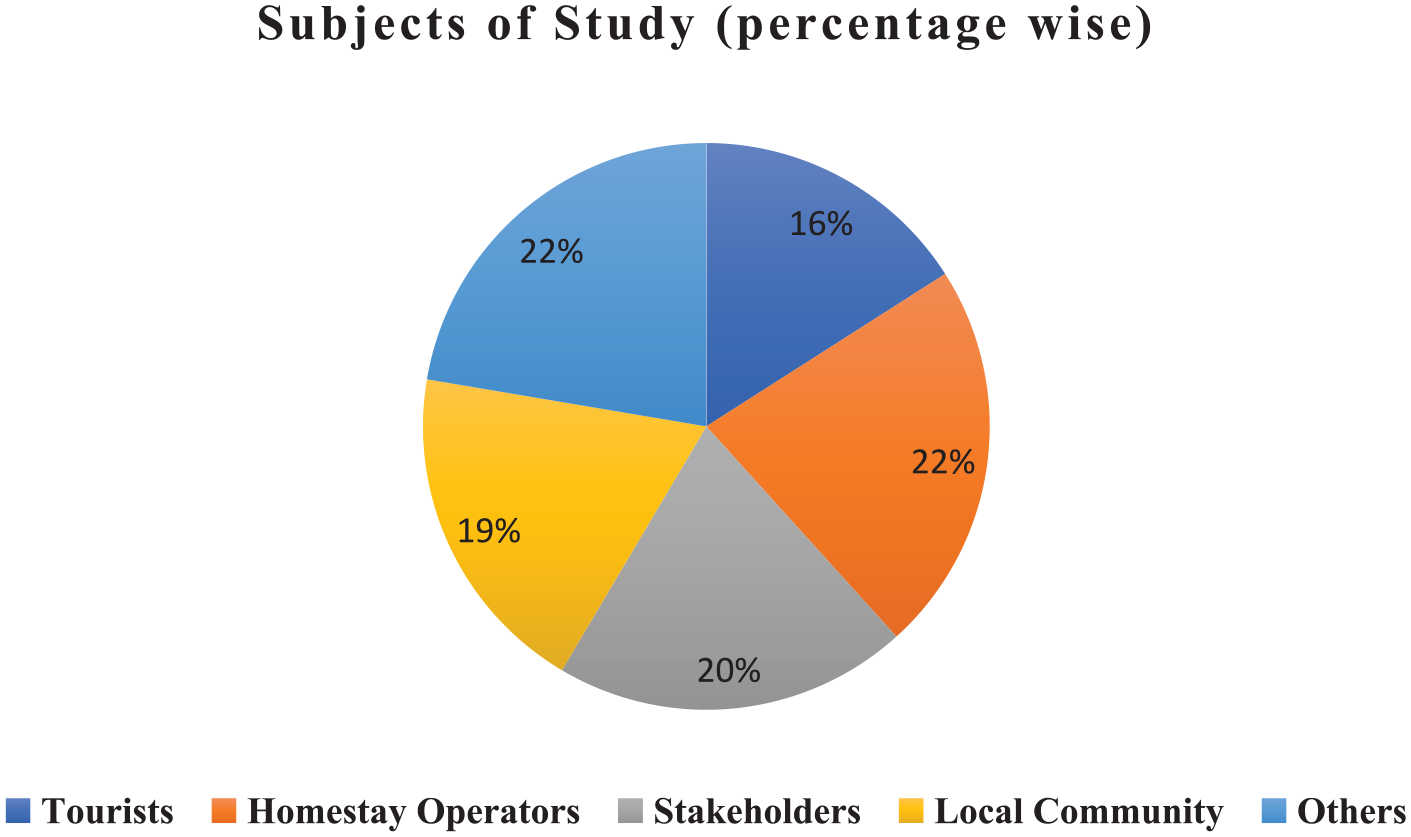
Respondents of the study.
As for research method category, studies with qualitative, quantitative, and mixed methods were included; the total number of qualitative studies were 56 (60%), quantitative studies were 22 (23%), mixed methods studies were 7 (7%), and the remaining exploratory, reviews, or conceptual papers were 10 (11%). Details of the research methods are shown in Figure 7.

Research methods.
The location of data collection is referred to as a geographical area. Major chunk of studies was conducted in the Asia-Pacific region. In Malaysia, 31 (33%) studies were conducted, Indonesia 12 (13%), India 8 (9%), and Thailand 6 (6%); also other regions (n = 27, 29%) were researched, for example, Vietnam (n = 5), Ghana (n = 4), and Peru (n = 2). The geographical details of the studies are shown in Figure 8.

Geographical locations of studies.
Theory(s) applied
By far most of the studies (n = 72, 76%) did not have any theory applied; the remaining (n = 22, 24%) used a theoretical framework and theories of interdisciplinary background. The predominant theories applied were the theory of planned behavior, social exchange theory, and theory of workplace learning.
Discussion
The results are summarized as follows: In a sustainable rural tourism context, 48 (51%) of the 94 studies reviewed had considered homestay as the core and independent area of inquiry. Nonetheless, the literature was selected for containing “homestays” in the title, abstract, text, and keywords. Sociocultural sustainability was addressed in 35 studies, economic sustainability directly addressed in 19 studies, and surprisingly, environmental sustainability related to rural community-based tourism or homestays was directly addressed in only six studies. Rural community-based tourism was addressed 45 times (48%) either directly or indirectly in the above-surveyed studies. Holistically sustainability was discussed in 28 studies.
We reviewed the literature systematically to identify the significant research domains of homestays as a sustainable rural tourism product by examining sustainable tourism practices, study areas, subject theme, study subjects, and theoretical contexts. This review has found that an increasing number of researchers from developing countries are working on community-based rural homestays, especially in the Asia-Pacific region that includes Malaysia, Thailand, Indonesia, India, Vietnam, and Cambodia. Rural tourism products have a huge potential across the Americas, Africa, and in the Caribbean (UNWTO, 2018). Rural tourism products improve livelihoods, promotes poverty alleviation, and enhances the protection of biodiversity and cultural heritage development (Haywood et al., 2020). However, an important rural tourism product—homestay—is not currently being studied by researchers in Africa, the Caribbean, and South America. In articles studied, we found only four African, one Caribbean, and four South American studies. These regions have massive potential for rural tourism but somehow are ignored.
Most studies originate from Asia-Pacific region, indicating that most countries’ rural tourism policies are efficient and effective in the region, especially for rural homestays. Also, the government departments overseeing rural tourism seem competent. Asia-Pacific region is suitable for tourism throughout the year just like most countries of Africa, Caribbean, and South America; yet more tourists visit rural areas of countries like Thailand, Malaysia, Indonesia, India, Nepal compared with South American countries (Ecuador, Brazil, Bolivia etc.) or African countries (Kenya, Ghana, South Africa, etc.). Perhaps the reason is better rural infrastructure, better country branding, promotion, country image, and connectivity with tourist home country. African, Caribbean, and South American countries need to improve their rural tourism infrastructure. Countries lagging in sustainable rural tourism products like homestays must also aim on expanding partnerships between national and international public and private stakeholders, as well as local rural communities.
The SLR results demonstrate that rural tourism researchers focused more on social pillar followed by economic pillar of sustainability, and environmental sustainability is not addressed as it should have been. Perhaps this is because all tourism products are perceived as environmentally sustainable; in fact, they are not. The environmental issues of tourism development require special attention (Streimikiene et al., 2021). As the development of tourism and particularly rural tourism is linked with all three dimensions of sustainability, one dimension cannot be ignored at the expense of others (UNWTO, 2018). Sustainability goal cannot be achieved by targeting a single aspect; it is essential to target all aspects simultaneously and attain the objective of long-term rural tourism development. Also, it is necessary to remind that the theoretical definition of sustainability in tourism involves economic, social, and environmental protection dimensions (UNWTO, 2018; Streimikiene et al., 2021
The outcomes of this SLR will help researchers and rural tourism managing authorities to have an easy access to publications on sustainable rural tourism, thereby contributing to narrowing the knowledge gap in sustainable rural tourism. Hence, the study can also be helpful to rural tourism researchers and practitioners.
Conclusion, Limitations, and Future Recommendations
Conclusion
A significant number of critical issues have been revealed by this review and content analysis of published literature. Branding, entrepreneurship, information and communication technology (ICT) competency, homestay operator training, and development are rarely addressed in the literature.
Rural communities especially homestay operators lack essential marketing skills especially branding skills; wide-ranging studies had linked the positive effects of CSR and sustainability with substantial performance brand equity (Wang & Sengupta, 2016). Only two articles addressed branding (eco-branding, eco-label, environmental branding, and brand experience) nevertheless homestay branding is largely ignored.
ICT is associated with innovation, productivity, internationalization, and development, and this association is proofed in all firms generally and particularly in small and medium enterprises (Giotopoulos et al., 2017). Developments in ICT provide competitive advantage and open new possibilities in rural tourism (Agyeiwaah & Mensah, 2017). Technological development can provide significant solutions for dealing with sustainable challenges of tourism development (UNWTO, 2018). In this information age, benefits of ICT competency in tourism is indisputable, but unexpectedly, only two studies addressed this critical area.
Sustainable entrepreneurs merge social and environmental concerns with economic objectives, so they are genuine models for generating social and environmental wealth (Muñoz et al., 2018). Human resource management (HRM) is one aspect of tourism firm’s effort to engage in social sustainability (Wikhamn, 2019). Having sustainable HRM practices is important for hospitality firms and their stakeholders (tourists, local communities, employees, NGOs) to project the image as socially responsible entities (Wikhamn, 2019). Besides many other important areas, entrepreneurship and HRM were somehow ignored in surveyed studies.
Moreover, the study highlights important implications for rural community-based homestays to position their tourism products strategically based on sustainability.
Limitations
This review is not without limitations as the research was limited to 11 years (January 2010 to December 2020); this period was selected due to resource constraint. A systematic review comes with its own limitations because of its retrospective, observational, and selective nature (Yang et al., 2017). Moreover, the publication language was limited to English, and all papers selected were journals and peer-reviewed papers so publication bias may be considered as a limitation. Conference papers, media articles, and other sources of gray literature were also ignored.
Despite these few limitations, this is the very first attempt to carry out a systematic review regarding sustainable homestays as a rural community-based tourism product. This review has revealed the entwined relationship between sustainable homestays and rural community-based tourism and has advanced future research direction.
Future Recommendations
SLRs can provide limited explanations to practical issues (Petticrew & Roberts, 2012; Tölkes, 2018), so future research needs to consider other review protocols to create a knowledge base that can benefit researchers and practitioners. As a commercial homestay’s business grows, it loses its authentic feel (Ye et al., 2018). So, homestay operators should fully exploit local cultural values while designing their homestays; homestay should reflect the identity and perception of an authentic rural community-based product.
In addition, the novel coronavirus (COVID-19) pandemic has had a significant impact on tourism industry especially rural tourism, due to the widespread introduction of travel restrictions by countries, as well as massive and unprecedented slump in demand among travelers (Gössling et al., 2020). Tourism is considered as one of the hardest sectors hit by the COVID-19 outbreak (UNWTO, 2020). The current COVID-19 outbreak and high risk of future pandemics have given rise to new challenges for sustainable tourism development (Streimikiene et al., 2021). So, future SLRs should comprehend tourism and natural crises (pandemics).
Footnotes
Declaration of Conflicting Interests
The author(s) declared no potential conflicts of interest with respect to the research, authorship, and/or publication of this article.
Funding
The author(s) disclosed receipt of the following financial support for the research, authorship, and/or publication of this article: This work was supported by the Enhancing brand equity through sustainability tourism marketing: A study on homestays in Malaysia, Project No: IPSR/RMC/UTARRF/2019-C1/G02, Vote No:6200/G46 Faculty of Business and Finance.
