




Abstract
Within the sustainable urbanization framework, two dimensions, namely, social urbanization and environmental urbanization, have complex coordinated interactions. To better understand the coordinated interaction status between the two dimensions of sustainable urbanization, an empirical study was carried out in the 14 cities of Hunan Province, China, from 2011 to 2019. This study establishes an integrated measurement framework, uses the coupling coordination degree model, information entropy weight analysis approach, and the Technique for Order Preference by Similarity to an Ideal Solution method to analyze the development degrees and coordinated interaction degrees of the two dimensions. The results show that the quality and efficiency of leisure facilities and water use have the greatest impacts on the coordinated interactions between the two dimensions. Besides, the development degrees of social urbanization and environmental urbanization are not consistent. What is more, the spatial noncorrelation of the coordinated interaction status demonstrates that the “high-quality development” tactics aiming to promote balanced development of dimensions among cities in China is feasible. Furthermore, corresponding suggestions are proposed, providing references for governments’ planning and decision-making processes.
Keywords
Introduction
By 2014, half the world’s people were living in towns and cities, and it is predicted that 66% of the world’s population will live in urban areas till 2050 (United Nations, 2014). Sustainable urbanization includes many aspects, such as maintaining biodiversity and environment, increasing social benefits, efficient use of land, developing economy, and so on (Gan et al., 2017; Jiao et al., 2018; Tan et al., 2016), and sustainable cities should be those succeeding in these dimensions. Therefore, it is important for us to measure whether cities develop these dimensions harmoniously and coordinatively to enhance the effectiveness of sustainable urbanization of the cities efficiently and comprehensively. Take the dimensions of society and environment of sustainable urbanization as examples; accelerating sustainable urbanization provides more social welfare (such as hospitals and libraries) and improves education levels of citizens, which raises public awareness to protect the urban-ecological environment, and thus promotes environmental urbanization; besides, during the urbanization process, some social welfare and activities (such as public transportation and garbage disposal) are causing direct or indirect harm to the ecological environment and impeding the process of sustainable environmental urbanization (Danish & Wang, 2019; Fang et al., 2019). At the same time, some environment-related problems during sustainable urbanization procedure (such as resource losses and waste, desertification, and greenhouse effects) limit the further social development of cities, affect citizens’ life quality, and hinder urban sustainability; on the contrary, benign eco-environment plays a positive and attractive role in facilitating the social process of cities (Jiang et al., 2019; O’Neil, 2020). Therefore, it is necessary to consider and measure the interactions between the social urbanization dimension and the environmental urbanization dimension within the sustainable urbanization framework with proper frameworks and approaches, whether these dimensions share coordinated growth and mutual common prosperity, or they are threats to each other, so that coordinated and scientific actions to enhance the mutual coordinated interactions can be taken.
Before the 1950s, most of the world’s urbanization happened in developed countries, whereas nowadays urbanization process is more likely to happen in developing countries such as China. Related studies regarding sustainable urbanization are quite popular in recent years mainly because of the rapid urbanization process during these decades in the globe (D. Zhang et al., 2020). China has witnessed its rise of the urbanization rate from 17.92% in 1978 to 58.5% in 2017, the trend of which is still moving upward (Chen et al., 2019). Now the central government of China is introducing certain vital policies and regulations to contribute to social development and environmental governance within the sustainable urbanization framework, which lets sustainable urbanization play a more important role, and which makes the coordinated interactions among dimensions of sustainable urbanization a hot topic in China (Fang et al., 2019). Taking China as an example and exploring the coordinated interactions between the two dimensions of sustainable urbanization (social urbanization and environmental urbanization) are beneficial for other countries to refer to sustainable urbanization procedures and achieve sustainable urbanization more effectively and efficiently.
Sustainable Urbanization: Concepts and Theories
The concept of urbanization was first proposed in 1860 (Kao et al., 2017). The interpretations of urbanization vary in different fields, but generally they can be included as follows: Urbanization is the transformation from agricultural or rural activities, population, and lifestyles to nonagricultural or urban ones (S. Gao et al., 2019; Geng & Zhang, 2020). However, such interpretation is somehow traditional with some deficiencies: it focuses on the quantity of urbanization process and ignores the quality of urbanization process; thus, the traditional view of urbanization is not sustainable (Wei et al., 2018). Thereafter, the concept of urbanization was gradually evolved into sustainable urbanization, which focuses on the quality of urbanization process, and contributes to solving potential urbanization-related problems (such as environmental pollution, income disparity, and food insecurity), with the idea of sustainability during the urbanization process (F. Li et al., 2009; Zhong et al., 2020). Sustainable urbanization was defined by the European Commission as the process to coordinate conflicts encountered by cities, to solve problems raised by cities, to enhance operational efficiency of cities, and to protect growth foundations of cities, which means that cities themselves can provide sufficient resources to propose ideal solutions and solve problems coordinatively during the sustainable urbanization process (Ochoa et al., 2018). Sustainable urbanization is welcomed and encouraged because it is beneficial to promote the efficiency of land use, protect local environment, enhance social and living environment, and achieve social growth, environmental governance, and economic development with sustainability. Furthermore, sustainable urbanization is a very complex dynamic process because it covers various interactive dimensions, such as society, environment, economy, space, and population, which means that we should consider the continuity and friendliness of the future, and deal with social value evolution and eco-space changes in all respects (X.-l. Gao et al., 2017). Therefore, it is important to achieve coordinated development of all the dimensions of sustainable urbanization, so that comprehensive and integrated sustainable urbanization can be finally achieved.
This study mainly focuses on the coordinated interactions of the two dimensions of sustainable urbanization, namely, social urbanization and environmental urbanization; social urbanization refers to the social benefits and welfare to citizens during the sustainable urbanization process. Social urbanization is the basis of sustainable urbanization mainly because society is the carrier of sustainable urbanization and citizens in urban societies are the main driving forces and stakeholders to promote sustainable urbanization (Akyildiz, 2020; Wei et al., 2018). The advantages and growth of urban society attract citizens to settle down from rural places; cities provide abundant social resources and welfare, such as education, health care, transportation, social insurance, and leisure facilities, to citizens, which exhibits values of society and social urbanization (Sato & Zenou, 2015).
Environmental urbanization is an integrated concept; it refers to the efficient use and protection of the environment, including soil, air, water, and biological resources during sustainable urbanization process. Environmental urbanization focuses on the importance of ecological environment to sustainable urbanization and aims to construct a balanced mechanism between humans and nature (Ameen et al., 2015; Fang et al., 2019). Environmental urbanization is a complicated and interactive dimension in the sustainable urbanization process; sustainable urbanization development to some degree may pollute the environment and threaten ecological environment, and the effects on environment are sometimes neglected; meanwhile, the proposal of certain legal regulations and social norms is likely to enhance the effectiveness and efficiency of environmental urbanization (Du & Huang, 2017). Environmental urbanization exhibits the core of sustainable urbanization because it depicts the coordinated development between society and nature.
Connect Social Urbanization and Environmental Urbanization
Within the framework of sustainable urbanization, the two dimensions of social urbanization and environmental urbanization are intertwined mutually. On one hand, both dimensions connect with each other with positive effects. From the social urbanization perspective, it provides sufficient resources and tools to accelerate environmental urbanization; social urbanization provides more environmental-friendly urban activities, which decreases per capita carbon emissions and accelerates sustainable environmental urbanization (Adams et al., 2020). For instance, more eco-friendly social activities such as social education contribute to better environment protection and sustainable environmental urbanization (Cao et al., 2020). Besides, social urbanization provides abundant opportunities for citizens to participate in the public governance process of environment protection; for instance, legislation regarding environmental governance plays an effective and positive tool to promote environmental urbanization theories and practice (Fang et al., 2019). Furthermore, social urbanization renews urban industrial structure and enhances urban service levels, which contributes to better environmental urbanization (Ulucak et al., 2020). For instance, more convenient public transportation such as subways and buses, and improved community services equipped with high technologies or efficient waste treatment facilities change the urban function and effectiveness, which are beneficial to protecting environment and decreasing environment pollutions (Danish et al., 2020). From the environmental urbanization perspective, it plays an active role in supporting social urbanization. First, environmental urbanization affects the prospect of social urbanization; the results of environmental urbanization such as urban public grasslands and parks provide sufficient environmental resources to cities, making it more suitable for society to live and more attractive to citizens (Zhong et al., 2020). Second, the evaluation of environmental urbanization promotes more specific and effective social actions to be taken, so that social urbanization status can be improved (Jiang et al., 2019). For instance, based on the assessment results of the environmental urbanization, the degradation of environmental urbanization may alert local authorities to forbid backward and energy-intensive social activities, and encourage eco-friendly social activities instead (Arshad et al., 2020). Third, environmental urbanization–related practices, such as constructing green facilities (i.e., waste treatment facilities, installing air-purification equipment), improving energy use efficiency, and using low-carbon technologies are themselves social activities to some degree; therefore, environmental urbanization practices can improve social urbanization (Jing & Wang, 2020).
On the other hand, both dimensions impede each other’s development with negative effects. From the social urbanization perspective, it hinders the development of environmental urbanization to some degree. Social urbanization increases the absolute values of waste emissions, which imposes pressure on environmental governance and environmental urbanization. For instance, some social activities such as private transportation and fireworks lead to the increase of carbon and garbage emissions, which are destructive to environmental urbanization (Ahmed, Asghar, et al., 2020; Ahmed, Zafar, et al., 2020). At the same time, public facilities constructed during the social urbanization process occupy green areas and may pollute surrounding natural resources, which also lead to pressure on environmental urbanization (Ameen et al., 2015; Baloch et al., 2020). Furthermore, the evaluation of social urbanization from the public may push some local governors to introduce some specific policies or take some short-term measures, which may satisfy the public and win elections, whereas they violate the goals of sustainable environmental urbanization in deed (H. Zhang et al., 2020). From the environmental urbanization perspective, it also impedes the growth of social urbanization to some degree. First, sustainable environmental activities increase the cost of social activities in the process of social urbanization. For example, by using upgraded eco-friendly, yet expensive, treatment facilities or equipment, social sectors such as tourism and medical treatment may contribute to environmental urbanization, whereas they must bear monetary loss (Rasheed et al., 2020). Meanwhile, environmental urbanization may lead to the Not-In-My-Back-Yard (NIMBY) syndrome (meaning that nearby residents are unwilling to bear the negative effects of environmental urbanization, although the benefits generated are shared by all society) and generate social conflicts. For instance, decision of where to build garbage treatment plants may cause social disputes or conflicts among communities (O’Neil, 2020). What is more, as the total resources or budgets of a city are relatively limited, more devotion to environmental urbanization means less devotion into social urbanization, which hinders the growth of social urbanization; in other words, environmental urbanization to some degree is at the cost of social urbanization (Nemeth-Durko, 2020). In conclusion, the dimensions of social urbanization and environmental urbanization are mutually and complicatedly intertwined.
Social urbanization and environmental urbanization are two dimensions within the sustainable urbanization framework and these two dimensions share some similarities; for instance, both reflect the activities of citizens and the subsequent impacts on citizens. Therefore, it is important to understand how these two dimensions interact coordinatively within the sustainable urbanization framework. Current studies mainly analyze the relationship between urbanization and other factors such as economy and environment; however, there are some deficiencies for current studies: The coordinated interactions among the dimensions of urbanization with the philosophy of sustainability is not focused, the research cases are mainly advanced or developed regions with less-developed places ignored, and the spatial comparisons among places are usually neglected. Therefore, it is urgent to study the exact coordinated interaction relationship between the dimensions of sustainable urbanization with the case of developing cities, which will help stakeholders to maintain high-quality and substantial development of sustainable urbanization in both society and environment.
The aim of this study is therefore to create an integrated measurement framework to explore the coordinated interactions between the social urbanization dimension and the environmental urbanization dimension within the sustainable urbanization framework. Thereafter, with the information entropy weight analysis approach, the Technique for Order Preference by Similarity to an Ideal Solution (TOPSIS), and the coupling coordination degree model, this study will discover the main influencing factors of the coordinated interactions and assess the development degrees and the coordinated interaction status of the two dimensions. The results are beneficial to facilitate a sound decision-making process for cities in the process of sustainable urbanization development.
Materials and Methods
Study Area
Hunan Province is in the south of China and is playing an important role in maintaining sustainable urbanization in China; the urbanization process, with the concept of sustainability, is accelerating these years after the Chang-Zhu-Tan Urban Agglomeration was approved as a comprehensive reform pilot zone in 2007. At the same time, Hunan is the birthplace of the Chinese revolution and is a relatively poorly developed province in China; due to its political and historical features, its sustainable urbanization procedures are somehow national concerns. Therefore, it is particularly important to explore the coordinated interaction status between social urbanization and environmental urbanization in Hunan, which will provide useful preferences to other places with similar conditions. There are 14 cities in Hunan, which are selected as the study cases. The administrative areas of the 14 cities are shown in Figure 1; in this study, the data are selected to describe the situations of the urban areas of the administrative areas and the data of the rural areas of the administrative areas are excluded.
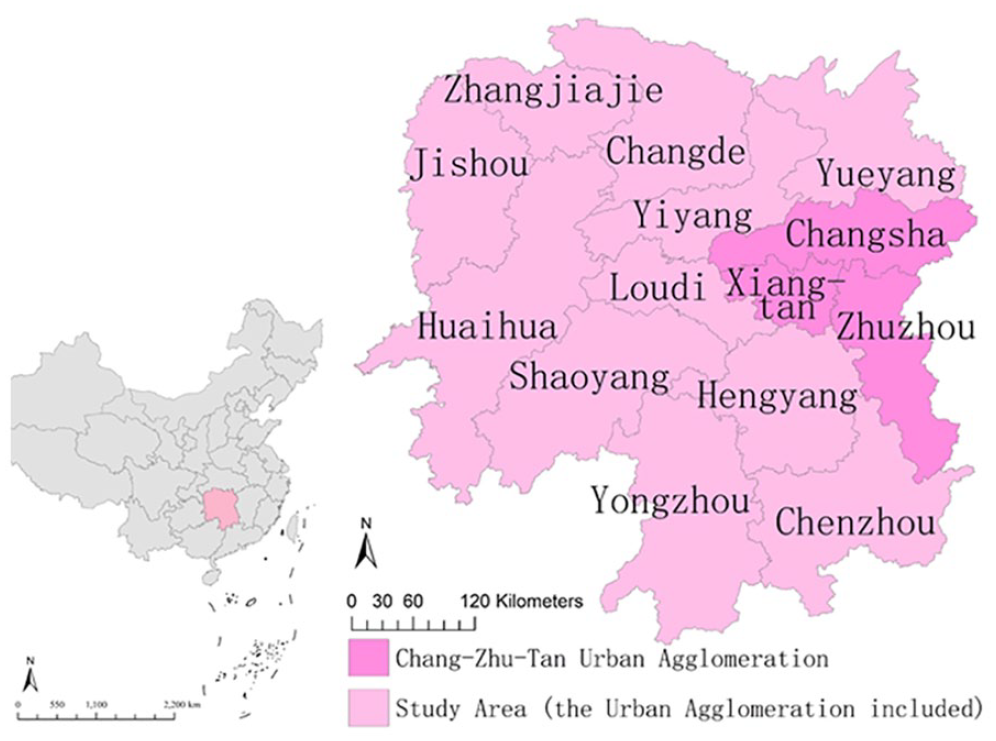
Study area.
Integrated Measurement Framework
There are complicated interactions between the two dimensions of social urbanization and environmental urbanization within the sustainable urbanization framework; they promote and hinder each other: Although social urbanization contributes to better development of environmental urbanization, improper approaches or procedures of social urbanization have negative impacts on the environmental urbanization procedure; on the contrary, benign and harmonious environmental urbanization accelerates the process of social urbanization although certain environmental urbanization actions hinder further benign process of social urbanization. The two dimensions have such complex interactions that they together form a coupling coordination mechanism where the coordinated interaction status between the two can be measured. A coupling coordination mechanism can depict how two dimensions interact each other and how they evolve interactively to more harmonious status (Geng, Wei, et al., 2020); hence, it is an important and useful approach to measure the coordinated interactions between social urbanization and environmental urbanization with the concept of sustainability. Based on this, an integrated measurement framework can be introduced to assess the coupling coordination mechanism between social urbanization and environmental urbanization. Based on previous research (Geng, Maimaituerxun, & Zhang, 2020; Geng & Tan, 2020; Liu et al., 2018), indicators of the integrated measurement framework are selected according to the following selection criteria: (a) select simple indicators to facilitate data collection and understanding, and to eliminate multicollinearity issues; (b) select indicators representing the connotation of sustainable urbanization; (c) select the indicators with more citations; (d) follow local policies or government strategies; (e) select indicators where the data include urban areas only and exclude rural areas. Thereafter, through expert reviews and quantitative analysis, the indicators are further screened and determined.
The dimension of social urbanization refers to the qualified infiltration and diffusion of urban lifestyle, cultural values, and social services, and includes five aspects: education, health, insurance, transportation, and leisure (L. Li & Liu, 2019; Wan et al., 2020; Table 1). The aspect of education reflects how citizens get benefits of mass education from social urbanization process, including two indicators: per capita number of teachers and per capita number of students. These indicators illustrate the qualitative development of fundamental schools (middle and primary schools) from the perspectives of both teachers and students. The aspect of health reflects the relative quality of health care services during the social urbanization process, including 2 indicators: per capita number of beds in hospitals and per capita number of doctors. These indicators demonstrate the health care situations in urban areas. The aspect of insurance illustrates the quality of social insurance or social security growth during the social urbanization process, including two indicators: ratio of people participating in endowment insurance and ratio of people participating in medical insurance. Higher ratio means higher insurance benefits of urban residents, together with higher social urbanization status. The aspect of transportation depicts the quality of urban public transportation development, including two indicators: per capita area of urban roads (this is more convincing than per capita length of urban roads) and per capita number of public transportation vehicles. The aspect of leisure demonstrates the quality of entertainment or leisure activities to urban citizens provided by social urbanization process, including two indicators: per capita number of books in libraries and ratio of internet users. These two indicators describe the quality of leisure situations of urban places.
Integrated Measurement Framework: Social Urbanization Dimension.

The dimension of environmental urbanization refers to the efficient use of environmental resources during the sustainable urbanization process, including the supply of environmental resources and the protection to environment (Table 2). There are four aspects: land, water, gas, and waste, which are divided mainly according to the composition of environment (Danish et al., 2019; Fang et al., 2019; Tan & Geng, 2020). The aspect of land illustrates the utilization efficiency of green spaces, including two indicators: per capita of park land (demonstrating the utilization quality of public park spaces in urban areas) and green area coverage rate (demonstrating the utilization efficiency of public green spaces in urban areas; the rate of area covered by trees is calculated and the coverage of parks, grasslands, football pitches, or sports grounds is excluded). The aspect of water demonstrates the use and protection efficiency of water in urban areas, including two indicators: ratio of water penetration in urban areas and density of drainage pipe in urban areas. These indicators represent the efficiency of using and protecting water resources in cities. The aspect of gas demonstrates how many citizens can use eco-friendly natural gas and how citizens use natural gas efficiently, including two indicators: ratio of gas penetration (percentage of population with access to natural gas in urban places) and per capita of gas supply volume (average use of natural gas in urban areas). The aspect of waste illustrates how citizens deal with wastes, protect environment, and achieve sustainable environmental urbanization. There are two indicators: ratio of sewage treatment (the percentage of sewage that is treated by each urban authority) and ratio of garbage harmlessly treated (the percentage of household waste that is treated in an eco-friendly manner by each urban authority). These indicators well represent the countermeasures taken to protect the environment and to enhance sustainable environmental urbanization.
Integrated Measurement Framework: Environmental Urbanization Dimension.

Solution Steps
The research data are from the Hunan Statistical Yearbook (2012–2020). The information entropy weight analysis approach and the TOPSIS are jointly utilized. The detailed processes are as follows.
Step 1. Weight Determination of Indicators
Normalize data and exclude the variations of measurement units.
Calculate
Calculate information entropy.
Calculate the deviations
Calculate the weight



Step 2. Calculation of Development Degree
Calculate M and L, the most and the least preferred alternatives.
Calculate SM, the separation measures from M to L.
Calculate the development degree DEV. Higher DEV means better status of the dimension in the assessed year.


Step 3. Calculation of coordinated interaction degree (CID)
Coupling coordination means that two dimensions interact with a harmonious and sustainable relationship. This study uses the coupling coordination degree model to assess the coordinated interactions among dimensions, which can be summarized as follows.

Calculate the coupling degree CO. There are two dimensions, then n = 2;

Calculate the coordination degree CR. The two dimensions of social urbanization and environmental urbanization are equally important in the coupling coordination mechanism (equally affect each other); therefore, after referring to existing research (Geng, Maimaituerxun, & Zhang, 2020), the coefficients

Calculate the coordinated interaction degree (CID).

Referring to the previous research (Wang et al., 2019), the measurement classification for CID with eight levels is constructed, which is shown in Table A1. The higher degree of CID represents better coordinated interaction status between dimensions of that city in a certain year.
Results and Discussions
Results of the Indicators’ Weight
The weights of the indicators for the dimensions of both social urbanization and environmental urbanization are shown in Table 3.
Weight of Dimensions.

For the social urbanization dimension, the accumulated weights of the five aspects are listed as follows: leisure: 0.38317, insurance: 0.31890, transportation: 0.14620, health: 0.10785, and education: 0.04389. This sequence shows that the key to social urbanization is the leisure aspect (i.e., per capita number of books in urban libraries and ratio of internet users) followed by the insurance aspect. Besides, the indicators with maximum contributions are as follows: per capita number of books in libraries (
For the environmental urbanization dimension, the aspects are weighted as follows: water: 0.44507, gas: 0.26522, land: 0.20092, and waste: 0.08879. The proportion of the weight of the water aspect occupies almost half, indicating that the current state of the urban water use is an important manifestation of environmental urbanization, and thus local authorities should pay more attention to urban water use during the sustainable urbanization process. In detail, the density of drainage pipe (
Results of Development Degree: Social Urbanization Dimension
The changing trends of the development degrees of the social urbanization dimension are shown in Figure 2, with the values in Table 4. Generally, it can be found that the development degrees of social urbanization apparently vary among different urban areas. Specifically, there are several findings.
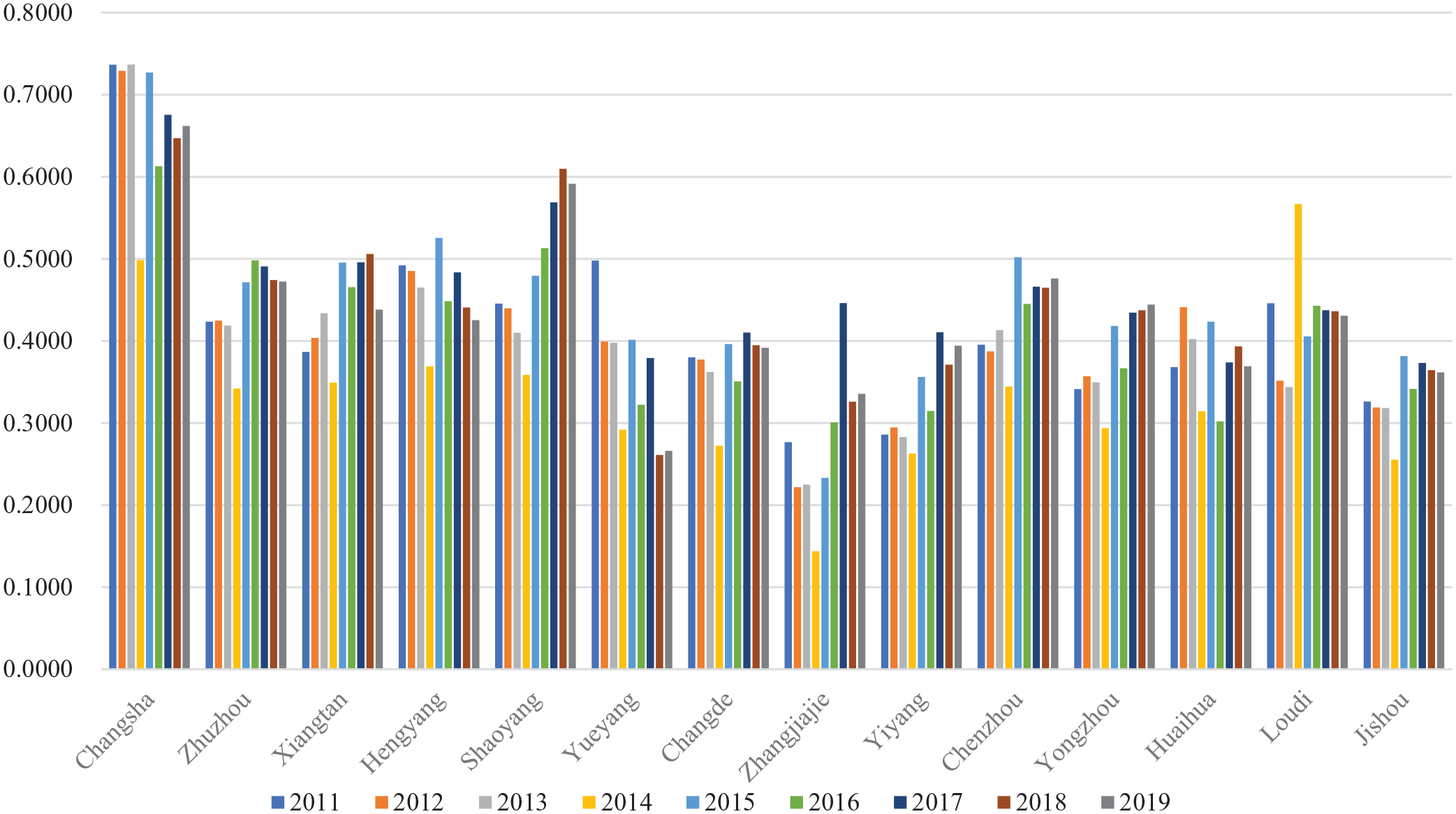
Trends of development degree: Social urbanization dimension.
Values of Development Degree: Social Urbanization Dimension.

The first finding of the development degree of social urbanization is that the provincial capital city (Changsha) can play a leading role in the sustainable social urbanization process. This demonstrates that in the past years, Changsha has achieved a comprehensive, integrated, and efficient sustainable social urbanization status in terms of education, health care, social insurance, transportation, and leisure facility growth. As the provincial capital of Hunan, Changsha enjoys preferential policies, such as the tactics of increasing the primacy of the provincial capital, leading to the result that more resources and benefits can be used into sustainable social urbanization process. This finding proves that emphasis on specific regions and devotion of tremendous efforts into city constructions are conducive to social urbanization development.
The second finding is that a pilot zone may not play a demonstration role in sustainable social urbanization; in detail, the Chang-Zhu-Tan Urban Agglomeration is not playing a leading role in social urbanization development. Within the same urban agglomeration, Zhuzhou and Xiangtan were not as outstanding as Changsha or performed even similar to other cities. This is mainly because these two cities are affected by the siphonic effect of Changsha, meaning that the resources of the two cities for social urbanization are used by Changsha, so that these two cities cannot enjoy sufficient and qualified social urbanization process. Although Zhuzhou and Xiangtan fluctuated with upward tendencies, proving that these two cities had devoted many efforts to accelerate sustainable social urbanization process, the synergistic and cooperative effects of the urban agglomeration are still not clear, which means that more endeavors to enhance coordinated growth are needed.
The third finding is that the gaps among cities relating to the development degree of social urbanization are likely to narrow with the passage of time. Take Zhangjiajie as an example: after several years’ decline, it gradually increased its development degrees from a low point (0.1438 in 2014) to a higher status (0.3357 in 2019) and narrowed the differences with other cities, demonstrating its continuous progress in sustainable social urbanization. This is mainly because Zhangjiajie, as a relatively backward city in Hunan Province, enjoys special policy advantages as a latecomer. Apparently, Zhangjiajie obtains benefits from the ideas of taking a holistic view and achieving all-around and balanced development, which is proposed by the provincial government. The declining of the gaps among cities proves that the policy of equal and balanced development among cities in China is feasible and effective.
Results of Development Degree: Environmental Urbanization Dimension
The development degrees of the environmental urbanization dimension for the 14 cities are shown in Table 5; the changing trends are shown in Figure 3. There are several detailed findings.
Values of Development Degree: Environmental Urbanization Dimension.


Trends of development degree: Environmental urbanization dimension.
The first finding is that there can be huge fluctuations between sequential years for environmental urbanization. For instance, from 2016 to 2017, there was an obvious decline of the development degrees for some cities such as Xiangtan, Zhangjiajie, and Jishou, whereas there was an obvious increase for some cities such as Changde and Chenzhou. The obvious changes are closely linked to the changes of some indicators; for instance, in 2017, the density of drainage pipe in Changde increased noticeably, whereas the density in Jishou decreased hugely, which led to great fluctuations of the development degrees. This can be explained with the theory of “the butterfly effect,” which is interpreted as certain key indicators with higher weights determining the overall development tendency of environmental urbanization. It can be learned that key indicators should be emphasized and key conflicts should be regarded as top priority in solving problems during the environmental urbanization process.
The second finding is that the development degrees of environmental urbanization are quite different from those of social urbanization: The development degrees of environmental urbanization are generally higher than the ones of social urbanization. In detail, the development degrees of this dimension are mostly between 0.45 and 0.50, which are much higher than those of social urbanization (between 0.40 and 0.45). This is mainly because the innate advantages of ecological resources of these cities are generally more than those of social resources, which proves that environmental foundations are conducive to sustainable environmental urbanization process.
The third finding is that the development degrees between the two dimensions are not exactly consistent. Cities with high development degrees of social urbanization may not have high degrees in the dimension of environmental urbanization. For example, Changsha is outstanding in social urbanization, whereas it performs average in environmental urbanization: its mean value of the development degree of environmental urbanization for the 9 years is 0.4675, lower than that of social urbanization (0.6695). This is mainly because metropolises usually have more pressures on environment protection, leading to more resistance on sustainable environmental urbanization. Therefore, more actions are required to enhance the coordinated development of the two dimensions.
Results of CID
The results of CID are shown in Table 6 and the trends of CID are shown in Figure 4. Generally, the development trends of CID of most cities were mildly fluctuating within the coordinated development range (0.6
Values of CID.

Note. CID = coordinated interaction degree.

Trends of CID.
Table 7 shows the specific coordinated interaction relationships between social urbanization and environmental urbanization of the 14 cities from 2011 to 2019. It can be found that social urbanization is the main lagging dimension in the coordinated interaction relationship; however, the two dimensions are gradually getting more harmonious and balanced with time. In detail, in 2012, 11 of the 14 cities (78.57%) were lagging in social urbanization; with the passage of time, only eight of the 14 cities (57.14%) were lagging in social urbanization in 2019. This means that social urbanization is emphasized during these years and has been narrowing the gap with environmental urbanization. The result gives insights to readers in other places that the constraints of environmental urbanization on social urbanization are gradually decreasing and it is possible for the two dimensions to achieve coordinated interactions. Besides, it is possible and feasible for local governors to introduce balanced development policies aiming to achieve coordinated interactions between dimensions.
Types of CID Among Cities.

Note. CID = coordinated interaction degree; IC-E = intermediate coordination with environment lagged; PC-E = primary coordination with environment lagged; PC-S = primary coordination with society lagged; IC-S = intermediate coordination with society lagged; RC-S = reluctant coordination with society lagged; RC-E = reluctant coordination with environment lagged; AI-S = approaching imbalance with society lagged.
To further analyze the spatial changes of CID, ArcGIS is used to visualize CID (Figure 5); the darker the color, the higher the CID. There are two main findings. The first finding is that cities in the northwest have lower CID. This is to some degree caused by the historical situations. Historically, the eastern cities were more developed due to the geographical and political advantages, so that the sustainable urbanization process is more coordinated; on the contrary, cities in the northwest have been sharing a weak social and environmental basis, leading to weak CID. Fortunately, more preferential policies aiming to enhance the coordinated development of the northwestern behindhand cities have been put forward, so that the differences between the northwest cities and other ones are diminishing. The second finding is that the spatial correlations of CID are not obvious, meaning that it is possible to decouple sustainable urbanization from geographic locations. This is a new finding because it somehow conflicts with former theories or studies that believe that society’s growth and geography are closely related (Yang et al., 2020). On the contrary, such balanced performances of CID without geographical correlations prove the usefulness and effectiveness of the “high-quality development” tactics, which was proposed in 2017 by the national authority of China, aiming to promote social balanced and full development and to accelerate efficiency, quality, and sustainability of society.

Spatial changes of CID; (a-i) 2011–2019.
Suggestions and Conclusion
Based on the previous discussion results in this study, several suggestions are proposed to realize more coordinated interaction status between social urbanization and environmental urbanization within the sustainable urbanization framework.
First, it is needed to look for key points of sustainable urbanization growth and devote great efforts to solve main problems during the sustainable urbanization process. In detail, it is possible to check the main components that have more impacts on social urbanization and environmental urbanization, and to take actions to improve these aspects. (a) Determine the main influential aspects to hinder local sustainable social and environmental urbanization processes and solve those main problems. For instance, leisure, social insurance, and water use should be considered as the main influential aspects during the sustainable urbanization process because they have greater weights in the coordinated interaction framework, according to the study results. (b) Further play the leading role of the provincial capital city, and make the provincial capital city as the main catalyst to enhance balanced sustainable urbanization within the province. As is found that the provincial capital city is playing the leading role in the sustainable social urbanization process, such key and important city should be greatly focused and supported to enhance its further status in leading sustainable urbanization.
Second, cities with social urbanization lagging should find more appropriate approaches to promote social urbanization and to achieve balanced coordination between the two dimensions. (a) Pursue all-around, comprehensive, and balanced growth of sustainable social urbanization. It is suggested to accelerate the construction of urban facilities to enhance sustainable social urbanization status. For example, it is needed to improve road density and quality, actively develop public transportations, and construct more public service facilities, such as hospitals, education institutions, libraries, and so on. (b) National and local authorities should introduce new and specialized tactics to reinforce the sustainable social urbanization process. Cities can learn from the northwestern behindhand cities to introduce more preferential policies to enhance the social urbanization performances and decrease dimensional differences.
Third, collaboration and coordination among cities to achieve balanced development of sustainable urbanization is needed. (a) It is needed to regard the Chang-Zhu-Tan Urban Agglomeration as the core growth pole of the sustainable urbanization process in Hunan Province and give play to the role of it in the coordinated interactions between social urbanization and environmental urbanization. In detail, the provincial government should improve the radiation capacity of the Chang-Zhu-Tan Urban Agglomeration, and construct collaboration and coordination mechanisms between the urban agglomeration and the rest of the cities. (b) Cities with lower CID should try to establish alliances or establish new agglomerations to jointly develop social urbanization and environmental urbanization, so that gaps among cities can be gradually eliminated and more balanced coordinated growth can be achieved.
In conclusion, studying the coordinated interactions between social urbanization and environmental urbanization within the sustainable urbanization framework is complex and dynamic. The results show that the two aspects of leisure and water have the greatest impacts on the dimensions of social urbanization and environmental urbanization, respectively; what is more, the development degrees between the two dimensions are not exactly consistent, and the coordinated interaction statuses generally show upward trends, proving that the “high-quality development” tactics, aiming to enhance balanced and comprehensive development among places in China, is feasible; therefore, local governments in Hunan should take new and comprehensive steps to enhance the development degrees and achieve coordinated statuses.
The contributions of this study are as follows. First, this study created an integrated measurement framework to evaluate the coordinated interactions between social urbanization and environmental urbanization, which is conducive to the understanding of the dimensional interaction relations of sustainable urbanization. Besides, the indicators selected in this study are closely related to the essence and nature of social urbanization and environmental urbanization within the sustainable urbanization framework, which helps to objectively identify main contributors of the two dimensions. Furthermore, the research results contribute to better understanding of the complex coordinated interaction status between the two dimensions, and then to the better implementation of sustainable strategies, so that balanced and high-qualified growth of the two dimensions can be achieved.
Footnotes
Appendix
Evaluation Classification of CID.
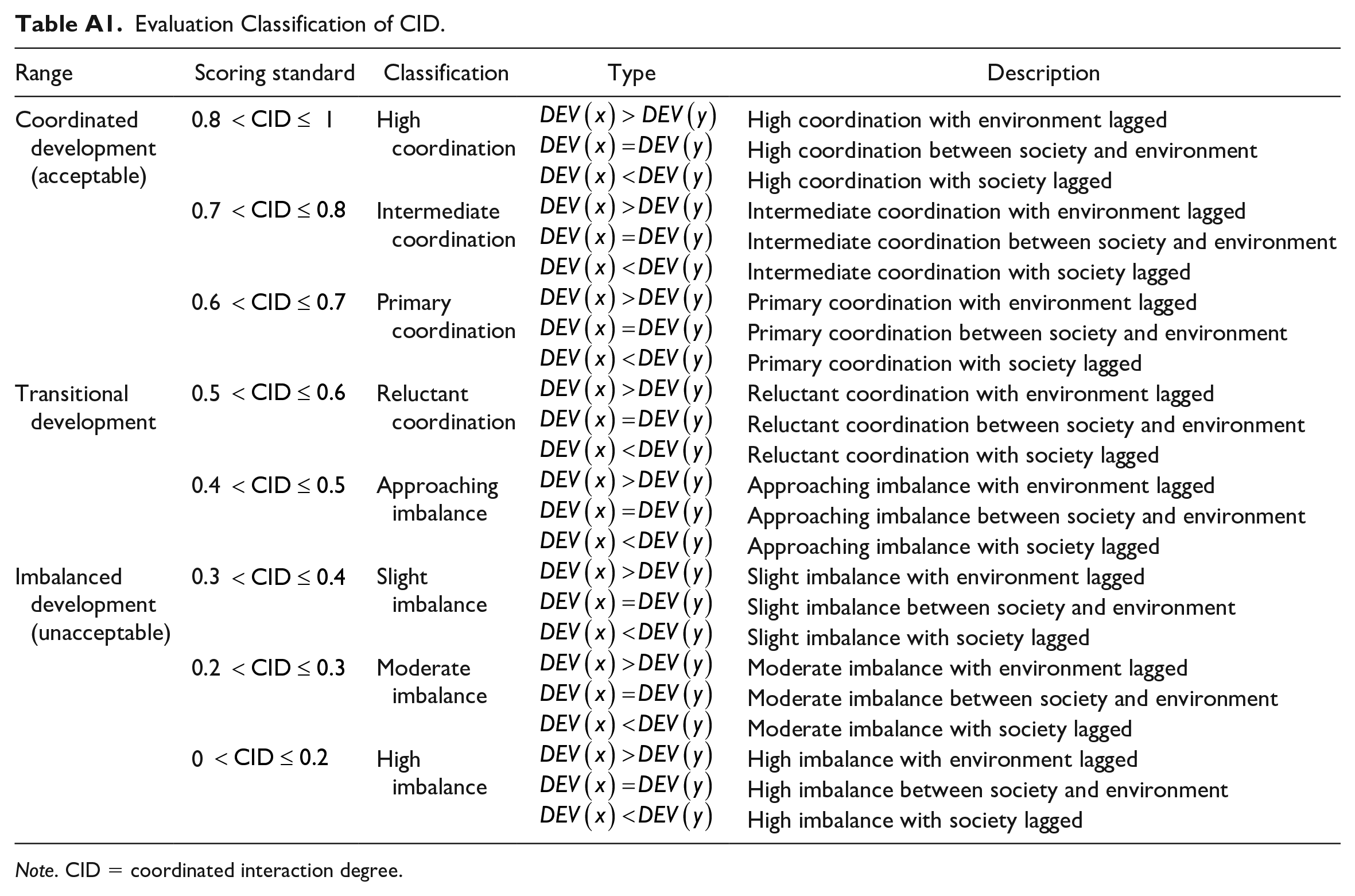
| Range | Scoring standard | Classification | Type | Description |
|---|---|---|---|---|
| Coordinated development (acceptable) | 0.8
1 |
High coordination | High coordination with environment lagged | |
| High coordination between society and environment | ||||
| High coordination with society lagged | ||||
| 0.7 | Intermediate coordination | Intermediate coordination with environment lagged | ||
| Intermediate coordination between society and environment | ||||
| Intermediate coordination with society lagged | ||||
| 0.6 | Primary coordination | Primary coordination with environment lagged | ||
| Primary coordination between society and environment | ||||
| Primary coordination with society lagged | ||||
| Transitional development | 0.5 | Reluctant coordination | Reluctant coordination with environment lagged | |
| Reluctant coordination between society and environment | ||||
| Reluctant coordination with society lagged | ||||
| 0.4 | Approaching imbalance | Approaching imbalance with environment lagged | ||
| Approaching imbalance between society and environment | ||||
| Approaching imbalance with society lagged | ||||
| Imbalanced development (unacceptable) | 0.3 | Slight imbalance | Slight imbalance with environment lagged | |
| Slight imbalance between society and environment | ||||
| Slight imbalance with society lagged | ||||
| 0.2 | Moderate imbalance | Moderate imbalance with environment lagged | ||
| Moderate imbalance between society and environment | ||||
| Moderate imbalance with society lagged | ||||
| 0 | High imbalance | High imbalance with environment lagged | ||
| High imbalance between society and environment | ||||
| High imbalance with society lagged |
Note. CID = coordinated interaction degree.
Author Contributions
Y.G. contributed to conceptualization and methodology. H.Z. contributed to software. Y.G. contributed to validation. H.Z. contributed to formal analysis and investigation. Y.G. contributed to resources. H.Z. contributed to data curation and writing—original draft preparation. Y.G. contributed to writing—review and editing, visualization, supervision, project administration, and funding acquisition.
Declaration of Conflicting Interests
The author(s) declared no potential conflicts of interest with respect to the research, authorship, and/or publication of this article.
Funding
The author(s) disclosed receipt of the following financial support for the research, authorship, and/or publication of this article: This research was funded by Shanghai Education Science Project, grant number C2-2020097; Shanghai Philosophy and Social Science Project, grant number 2019BGL018; and Shanghai Municipal Education Commission, grant number ZZSDJU19012.

Data Availability
Data are available if requested to the authors.