




Abstract
This paper focused on human resource issues in a private sector organization. The study adopted a qualitative approach, using Systemic Intervention to identify and develop solutions to tackling human resource issues through the engagement of relevant stakeholders in the organizational operations. Interviews, workshops, and boundary critique were used for data collection. Collected data were sorted for thematic analysis. Critical issues identified in the research process included frequent junior staff turnover challenges, general human resource security, junior staff’s educational qualification, and irregular work schedule. Findings showed that joint participation in the research process enables learning among participants from across the case study organization structure. It also provided a significant platform for the exploration of diverse opinions and perspectives of participants. A reflection on the qualitative methodology showed the usefulness of combining techniques and methods from different methods in addressing complex human resource issues. However, it is noted that the implementation of developed solutions requires continuous evaluation to maintain effectiveness in systemic intervention. The study concluded with the suggestion for further research to use various methods to explore the influence(s) of external factors on internal human resource challenges, especially in the private sector and a developing economy such as Nigeria.
Keywords
Introduction
Effective human resource management remains a treasured objective for managers. Similarly, human capital development is pivotal to organizational success and competitive advantage (Bolman & Deal, 2017; Makštutis & Makštutytė, 2017). Human capital development and organizational goal sustainability form the meeting point for measuring effective performance. This is usually geared toward addressing organizational issues which dominate today’s business activities (Adeniji & Osibanjo, 2012; Boh et al., 2007).
The presence of operational issues of concern demands a critical view of human resource capabilities and resilience to address challenges that could oppose the achievement of set organizational objectives (Curtis & Reddy, 2015). Adapting the human resource tradition of the participative operational process can provide a learning platform for organization members, which can further redirect their focus toward the achievement of set goals (Budi et al., 2018).
The current study is focused on addressing human resource issues through the application of a systems approach. This is predicated on a collaborative effort among organizational members with the broad intention to develop an understanding of complex organizational issues, and also enhance a process of interactive reflection and deliberations, aimed to create a functional approach to address them (Ufua et al., 2021; Wang & Wang, 2016). This process can both enhance commitment and “ownership mentality” across the organizational structure, which can, in turn, project long-run efficiency in the use of available resources as well as effectiveness in terms of yielding acceptable solutions to address identified operational issues, with minimal objections, and marginalization of certain organization members (Mgbenka et al., 2016).
Furthermore, it is observed that knowledge-based organizations develop distinctive capabilities within their human resource strength to develop performance strategies, striving to collaboratively blend competence portfolios to make the operational process perform better than competitors (Merali & McKelvey, 2006; Olujobi et al., 2022). It, therefore, seems that because of the increase in the pace at which emerging operational events unfold, the adoption of multifaceted human resource thinking, in line with systems practices, has become essential to organizational success. This is part of the key motivation for the current study.
The significant gap addressed in the current research is the minimal focus of research attention on human resource welfare among organizations in Nigeria. Small and medium scale organizations are also not widely considered in extant literature regarding this issue (Huselid, 2018; Muideen, 2020; Ogunyomi & Bruning, 2016). The current research is focused on exploring the contextual operational factors that determine the extent of human resource management practices and interactions toward attaining set operational objectives. The study examines how human resource issues that can hinder the achievement of set performance objectives are addressed using various systems methods and involving the organization members. This study’s critical question is how a systems approach can support the strive to address human resource issues in an operational process? The answer to this research question is intended to contribute to the debate both in the human resource management and the systems approach, taking a systemic view of human resource management challenges from the perspectives of the affected stakeholders (Schneider et al., 2017).
Researchers have begun to explore the use of systems approaches to address human resource-related issues in various sectors. Systems approaches are predicated on diagnosing issues affecting the various functional parts that interact in an operational process. These interactions project critical issues within the human resource structure of an operation, requiring more than a single approach to address (Midgley, 2000, 2003, 2008). In the context of this study, systems approach implies the recognition of the effects of decisions and actions on the stakeholders, that is, the human participants that make organizational operations functional (Dorel & Bradic-Martinovic, 2011).
For instance, Agusdinata and Delaurentis (2011) engaged human actors in a system process, using a case study approach to have a jointly developed policy solution to an identified problem of carbon emission in the United States aviation sector. Carayon et al. (2015) applied a systems approach to address workplace safety practice challenges through a multilevel engagement aim to produce sustainable safety practices that can guarantee human safety at work. These researchers suggest the enhancement of human resource learning process through effective connectivity between the sector and the environment to project a socially sustainable workplace that can improve human resource productivity in the operational system. However, the current research aims to project learning on how systems activities within the case study organization interact in an ongoing process to identify and address emerging human resource issues, thereby contributing to effective organizational development in the Nigerian context. These encompass vital environmental issues that can affect human resource practices in an operational process.
Overview of the Impacts of Human Resource Challenges and the Usefulness of Systems Approach in Addressing Human Resource Issues
The search for an appropriate human resource approach to address operational process challenges remains an ongoing challenge faced by organizations, especially in the private sector. The emergence of issues in the operational process has made the conventional human resource practices insufficient in developing a sustainable human resource team (Beardwell & Claydon, 2007; Lengnick-Hall et al., 2011). As a result, managers in such organizations tend to be saddled with the continual responsibility of developing a more resilient approachs, such as a participatory engagement of the concerned stakeholders, to effectively address these emerging realities relating to human resource management (Goff et al., 2008; Ibidunni et al., 2021).This would also provide a platform for effective human resource practice that aligns with a specific context, able to manipulate the effects to their organizational advantage, instead of usual practice that may not reflect the intended human resource management’s objectives, while striving for long term sustainability (Arena & Uhl-Bien, 2016; Lichtenstein & Plowman, 2009).
Complex organizational issues require more than the conventional human resource principles (such as hiring and rewards), to effectively address. Researchers have acknowledged the multifaceted nature of issues, such as culture, competition, globalization, and internal organization demands (Briscoe et al., 2012). While the current research acknowledges the multiplicity of these challenges, it embraces the necessity to apply systems approach to effectively address identified human resource issues, with adequate consideration of the affected stakeholders in an operational process.
Similarly, systems thinkers assume that everything in a functional system is connected to something else (Midgley, 2011; Van den Brink et al., 2013). According to Adeniji et al. (2013), emerging complexity can result in changes in an operational process, requiring the human resource to develop suitable adaptive approaches that can redirect the operational process to the desired ends. Systems approach, therefore, serves as a means to effective human resource management practices due to its usefulness in recognizing the connectivity between identified human resource issues and the entire operational process of an organization. In other words, systems approach to human resource management can facilitate a platform for connected thinking among operational process participants, resulting in effective and broad acceptable decisions. These take account of how the operational process as a “whole,” with due consideration to the interests of the various affected stakeholders, which usually include the human resource structure in an organization (Bailey et al., 2018; Ulrich, 1996, 2003).
The process can result in a fair human resource engagement that provides a platform for ownership mentality for effective and efficient human resource management exertions to address operational issues (Byrne, 2013; Ufua et al., 2020). However, the challenge of fairness, especially among Nigerian private sector organizations, tends to be a nagging issue. This is due to fundamental factors such as the weakness of the legal system and inadequate regulations of the labor market activities (Olujobi et al., 2020). These factors have resulted in critical effects such as undue exploitation, stress through operational practices such as multitasking witnessed in the Nigerian private sector (Adebayo, 2005; Ufua, 2015). For example, Sule et al. (2015) further highlight the consequential effects of poor motivation and inadequate compensation on organizational development and sustainability. Also, Osibanjo et al. (2016) found out that clearer job roles specification, connectivity, recognition, and equity can impact positively on organizational performance.
Furthermore, human resource operational current trends suggest that sophisticated human resource structures embedded with resilient reporting, action-driven features can retain the needed capacity for addressing emerging operational issues. This is mainly in the private sector, where skills and multiple approaches are commonly required to address operational issues (Muda et al., 2017). These observations are in tandem with the application of systems approach focused in the current research, which allows the combination and reformation of adopted approaches to suit identified issues, especially concerning human resource issues that seem to be unpredictable in most operational processes (Hollenbeck & Jamieson, 2015; Jackson, 2003, 2007; Midgley, 1997). This inconsistency in operational business practices calls for the use of a more suitable approach that can embrace and address emerging changes that can also affect human resources in an operational process. This informs the adoption of a systemic approach in the current research (Doyle et al., 2009; Iles & Yolles, 2003).
Methodology
Methodological Approach
This study adopted systemic intervention as the methodology to explore human resource challenges in an operational process. Systems thinkers see systemic intervention as a systems approach that allows the combination of different methods, ideas, and techniques, to identify and address operational issues to achieve desired change (Midgley, 2003). The current research applied a qualitative approach, focusing on contextual data about identified issues, and adopted a joint participatory approach to deliberate and address issues in the research process (Grint, 2005; Hester, & MacG, 2017; Liamputtong & Ezzy, 2005; McKernan, 2013; McNiff, 2013).
The research is based on a case study of a commercial farm, chosen to enhance an in-depth research process on the topic, to generate adaptable findings from the intervention (Oyebola et al., 2020; Rendtorff, 2015; Yin, 2004, 2009). The choice of a livestock farm in this study was due to the intention to contribute further learning toward the development of the Nigerian Agricultural sector, reputed to provide employment sources to over one-third of the working population in Nigeria (Mgbenka et al., 2016). Case study approach was also chosen to serve as a positive response to the strive to address food security in Nigeria, through suggestions from the unique findings from participants in the research process, who are directly involved with the case study organization’s operations (Ibeagha-Awemu et al., 2019; Osabohien et al., 2020).
An approval to carry out the study was secured from the management of the case study organization, through a standing approval earlier given to the lead author during his previous research in the case study organization (see, Ufua & Adebayo, 2019; Ufua et al., 2015, 2018, 2019). This was affirmed by the management of the case study organization, who had earlier granted the approval. Similarly, the relevant committee in the lead authors’ University is aware of the research. All participants were engaged on a voluntary basis in the research data collection process. The identities of participants and the case study organization were held in confidentiality. Data collected were applied only for academic research purposes as agreed with the management of the case study organization.
A multiple data collection approach was applied to address the limitation of using a single data collection method and have in-depth views from the participants (Morse, 2005; Shorten & Smith, 2017). For instance, those who could not have the full confidentiality to make their contributions at the workshop could do this through personal interviews. These data collection methods were applied on a complimentary basis in the research (Moffatt et al., 2006).
Methods of Data Collection
Interviews
At the inception of the research, personal interviews were conducted with key members of the case study organization. The focus was to identify human resource issues and the relevant stakeholders involved in addressing them. This helped the grouping of issues and the participants. Interview respondents included the junior staff, middle managers from various departments, the general manager, and the assistant general manager. The researchers also asked about other relevant stakeholders who could have different perspectives on their organization’s human resource operations (Dick, 1999; Ufua et al., 2019). As a result, different stakeholder groups, such as the government agency, the input material suppliers, and the organization’s downstream customers, were identified.
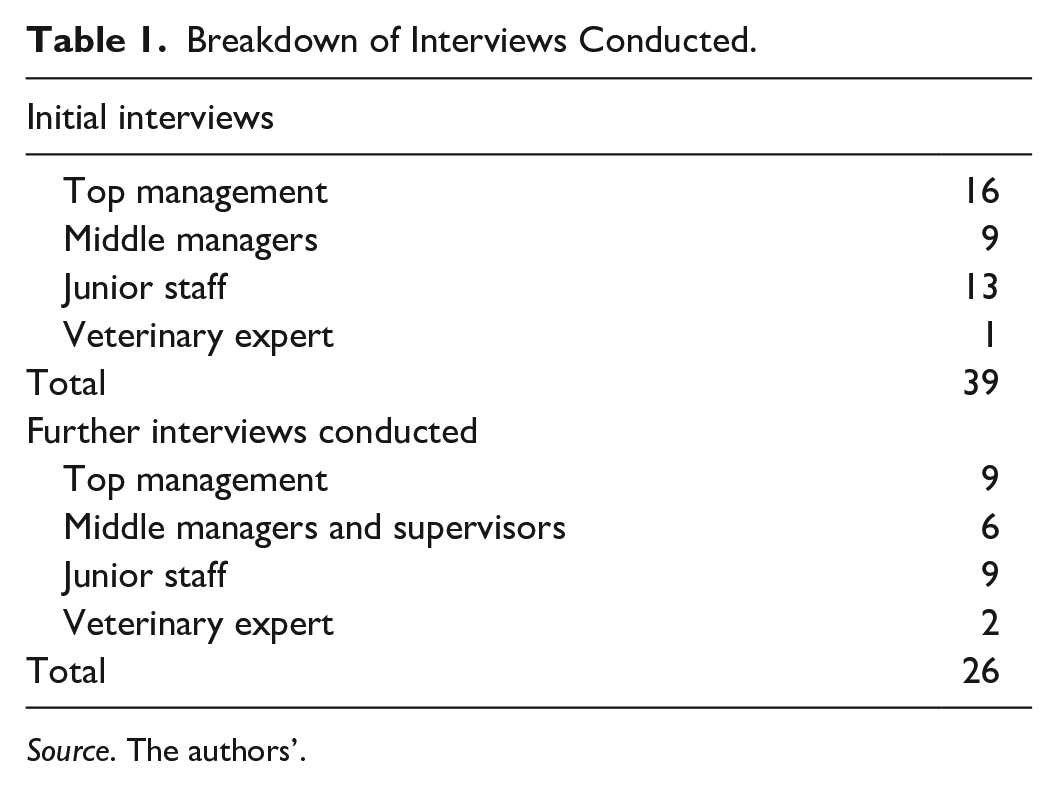
Some of these interviewees were interviewed more than once, depending on the issue being considered in the data collection process (see Table 1). Other ethical factors such as the interviewees’ interest and availability to respond to interviews were duly considered in the research process. Interview and workshop data were recorded electronically and later transcribed manually for this study’s thematic analysis. Sixty-five (65) interviews were conducted. Interviews were conducted based on their relevance to human resource practices, highlighted in the research process (Ufua et al., 2015).
Breakdown of Interviews Conducted.
Source. The authors’.
Workshops
Workshops were used as a research tool to identify human resource issues in the case study organization, and deliberate on addressing them using the systemic intervention approach. These were done with the involvement of participants who are members of the case study organization. Two workshops were organized on human resource issues. Different participants (see Table 2) were engaged in workshop sessions, focusing on human resource issues (Leteta et al., 2020; Ufua & Adebayo, 2019).
Breakdown of Participants at the Workshop Sessions.

Source. The authors’.
Based on the initial interviews conducted with members of the case study organization, key human resource issues were identified. This guided participant’s selection based on the issues in selecting members of the case study organization who were affected by each issue identified. Participants were duly informed ahead of time about their participation in the workshop sessions (Ufua, 2015).
Boundary setting
Systemic intervention has the theory of boundary critique as a central component. It encouraged participants to reflect on issues and decide what to be considered at each stage of the research process (Córdoba & Midgley, 2008; Midgley & Pinzón, 2013; Ufua, 2020; Ufua et al., 2018). Therefore, the researchers engaged participants on a boundary-setting based on the issues that surfaced to establish critical boundaries such as the time and interest and participants’ commitment to voluntary participation in the research process. Boundary critique was applied to ensure suitable use of other research data collection tools in this study. This was to create a useful preamble to determine the participants to be included or engaged and ensure they are willing to participate voluntarily at each stage of the research process (Foote et al., 2007; Midgley et al., 1998). Such boundaries were built to reflect issues of common interest among participants in the research process. Therefore, Boundary setting involved value judgments that could influence what improvement decisions and actions that might be needed in the next step of the intervention (Córdoba & Midgley, 2006; Midgley & Pinzón, 2011).
The Case Study Organization
A commercial livestock farm located in Southern Nigeria, was used as a case study in this research. The decision to establish the farm followed a Nigerian government’s appeal for investment in the food production sector of the economy. While the farm was registered in the year 2000, it moved its operation from its initial location to a new base due to its expansionary drive. Part of the farm’s aim was to contribute to the development of the food production sector of the Nigerian economy.
Key stakeholders to the organization included the suppliers who provided input materials for its operations (e.g., Maize, Limestone, Sawdust, and Charcoal), required for livestock management. The host community and the customers who bought the company’s products on either a wholesale or retail basis were identified as stakeholders. The top management and members of the organization, including the supervisors and middle managers, who manage the different sections of the farm. Others were the junior staff who work as shop floor staff on the farm’s daily operations and the general manager who oversees the farm’s operations (Figure 1). The organization turns out products in batches and also in high quantities from all the sections.

Structure of the case study organization.
Human Resource Issues Identified in the Case Study Organization
In an interview with the general manager organized at the inception of this research, it was learnt that the case study organization’s security department was responsible for ensuring the security of property and people on the farm premises. Therefore, another round of interviews was scheduled with senior security staff, including the chief security officer (CSO), to deliberate further on the security activities in the organization. Other interviewees also noted that the security of property and lives is at the forefront of consideration in the organization’s region (see Figure 1). They highlighted the challenge of criminality, ranging from the theft of products (e.g., birds, eggs) to cases of kidnapping individuals (e.g., members of the organization).
The CSO remarked that “there is 24-hour security coverage in the farm because no one is safe without security, especially during peak periods of business activities. We are aware of this, and we have a strong relationship for support with the public security service.” The CSO noted further that one of the causes of challenging issues witnessed in the organization’s operational process was staff turnover in the general manager’s position due to the company board’s action. He explained that the board had to dismiss several past general managers at various times due to allegations of fraudulent practices that involved misappropriation of resources and inadequate commitment to the pursuit of the organization’s objectives. This issue resulted in huge losses recorded in livestock mortality and termination of contractual agreements with the downstream customers due to breaches of contract.
However, further interaction with the general accountant confirmed the frequent sacking of general managers but cautioned that such is a critical issue that the organization wishes not to allow for further investigation. “It is in the interest of our organization to stop all discussion about general manager’s office. That is not a preference for this organization” (the general accountant). For ethical reasons, the researchers had to respect what became the participants’ popular wish, not to go further on the issue with the general manager’s position in the research process. Instead, the general accountant raised another human resource issue: the high rate of junior staff turnover after receiving their end-of-year bonuses. The organization had a practice of rewarding their staff with a bonus of 100% of their monthly wages/salary at the end of each operational year. “Our records show that just after receiving their annual bonuses which the organisation approved to motivate staff loyalty, some of these juniors quit their jobs. . .” (the general accountant).
In a further interview, the CSO explained that security issues on the farm are reported directly to the top management by the CSO (see Figure 1). He also expressed the opinion for a multi-stakeholder workshop for further deliberations, noting that he alone did not sufficiently understand all the dimensions of the problems to solve them. “This is not a matter to be handled by just the security department; it is a company-wide challenge that requires the representation of the various functions of the farm to fix. That way, everyone will be ready to work to achieve decisions made” (CSO).
Upon approval from the top management, a workshop was convened. The purpose was agreed with the top management to deliberate on the key issues that were raised during the personal interviews. The managers and supervisors from various sections were invited to participate. Other invited participants were the veterinary experts and the top management members of the farm to contribute to deliberations on the security and other key human resource issues in the farm. It was meant to focus on the root causes of such challenges, identify their effects, and deliberate on possible means for improvement. Among those in attendance were the CSO, assistant general manager, administrative manager, veterinary experts, and four more staff from the Security Department. At a later point in the workshop, the middle managers and supervisors from the Brooding, Abattoir, Piggery, Fishery, and Cockerel departments who were earlier occupied with their routine duties, joined the workshop (see Figure 1).
At the inception, the assistant general manager encouraged participants to feel free to contribute to the discussion and the joint development of solutions to address the identified issues in their organization’s operational structure. He explained that the top management’s position in addressing the issue of junior staff turnover, especially after receiving the payment of the annual bonuses. He noted that the top management has resolved to stop the payment of annual bonuses. Instead, the monthly payment for all staff would be increased by the same margin. “That would mean an increase in our monthly payment and the assurance of a stable operation” (the supervisor at Abattoir).
Other participants, such as the veterinary expert and managers from the Brooding and Cockerel departments, highlighted a critical challenge of low educational qualification of some junior staff, who work in the various departments in the production section of the organization. While participants duly acknowledged these issues, the workshop was concluded after about 68 minutes of deliberation because of a scheduled meeting requiring most participants’ attendance at the first workshop session. “Gentlemen, we are really sorry but we cannot continue with this all-important conversation, many of us here present are meant to have another meeting that cannot be rescheduled” (the assistant general manager). A future date is agreed by participants to reconvene and continue the discussion.
On the second workshop session, all the earlier participants were in attendance, except the veterinary experts who were on duty at the time of the workshop. Participant managers from the production section (e.g., Brooding, Layers, and Cockerel) explained their adoption of on-the-job training approaches such as mentoring and in-house seminars to engage these less literate junior staff on a vocational development process. They, however, noted the difficulty in coaching these affected staff as a number of them tend to show less commitment to learning and development. They expressed the concern that leaving them to carry out critical tasks such as administration of livestock feed and medication can put the livestock at risk, resulting in negative consequences such as health and a high rate of mortality in the farm.
The administrative manager acknowledged the situation. He noted that it was due to the farm’s agreement with the host community at the farm’s inception, which provided approval for the farm to operate in the locality. As a result of this, a percentage of the junior staff was absorbed from among the host community’s youth. He explained further that the top management has an intention to address the challenge of low entry educational qualification among junior staff. He explained that this could also effectively enhance their ability to implement operational tasks such as livestock feed formulation and administration to birds in the poultry pens. He corroborated the earlier presentation of managers from the production section, noting that sometimes the less literate junior staff tend to demonstrate poor learning skills required for effective job performance in the case organization.
The assistant general manager commended and advised the managers to continue to train these junior staff to meet the organization’s operational standards noting that dismissing them can result in conflict between the organization and the host community. Staff from the security department raised an issue about the 24 hour security, noting that the security work schedule is rather intense, requiring top management reviews to provide a fair security work schedule benchmarks that duly consider their health and other welfare for security staff. The CSO confirmed this, noting that most times, the task of security does not allow some staff in the department to attend worship services. However, this resulted in an objection by the administrative manager, saying, “security is relevant to our operations that must not be compromised.” The CSO provided a suggestion saying, “I think we can, and we really have to review this.” This was supported by the assistant general manager who agreed with the CSO’s thought and advised the security department to develop a review schedule for improved security service structure with these highlighted challenges addressed. This was supported by other participants in the workshop session.
Similarly, the Brooding department manager also raised the potential danger of using public security service patrol in the farm, citing biosecurity reasons. He explained that “the guys are good but do not use disinfectant before patrolling the farm. We cannot impose this on them.” However, the Sales and Marketing manager expressed support for continued use of these securities as they have helped to address the challenge of theft in the farm. This resulted in some disagreement among other participants (e.g., the supervisors in the Layers and Broiler departments). “If we keep on using them, there can be an outbreak in the farm, and these infections spread quickly. . .” (supervisor at the Broiler Department).
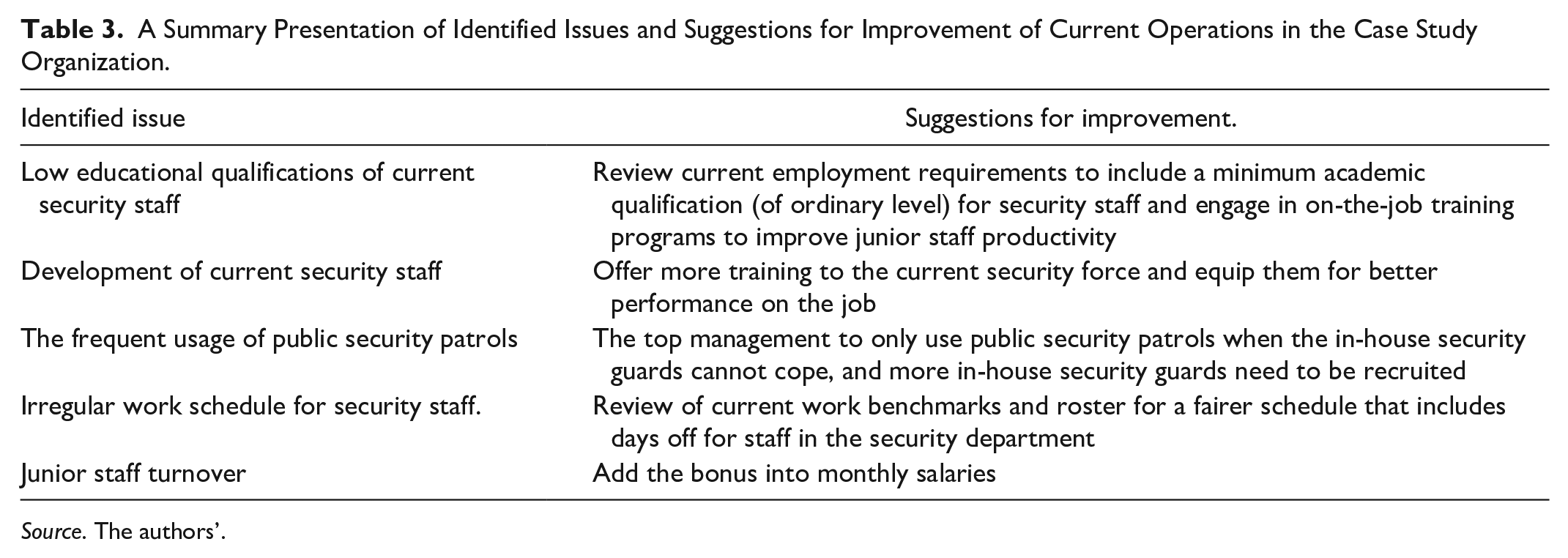
The manager at the Piggery affirmed the importance of security but reminded participants of the need to treat the issue with caution because “we are dealing with livestock if our operations are not duly structured the eventual losses and the threats of sanction from the government agency can be unacceptable. . ..” He suggested minimal use of public security patrol and further support to the farm security department. This was supported by other participants, such as the general accountant. However, he suggested that the public security patrol can still be used only when there is a critical need, such as the festive periods and other seasons of high sales volumes and influx of customers in the farm. The session ended after about one and a half hours. The points raised by participants were summarized in categories and ensured that the participants agreed with the captions on the different issues identified, as depicted in Table 3.
A Summary Presentation of Identified Issues and Suggestions for Improvement of Current Operations in the Case Study Organization.
Source. The authors’.
Discussion of Findings
This section covers further discussion on the use of methods and the key findings and solutions in the study. The issues identified through our research process come with different attributes requiring a pluralist approach, involving the use of various methods such as interviews, workshops, the boundary critique, and observation were applied to address issues in the research process effectively (Braithwaite et al., 2018; Bukowski et al., 2018; Helbing et al., 2015). The research provided a platform to engage the participants in deliberating on the identified issues effectively. Organizational learning researchers (e.g., Duffield & Whitty, 2015; Hester & Adams, 2017; McClory et al., 2017; Nonaka et al., 2000; Nonaka & Toyama, 2003; Olokundun et al., 2019), have highlighted the usefulness of engaging organizational members in continual learning for adaptation and competitive advantage in a complex business environment.
Similarly, findings from the current research suggested that learning among organizational members on a fair platform can provide resilient and acceptable solutions to many human resources and other related issues (Forsyth, 2018). This is because continuous development and enhanced human resource dialogue resulted in a cordial relationship among the organization members. These are also pivotal to the productive use of other material resources in the organization. The research process equally addresses the gap highlighted by researchers (e.g., Boon et al., 2019; McDonnell et al., 2017). They observed that there had been significant negligence among researchers to the usefulness of individual human resource talent as a unit of analysis and insufficient attention given to free interactions within human resource systems. In this research, learning among participants gave rise to free expression of interest and contribution to deliberations on the research process’s highlighted human resource issues. This aligns with the finding of Bos-Nehles et al. (2017), who reckon that such could encourage innovative behavior across the structure in an operational process.
Junior Staff Turnover
Findings from the study showed that the case study organization had a significant challenge with junior staff’s turnover after getting their annual bonus. This points to low job satisfaction and other human resource management issues that could be responsible for staff turnover among the junior staff cadre in the organization. According to Heimerl et al. (2020), job satisfaction deserves the continued focus of an organization due to its relevance to performance in an operational structure. They found that relationship building across an organization’s structure strongly indicates job satisfaction that can project commitment and loyalty of human resources. This issue aligns with the findings of Allam (2017), who focused on the adverse effects of employees’ disengagement in an organization, highlighting the key challenges to continuous recruitment and adaptation of new staff, both to the organization and its environments.
Evidence from collected qualitative data tended to show significant intrinsic autocratic decisions and actions by the managers, favoring organizational tradition but could result in unintended marginalization of human resource groups such as the junior staff. Allam (2019) emphasizes eliminating discrimination in a firm’s human resource structure to have a free operational process that encourages unreserved commitment to a firm’s operational structure. The stake of this study is that while an organization strives to maintain operational objectives, members’ interests should be duly considered. For instance, during the research, participants were completely restricted from discussing the dismissal of the general managers in the organization’s history. “It is in the interest of our organisation to stop all discussion about general manager’s office. That is not a preference for this organisation”(the General Accountant). An issue like this, which is similar to the junior staff turnover, should have opened up a further discussion that could improve human resource management practices in the organization. For the junior staff turnover, the critical question is whether the organization has an acceptable operational structure that provides the needed comfort that can support staff loyalty and long-term commitment other than the annual bonus mentioned at the workshop?
Low Educational Qualifications of Current Security Staff and the Organization’s Agreement With the Host Community
While managers in the case study organization have outlined their commitment to further training of junior staff; however, the learning difficulty expressed by some of these junior staff is a critical issue identified in the research. The management is bound by an agreement reached with the host community, which also underscores the cordial relationship with these stakeholder groups. It calls for further human resource development, creativity, and innovation to enhance a conducive work environment for junior staff development that would encourage their long-term commitment to the organization (see Ufua et al., 2021).
In the livestock management sector, the warning against unnecessary staff turnover also aligns with the intrinsic danger of adverse effects on biosecurity practices (Conan et al., 2012). Therefore, the argument of this study is that the top management of the case study organization has the responsibility to offer more support to facilitate the commitment of current human resources to learning and commitment to their organization (Nonaka & Takeuchi, 1995). While the case study organization needs to review the entering qualification of these staff, we argue that training is still required for effective induction of new staff and adaption of their skills to suit the operational system of the case study organization.
Researchers suggest the relevance in developing human capital to be resilient in handling unpredictable challenges in organizations. For example, Falola et al. (2014) examined the impact of human capital in the Nigerian banking industry and found a strong relationship between human capital in terms of employees’ skills development and training and performance in an organization. They also draw the human resource managers’ attention to the need to modify the traditional bureaucratic organizational structure to allow flexibility to yield innovation to address operational challenges (Grint, 2005; Imhonopi et al., 2019; Laursen & Foss, 2003). Training will equip these staff with the power to act promptly in the organization’s right directions and become committed, with minimal supervision in the long run (Sanders, 2020).
The Irregular Work Schedule for Security Staff in the Cases Study Organization
Among the key issues raised in the research was the challenge of irregular work schedules in the security department due to 24 hour security coverage in the organization. While security is a critical requirement for effective operations, especially in the context of the case study organization, the welfare conditions of the human resource need due consideration to avoid unwanted effects such as the complaints about irregular works schedule, whereby the staff are not sure of their off-duty times and are also not able to attend to personal concerns such as attending worship services. While this was addressed in the case study organization by participants at the workshop, it draws the attention of human resource managers to the complex effects of inattention to staff welfare on the job. Ufua, Salau, Dada, et al. (2020) recognize the dearth of inadequate legal regulatory frames in the Nigerian private sector. It seems that organizations have the immoral liberty to frame their human resource practices to suit their operational objectives with minimal consideration of the welfare of these staff, especially those in the junior categories.
Similarly, Mordi et al. (2013) recognize the influence of both operational and cultural diversity in understanding and addressing critical human resource work schedule challenges, and they advise human resource management practitioners to focus on the prevailing context in addressing the issue of work schedule in their operational process. Akanji et al. (2020) highlight employers’ misconceptions concerning staff non-work preferences as well as an undervaluation of their non-work time, which constitutes biases due to human resource managers’ high attitude toward the pursuit of organizational goals at the expense unfairness works schedule.
This study underscores such negligence of staff welfare can result to unintended effects such as staff turnover, fatigue, and lack of commitment of the affected staff. It is also necessary for human resource managers to consider these factors in setting their schedule benchmarks to create fair human resource operational platforms, void of marginalization. Such can lead to unpatriotic exertions, such as the challenges with the 24 hour security in the case study organization (see Table 3).
Review of Staff Rewards Bonuses
On the issue of review of end of year staff bonus, while the agreement reached the workshop seemed robust as it suits the interest of participants, what remains a critical human resource management concern is what seemed like the reliance on the agreement with the host community and the less attention to the effects of rewards systems in the organization. Agwu (2013) suggests that effective human resource rewards practice demands a continued evaluation of its effects on the organization’s operations, especially in the critical organizational setting such as the case in this study, where staff retention is coveted practice. This is essential to effective human resource management practice as it can highlight what went wrong and what could be done better in the adopted approach. It can also serve as a medium to address the complexity and inadequacy of the staff reward system and improve continuous staff commitment to the organization (Midgley et al., 2013; Rouwette et al., 2009).
While the decision to review the staff bonus seems effective, Heimerl et al. (2020) found out that monetary rewards may not provide the real motivation to keep staff loyal and committed to an organization for the long term. This leaves the management of the case study organization with the responsibility to continually evaluate and necessarily review their reward and motivation policies to suit the changes and sentient appeal of the staff, as they strive to sustain an unbroken operation. It is also arguable to note such can enhance the security staff commitment to provide adequate security services.
The Implications of Systemic Intervention in Addressing Human Resource Challenges
The adoption of systemic intervention provided a participatory platform that projected the research data collection, reflecting the interest of all participants who are involved in the operations of the case study organization. This was achieved through the use of various data collection methods. For instance, boundary critique facilitated the exploration of the diversity of perspectives and thoughts of participants, and it generated a possibility for an in-depth suggestion that adequately addressed the identified issues. This enhanced a careful selection of participants based on their interest in the identified issues and willingness to participate at each stage of the research process (Inyang, 2011; Ufua, 2020).
Findings also validate the authors’ thoughts on the choice of systemic intervention in the current research with the complementary application of different techniques in the research process (Midgley & Rajagopalan, 2019). The engagement with participants involved in the operations of the case study organization also supported learning across in the case study organization about the depth of human resource operational challenges addressed in the research. It equally facilitated a deeper understanding and a less-argumentative interaction in the research process (Córdoba & Midgley, 2006; Jackson, 2003; Midgley, 2000, 2017). It, therefore, connotes those ideas and methods of systems thinking that can effectively support human resource practice in an organization.
However, while the systemic intervention was useful in identifying and addressing human resource issues, the process of systemic intervention was observed to be time-consuming on occasions. Deliberations sometimes resulted in prolonged disagreements, and at some points, the attention of participants wandered. This draws the attention of systems and human resource management researchers and practitioners to the fact that systemic intervention process may not be useful in addressing some operational issues that may require an immediate response (for instance, machine breakdown or health and safety challenges at work). This is because of the slow pace it assumed in its process. Such emerging issues would rather require the effective exertion of acquired skills and knowledge of the managers. These can be based on several factors such as the manager’s world view, the environment, and the partners in the operational process (Brewster, 2017; El-Sabaa, 2001; Moulton & Sandfort, 2017; Smith, 2011). A final reflection on the implication of the findings of the current research is that participants in the study may consider as good as the solutions advanced from the research, the pace of implementation rests with the management of the case study organization. This points to other factors that can either influence or determine human resource management decisions and actions, including the managers perception, available resources, leadership approach (Rajagopalan & Midgley, 2015: Ufua, Salau, Ikpefan, et al., 2020).
Conclusion
This research applied systemic intervention to address human resource issues in a commercial livestock farm in southern Nigeria. Findings showed that the involvement of internal organizational members provided a platform for valuable learning, suggestions by participants who are members of the case study organization. This created a participatory process of identifying critical human resource issues and enhancing a joint development of solutions to address them. The research also provided awareness and re-orientation among participants, especially the managers, of the need to consider the effects of human resource-related decisions and actions from the perspective of the affected stakeholders, for example, the junior staff, while striving toward achieving set key organizational objectives. These can result in a cohesive operational process, stability, and minimal disruptions such as junior staff turnover.
In line with the main research objective, findings showed that the adoption of systemic intervention effectively supported the identification and addressing of human resource issues focused in the study, can lend support to positive effects such as staff commitment and productivity across the case study organization’s structure. Therefore, a significant contribution of this research is the affirmation that effective human resource management is fast becoming an all-inclusive and continuous task that requires the active involvement of the affected stakeholders across an operational structure.
However, a critical issue of interest is that the implementation of advanced solutions requires continuous evaluation by participants to maintain effectiveness in the human resource management practices, void of marginalization in the operational process.
A limitation observed in the adoption of the systemic intervention was the slow pace of its application could make it inadequate in addressing certain emergent issues that could require prompt actions to address in an operational process. The adoption of systemic intervention does not rule out the need for human resource management practitioners to develop supplementary approaches through their skills to address emerging issues that cannot fit with systemic intervention.
While this study was focused on internal human resource issues, a critical suggestion is for further research to consider the use of systems methods to explore the effects of external forces (for instance, government laws, trade unionism, and labor market behaviors and risks), on human resource practices, especially in a developing economy like Nigeria, where this research was based. The focus of further research can be on effective teamwork development in relation to human resource practices and complex organizational issues of interest. This could project further learning and the development of new approaches to address further emerging issues relating to the practice of human resource management.
Footnotes
Acknowledgements
The authors wish to appreciate Covenant University Centre for Research, Innovation and Discovery (CUCRID), Covenant University, Ota, Nigeria for supporting this research. In addition, the authors thank the reviewers for their helpful corrections. Also, the authors acknowledge the Equipment Subsidy Grant awarded by the Alexander von Humboldt Foundation [REF: 3.4-8151/19047] to the Centre for Economic Policy and Development Research (CEPDeR) of Covenant University, Ota Nigeria, where the final writing and completion of this study was done.
Declaration of Conflicting Interests
The author(s) declared no potential conflicts of interest with respect to the research, authorship, and/or publication of this article.
Funding
The author(s) received no financial support for the research, authorship, and/or publication of this article.
