




Abstract
This study attempts to investigate the linkage of human resources management practices with customer satisfaction through intervening role of employee job satisfaction. The study also examined the moderating role of procedural justice between human resource management practices and job satisfaction. A conceptual model with four hypotheses was developed and two-source field data were collected from paramedical staff members and patients (n= 228, dyads) working in the health care sector of Pakistan. Results indicate that full mediation where job satisfaction fully mediates between human resource management practices and customer satisfaction. Furthermore, moderated regression analysis also proved the significant moderating role of procedural justice between human resource practices and job satisfaction. The findings of the study provide useful insights to evaluate and improve human resource management practices for the wellbeing of the employees and to enhance the customer satisfaction.
Introduction
From last two decades, scholars and practitioners have recognized the importance of human resource (HR) management practices and their effectiveness for positive organizational outcomes (Alfes et al., 2013; Delaney & Huselid, 1996; Kehoe & Wright, 2013). It is demonstrated in the literature that effectiveness of HR practices should be evaluated from the employee’s point of view in the form of behavioral and psychological effects (Lam et al., 2009; Park et al., 2003). Although, few recent studies and meta-analyses support the notion that employee unearths-oriented HR management practices drive better performance and employee attitudes and behaviors like organizational citizenship behavior (Boon et al., 2011; Combs et al., 2006). However, these past studies came up with inadequate understanding on the effectiveness of HR practices, that is, how these practices create value for the organization. Literature of HR management necessitates developing a theoretical and empirical model that explains the link between HR practices and its positive and negative effects on employees and organizational outcomes (Conway et al., 2016; Hashim et al., 2016; Kehoe & Wright, 2013). One such outcome is customer satisfaction, which has been the goal of every organization, as it helps to retain customers and to gain market share (Hansemark & Albinsson, 2004).
Various studies (Helm et al., 2010; Xu & Geodegebuure, 2005) point out that cost of attracting a new customer is five times higher than that of retaining the existing ones, thus it is pertinent for firms to make sure that their customers are satisfied with provided products or services. Customer satisfaction has been identified as a useful predictor for firm’s financial performance and a vital source of word-of-mouth behavior and loyalty (Chi & Gursoy, 2009; Spinelli & Canavos, 2000). Therefore, for organizations to achieve a competitive advantage and enhance its market share, it needs to focus on customers’ satisfaction.
Prior research in HRM field has shown that HR practices are linked with Job satisfaction (Hashim et al., 2016; S. M. Lee et al., 2012; Uzair et al., 2017). Despite of its importance for an organization, only few studies empirically investigated and explained the process how HRM practices may influence the customer satisfaction or an underlying mechanism for it. Rogg et al. (2001) examined the mediating role of organization climate in the relationship of HR practices and customer satisfaction and recommended to investigate this indirect relationship through other intervening variables.
Moynihan et al. (2001) states that HR Practices do influence customer satisfaction through enhancing the aspect of employee involvement and identification. Another study by Meyer and Collier (2001) conducted in an health sector also proves that HR practices have a positive relationship with customer satisfaction. Similarly in a study by S. M. Lee et al. (2012), high-performance work system (HPWS) in terms of HR practices influences customer satisfaction via mediational role of job satisfaction, which concludes that employees once satisfied by their HR practices do reciprocate and work in best manner to achieve customer’s satisfaction. Thereby, our study has identified and bridged the gap in HRM literature by empirically investigating the mechanism through which organizational HR practices affect the customer satisfaction, particularly investigating an intervening role of employee job satisfaction between HR practices and customer satisfaction.
Past literature and theoretical work also propose that the relationship between HR practices and employee behaviors and attitudes is not as simple as justified in past studies rather employee’s perception about HR practices varies from implemented HR practices (Bowen & Ostroff, 2004; Liao et al., 2009; Takeuchi et al., 2009). Some scholars demonstrated that employee perception of procedural fairness or justice plays an indirect role on the effectiveness of HR practices for better outcomes (Paré & Tremblay, 2007).
Furthermore, it is believed that procedural justice plays a critical role in relationship of HR practices and job satisfaction as it may enhance the employee’s feeling of being treated fairly which in turn enhances emotional bond and commitment between employee and organization yielding numerous organizational benefits (Liao et al., 2009), and they also identified as a potential variable to test moderation effect for job outcomes. In light of these identified research gap and extensive need to unearth the mechanism through which HR practices impact customer satisfaction, present study prosed a theoretical model that link the HR practices with customer satisfaction with mediating role of customer satisfaction and moderating role of procedural justice carried by the organization between HR practices and job satisfaction.
Finally, most of the studies emphasized generic HRM-related concerns in the health care sector, for example, scarcity of nurses, doctors’ lack of commitment, job dissatisfaction, and problems in quality and safety of patients’ care (Dickinson et al., 2011; Townsend et al., 2011). However, limited research has been found about the sensitivity regarding how employees (paramedical staff) perceive fairness in terms of HRM practices in settling their job satisfaction with the health care organization; a relatively under the explored context in Pakistan. Specifically, the present study identified existing research gap and examined the proposed theoretical model to know how HR practices of hospital management can spill over to the satisfaction of employees and customers.
Theoretical Foundation
The theoretical basis for the study derives from two theoretical models of management: Ability, Motivation, Opportunity Theory, and Social Exchange Theory. The Ability, Motivation, and Opportunity (AMO) framework (Appelbaum et al., 2002) has been used in this model to explain and establish the relationship of employee and organizational performance in the shape of customer satisfaction. The model states that HR practices contribute toward employee’s characteristics by adding toward its ability and motivating to work better way and seek opportunities which adds to the organization’s performance. This theory holds the view that employees will carry out their job well when
They have sufficient KSAs that are necessary to perform their jobs (abilities).
They are fully interested and incentivized to perform their task (motivation).
They are offered with complete support and opportunities are given to them to show their abilities at job (opportunity to participate).
Appelbaum et al. (2002) consider specific HRM practices, called as high-performance HR Management Practices instrumental in regard of AMO theory. Recruitment, selection, and training as HRM practices used to enhance the employee’s ability on the other side performance based pay and wages specifically high wages seem to augment motivation of employees, job autonomy, and involvement in decision making are observed as being important in enhancing opportunities to participate and cause discretionary strength. Hence, use of these high-performance HRM practices positively shape employee attitudes and behaviors (Boselie, 2010).
A prevailing methodology in clarifying employee–organization relationship is a social exchange point of view, established underway of Gouldner (1960) and Blau (1964). Social exchange theory (SET) proposed by Blau (1964) stands on the proposition that “a set of interactions” takes place between two interdependent parties, which yields mutual benefits for both. The theory is based upon the aspect that social context of an organization plays an effective role in shaping an employee’s behavior in terms of mutual trust and performance. Gouldner (1960) state that social exchange as an example of commonly unexpected trades of delight between two parties with a faith in correspondence summed up the good norm. Blau (1964) further clarified the idea of social exchange by separating it from monetary trade, that is, economic exchange. Unlike a monetary exchange, social exchange includes less substantial or even typical assets, and both the time span and nature or the normal future returns are not determined. Emerson (1976) conceived social exchange as a frame of reference rather than a theoretical approach, derived from multiple disciplines such as sociology and economics, and developed a psychological referent for this notion on the basis of reinforcement. Thus, if an individual sees that a value or contingent reinforcement is being provided, a relationship would be established. According to this theoretical base, an exchange takes place among employees and organization. Employees reciprocate in terms of perception and performance to the efforts input by an organization (Liaquat & Mehmood, 2017). Thus, the organization investment in its employees in terms of training and development paves off way in terms of employee satisfaction with the organization, improved performance, and positive attitudes.
Literature Review
HR Management Practices
HR Management Practices (HR-Practices) are management undertakings related to HR that takes account of HR planning, staffing, assortment, reward, performance evaluation, training, and development (Aguinis, 2009). According to Jackson et al. (1989), there are two key functions of HR Practices; first, they should provoke and then strengthen the kinds of behaviors that are required or chosen by the top management. These mutually exclusive sets of HR Practices (HRP) are generally identified as High-Performance HRP, based on the idea that individual experiences of HRP form employees’ beliefs about the kind of exchange relationship while entering into the organization (Rousseau & Greller, 1994).
Areas of HRP to be considered as High-Performance HRP got agreement of researchers upon three broad but focused areas (Wright & Boswell, 2002): (1) employee skills, which includes selection and recruitment process; (2) motivation, which includes performance-based appreciation; and (3) empowerment, which includes equal participation rights (Snape & Redman, 2010). Most of the researchers claimed that these three areas of HRP create synergic effect when considered together. According to Snape and Redman (2010), HRM systems can be defined as a system consisted of “interconnected HR activities, designed to ensure that employees have a broad range of superior skills and abilities, which are utilized to achieve the organization’s goals.” HR Management Practices are advocated as vibrant for development of enterprises (Paul & Anantharaman, 2003). HRP has been widely expected philosophy that acts as a strong ingredient for attaining competitive advantage through loyalty and enhanced organizational performance (Madanat & Khasawneh, 2018). In previous researches, it was argued that harmonizing sets of HR Management Practices in contrast to individual Human Resource Management Practice (HRP) can lead to greater levels of organizational outcome (Combs et al., 2006). These mutually exclusive sets of Human Resource Management Practices are generally identified as High-Performance HRP; this is built on the belief that individual experiences of sets of HRP shape employees’ beliefs about the nature of the exchange relationship while entering into the organization (Rousseau & Greller, 1994). Hence, a whole System of HRP is required to assess the impact of Human Resource Management in any enterprise rather than just taking individual practice of Human Resource Management alone (Wright & Boswell, 2002).
Job Satisfaction
Job satisfaction is defined as “a pleasurable or positive emotional state resulting from the appraisal of one’s job or job experience” (Locke, 1976, p. 1304). Spector (1997) defined job satisfaction as the magnitude on which people like or dislike their jobs. In the perspective of these basic and primary definitions, Chiu and Chen (2005) elaborated the two different aspects of job satisfaction: intrinsic satisfaction and extrinsic satisfaction. Intrinsic Satisfaction is the degree of employees’ contentment with the job; like job independence, job change and job security, sense of accountability, creativity and sense of achievement. Extrinsic satisfaction is the degree of employees’ satisfaction with the elements that are not directly associated with the job; these factors are working conditions, procedures, and admiration (Chiu & Chen, 2005). In conjunction with previous researches in HRM (Gould-Williams & Gatenby, 2010; Messersmith et al., 2011), this study has adopted the comprehensive view of job satisfaction as supported by Spector (1997) and Locke (1976). JC is identified as a generic attitude which enfolds workers feelings toward work place, compensation, and promotional aspects along with the social relationship at workplace; thus, it is amalgamation of sentiments associated with tasks performed at job place (Kianto et al., 2016; Nazneen et al., 2018).
Procedural Justice
Justice addresses the question of “what do employees consider as fair” (Greenberg, 1990). According to Cruceru and Macarescu (2009), organizational justices help organizations in creating benefits in shape-enhancing employee motivation, less lawsuits, and employee loyalty and retention. Researchers have identified three types of justices: Distributive justice that addresses to fairness perceptions related with outcomes or results of allocation of resources (Deutsch, 1975). Procedural fairness that denotes perceived fairness of formal procedures used in decision making (Lind & Tyler, 1988) and Interactional justice which is about interpersonal and informational relationship at work (Greenberg, 2006). Generally, the way organizations allocate their resources represents the procedures of organizations, so it creates difference for the opportunities and career outcomes for the different employees of that organization. Procedural justice works as an important factor to make perceptions of employees about their organizations, which highly affect their responses about their experience at the workplace (Foley et al., 2005).
According to Leventhal (1980) theory of procedural justice, a procedure must meet six conditions to be considered as fair. They should be reliable, unbiased, and based on accurate and exhaustive information; have formal corrective measures, ethical code of conduct, and morality and be made after listening to voice of concerned parties. Procedural justice is useful in terms of making employees understand the decisions and policies which yield specific outcomes they receive in organizations (Tufail et al., 2016).
Customer Satisfaction
Satisfaction is a term that describes the feeling of a person that is raised from the contentment of any wish, expectation, or a need. Satisfaction is more deeply defined by Allen and Allen (2004) that it is the state of getting more than or equal to the expectation and results in gratification and motivation. Many organizations used this Customer Satisfaction as their nonfinancial measure to monitor their status (Banker et al., 2000). The customer uses their satisfaction as the measure to judge how their interaction with service provider went up till now and they also foresee their future interaction with that organization and its service provider (Crosby et al., 1990).
Customer Satisfaction is an extensive feeling that is influenced by the quality of service or product, their incurred expense, circumstantial, and personal factors (Zeithaml, 2000). Because of the development of the service sector, researchers have accepted a paradigmatic movement from the trade of physical goods toward trade of services, where the customer is assumed to be an essential part of trade (Lovelock & Gummesson, 2004). Disposition and activities of the front-line employees during the service procurement can mark an impression on customer, adding to their degree of satisfaction, constancy, and eventually budgetary execution for firm (Rust & Zahorik, 1993).
Theoretical Linkages and Hypothesis Development
Relationship Between HR Practices and Job Satisfaction
Job Satisfaction is a widely explored job-related outcome in organizational studies (Vilela et al., 2008). Recent researches have explored that HRM practices are positively related to job satisfaction. In the United Kingdom, while investigating individual HRM practices, Gould-Williams and Gatenby 2010) explored about local government workers; that performance-based rewards and training and development have significantly positive impact on job satisfaction. Same positive impact on job satisfaction was explored in manufacturing organizations of Greece through job evaluation, compensation, promotion, incentives, and benefits (Katou & Budhwar, 2010).
While considering a whole set of high-performance HRM practices, Gould-Williams and Gatenby (2010) in a comparative study conducted in the United Kingdom and Malaysia found weighty positive effects on job satisfaction of employees. In the similar vein, HRM Practices such as team work, training, compensation, and performance appraisal have been identified as having strong relationship with job satisfaction (Khanna & Sehgal, 2016). As per essence of Ability, Motivation, and Opportunity (AMO) theory, employees’ motivation can be enhanced by providing them support, so if organizations provide back end support to its employees, it will help them to be satisfied with their job nature and work in better way. Therefore, it is hypothesized that
Relationship Between Employees’ Job Satisfaction and Customer Satisfaction
Achievement in business is a definitive consequence of the employee satisfaction; however, it is reflected through customer satisfaction (Xu & Geodegebuure, 2005). Roughly 20 years earlier, service-profit chain was proposed (Heskett & Schlesinger, 1994), recommending that different human resource management practices, that is, job design, employee selection, employee development, rewards and recognition, and so forth can viably affect worker states of mind and actions in a manner which can enhance service quality for customers and organizational performance, proposing that there exists a basic connection between and organizations’ employees and its customers (Herington & Johnson, 2010; Schneider & Bowen, 1985). The service profit chain is carried out by numerous studies and additionally contributed in the impracticality of the loyal customer without steadfastness of employee (Myrden & Kelloway, 2015).
A lot of researches dedicated to finding this relationship recommends that there is a positive relationship between employee satisfaction and customer satisfaction (Bernhardt et al., 2000; Harter et al., 2002; Koys, 2003; Tornow & Wiley, 1991). As proposed by the service-profit chain, if employees are given a comfortable inner workplace, it will lead to satisfied employees who are both faithful to the company and are willing to give the client a fantastic service experience, that would bring out satisfied customers. This also lies in line with Social Exchange Theory (SET; Emerson, 1976) that employees reciprocate their behavior as per the treatment they receive. Thus if employees are satisfied and valued at their job, they would be prone to work for organization’s goals that is to serve its customers and achieve their satisfaction level. According to service-profit chain concept, SET and previous researches, following hypothesis is proposed:
Relationship Between HR Practices and Customer Satisfaction
With the expansion of service sectors, the scholars and management of companies are trying to apply best practices in utilitarian areas of organizations, that is, production and human resource management. That is, the reason the services are the hotly debated issue for specialization in scholastic professions. As the marketing segment includes the direct communication with the overall population, so the inquiry is needed that what connection is there between human resource management unit and customer satisfaction. The policies and procedures implemented in human resource management influence the satisfaction of employees and employee satisfaction sway toward customer satisfaction (Xu & Geodegebuure, 2005).
In service sector, HRM practices have been in discussion such as how does it influences the organizational overall performance and engage in providing better customer satisfaction. Study conducted by Chand (2010) in hospitality provides an evidence that HRM practices have positive influence on delivering effective and quality service which in return yields high customer satisfaction. In similar fashion, socialization of HRM practices has been identified as medium of enhancing communication and knowledge transfer, which contributes in better understanding of different levels of customer satisfaction and needs (Cantarello et al., 2012). Thus, it can be hypothesized that:
Moderating Role of Procedural Justice
Views of procedural justice establish a critical heuristic in hierarchical-based organization’s decision making, as research has found its relationship with job satisfaction, turnover, leadership, employee citizenship, organizational duty, trust, customer satisfaction, job execution, breadth of role, distance between employee and organization, and leader-member exchange (Cohen-Charash & Spector, 2001). Kim (2004) initiated the notion that workers who were dealt fair by their organization had tendency to create and keep up association with the organization. In addition, it is found that based on the perception of employees, when they feel that they are treated on a fair basis by the organization, they would probably hold their trust, commitment, and job satisfaction. Moreover, research on organizational justice with respect to the fairness in the organization have revealed that justice perceptions have strong effect on the outlook of employees which include job satisfaction, intention to quit, obligation, working environment conduct, truancy, and organizational citizenship conduct (Colquitt et al., 2001).
Aziri (2011) states that job satisfaction is influenced by different factors such as working conditions, work groups, management practices, and so on. So, an employee’s behavior is shaped through the practices and policies being carried out to determine whether these are fair or not; hence comes the procedural justice to play its role. Various studies (K. Lee et al., 2017; Tyler & Lind, 1992) identify procedural justice as a strong job resource or constituent, which buffers employee negative behaviors. Thus, if an employee perceives the HRM practices to be fair, it will help in getting rid of negative behavior and would lead to satisfactory belief about one’s organization and job; thus, the following is hypothesized:
Mediating Role of Job Satisfaction Between HR Practices and Customer Satisfaction
Policies and strategies implemented by human resource management influence the employee satisfaction, and employee satisfaction has an influence toward customer satisfaction (Xu & Geodegebuure, 2005). The most encouraging model, the service-profit chain of Heskett and Schlesinger (1994), is utilized for experimentally testing the connection between employee satisfaction and customer satisfaction. Past research argued that dispositions of an employee is partially controlled by the HR practices of the organization and are basic determinant of intermediary markers of companies’ performance and its sustainable competitive advantage (Shore et al., 2004; Takeuchi et al., 2007, 2009).
Front-line employees play an essential role in services and maintaining relationship with outer groups, that is, customers; therefore, it is important to consider the recruitment, training, development retention, and compensation of workforce (Camps & Luna-Arocas, 2012). Therefore, if an organization is going to fabricate and keep up a solid relationship with its customers, it appears to be sure that a key method for doing this will be by enhancing the management of people (Giannakis et al., 2015). On the premise of SET, it can be argued that a company practicing their HR policies care for its employees and have more satisfied employees, and thus, have a long-term relationship with customers resulting in the form of customer satisfaction, thereby creating a sense of reciprocity in employees and motivating them as well. Thus, the can be hypothesized:
Rubery (1995) states that in explaining HR practices, gender play an essential role, as it provides a complete view of how male and female both are affected through these practices. Dickens (1998, p. 73) states that most of the HR studies suffer from gender blindness, which restricts them in practical and academic implications. Therefore, along with organizational constructs, gender has been identified as an important predictor in job outcomes, causing probable effects on performance and behaviors (Blomme et al., 2010). Therefore, to gain inside perspective that among paramedical staff being influenced by HR practices resulting in effecting job satisfaction and customer satisfaction, gender is used as control variable in this study. Thus, the following is hypothesized:
Based on aforementioned relationship, conceptual framework of the study is as follows (see Figure 1).

Diagrammatical representation of relationship between independent and dependent variables along with the mediation effect.
Methodology
Participants and Procedure
Data were collected from Paramedical staff members to investigate the HRM practices carried out in the hospitals and the level of their perception about the formal procedures to carry these HRM practices and their resulting job satisfaction. However, patients served by the staff member were asked to rank the degree of satisfaction they got from service of that very staff member. The purpose of study was clearly stated in a cover letter, which was annexed with each questionnaire. The survey was personally administrated by one of the authors and after discarding almost 72 responses due to missing data, 228 complete and useable responses having response rate 76% were used for analysis.
Furthermore, each respondent (paramedical staff) also provided demographic information such as gender, age, and educational job experience. Out of 228 responses, 75% responses were from the public sector and 25% were from the private sector hospitals. Among all the respondents, 137 (60%) were male and 91 (40%) were female; 52% of the respondents were of age between 31 and 40 years; 34% of the respondents have qualification above graduation and 36% have work experience between 6 and 10 years, 18% has work experience between 11 and 15 years, 10% have 16 and 20 years’ work experience, and 36% have below 5 years work experience.
Measures
In this study, HR practices, procedural justice, and resulting job satisfaction were self-reported, while patients rated customer satisfaction. All the responses were assessed using a 5-point Likert-type scale (1 = strongly disagree, 2 = disagree, 3 = neither agree nor disagree, 4 = agree, and 5 = strongly agree). Operational definitions of scales and item details are given in the following.
HRM Practices
Human Resource Management Practices are “administration undertakings identified with human resource (HR); that incorporates HR planning, recruitment, selection, compensation, and performance appraisal” (Aguinis, 2009). A 10-item scale developed by Pfeffer and Veiga (1999) is used to measure HRM Practices. Examples of the items for HRM practices include “This hospital tries to relate your pay with your performance in some way” and “There is a clear status difference between management and staff in this hospital.”
Procedural Justice
Procedural Justice is the perception of employees about their organization and it has a strong influence to shape up their views about their experience of that particular working environment (Foley et al., 2005). It was measured using six-item scale developed by Moorman (1991). Sample items include “All job decisions are applied consistently across all affected staff members” and “To make job decisions, my supervisor (MS) collects accurate and complete information.”
Job Satisfaction
Job satisfaction is the degree that is concerned with the contentment of employee with his or her employment (Loi et al., 2009). It was measured by using three-item scale of Hackman and Oldham (1975). Example of the items is “All things considered, I am satisfied with my job.”
Customer Satisfaction
Customer satisfaction is a general disposition shaped on the basis of experience after customer buy an item or served by a service (Fornell, 1992). Scale developed by Voss et al. (1998) was used to measure customer satisfaction. Example of the items includes “I was satisfied with the service provided.”
Reliability of all scales was above cut-off value of .70, as shown in Table 1.
Reliability, Mean, Standard Deviation, and Correlation.
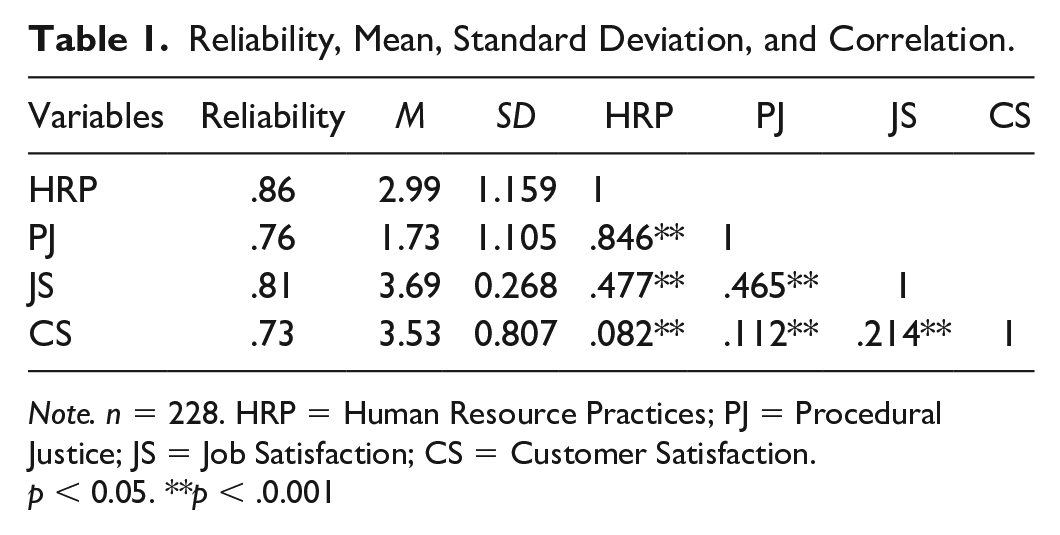
Note. n = 228. HRP = Human Resource Practices; PJ = Procedural Justice; JS = Job Satisfaction; CS = Customer Satisfaction.
p < 0.05. **p < .0.001
Methodology
Participants and Procedure
The study follows the quantitative (positivism), cross-sectional research design to test the hypothesis empirically. Data were collected from two sources: paramedical staff and patients. Paramedical staff members were asked to rate the HRM practices carried out in the hospitals and the level of their perception about the formal procedures to carry these HRM practices and their resulting job satisfaction. However, patients served by the staff member were asked to rank the degree of satisfaction they got from service of that very staff member. The purpose of study was clearly stated in a cover letter, which was annexed with each questionnaire. The survey was personally administrated by one of the authors and after discarding almost 72 responses due to missing data, 228 complete and useable responses having response rate of 76% were used for analysis.
Furthermore, each respondent (paramedical staff) also provided demographic information such as gender, age, and education job experience. Out of 228 responses, 75% responses were from the public sector and 25% were from the private sector hospitals. Among all the respondents, 137 (60%) were male and 91 (40%) were female, 52% of the respondents were of age between 31 and 40 years, 34% of the respondents have qualification above graduation and 36% have work experience between 6 and 10 years, 18% has work experience between 11 and 15 years, 10% has 16 and 20 years’ work experience, and 36% has below 5 years of work experience.
Measures
In this study, HR practices, procedural justice, and resulting job satisfaction were self-reported, while patients rated customer satisfaction. All the responses were assessed using a 5-point Likert-type scale (1 = strongly disagree, 2 = disagree, 3 = neither agree nor disagree, 4 = agree, and 5 = strongly agree). For HRM Practices, a 10-item scale was developed by Pfeffer and Veiga (1999). Examples of the items for HRM practices include “This hospital tries to relate your pay with your performance in some way” and “There is a clear status difference between management and staff in this hospital.” Procedural justice was measured using six-item scale developed by Moorman (1991). Sample items contain “All job decisions are applied consistently across all affected staff members” and “To make job decisions, my supervisor (MS) collects accurate and complete information.” Job Satisfaction was measured by using three-item scale of Hackman and Oldham (1975). Example of the items included is “All things considered, I am satisfied with my job.” Three-item scale of Voss et al. (1998) was used to measure customer satisfaction. Example of the items included is “I was satisfied with the service provided.” Reliability of all scales was above cut-off value of .70, as shown in Table 1.
Data Analysis and Results
Data analysis is carried out through a series of steps starting with checks of reliability through Cronbach’s alpha and measurement and structural models. The measurement model starts by measuring of means, standard deviation, and correlation as shown in Table 1.
Measurement Model
Measurement model is used to conduct confirmatory factor analysis (CFA). CFA is used for factor reduction on validity and reliability criteria of items and constructs; on the other side of story while conducting CFA is to assess measurement model’s convergent and discriminant validity.
Confirmatory Factor Analysis
Analysis of initial measurement model. Initial measurement model of this study comprised twenty-two observed variables and four latent variables. Measurement model was initially analyzed on the basis of five model fit indices: CMIN/DF, GFI, AGFI, CFI, RMSEA, and PCLOSE. Initial model fitness is presented in Table 2.
Re-Specification of Initial Measurement Model.
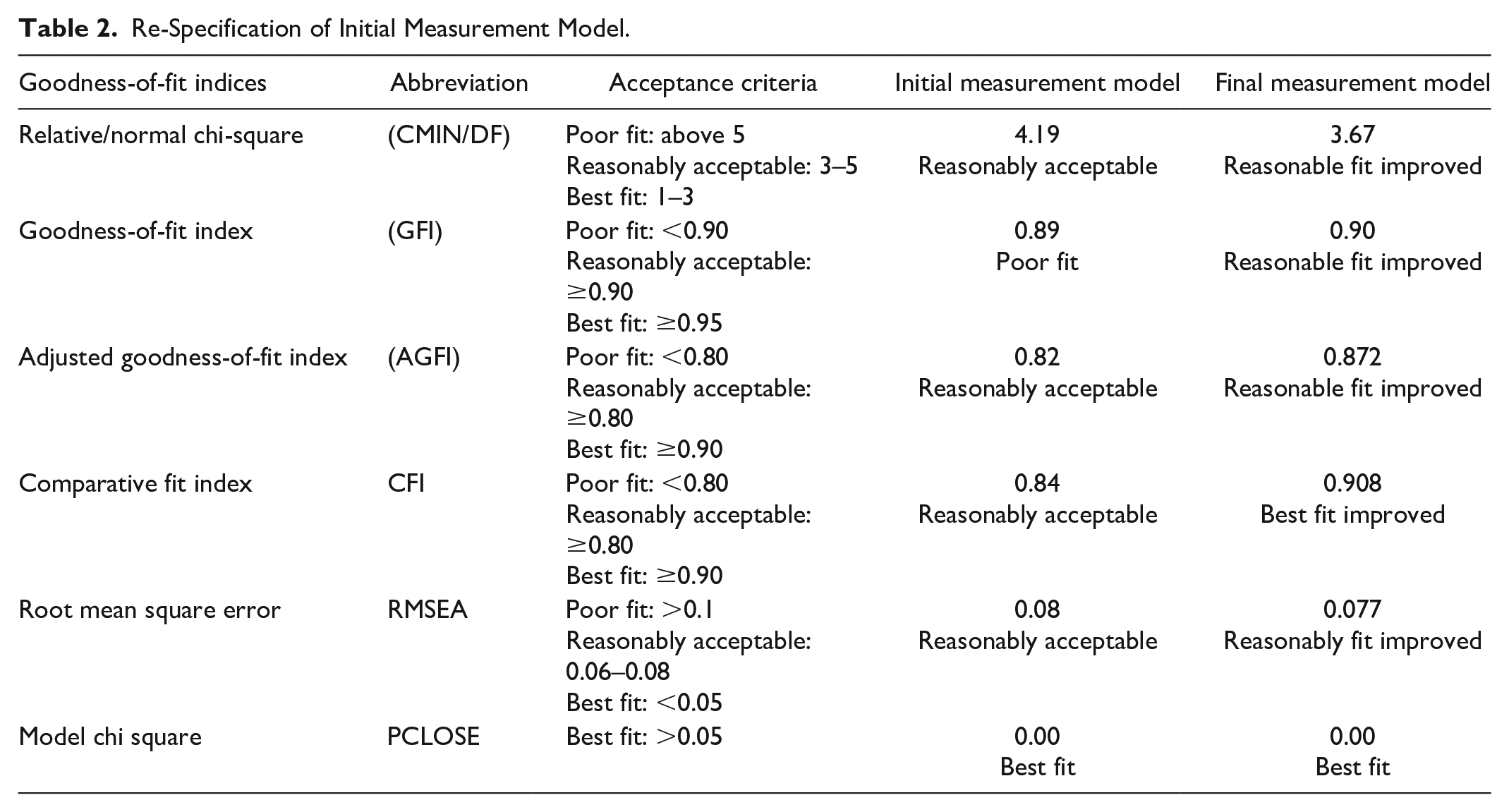
Re-specification of initial measurement model
Specification search is a process that consists of spotting and then fixing any form of error generated from misspecification. Examining factor loadings, standardized residuals, and modification indices are used to detect and correct the detected errors (Segars & Grover, 1993). Researchers need to be careful in deleting the items, and this process should be theoretically defensible. Theoretical support is necessary because all parameters have significant impact on other parameters in the model. This is a three-step process in which researcher first pinpoints the problematic observable errors, and second, there comes the respecification of model. At the third level of this process, re-estimation of model is conducted. MacCallum (1986) recommends to make one alteration or deletion of one item at a moment to remain on the safer side. This specification search is iterative process until model reaches to an acceptable model fit.
Examination of factor loadings
Examining the factor loadings is the very initial and most common measure to eliminate problem creating items in the specification search process. Items having standardized regression weights below 0.4 needs to be excluded.
Examination of standardized residuals
Second step to eliminate problem creating observations in specification search process is the examination of standardized residuals. After eliminations of poor factor loadings, items having below 2.58 standardized residuals are removed from the model (Byrne, 2001).
Examination of modification indices
On the third step of specification search, modification indices are examined to eliminate problem creating observations. If correlation is present within the error containing items, then adjustment in χ2 is provided by modification indices. These adjustments should be theoretically defensible.
In our specification search process, two items were deleted one by one from the scale of Procedural Justice (PJ), that is, PJ1 and PJ6, due to poor factors loadings. HRP2 and HRP6 were found to have squared multiple correlations (SMCs) below 0.2; so, they were also deleted. By examining modification indices, some items were having high value of modification indices, hence needed for covariance among items. HRP4, PJ2, and PJ4 were made one by one to remain on safe side (see Figures 2 and 3).

Initial measurement model.

Final measurement model testing of structural model for hypothesis.
Fit of structural model is examined to observe hypothesized relationships among the variables crafted in the model. An Inclusive list of specifications of the structural model is presented in the succeeding section.
Table 3 provides details about structural model analysis and value of standardized regression estimate (β = .584, p < .01), thus showing a significant and positive relationship between HR Practices and job satisfaction and shows that HR Practices initiated 58% variation in job satisfaction which leads to acceptance of H1. Standardized estimates show a positive relationship between job satisfaction and customer satisfaction with value of (β = .584) and significant with p value <.01, thus H2 is accepted. However, in the absence of mediator, there exists an insignificant relation between independent and dependent variables β = .26 and p value = .622, which leads to rejection of H5 (see Figure 5).
Results of Hypothesis Through Structural Model Analysis.
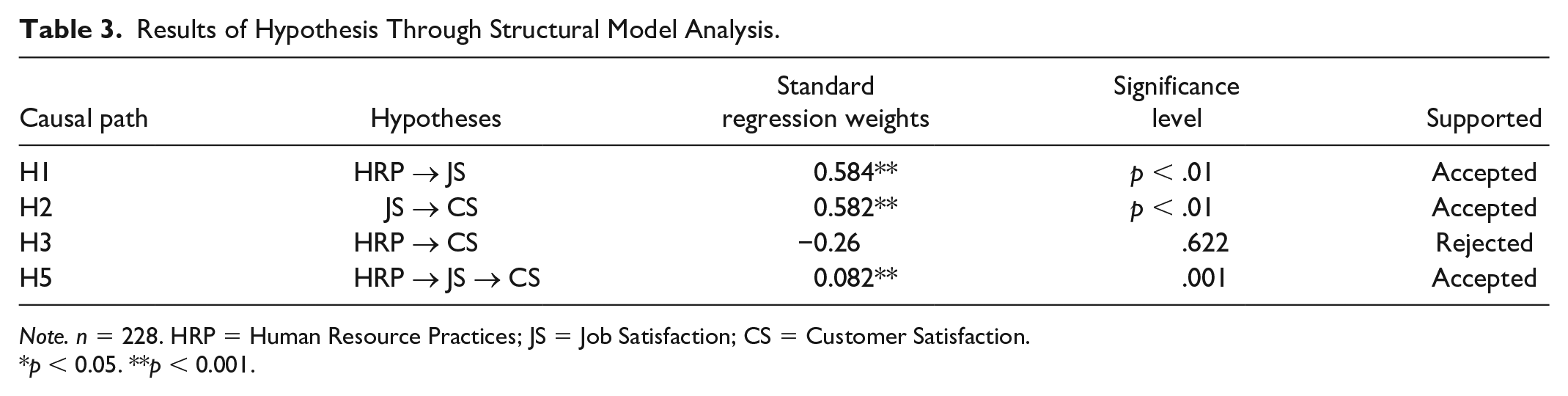
Note. n = 228. HRP = Human Resource Practices; JS = Job Satisfaction; CS = Customer Satisfaction.
p < 0.05. **p < 0.001.
For further testing of hypothesis, mediation analysis was run using AMOS v 21 with the variables HRP, JS, and CS. Mediation analysis confirmed significant positive association of HR-practices and Customer satisfaction in the presence of mediator with values of β = .082 and p = .001. According to Hayes and Preacher (2014), the indirect path was significant; therefore, mediating role of job satisfaction was proved between HR practices and customer satisfaction; hence, Hypothesis 5 is accepted.
For moderated regression analysis, Slop test revealed as evident in Table 4 and Figure 4 that positive relationship of HR practices and Job satisfaction will be stronger in the presence of high value of procedural justice, while positive relationship of HR practices and Job satisfaction would be weaker in case of low value of procedural justice. It is proved that the presence of high procedural justice will increase the employee’s job satisfaction level. Hence, this lead to acceptance of Hypothesis 4.
Relationship Between Human and Job Satisfaction With Moderating Role of Procedural Justice.
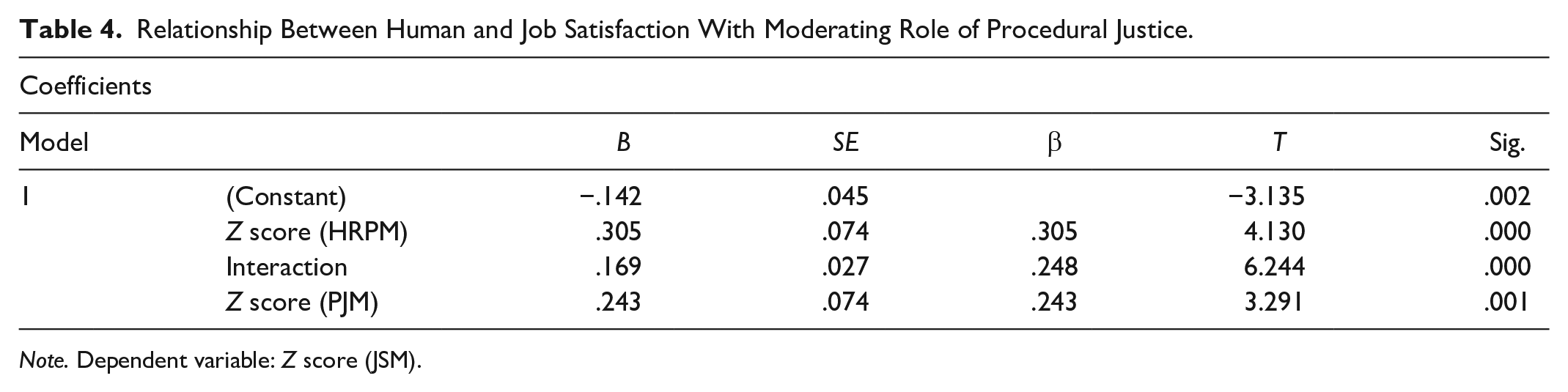
Note. Dependent variable: Z score (JSM).

Moderating role of procedural justice.

Structural model of study.
To test hypothesis H6 and H7, regression analysis was run identifying positive and significant relationship for gender responsiveness toward HRM practices and job satisfaction and job satisfaction and customer satisfaction. Table 5 provides estimate and p values leading to acceptance of hypothesis. Regression analysis was run to check cumulative effect as well as individual gender basis.
Regression Analysis for Gender.

Note. HRP = Human Resource Practices; JS = Job Satisfaction; CS = Customer Satisfaction.
p < 0.05. **p < 0.01.
In case of cumulative test, both H6 and H7 were accepted with b-values of .477 for HRP and job and 0.226 for JS and CS with p value of .000. However, in case individual effects in both run female paramedical staff are highly influenced by HR practices with b-value of 0.547 as compared to male staff with 0.460. Similarly, in case of JS and CS, ratio of female staff is more with b-value of .267 and .181, respectively.
Discussion
This study was aimed at exploring outcomes of human resources practices on customer satisfaction with job satisfaction as mediator and exploring procedural justice as moderator between HRP and JS. Theoretical foundation for the study comes from AMO framework and social exchange theory revealing these constructs having affirming relationships with theoretical basis. AMO framework enfolds the ability, motivation, and opportunity perspective, which aligns with HR practices in a way that HR provides training to employees that helps in enhancing their abilities and motivates them in performing well. This performance provides employees with opportunity of growth that is monitored by performance management system. Thus, HRP outcomes such as job satisfaction, loyalty, and rewards lies in line with the study of Paauwe (2009), which states that AMO framework supports HR-related outcomes such as job attitudes and job satisfaction. Blau’s (1964) work on Social Exchange Theory was used as a base to hypothesize that mutual contingent exchange of gratification between two parties like human resource management and staff members occur as a belief in reciprocity. This study supports social exchange perspective that when organizations invest in their employees, this in return encourages pro-social and active behaviors on part of individuals leading them to better performance (Hennekam, 2013).
Human resource management practices are the management activities related to a human asset which also acts as predictor of various organizational outcome, that is, job satisfaction of employee (Boselie, 2010). Analysis revealed the same that HRP at hospitals is having a significant relationship with Job Satisfaction (JS) of paramedical staff. This significant relationship has been supported by the past studies (Boon et al., 2011; Madanat & Khasawneh, 2018) where employees’ performance at both individual and collective levels have identified to be influenced by HRM practices. Procedural Justice is the perceived impartiality of the formal procedures employed in organizational decision making (Cropanzano & Greenberg, 1997). In the same vein, Job Satisfaction has been identified as having positive strong relations with CS affirming with earlier studies (Eid, 2019; Hur, 2015) that in both private caregiver organizations and public organizations, internal branding has strong effects on organizational outcomes. Employee’s job satisfaction acts as boosting factor in their performance enabling them to perform better, thus yielding high customer satisfaction with organization’s products and services.
This study came up with exploring the moderating role of Procedural Justice as it positively strengthens the relationship between Human Resource Management Practices (HRP) at hospitals with Job Satisfaction (JS) of paramedical staff. This was a unique outcome of the research that was not found in the previously conducted studies up to the extent the literature was searched. Analysis revealed the significant relationship between job satisfaction of paramedical staff and their corresponding served Patients (Customers). This significant relationship was supported by the previous researchers (Tornow & Wiley, 1991). The direct relationship between human resource management practices (HRP) with customer Satisfaction (CS) was found insignificant without the presence of Intervening variable job satisfaction (JS) in the health sector, and this insignificance aligns with previous studies (Rogg et al., 2001; Xu & Geodegebuure, 2005). Another effect measured was of gender, which reveals gender responsiveness toward HRM practices of the organization. Results reveal that female employees are more likely to be influenced by HRM practices and it influences their job satisfaction and casts its effects on customer satisfaction. This result is aligned with prior study of Ismail and Nakkache (2015) stating female workers to be more responsive toward HRM practices, as the decisions taken by HR strongly influence the task performance of female employees.
Conclusion
This study was aimed at exploring the significant relationship between Human Resource management Practices (HRP) with the Customer Satisfaction (CS) in the presence of intervening role of Job Satisfaction (JS). Few hypotheses were developed and tested to examine the conceptual framework. Findings of study revealed that the Human Resource Management Practices (HRP) affect Job Satisfaction (JS) of employee, that is, paramedical staff member of the hospitals. Procedural Justice proved to be the interacting variable that strengthens the significant relationship between HRP and JS at hospitals. This study found an insignificant relationship between HRP and Customer Satisfaction without the presence of mediator variable, that is, Job Satisfaction.
Implications
This study is rich in its contributions both academically and practically. In case of academia, Human Resource Management practices and their link with different organizational outcomes have already been explored widely in different backgrounds, yet the health sector is found to be an understudied area found up to the best of researchers’ knowledge. This study was aimed to uncover the suitable model for the health sector in existing literature. Moreover, the moderating role of Procedural Justice was added to affect the relationship of Human Resource Management Practices (HRP) and Job Satisfaction (JS).
From practical perspective, this study, if adopted in real terms by the hospitals’ administration, can come up with the best steps to make their staff members satisfied with their job, which will ultimately resolve the issues of low motivation at work and high absenteeism. This will help employees to better serve their customers and make them satisfied too. Results from the study showed that even best practices conducted in hospitals could be affected by the justice-related procedures, thus indicating to carefully carry the procedural justice rules along with employee friendly HRP to keep both employee and customer satisfied at the same time. Policy makers are the persons who are responsible to make rules and policies to get the work done smoothly. This study is helpful for the policy makers of HRP in every sector that how the employee friendly Human Resource Management Practices can help any organization to be a satisfied place to work in for their employees. This satisfied environment for work is thus automatically turned into a place that is going to satisfy their customers (patients).
Moreover, this study can be replicated in other service industries of Pakistan where there is a great role of front-line employees especially in aviation industry which has less competition and employees are not motivated to satisfy their customers. The future researchers can also undertake such study in hospitality industry.
Limitations
One of the major limitations of the study was the inability to access private hospitals (only 25%) to analyze the difference between the practices of Human Resource Management of private and public hospitals. If private hospitals were equally accessed to make a comparison, then the true picture of Job Satisfaction of employees would have been explored, as it is a stereotype in the Pakistani culture that government job is secure, hence making employees more satisfied regardless of the HRP and Procedural Justice as compared to private jobs. Another limitation was limiting this study only to the major cities of Punjab. If it would have been undertaken in small cities of Punjab, it could help policy makers to grasp a broader picture.
Supplemental Material
questionnaire – Supplemental material for A Link Between Human Resource Management Practices and Customer Satisfaction: A Moderated Mediation Model
Supplemental material, questionnaire for A Link Between Human Resource Management Practices and Customer Satisfaction: A Moderated Mediation Model by Usama Najam, Sadia Ishaque, Saadia Irshad, Qurat-ul-ain Salik, Maria Shams Khakwani and Malka Liaquat in SAGE Open
Footnotes
Declaration of Conflicting Interests
The author(s) declared no potential conflicts of interest with respect to the research, authorship, and/or publication of this article.
Funding
The author(s) received no financial support for the research, authorship, and/or publication of this article.

Supplemental Material
Supplemental material for this article is available online.
References
Supplementary Material
Please find the following supplemental material available below.
For Open Access articles published under a Creative Commons License, all supplemental material carries the same license as the article it is associated with.
For non-Open Access articles published, all supplemental material carries a non-exclusive license, and permission requests for re-use of supplemental material or any part of supplemental material shall be sent directly to the copyright owner as specified in the copyright notice associated with the article.
