




Abstract
Based on the attraction–selection–attrition (ASA) framework, this research aimed to investigate the mechanism which affects the link between high-performance human resource practices (HPHRPs) and the two negative employee outcomes of the present study: emotional exhaustion and quit intentions. Using the ASA framework, the authors examine one such mechanism namely person–organization (P-O) fit, through which HPHRPs influence both the studied employee negative outcomes. A sample of professionals working in the public sector universities of Pakistan is adopted for testing the mediation model by using structural equation modeling. Findings reveal that HPHRPs have positive association with P-O fit, and negative with emotional exhaustion and quit intentions. Moreover, the findings illustrated a full mediation effect of P-O fit on the relationship among HPHRPs and both of the employee outcomes. The study has important theoretical and practical implications.
Keywords
Introduction
High-performance human resource practices (HPHRPs) have no consensus in the mainstream of HRM literature. Chan and Mak (2012) and Hodgkinson et al. (2018) described HPHRPs as “a set of appropriate policies and practices,” which ensures the contribution of an organization’s human resources toward the goals and objectives of the organization. Souza and Beuren (2018) referred HPHRPs as the set of best practices having the potential to boost up the performance of organizations by developing their workforce as skillful and committed. According to Messersmith et al. (2011, 2012), HPHRPs are commonly assumed as the practices related to human resources specially predetermined to enrich the quality and boost up the employees’ performance within the organizations. Moreover, most of the studies have analyzed these constructs in different contexts independently, but the gap to investigate the mechanism of their relationship and its impact on employee outcomes is not studied yet. Such studies are as follows: Batistič et al. (2017) have studied HPHRPs in the context of team creativity and knowledge sharing, Teo et al. (2016) studied person–organization (P-O) fit in the context of change, Akbar and Akhtar (2018) investigated emotional exhaustion in relation to leader member exchange and agreeableness, and Tepper et al. (2009) related quit intentions with the abusive supervision and workplace deviation. To date, a very little knowledge has been gathered and made available in the literature regarding the mechanism which builds this relationship and the way it affects employee outcomes.
Previous studies have analyzed the link among HPHRPs and multiple employee outcomes (e.g., Ahmed, 2016; Jyoti et al., 2017; Kehoe & Wright, 2013; Kuvaas, 2008; Whitener, 2001; Zhong et al., 2016). However, a very few studies have studied the mechanism by which this relationship is built up, and still the researchers are not clear with how the HPHRPs are linked with employee outcomes (Alfes et al., 2013; Boon & Kalshoven, 2014). We seek to fill this gap and provide answer by analyzing the mediating impact of P-O fit, that is, the extent of resemblance among the employees and the values and goals of the organizations, on the relationship among HPHRPs and the two negative outcomes of employees: emotional exhaustion and intentions to quit. In this way, our research provides response to calls for study regarding the impact of P-O fit on the link among HPHRPs and employee outcomes (Mostafa, 2016). Applying the attraction–selection–attrition (ASA) framework, we propose that HPHRPs raise the fit levels between employees and their organizations, thereby minimizing the emotional exhaustion and quit intentions.
We choose to study these outcome variables due to four considerations. First, earlier studies have discussed the considerable association of emotional exhaustion and quit intentions to HPHRPs as well as P-O fit (e.g., El-Sakka, 2016; Gould-Williams & Mohamed, 2010; Jyoti et al., 2015; Leka et al., 2003). Second, it is clear from the literature and previous studies that increase in emotional exhaustion leads to high quit intentions; thus, it is discussed to be one of the main reasons for quit intention (El-Sakka, 2016; Jyoti et al., 2015). Third, emotional exhaustion and quit intentions are the key outcomes and have major implications for the performance of employees and the organizations as a whole (Eatough et al., 2011; Jyoti et al., 2015; Khatri et al., 2001). Finally, studying the impact of HPHRPs on emotional exhaustion and quit intentions will be useful to assess whether HPHRPs, which are meant to provide the competitive benefits to the organizations, do so at the employees’ cost: which lead to negative outputs for employees (Jensen et al., 2011; Mostafa & Gould-Williams, 2014). Frequent quit behaviors of the employees influence the behavioral economics of the organizations which in turn create challenges for the organizations regarding the performance and financial issues. As the employees quit, the organizations have to initiate the recruitment process to replace the quitters; by doing so, they put extra efforts and resources for the recruitment, training, and development of the newly hired employees. After the recruitment is completed, the organizations still need to give some more extra efforts to make inline their goals and objectives with the employees (Akerlof & Kranton, 2005; Camerer & Malmendier, 2012).
Our focus, in the present study, is on the perceptions of employees about HPHRPs. Employees’ perceptions are crucial, due to the reason that HPHRPs are not necessarily revealed as expected because of the variations in understanding and preferences (Nishii & Wright, 2008). Moreover, the researchers discussed that employees’ perceptions for HPHRPs are liable of being more surmising than those of managers’ ratings about their outcomes. Therefore, it is recommended by Boon and Kalshoven (2014) and Kehoe and Wright (2013) to conduct empirical research regarding the link among HPHRPs and employee outcomes by adopting the responses from employees; we seek to fill this gap and provide answer to recent calls.
The current study adds significant contribution to the literature of P-O fit. Prior research findings show the connection between P-O fit and employee outcomes as highlighted in literature of HPHRP (e.g., El-Sakka, 2016; Narayanan & Sekar, 2009; Nur Iplik et al., 2011). However, a very little consideration is given to the mechanism about how to establish and maintain P-O fit (Bright, 2008; Jyoti et al., 2015). Furthermore, Boon et al. (2011) discussed that HPHRPs will expand the resemblance among the employees and their organizations on the grounds that as framework of practices, they impart organization’s values, objectives, and goals to the employees. Thus, we explore the impact and significance of HPHRPs on the level of P-O fit.
The present research broadens the past studies regarding the relationship of HPHRPs with employee outcomes by investigating it in public sector universities of Pakistan. Recently, a notable rise has been seen in studying the link of HPHRPs with numerous employee outcomes, but greater part of these studies are conducted related to large business organizations and multinational groups and less is explored in public sector organizations (Boselie, 2010; Messersmith et al., 2012). ASA framework has been applied in this study which is best used to describe the way HPHRPs affect fit between the employees and organizations. This framework shows the homogeneity between employees and organizations including structure, operationalization, and culture of the organizations. Subsequently, this research answers to these calls, and our research findings will be more useful and a significant contribution to the growth of HRM theory and literature by expanding the domain of the empirical research adapted to test the theory.
Link Connecting HPHRPs and P-O Fit
HPHRPs consist the best practices, which include selective staffing, extensive training, internal mobility, employment security, clear job description, result-oriented appraisal, incentive reward, and participation, all of which result in good firm performance and sustainable competitive advantage, through enhancing the skills of the workforce and increasing employees’ participation in decision-making and their motivation to put forth discretionary effort (Hou et al., 2017). Some recent studies define HPHRPs as a practice or action that forms the internal functioning of any firm and encourages the employees to come forward and take active part in the organizational life which will be helpful for them to grow professionally (Ruiz-Palomino et al., 2019). HPHRPs are also termed as a long-term exchange relation among the organizations and their employees, which is meant to ensure their motivation and commitment (Sun et al., 2007). Scholars of management have discussed for long the implementation of strategically determined activities of human resources liable to improve the functioning of the organizations (McWilliams et al., 2006). Recently, these actions have been designated as “HPHRPs” and are described as the set of practices related to human resources which are designed to enrich the motivation and commitment of the employees (Kehoe & Wright, 2013).
“Person-organization fit” is defined as congruence between an individual and his or her organization in terms of such dimensions as values and goals. As the similarity between the employees and organizations increases, the employees are likely to become more committed and thus more productive in their jobs (Jin et al., 2018). According to Kristof (1996), P-O fit is the alliance among the employees and their organizations, which results when one imparts the need of other, or both of them share comparable characteristics. Vogel and Feldman (2009) and Piasentin and Chapman (2006) discussed two core categories of P-O fit: Complementary and Supplementary P-O fit. Complementary fit is accomplished when the characteristics of the employees meet the necessity of the organization or vice versa, while supplementary fit is accomplished when an employee and organization share similar characteristics (Kristof, 1996). Hence, we consider the degree of congruence among the values and objectives of employees with their organizations in accomplishing the desirable outcomes of the employees. Therefore, the description of “fit” in the present research is more similar to the “supplementary fit.”
The assumptions of the present study are underpinned by the concept of ASA framework which states that homogeneity (consistency or similarity) of human resources within any organization represents its structure, processes, and the organizational culture. Since the employees were attracted to the organization, selected by the organization, and stayed within the organizations matching their personal characteristics. An employee within a particular organization (where he or she is employed) shares his or her needs, ideals, values, and personalities, which becomes homogeneity in between them and leads the employee to make a place there. Moreover, the ASA framework emphasized on the P-O fit formation and function, which helped us to select this framework for this research.
We use the ASA framework of Schneider (1987), which is useful to describe the way HPHRPs affect fit among the workforce and organizations. The key idea we get from ASA framework is the following: The multiple organizations attract individuals on the basis of the prerequisites of their core values and objective. After that, the organizations select individuals who fit their criteria and values and objectives by following their formal and informal recruitment procedures. By that time, the goals and values of some employees may change and become unfit for the organization, which in turn may lead them to take the decision to quit their organizations. P-O fit is charismatic and flexible; employees get used to and comply to their organizations as well as the organizations undergo changes with the passage of time (McLaurin & Al Amri, 2008; Petrou et al., 2015). For example, the execution of new public management (NPM) brought the change in the culture of public sectors which required the same changes in the employees’ perceptions and readiness to get used to and adapt to that organizational culture. This suggests that new strategies might be only effective if the employees are easy and comfortable with the newly adapted culture of organization and identify the values, goals, and objectives of their organization (Carnevale, 1988). Therefore, as the recruiting practices are essential for assessing the capacity of the individuals so as to make them fit with their organization, the other HPHRPs are likewise essential to match the individuals with the organizations. The HPHRPs like training and development, promotion, and job security convey the organizational principles, goals, objectives, and expectations to the employees resulting in the employees’ perceptions of P-O fit (Boon et al., 2011; Hom et al., 2010; Lee et al., 2017). On the basis of aforementioned arguments and the previous studies which discussed the link among HPHRPs and P-O fit, and concluded positive relation of the employee perceptions for HPHRPs as well as P-O fit, we posit the following:
Hypothesis 1: HPHRPs are positively related to P-O fit.
The Mediating Role of P-O Fit
According to O’Reilly et al. (1991), P-O fit is the extent of match and similarities between the values and characteristics of the individuals and organizations, which attracts individuals to the organizations. Individuals decide whether they want to work with the firm on the basis of the perception that if their personal characteristics and values are congruent to those of the firm. The main objective of the firms is to induct the employees having a good fit so as to retain them for long time and work with them smoothly. Verquer et al. (2003) argue several means of operationalizing the P-O fit. The subjective fit measures the extent of match between employees’ own characteristic and those of the firm. However, objective fit provides a comparison of the employee’s characteristics to the organization’s independent rating on those. Finally, the perceived value congruence gives a comparison between the employees’ self-rating and the organization (Coldwell et al., 2019).
Drawing on ASA framework, we predict that one of the mechanisms through which HPHRPs affect emotional exhaustion and quit intentions is P-O fit. Boon et al. (2011) discussed that the HPHRPs are aimed to accomplish the employee needs and attract those employees whose goals and values are similar to those of the recruiting organizations. Once if a good fit is accomplished, the individuals respond by showing the optimistic and favorable attitudes, encounter security, prosperity, and happiness at a higher level. According to Bright (2007), P-O fit grabs the congruence among the employees’ characteristics (i.e., goals, skills, and values) and organizations (i.e., goals, values, resources, and culture). Accordingly, P-O fit is predicted to mediate the relationship between HPHRPs and employee outcomes. Indeed, the P-O fit is also recommended to play a mediating role in the previous studies as Ruiz-Palomino et al. (2013) studied the mediating role of P-O fit in the relationship among ethical culture and job satisfaction, affective commitment, and intention to stay. Bright (2007) did the same in Indiana, Kentucky, and Oregon. Saks and Ashforth (1997) also examined the mediating role of P-O fit. Boon et al. (2011) also investigated the mediating effect of P-O fit in the relationship between HPHRPs, organizational citizenship behavior, and organizational commitment. We choose to examine P-O fit as a mediator among the relationship of HPHRPs and both the employee outcomes of the present study: emotional exhaustion and quit intentions. Based on the ASA framework, we predict that P-O fit is one of the mechanisms through which HPHRPs affect both the employee outcomes.
Emotional Exhaustion
The roots of emotional exhaustion arise from the Maslach’s (1982) influential model of burnout. It results from the reaction of prolonged stress (W. Schaufeli & Enzmann, 1998). Cordes and Dougherty (1993) argued that emotional exhaustion is described by inadequacy of energy and a feeling of one’s emotional resources being exhausted. Findings of many studies suggest the pessimistic impacts of emotional exhaustion on the health, and well-being of the employees and the organizational performance as a whole (Van De Voorde et al., 2012). It has also been discussed in the previous studies that the employees working in public sectors are not immune or unaffected by stress but they are also subject to vulnerable situations because of experiencing the emotional exhaustion at higher levels (Kahn, 1993; Raj & Siddique, 2014; Wainwright & Calnan, 2002).
It is quite clear from the previous studies that less attention has been given to the relationship among HPHRPs and employee job outcomes that affect the health and prosperity of employees. Obeidat et al. (2010) examined the link among HPHRPs and organizational performance in Jordan; Ma et al. (2017) studied the link between HPHRPs and collective efficacy and knowledge sharing. Renee Baptiste (2008) examined the same on employee well-being and performance. But still there is a need of more research in this area, as these studies examined the link among HPHRPs and employee outcomes but still the underlying mechanism is unclear which is to be studied and made clear. We propose that the compatibility level among the employees and their employer organizations makes it easy to understand and explore the relationship between HPHRPs and emotional exhaustion.
Emotional exhaustion is assumed to be a chronic situation of the emotional as well as physical depletion. It is considered a kind of strain which is caused due to the stress at workplace; in other words, emotional exhaustion is closely related to stress and job-related depression (Kacmar et al., 2013; Kohl et al., 2012). According to W. B. Schaufeli et al. (2009), emotional exhaustion results from the job-related stress which often increases on the grounds of differences among the values, goals, and characteristics of the employees and the organizations. This diversity among the employees and their organizations gives adverse effects on fit, resulting in the pessimistic psychological impacts (Edwards & Cooper, 1990). Research on P-O fit indicates that the employees and their organizations are very efficient and effective when they have the similar characteristics (i.e., higher P-O fit level; Kristof et al., 2005; O’Reilly et al., 1991). This resemblance facilitates communication among the employees within the organization to seek help and support from one another, which leads to reduce the emotional exhaustion of the employees (Dollard et al., 2003; Kanov et al., 2004). Based on the findings of the previous studies and aforementioned arguments, we posit the following:
Hypothesis 2: P-O fit mediates the relationship between HPHRPs and emotional exhaustion.
Intention to Quit
Intentions to quit imply to the degree of employees’ willingness to leave their organizations (S. Cho et al., 2009). According to Nadiri and Tanova (2010), the organizations can easily lessen the employees’ intentions to quit if they recognize and realize the reasons behind these intentions. Lambert and Hogan (2009) argued that intentions to leave are more essential in the viewpoint of the organizations than the actual turnover behavior of the employees. After the employees switch the organizations, they let the organizations bear the expenditure of hiring and training of the new employees. Researchers discuss the quit intention is easy to evaluate and foresee as compared with actual turnover (Firth et al., 2004; Nadiri & Tanova, 2010) and others predict to be very good indicators of the management practice and leadership (Guchait & Cho, 2010; Siyal, 2018; Siyal & Peng, 2018). Moreover, prior studies related to private and business sectors have found the moderate relationship among the intentions to quit and the turnover behavior (Macky & Boxall, 2007), while the recent studies found that the same relationship is stronger in the context of the public sector organizations (Carmeli & Weisberg, 2006; Y. J. Cho & Lewis, 2012; Vigoda, 2000). Based on these findings, we choose to use the intentions to quit as a surrogate for the actual turnover. Prior research has predicted that HPHRPs have the negative association with the quit intentions (Jyoti et al., 2015). It has also been argued by many researchers that the mechanisms which cause this relationship are still uncertain (Kehoe & Wright, 2013). Therefore, we argue that HPHRPs are more prone to have indirect impact on the intentions to quit via P-O fit.
Many researchers (e.g., Cable & DeRue, 2002; Saks & Ashforth, 1997) have found that the employees having higher P-O fit perceptions are more prone to make their identity and terms in their employer organizations due to the high fit between them. Accordingly, the values, goals, and the characteristerists of the employees and their organizations will mirror their integrity and identities. This will in turn build up the stronger relations between organizations, employees, and their coworkers, resulting in minimizing the quit intentions of employees (Ones et al., 1994). The arguments and findings of these researchers are persistent to ASA framework as well as the outcomes revealed by the recent empirical studies conducted by El-Sakka (2016) and Liu et al. (2010). Based on this, we propose the following:
Hypothesis 3: P-O fit mediates the relationship between HPHRPs and quit intentions.
Method
Data Sampling and Procedure
Our study is based on 380 participants from public sector universities of Pakistan (including professors, associate and assistant professors, lecturers, teaching assistants, research associates, and the administration staff of the departments and schools of the universities). The participants were contacted directly by using personal contacts and were promised for the confidentiality of their particulars. The human resource departments and the respondents were given full description about the nature of study in verbal as well as in written form, with the emphasis of voluntary participation of respondents. They were insured that their data and responses will be only used for this study purpose, and no such sign of identity is kept in the questionnaires so as to identify the respondents. The survey questionnaires were sent to the respondents by email and personal visits. We distributed 600 questionnaires, of which we received 380 complete questionnaires, giving a response rate of 63.3%, which contained 58.6% males and 41.4% females. 51.2% of the respondents had a doctorate degree, 32.8% had a master’s degree, and rest of the 16% was bachelor degree holders. 51.3% of the respondents had 1 to 5 years of experience in their current job, 32.6% had 6 to 10 years, and the rest of the 16.1% had more than 10 years of experience in their current job.
Measures
The questionnaire consisted of 35 items, with demographic questions (e.g., gender, age, education, job, and tenure) and scales measuring HPHRPs, P-O fit, emotional exhaustion, and quit intentions. All the items were measured using a 7-point Likert-type scale where 1= strongly disagree and 7 = strongly agree.
HPHRPs
We used five practices in our research to evaluate the HPHRPs in the employees’ perspective using the responses from employees. These are among the common practices which are taken in the previous studies investigating the relationship among HPHRPs and outcomes of the employees. The practices used in this study include training and growth, job-related security, promotion, autonomy in work, and communication.
This study adopted the 20-item scale from the previous studies (Boon et al., 2011; Kehoe & Wright, 2013). The examples include the following: When my job involves new tasks, I am properly trained. This measure demonstrated the Cronbach’s alpha of all the five studied HPHRPs ranging from .75 to .88.
P-O Fit
Direct and indirect measures can be adopted to evaluate P-O fit using the scale from the previous study (Kristof, 1996). Direct measures are often useful for the evaluation of perceived fit, and are conducted by asking from the respondents of study about their perceptions of fit with their employer organization, while the indirect measures are often used to examine the actual fit, and are conducted by making comparison among evaluations of fit by the individual employee as well as their employing organizations. Bright (2007) found the direct fit measures being good and effective as compared with the indirect measures. Thus, we adopted the 4-item scale from Bright (2007), representing direct measures of fit to examine the level of congruence among the employees and their employer organizations. The examples of the items include “My values match the values of my institution.” This measure demonstrated the acceptable levels of Cronbach’s alpha (.84).
Emotional Exhaustion
We adopted the 7-item scale from Maslach and Jackson (1981) to examine the emotional exhaustion. The sample item includes “I feel emotionally drained from my work.” This measure demonstrated the acceptable levels of Cronbach’s alpha (.86).
Intention to Quit
This study used the 4-item scale from O’Reilly et al. (1991) to assess quit intentions. The example of the items includes “I have seriously thought about leaving this institution.” This measure demonstrated the acceptable levels of Cronbach’s alpha (.85).
Analysis and Results
Following the recommendations of Gerhart (2013) to use structural equation modeling (SEM) for analyzing the mediation role, we examined the mediating effect between HPHRPs and employee outcomes. SEM is a power assessment mechanism having two popular variations, that is, partial least squares structural equation modeling (PLS-SEM; Aghmiuni et al., 2019) and covariance-based structural equation modeling (CB-SEM; Kline, 2005b; Williams et al., 2009). Thus, we used the SEM with AMOS 21 to analyze the mediating impact of P-O fit. We followed a two-step approach of Anderson and Gerbing (1988), in which they suggested to first evaluate the measurement model and then evaluate the proposed structural model. We tested the data to make sure and maintain the normality of the assumptions. The skewness and kurtosis revealed values below 2, which indicates that there is no serious violation for the normality assumptions (Anderson & Gerbing, 1988). Moreover, we accounted the SEM models with bootstrapped standard errors on the basis of 1,000 resampling. The coefficients of the resampled measures presided like a proxy for the sample circulation of parameters of population (Im & Workman, 2004).
Measurement Validation
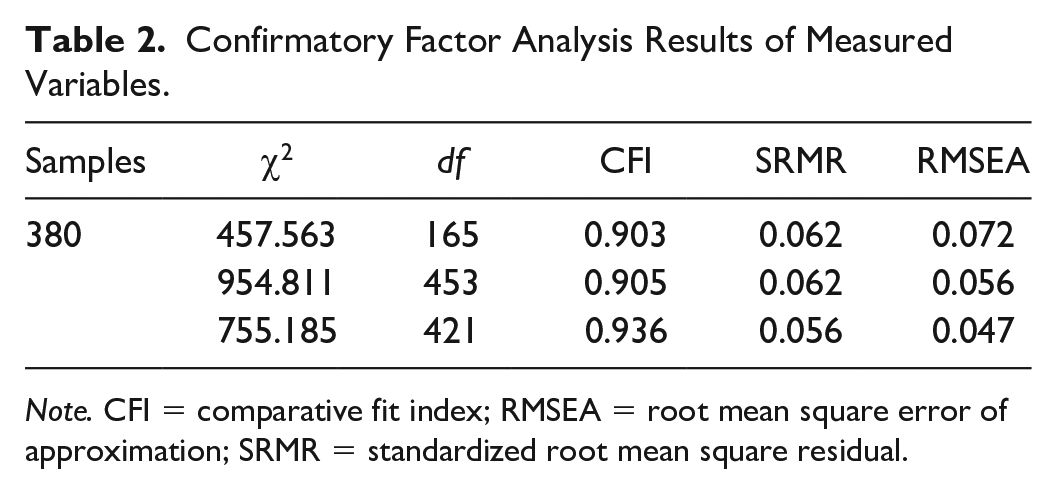
We used the confirmatory factor analysis (CFA) to measure the relationships and analyze the reliability and validity of all the study constructs. We examined the measurement model in two steps. At first, we did CFA of the HPHRPs’ second-ordered measurement model, within which all the five studied practices were considered as the factors of the first order along with their objects considered as the observed indicators. Next, we did CFA of the whole model in which we correlated all constructs along with the HPHRPs’ second-order construct. The indices suggested by Williams et al. (2009) were applied to evaluate model fit, which include the comparative fit index (CFI), root mean square error of approximation (RMSEA), and standardized root mean square residual (SRMR). It is recommended for a good fit when the CFI is above 0.90, the RMSEA is less than 0.08, and the SRMR is less than 0.10. We determined a good fit of the HPHRPs’ second-ordered measurement model, χ2 (df = 165) = 457.563, p < .001; CFI = 0.903, RMSEA = 0.072, SRMR = 0.062. We observed the second-order factor loadings with standardized values ranging from 0.57 to 0.83, in which all the coefficients are significant at p < .001 level. It illustrated that the whole model achieved a good fit, χ2 (df = 453) = 954.811, p < .001; CFI = 0.905, RMSEA = 0.056, SRMR = 0.062. We also calculated composite reliability as well as average variance extracted (AVE) and revealed the outcomes showing the constructs with internal consistency at a higher level, in which the values of all the composite reliabilities are above .80 and the AVE values are above 0.50 (see Table 1). Moreover, the coefficients of the correlation between all the studied variables were up to .75, which indicated that multicollinearity did not appear in the present study (Kline, 2005a, 2005b).
The Correlations and the Reliability Among the Variables.

Note. Subdiagonal entries are the latent construct intercorrelations. The first on the diagonal is the square root of the average variance extracted (AVE), while the second in parenthesis is the composite reliability score. HPHRPs = high-performance human resource practices; P-O = person–organization.
As all the study variables in the present research have been measured by means of the same source, we examined the effects of common method bias (Podsakoff et al., 2003). We used the unmeasured latent method factor technique to examine for the method bias. It is an approach that involves measuring a latent construct model, wherein the factors are permitted for loading on their hypothetical constructs and the concealed common method factor (Dulac et al., 2008). The findings indicated a good fit of the model to the data, χ2 (df = 421) = 755.185, p < .001; CFI = 0.936, RMSEA = 0.047, SRMR = 0.056 (see Table 2).
Confirmatory Factor Analysis Results of Measured Variables.
Note. CFI = comparative fit index; RMSEA = root mean square error of approximation; SRMR = standardized root mean square residual.
Structural Model and Testing of the Hypotheses
The structural model was examined with controls as well as without them, but we got the findings highly consistent in both cases. Thus, we are reporting the results without control variables in the interest of parsimony. A good fit was seen for our proposed model, χ2 (df = 453) = 954.811, p < .001; CFI = 0.905, RMSEA = 0.056, SRMR = 0.062. The HPHRPs estimated 47.8% of variance (R2) in the P-O fit for the present model. In addition, altogether both of them interpreted only 4% of variance in the emotional exhaustion and 13% in intentions to quit.
Looking at the paths separately (Figure 1), we see a positive as well as significant relationship among HPHRPs and P-O fit (β = .677, p < .001), which suggests that HPHRPs strengthen the fit among the human resources and organizations. Hence, we get support for Hypothesis 1. Moreover, P-O fit is significantly and negatively correlated to quitting intentions (β = −.237, p < .05) and emotional exhaustion (β = −.235, p < .05). Altogether, it is clear from these relationships for P-O fit that it plays a mediating role in the relationship of HPHRPs with the employee outcomes of our study; thus, our Hypotheses 2 and 3 are supported. The findings illustrated the insignificancy of the direct relation of the HPHRPs and both the employee outcomes (emotional exhaustion and quit intentions), and this indicates the full mediating effect of P-O fit.

Structural model of the study.
Mediation Results
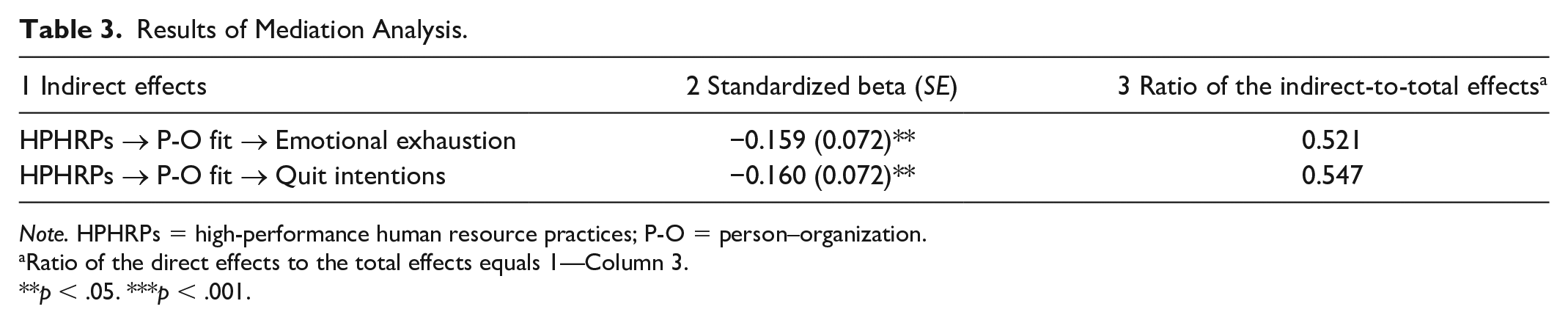
Prior studies (e.g., Lau & Cheung, 2012) suggested to calculate the mediation proportion by a process which involves comparison of the magnitudes from the indirect relationship to total relationships (i.e., adding direct and indirect relationship coefficients) such as ([a × b] / [a × b] + c′). The magnitude of the indirect relationship is normally labeled as a × b. In the present research, “a” indicates the relationship of HPHRPs with P-O fit, while “b” represents the relationship of P-O fit with employee outcomes (see Table 3). The coefficient of the link of HPHRPs with employee outcomes is labeled as “c.” In the case where both the paths (“a” and “b”) are observed to be significant, it means there is a mediation effect in that relationship. Before analyzing mediation analysis, we estimated by applying the bootstrapping technique on 1,000 resampling to see whether the indirect paths (a × b) are statistically significant (approach is suggested by MacKinnon et al. (2004)).
Results of Mediation Analysis.
Note. HPHRPs = high-performance human resource practices; P-O = person–organization.
Ratio of the direct effects to the total effects equals 1—Column 3.
p < .05. ***p < .001.
The coefficient of indirect path of HPHRPs via P-O fit to quitting intentions was significantly dissimilar to zero (p < .05) and equaled 0.160 (0.677 × 0.237). The proportion of the indirect effects to that of the total effect was equal to 0.547 (0.160 / [0.160 + 0.132]). The results suggest that 54.7% of the quit intention variance interpreted by both the HPHRPs and P-O fit was estimated by indirect relationship through P-O fit. The same is applicable to emotional exhaustion because the ratio of the HPHRPs’ indirect link through P-O fit was observed to be greater than 0.5.
Discussion
The present study aims to provide answer to the recent calls to explore the mechanism by which HPHRPs influence employee outcomes. We tested such mechanism by P-O fit and analyzed the mediating impact of P-O fit on two negative employee outcomes, namely, emotional exhaustion and quit intentions. We used a data sample from the public sector universities of Pakistan to test our hypotheses. This study adds contributions to the literature of human resource management and gives new insights to the empirical studies on the impacts of HPHRPs by presenting numerous significant research findings. On the basis of ASA framework and previous findings by Takeuchi and Takeuchi (2013), our study concluded that employee perceptions of HPHRPs were found to have a positive as well as significant link with P-O fit, and this indicates that employees come to know the values, goals, objectives, and expectations of the organization through HPHRPs, which in turn creates better resemblance among employees and the organizations (Boon et al., 2011).
The HPHRPs of the current research were found to have a large ratio of the variance in P-O fit, as compared with those of the previous studies conducted in Japan by Boon et al. (2011) and in the Netherlands by Takeuchi and Takeuchi (2013). This suggests that, in context of public sector universities of Pakistan, HPHRPs play a key role in determining the values and goals of employees. This is because of some reasons. First, in the public sector universities of Pakistan, the recruitment process prefers the individuals having the job skills as required by the organization rather than the individuals who fit the organizational characteristics. It is found by Lauver and Kristof-Brown (2001) that the individuals having the required qualification and skills do not always fit the organizations. Second, the job nature also matters to be in alliance with the nature of the individuals as different employees have different preferences. The third reason is related to the age of our study sample adopted in the current study because greater part of the respondents was younger than 30 years. According to Vigoda and Cohen (2002), the older employees have spent much time in the organizations and they know more than the younger employees and consider it as a part of their life, which enables them to have the high P-O fit as compared with the younger employees. Thus, HPHRPs are prone to have a greater impact on bringing the congruence among the values and goals of the younger employees and their organizations. In addition, our research findings recommend that the HPHRPs have positive effect on the employee outcome throughout the extent of similarity among values, objectives, and goals of employees and the organizations (Takeuchi & Takeuchi, 2013). Furthermore, the relationship among HPHRPs and both the employee outcomes (emotional exhaustion and quit intentions) was fully mediated by the P-O fit, and the impact of P-O fit was observed to be consistent across both the studied outcome variables. The results of the indirect effects of the HPHRPs via P-O fit suggested that P-O fit is an important mediator between the relationships of HPHRPs and the employee outcome variables.
Theoretical Implications
Our research findings add many theoretical contributions in the current literature. First, it provided answers to recent calls to study the mechanisms through which HPHRPs affect employee outcomes (Boon & Kalshoven, 2014). In addition, the findings indicate existence of fit among the employees and their employer organizations only because of the HPHRPs which in turn lessen the emotional exhaustion and the intentions to quit their organizations. Second, the present research also extends the literature of P-O fit, by investigating impacts of the HPHRPs on employee outcomes and fit with their organizations. Third, the outcomes of this research enhance the understanding of the quit intentions and the underlying mechanisms behind these outcomes. The results of this research give the empirical evidence of how the employees get emotionally exhausted which leads to the quit intentions. This behavior of the employees proves unfavorable for the organizations as they lose their skilled human resources. Fourth, we tested the proposed correlations in the public sector universities of Pakistan, which is the understudied and emerging context in this area, leading to establish the generalization of the research outcomes developed in other parts of the world (Eatough et al., 2011; Khatri et al., 2001). Fifth, the findings fill the gaps highlighted in the introduction part, which are required to address the impact of P-O fit mechanism on the relationship between HPHRPs and employee outcomes (Mostafa, 2016).
Practical Implications
The present research reveals several practical implications. First, the findings suggest that the HPHRPs like trainings, job security, and promotion are important, which develop the experience of employees and raise the congruence among goals and values of the employees and organizations, which in turn will lessen the emotional exhaustion and intentions to quit. Second, the employees of public sector universities are found to have certain issues with their human resource managers which increase emotional exhaustion in them, leading to develop quit intentions in them. The human resource managers are advised to build good relations with their employees, which makes them free to share their problems, leading to lessen emotional exhaustion and quit intentions. The working environment, organizational culture, and congruence between the employees and organizations also play an important role in P-O fit. It shows homogeneity in the objectives of both, the employees and organizations. Third, the reduction in emotional exhaustion weakens the quit intentions in employees; the organizations are advised to hire employees with similar work values and objectives, which makes them feel easy in working with them and the employees may work with interest rather than working forcefully just to accomplish the tasks and assignments assigned to them. Fourth, the integration of P-O fit mechanism in the relationship between HPHRPs, emotional exhaustion, and quit intentions gives new insights and implications in the area, thereby giving a mechanism to find the best and suitable employees for their organization. Finally, this study adds new perspective to the impact of HPHRPs on emotional exhaustion and quit intentions by establishing a mediation framework.
Limitations and Future Directions
Although our research includes the aforesaid contributions and implications, some limitations are yet worth nothing. First, our study is limited by cross-sectional design. SEM only allows testing the model fit rather than proving the causal relationships which require longitudinal or experimental data. The future researchers may do so by using the longitudinal or experimental data. Second, the present research limited the employee outcome variables to emotional exhaustion and intentions to quit; the future studies may choose some other employee outcome variables which have been less studied in the same context (e.g., organizational commitment, job performance, job satisfaction). Third, due to the unavailability of the agreement about which of the HPHRPs should be applied to analyze the relationships among HPHRPs and employee outcomes, we used five set of practices in our study which are among the common practices applied in research studies which examine the link of HPHRPs to employee outcomes, but there is possibility that it may not represent all the HPHRPs being practiced in the organizations. Finally, the current study adopted the sample from the public sector universities of Pakistan; therefore it cannot generalize the research findings as a whole in the Pakistani context. Thus, we encourage future researchers to consider the studied relationships across other organizations globally.
Conclusion
Our research extends the literature of HPHRPs and P-O fit in the context of public sectors by highlighting the impact of HPHRPs on emotional exhaustion and quitting intentions of the employees in public sector universities of Pakistan. We present a mediation framework and explore the mechanism by which HPHRPs influence employee outcomes. Furthermore, our research findings show how HPHRPs influence employee outcomes via P-O fit mechanism to reduce the emotional exhaustion in employees and weaken their intentions to leave the organization. The findings show a positive relationship between HPHRPs and P-O fit, whereas P-O fit is found to mediate the relationship of HPHRPs with quit intention and emotional exhaustion of public sector university employees. The study outcomes will be effectual for the public sector universities in general and in the context of Pakistan in particular. We expect that the findings of this study will encourage the scholars to further investigate our model in other contexts.
Footnotes
Declaration of Conflicting Interests
The author(s) declared no potential conflicts of interest with respect to the research, authorship, and/or publication of this article.
Funding
The author(s) disclosed receipt of the following financial support for the research, authorship, and/or publication of this article: The work described in this article was supported by National Key Research and Development Program of the Ministry of Science and Technology of China (No. 2019YFC1906102), National Key Technology Research and Development Program of the Ministry of Science and Technology of China (No. 2015BAK39B00), the Funds for First-class Discipline Construction (XK1802-5), Anhui province science and technology innovation strategy and soft science research special project (project no.: 201806a02020056), and Anhui provincial higher education teaching research project (Joint cultivation mechanism of adult education under collaborative innovation environment, project no.: 2018jyxm0603).
