




Abstract
Nowadays, employees in the higher education sector are faced with an increasingly demanding environment, which can lead to high levels of stress and emotional exhaustion. In this context, the Demand-Resource Model can explain the different variables that influence the emotional exhaustion of professors. However, although the model has been tested on different samples of workers, there is a lack of literature on other variables that may mediate this relationship. In this sense, this research aims to investigate the mediating effect of psychological capital, a positive psychological construct, on the relationship between job demands and resources and its impact on emotional exhaustion. To this end, we conducted a survey of 205 professors from different Ecuadorian universities. Structural equation modeling (SEM) analysis was applied to the data collected. The results showed that high work resources had a direct impact on emotional exhaustion, as suggested by the model, and that this relationship was mediated by psychological capital. Similarly, high job demands (high work rhythms and emotional demands) were another source of emotional exhaustion, although in this case the relationship was not significantly mediated by psychological capital. The study shows that high job demands significantly increase emotional exhaustion, whereas an adequately resourced work environment, such as fair leadership and supervisor support, promotes psychological safety and reduces emotional exhaustion. Furthermore, psychological capital positively modulates the influence of resources on emotional exhaustion but shows no significant mediation with job demands.
Plain Language Summary
Higher education workers face an increasingly demanding environment, which can cause high levels of stress and emotional exhaustion. This study uses the Demands and Resources Model to explain how various variables affect emotional exhaustion among faculty. Although this model has been tested with other groups of workers, there is little research on variables that may mediate this relationship. Therefore, the research seeks to explore how psychological capital, a positive construct, influences the relationship between job demands and resources and its effect on emotional exhaustion. To this end, 205 professors from different Ecuadorian universities were surveyed and a structural equation analysis (SEM) was applied. The results indicated that having high labor resources directly affects emotional exhaustion, and that this relationship is mediated by psychological capital. On the other hand, high job demands (such as intense work rhythms and emotional demands) also contribute to emotional exhaustion, although in this case psychological capital did not mediate the relationship. The study concludes that high job demands increase emotional exhaustion, whereas a well-endowed work environment, such as fair leadership and supervisor support, promotes psychological safety and reduces emotional exhaustion. In addition, psychological capital positively modulates the influence of resources on emotional exhaustion, but does not show significant mediation with respect to job demands.
Introduction
The development of teaching involves a complex emotional and cognitive management burden that can lead to processes of chronic stress and emotional exhaustion (Han et al., 2020). This type of burnout refers to feelings of emotional emptiness and a decrease in personal resources in response to chronic interpersonal stressors in the work environment (Leiter & Maslach, 2016) and is the most prevalent dimension of burnout.
In the case of teachers, they have to cope not only with the demands of the organization itself, but also with other psychosocial factors inherent to their teaching role (Alvarado & Bretones, 2018; Karakus et al., 2021). Recent studies have highlighted emotional complexity, workload, peer support, and organizational justice as the elements most likely to modulate perceived stress (Hagenauer & Volet, 2014). This situation is exacerbated among university teachers, especially in the aftermath of the COVID-19 pandemic, as pedagogical demands related to technological adaptation and increased organizational and bureaucratic responsibilities have increased significantly (Cotter et al., 2024). As a result, university faculty are not only faced with traditional pedagogical stressors, such as managing interactions with students, but also with additional extracurricular responsibilities, such as administrative and research activities (Weinstein et al., 2023).
Despite the extensive literature documenting the rise of emotional exhaustion and its negative consequences at the individual, institutional, and societal levels (Si, 2024), research in Latin American educational contexts remains scarce, limiting the development of context-specific explanatory models. In particular, the Ecuadorian higher education system presents distinct organizational, economic, and sociocultural characteristics—such as recent regulatory reforms, limited resource availability, and ongoing organizational restructuring—that may differentially shape the occurrence and intensity of burnout compared to the contexts traditionally studied in the JD-R model literature. Moreover, the pandemic intensified these structural challenges, further underscoring the importance of examining how educators cope with job demands and use available resources in a context of increased instability.
In this regard, the JD-R model (Demerouti et al., 2001) provides a solid theoretical framework for analyzing emotional exhaustion by identifying job demands (e.g., workload, emotional intensity) that deplete employees’ psychological resources, as well as job resources (e.g., supervisor support, organizational justice) that buffer such detrimental effects. This model is particularly relevant for the Ecuadorian university faculty, given the significant disparities in institutional support and the unpredictable nature of employment conditions, which may exacerbate the effects of job demands on well-being. Recent empirical findings support the efficacy of this model in diverse occupational contexts, including higher education (Mudrak et al., 2022; Whitsed et al., 2025). Nevertheless, previous JD-R research has predominantly focused on environmental and organizational factors, with little attention paid to individual psychological resources, such as psychological capital (PC), which may significantly mediate these relationships (Lei et al., 2021).
Therefore, this study aims to fill these theoretical and contextual gaps by specifically examining the mediating role of psychological capital in the relationship between job demands, job resources, and emotional exhaustion among Ecuadorian university teachers. The rationale for selecting psychological capital as a mediator lies in its potential to enhance personal resilience and coping mechanisms, thereby influencing how teachers cope with stress in a demanding environment. Furthermore, the Ecuadorian context offers a unique research opportunity due to its distinct sociocultural, organizational, and economic conditions that may have a critical impact on how university teachers perceive and respond to occupational stressors and available resources. By extending the JD-R model to this specific context, this study not only contributes to the generalizability of the theoretical model but also facilitates a deeper and more culturally informed understanding that can guide more effective intervention strategies tailored to Ecuadorian and similar contexts.
A summary of the proposed study model can be seen in Figure 1 below:
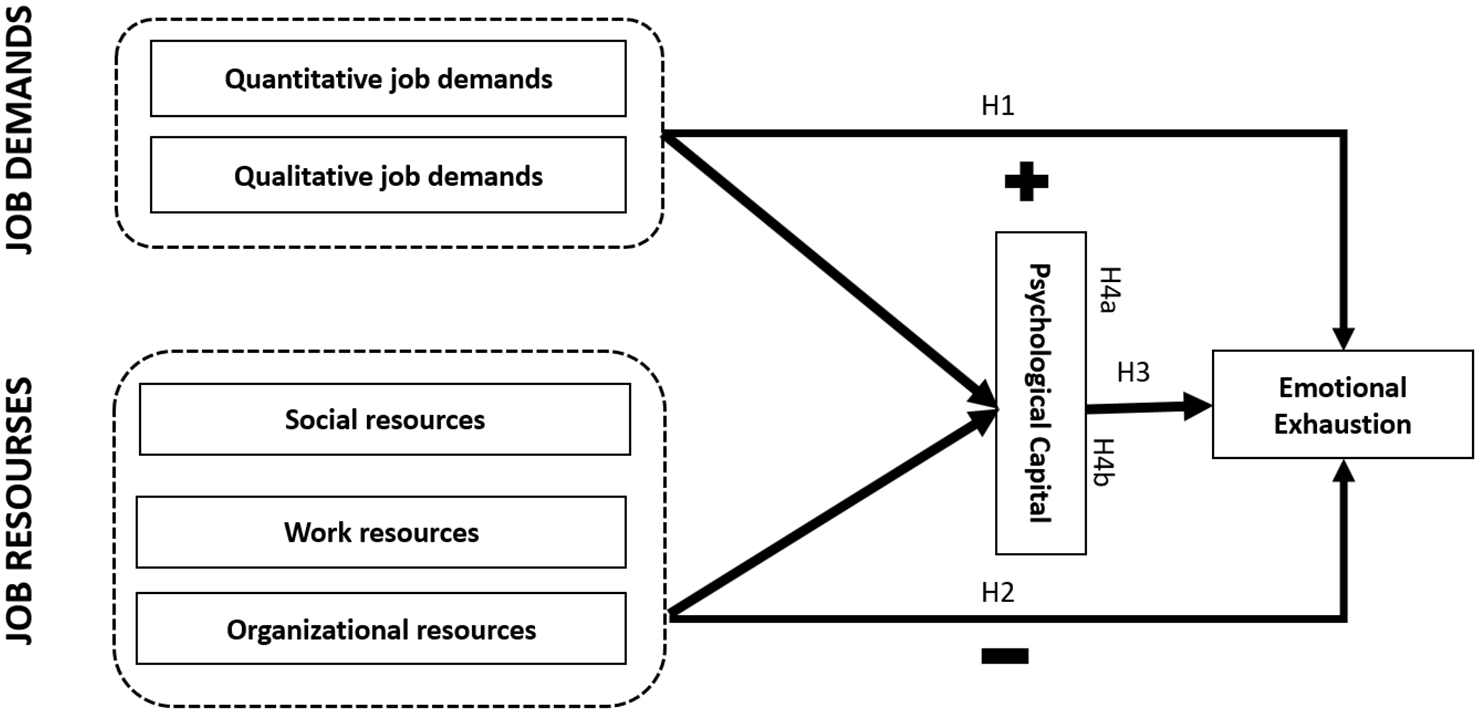
Study model.
In the following sections, we present the literature review of each of these factors and the hypotheses that will underpin and guide the research. Subsequently, we present the methodology employed in the study, followed by the results obtained. Finally, we present the discussion and conclusion, highlighting the contributions of the study, its possible limitations, and suggest areas for future research.
Literature Review and Hypothesis Development
Job Demand and Emotional Exhaustion
One of the main limitations of the JD-R model (Demerouti et al., 2001) is the specification of variables that can be categorized as either demands or labor resources. In this sense, Schaufeli (2017) points out that some of the job demands in the model could be both quantitative demands (related to the amount and speed of work, as well as the number of hours required) and qualitative demands (such as the type of skill tasks required to complete the job tasks, and which hinder or facilitate the level of demand to complete the job).
In the current educational context, the trend toward the intensification of workloads, as well as the need to maintain appropriate emotional expression in the workplace, has become an implicit norm in the teaching of work (Balzano et al., 2025).
These are also associated with perceptions of overload due to excessive demands and reduced rest and recovery time. As a result, when teachers perceive increased pressure and stress, they experience an imbalance in the cognitive-emotional system that makes them more vulnerable to burnout (Zhao et al., 2024). In other words, when work demands are chronically high and are not compensated by work resources, teachers’ energy is progressively depleted, leading to a state of mental exhaustion (Trillo et al., 2024). Therefore, based on the existing literature, which has demonstrated the influence of job demands on the development of emotional exhaustion in teachers (Baeriswyl et al., 2021; Whitsed et al., 2025), we hypothesized the following:
H1: Job Demands (JD) will significantly and positively influence the Emotional Exhaustion (EE) of teachers.
Job Resources and Emotional Exhaustion
However, in addition to job demands, the JD-R model states that job resources cushion the impact of job demands on the development of emotional exhaustion. Although there are several resources that can be found in the work environment, Schaufeli identified three basic resources: social, work, and organizational. For this author, social resources include the quality of the relationship between workers and their direct supervisors. In education, several authors, such as Xu (2019), have found that when leaders show support and empathy toward their employees, an environment is created where teachers feel more comfortable discussing the problems that cause them stress, increasing the chances of finding effective solutions and reducing their stress levels and therefore their EE. Conversely, when teachers have a poor interpersonal relationship with their leader, they tend to experience feelings of sadness, unhappiness, or anger, which ultimately lead to greater exhaustion (Ueno et al., 2025).
Similar to social resources, Schaufeli (2017) points to work resources as an inhibitor of work demands. Among these, the author includes predictability: if workers have enough relevant work-related information, they can anticipate and foresee future changes in the overall work process, making it more meaningful and thus reducing the risk of chronic stress and exhaustion (Erickson et al., 2021).
Finally, a third set of resources would be organizational. Within this, Schaufeli (2017) points to organizational justice, a variable that focuses on perceptions of fairness and justice, which has been shown to have a greater impact on employees’ organizational outcomes than other perceptions (González-Cánovas et al., 2024). The relevance of organizational justice is due to its ability to satisfy teachers’ instrumental and relational needs, thereby reducing the negative psychological states that can lead to EE (Shahid et al., 2018). Based on this, we propose the following hypothesis:
H2: Employees’ perceptions of Job Resources (JR) will decrease their Emotional Exhaustion (EE).
Psychological Capital and Emotional Exhaustion
Based on the assumption that job demands and resources play an important role in shaping emotional exhaustion (Schaufeli, 2017), it is crucial to consider how individual psychological resources, such as psychological capital (PC), can directly influence emotional exhaustion (EE). According to Luthans et al. (2015), this variable is an individual’s positive psychological state characterized by: (1) having the confidence (efficacy) to take on challenging tasks and exert the necessary effort to succeed; (2) making positive attributions (optimism) about current and future success; (3) persevering toward goals and redirecting the path toward them when necessary (hope); and (4) having the ability to persevere and recover when problems and adversities arise to achieve success (resilience). Thus, these characteristics not only enhance individual coping skills but also influence emotional well-being despite workplace demands. In this sense, a teacher with a low level of psychological capital will lack important internal resources that could protect him/her from the negative effects of work demands and related stress (López-Núñez et al., 2020). As a result, the teacher will expend large amounts of energy, physically, emotionally, and mentally. When faced with unsatisfactory outcomes, they will lose the ability to reinterpret negative situations as positive challenges (through hope, self-efficacy, optimism, and resilience), which may lead to a state of burnout (Adil & Kamal, 2018).
Based on previous studies that have confirmed PC as a determinant of emotional exhaustion (Gong et al., 2019; Rehman et al., 2017), we hypothesize the following:
H3: Psychological Capital (PC) will significantly and negatively influence the Emotional Exhaustion (EE) of teachers.
Mediating Effect of Psychological Capital
Although the JD-R model focuses mainly on job demands and organizational resources, it does not sufficiently consider other psychological variables that could mediate the relationship between these and emotional exhaustion. In this sense, psychological capital (PC) could play a crucial role, as this construct is associated with the ability of individuals to cope effectively with the demands of the work environment by using their internal resources more efficiently (De los Reyes et al., 2022).
As previously stated, a high work pace and emotional demands increase the risk of burnout at work (Quinlan, 2019). However, psychological capital can mitigate the impact of psychological and physical stress experienced by workers due to high work demands (Gong et al., 2021; Lei et al., 2021). According to the authors, employees with a high level of psychological capital are better able to develop a positive perception of job demands (Obeng et al., 2021), acting as a stress buffer (Yang et al., 2022). In this way, the employee possesses a positive perception of the future that leads to a brighter outlook on all aspects and a belief that they can meet their job demands, experiencing less stress and the negative outcomes it entails (Freire et al., 2020). Along these lines, several authors such as Nielsen et al. (2017) have verified the potential mediating effect of psychological capital. Therefore, we describe the following hypothesis:
H4a: Psychological Capital (PC) mediates the relationship between Job Demands (JD) and Emotional Exhaustion (EE).
As mentioned above, the relationship between JR and the development of EE among teachers will also be influenced by PC. In this context, psychological capital can be seen as a positive resource that creates an environment that favors the improvement of social relations among employees in educational institutions, including the relationship with the leader and the perception of his or her leadership (Bogler & Somech, 2021). Therefore, several authors have highlighted its mediating role, in that optimism or positive expectations of success can reduce emotional exhaustion in a work environment (Weidlich & Kalz, 2021).
In the case of teachers, some authors (Zhang et al., 2019) found that teachers’ positive perceptions of their readiness to face current and future challenges in their work context not only increased their ability to regulate their behavior, but also promoted an optimistic and resilient attitude that prevented the occurrence of EE (Ortega-Jiménez et al., 2025). Therefore, with reference to these studies that defend the protective role of psychological capital in the relationship between JR and EE (Gong et al., 2019), we describe the following hypothesis:
H4b: Psychological Capital (PC) mediates the relationship between Job Resources (JR) and Emotional Exhaustion (EE).
Methods
To test these hypotheses, we conducted a study with the following characteristics:
Study Participants
The study population consisted of professors from four public universities located in three different regions of Ecuador (the north, center, and south of the country). A total of 370 online invitations were sent to professors at these universities. The inclusion criterion for participation in the study was to be an active professor with at least 1 year of tenure at the institution. A total of 218 responses were received (58.92%). However, 13 questionnaires (5.96%) were subsequently excluded from the data analysis for various reasons, such as incomplete data, no response, or multiple responses to the same item. The final sample comprised 205 university teachers.
The survey included an informed consent form, which had to be completed and accepted by the participants. In addition, the objectives of the research and the anonymous nature of the study were explained. Regarding the procedures performed in this study, the ethical standards of the 1964 Helsinki declaration and its subsequent modifications or comparable ethical standards were followed. The methodology of this study was approved by the Human Research Ethics Committee of the Universidad Técnica Particular de Loja (CEISH UTPL) with Oficio No. UTPL-CEISH-2020-RI12.
Regarding the demographic characteristics of the sample, there was a predominance of females (57.1%). The age of the teachers participating in the study ranged from 23 to 67 years, with a mean age (
Research Instruments
In terms of measurement tools, we used a survey consisting of two parts. First, we collected sociodemographic and work information. The second study focused on the effects of the variables described in the previous section using the following standardized questionnaires.
To measure job demands, we used some of the dimensions of the Copenhagen Psychosocial Questionnaire (COPSOQ) in its Spanish version (Moncada et al., 2005). Specifically, to assess quantitative demands, we used the item of the variable “Time and pace of work” of the aforementioned instrument (“Do you have to work very fast?”), which refers to the intensity and speed required in work tasks. For qualitative demands, we used two items of the variable “Emotional demands” (e.g., “Is your job emotionally demanding?”). This assessment assesses the perception of emotional strain associated with work, including managing one’s own and others’ emotions. All responses were collected on a 6-point Likert scale ranging from 0 (no strain on the factor) to 5 (total strain on the factor).
We also used several variables from the Spanish version of the Copenhagen Psychosocial Questionnaire (COPSOQ; Moncada et al., 2005) to measure the work resources dimension. Specifically, for the assessment of social resources, we used the variable “supervisor support,” which consists of two items (e.g., “Is your work recognized and appreciated by management?”) and refers to the perception of support, appreciation, and recognition that employees receive from their supervisors. To measure job resources, we used the variable “predictability” from the above instrument, consisting of two items (e.g., “Do you get all the information you need to do your job well?”), which assesses aspects related to the clarity, predictability, and availability of relevant information to perform current and future tasks. Finally, to measure organizational resources, we used the variable “organizational justice,” which consists of two items (e.g., “Are conflicts resolved fairly?”). This variable assesses how employees perceive the treatment they receive from the organization in terms of fairness in work decisions, policies, and practices. Responses were collected on a 6-point Likert scale ranging from 0 (no effect of the factor) to 5 (full effect of the factor).
To assess the psychological capital dimension, we used the Psychological Capital Questionnaire PCQ (Luthans et al., 2007) in its Spanish adaptation (Azanza et al., 2014). This questionnaire consists of 20 items (e.g., “I feel confident presenting information to a group of peers”) and measures a set of positive psychological traits (efficacy, hope, resilience, and optimism), specifically in the work context. Responses were collected on a 6-point Likert scale ranging from 1 (“strongly disagree”) to 6 (“strongly agree”).
Finally, to measure emotional exhaustion, we used the Maslach Burnout Inventory MBI (Maslach et al., 1997) in its Spanish adaptation (Gil-Monte & Peiró, 1999). This questionnaire consists of five questions (e.g., “Because of my work I feel emotionally exhausted”) that assess the perception of being emotionally overloaded and exhausted by work. Participants responded on a 7-point Likert scale ranging from 0 (never) to 6 (daily).
Data Analyses
To validate the proposed hypotheses, we applied different statistical analyses to the collected data set. First, following the order suggested (Henseler et al., 2015), we calculated the factor loadings of the items and the descriptive statistics of the collected data using the SPSS© v.25 program. After the initial analysis, we identified the presence of common method bias (CMB), given that both the dependent and independent variables were determined by the same response mechanism, in this case a Likert-type scale questionnaire (Kock, 2021).
We also verified the reliability of the instruments using Cronbach’s alpha coefficients and DGrho, as well as convergent validity using factor loadings, Average Variance Extracted (AVE), and discriminant validity using the criterion proposed by Fornell and Larcker (1981). In addition, to evaluate our model and test our hypotheses, we used partial least squares structural equation modeling (PLS-SEM) with the program Smart PLS 4. In this study, we chose this technique because it is one of the most complete methods for factorial, structural, and composite model analysis, allowing the measurement of latent variables and determining whether the direction of Hypotheses is imposed or not (Ghasemy et al., 2020).
Finally, we ensured that the assumptions required for the SEM analysis were met, including verifying the multivariate normality of the data and the absence of multivariate outliers, to guarantee the robustness of our findings. In addition, following the guidelines of Hwang et al. (2020), we calculated the R2 and Q2 of the endogenous variables, path coefficients by statistical inference, and effect sizes, taking Cohen’s f for multiple regression as a reference.
Results
Reliability and Validity
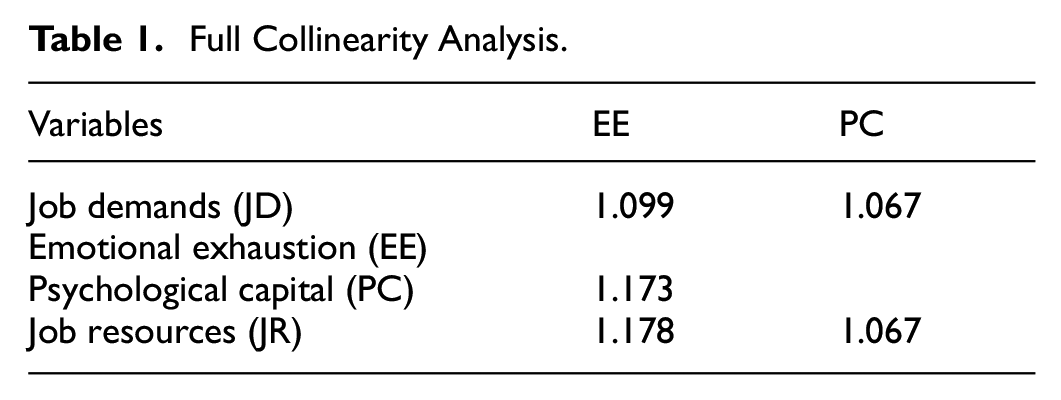
As indicated above, given that both the dependent and independent variables were assessed using a Likert-type questionnaire, we decided to analyze the potential risk of common method bias CMB (Kock, 2021). CMB poses a threat because its variance may affect the interrelationship between constructs, potentially biasing the empirical results and jeopardizing the validity of the study findings (Schwarz et al., 2017). To this end, we adopted the Variance Inflation Factor (VIF) method, such that a VIF value above the threshold of 3.3 would indicate the presence of collinearity in the model (Kock, 2021). However, as we can see in Table 1, all the VIF coefficients obtained were lower than the threshold, so the proposed model does not present collinearity problems.
Full Collinearity Analysis.
Structural Model Evaluation
After verifying the lack of collinearity of the study variables, we assessed the composite reliability and the convergent and discriminant validity of each construct.
To verify the convergent validity, we analyzed the structure and factor loadings of each item. After this initial analysis, it was decided to eliminate one item of the psychological capital variable (i.e., PC1 “I feel confident in proposing solutions to long-term problems”) and one item of the emotional exhaustion variable (EE2 “At the end of the day I feel exhausted”) because their factor loadings were lower than 0.6 (Chin, 1998), thus validating the internal consistency of the remaining 30 items with their respective constructs (see Table 2).
Outler Loadings, AVE, Cronbach’s Alpha, and DGrho.
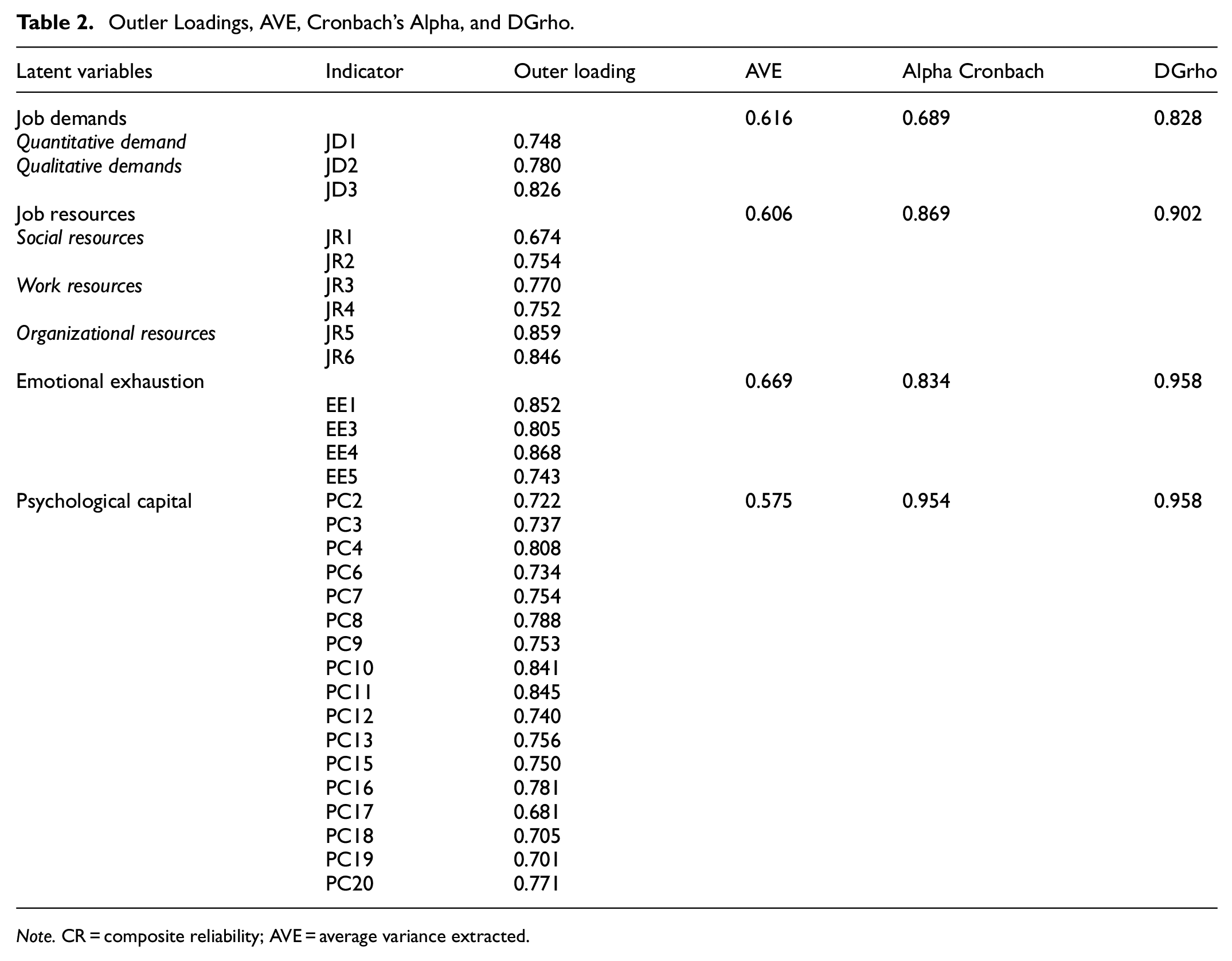
Note. CR = composite reliability; AVE = average variance extracted.
Following the general criteria (Hair et al., 2020), Cronbach’s alpha, Dillon-Goldstein (DGrho), and average variance extracted (AVE) were then tested. It was decided to include the DGrho because it allows the dimensionality of the block to be assessed and provides a complementary estimate of reliability that is less biased than Cronbach’s alpha (Götz et al., 2010). As can be seen in Table 2, the constructs examined in the study have higher Cronbach’s alpha and DGrho values of .6 and 0.7, respectively, which are acceptable (Hair et al., 2022). Finally, the AVE found for each dimension was in all cases higher than 0.5, the generally accepted minimum threshold (Cheung et al., 2024).
After confirming the convergent validity of the measurement model, we proceeded to assess its discriminant validity, according to the criterion that the square root of the AVE of each construct must be higher than the correlations between this construct and any other construct within the model (Fornell & Larcker, 1981). As shown in Table 3, the items located on the main diagonal, which represents the square root of the AVE of each construct, exceed the correlations between the constructs, as we can observe in the values corresponding to the rows and columns. Therefore, these results confirm that the scales used in our study do not show any inconsistencies in terms of discriminant validity.
Means, Standard Deviations, and Correlations.

Note. Square root of AVE on the diagonal; correlations between constructs are shown below the diagonal.
p < .01.
Structural Model Assessment
After checking the validity of the instruments, we tested the structural model of the study and the direct and indirect effects of each exogenous variable on the endogenous variable.
Table 4 shows the interaction values. As for the direct effects, we can observe that JD, JR, and PC have a significant relationship with EE, which confirms H1 as well as H2 and H3. On the other hand, the results showed that PC acted as a significant mediator in the relationships between JR and EE, leading us to accept H4b. However, in the case of the relationship between JD and EE, PC did not show significant mediation, so we reject H4a. In all cases, we used a 5,000-sample bootstrapping method.
Structural Model.

Note. JD = job demands; JR = job resources; PC = psychological capital; EE = emotional exhaustion; BCI UL = bias confidence interval upper level; BCI LL = bias confidence interval lower level.
p < .05. **p < .01.
In addition to hypothesis testing, we assessed the effect size (f2) of the variables in relation to the hypotheses. This evaluation is crucial for determining the magnitude of the impact of the independent variables on the dependent variable of our model. For this purpose, we follow the threshold established by Cohen (2013), according to which f2 values of 0.02, 0.12, and 0.35 indicate small, medium, and large effect sizes, respectively (see Table 4). The data obtained indicate that although JR and PC have a small effect, JD has a medium effect on EE.
A summary of the interaction values obtained for each variable and the results related to the study hypotheses is presented in Figure 2. This figure presents the path coefficients between the predictor and endogenous variables of the proposed model and the explanatory power (R2) of each of the proposed relationships. In addition, we estimated the goodness-of-fit (GoF) index, which allowed us to assess the adequacy and fit of the proposed structural model. According to the authors, a structural model is adequately fitted if the GoF is greater than 0.36. The value of our model (GoF = 0.462) showed a level of fit higher than 0.36 (Wetzels et al., 2009) and was therefore satisfactory.
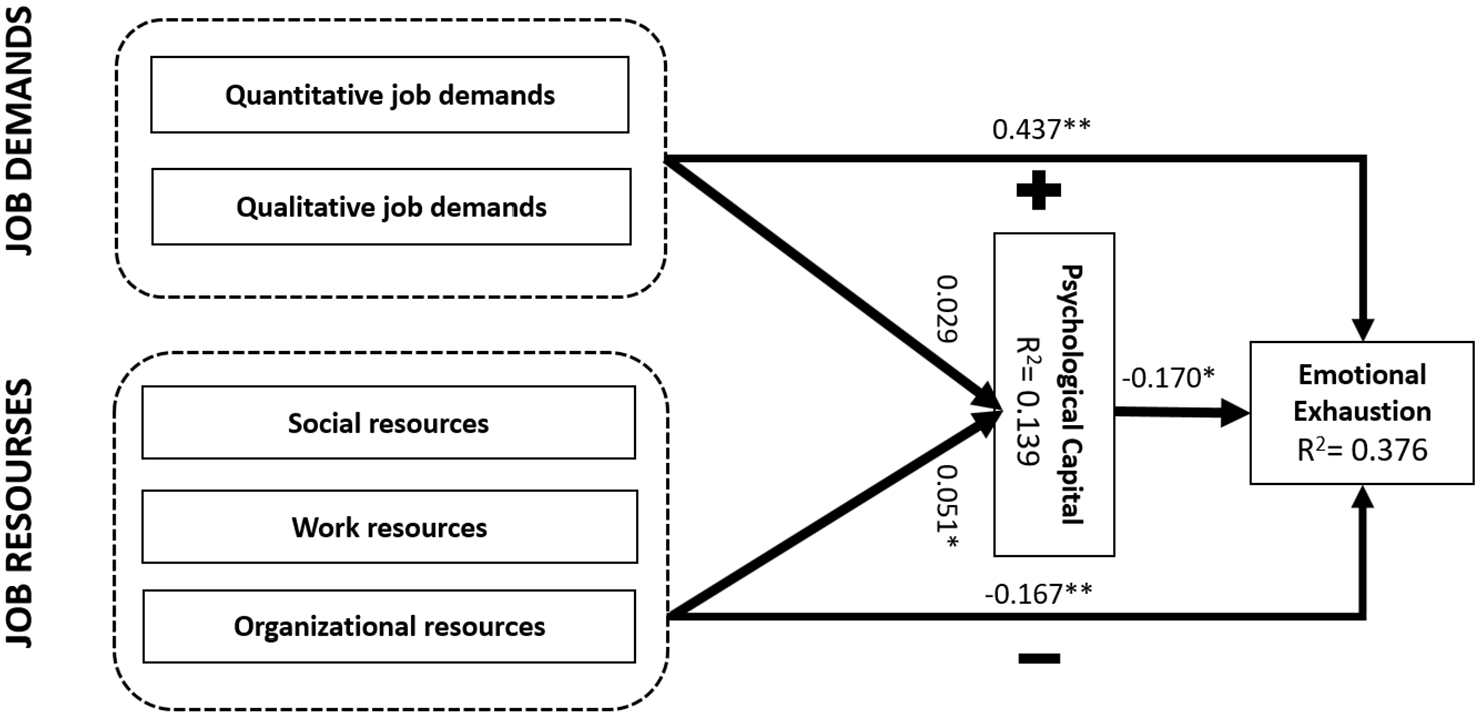
Results of the study model.
Finally, we evaluated the predictive power of the model using PLS Predict with 10 folds and one repetition. In this analysis, a single point is removed from the data matrix, and the removed data are replaced by the mean to estimate the model parameter. In this way, the Q2 values integrate the explanatory power of the out-of-sample model. According to the criteria (Hair et al., 2019), these values must be greater than 0, with the values of 0, 0.25, and 0.50 representing small, medium, and large significance, respectively. The results of our analysis showed that the relevance of emotional exhaustion and psychological capital was of medium (Q2 = 0.333) and small (Q2 = 0.108) magnitude.
Discussion
Several conclusions can be drawn from the results of the data analysis. In our study, we analyzed the mediating role of psychological capital in the relationship between job demands and resources in the development of emotional burnout in a sample of university teachers.
One of the first conclusions we can draw from the analysis of the collected data is that high job demands are positively associated with emotional exhaustion, which is consistent with previous studies indicating that work overload and intense emotional demands are critical factors in the development of burnout (Mudrak et al., 2022; Zhao et al., 2024). However, it should be noted that the impact of job demands on EE was moderate in magnitude, reinforcing the idea that not all demands have the same impact (Schaufeli, 2017). This nuance suggests that the qualitative and quantitative nature of the demands may have different impacts on teachers’ emotional health.
In terms of job resources, our findings are consistent with previous research suggesting that supervisor support, predictability, and organizational labor act as buffers to job stress (Ortega-Jiménez et al., 2021; Ueno et al., 2025). These resources enhance perceptions of control and reduce uncertainty, which ultimately reduces the risk of emotional exhaustion. However, the magnitude of the effect is smaller than that observed for job demands, highlighting the need for an appropriate balance between demands and resources (Leiter & Maslach, 2016).
In line with the third hypothesis (H3), which predicted a negative relationship between psychological capital and emotional exhaustion, the results obtained confirm that high levels of PC are associated with lower levels of EE. This finding is in line with previous studies highlighting the protective role of PC against exposure to adverse working conditions (Gong et al., 2019; Rehman et al., 2017). CP, by encompassing dimensions such as self-efficacy, optimism, hope, and resilience (Luthans et al., 2015), provides teachers with internal resources that allow them to reinterpret stressful situations and face work demands with a more positive attitude. Thus, teachers with high levels of hope and self-efficacy are more likely to seek adaptive solutions to workload, while resilience facilitates emotional recovery after adverse work experiences.
However, it is worth noting that while PC was shown to be an effective mediator in the relationship between job resources and EE, no significant mediating effect was observed between job demands and EE. This finding suggests that although PC directly contributes to reducing the likelihood of experiencing emotional exhaustion, its mediating capacity is limited when job demands are too high or prolonged. This limitation is consistent with the literature suggesting that when faced with chronic and overwhelming demands, personal resources may be insufficient to counteract accumulated emotional exhaustion (Lei et al., 2021; Wang et al., 2024).
Conclusion
Although the results are promising, we have identified some limitations that should be considered in future research. First, the generalizability of our findings may be limited. Despite using complex statistical analyses, focusing on a specific population of university teachers in Ecuador might not reflect the diversity of experiences in other educational or regional contexts. Therefore, it is recommended to replicate the study in different work environments and geographical regions.
In addition, as this is a cross-sectional study, it cannot measure the influence of external variables over time; thus, we suggest conducting longitudinal studies to capture these effects. Although data anonymity was guaranteed and the information was used solely for research purposes, the use of self-reports may introduce inaccuracies due to potential recall bias, social desirability, and acquiescence responses.
Finally, the results of this research highlight the significant direct and indirect impact of some organizational and social variables on emotional exhaustion, in line with the existing models. However, we suggest that this model be extended to include additional new variables to provide a more complete understanding of how the work environment may affect teachers’ emotional well-being.
Implications
Theoretical Implications
This study contributes relevant theoretical implications to the Job Demands-Resources (JD-R) model, extending its applicability and understanding in three main dimensions. First, by including psychological variables such as psychological capital (PC) as a personal resource, the study contributes to a more nuanced understanding of the role of individual resources in the relationship between job demands and emotional exhaustion. The finding that psychological capital does not significantly mediate the relationship between job demands and burnout highlights the need to explore other psychological mechanisms that may influence this relationship.
Second, the empirical application of specific variables within the model, such as organizational justice, predictability, and supervisor support, allows us to refine the distinction between different types of job demands and resources. These findings highlight that not all resources have the same buffering effect on demands, which invites future research to explore the dynamic interplay between social, organizational, and personal resources in the educational context.
Finally, this paper extends the applicability of the JD-R model to an underexplored sociocultural and professional context: the Ecuadorian university setting. The choice of the Ecuadorian context responds to the scarcity of studies in Latin America that consider the cultural, organizational, and economic specificity of the region, which can significantly influence the manifestation of emotional exhaustion. The extension of the model to the university education sector in Ecuador allows us not only to validate the universality of the JD-R but also to evidence nuances specific to work environments with structural limitations and organizational changes accentuated after the COVID-19 pandemic. In this sense, this study responds to the need to contextualize international theoretical models in local realities, contributing empirical evidence that could not only benefit the Ecuadorian academic environment but also serve as a comparative basis for other countries in similar conditions.
Management Implications
In other areas, the study offers implications for human resource management in the university teaching environment. On the one hand, the evidence that high work demands are significantly associated with emotional exhaustion reinforces the need to implement institutional policies aimed at equitably redistributing workloads and reducing unnecessary bureaucracy. This is particularly relevant in the Ecuadorian context, where budgetary constraints and academic demands can increase the pressure on teachers.
It also highlights the importance of strengthening the available human resources. Actions such as improving internal communication, providing predictability in the allocation of tasks, and promoting supportive and equitable leadership could mitigate the negative effects of work demands. Therefore, it is recommended that educational institutions develop training programs for managers and supervisors that focus on empathic leadership and fair conflict resolution.
Third, although psychological capital was not shown to mediate work demands, its direct effect on reducing emotional exhaustion suggests that universities should invest in personal development programs that foster internal resources such as resilience, optimism, and self-efficacy among their faculty. Strategies such as stress management workshops, emotional skills training, and mentoring programs could not only improve individual well-being but also promote a healthier and more productive work environment.
Footnotes
Acknowledgements
We thank the professors who participated in this study and the Ecuadorian universities for their collaboration.
ORCID iDs

Ethical Considerations
The procedures used in this study conformed to the ethical standards of the Helsinki Declaration of 1964 and its subsequent amendments or equivalent ethical standards. In addition, this study was approved by the Ethics Committee of the Psychology Department Council of the Universidad Particular de Loja.
Consent to Participate
All participants gave informed consent before being included in the study.
Author Contributions
All authors contributed equally to this work.
Funding
The author(s) disclosed receipt of the following financial support for the research, authorship, and/or publication of this article: This study was funded by the Unit of Excellence “Work, Territory and Competitiveness” of the University of Granada (Research Project UCE-PP2023-08).
Declaration of Conflicting Interests
The author(s) declared no potential conflicts of interest with respect to the research, authorship, and/or publication of this article.
Data Availability Statement
The data that support the findings of this study are available from the corresponding author upon reasonable request.